http://dx.doi.org/10.4236/jbm.2016.41001
RAPD-SCAR Markers: An Interface Tool for
Authentication of Traits
Sameer S. Bhagyawant
School of Studies in Biotechnology, Jiwaji University, Gwalior, India
Received 26 October 2015; accepted 22 December 2015; published 25 December 2015
Copyright © 2016 by author and Scientific Research Publishing Inc.
This work is licensed under the Creative Commons Attribution International License (CC BY). http://creativecommons.org/licenses/by/4.0/
Abstract
The versatility of the PCR technique is that several kinds of primers can be explored for genome analysis depending on the purpose of study. The easy to access and low cost PCR-based markers include Random Amplified Polymorphic DNA (RAPD). The RAPD markers are easy to develop but lack of reproducibility makes it less reliable and obstacles to their further use in authentication of traits. In addition, other PCR and non PCR based markers like Amplified Fragment Length Poly-morphism (AFLP), Simple Sequence Repeat (SSR) and Restriction Fragment Length PolyPoly-morphism (RFLP) are also employed in authentication of traits with certain restrictions vis-à-vis use of ra-dioactive materials, high cost and requirement of sequence information etc. Therefore, this prob-lem can be overcome by converting RAPD markers to more robust sequence characterized ampli-fied regions i.e. SCAR markers. SCARs are locus specific, co-dominant in nature and amplified by PCR using specific 15 - 30 bp DNA fragments. For developing SCAR markers, primers are designed from the nucleotide sequences of a cloned RAPD fragments linked to a trait of interest. SCAR markers are easy to develop and reliable tools for DNA fingerprinting. This mini review is an at-tempt to summarize efficacy of RAPD-SCAR interface in authentication of traits.
Keywords
SCAR Marker, Molecular Marker
1. Introduction
their technical simplicity, ease of screening large number of samples in a short period of time and can be carried out in a moderately equipped laboratory. Specific, semi-specific and arbitrary primers can be used in various combinations to target DNA motifs/genes of interest [1].
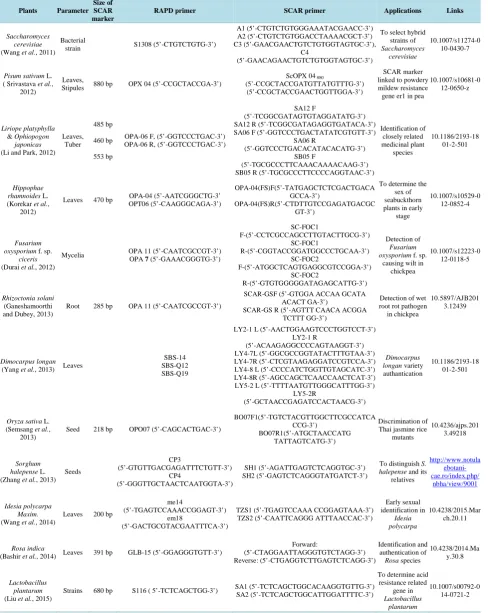
One of the simplest and most pervasive applications of PCR-based DNA markers in plants is DNA finger-printing [3]. Seed companies and national registration agencies have an interest in DNA fingerprinting because the technology can be used to protect intellectual property, establish identity and assess purity. For these reasons, DNA fingerprinting has to be an integral part of research organizations. Equally their systematic authentications with fast and reliable methods are very much demanding. SCAR markers have proven their utility in detection of Fusarium oxysporium f. sp. ciceris and cubense [4][5], selection of hybrid strains of Saccharomyces cerevi-siae [6], validation of sex of plants in early stage [7] and identification of powdery mildew resistance genes [8]. The several potential applications that are put together by earlier workers are well summarized in Table 1. This mini review is an attempt to summarize the available information between 2010-2015; vis-à-vis RAPD-SCAR maker development and its use as an interface tool for authentication of traits in diverse biological systems.
2. RAPD Markers
RAPD is a PCR-based technique introduced by Williams et al. [9]. It employs single primers with 10 nucleo-tides and a GC content of at least 50%. PCR products are separated on agarose gels and detected by ethidium bromide staining. In this, amplification reactions are carried out under relaxed stringency conditions and no prior knowledge of DNA sequence is required. The basic principles of this technique have been presented by three independent groups in early 1990s, each suggesting different protocols [9]-[11]. Technically, RAPD primer se-quences are arbitrarily chosen and the genome is expected to be sampled randomly.
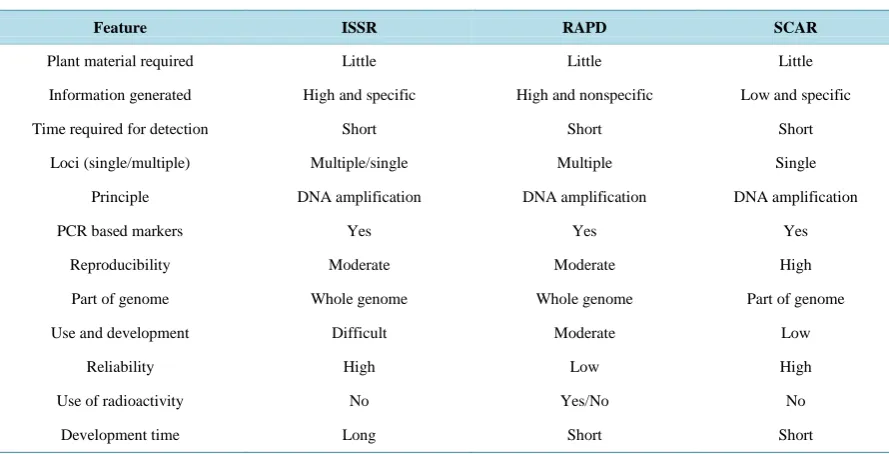
The advantage of RAPD-PCR, as depicted inTable 2, is its technical simplicity paired with independence of any prior DNA sequence information [9][10]. The low stringency annealing temperatures of 35˚C - 45˚C allow primer competition to genome size more closely. Being a dominant marker, its use for population genetics and genome mapping is restricted. Hence a further extension of RAPD to more authenticate SCAR marker is pre- requisite for transforming its applicability. Most, but not all, of the RAPD markers inherit in a dominant fashion and are scored as presence/absence polymorphisms [12].
Consistency of RAPD markers is debatable. RAPD technique is sensitive to changes in the reaction condi-tions. Therefore, there exists a gap between the ability to obtain la linked markers to a gene of interest in a short time and the use of these markers for map based cloning approaches and for routine screening procedures. When sorghum germplasm consisting of 42,000 accessions was analyzed with RAPD markers, the clusters developed were not close to those obtained on the basis of morphological and agronomic data [13]. There exist many ex-amples revealing ambiguous nature of RAPD marker which needs to be authenticated with an interface tools like SCAR markers.
3. Sequence Characterized Amplified Regions (SCAR)
In 1993, RAPD-derived molecular marker i.e. SCAR marker was first of all developed by Paran and Michel-more for downy mildew resistance genes in lettuce [13]. They used SCAR markers as a genetic marker for tag-ging the gene of interest in lettuce from parents of mapping population. SCARs have the advantages over RAPD markers in having additional specificity and reproducibility. SCARs may identify polymorphisms that are less accessible by other techniques. SCAR is also one of the PCR-based monolocus and co-dominant genetic mark-ers can also be useful in physical mapping. SCARs will bridge the gap between the ability to obtain molecular markers linked to genes of interest in a short time and use of these markers in a map-based cloning approac.
Technically, developing a SCAR marker requires the use of two specific primers designed from nucleotide sequence established in cloned RAPD fragment linked to a trait of interest. Once it is developed, large number of samples can be screened at a time thus reduces the time and enhances reliability [15]. Thus, number of reac-tions required to fingerprint many samples could be reduced to one.SCAR marker separation efficiency is better than that of RAPD markers based on the number of reactions required per sample. In addition, the SCAR marker gels are cleaner and much easier to score assisting computer automation. The only limitation of its development may be the requirement of sophisticated laboratory facilities like sequencing.
Table 1. Plant parts used for developing SCAR markers with their application.
Plants Parameter Size of SCAR marker
RAPD primer SCAR primer Applications Links
Saccharomyces cerevisiae
(Wang et al., 2011) Bacterial
strain S1308 (5’-CTGTCTGTG-3’)
A1 (5’-CTGTCTGTGGGAAATACGAACC-3’) A2 (5’-CTGTCTGTGGACCTAAAACGCT-3’) C3 (5’-GAACGAACTGTCTGTGGTAGTGC-3’),
C4
(5’-GAACAGAACTGTCTGTGGTAGTGC-3’)
To select hybrid strains of
Saccharomyces cerevisiae
10.1007/s11274-0 10-0430-7
Pisum sativum L. ( Srivastava et al.,
2012)
Leaves,
Stipules 880 bp OPX 04 (5’-CCGCTACCGA-3’)
ScOPX 04 880
(5’-CCGCTACCGATGTTATGTTTG-3’) (5’-CCGCTACCGAACTGGTTGGA-3’)
SCAR marker linked to powdery mildew resistance gene er1 in pea
10.1007/s10681-0 12-0650-z
Liriope platyphylla
& Ophiopogon japonicas
(Li and Park, 2012) Leaves,
Tuber 485 bp
460 bp
553 bp
OPA-06 F, (5’-GGTCCCTGAC-3’) OPA-06 R, (5’-GGTCCCTGAC-3’)
SA12 F
(5’-TCGGCGATAGTGTAGGATATG-3’) SA12 R (5’-TCGGCGATAGAGGTGATACA-3’) SA06 F (5’-GGTCCCTGACTATATCGTGTT-3’)
SA06 R
(5’-GGTCCCTGACACATACACATG-3’) SB05 F
(5’-TGCGCCCTTCAAACAAAACAAG-3’) SB05 R (5’-TGCGCCCTTCCCCAGGTAAC-3’)
Identification of closely related medicinal plant species 10.1186/2193-18 01-2-501 Hippophae rhamnoides L. (Korekar et al.,
2012)
Leaves 470 bp OPA-04 (5’-AATCGGGCTG-3’ OPT06 (5’-CAAGGGCAGA-3’)
OPA-04(FS)F(5’-TATGAGCTCTCGACTGACA GCCA-3’)
OPA-04(FS)R(5’-CTDTTGTCCGAGATGACGC GT-3’)
To determine the sex of seabuckthorn plants in early
stage
10.1007/s10529-0 12-0852-4
Fusarium oxysporium f. sp.
ciceris
(Durai et al., 2012)
Mycelia OPA 11 (5’-CAATCGCCGT-3’) OPA 7 (5’-GAAACGGGTG-3’)
SC-FOC1 F-(5’-CCTCGCCAGCCTTGTACTTGCG-3’) SC-FOC1 R-(5’-CGGTACCGGATGGCCCTGCAA-3’) SC-FOC2 F-(5’-ATGGCTCAGTGAGGCGTCCGGA-3’) SC-FOC2 R-(5’-GTGTGGGGGATAGAGCATTG-3’) Detection of Fusarium oxysporium f. sp.
causingwilt in chickpea
10.1007/s12223-0 12-0118-5
Rhizoctonia solani
(Ganeshamoorthi and Dubey, 2013)
Root 285 bp OPA 11 (5’-CAATCGCCGT-3’)
SCAR-GSF (5’-GTGGA ACCAA GCATA ACACT GA-3’)
SCAR-GS R (5’-AGTTT CAACA ACGGA TCTTT GG-3’)
Detection of wet root rot pathogen in chickpea
10.5897/AJB201 3.12439
Dimocarpus longan
(Yang et al., 2013) Leaves
SBS-14 SBS-Q12 SBS-Q19
LY2-1 L (5’-AACTGGAAGTCCCTGGTCCT-3’) LY2-1 R
(5’-ACAAGAGGCCCCAGTAAGGT-3’) LY4-7L (5’-GGCGCCGGTATACTTTGTAA-3’) LY4-7R (5’-CTCGTAAGAGGATCCGTCCA-3’) LY4-8 L (5’-CCCCATCTGGTTGTAGCATC-3’) LY4-8R (5’-AGCCAGCTCAACCAACTCAT-3’) LY5-2 L (5’-TTTTAATGTTGGGCATTTGG-3’)
LY5-2R
(5’-GCTAACCGAGATCCACTAACG-3’)
Dimocarpus longan variety authantication
10.1186/2193-18 01-2-501
Oryza sativa L. (Semsang et al.,
2013)
Seed 218 bp OPO07 (5’-CAGCACTGAC-3’)
BO07F1(5’-TGTCTACGTTGGCTTCGCCATCA CCG-3’)
BO07R1(5’-ATGCTAACCATG TATTAGTCATG-3’)
Discrimination of Thai jasmine rice
mutants
10.4236/ajps.201 3.49218
Sorghum halepense L. (Zhang et al., 2013)
Seeds CP3 (5’-GTGTTGACGAGATTTCTGTT-3’) CP4 (5’-GGGTTGCTAACTCAATGGTA-3’) SH1 (5’-AGATTGAGTCTCAGGTGC-3’) SH2 (5’-GAGTCTCAGGGTATGATCT-3’)
To distinguish S. halepense and its
relatives http://www.notula ebotani-cae.ro/index.php/ nbha/view/9001 Idesia polycarpa Maxim.
(Wang et al., 2014)
Leaves 200 bp
me14
(5’-TGAGTCCAAACCGGAGT-3’) em18
(5’-GACTGCGTACGAATTTCA-3’)
TZS1 (5’-TGAGTCCAAA CCGGAGTAAA-3’) TZS2 (5’-CAATTCAGGG ATTTAACCAC-3’)
Early sexual identification in Idesia polycarpa 10.4238/2015.Mar ch.20.11 Rosa indica
(Bashir et al., 2014) Leaves 391 bp GLB-15 (5’-GGAGGGTGTT-3’)
Forward:
(5’-CTAGGAATTAGGGTGTCTAGG-3’) Reverse: (5’-CTGAGGTCTTGAGTCTCAGG-3’)
Identification and authentication of
Rosa species
10.4238/2014.Ma y.30.8
Lactobacillus plantarum
(Liu et al.,2015)
Strains 680 bp S116 ( 5’-TCTCAGCTGG-3’) SA1 (5’-TCTCAGCTGGCACAAGGTGTTG-3’) SA2 (5’-TCTCAGCTGGCATTGGATTTTC-3’)
Continued
Litchi chinensis Sonn.
(Chang et al., 2015) Leaves 250 bp 550 bp and 150 bp 400 bp SBC-I10 SBC-A12 SBC-A16 L7-16L (5’-AGCTGAGGGTGCATTACGAT-3’) L7-16R ( 5’-TGGCAAAGTCTGGTCTCAAA-3’) L9-6L (5’-TATCAAAAACGCAGCCGTTA-3’) L9-6R (5’-ACAGGACCCTTTCCAGACCT-3’) L11-26L (5’-TCCTTCAGGGATTCGTTTTG-3’) L11-26R (5’-GATCCCTACGACCATCTGGA-3’) Identification of Litchi chinensis sonn. species
10.1016/j.ejbt.201 4.11.004
Eucalyptus grandis
(Laia et al.,2015) Leaves 800 bp AT9 R (5’-ACGCTAACGG-3’)
AT99151L
(5-‘CCGTTAGCGTGAGTAGATGTAGAG-3’) AT9915914R
(5’-CGTTAGCGTCATCAGTAGGTCA-3’)
Marker-assisted selection of E. grandis trees resistance to P.
psidii Winter.
10.5897/AJAR20 13.8016
Fusarium oxysprum
f. sp. cubenes in banana
(Cunha et al., 2015) Bacterial
strain 1700 bp OPP-12 (5’-AAGGGCGAGT-3’)
SuscPD-F (5’-GAACCAGAGCCAGGGCATAG-3’) SuscPD-R (5’-TCTATGCGCCTACCCTCCTT-3’) To discriminate resistant and susceptible genotypes to
Foc infection
10.1016/j.scienta. 2015.04.038
Ralstonia solanacearum
(Truong et al., 2015) Bacterial strain 534 bp 1190 bp UBC#176, UBC#317 UBC#676 SCU176-534 F(5’-TTGAACCAAGAATCTATTCG-3’) R (5’-GAACTTGAATGCCTACCAAA-3’) SCU176-1190 F1 (5’-TGCGGATACTATCGGAAATA-3’) R1 (5’-CAACTCATTTCAGTCCGATT3’-) SCU176-1190 F2 (5’-TCACTCGGTGAGTCAAT-3’) R 2(5’-TTTGCCGATGTTATCATGT-3’) Early selection of resistant lines in tomato
10.1007/s13580-0 15-1050-9
T. harzanium T. viride
(Parmar et al., 2015) Mycelia 220 bp 900 bp OPA-16 (5’-AGCCAGCGAA-3’) OPC-05 (5’-GATGACCGCC-3’) HAR220FP5 (5’-CTTTTGGTTTGACACGGTTCT-3’) HAR220RP5 (5’-AAGCTTTGAAGTTGCGAGGA-3’) VIRI900FP7 (5’-TACGCTCCAGGCTACCACTT-3’) VIRI900RP7 (5’-GAGATGAGCTCCTTGCTGCT-3’) To distinguish Trichoderma species 10.12691/ajmr-3-1-7 Fusarium oxysporum f. sp.
Radicis-lycopersici
(Mutlu et al., 2015) leaves 950 bp 1000 bp SCAR200 F(5’-TCGGTCCAAATTCACTTCAA-3’) R(5’-ACTCCTCCACTTGCATACCC-3’) SCARFr F(5’-CACATTCATCATCTGTTTTTAGTCTATTC-3’) R(5’-CACAATCGTTGGCCATTGAATGAAGAAC-3’)
To study linkage of Fr1 gene in
tomato
[image:4.595.91.536.457.684.2]10.1007/s00122-0 15-2547-4
Table 2.Comparison of various features of molecular markers.
Feature ISSR RAPD SCAR
Plant material required Little Little Little
Information generated High and specific High and nonspecific Low and specific
Time required for detection Short Short Short
Loci (single/multiple) Multiple/single Multiple Single
Principle DNA amplification DNA amplification DNA amplification
PCR based markers Yes Yes Yes
Reproducibility Moderate Moderate High
Part of genome Whole genome Whole genome Part of genome
Use and development Difficult Moderate Low
Reliability High Low High
Use of radioactivity No Yes/No No
Development time Long Short Short
R. solanacearum [20], R. solani [21], F. oxysporum f. sp. radicis-lycopersici [22], Saccharomyces cerevisiae [6]
4. Development of SCAR Markers
The fragment polymorphisms produced by RAPD-PCR amplifications are not always reproducible [2]. This li-mitation can be overcome by converting RAPDs into sequence-characterized amplified region i.e. SCAR. The SCAR marker has proven to be more reproducible for the authentication and identification of genotypes [24] [14]. SCAR markers may contain high-copy number and dispersed genomic sequences within the amplified re-gion. Thus, they are valuable in large scale and locus-specific applications such as marker-assisted screening and map-based gene cloning. The other PCR-based/non-PCR-based methods like AFLP, SSR and ISSR have repro-ducible amplifications patterns than RAPD markers. But development of SCAR markers from theses markers are laborious and time consuming. A SCAR marker, generated from polymorphic regions that differ in size be-tween species, permits sample authentication based on SCAR size shifts. Thus SCAR marker has came out as a best marker technology for authentication of crop species [15].
5. Procedure
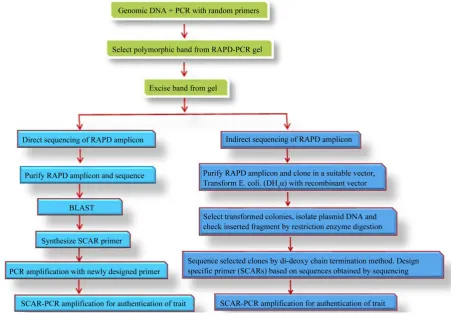
To develop RAPD-SCAR marker, purification of PCR fragments followed by designing of SCAR primer is practiced [14][15]. Briefly, a polymorphic band of interest is identified, selected and eluted from agarose gel. The nucleotide sequence of the eluted DNA fragment is determined. The nucleotide sequence of the polymor-phic DNA band is thereafter analysed for sequence uniqueness by comparing with the known DNA sequences available at NCBI database, using BLAST. Finally, the nucleotide sequence of the polymorphic DNA band is used to synthesize specific SCAR primers (Figure1).
Another approach includes indirect sequencing of RAPD amplicons. Shortly, polymorphic DNA fragments of interest is cloned in a suitable vector and transformation is done using high efficiency competent cells of DH-5α strain of E. coli. Further, clones are selected for plasmid DNA isolation. The same size fragments corre-sponding to the RAPD markers can be recovered from restriction enzyme digetion and the ends of the cloned fragments are sequenced. Specific SCAR markers are designed including the sequence of the original 10-mer primer with supplementary 11 - 15 bases 3 to the 10-mer [14] [15]. The newly designed SCAR primers are tested using PCR for authentication of a particular trait/genotyping (Figure 2).
6. Applications of SCAR Marker
[image:5.595.89.540.470.713.2]The utility of SCAR markers in authentication of medical herbs are well reviewed [15]. In this mini review, ap-
Figure 2. SCAR marker development (in-direct method) [15].
plications of SCAR marker as a interface that are developed after 2010 are reported. SCAR markers are locus specific and therefore, can easily be identified. The concept of generating locus-specific SCARs from anony-mous PCR fragments is not restricted to RAPDs but can also be applied to other multilocus marker techniques such as AFLPs. Fragments of interest are physically isolated from a multilocus banding pattern, and either re-amplified or cloned prior to sequencing (Figure3).
RAPD-SCAR can be applied in industrial breeding instead of auxotrophic markers. The strains of Saccharo-myces cerevisiae, the most useful species of yeast, are instrumental to winemaking, baking, and brewing since ancient times. Protoplast fusion has the potential to generate improved hybrids possessing novel combinations of parent characteristics [6]. Yeast breeding by protoplast fusion however, has a limited practical applications that can be successfully employed for screening of hybrid strains [26]. Wang et al. overcome this drawback. The parent Saccharomyces cerevisiae strains Z8 and Z9, showing high ethanol production, were electrofused and hybrids were screened by PCR using SCAR markers. Hence utility of SCAR markers can be employed in se-lecting strains from protoplast fusion in industrial breeding [6].
Powdery mildew is one of the major constraints in pea production worldwide causing severe seed losses. The resistance is governed by a single recessive gene er1 in majority of the resistant cultivars, but er2 and er3 have also been reported. Srivastava et al. developed a coupling-phase SCAR marker linked to the powdery mildew resistance gene “er1” gene in pea (Pisum sativum L.) They demonstrated successfully that the RAPD-SCAR marker systems could be used for pyramiding genes against powdery mildew pathogen [8].
RAPD-SCAR marker also proved their potency in discriminating species of therapeutically important medi-cinal plants. Such molecular maker is becoming increasingly popular tools of preferred choice for raw drug au-thentication and management of herbal drugs [27]. The actinorhizal plant seabuckthorn (Hippophae rhamnoides L., Elaeagnaceae) is a wind pollinated dioecious crop. For the first time, sex-specific SCAR markers were de-veloped in seabuckthorn. The studies of Korekar et al. [7] reported for the first time two robust sex-linked SCAR markers, namely HrX1 and HrX2. The RAPD-SCAR patterns authenticated large sets of 120 female plants and rejected 100 male plants. Thus, such a robust SCAR maker developed in seabuckthorn, may provide early sex information and enhance its production for commercial and pharmaceutical exploitations.
Dimocarpus longan, is an edible fruit and source of traditional medicine, mostly grown in the Southern China. D. longan fruits have many medicinal properties like enhancing memory, promoting blood metabolism, reliev-ing insomnia, and preventreliev-ing amnesia. Yang et al. [28] developed a cloning based RAPD-SCAR marker and va-lidated its usefulness in diagnosing the specific variety authentication, particularly for distinguishing D. longan from D. confinis. Literature perusal suggests that few studies have also carried out in 2014. Bashir et al. [29]
Figure 3. Schematic representation of RAPD-SCAR marker development.
of 391 bp was detected in R. bourboniana, which was cloned, purified, sequenced, and used to design a pair of species specific SCAR markers having forward and reverse orientations.
Combining RAPD and SCAR markers provides a simple and reliable tool for the genetic characterization of plant species. Litchi (Litchi chinensis Sonn., L. chinensis), belongs to the family Sapindaceae. It is mostly culti-vated in Southeast Asia. Litchi is an edible fruit having many medicinal properties. The numerous litchi cutivars grown across the globe creates confusion regarding their naming and identification. Cheng et al. [30] took a note of this and developed a SCAR marker for the authentication of Litchi species by improved RAPD-SCAR ampli-fication.
The wine industry needs various single-factor or multiple-factor tests to select and evaluate the potential strains. The traditional methods are limited due to its inefficiency and inaccuracy [29]. Wen-Liu et al. [31] de-veloped a SCAR marker for acid resistance-related gene in Lactobacillus plantarum. The results of their studies enabled them to screen desirable malolactic fermentation strains.
The banana is an edible fruit, produced by several kinds of large herbaceous flowering plants in the genus Musa [32]. Panama disease or Fusarium wilt of banana, is caused by Fusarium oxysporum sp. cubense. This fungus infects cultivars causing plant death. Developing resistant/tolerant cultivars is expensive and time con-suming and may take years to develop. Molecular techniques offers a potential means to screen our cultivars in a specified field at any stage of its developments. In this context, Cunha et al. [5] have developed a RAPD-SCAR markers as a tool to discriminate resistant and susceptible genotypes of Foc infected banana plants. This diag-nostic application of SCAR marker helps the plant breeders to eliminate Foc-susceptible genotypes with a high degree of probability, leaving only the resistant plants for further evaluation.
7. Future Applications
done at an early stage to reduce the time, field evaluation and labor cost. The reliability of SCAR markers ap-pears to be the best choice available for DNA fingerprinting vis-à-vis authentication, and trait specific characte-rization. More number of SCAR markers needs to develop/widen in various biological systems for discrimina-tion of traits of importance.
References
[1] Mullis, K.B., Ferre, F. and Gibbs, R.A., Eds. (1994) The Polymerase Chain Reaction. Birkhauser, Basel.
[2] Saiki, R.K., Gelfand, D.H., Stoffel, S., Scharf, S.J., Higuchi, R., Horn, G.T., Mullis, K.B. and Erlich, H.A. (1988) Pri-mer Directed Enzymatic Amplification of DNA with a Thermostable DNA PolyPri-merase. Science, 239, 487-491.
http://dx.doi.org/10.1126/science.2448875
[3] Soller, M. and Beckmann, J.S. (1983) Genetic Polymorphism in Varietal Identification and Genetic Improvement.
Theoretical and Applied Genetics, 67, 25-33. http://dx.doi.org/10.1007/BF00303917
[4] Durai, M., Dubey, S.C. and Triphathi, A. (2012) Genetic Diversity Analysis and Development of SCAR Marker for Detection of Indian Populations of Fusarium oxysporum f. sp. ciceris Causing Chickpea Wilt. Folia Microbiology, 57, 229-235. http://dx.doi.org/10.1007/s12223-012-0118-5
[5] Cunha, C.M.S., Hinz, R.H., Pereira, A. and Tcacenco, F.A. (2015) A SCAR Marker for Identifying Susceptibility to
Fusarium oxysporum f. sp. Cunense in Banana. Scientia Horticulturae, 191, 108-112.
http://dx.doi.org/10.1016/j.scienta.2015.04.038
[6] Wang, P.M., Wu, X.C., Chi, X.Q., Li, Y.D., Zheng, D.Q., Ding, R. and Min, H. (2011) Development and Application of RAPD-SCAR Markers to Identify Intra-Species Hybrids of Industrial Saccharomyces cerevisiae. World Journal of Microbiology Biotechnology, 27, 185-188. http://dx.doi.org/10.1007/s11274-010-0430-7
[7] Korekar, G., Sharma, R.K., Kumar, R., Meenu, Bisht, C., Srivastava, R.B., Ahuja, P.S. and Stobdan, T. (2012) Identi-fication and Validation of Sex-Linked SCAR Markers in Dioecious Hippophae rhamnoides L. (Elaeagnaceae). Bio-technology Letter, 34, 973-978. http://dx.doi.org/10.1007/s10529-012-0852-4
[8] Srivastava, R.K., Mishra, S.K., Singh, A.K. and Mohapatra, T. (2012) Development of a Coupling-Phase SCAR Marker Linked to the Powdery Mildew Resistance Gene “er1” in Pea (Pisum sativum L.). Euphytica, 186, 855-866.
http://dx.doi.org/10.1007/s10681-012-0650-z
[9] Williams, J.G.K., Kubelik, A.R., Livak, K.J., Rafalski, J.A. and Tingey, S.V. (1990) DNA Polymorphism Amplified by Arbitrary Primers Are Useful as Genetic Markers. Nucleic Acids Research, 18, 6531-6535.
http://dx.doi.org/10.1093/nar/18.22.6531
[10] Welsh, J. and McClelland, M. (1990) Fingerprinting Genomes Using PCR with Arbitrary Primers. Nucleic Acids Re-search, 18, 7213-7218. http://dx.doi.org/10.1093/nar/18.24.7213
[11] Caetano-Anolles, G., Bassam, B.J. and Gresshoff, P.M. (1991) High Resolution DNA Amplification Fingerprinting Using Very Short Arbitrary Oligonucleotide Primers. Bio/Technology, 9, 553-557.
http://dx.doi.org/10.1038/nbt0691-553
[12] Wang, S., Yang, W. and Shen, H. (2011) Genetic Diversity in Apium graveolens and Related Species Revealed by SRAP and SSR Markers. Scientia Horticulturae, 129, 1-8. http://dx.doi.org/10.1016/j.scienta.2011.03.020
[13] Dahlberg, J.A., Zhang, X., Hart, G.E. and Mullet, J.E. (2002) Comparative Assessment of Variation among Sorghum Germplasm Accessions Using Seed Morphology and RAPD Measurements. Crop Science, 42, 291-296.
http://dx.doi.org/10.2135/cropsci2002.0291
[14] Paran, I. and Michelmore, R.W. (1993) Development of Reliable PCR-Based Markers Linked to Downy Mildew Re-sistance Genes in Lettuce. Theoretical and Applied Genetics, 85, 985-993. http://dx.doi.org/10.1007/BF00215038
[15] Kiran, U., Khan, S., Mirza, K.J., Ram, M. and Abdin, M.Z. (2010) Scar Markers: A Potential Tool for Authentication of Herbal drugs. Fitoterapia, 81, 969-976. http://dx.doi.org/10.1016/j.fitote.2010.08.002
[16] Zhang, W., Liping, Y., Shasha, W.E.I., Deng, Z., Jianping, Y.I., Renqi, W.U. and Chen, Q. (2013) RAPD Marker Conversion into a SCAR Marker for Rapid Identification of Johnsongrass (Sorghum halepense (L.) Pers.). Notulae Botanicae Horti Agrobotanici Cluj-Napoca, 41, 306-312.
[17] Semsang, N., Chundet, R. and Phanchisri, B. (2013) Development of a SCAR Marker for Discrimination of a Thai Jasmine Rice (Oryza sativa L. cv. KDML105) Mutant, BKOS6, and Associated with Purple Color Trait in Thai Jas-mine Rice-Related Varieties. American Journal of Plant Sciences, 4, 1774-1783.
http://dx.doi.org/10.4236/ajps.2013.49218
[19] Laia, M.L., Alfenas, A.C., Brommonschenkel, S.H., et al. (2015) Identification of a Sequence Characterized Amplified Region (SCAR) Marker Linked to the Puccinia psidii Resistance Gene 1 (Ppr1) in Eucalyptus grandis. African Jour-nal of Microbiology Research, 10, 1957-1964.
[20] Truong, H.T.H., Kim, S., Tran, H.N., Nguyen, T.T.T., Nguyen, L.T. and Hoang, T.K. (2015) Development of SCAR Marker Linked to Bacterial Wilt (Ralstonia solanacerum) Resistance in Tomato Line Hawaii 7996 Using Bulked- Segregant Analysis. Horticulture Environment and Biotechnology, 56, 506-515.
http://dx.doi.org/10.1007/s13580-015-1050-9
[21] Ganeshamoorthi, P. and Dubey, S.C. (2013) Phylogeny Analysis of Indian Strains of Rhizoctonia solani Isolated from Chickpea and Development of Sequence Characterized Amplified Region (SCAR) Marker for Detection of the Patho-gen. AfricanJournal of Microbiology Research, 7, 5516-5525.
[22] Mutlu, N., Demirelli, A., Ilbi, H. and Ikten C. (2015) Development of Co-Dominant SCAR Markers Linked to Resis-tant Gene against the Fusarium oxysporum f. sp. radicis-lycopersici. Theoretical and Applied Genetics, 128, 1791- 1798.
[23] Parmar, H.J., Hassan, M.M., Bodar, N.P., Lakhani, H.N., Umrania, V.V. and Golakiya, B.A. (2015) Development of SCAR Marker for Specific Detection of Trichoderma harzanium and Trichoderma viride. American Journal of Micro-biology Research, 3, 45-49.
[24] Li, H.B., Wu, X.Q., Peng, H.Z., Fu, L.Z., Wei, H.L., Wu, Q.Q., Jin, Q.Y. and Li, N. (2008) New Available SCAR Markers: Potentially Useful in Distinguishing a Commercial Strain of the Superior Type from Other’s Trains of Lenti-nula edodes in China. Applied Microbiology and Biotechnology, 81, 303-309.
http://dx.doi.org/10.1007/s00253-008-1671-3
[25] Weising, K., Nybom, H., Wolff, K. and Kahl, G. (2005) DNA Fingerprinting in Plants. CRC Press, Taylor & Francis group, Boca Raton. http://dx.doi.org/10.1201/9781420040043
[26] Urano, F., Wang, X., Bertolotti, A., Zhang, Y., Chung, P., Harding, H.P., et al. (2000) Coupling of Stress in the ER to Activation of JNK Protein Kinases by Transmem-Brane Protein Kinase IRE1. Science, 287, 664-666.
http://dx.doi.org/10.1126/science.287.5453.664
[27] Li, G. and Park, Y-J. (2012) Scar Markers for Discriminating Species of Two Genera of Medicinal Plants, Liriope and
Ophiopogon. Genetics and Molecular Research, 11, 2987-2995. http://dx.doi.org/10.4238/2012.May.18.14
[28] Yang, L., Fu, S., Khan, M.A., Zeng, W. and Fu, J. (2013) Molecular Cloning and Development of RAPD-SCAR Markers for Dimocarpus longan Variety Authentication. Springerplus, 2, 501.
http://dx.doi.org/10.1186/2193-1801-2-501
[29] Bashir, K.M.I., Awan, F.S., Khan, I.A., Khan, A.I. and Usman, M. (2014) Identification and Authentication of Rosa
Species through Development of Species-Specific SCAR Marker(s). Genetics and Molecular Research, 13, 4130-4139.
http://dx.doi.org/10.4238/2014.May.30.8
[30] Cheng, J., Long, Y., Khan, M.A., Wei, C., Fu, S. and Fu, J. (2015) Development and Significance of RAPD-SCAR Markers for the Identification of Litchi chinensis Sonn. by Improved RAPD Amplification and Molecular Cloning.
Electronic Journal of Biotechnology, 18, 35-39. http://dx.doi.org/10.1016/j.ejbt.2014.11.004
[31] Liu, S.W., Li, K., Yang, S.F. and He, L. (2015) Development of a SCAR (Sequence-Characterized Amplified Region) Marker for Acid Resistance-Related Gene in Lactobacillus plantarum. Extremophiles, 19, 355-361.
http://dx.doi.org/10.1007/s00792-014-0721-2
![Figure 1. SCAR marker development (direct method) [25].](https://thumb-us.123doks.com/thumbv2/123dok_us/8028860.768146/5.595.89.540.470.713/figure-scar-marker-development-direct-method.webp)
![Figure 2. SCAR marker development (in-direct method) [15].](https://thumb-us.123doks.com/thumbv2/123dok_us/8028860.768146/6.595.72.539.77.318/figure-scar-marker-development-direct-method.webp)