S T U D Y P R O T O C O L
Open Access
Electrical stimulation for chronic non-specific low
back pain in a working-age population: a 12-week
double blinded randomized controlled trial
Matthew S Thiese
*, Matthew Hughes and Jeremy Biggs
Abstract
Background:Non-invasive electrotherapy is commonly used for treatment of chronic low back pain. Evidence for efficacy of most electrotherapy modalities is weak or lacking. This study aims to execute a high-quality, double-blinded randomized controlled clinical trial comparing 1) H-WaveWDevice stimulation plus usual care with 2) transcutaneous electrical nerve stimulation (TENS) plus usual care, and 3) Sham electrotherapy plus usual care to determine comparative efficacy for treatment of chronic non-specific low back pain patients.
Methods/Design:Patients- Chronic non-specific low back pain patients between ages of 18–65 years, with pain of at least 3 months duration and minimal current 5/10 VAS pain. Patients will have no significant signs or symptoms of lumbosacral nerve impingement, malignancy, spinal stenosis, or mood disorders.
Study design- Double blind RCT with 3 arms and 38 subjects per arm. Randomization by permuted blocks of random length, stratified by Workers Compensation claim (yes vs. no), and use of opioids. The null hypothesis of this study is that there are no statistically significant differences in functional improvement between treatment types during and at the end of a 12-week week treatment period.
Data collection- Subjective data will be collected using Filemaker ProTM
database management collection tools. Objective data will be obtained through functional assessments. Data will be collected at enrollment and at 1, 4, 8, and 12 weeks for each participant by a blinded assessor.
Interventions- H-WaveWdevice stimulation (Intervention A) plus usual care, transcutaneous electrical nerve stimulation (TENS) (Intervention B) plus usual care, and sham electrotherapy plus usual care (control). Each treatment arm will have identical numbers of visits (4) and researcher contact time (approximately 15 hours). Outcomes- Primary outcome measure: Oswestry Disability Index. Secondary measures include: Rowland Morris Instrument, VAS pain score, functional evaluation including strength when pushing and pulling, pain free range of motion in flexion and extension. Outcome measures assessed at baseline, 1, 4, 8, and 12 weeks. Treatment failure will be defined if patient terminates assigned treatment arm for non-efficacy or undergoes invasive procedure or other excluded cointerventions. Data will be analyzed using intention-to-treat analysis and adjusted for covariates related to LBP (e.g. age) as needed.
Discussion:Study strengths include complex randomization, treatment group allocation concealment, double blinding, controlling for co-interventions, rigorous inclusion criteria, assessment of compliance, plans for limiting dropout, identical assessment methods and timing for each treatment arm, and planned intention-to-treat analyses.
Keywords:Chronic low back pain, Transcutaneous electrical nerve stimulation, Double-blind randomized controlled trial, H-wave, TENS, Usual care
* Correspondence:matt.thiese @hsc.utah.edu
Rocky Mountain Center for Occupational & Environment Health, Department of Family and Preventive Medicine, University of Utah, 391 Chipeta Way, Suite C, Salt Lake City, UT 84108, USA
Background
Low Back Pain (LBP) is one of the most common rea-sons for medical visits to physician offices and emer-gency departments, with an estimated 61 Million visits in 2007, up from an estimated 15 million visits in 1990 [1-3]. Chronic low back is associated with significant co-morbidity and direct health care costs due to increased health care utilization [4]. The economic burden of low back pain is estimated between $20 and $50 billion annual cost to the U.S. economy [5]. Additionally, low back injur-ies result in an estimated 149 million lost workdays per year and an additional $28 billion in productivity losses [6]. Despite the relative pervasiveness of low back pain, and the enormous financial burden on the health care sys-tem, chronic low back pain remains a difficult condition to treat [7,8]. Identification of efficacious noninvasive, non-pharmacologic therapies could yield meaningful gains and result in substantial population improvement in morbidity and costs associated with LBP. A well-designed random-ized trial is needed to determine comparative treatment efficacy of electrical stimulation treatments that are rela-tively inexpensive, noninvasive and nonpharmacologic.
Myriad treatments have been described for chronic LBP, yet the body of quality randomized trials demon-strating efficacy for many commonly used treatments is limited [9-11]. A recent evidence based review demon-strated that only 47 of 148 treatment interventions for Chronic LBP have quality randomized trials as the basis of recommendation for the intervention for low back pain [8]. Thus, the majority of commonly used interven-tions have little or no evidence of efficacy.
Specific to electrotherapy modalities, multiple devices producing varying electronic waveform types, wave fre-quency, and wave amplitude are used for analgesic relief of chronic pain conditions, including nonspecific low back pain. An evidence based review of electrotherapy literature identified a modest number of moderate and low quality trials that demonstrated evidence of transcutaneous elec-trical nerve stimulation (TENS) efficacy for select patients with chronic low back pain, however there is still no con-sensus regarding efficacy of TENS for treating chronic LBP [8,12-20]. Additionally, the reviews found insufficient quality evidence for recommending for or against the use of high-voltage galvanic therapy, interferential therapy, iontophoresis, percutaneous electrical nerve stimulation (PENS), microcurrent electrical stimulation, and sympa-thetic electrotherapy for treating chronic low back pain. Similarly, although there is strong anecdotal support, there are no reported quality randomized controlled trials demonstrating efficacy of the H-WaveWDevice for symp-tomatic relief of chronic low back pain. Regardless of the evidence of efficacy of TENS in treating chronic LBP, it is a common modality for treating LBP due to high demand for noninvasive, nonpharmacologic interventions. It is
highly prescribed due to low cost and low occurrence of side effects [21]. Identification of electrotherapy treat-ments with quality evidence of efficacy, low cost, and low adverse effect profile would be expected to result in im-proved patient function, reduced pain, reduced morbidity, improved productivity, and overall lower health care costs. In this study, we evaluate anecdotal properties of the H-WaveWdevice, which is reported to be highly efficacious for many patients, and compares both economically and in safety with achieved TENS treatment protocols.
The H-WaveWDevice (Electronic Waveform Lab, Inc) stimulation is an electrotherapy modality. The primary difference between other electrotherapies and H-WaveW is the waveform, with larger pulse durations and uni-quely low frequencies. H-WaveW utilizes a bipolar ex-ponentially decaying pulse with frequencies between 1-70Hz and a pulse duration of 5 milliseconds along with some other proprietary factors. The H-WaveW de-vice has received FDA clearance for a number of indica-tions, including home-based treatment of chronic pain, post-surgical pain, circulation, range of motion, and muscle spasms. The mechanism(s) of action for the H-WaveW Device are unique and include nitric-oxide dependent enhanced microcirculation and angiogenesis, stimulation and contraction of muscle fibers within the subdermal lymphatic system, and deactivation of the so-dium pump within the nerve fiber [22,23]. While the exact mechanism of LBP treatment is unknown there are multiple mechanisms, including the one that is refe-renced above that may demonstrate efficacy for treating LBP. Other mechanisms include stimulation of nocire-ceptors and other nerve types to mask pain and allow patients to improve function.
The intent of this trial is to execute a high-qualitya double-blinded randomized controlled clinical trial that compares the efficacy of the H-WaveWDevice with a com-monly used TENS device and with a control group using a sham electrotherapy device [24]. A well-designed, high-quality trial will provide definable level of evidence for treatment efficacy, and provide a basis for evidence-based recommendation for or against utilization of the use of the H-WaveWdevice. The results for H-WaveW device, if positive, could significantly impact morbidity by providing a non-invasive, non-pharmacologic treatment for symp-tomatic relief, and reduce overall disability and health care costs associated with chronic low back pain.
Methods/Design
Participants
Potential study subjects identified through the institu-tional review board (IRB) approved study marketing ma-terials will be screened based on inclusion and exclusion criteria. If all criteria are met, they will be scheduled for a consent, randomization, and initial treatment.
Inclusion criteria for study eligibility includes: ages 18–65 with chronic low back pain (≥3 months duration; a current VAS pain rating≥5/10; no radiating pain below the knee; ≥75% back or buttock pain rather than lower extremity pain; English speaking, and able to complete and tolerate treatment for the study period.
Exclusion criteria include: Prior home use of H-WaveW Device or TENS. Prior history of spinal fusion or failed spinal surgery syndrome. Laminectomy, laminotomy or discectomy within 12 months of enrollment. Diagnostic or interventional injections or any low back surgeries not mentioned above, including radiofrequency neuroablation within 6 months of enrollment. Current implanted cardiac demand pacemakers, defibrillators, cardiac pumps, spinal stimulators or other implanted electronic devices. Patients using personal home based electrical stimulation devices are excluded to reduce risk of blinding failure. Patients with other concomitant illnesses (e.g., malignancy, osteo-porosis) which, in the opinion of the investigator, would
preclude successful patient participation will also be excluded. Active psychiatric disorders will be excluded (e.g. use of antipsychotic medication, bipolar disorder, schizophrenia). Patients diagnosed with history of signifi-cant mood disorder will be excluded (e.g., depression or anxiety with adequate control would be acceptable). Pa-tients currently are or who become pregnant will be excluded.
Consent will be obtained prior to randomization. Po-tential study subjects will be given a copy of the consent document and the document will be outlined in detail by a research team member. Potential study subjects will be given opportunities to ask questions prior to signing the consent form and enrolling in the study.
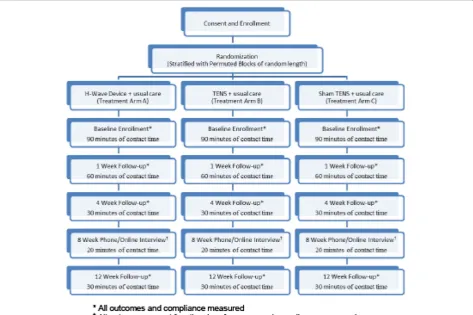
This study has been approved through the University of Utah Institutional Review Board (IRB # 52918). Study participants will receive compensation for participation in this study (Figure 1).
Randomization and allocation procedures
[image:3.595.62.536.392.707.2]Subjects will be allocated through central, computerized randomization utilizing a stratified permuted-block randomization employing random block sizes. After confirming eligibility and completion of baseline data
collection, the Study Coordinator will contact the desig-nated investigator (MST) for allocation. He will consult the prepared block randomized list and the next alloca-tion contained in sealed opaque envelope will be given to the treatment provider, while also recording the sub-ject ID number to allow for ascertainment of compli-ance with treatment allocation. The three treatment arms are labeled using letters “L”, “W” and “E” and correspond to a labeled device. The names of particular devices will not be used. The treatment provider will open the envelope and provide the assigned treatment device to the participant. Block stratification will be performed for opioid use (current vs. past/never) and workers’compensation claim (yes vs. no).
Blinding
We will attempt to blind patients and assessors to achieve double blinding. Patients will not be told what electrotherapy techniques are being utilized in this study, only that there are two active electrotherapies out of the spectrum of electrotherapy devices and a sham group. All study materials will be void of the words H-WaveW or TENS. Patient blinding will be accomplished by providing all patients either a H-WaveW device, a fully operation TENS Unit modified to function within a H-WaveW device housing, or a sham electrotherapy de-vice with minimally perceptible electrical current output modified to function within a H-WaveW device housing. Researchers providing the treatment are not blinded. As-sessors are blinded and will not be present for the inter-vention. Participants will be instructed not to reveal or discuss the type of treatment characteristics they are experiencing.
Sham devices will appear to operate in the same exact way as a fully functional electrotherapy device, including battery drain and usage log. At maximal settings, weak electrical current will be flowing to the pads so that the patients may perceive the device as active treatment.
Additional blinding of subjects or treatment within this trial is not possible. The research team will be re-quired to wear color-coded nametags indicating whether or not the researcher is blinded or non-blinded to avoid any confusion at the time of assessments. Efficacy of as-sessor blinding will be conducted at all onsite assess-ments by recording assessor’s opinion of treatment arm for each subject.
Outcome measures
Outcome measures will be assessed at baseline, 1 week, 4 weeks, 8 weeks, and 12 weeks, with the primary out-come being at 4 weeks. Assessment will occur in the same manner and at the same time intervals for all treatment arms utilizing standardized methods. Treatment failure will be defined as if patient terminates assigned treatment
arm for non-efficacy or election to pursue surgical or inva-sive procedure or other excluded cointerventions.
The primary outcome measure will be the Oswestry Disability Index (ODI). The ODI is widely used in low back pain intervention trials, and provides a measure of functional improvement The ODI was selected com-pared to a subjective pain rating [25-29]. Secondary out-come measures include Rowland Morris Instrument (0–24 scale of disability); VAS Pain score (0–100); phys-ical activity levels objectively measured using accelerom-eters worn by participants during waking hours over during the entire 12 week study period; functional cap-acity evaluation including strength when pushing and pulling (3 repetitions lasting 5 seconds each of both pushing and pulling measuring both peak and average kg of force according to standard EvalTech Functional Systems protocol which utilizes a load cell to measure forces exerted); range of lumbar spine motion (up to parti-cipants maximum range of specific movement) in flexion, extension, lateral rotation; duration of time (minutes) sit-ting comfortably (subjective estimate made by participant during questionnaire); duration of time (minutes) standing comfortably (subjective estimate made by participant during questionnaire); duration (minutes) and distance (meters) walking comfortably (subjective estimate made by participant during questionnaire); summed VAS pain × days rating; days of impairment (days); lost workdays (days); time to exacerbation (days until increase 3/10 pain); rescue acetaminophen tablets consumed (% and number); NSAID discontinuation (%); opioid discontinu-ation (%). The pain VAS score is assessed immediately be-fore and after treatment at weeks 0, 1, and daily scores pre and post home-treatment in a diary that the participant keeps (Table 1).
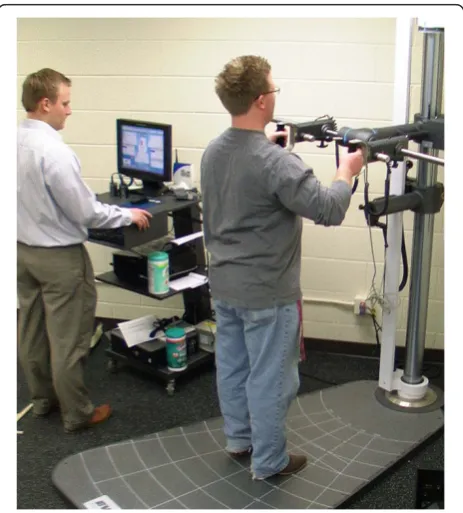
Functional assessments will be completed using a stan-dardized protocol on a BTE EvalTech system. Standard protocols for Lumbar Flexion/Extension, Lumbar Lateral Flexion, Shoulder Height Push and Pull, Cart Height Push and Pull are used. Researchers performing assessments are trained to perform all assessments exactly the same following the BTE EvalTtech protocol (Figure 2).
Subjective outcomes data will be collected using com-puterized data collection tools utilizing Filemaker ProTM
database management to assure complete and accurate data collection. Data will be collected at enrollment and subsequent treatments. Data after treatments end will be collected in person using the same tools for every par-ticipant study by a blinded assessor.
Assessments
initial treatment for assessment of subject ability to cor-rectly use their assigned device; have questions answered about the protocol, and to complete week 1 assessment. Subjective assessments will be measured at baseline, 1 -week, 4 weeks, 8 weeks, and 12 weeks. Objective assess-ments will be measured pre and post-treatment at baseline and post-treatment at week 1, week 4, and week 12. No treatments are provided by the researchers after week 1, although patients will be performing home treat-ments per protocol for the entire 12 week period. Compli-ance will be assessed using digital time data logs recorded automatically by each device and diaries kept by partici-pants. Participants in each arm will have identical and comparable contact time with providers and assessors to minimize treatment bias. All participants will be contacted weekly by a blinded assessor via telephone to encourage compliance and use of daily treatment diaries.
At each assessment, all participants receive the same assessment, including questionnaire, physical functio-ning assessment form, and recording of accelerometer use. All measures will be assessed using computerized data collection methods at baseline and each follow-up, except at the 8-week follow-up where outcomes will be assessed over the phone. There are four objective
measures which are assessed via electronic device (Actigraph GT3X + Accelerometers and EvalTech func-tional testing equipment manufactured by BTE Tech-nologies). The accelerometers provide physical activity levels on a per minute basis and store up to 40 days of data. These accelerometers have demonstrated validity and reliability in a variety of settings [30-38]. Functional strength and lumbar range of motion will be captured using EvalTech functional evaluation tools. These in-clude fully modifiable load cells allowing different heights, widths, and orientations, as well as electronic range of motion devices for adequate capture. All trials will be performed 3 times. Pushing and pulling strength will be three trials each with exertions for 5 seconds and a 20 second break between trials. These will be at both shoulder height and cart height (approximately 49 inches). There will be a minimum of 6 trials (3 push and 3 pull at both shoulder height and cart height). Peak and average forces will be recorded for each trial.
Treatment protocols
[image:5.595.58.291.99.429.2]Subjects will be allocated to one of the three arms. Each treatment arm will have identical numbers of visits and contact time. Each arm will receive the uniform ins-tructions for using of their assigned electrotherapy device. Patients will be instructed to use their assigned device daily upon waking and before bedtime, and up to two add-itional treatments during the day as needed (e.g., 4 1-hour treatment sessions). Providers will place electrodes and Table 1 Outcome measures
Primary outcome measure:
Oswestry Disability Index (ODI)
Secondary measures:
a. Rowland Morris Instrument (0–24 scale of disability)
b. VAS Pain score (0–10)
c. Physical activity levels (objectively measured using accelerometers)
d. Functional evaluation including strength when pushing (peak and average kg of force)
e. Functional evaluation including strength when pulling (peak and average kg of force)
f. Comfortable (up to maximum baseline pain level) range of motion in flexion (degrees from neutral)
g. Comfortable (up to maximum baseline pain level) range of motion in extension (degrees from neutral)
h. Duration of time sitting comfortably (up to maximum baseline pain level) (minutes)
i. Duration of time standing comfortably (up to maximum baseline pain level) (minutes)
j. Duration and distance walking comfortably (up to maximum baseline pain level) (minutes and meters)
k. Summed VAS pain × days rating
l. Days of impairment (days)
m. Lost workdays (days)
n. Time to exacerbation (days until increase 3/10 pain)
o. Rescue acetaminophen tablets consumed (% and number)
p. NSAID discontinuation (%)
q. Opioid discontinuation (%)
[image:5.595.306.538.449.706.2]activate the device as per the protocol for each arm. Patients will be told that it is possible to not immediately feel effects of electrical treatment due to current levels that do not meet sensory thresholds. Patients will return after 1 week for reevaluation on electrode placement and ability to achieve the required self-administered stimula-tion levels. Providers are trained in standardized fashion to educate each participant on their assigned therapy.
The H-WaveW device delivers electrical stimulation through the placement of 4 electrode pads in a rectangu-lar geometric pattern at the circumference of the low back pain nidus. Patients will be instructed on optimal electrode placement for home use. The H-WaveWDevice is controlled by the patient after instruction from a ther-apist or practitioner. The stimulation parameters in terms of pulse duration and frequency are proprietary for the manufacturer and thus are not included in this protocol. However, the maximal intensity offered by the device is the goal of the treatment intensity. Patients are instructed to achieve the highest intensity possible in graduated fashion. Lower intensities are accepted if the patient cannot comfortably reach the maximal device intensity and will be noted on diary logs. There are con-trols for intensity and frequency, which the patient manipulates according to specific instructions and toler-ances. Patients in this arm will be required to reach near maximal intensity on low frequency. The maximal inten-sity may, in rare cases, induce transient muscular con-tractions. Patients are instructed not to increase the intensity to a painful level. The treatment is then self-administered for the duration of the study.
There are no accepted standardized protocols found in the literature for TENs treatment of chronic low back pain. There are no trials that demonstrate maximum ef-ficacy of pulse duration, wave type, or frequency. There-fore, the TENS units in this study allow adjustment of amplitude (intensity) only at a fixed frequency of 100 Hz with steady state pulsing. Modulation and pulse modes will be disabled in order to maintain uniformity of elec-trotherapy protocols. Pad placement will be directed by the provider to provide maximal clinical efficacy. The device is two channel TENS and will be administered by the patient after training by the provider.
The sham or control device will appear to operate in the same exact way as a fully functional TENS device, including battery drain and usage log. Subtherapeutic electrical current will be flowing to the pads so that the patient may perceive it as an active therapy. They will be instructed to use the device for the same duration as ac-tive treatments, daily upon waking and before bedtime, and up to two additional treatments during the day as needed (e.g., 4 1-hour treatment sessions). There is no quality evidence that subtherapeutic electrical current provides any clinical benefit over no electrotherapy
effectiveness for LBP, however this will likely blind the patients because none of them have ever experienced the H-Wave Device. Blinding of patients is achieved as none will have previously experienced H-Wave, home based TENS therapy, or subtherapeutic electrotherapy. Further, patients are kept blind as to which electrother-apy devices out of the myriad devices on the market, are included in the study and therefore have few precon-ceived notions to their assigned device.
Compliance
Compliance will be assessed by device logs and diaries. Each device will be capable of recording treatment appli-cations and duration, and will be downloaded electronic-ally at each in-person assessment. Total treatment time of 3.5 hours per week will be set as the threshold for compliance. If VAS Pain drops to a daily average of less than or equal to 2 out of 10, patients will be considered in compliance regardless of the number of treatments completed on that day. Patients will be called once per week to promote compliance and answer any questions.
Discontinuation
Subjects will be encouraged to continue to follow-up throughout the study. There are no penalties for early dropouts other than the amount of incentive earned is reduced if the entire follow-up period is not completed. Each device (H-WaveW, TENS) has very low adverse ef-fect profile. Although unexpected, those developing an adverse event will be reported to the IRB.
Usual care and co-interventions
Study participants will be asked to avoid significant changes in medical/healthcare management of their LBP during the study period. All participants will be allowed to pursue usual care with their own personal treating physician. No other treatment other than the assigned electrotherapy intervention will be provided by the trial researchers. Usual care will be limited to non-invasive therapies, including medications such as NSAIDS (pre-scription or over the counter) and opioids, physical therapy, manipulation, stretching and aerobic exercise. Self-applications of heat or ice are also acceptable. All usual care medications and interventions will be recorded.
Interventions not allowed
treatments. Patients are asked about any additional treat-ments received at each assessment to determine con-tinued eligibility.
Statistical approach
Statistical power/Sample size
Sample size determination is based on the comparisons of the study arms for the primary outcome variable, ODI. In previous studies of low back pain patients , the baseline ODI values for one study group were mean (SD) of 60.2 (15.0) and for a second study group were 59.9 (14.4) [39,40]. The total score for the ODI is a per-centage, ranging from 0 to 100. It is suggested that the reliability of the ODI requires a minimum detectable change of at least 10 points, as any smaller difference may be attributable to error in the measurement [25]. Assuming equality of the study arms at baseline, which can be assured by adjusting for baseline ODI in the re-gression model, and a minimal detectable effect size of a 10 point difference on the post-treatment value, sample size is based on a comparison of mean (SD) of 60 (15) vs. 50 (15), a 17% relative difference post treatment, using a two-sided comparison with alpha of 0.025 to allow for multiplicity adjustment. Under these assump-tions, a sample size of n = 43 subjects per study arm is required to achieve 80% power. However, it is expected that the stimulation arms will produce at least a 25% relative improvement over the control arm. Assuming 60 (15) vs. 45 (15), a 25% relative difference, using a two-sided alpha 0.025 comparison, a sample size of n = 20 subjects per study arm is required for 80% power, or n = 25 subjects for 90% power. Allowing for a 20% drop-out rate, a sample size of n = 38 subjects will be enrolled in each study arm to provide n = 25 evaluable subjects for data analysis.
Statistical analysis
Primary analysis
The primary analysis is the comparison of the three study arms on the primary outcome, Oswestry Disability Index (ODI). Given that repeated measurements are col-lected, a mixed effects linear regression model will be fit-ted with an unstructured covariance matrix to account for lack of independence introduced by the repeated measurements. In this model, the repeated measure-ments are nested within study subject (weeks 0, or base-line, and weeks 1, 4, 8, and 12). The primary predictor is study group. A time variable will be included as a covari-ate, since visits will not always be at the planned inter-vals. Other covariates will be assessed for possible confounding in the relationship between treatment arm and outcome. It is likely that the pattern of dropouts will vary between the study groups, where the study inter-ventions that are most effective having the dropouts
later on in the follow-up, while the intervention least effective to have dropouts early on. The analysis will emphasize the 4-week time point as the primary end point, which ends the intensive intervention period. At 4 weeks compliance to the protocol and complete follow-up should be at a maximum. The remaining time to 12 weeks will measure long term effectiveness and ac-ceptance of the study interventions.
Secondary analyses
The changes from baseline to each follow-up visit in the pain VAS (the main secondary endpoint) will be ana-lyzed using the same longitudinal model described above for the Oswestry score. Key secondary comparisons will include the three pair wise comparisons between the treatment groups in the mean change in the Roland Morris Instrument, VAS, strength, and flexibility mea-sures at the different time points.,
The changes to 12 weeks will evaluate the persistence of treatment effects of the interventions to that time; changes to 4 weeks evaluate treatment effects at the completion of the intensive intervention period, and the slopes from weeks 4 to 12 evaluate changes in the treat-ment effects after 4 weeks. The null hypothesis is that there is no difference between the three treatment arms at 12 weeks.
Intent-to-treat analysis
These data will be analyzed using an intent-to-treat ana-lysis. As H-WaveWDevice is not widely utilized in study catchment area it is doubtful that individuals will inad-vertently crossover to that arm from the controls. How-ever, that possibility will be both discouraged and tracked.
Multiplicity
A multiplicity adjustment will be made for the compari-son of the primary outcome variable, Oswestry Disability Index (ODI). The two-sided p values from the hypoth-esis tests will be adjusted for two comparisons using the Hochberg procedure [41]. With that procedure, the smaller of the two p values is compared against alpha = 0.025 and the larger p value is compared against alpha = 0.05. This maintains the overall alpha at 0.05 for the ef-fectiveness win strategy evaluation.
Co-variates
Age, gender, tobacco, undiagnosed anxiety, undiagnosed depression, past back pain history, prior and current NSAID use, rescue acetaminophen use.
Post-hoc analyses
two treatment arms. Potential prognostic factors include gender, tobacco, anxiety, depression, (age and past back pain history will be assessed for residual confounding, but controlled in study design), belief in effectiveness of the treatments, NSAID use, rescue acetaminophen use.
Other considerations
The primary and main secondary analyses will be per-formed using an intent-to-treat strategy in which patients are analyzed based on their randomized assignment irre-spective of their compliance to the treatment protocol. Formal interim analyses of efficacy will not be conducted. However, the operational aspects of the study (recruit-ment, retention, adherence rates, and rates of missed visits) will be monitored as the study progresses so that corrective action may be taken to address any unexpec-ted difficulties. Monitoring for safety will be conducunexpec-ted throughout the study, investigating all possible unantici-pated safety events, including increased pain and discom-fort which are the two most likely types of events to occur. These treatments are widely used and are consid-ered safe with low rates of adverse effects. Efforts will be made to minimize the rates of missing data, including telephone follow-up of missed visits. The restricted max-imum likelihood procedure of the primary analysis pro-duces approximately unbiased estimates of the treatment effects so long as data are missing at random [42] and is less sensitive to missing data than analyses restricting to complete data [43]. In sensitivity analyses, multiple imput-ation incorporating baseline and follow-up predictors of outcome [44] will be used to assess the effect of potential violations of the missing at random assumption.
Discussion
Chronic low back pain is a significant issue, resulting in significant costs, lost productivity, and morbidity [1-6]. Therefore, even small improvements in treatment effi-cacy, particularly for treatments with few side effects, can have a meaningful impact on improving LBP. While there have been some studies assessing the therapeutic effectiveness of TENS, the effect generally is relatively small improvements in chronic LBP as compared to sham treatment. The use of two comparison arms in this study, both TENS and sham treatment, allows for com-parisons of experimental device with both TENS as well as sham treatment.
Blinding within this study is a significant strength. All devices are identical in appearance, weight, display, charge time, and sound. It is anticipated that complete blinding of the assessors and patients will be achieved. Care will be taken to limit contact between participants, e.g. schedule participants one at a time so they are not waiting in the same room together. All treatment ques-tions will be directed to the interventionalists, as to
maintain blinding of the assessors. Additionally, this protocol outlines concealing the treatment allocation by using opaque envelopes that appear identical. The utili-zation of a complex randomiutili-zation schedule is another strength that may ensure equality of treatment groups at baseline. The intent-to-treat analysis may account for unequal dropout between groups and any contamination that may occur.
Potential weaknesses include the possibility of high dropout in one or more treatment arm. To combat this, we are offering incentives and encouraging participants to continue for the entire duration of the study. There is the possibility of a randomization failure, which cannot be overcome. Additionally, due to the nature of the treatment, specifically the differences between the ex-perimental treatment and the TENS treatment, it was not feasible to blind the interventionalist. To address this all interventionalists will undergo strict training and re-standardization based on the treatment protocol. This training will stress treating all patients similarly with regards to demeanor and contact time, regardless of their randomized treatment arm.
Endnotes
a
Based on the ACOEM criteria, this study protocol is intended to provide a high-quality score (Randomization– 1, Blinded Allocation–1, Baseline Comparability–1, Pa-tient blinding – 1, Interventionist blinding – 0, Assessor Blinding – 1, Control of co-interventions– 0.5, Compli-ance–1.0, Drop Out < 20%–1, Timing of assessments– 1, ITT analysis–1 (Total score 9.5/11) High-quality≥8.0.
Competing interests
The authors declare they do not have any competing interests.
Authors’contributions
All listed authors contributed to the conception and design of the study. All authors were involved in drafting the manuscript and read and approved the final manuscript.
Sponsor
Electronic Waveform Lab, Inc.
Received: 7 August 2012 Accepted: 20 March 2013 Published: 28 March 2013
References
1. Deyo RA:Promises and limitations of the Patient Outcome Research Teams: the low-back pain example.Proc Assoc Am Physicians1995, 107(3):324–328.
2. Friedman BW,et al:Diagnostic testing and treatment of low back pain in United States emergency departments: a national perspective.Spine (Phila Pa 1976)2010,35(24):E1406–E1411.
3. Licciardone JC:The epidemiology and medical management of low back pain during ambulatory medical care visits in the United States.
Osteopath Med Prim Care2008,2:11.
4. Gore M,et al:The burden of chronic low back pain: clinical comorbidities, treatment patterns, and health care costs in usual care settings.Spine (Phila Pa 1976)2012,37(11):E668–E677.
6. Maetzel A, Li L:The economic burden of low back pain: a review of studies published between 1996 and 2001.Best Pract Res Clin Rheumatol 2002,16(1):23–30.
7. Fourney DR,et al:Chronic low back pain: a heterogeneous condition with challenges for an evidence-based approach.Spine (Phila Pa 1976) 2011,36(21 Suppl):S1–S9.
8. Hegmann KT, Thiese MS, Hughes MA, Edwards H, Ott U, Robertson D, Russo R, Srisukhumbowornchai S, Frischknecht M, Ording JA, Turner GE, Machata N:Update. Chapter 6: Chronic Pain. InAmerican College of Occupational and Environmental Medicine’s Occupational Medicine Practice Guidelines.2nd edition. Edited by Hegmann K. Elk Grove Village, IL:; 2008.
9. Arnau JM,et al:A critical review of guidelines for low back pain treatment.Eur Spine J2006,15(5):543–553.
10. Schnitzer TJ:Update on guidelines for the treatment of chronic musculoskeletal pain.Clin Rheumatol2006,25:22–29.
11. Kamper SJ,et al:Treatment-based subgroups of low back pain: a guide to appraisal of research studies and a summary of current evidence.Best Pract Res Clin Rheumatol2010,24(2):181–191.
12. Brosseau L,et al:Efficacy of the transcutaneous electrical nerve stimulation for the treatment of chronic low back pain: a meta-analysis.
Spine2002,27(6):596–603.
13. van Middelkoop M,et al:A systematic review on the effectiveness of physical and rehabilitation interventions for chronic non-specific low back pain.Eur Spine J2011,20(1):19–39.
14. Buchmuller A,et al:Value of TENS for relief of chronic low back pain with or without radicular pain.Eur J Pain2012,16(5):656–65.
15. Furlan AD,et al:A systematic review and meta-analysis of efficacy, cost-effectiveness, and safety of selected complementary and alternative medicine for neck and low-back pain.Evidence-Based Complementary and Alternative Medicine2011,2012.
16. Khadilkar A,et al:Transcutaneous electrical nerve stimulation for the treatment of chronic low back pain: a systematic review.Spine2005, 30(23):2657–2666.
17. Milne S,et al:Transcutaneous electrical nerve stimulation (TENS) for chronic low back pain (Cochrane Review).The Cochrane Library2002,2. 18. Khadilkar A,et al:Transcutaneous electrical nerve stimulation (TENS) for
chronic low-‐back pain.The Cochrane Library2008(4):CD003008. 19. Milne S,et al:Transcutaneous electrical nerve stimulation (TENS) for
chronic low-‐back pain.The Cochrane Library2001(2):CD003008. 20. Poitras S, Brosseau L:Evidence-informed management of chronic low
back pain with transcutaneous electrical nerve stimulation, interferential current, electrical muscle stimulation, ultrasound, and thermotherapy.
Spine J2008,8(1):226–233.
21. Williams CM,et al:Low back pain and best practice care: A survey of general practice physicians.Arch Intern Med2010,170(3):271. 22. Smith TL,et al:H-Wave induces arteriolar vasodilation in rat striated
muscle via nitric oxide-mediated mechanisms.J Orthop Res2009, 27(9):1248–1251.
23. Blum K,et al:The H-Wave((R)) Device Induces NODependent Augmented Microcirculation and Angiogenesis, Providing Both Analgesia and Tissue Healing in Sports Injuries.Phys Sportsmed2008,36(1):103–114.
24. Harris JS,et al:Methodology to update the practice recommendations in the American College of Occupational and Environmental Medicine's Occupational Medicine Practice Guidelines.J Occup Environ Med2008, 50(3):282–295.
25. Fairbank JC, Pynsent PB:The Oswestry disability index.Spine2000, 25(22):2940–2953.
26. Roland M, Fairbank J:The Roland–Morris disability questionnaire and the Oswestry disability questionnaire.Spine2000,25(24):3115–3124. 27. Gronblad M,et al:Intercorrelation and Test—Retest Reliability of the
Pain Disability Index (PDI) and the Oswestry Disability.Clin J Pain1993, 9(3):189–195.
28. Smeets R,et al:Measures of function in low back pain/disorders: Low Back Pain Rating Scale (LBPRS), Oswestry Disability Index (ODI), Progressive Isoinertial Lifting Evaluation (PILE), Quebec Back Pain Disability Scale (QBPDS), and Roland-‐Morris Disability Questionnaire (RDQ).Arthritis Care Res2011,63(S11):S158–S173.
29. McCormick JD, Werner BC, Shimer AL:Patient-reported Outcome Measures in Spine Surgery.J Am Acad Orthop Surg2013,21(2):99–107. 30. Bassett DR Jr:Validity and reliability issues in objective monitoring of
physical activity.Res Q Exerc Sport2000,71(2 Suppl):S30–S36.
31. Brage S,et al:Reexamination of validity and reliability of the CSA monitor in walking and running.Med Sci Sports Exerc2003,35(8):1447–1454. 32. Crouter SE, Clowers KG, Bassett DR Jr:A novel method for using
accelerometer data to predict energy expenditure.J Appl Physiol2006, 100(4):1324–1331.
33. Freedson PS, Melanson E, Sirard J:Calibration of the Computer Science and Applications, Inc. accelerometer.Med Sci Sports Exerc1998,30(5):777–781. 34. Fudge BW,et al:Estimation of Oxygen Uptake during Fast Running Using
Accelerometry and Heart Rate.Med Sci Sports Exerc2007,39(1):192–198. 35. Hendelman D,et al:Validity of accelerometry for the assessment of
moderate intensity physical activity in the field.Med Sci Sports Exerc2000, 32(9 Suppl):S442–S449.
36. Matthews CE,et al:Sources of variance in daily physical activity levels as measured by an accelerometer.Med Sci Sports Exerc2002,34(8):1376–1381. 37. Swartz AM,et al:Estimation of energy expenditure using CSA
accelerometers at hip and wrist sites.Med Sci Sports Exerc2000, 32(9 Suppl):S450–S456.
38. Yngve A,et al:Effect of monitor placement and of activity setting on the MTI accelerometer output.Med Sci Sports Exerc2003,35(2):320–326. 39. Jarzem PF,et al:Transcutaneous electrical nerve stimulation [TENS] for
short-term treatment of low back pain- randomized double blind crossover study of sham versus conventional TENS.Journal of Musculoskeletal Pain2005,13(2):11–17.
40. Khadilkar A,et al:Transcutaneous electrical nerve stimulation (TENS) for chronic low-back pain.Cochrane Database Syst Rev2005,3, CD003008. 41. Wright S:Adjusted p-values for simultaneous inference.Biometrics1992,
48(4):1005–1013.
42. Little RJA:Statistical Analysis with Missing Data Second Ed.New York: Wiley & Sons; 2002.
43. Tukey JW:Exploratory Data Analysis.Reading, MA: Addison-Wesley; 1977. 44. Brinkhaus B,et al:Acupuncture in patients with chronic low back pain: a
randomized controlled trial.Arch Intern Med2006,166(4):450–457.
doi:10.1186/1471-2474-14-117
Cite this article as:Thieseet al.:Electrical stimulation for chronic non-specific low back pain in a working-age population: a 12-week double blinded randomized controlled trial.BMC Musculoskeletal Disorders2013
14:117.
Submit your next manuscript to BioMed Central and take full advantage of:
• Convenient online submission
• Thorough peer review
• No space constraints or color figure charges
• Immediate publication on acceptance
• Inclusion in PubMed, CAS, Scopus and Google Scholar
• Research which is freely available for redistribution