2019 International Conference on Applied Mathematics, Modeling, Simulation and Optimization (AMMSO 2019) ISBN: 978-1-60595-631-2
A Study of Playability by Operation Bounds and Game Theory
Tian-yu MU
1, Wei WEI
1,2,3,* and Zhen-yu SHI
1,21
LMIB and School of Mathematics and Systems Science, Beihang University, Beijing, China
2Beijing Advanced Innovation Center for Big Data and Brain Computing, Beihang University,
Beijing, China
3Peng Cheng Laboratory, Shenzhen, Guangdong, China
*Corresponding author
Keywords: Game theory, Playability, Operation bound.
Abstract. We analyzed the influential factors of game playability, which could represent the popularity of the game. The upper operation bound and lower operation bound are proposed according to the popular complicated tricks and easy starting. Seen from the perspective of one player, we further explore the influential factors of game playability based on a one-to-one player battle model. By analyzing the conditional dominant strategy under game theory, three important factors are achieved to reveal the essence of game playability. Randomness that lies in a certain range may enhance the game playability, repetition can prevent us from falling into the random trap, and freedom allows the player to complete more appropriate operations. Use these three methods, we can build a framework to complete a game with high playability.
Introduction
Playing games has become a mainstream way of entertainment, and you’ll find lots of games online. But when we observe the comments and star ratings of some games, we find that although some games are highly popular among most people, many more others are commented as “trash”. We want to know why those games looking similar have different comments. Aimed at that, we analyze the influential factors of game playability, which could represent the popularity of the game.
As often said in advertising, those complex operations and gorgeous moves are associated with high playability of games. In order to study these factors, we investigated the comments of some popular games, including World of Warcraft [1], StarCraft [2], and the ancestor of the famous Arkanoid
game, PONG [3]. Through those comments, we discover that game playability is related to not only the many gorgeous and complicated operations that player can play in the game, but also the easy starting of the game. A game with more complicated operations is more likely to attract people. Meanwhile, it is also more likely to drive people away since it is hard to get started. Based on these results, we define the upper operation bound and the lower operation bound of the games, which represent the amount of strategies of experienced players and pure novices respectively.
According to the result of Yu-Hui Chu et al., the designed pattern and concept of the game will have an impact on the playability of the game [4]. We illustrate the impact of the design concept, including how players should play this game, etc. According to the result of Zhao-Quan Jian et al., non-zero-sum game mode can form a cooperative mechanism in competition [5], and we finally choose a non-zero-sum one-on-one game mode. Using the binary tree approach proposed by Ross et al. [6], we divided the players into two categories to form the basis of the model.
Next, we observe the progress of the whole game from the main perspective of one player. By using the ideas in Game Theory and Society written by Wei-Ying Zhang [7], we analyze the player's decision process in single round game. Then we calculate the upper operation bound and the lower operation bound of the game, to construct a preliminary understanding of the playability of the game.
that, the influence of randomness on player decision-making is discussed, and the conclusion that randomness within a certain range can improve game playability is obtained. Meanwhile, through the research of Feng Huang et al. [11], Marx [12], and Xiao-Lei Zhao et al. [13], we constructed the idea which called the random trap to describe the adverse effects of excessive randomness.
After that, using the repeated game mode in the traditional game theory [7], we further consider the impact of repeated game mode on the playability of the game. Qing-Wen Sun has shown that in the case of repeated games, even if there is information asymmetry, the final game results can gradually converge to an evolutionary equilibrium [14]. Therefore, we studied the improvement of the lower operation bound on the repeated game mode and the limited increase of the upper operation bound. We find that repeated game mode may not improve the playability of the game, and too many game times will even reduce the playability of the game. But through the study of the central limit theorem
[15]
, we study the inhibition of randomness by repeated games and its promotion of game playability in this aspect.
According to Teodorovic, it is difficult to determine the specific benefits of a particular thing, and virtually any gain that falls within a certain range is accepted [16]. We use a fuzzy treatment of the player's understanding of the strategy, and thus define the player's cognitive lower bound. By continuously segmenting the two strategies, the upper operation bound can be greatly improved, but the lower operation limit of the operation just rises to a certain level. Therefore, this strategy could improve the game playability.
Assumptions
We define the upper operation bound of a game as the number of combinations of strategies that players with deep game experience can choose. Obviously, we can see that those famous online games, such as World of Warcraft [1], have high upper operation bound. The higher the upper operation bound of a game, the more strategies can be selected while playing the game, so that players can experience a completely different process in every game. From that we could make hypothesis:
Hypothesis 1: The game playability is affected by upper operation bound. The higher the upper operation bound, the higher the game playability, while other conditions remain unchanged.
The game playability depends on whether it is easy to get started as well. Here we define the lower operation bound as the number of combinations of strategies that pure novices of the game can choose. Obviously, the lower the lower operation bound, the easier the player can learn the basic operations of the game. Since learning the basic operation is the basis for a player to get a deeper understanding of a game, we make the following hypothesis:
Hypothesis 2: The game playability is affected by lower operation bound. The lower the lower operation limit, the higher the game playability, while other conditions remain unchanged.
The Battle Model
The Basis of the Model
By the number of players, games can be divided into a variety of modes including cooperative mode, in which players and players cooperate with each other against the set computer enemies, and competitive mode, in which players play against each other according to certain rules. Anyway, in competitive game mode, there are also factors of cooperation. Here, due to space limitations, we only consider the one-to-one game mode, and further explore the influencing factors of game playability based on a 1v1 player battle model. In our paper, we will focus on the core rules of the game to analyze the impact of designed concept on game playability.
Table 1. The payoff matrix for both players.
Player B
Strategy 1 Strategy 2
Player A Strategy 1 (a,a) (b,c) Strategy 2 (c,b) (d,d)
Where: a,b,c,d is set as the profits, a,b,c,d∈R. The profit at the left side of the brackets is the profit of player A, while the other one is the profit of player B.
Since two players can choose the same strategy here, in order to distinguish different combinations of strategies, we choose a non-zero-sum method. Since player A and player B are essentially identical in the game, in the following discussion, we only observe from player A's perspective to discuss the impact of different designed concept on the game's lower operation bound and the upper operation bound. To this end, we use the Cox-Ross-Rubinstein binomial option pricing model [6] to divide players into two categories.
The first is someone who doesn't understand the game at all, called pure novice. They only have the shallowest understanding of the game, and can't calculate the profit of a certain strategy accurately, so they can only choose one strategy at random. The number of strategies included in their strategy set can be considered as the lower operation bound of the game.
The second is someone who has a deep understanding of the game, called experienced player. They can accurately calculate the benefits of each strategy in the game, and choose the appropriate strategy according to the specific situation. The number of strategies included in their strategy set can be considered as the upper operation bound of the game.
Single Round Game
First, let's discuss what will happen if the game only has one turn.
(1) The lower operation bound. If player A is a pure novice, he will just randomly choose one strategy from the two strategies given in the game. The lower operation bound is 2.
(2) The upper operation bound. If player A is experienced, he will try to make bigger profits according to his comprehension of the game. So that he must guess what strategy player B will choose, to choose targeted strategy to win the game. Using the game theory, we can write the strategy set of player A as (1|1, 1|2, 2|1, 2|2). But the upper operation bound is not 4. Let’s see the situation below:
Here we set a<c, If player B chooses strategy 1, player A will choose strategy 2. Or to say, under the situation that player B chooses strategy 1, strategy 2 is a conditional dominant strategy. Specially, if strategy 2 is a conditional dominant strategy under any situations, we call it dominant strategy. Obviously, if there’s a conditional dominant strategy, the upper operation bound will be lower than its maximum value since experience player will only choose that strategy under certain situations.
In the single round situation, we can see that for each strategies of player B, player A has a conditional optimal strategy, so the upper operation bound is 2. It is obvious that if player A cannot find a conditional optimal strategy under certain situations affected by the choice of player B, the upper operation bound could be even more. So now let’s see an available way to enhance the upper operation bound.
Randomness
Table 2. Payoff Matrix with Randomness.
Player B
Strategy 1 Strategy 2
Player A Strategy 1 (a,a) (b,c
')
Strategy 2 (c',b) (d',d')
Where: c'~U(c-s,c+s), d'~U(d-s,d+s).
Therefore, we construct a new strategy with randomness. In order to measure its benefits, we comprehensively use Markowitz's effective market portfolio theory [8], asset prospect theory [9] and VNM utility function [10] to build a risky revenue model U(r)=E(r)-1
2As
2. Where: U(r) stands for the
player’s psychological profits on a risk strategy, E(r) stands for the expected return of the strategy, and A stands for the player's aversion to risk.
The player's aversion to risk is determined by the player's subjective factors and the process of the game, but the player often misjudges the situation. Therefore, under many situations, player A cannot compare strategy 1 with strategy 2. Although the expected returns are constant, even if player B chooses the same strategy in different situations, player A may have difficulty comparing the psychological profits of strategy 1 with those of strategy 2. Thus, in a single game, there is no conditional optimal strategy under most of the circumstances, so the upper operation bound is considered as 4.
In order for randomness to work, it is clear in our model that:
{ a∈(c-s,c+s),
(c-s,c+s)∩(d-s,d+s)≠∅. (1) At the same time, according to the risk premium theory [11], there must be c>a. From this we can see that randomness can increase the upper operation bound of the game.
Derived from the situation of two strategies, we can see that in the situation of multiple strategies, as the randomness increases, the conditional optimal strategy becomes less and less, and the upper operation bound is higher. But can we increase the randomness infinitely to reach the maximum upper operation bound? Imagine a situation where we increase the standard deviation of Strategy 2 to 3a. At this time, if player B chooses strategy 2, and gets a profit more than a, player A can only choose high risk strategy 2, begging that he is lucky enough to win the game.
When the high-benefit brought by the high-risk reaches a certain amount, the high-risk option will become excellent strategy, since the benefits of choosing low-risk options are far from winning. So, the game will become a guessing game, although the lower operation bound is still unchanged, the upper operation bound is only 1, we call it the random trap. We can conclude that:
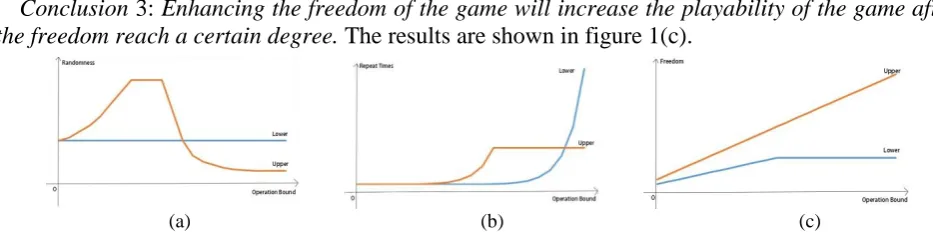
Conclusion 1: Randomness that lies in a certain range may enhance the game playability, but excessive randomness may lead to the random trap. The results are shown in figure 1(a).
Repetition
Previously we discussed the player's strategy in single round games, but that kind of game is more like Russian roulette, pure luck. In order to improve the game playability, we introduce the traditional method in game theory, the repeated game, to solve this problem. We assume that the repeat times is 𝑛, and the winning condition is that the sum of the profits obtained in each round is larger, then we can find:
(1) The lower operation bound. If player A is a pure novice, he will choose one strategy from the two strategies given randomly at each turn, so that the number of strategies in his strategy set is 2𝑛, which is the lower operation bound.
influence of player B’s strategy, the strategy set in a single round decreases, the number of which decreases from 4 to 3, and then to 2. Finally, players may reach a certain equilibrium. Thus, we can write the upper operation bound as:
4n, 1≤n≤n1; 4n1*3n-n1, n1<n≤n2; 4 n1
*3n2*2n-n1-n2, n
2<n≤n3; 4n1*3n2*2n3, n>n3 (2)
Where: n1,n2,n3 stand for the number of rounds when the number of strategies in player A’s strategy set is 4, 3 or 2, respectively.
From this we can see that a certain degree of repetition will have an unpredictable impact on the game playability. But after the game has been carried out many times, both players have a deep understanding of each other's strategy set, thus achieving a Nash equilibrium [7], at which point the upper operation bound no longer increases. Therefore, the number of repetitions should be controlled below a certain level.
When using the method of mora to make a decision, we usually choose the winning method of best of three or five games. Obviously, repeated games have improved the game playability. In the case of repeated games, the final result can be seen as comparing the average profit of each round, using the central limit theorem [15], repeated games can reduce the variance caused by randomness, so that we can improve the randomness of the game without falling intothe random trap.
Conclusion 2: Increasing the repeatability of the game can improve the game playability, but this improvement obeys the nature of diminishing marginal returns, and when the repetition is too high, it will reduce the game playability. The results are shown in figure 1(b).
Freedom
In our game model, if we offer a variety of strategies, we will increase the lower and upper operation bound at the same time, which will bring unpredictable impact on the game's playability. So, we have to choose a more mitigating way to deal with the game process. Here we use the method of refinement, we take a number α in (0,1), and the profit of a strategy with the serial number 1*(1-α)+2*α is r1+α=(1-α)r1+αr2. Where: r1, r2 stand for the profits of strategy 1 and 2, respectively.
Thus, we define a segmentation between strategy 1 and 2 as (1,1+α,1+2α,…1+kα,2). Where: k satisfies kα<1≤(k+1)α. We call αsegmentation degree.
When α gets smaller, we can provide more strategies. It is not hard to understand that we enhance the upper operation bound. But what for the lower operation bound? We can think that people's perception of bias increases with experience, and as experience increases, people are more responsive to smaller changes in utility.
Since a pure novice cannot accurately calculate the profit of each strategy, it is difficult to distinguish between two strategies with small utility gaps. But an experienced player can distinguish the difference easily. We define the estimated return as (r-sr,r+sr). Where: r stands for the true expected return and sr stands for its standard deviation. For different players, the values of sr are different. [16]
We also define that seen from the point of view of a certain player, if ∃ρ>0, so that for all α1 and α2 satisfying |α1-α2|<ρ, we have (r1-s1,r1+s1)∩(r2-s2,r2+s2)≠∅. Then we call ρthe lower cognitive bound of the player. Where: (r1-s1,r1+s1) and (r2-s2,r2+s2) stands for the estimated return of the
player whose serial numbers are 1+α1 and 1+α2, respectively. We set the lower cognitive bound of
pure novices isρ0, while that of experienced players is ρ1. (0≈ρ1≪ρ0≪1)
So for a pure novice, there is only a maximum of [1 ρ⁄ ]0 valid subdivisions between the two strategies, while others may not be distinguished. We can see that the segmentation of the strategy will only increase the lower operation bound of the game to a certain extent, but it can always increase the upper operation bound of the game to a large extent, thus improve the game playability.We define freedom as 𝑚𝑎𝑥𝛼1
𝛼, where: α∈F,F stands for all the segmentation degree between any two strategies.
Conclusion 3: Enhancing the freedom of the game will increase the playability of the game after the freedom reach a certain degree. The results are shown in figure 1(c).
[image:6.595.59.526.75.191.2]
(a) (b) (c)
Figure 1. The influence of randomness, repetition and freedom.
Summary
Through the analysis of the various games in the market, we find that players tend to play games with cool operation and more thinking, in which they can show off their high operations to their friends. However, the games with low difficulty of getting started are also popular with players because players don't need a lot of time to master the game. In this paper, we analyze the core part of the game, taking a one-to-one game as an example to analyze the impact of various designed concept on the game playability. We have established a non-zero-sum game model to describe this kind of games. Through the analysis of the player's decision mode, we find three ways to improve the game playability. Improve the randomness of the game to force the player to think deeper, increase the number of repetitions of the game to force the player to understand the opponent's strategy, and improve the freedom of the game to allow the player to complete more appropriate operations. Using these three methods, we can build a framework for the game playing, so that we can complete a game with high playability.
Acknowledgement
This work was supported by the Fundamental Research Funds for the Central Universities, Beijing Natural Science Foundation (1192012, Z180005), and Fundamental Research of Civil Aircraft No. MJ-F-2012-04.
References
[1] Information on https://www.wowchina.com/zh-cn [2] Information on http://sc2.blizzard.cn/home
[3] Information on https://en.wikipedia.org/wiki/Pong
[4] Yu-Hui Chu, Yi-Fan Gong, Yun Chen, The Application of the Design Pattern in Online Games[J], Computer Knowledge and Technology, 2008(26):1620-1621+1632.
[5] Zhao-Quan Jian, Huan Li, The Formation Mechanism of Strategic Alliance—Non-Zero and Cooperation Game[J], Science of Science & Management, 1998(09):17-18.
[6] Ross, Cox, Mark Rubinstein, Option pricing: a simplified approach[J], Journal of Financial Economics, Volume 7, Issue 3, September 1979, Pages 229-263.
[7] Wei-Ying Zhang, Game Theory and Society[M], Beijing, Beijing University Press, 2013.
[10] Hui Zhang, Jie Sun, Interpretation of Friedman-Savic's Mystery: on the Modified VNM Utility Function[J], Zhejiang Finance, 2012(02):19-22.
[11] Feng Huang, Zhao-Jun Yang, Liquidity Risk and Stock Pricing: Empirical Evidence from China's Stock Market[J], Management World, 2007(05):30-39+48.
[12] Karl Marx, Capital, Beijing, Commercial Press, 1934.
[13] Xiao-Lei Zhao, Deflation, Liquidity Trap and China's Macroeconomic Policy Integration Study[J], Financial Research, 1999(10):14-21+81.
[14] Qing-Wen Sun, Liu Lu, Guang-Le Yan, Hong-An Che, Stability Analysis of Evolutionary Game Equilibrium under Incomplete Information Conditions[J], System Engineering Theory and Practice, 2003(07):11-16.
[15] Dian-Ni Wang, Xiu-Sheng Liu, Central Limit Theorem and Application, Journal of Hubei Institute of Technology, 2018, 34(05):57-62.