R E S E A R C H
Open Access
The common solution for a generalized
equilibrium problem, a variational inequality
problem and a hierarchical fixed point
problem
Ibrahim Karahan
1, Aydin Secer
2*, Murat Ozdemir
3and Mustafa Bayram
2*Correspondence:
2Department of Mathematical
Engineering, Faculty of Chemistry-Metallurgical, Yildiz Technical University, Istanbul, Turkey Full list of author information is available at the end of the article
Abstract
The present paper aims to deal with a new iterative method to find a common solution of a generalized equilibrium problem, a variational inequality problem and a hierarchical fixed point problem for a sequence of nearly nonexpansive mappings. It is proved that the proposed method converges strongly to a common solution of above problems under some assumptions. The results here improve and extend some recent corresponding results by many other authors.
MSC: 90C33; 49J40; 47H10; 47H05
Keywords: generalized equilibrium problem; variational inequality; hierarchical fixed point; projection method; nearly nonexpansive mappings
1 Introduction
LetHbe a real Hilbert space whose inner product and norm are denoted by·,·and · , respectively,Cbe a nonempty, closed, and convex subset ofH. It is well known that for anyx∈H, there exists a unique pointy∈Csuch that
x–y=inf
x–y:y∈C.
Here,yis denoted byPCx, wherePCis called the metric projection ofHontoC.
Let us recall some kinds of nonlinear mappings as follows, which are needed in the next sections. A mappingT:C→His calledL-Lipschitzian if there exists a constantL> such thatTx–Ty ≤Lx–y,∀x,y∈C. In particular, ifL∈[, ), thenT is said to be a contraction; ifL= , thenT is called a nonexpansive mapping. Let us fix a sequence{an}
in [,∞) withan→. If the inequalityTnx–Tny ≤ x–y+anholds for allx,y∈C
andn≥, thenTis said to be nearly nonexpansive [, ] with respect to{an}. Let{Tn}be
a sequence of mappings fromCintoH. Then the sequence{Tn}is called a sequence of
nearly nonexpansive mappings [, ] with respect to a sequence{an}if
Tnx–Tny ≤ x–y+an, ∀x,y∈C,∀n≥. (.)
It is obvious that the sequence of nearly nonexpansive mappings is a wider class of se-quence of nonexpansive mappings. A mapping A:C→H is calledα-inverse strongly monotone if there exists a positive real numberα> such that
Ax–Ay,x–y ≥αAx–Ay, ∀x,y∈C,
and a mappingF:C→His calledη-strongly monotone if there exists a constantη≥ such that
Fx–Fy,x–y ≥ηx–y, ∀x,y∈C.
In particular, ifη= , thenFis said to be monotone.
LetG:C×C→Rbe a bifunction andBbe a nonlinear mapping. The generalized equilibrium problem, denoted byGEP, is to find a pointx∈Csuch that
G(x,y) +Bx,y–x ≥ (.)
for ally∈C, and the solution of the problem (.) is denoted byGEP(G),i.e.,
GEP(G) =x∈C:G(x,y) +Bx,y–x ≥, ∀y∈C.
IfB= , then theGEPis reduced to equilibrium problem, denoted byEP, which is to find a pointx∈Csuch that
G(x,y)≥
for ally∈C. The set of solutions ofEPis denoted byEP(G). In the case ofG= , thenGEP
is equivalent to find ax∈Csuch that
Bx,y–x ≥ (.)
for all y∈ C. The problem (.) is called variational inequality problem, denoted by
VI(C,B), and the solution ofVI(C,B) is denoted by,i.e.,
=x∈C:Bx,y–x ≥, ∀y∈C.
The generalized equilibrium problem includes, as special cases, the optimization prob-lem, the variational inequality probprob-lem, the fixed point probprob-lem, the nonlinear comple-mentarity, the Nash equilibrium problem in noncooperative games, the vector optimiza-tion problem, etc. Hence, the existence of soluoptimiza-tions of generalized equilibrium problems has been extensively studied by many authors in the literature (see,e.g., [–]).
LetS:C→Hbe a nonexpansive mapping. The following problem is called a hierarchi-cal fixed point problem: Findingx∗∈Fix(T) such that
whereFix(T) is the set of fixed points ofT,i.e.,Fix(T) ={x∈C:Tx=x}. The problem (.) is equivalent to the following fixed point problem: Finding anx∗∈Cthat satisfiesx∗=
PFix(T)Sx∗. SinceFix(T) is closed and convex, the metric projectionPFix(T)is well defined. It is well known that the hierarchical fixed point problem (.) links with some monotone variational inequalities and convex programming problems; see [–]. Therefore, there exist various methods to solve the hierarchical fixed point problem; see Yao and Liou in [], Xu in [], Marino and Xu in [] and Bnouhachem and Noor in [].
Now, we give some iteration schemes which are related with the problems (.), (.), and (.). In , Cenget al.[] investigated the following iterative method:
xn+=PC
αnρVxn+ ( –αnμF)Txn
, ∀n≥, (.)
where F is aL-Lipschitzian and η-strongly monotone operator with constantsL,η> andV is a γ-Lipschitzian (possibly non-self-)mapping with constant γ ≥ such that <μ<Lη and ≤ργ < –
–μ(η–μL). They proved that under some approxi-mate assumptions on the operators and parameters, the sequence{xn}generated by (.)
converges strongly to the unique solution of the variational inequality
(ρV–μF)x∗,x–x∗≤, ∀x∈Fix(T). (.)
Recently, in , Sahuet al.[] introduced the following iterative process for the se-quence of nearly nonexpansive mappings{Tn}defined by (.):
⎧ ⎨ ⎩
yn= ( –βn)xn+βnSnxn,
xn+=PC[αnfxn+ni=(αi––αi)Tiyn], ∀n≥,
(.)
wheref is a contraction and{Sn}is a sequence of nonexpansive mappings fromCinto
itself. They proved that the sequence{xn} generated by (.) converges strongly to the
unique solution of the following variational inequality:
τ(I–f)x
∗+ (I–S)x∗,x–x∗≥, ∀x∈∞
i=
Fix(Tn).
In the same year, Bnouhachem and Noor [] introduced a new iterative scheme to find a common solution of a variational inequality, a generalized equilibrium problem and a hierarchical fixed point problem. Their scheme is as follows:
⎧ ⎪ ⎪ ⎪ ⎪ ⎪ ⎨ ⎪ ⎪ ⎪ ⎪ ⎪ ⎩
G(un,y) +Bx,y–un+rny–un,un–xn ≥, ∀y∈C,
zn=PC(un–λnAun),
yn=PC(βnSxn+ ( –βn)zn),
xn+=PC(αnfxn+
n
i=(αi––αi)Viyn), ∀n≥,
(.)
where Vi =kiI + ( –ki)Ti, ≤ki < , {Ti}∞i= :C → C is a countable family of ki
They proved that the sequence {xn} generated by (.) converges strongly to a point z∈P∩GEP(G)∩Fix(T)f(z) which is the unique solution of the following variational inequality:
(I–f)z,x–z≥, ∀x∈∩GEP(G)∩Fix(T),
whereFix(T) =∞i=Fix(Ti).
In , Bnouhachem and Chen [] introduced the following iterative method:
⎧ ⎪ ⎪ ⎪ ⎪ ⎪ ⎨ ⎪ ⎪ ⎪ ⎪ ⎪ ⎩
F(un,y) +Dxn,y–un+ϕ(y) –ϕ(un) +rny–un,un–xn ≥, ∀y∈C;
zn=PC(un–λnAun);
yn=βnSxn+ ( –βn)zn;
xn+=PC[αnρUxn+γnxn+ (( –γn)I–αnμF)(T(yn))], ∀n≥,
(.)
whereD,A:C→Hare inverse strongly monotone mappings,F:C×C→Ris a bifunc-tion,ϕ:C→Ris a proper lower semicontinuous and convex function,S,T:C→Care nonexpansive mappings,F:C→Cis Lipschitzian and a strongly monotone mapping and
U:C→Cis a Lipschitzian mapping. The authors proved the strong convergence of the sequence generated by (.) to a common solution of a variational inequality, a generalized mixed equilibrium problem, and a hierarchical fixed point problem.
In addition to all these papers, similar problems are considered in several papers; see,
e.g., [–].
In this paper, motivated by the above works and by the recent work going in this direc-tion, we introduce an iterative projection method and prove a strong convergence theorem based on this method for computing an approximate element of the common set of so-lution of a generalized equilibrium problem, a variational inequality problem and a fixed point problem for a sequence of nearly nonexpansive mappings defined by (.). The pro-posed method improves and extends many known results; see,e.g., [, , , , ] and the references therein.
2 Preliminaries
Let{xn}be a sequence in a Hilbert spaceHandx∈H. Throughout this paper,xn→x
denotes the strong convergence of{xn}toxandxnxdenotes the weak convergence.
LetCbe a nonempty subset of a real Hilbert spaceH. For solving an equilibrium problem for a bifunctionG:C×C→R, let us assume thatGsatisfies the following conditions:
(A) G(x,x) = ,∀x∈C,
(A) Gis monotone,i.e.G(x,y) +G(y,x)≤,∀x,y∈C, (A) ∀x,y,z∈C,
lim
t→+G
tz+ ( –t)x,y≤G(x,y),
(A) ∀x∈C,y−→G(x,y)is convex and lower semicontinuous.
Lemma [] Let C be a nonempty,closed,and convex subset of H,and let G be a
such that
G(z,y) +
ry–z,z–x ≥ (.)
for all x∈C.
Lemma [] Suppose that G:C×C→Rsatisfies(A)-(A).For r> and x∈H,define a mapping Tr:H→C as follows:
Tr(x) =
z∈C:G(z,y) +
ry–z,z–x ≥, ∀y∈C
for all z∈H.Then the following hold:
() Tris single valued,
() Tris firmly nonexpansive i.e.
Trx–Try≤ Trx–Try,x–y, ∀x,y∈H,
() Fix(Tr) =EP(G),
() EP(G)is closed and convex.
LetT,T:C→H be two mappings. We denoteB(C), the collection of all bounded subsets of C. The deviation betweenTandT onB∈B(C), denoted byDB(T,T), is defined by
DB(T,T) =sup
Tx–Tx:x∈B
.
The following lemmas will be used in the next section.
Lemma [] Let C be a nonempty,closed,and bounded subset of a Banach space X and {Tn}be a sequence of nearly nonexpansive self-mappings on C with a sequence{an}such thatDC(Tn,Tn+) <∞.Then,for each x∈C,{Tnx}converges strongly to some point of C. Moreover,if T is a mapping from C into itself defined by Tz=limn→∞Tnz for all z∈C, then T is nonexpansive andlimn→∞DC(Tn,T) = .
Lemma [] Let V:C→H be aγ-Lipschitzian mapping with a constantγ≥and let F:C→H be a L-Lipschitzian andη-strongly monotone operator with constants L,η> .
Then for≤ργ<μη,
(μF–ρV)x– (μF–ρV)y,x–y≥(μη–ργ)x–y, ∀x,y∈C.
That is,μF–ρV is strongly monotone with coefficientμη–ργ.
Lemma [] Let C be a nonempty subset of a real Hilbert space H.Suppose thatλ∈(, )
andμ> .Let F:C→H be a L-Lipschitzian and η-strongly monotone operator on C.
Define the mapping G:C→H by
Then G is a contraction that providedμ<Lη.More precisely,forμ∈(,
η
L),
Gx–Gy ≤( –λν)x–y, ∀x,y∈C,
whereν= – –μ(η–μL).
Lemma [] Let C be a nonempty,closed,and convex subset of a real Hilbert space H,
and T be a nonexpansive self-mapping on C.IfFix(T)=∅,then I–T is demiclosed;that is whenever {xn}is a sequence in C weakly converging to some x∈C and the sequence {(I–T)xn}strongly converges to some y,it follows that(I–T)x=y.Here I is the identity operator of H.
Lemma [] Assume that{xn}is a sequence of nonnegative real numbers satisfying the
conditions
xn+≤( –αn)xn+αnβn, ∀n≥,
where{αn}and{βn}are sequences of real numbers such that
(i) {αn} ⊂[, ] and
∞
n=
αn=∞,
(ii) lim sup
n→∞ βn≤.
Thenlimn→∞xn= .
3 Main results
LetCbe a nonempty, closed, and convex subset of a real Hilbert spaceH. LetA,B:C→H
beα,θ-inverse strongly monotone mappings, respectively. LetG:C×C→Rbe a bifunc-tion satisfying assumpbifunc-tions (A)-(A),S:C→H be a nonexpansive mapping and{Tn}
be a sequence of nearly nonexpansive mappings with the sequence{an}such thatF:=
Fix(T)∩∩GEP(G)=∅whereTx=limn→∞Tnxfor allx∈CandFix(T) =
∞
n=Fix(Tn).
It is clear that the mappingT is nonexpansive. LetV:C→Hbe aγ-Lipschitzian map-ping,F:C→Hbe aL-Lipschitzian andη-strongly monotone operator such that these coefficients satisfy <μ< Lη, ≤ργ <ν, whereν= –
–μ(η–μL). For an arbi-trarily initial valuex, define the sequence{xn}inCgenerated by
⎧ ⎪ ⎪ ⎪ ⎪ ⎪ ⎨ ⎪ ⎪ ⎪ ⎪ ⎪ ⎩
G(un,y) +Bxn,y–un+rny–un,un–xn ≥, ∀y∈C,
zn=PC(un–λnAun),
yn=PC[βnSxn+ ( –βn)zn],
xn+=PC[αnρVxn+ (I–αnμF)Tnyn], n≥,
(.)
where{λn} ⊂(, α),{rn} ⊂(, θ),{αn}and{βn}are sequences in [, ].
As can be seen, the convergence of the sequence{xn}generated by (.) depends on
on them:
(C) lim
n→∞αn= and
∞
n=
αn=∞;
(C) lim
n→∞ an
αn
= , lim
n→∞
βn
αn
= , lim
n→∞
|αn–αn–|
αn
= , lim
n→∞
|λn–λn–|
αn
= ;
lim
n→∞
|βn–βn–|
αn
= , and lim
n→∞
|rn–rn–|
αn
= ;
(C) lim
n→∞DB(Tn,Tn+) = and nlim→∞
DB(Tn,Tn+)
αn
= for eachB∈B(C).
Now, we need the following lemmas to prove our main theorem.
Lemma Assume that the conditions(C), (C)hold and p∈F.Then the sequences{xn}, {yn},{zn},and{un}generated by(.)are bounded.
Proof It is easy to see that the mappingI–rnBis nonexpansive, so the mappingI–λnA
is also nonexpansive. From Lemma , we haveun=Trn(xn–rnBxn). Letp∈F. So, we get
p=Trn(p–rnBp). Then we obtain
un–p=Trn(xn–rnBxn) –Trn(p–rnBp)
≤(xn–rnBxn) – (p–rnBp)
=xn–p– rnxn–p,Bxn–Bp+rnBxn–Bp
≤ xn–p–rn(θ–rn)Bxn–Bp
≤ xn–p. (.)
From (.), we get
zn–p=PC(un–λnAun) –PC(p–λnAp) ≤un–p–λn(Aun–Ap)
≤ un–p–λn(α–λn)Aun–Ap ≤ un–p
≤ xn–p. (.)
It follows from (.) that
yn–p=PC
βnSxn+ ( –βn)xn
–PCp
≤βnSxn+ ( –βn)zn–p ≤( –βn)zn–p+βnSxn–p
≤( –βn)xn–p+βnSxn–Sp+βnSp–p
Sincelimn→∞βαnn= , without loss of generality, we can assume thatβn≤αn, for alln≥.
This gives uslimn→∞βn= .
Lettn=αnρVxn+ (I–αnμF)Tnyn. Then we get
xn+–p=PCtn–PCp ≤ tn–p
=αnρVxn+ (I–αnμF)Tnyn–p
≤αnρVxn–μFp+(I–αnμF)Tnyn– (I–αnμF)Tnp ≤αnργxn–p+αnρVp–μFp
+ ( –αnν)
yn–p+an
. (.)
From (.) and (.), we get
xn+–p ≤αnργxn–p+αnρVp–μFp
+ ( –αnν)
xn–p+βnSp–p+an
≤ –αn(ν–ργ)
xn–p
+αn
ρVp–μFp+Sp–p+an
αn
≤ –αn(ν–ργ)
xn–p
+αn(ν–ργ)
(ν–ργ)
ρVp–μFp+Sp–p+an
αn
. (.)
From condition (C), there exists a constantM> such that
ρVp–μFp+Sp–p+an
αn≤
M, ∀n≥.
Thus, from (.) we have
xn+–p ≤
–αn(ν–ργ)
xn–p+αn(ν–ργ) M (ν–ργ).
By induction, we get
xn+–p ≤max
x–p,
M (ν–ργ)
.
Hence, we find that{xn}is bounded. So, the sequences{yn},{zn}, and{un}are bounded.
Lemma Assume that(C)-(C)hold.Let p∈Fand{xn}be the sequence generated by
(.).Then the follow hold:
(i) limn→∞xn+–xn= .
Proof (i) Since the mappingsPCand (I–λnA) are nonexpansive, we get
zn–zn–=PC(un–λnAun) –PC(un––λn–Aun–) ≤(un–λnAun) – (un––λn–Aun–)
=un–un––λn(Aun–Aun–) – (λn–λn–)Aun–
≤un–un––λn(Aun–Aun–)+|λn–λn–|Aun–
≤ un–un–+|λn–λn–|Aun–, (.)
and so
yn–yn–=PC
βnSxn+ ( –βn)zn
–PC
βn–Sxn–– ( –βn–)zn–
≤βnSxn+ ( –βn)zn–βn–Sxn–+ ( –βn–)zn–
≤βn(Sxn–Sxn–) + (βn–βn–)Sxn–
+ ( –βn)(zn–zn–) + (βn––βn)zn–
≤βnxn–xn–+ ( –βn)zn–zn–
+|βn–βn–|
Sxn–+zn–
≤βnxn–xn–+ ( –βn)
un–un–
+|λn–λn–|Aun–
+|βn–βn–|
Sxn–+zn–
. (.)
On the other hand, sinceun=Trn(xn–rnBxn) andun–=Trn–(xn––rn–Bxn–), we have
G(un,y) +Bxn,y–un+
rn
y–un,un–xn ≥, ∀y∈C, (.)
and
G(un–,y) +Bxn–,y–un–
+
rn–
y–un–,un––xn– ≥, ∀y∈C. (.)
If we takey=un–andy=unin (.) and (.), respectively, then we get
G(un,un–) +Bxn,un––un+
rnun–
–un,un–xn ≥ (.)
and
G(un–,un) +Bxn–,un–un–
+
rn–
It follows from (.), (.), and monotonicity of the functionGthat
Bxn––Bxn,un–un–+
un–un–,
un––xn–
rn–
–un–xn
rn
≥.
The last inequality implies that
≤
un–un–,rn(Bxn––Bxn) + rn rn–
(un––xn–) – (un–xn)
=
un––un,un–un–+
– rn
rn–
un–
+ (xn––rnBxn–) – (xn–rnBxn) –xn–+
rn rn–
xn–
=
un––un,
– rn
rn–
un–+ (xn––rnBxn–)
– (xn–rnBxn) –xn–+
rn rn–
xn–
–un–un–
=
un––un,
– rn
rn–
(un––xn–)
+ (xn––rnBxn–) – (xn–rnBxn)
–un–un–
≤ un––un
– rn
rn–
un––xn–
+(xn––rnBxn–) – (xn–rnBxn)
–un–un–
≤ un––un
– rn
rn–
un––xn–
+xn––xn
–un–un–. (.)
From (.), we have
un––un ≤
– rn
rn–
un––xn–+xn––xn.
Without loss of generality, we can assume that there exists a real number μsuch that
rn>μ> for all positive integersn. Then we obtain
un––un ≤ xn––xn+
μ|rn––rn|un––xn–. (.)
From (.) and (.), we get
yn–yn– ≤βnxn–xn–
+ ( –βn)
xn––xn+
+|λn–λn–|Aun–
+|βn–βn–|
Sxn–+zn–
=xn–xn–+ ( –βn)
μ|rn––rn|un––xn–
+|λn–λn–|Aun–
+|βn–βn–|
Sxn–+zn–
.
Then we have
xn+–xn=PCtn–PCtn–
≤ tn–tn–
=αnρVxn+ (I–αnμF)Tnyn
–αn–ρVxn–+ (I–αn–μF)Tn–yn–
≤αnρV(xn–xn–) + (αn–αn–)ρVxn–
+ (I–αnμF)Tnyn– (I–αnμF)Tnyn–
+Tnyn––Tn–yn–
+αn–μFTn–yn––αnμFTnyn–
≤αnργxn–xn–+γ|αn–αn–|Vxn–
+ ( –αnν)Tnyn–Tnyn–+Tnyn––Tn–yn–
+μαn–FTn–yn––αnFTnyn–
≤αnργxn–xn–+γ|αn–αn–|Vxn–
+ ( –αnν)
yn–yn–+an
+Tnyn––Tn–yn–
+μαn–(FTn–yn––FTnyn–) – (αn–αn–)FTnyn–
≤αnργxn–xn–+γ|αn–αn–|Vxn–
+ ( –αnν)
xn–xn–
+ ( –βn)
μ|rn––rn|un––xn–+|λn–λn–|Aun–
+|βn–βn–|
Sxn–+zn–
+ ( –αnν)an+DB(Tn,Tn–)
+μαn–LDB(Tn,Tn–) +|αn–αn–|FTnyn–
≤ –αn(ν–ργ)
xn–xn–
+|αn–αn–|
γVxn–+FTnyn–
+ ( +μαn–L)DB(Tn,Tn–) +an
+
μ|rn––rn|un––xn–+|λn–λn–|Aun–
+|βn–βn–|
≤ –αn(ν–ργ)
xn–xn–+ ( +μαn–L)DB(Tn,Tn–)
+M
|αn–αn–|+
μ|rn––rn|
+|λn–λn–|+|βn–βn–|
+an, (.)
where
M=max
sup
n≥
γVxn–+FTnyn–
,sup
n≥un– –xn–,
sup
n≥
Aun–,sup
n≥
Sxn–+zn–
.
Hence, we write
xn+–xn ≤
–αn(ν–ργ)
xn–xn–+αn(ν–ργ)δn, (.)
where
δn=
(ν–ργ)
( +μαn–L)
DB(Tn,Tn–)
αn
+an
αn
+M
|αn–αn–|
αn
+
μ
|rn––rn|
αn
+|λn–λn–|
αn
+|βn–βn–|
αn
.
From conditions (C) and (C), we get
lim sup
n→∞
δn≤. (.)
So, it follows from (.), (.), and Lemma that
lim
n→∞xn+–xn= . (.)
(ii) First, we show thatlimn→∞un–xn= . Sincep∈F, from (.) and (.), we obtain xn+–p≤ tn–p
=αnρVxn+ (I–αnμF)Tnyn–p
=αnρVxn–αnμFp+ (I–αnμF)Tnyn– (I–αnμF)Tnp
≤αnρVxn–μFp+ ( –αnν)
yn–p+an
=αnρVxn–μFp
+ ( –αnν)
yn–p+ anyn–p+an
=αnρVxn–μFp+ ( –αnν)yn–p
+ ( –αnν)anyn–p+ ( –αnν)an
≤αnρVxn–μFp+ ( –αnν)
βnSxn–p
+ ( –βn)zn–p
=αnρVxn–μFp+ ( –αnν)βnSxn–p
+ ( –αnν)( –βn)zn–p
+ ( –αnν)anyn–p+ ( –αnν)an
≤αnρVxn–μFp+ ( –αnν)βnSxn–p
+ ( –αnν)( –βn)
xn–p–rn(θ–rn)Bxn–Bp
–λn(α–λn)Aun–Ap
+ ( –αnν)anyn–p+ ( –αnν)an
≤αnρVxn–μFp+βnSxn–p+xn–p
– ( –αnν)( –βn)
rn(θ–rn)Bxn–Bp
+λn(α–λn)Aun–Ap
+ ( –αnν)anyn–p+ ( –αnν)an. (.)
Then, from (.), we get
( –αnν)( –βn)
rn(θ–rn)Bxn–Bp+λn(α–λn)Aun–Ap
≤αnρVxn–μFp+βnSxn–p+xn–p–xn+–p
+ ( –αnν)anyn–p+ ( –αnν)an
≤αnρVxn–μFp+βnSxn–p+
xn–p+xn+–p
xn+–p
+ ( –αnν)anyn–p+ ( –αnν)an.
It follows from (.) and from conditions (C) and (C) thatlimn→∞Bxn–Bp= and
limn→∞Aun–Ap= .
SinceTrnis firmly nonexpansive mapping, we have
un–p=Trn(xn–rnBxn) –Trn(p–rnBp)
≤un–p, (xn–rnBxn) – (p–rnBp)
=
un–p+(xn–rnBxn) – (p–rnBp)
–un–p–
(xn–rnBxn) – (p–rnBp)
.
Therefore, we get
un–p≤(xn–rnBxn) – (p–rnBp)
–un–xn–rn(Bxn–Bp)
≤ xn–p–un–xn–rn(Bxn–Bp) ≤ xn–p–un–xn
Then, from (.), (.), and (.), we obtain
xn+–p≤αnρVxn–μFp+ ( –αnν)
βnSxn–p
+ ( –βn)zn–p
+ ( –αnν)anyn–p+ ( –αnν)an
≤αnρVxn–μFp+ ( –αnν)
βnSxn–p
+ ( –βn)un–p
+ ( –αnν)anyn–p+ ( –αnν)an
≤αnρVxn–μFp+ ( –αnν)
βnSxn–p
+ ( –βn)
xn–p–un–xn
+ rnun–xnBxn–Bp
+ ( –αnν)anyn–p+ ( –αnν)an
≤αnρVxn–μFp+βnSxn–p+xn–p
– ( –αnν)( –βn)un–xn+ rnun–xnBxn–Bp
+ ( –αnν)anyn–p+ ( –αnν)an.
The last inequality implies that
( –αnν)( –βn)un–xn
≤αnρVxn–μFp+βnSxn–p
+xn–p–xn+–p+ rnun–xnBxn–Bp
+ ( –αnν)anyn–p+ ( –αnν)an
≤αnρVxn–μFp+βnSxn–p
+xn–p+xn+–p
xn+–xn
+ rnun–xnBxn–Bp
+ ( –αnν)anyn–p+ ( –αnν)an.
Sincelimn→∞Bxn–Bp= and{yn–p}is a bounded sequence, by using (.) and
conditions (C), (C), we obtain
lim
n→∞un–xn= . (.)
On the other hand, since a metric projectionPCsatisfies
u–v,PCu–PCv ≥ PCu–PCv,
we write
zn–p=PC(un–λnAun) –PC(p–λnAp)
≤zn–p, (un–λnAun) – (p–λnAp)
=
zn–p+un–p(Aun–Ap)
–un–p–λn(Aun–Ap) – (zn–p)
≤
zn–p+un–p
–un–zn–λn(Aun–Ap)
≤
zn–p+un–p
–un–zn+ λnun–zn,Aun–Ap
≤
zn–p+un–p–un–zn
+ λnun–znAun–Ap
.
So, we get
zn–p≤ un–p–un–zn
+ λnun–znAun–Ap
≤ xn–p–un–zn
+ λnun–znAun–Ap. (.)
By using (.) and (.), we have
xn+–p≤αnρVxn–μFp+ ( –αnν)
βnSxn–p
+ ( –βn)zn–p
+ ( –αnν)anyn–p+ ( –αnν)an
≤αnρVxn–μFp+ ( –αnν)
βnSxn–p
+ ( –βn)
xn–p–un–zn
+ λnun–znAun–Ap
+ ( –αnν)anyn–p+ ( –αnν)an
≤αnρVxn–μFp+βnSxn–p+xn–p
– ( –αnν)βnun–zn+ λnun–znAun–Ap
+ ( –αnν)anyn–p+ ( –αnν)an.
Therefore, we get
( –αnν)βnun–zn≤αnρVxn–μFp+βnSxn–p
+xn–p–xn+–p
+ λnun–znAun–Ap
+ ( –αnν)anyn–p+ ( –αnν)an
+xn–p+xn+–p
xn+–xn
+ λnun–znAun–Ap
+ ( –αnν)anyn–p+ ( –αnν)an.
Sincelimn→∞Aun–Ap= and{yn–p}is a bounded sequence, by using (.) and
conditions (C), (C), we obtain
lim
n→∞un–zn= . (.)
Also, from (.) and (.), we have
lim
n→∞xn–zn= . (.)
On the other hand, we get
xn–yn ≤ xn–un+un–zn+zn–yn
=xn–un+un–zn+βn(Sxn–zn).
Sincelimn→∞βn= , again from (.) and (.), we obtain
lim
n→∞xn–yn= . (.)
Now, we show thatlimn→∞xn–Txn= . Before that we need to show thatlimn→∞xn– Tnxn= :
xn–Tnxn ≤ xn–xn++xn+–Tnxn ≤ xn–xn++PCtn–PCTnxn
≤ xn–xn++αnρVxn+ (I–αnμF)Tnyn–Tnxn ≤ xn–xn++αn(ρVxn–μFTnyn) +Tnyn–Tnxn ≤ xn–xn++αnρVxn–μFTnyn+yn–xn+an.
Sincean→, by using (.), (.), and condition (C), we obtain
lim
n→∞xn–Tnxn= . (.)
Hence, from (.) and condition (C), we have
xn–Txn ≤ xn–Tnxn+Tnxn–Txn
≤ xn–Tnxn+DB(Tn,T)→ asn→ ∞.
Since{xn}is bounded, there exists a weak convergent subsequence{xnk}of{xn}. Letxnk
Theorem Assume that(C)-(C)hold.Then the sequence{xn}generated by(.) con-verges strongly to x∗∈F,which is the unique solution of the variational inequality
(ρV–μF)x∗,x–x∗≤, ∀x∈F. (.)
Proof Since the mappingT is defined byTx=limn→∞Tnxfor all x∈C, by Lemma , T is a nonexpansive mapping, andFix(T)=∅. Moreover, since the operatorμF–ρV is (μη–ργ)-strongly monotone by Lemma , we get the uniqueness of the solution of the variational inequality (.). Let us denote this solution byx∗∈Fix(T) =F.
Now, we divide our proof into three steps.
Step. From Lemma , since{xn}is bounded, there exists an elementwsuch thatxnw.
First, we show that w∈F =Fix(T)∩∩GEP(G). It follows from Lemma thatw∈
Fix(T) =∞n=Fix(Tn). Next we show thatw∈. Let NCvbe the normal cone toCat v∈C,i.e.,
NCv=
w∈H:v–u,w ≥, ∀u∈C.
Let
Hv=
⎧ ⎨ ⎩
Av+NCv, v∈C, ∅, v∈/C.
ThenHis maximal monotone mapping. Let (v,u)∈G(H). Sinceu–Av∈NCvandzn∈C,
we get
v–zn,u–Av ≥. (.)
On the other hand, from the definition ofzn, we have
v–zn,zn–un–λnAun ≥
and hence,
v–zn, zn–un
λn
+Aun
≥.
Therefore, using (.), we get
v–zni,u ≥ v–zni,Av
≥ v–zni,Av–
v–zni,
zni–uni
λni
+Auni
=
v–zni,Av–Auni–
zni–uni
λni
=v–zni,Av–Azni+v–zni,Azni–Auni–
v–zni,
zni–uni
λni
≥ v–zni,Azni–Auni–
v–zni,
zni–uni
λni
By using (.), (.), and (.), we getuniwandzniwfori→ ∞. Hence, from
(.) we have
v–w,u ≥.
SinceHis maximal monotone, we havew∈H– and hencew∈. Finally, we show thatw∈GEP(G). By usingun=Trn(xn–rnBxn), we get
G(un,y) +Bxn,y–un+
rny
–un,un–xn ≥, ∀y∈C.
Also, from the monotonicity ofG, we have
Bxn,y–un+
rn
y–un,un–xn ≥G(y,un), ∀y∈C,
and
Bxnk,y–unk+
y–unk,
unk–xnk
rnk
≥G(y,unk), ∀y∈C. (.)
Lety∈Candyt=ty+ ( –t)w, fort∈(, ]. Thenyt∈C. From (.), we get
Byt,yt–unk ≥ Byt,yt–unk–Bxnk,yt–unk
–
yt–unk,
unk–xnk
rnk
+G(yt,unk)
=Byt–Bxnk,yt–unk+Bunk–Bxnk,yt–unk
–
yt–unk,
unk–xnk
rnk
+G(yt,unk). (.)
SinceBis Lipschitz continuous, using (.) we obtainlimk→∞Bunk–Bxnk= . It follows
from (.),unkwand the monotonicity ofBthat
Byt,yt–w ≥G(yt,w). (.)
Therefore, from assumptions (A)-(A) and (.), we have
= G(yt,yt)≤tG(yt,y) + ( –t)G(yt,w)
≤tG(yt,y) + ( –t)Byt,yt–w ≤tG(yt,y) + ( –t)tByt,y–w.
The last inequality implies that
G(yt,y) + ( –t)Byt,y–w ≥.
If we take the limitt→+, we get
G(w,y) +Bw,y–w ≥, ∀y∈C.
Step. We show that lim supn→∞(ρV–μF)x∗,xn–x∗ ≤, wherex∗ is the unique
solution of variational inequality (.). Since the sequence{xn}is bounded, it has a weak
convergent subsequence{xnk}such that
lim sup
n→∞
(ρV–μF)x∗,xn–x∗
=lim sup
k→∞
(ρV–μF)x∗,xnk–x
∗.
Letxnkw, ask→ ∞. It follows from Step thatw∈F. Hence
lim sup
n→∞
(ρV–μF)x∗,xn–x∗
=(ρV–μF)x∗,w–x∗≤.
Step .Finally, we show that the sequence{xn}generated by (.) converges strongly to the
pointx∗. By using the iteration (.), we have
xn+–x∗
=PCtn–x∗,xn+–x∗
=PCtn–tn,xn+–x∗
+tn–x∗,xn+–x∗
. (.)
Since the metric projectionPCsatisfies the inequality
x–PCx,y–PCx ≤, ∀x∈H,y∈C,
from (.), we get
xn+–x∗
≤tn–x∗,xn+–x∗
=αnρVxn+ (I–αnμF)Tnyn–x∗,xn+–x∗
=αn
ρVxn–μFx∗
+ (I–αnμF)Tnyn
– (I–αnμF)Tnx∗,xn+–x∗
=αnρ
Vxn–Vx∗,xn+–x∗
+αn
ρVx∗–μFx∗,xn+–x∗
+(I–αnμF)Tnyn– (I–αnμF)Tnx∗,xn+–x∗
.
Hence, from Lemma , we obtain
xn+–x∗
≤αnργxn–x∗xn+–x∗+αn
ρVx∗–μFx∗,xn+–x∗
+ ( –αnν)yn–x∗+anxn+–x∗
≤αnργxn–x∗xn+–x∗+αn
ρVx∗–μFx∗,xn+–x∗
+ ( –αnν)
βnxn–x∗+βnSx∗–x∗
+ ( –βn)zn–x∗+anxn+–x∗
≤αnργxn–x∗xn+–x∗+αn
ρVx∗–μFx∗,xn+–x∗
+ ( –αnν)
βnxn–x∗+βnSx∗–x∗
+ ( –βn)xn–x∗+anxn+–x∗
+αn
ρVx∗–μFx∗,xn+–x∗
+ ( –αnν)βnSx∗–x∗xn+–x∗
+ ( –αnν)anxn+–x∗
≤( –αn(ν–ργ))
xn–x ∗
+xn+–x∗
+αn
ρVx∗–μFx∗,xn+–x∗
+ ( –αnν)βnSx∗–x∗xn+–x∗
+ ( –αnν)anxn+–x∗.
The last inequality implies that
xn+–x∗≤
( –αn(ν–ργ))
( +αn(ν–ργ))
xn–x∗
+ αn ( +αn(ν–ργ))
ρVx∗–μFx∗,xn+–x∗
+ βn ( +αn(–ργ))
Sx∗–x∗xn+–x∗
+ an ( +αn(ν–ργ))
xn+–x∗
≤ –αn(ν–ργ)xn–x∗
+αn(ν–ργ)θn,
θn=
( +αn(ν–ργ))(ν–ργ)
ρVx∗–μFx∗,xn+–x∗
+βn
αn M+
an
αn
xn+–x∗
,
and
sup
n≥
Sx∗–x∗xn+–x∗≤M.
Since βn
αn → and
an
αn→, we get
lim sup
n→∞ θn≤.
So, it follows from Lemma that the sequence{xn}generated by (.) converges strongly
tox∗∈Fwhich is the unique solution of variational inequality (.).
PuttingA= in Theorem , we have the following corollary.
Corollary Let C be a nonempty,closed,and convex subset of a real Hilbert space H.
Let B:C→H be θ-inverse strongly monotone mapping, G:C×C→Rbe a bifunc-tion satisfying assumpbifunc-tions(A)-(A),S:C→H be a nonexpansive mapping and{Tn} be a sequence of nearly nonexpansive mappings with the sequence {an} such that F :=
Fix(T)∩∩GEP(G)=∅where Tx=limn→∞Tnx for all x∈C andFix(T) =
∞
ν= – –μ(η–μL).For an arbitrarily initial value x
∈C,consider the sequence{xn} in C generated by
⎧ ⎪ ⎪ ⎨ ⎪ ⎪ ⎩
G(un,y) +Bxn,y–un+rny–un,un–xn ≥, ∀y∈C,
yn=PC[βnSxn+ ( –βn)un],
xn+=PC[αnρVxn+ (I–αnμF)Tnyn], n≥,
(.)
where{rn} ⊂(, θ),{αn}and{βn}are sequences in[, ]satisfying the conditions(C)
-(C)except the conditionlimn→∞|λn–αλnn–|= .Then the sequence{xn}generated by(.)
converges strongly to x∗∈F,where x∗is the unique solution of variational inequality(.).
In Theorem , if we take A= andβn= for alln≥, then we have the following
corollary.
Corollary Let C be a nonempty,closed,and convex subset of a real Hilbert space H.
Let B:C→H beθ-inverse strongly monotone mapping,G:C×C→Rbe a bifunction satisfying assumptions(A)-(A),{Tn}be a sequence of nearly nonexpansive mappings with the sequence{an}such thatF:=Fix(T)∩∩GEP(G)=∅where Tx=limn→∞Tnx for all x∈C andFix(T) =∞n=Fix(Tn).Let V:C→H be aγ-Lipschitzian mapping,F:C→H be a L-Lipschitzian andη-strongly monotone operator such that these coefficients satisfy
<μ< Lη, ≤ργ <ν,whereν= –
–μ(η–μL).For an arbitrarily initial value
x∈C,consider the sequence{xn}in C generated by
⎧ ⎨ ⎩
G(un,y) +Bxn,y–un+rny–un,un–xn ≥, ∀y∈C,
xn+=PC[αnρVxn+ (I–αnμF)Tnun], n≥,
(.)
where{rn} ⊂(, θ),{αn}is a sequence in[, ]satisfying the conditions(C)-(C)except the conditionslimn→∞βαnn = ,limn→∞
|λn–λn–|
αn = andlimn→∞
|βn–βn–|
αn = .Then the
se-quence {xn} generated by(.) converges strongly to x∗∈
∞
n=Fix(Tn)∩∩GEP(G), where x∗is the unique solution of variational inequality(.).
PuttingA= and B= , we have the following corollary, which gives us an iterative scheme to find a common solution of an equilibrium problem and a hierarchical fixed point problem.
Corollary Let C be a nonempty,closed,and convex subset of a real Hilbert space H.Let G:C×C→Rbe a bifunction satisfying assumptions(A)-(A),S:C→H be a non-expansive mapping and {Tn} be a sequence of nearly nonexpansive mappings with the sequence {an}such that F :=Fix(T)∩∩GEP(G)=∅ where Tx=limn→∞Tnx for all x∈C andFix(T) =∞n=Fix(Tn).Let V:C→H be aγ-Lipschitzian mapping,F:C→H be a L-Lipschitzian andη-strongly monotone operator such that these coefficients satisfy
<μ<η
L, ≤ργ<ν,whereν= –
–μ(η–μL).For an arbitrarily initial value x ,
define the sequence{xn}in C generated by
⎧ ⎪ ⎪ ⎨ ⎪ ⎪ ⎩
G(un,y) +rny–un,un–xn ≥, ∀y∈C,
yn=PC[βnSxn+ ( –βn)un],
xn+=PC[αnρVxn+ (I–αnμF)Tnyn], n≥,
where{rn} ⊂(,∞),{αn}and{βn}are sequences in[, ]satisfying the conditions(C)-(C) except the conditionlimn→∞|λn–λn–|
αn = .Then the sequence{xn}generated by(.)
con-verges strongly to x∗∈∞n=Fix(Tn)∩EP(G),where x∗is the unique solution of variational inequality(.).
Corollary Let C be a nonempty,closed,and convex subset of a real Hilbert space H.Let
A,B:C→H be α,θ-inverse strongly monotone mappings,respectively.G:C×C→R be a bifunction satisfying assumptions(A)-(A),S:C→H be a nonexpansive mapping and{Tn}be a sequence of nonexpansive mappings such thatF:=Fix(T)∩∩GEP(G)=∅ where Tx=limn→∞Tnx for all x∈C andFix(T) =
∞
n=Fix(Tn).Let V :C→H be aγ -Lipschitzian mapping,F:C→H be a L-Lipschitzian andη-strongly monotone operator such that these coefficients satisfy <μ<Lη, ≤ργ <ν,whereν= –
–μ(η–μL).
For an arbitrarily initial value x∈C,consider the sequence{xn}in C generated by(.) where{λn} ⊂(, α),{rn} ⊂(, θ),{αn}and{βn}are sequences in[, ]satisfying the con-ditions (C)-(C)of Theorem except the condition limn→∞aαnn = .Then the sequence
{xn}converges strongly to x∗∈F,where x∗is the unique solution of variational inequality
(.).
Remark Our results can be reduced to some corresponding results in the following ways:
() In our iterative process (.), if we takeG(x,y) = for allx,y∈C,B= , andrn= for alln≥, then we derive the iterative process
xn+=PC
αnρVxn+ (I–αnμF)Tnxn
, n≥,
which is studied by Sahuet al.[]. Therefore, Theorem generalizes the main result of Sahuet al.[, Theorem .]. So, our results extend the corresponding results of Cenget al.[] and of many other authors.
() If we takeSas a nonexpansive self-mapping onCandTn=Tfor alln≥such that Tis a nonexpansive mapping in (.), then it is clear that our iterative process generalizes the iterative process of Wang and Xu []. Hence, Theorem generalizes the main result of Wang and Xu [, Theorem .]. So, our results extend and improve the corresponding results of [, ].
() The problem of finding the solution of variational inequality (.) is equivalent to finding the solutions of hierarchical fixed point problem
(I–S)x∗,x∗–x≤, ∀x∈F,
whereS=I– (ρV–μF).
Example LetH=RandC= [, ]. LetG:C×C→R,G(x,y) =y+xy– x,S=I,
A:C→H,Ax= x,B:C→H,Bx= x– ,Vx= x+ ,Fx= x, and
Tnx=
⎧ ⎨ ⎩
–x, ifx∈[, ),
for allx∈C. It is clear thatG(x,y) is a bifunction satisfying the assumptions (A)-(A),
S is nonexpansive mapping,Ais -inverse strongly monotone mapping,Bis -inverse strongly monotone mapping,Visγ-Lipschitzian mapping withγ = ,FisL-Lipschitzian andη-strongly monotone operator withL=η= and{Tn}is a sequence of nearly
non-expansive mappings with respect to the sequencean=n–. Define sequences{αn}and {βn} in [, ] byαn=n andβn=n+ for alln≥ and takeμ=ρ= ,ν= , rn= n+ ,
andλn=n+ . It is easy to see that all conditions of Theorem are satisfied. First, we find
the sequence{un}which satisfies the following generalized equilibrium problem for all y∈C:
G(un,y) +Bxn,y–un+
rny
–un,un–xn ≥.
For alln≥, we get
G(un,y) +Bxn,y–un+
rn
y–un,un–xn ≥
⇒ y+uny– un+ (xn– )(y–un) +
rn
(y–un)(un–xn)≥
⇒ yrn+y(unr+ xnrn+un–rn–xn) – unrn– xnunrn+unrn–un+unxn≥.
PutK(y) =yr
n+y(unr+ xnrn+un–rn–xn) – unrn– xnunrn+unrn–un+unxn. Then Kis a quadratic function ofywith coefficientsa=rn,b=unrn+ xnrn+un–rn–xn, and c= –u
nrn– xnunrn+unrn–un+unxn. Next, we compute the discriminantofKas
follows:
=b– ac
= (unr+ xnrn+un–rn–xn)
– rn
–unrn– xnunrn+unrn–un+unxn
= (un–rn–xn+ rnun+ rnxn).
We know thatK(y)≥ for ally∈C= [, ]. If it has most one solution in [, ], so≤ and henceun=rn+x+n(–rnrn)=+nnx+n. By using this equation, the sequence{xn}generated by
the iterative scheme (.) becomes ⎧
⎪ ⎪ ⎪ ⎪ ⎪ ⎨ ⎪ ⎪ ⎪ ⎪ ⎪ ⎩
y+uny– un+ (xn– )(y–un) + (n+ )(y–un)(un–xn)≥, ∀y∈C,
zn=un–n+un,
yn=n+xn+ ( –n+)zn,
xn+=n(xn+ ) + ( –n)( –yn), ∀n≥,
(.)
for all n≥, and it converges strongly tox∗= . which is the unique common fixed point of the sequence{Tn}and the unique solution of the variational inequality (.) over
∞
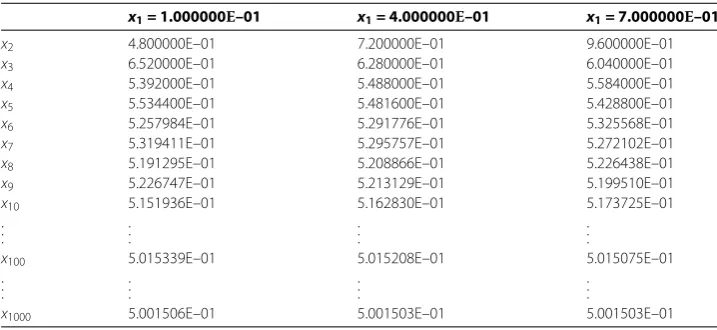
n=Fix(Tn). Some of the values of the iterative scheme (.) for the different initial
Table 1 Some of the values of the iterative scheme (3.37)
x1= 1.000000E–01 x1= 4.000000E–01 x1= 7.000000E–01
x2 4.800000E–01 7.200000E–01 9.600000E–01
x3 6.520000E–01 6.280000E–01 6.040000E–01
x4 5.392000E–01 5.488000E–01 5.584000E–01
x5 5.534400E–01 5.481600E–01 5.428800E–01
x6 5.257984E–01 5.291776E–01 5.325568E–01
x7 5.319411E–01 5.295757E–01 5.272102E–01
x8 5.191295E–01 5.208866E–01 5.226438E–01
x9 5.226747E–01 5.213129E–01 5.199510E–01
x10 5.151936E–01 5.162830E–01 5.173725E–01
. . .
. . .
. . .
. . .
x100 5.015339E–01 5.015208E–01 5.015075E–01
. . .
. . .
. . .
. . .
x1000 5.001506E–01 5.001503E–01 5.001503E–01
Competing interests
The authors declare that they have no competing interests.
Authors’ contributions
All authors contributed equally to the writing of this paper. All authors read and approved the final manuscript.
Author details
1Department of Mathematics, Faculty of Science, Erzurum Technical University, Erzurum, Turkey.2Department of
Mathematical Engineering, Faculty of Chemistry-Metallurgical, Yildiz Technical University, Istanbul, Turkey. 3Department
of Mathematics, Faculty of Science, Ataturk University, Erzurum, Turkey.
Received: 19 November 2014 Accepted: 16 January 2015 References
1. Agarwal, RP, O’Regan, D, Sahu, DR: Iterative construction of fixed points of nearly asymptotically nonexpansive mappings. J. Nonlinear Convex Anal.8(1), 61-79 (2007)
2. Agarwal, RP, O’Regan, D, Sahu, DR: Fixed Point Theory for Lipschitzian-Type Mappings with Applications, Topological Fixed Point Theory and Its Applications. Springer, New York (2009)
3. Wong, NC, Sahu, DR, Yao, JC: A generalized hybrid steepest-descent method for variational inequalities in Banach spaces. Fixed Point Theory Appl.2011, Article ID 754702 (2011)
4. Sahu, DR, Kang, SM, Sagar, V: Approximation of common fixed points of a sequence of nearly nonexpansive mappings and solutions of variational inequality problems. J. Appl. Math.2012, Article ID 902437 (2012) 5. Sanhan, S, Inchan, I, Sanhan, W: Weak and strong convergence theorem of iterative scheme for generalized
equilibrium problem and fixed point problems of asymptotically strict pseudo-contraction mappings. Appl. Math. Sci.5, 1977-1992 (2011)
6. Kangtunyakarn, A: Strong convergence theorem for a generalized equilibrium problem and system of variational inequalities problem and infinite family of strict pseudo-contractions. Fixed Point Theory Appl.2011, 23 (2011) doi:10.1186/1687.1812.2011.23
7. Min, L, Shisheng, Z: A new iterative method for common states of generalized equilibrium problem, fixed point problem of infiniteκ-strict pseudo-contractive mappings, and quasi-variational inclusion problem. Acta Math. Sci. 32B(2), 499-519 (2012)
8. Wang, Y, Xu, HK, Yin, X: Strong convergence theorems for generalized equilibrium, variational inequalities and nonlinear operators. Arab. J. Math.1, 549-568 (2012)
9. Razani, A, Yazdı, M: A new iterative method for generalized equilibrium and fixed point problem of nonexpansive mappings. Bull. Malays. Math. Soc.35(4), 1049-1061 (2012)
10. Cianciaruso, F, Marino, G, Muglia, L, Yao, Y: On a two-steps algorithm for hierarchical fixed point problems and variational inequalities. J. Inequal. Appl.2009, 13 (2009)
11. Tian, M: A general iterative algorithm for nonexpansive mappings in Hilbert spaces. Nonlinear Anal., Theory Methods Appl.73(3), 689-694 (2010)
12. Yao, Y, Cho, YJ, Liou, YC: Iterative algorithms for hierarchical fixed points problems and variational inequalities. Math. Comput. Model.52(9-10), 1697-1705 (2010)
13. Gu, G, Wang, S, Cho, YJ: Strong convergence algorithms for hierarchical fixed points problems and variational inequalities. J. Appl. Math.2011, 1-17 (2011)
14. Yao, Y, Chen, R: Regularized algorithms for hierarchical fixed-point problems. Nonlinear Anal.74, 6826-6834 (2011) 15. Tian, M, Huang, LH: Iterative methods for constrained convex minimization problem in Hilbert spaces. Fixed Point
Theory Appl.2013, 105 (2013)
16. Yao, Y, Liou, YC: Weak and strong convergence of Krasnoselski-Mann iteration for hierarchical fixed point problems. Inverse Problems24, 015015 (2008)