S T U D Y P R O T O C O L
Open Access
Study protocol of effectiveness and
cost-utility of a biopsychosocial multidisciplinary
intervention in the evolution of non-specific
sub-acute low back pain in the working population:
cluster randomised trial
Anna Berenguera
1, Enriqueta Pujol-Ribera
1*, Teresa Rodriguez-Blanco
1, Concepció Violan
1, Marc Casajuana
1,
Nelleke de Kort
1and Marta Trapero-Bertran
2Abstract
Background:Low back pain (LBP), with high incidence and prevalence rate, is one of the most common reasons to consult the health system and is responsible for a significant amount of sick leave, leading to high health and social costs. The objective of the study is to assess the cost-effectiveness and cost-utility analysis of a
multidisciplinary biopsychosocial educational group intervention (MBEGI) of non-specific sub-acute LBP in comparison with the usual care in the working population recruited in primary healthcare centres.
Methods/design:The study design is a cost-effectiveness and cost-utility analysis of a MBEGI in comparison with the usual care of non-specific sub-acute LBP.
Measures on effectiveness and costs of both interventions will be obtained from a cluster randomised controlled clinical trial carried out in 38 Catalan primary health care centres, enrolling 932 patients between 18 and 65 years old with a diagnosis of non-specific sub-acute LBP. Effectiveness measures are: pharmaceutical treatments, work sick leave (% and duration in days), Roland Morris disability, McGill pain intensity, Fear Avoidance Beliefs (FAB) and Golberg Questionnaires. Utility measures will be calculated from the SF-12. The analysis will be performed from a social perspective. The temporal horizon is at 3 months (change to chronic LBP) and 12 months (evaluate the outcomes at long term).
Assessment of outcomes will be blinded and will follow the intention-to-treat principle.
Discussion:We hope to demonstrate the cost-effectiveness and cost-utility of MBEGI, see an improvement in the patients’ quality of life, achieve a reduction in the duration of episodes and the chronicity of non-specific low back pain, and be able to report a decrease in the social costs. If the intervention is cost-effectiveness and cost-utility, it could be applied to Primary Health Care Centres.
Trial registration:ISRCTN: ISRCTN58719694
* Correspondence: [email protected]
1Institut Universitari d’Investigació en Atenció Primària Jordi Gol (IDIAP Jordi Gol), Institut Català de la Salut, C/Gran Via de les Corts Catalanes 587 àtic, 08007 Barcelona, Spain
Full list of author information is available at the end of the article
Background
Lower back pain (LBP), in any of its forms (acute, suba-cute, chronic), is one of the principal reasons for consult-ing the general practitioner (GP). The annual prevalence of LBP is estimated at 14.8% in a study carried out in the Spanish population [1], and these results were confirmed by the 2006 Spanish National health survey [2] and recent data from the Primary Care Information System of Catalonia [3].
LBP has an important impact in the performance of daily tasks and the quality of life of the individuals affected by this pathology. It also has social and family repercussions which are often ignored [1,4]. LBP is one of the six most frequent health problems in developed countries [5,6]. When the LBP diagnosis is established, the minimisation of disability and the cost of labour absenteeism constitutes a shared problem among patients, health professionals, business management, and administration, and makes early intervention necessary to avoid chronic LBP. Some epidemiological studies show that aspects such as psychosocial malaise and fear and avoidance behaviour are associated with a higher risk of developing incapacity in the long term. In patients with these characteristics, a cognitive beha-vioural intervention has been shown to be effective in reducing this risk [7,8]. Therefore, psychological and social factors associated with the symptoms should be considered because they could affect the level of pain and increase the risk of evolution to chronic LBP [9-12]. Failure to reduce pain represents an important increase in the economic cost to society and reduction in the quality of life of the patient [13,14].
The labour absenteeism caused by LBP is estimated at an average of 21.9 working days lost per illness episode, which represents a cost of 1260€per worker per year [3]. This cost would be higher if the calculation also took into account“presenteeism” (reduced work productivity), which doubles or triples the cost of labour absenteeism alone [15]. Clinical practice guidelines include scant infor-mation about the cost-effectiveness of the treatments, except for those provided by the National Institute for Health and Clinical Excellence (NICE) [16]. In addition, the few studies published have important methodological limitations and are very heterogeneous, which limits the available evidence about the cost effectiveness of LBP interventions [17,18].
Given that the guidelines considered a range of interven-tions to be effective, it is important to assess the efficiency of treatments versus current intervention throughout the cost-effectiveness analysis [19-21]. As the number of pub-lished economic evaluations of interventions for LBP is increasing, it may now be possible to consider evidence of cost-effectiveness when making recommendations about
treatment [15,22]. However, no studies have been identi-fied that analyse the cost-effectiveness and cost-utility of multidisciplinary biopsychosocial interventions with respect to habitual practice in primary care.
The objective of the study is to assess from a societal perspective the cost-effectiveness and cost-utility of a multidisciplinary biopsychosocial educational group intervention (MBEGI) in comparison with the usual care of non-specific sub-acute LBP in the working population recruited in Barcelona and its surrounding Primary Health Care Centres (PHCC) since May 2009.
Secondary objectives are to identify and quantify the various costs associated with the disease and their distri-bution among all of the actors in society.
Methods/Design
Study design
Cost-effectiveness and cost-utility analysis of a cluster randomised clinical trial which compares patients with subacute non-specific LBP treated with a MBEGI approach, with a control group receiving only usual clini-cal care in PHCC. The analysis adopts the societal per-spective because, it takes into consideration all other perspectives, will provide disaggregated data, and will make available the most extensive information for use in comparing studies [23].
Setting (*)
The trial is being conducted in a primary care setting, in 38 PHCCs located in Barcelona, Spain and its surround-ing areas. We contact all the PHCCs, present the study to their staff members and invite them to participate.
Study population
Eligible patients will be identified by the GP or nurses when they consult for a new episode of sub-acute LBP or from searches of electronic clinical records. Patients are informed about the study objectives and those who agree to participate will be given written informed consent to sign.
Patients will be included if the current episode of LBP occurs suddenly after at least 6 months without LBP and lasts between 15 days and 12 weeks [24], and if they do not fulfil any of the exclusion criteria [20].
(e) they might have anti-inflammatory intolerance or allergy; (f) treatment has been received for physical pro-blems in the preceding 3 months; (g) they have been referred for intensive functional restoration pro-grammes; or (h) they have a confirmed diagnosis of fibromyalgia.
Furthermore, the GP has to ensure that the patient has no red flag signs or symptoms that are frequently associated with specific LBP or potentially severe ill-nesses [25-28].
Randomisation
In this study a cluster design is used because the interven-tion is delivered to groups. To minimise contaminainterven-tion, the unit of randomisation will be the PHCC. Those PHCCs who agree to participate will be randomly allocated to control or intervention groups by a random sequence generated by a computer programme in blocks of random size and prepared before recruitment of the PHCC by an independent statistician who will be blinded to the PHCC identity. The blocking factor was a randomly selected even number (i.e., 4, 6, or 8) and will vary as the recruitment continues. GP or nurses will be informed about their allo-cation after giving final consent to participation.
To minimise imbalance across intervention groups, ran-domisation was stratified by percentage of immigrants from developing countries registered in each district. We consider two strata, less than and more than 15% immi-grants. This variable is taken as a proxy of socioeconomic level.
Blinding
During the recruitment, patients who meet the inclusion criteria are allocated to the intervention group corre-sponding to the centre. To avoid bias, consent to partici-pate is obtained before the allocation. Because of the nature of the intervention, GPs or nurses cannot be blind to patients’allocation. Data analysis will be carried out so that the intervention groups allocated to the patients will be unknown to the analyst.
Intervention Design
Control group
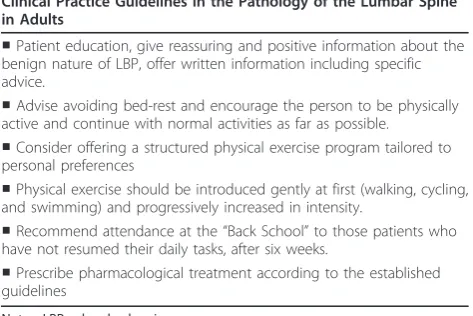
Patients allocated to the control group will receive usual clinical care, and individual intervention based on the application of the “Clinical Practice Guidelines in the Pathology of the Lumbar Spine in Adults”. These recommendations are published by the Catalan Institute of Health (Institut Català de la Salut) [25]. Details are given in Table 1.
Intervention group
In addition to the same individual intervention as the control group, patients allocated to the intervention
group will receive an educational booklet “The Back Manual” [29] (a transculturally adapted Spanish version of the Back Book) [30] and a biopsychosocial multidisci-plinary group intervention.
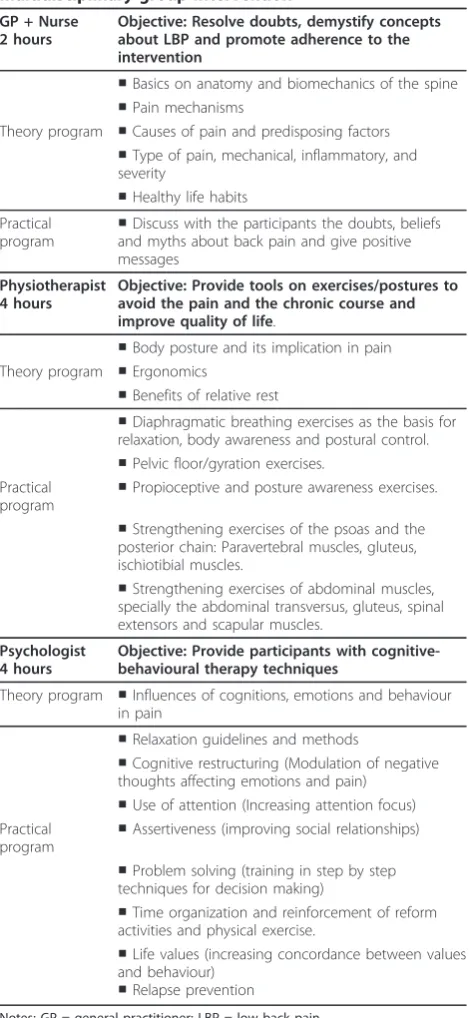
The group intervention will be carried out by a GP, a nurse, a psychologist and a physiotherapist. The pro-gramme consists of 2 sessions of 4 hours duration each and 1 session of 2 hours duration. Each group includes up to 12 participants. Details of the MBEGI intervention and the educational digital video disc (DVD) are included in Tables 2 and 3.
To guarantee the standardisation of the group sessions, only one qualified psychologist and one physiotherapist, both of them with extensive expertise in development of training groups, will apply the intervention in all PHCCs.
Outcomes
Effectiveness measures The primary effectiveness mea-sures of the study consist of Roland Morris Disability Questionnaire (RDQ) [31,32] (scale 0-24; lower score indicates lower disability), Mc Gill Pain Questionnaire [33-37] (including VAS 1-10; lower score indicates less pain), and Goldberg questionnaire on anxiety and depression. Duration of days of pain, the reduction of days off work, the reduction of prescription, the dura-tion of pharmacological treatments and recurrent epi-sodes of LBP and the incidence of chronic LBP at 12 months will be measured.
[image:3.595.304.541.117.275.2]The secondary effectiveness measures are inadequate behaviour and work factors assessed by Fear Avoidance Beliefs Questionnaire (FAB) [38] (scale 0-24; lower score indicates lower fear-avoidance belief), and the Goldberg questionnaire of anxiety and depression [39] (each scale 0-9; lower scores indicates less anxiety or depression). All these questionnaires are validated in Spanish. Patient’s assessment of global perceived effect on health will be mea-sured by self-assessment with a Likert 7-point scale [40]. Table 1 Contents of the clinical guidelines applied in the cluster randomised trial
Clinical Practice Guidelines in the Pathology of the Lumbar Spine in Adults
■Patient education, give reassuring and positive information about the benign nature of LBP, offer written information including specific advice.
■Advise avoiding bed-rest and encourage the person to be physically active and continue with normal activities as far as possible.
■Consider offering a structured physical exercise program tailored to personal preferences
■Physical exercise should be introduced gently at first (walking, cycling, and swimming) and progressively increased in intensity.
■Recommend attendance at the“Back School”to those patients who have not resumed their daily tasks, after six weeks.
■Prescribe pharmacological treatment according to the established guidelines
Utility measures The primary utility measure of the study is quality adjusted life years (QALYs), and will be calculated from the SF-12 scores (scale 0-100; lower score indicates poorer quality of life) [32].
Other variables The main independent variable is the intervention arm: MBEGI, or usual clinical care.
Sociodemographic and clinical variables were detailed in the study protocol [21]. Among others, clinical
variables are PHCC and hospital emergency visits due to current sub-acute LBP episode; patient compliance with recommendations and treatments; prescribed diagnostic tests; prescribed pharmacological treatment; referrals to other departments; and nonpharmacological treatment measures [41]. Absenteeism will be calculated, and reduced work productivity (presenteeism) will be mea-sured by the Quantity and Quality instrument (QQ). The amount and quality of productivity will be mea-sured on a 10-point numerical rating scale, with 0 repre-senting “nothing”and “very poor quality,” respectively, and 10 representing “normal quantity” and “normal quality,” respectively [42,43].
Other non-pharmacological therapeutic measures and
Patient Compliance The non-pharmacological
thera-peutic measures are detailed in Table 4.
During follow-up visits (at 3, 6 and 12 months) we will ask the patient about compliance with treatment recommendations and data collection questionnaires will be completed.
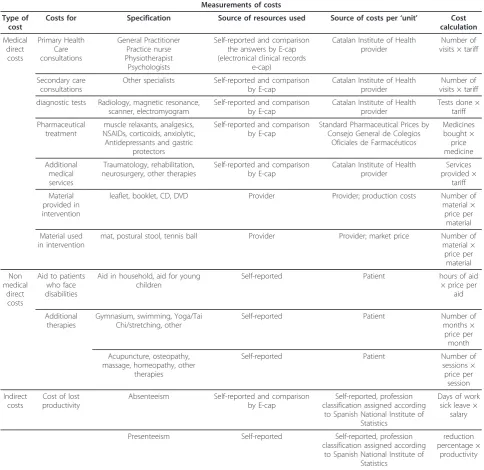
Measures of resources and costsThe costs analysis will be conducted using a bottom-up approach (bottom-indi-vidual; up-societal costs). Average costs will be calculated for each particular type of cost. Costs related to both the MBEGI and the usual care will be collected. The costs of non-specific sub-acute LBP and its treatment consist of direct medical costs and direct and indirect non-medical costs [44]. An overview of the measured costs and the corresponding sources can be found in table 4.
[image:4.595.308.538.100.306.2]Direct medical costs include those attributable to health care visits for the treatment of LBP: the cost of MBEGI material utilized and distributed to the patients; visits to primary care professionals, to other specialists, and to rehabilitation services; number of Table 2 Components of the biopsychosocial
multidisciplinary group intervention
GP + Nurse 2 hours
Objective: Resolve doubts, demystify concepts about LBP and promote adherence to the intervention
■Basics on anatomy and biomechanics of the spine ■Pain mechanisms
Theory program ■Causes of pain and predisposing factors ■Type of pain, mechanical, inflammatory, and severity
■Healthy life habits Practical
program ■
Discuss with the participants the doubts, beliefs and myths about back pain and give positive messages
Physiotherapist 4 hours
Objective: Provide tools on exercises/postures to avoid the pain and the chronic course and improve quality of life.
■Body posture and its implication in pain Theory program ■Ergonomics
■Benefits of relative rest
■Diaphragmatic breathing exercises as the basis for relaxation, body awareness and postural control. ■Pelvic floor/gyration exercises.
Practical program
■Propioceptive and posture awareness exercises.
■Strengthening exercises of the psoas and the posterior chain: Paravertebral muscles, gluteus, ischiotibial muscles.
■Strengthening exercises of abdominal muscles, specially the abdominal transversus, gluteus, spinal extensors and scapular muscles.
Psychologist 4 hours
Objective: Provide participants with cognitive-behavioural therapy techniques
Theory program ■Influences of cognitions, emotions and behaviour in pain
■Relaxation guidelines and methods
■Cognitive restructuring (Modulation of negative thoughts affecting emotions and pain)
■Use of attention (Increasing attention focus) Practical
program ■
Assertiveness (improving social relationships)
■Problem solving (training in step by step techniques for decision making)
■Time organization and reinforcement of reform activities and physical exercise.
■Life values (increasing concordance between values and behaviour)
■Relapse prevention
Notes: GP = general practitioner; LBP = low back pain.
Table 3 Contents of the educational Digital Video Disk
Contents of the educational Digital Video Disk ■Basics on anatomy and biomechanics of the spine ■Causes and mechanisms of pain
■Recommendations on dealing with pain and coping with it in daily life
■A series of stretching, strengthening, and flexibility exercises and methods to promote physical activity
■Ergonomics applied to daily life (home, work and leisure) ■Cognitive restructuring (Modulation of negative thoughts affecting emotions and pain)
■Use of attention (increasing attention focus) ■Assertiveness (Improving social relationships)
■Problem solving (training in step by step techniques for decision making)
■Time organization and reinforcement of reform activities and physical exercise
[image:4.595.57.292.107.617.2]complementary tests; and costs of pharmacological treatment and disposable supplies for medical and emergency services use.
These costs will be assessed in accordance with the official rates most recently published in theDiari Oficial de la Generalitat de Catalunya(DOGC) for the public health service.
Direct non-medical costs will include home help received as a result of disability related to LBP, patient time directly related to the intervention (time spent in transportation, waiting rooms, and the intervention), non-medical activities (gymnasium, swimming, Yoga/Tai
Chi/stretching), and additional therapies (acupuncture, osteopathy, massage, homeopathy).
Indirect non-medical costs include loss of productivity and will be calculated on the basis of time off work (absenteeism) as well as reduced productivity at the workplace (presenteeism). The respondent will be asked to quantify how much work was actually performed dur-ing regular hours and the quality of this work as com-pared with a normal work day [42,43].
[image:5.595.56.541.102.572.2]Costs will be calculated in euros (€) based on the most actualized prices using the general Spanish consumer price index.
Table 4 Measurements of cost
Measurements of costs
Type of cost
Costs for Specification Source of resources used Source of costs per‘unit’ Cost
calculation
Medical direct
costs
Primary Health Care consultations
General Practitioner Practice nurse Physiotherapist
Psychologists
Self-reported and comparison the answers by E-cap (electronical clinical records
e-cap)
Catalan Institute of Health provider
Number of visits × tariff
Secondary care consultations
Other specialists Self-reported and comparison by E-cap
Catalan Institute of Health provider
Number of visits × tariff
diagnostic tests Radiology, magnetic resonance, scanner, electromyogram
Self-reported and comparison by E-cap
Catalan Institute of Health provider
Tests done × tariff
Pharmaceutical treatment
muscle relaxants, analgesics, NSAIDs, corticoids, anxiolytic, Antidepressants and gastric
protectors
Self-reported and comparison by E-cap
Standard Pharmaceutical Prices by Consejo General de Colegios
Oficiales de Farmacéuticos
Medicines bought × price medicine
Additional medical services
Traumatology, rehabilitation, neurosurgery, other therapies
Self-reported and comparison by E-cap
Catalan Institute of Health provider
Services provided ×
tariff
Material provided in intervention
leaflet, booklet, CD, DVD Provider Provider; production costs Number of material × price per
material
Material used in intervention
mat, postural stool, tennis ball Provider Provider; market price Number of material × price per
material
Non medical
direct costs
Aid to patients who face disabilities
Aid in household, aid for young children
Self-reported Patient hours of aid
× price per aid
Additional therapies
Gymnasium, swimming, Yoga/Tai Chi/stretching, other
Self-reported Patient Number of
months × price per
month
Acupuncture, osteopathy, massage, homeopathy, other
therapies
Self-reported Patient Number of
sessions × price per
session
Indirect costs
Cost of lost productivity
Absenteeism Self-reported and comparison by E-cap
Self-reported, profession classification assigned according
to Spanish National Institute of Statistics
Days of work sick leave ×
salary
Presenteeism Self-reported Self-reported, profession
classification assigned according to Spanish National Institute of
Statistics
reduction percentage ×
Data collection and information sources All partici-pants will be invited to attend the PHCC for outcome assessments. They will be assessed at the first visit to the PHCC and at 3 months, 6 months, and 12 months after the onset of LBP. Primary data will be collected from the patient by an interview and the electronic clin-ical records. All outcomes will be measured at the indi-vidual level.
The data source of the costs of lost productivity and indirect costs of wages lost to LBP, whether remunerated or not, will be Spain’s National Statistics Institute (INE) [44-46], calculated on the basis of the national classifica-tion of economic activity [45]. Each participant’s profes-sion will be placed into one of the categories of economic activity.
A human capital focus will be used to determine the cost of absenteeism from paid employment. This mea-sure considers the social value of an individual to equal future potential production, measured by the value of anticipated lifetime income. A limitation of this method is it does not take unemployment into account (retirees or those with a disability), although we will correct for this by assigning a value equal to the minimum wage or average salary of their profession [46,47].
Sample size The sample-size calculation is based on
change in RDQ at 3 months after onset of LBP. It is recommended that a change of 2 to 3 points on the RDQ should be considered the minimum clinically important change [48]. To allow for the cluster randomisation by PHCC, we assume an intraclass correlation coefficient of 0.1 [49] and a minimum average number of individuals sampled per PHCC of 25. In order to detect a difference of 2.5 points between the two intervention arms with a standard deviation of 5.7 [48,50], an alpha error of 0.05, a beta error of 0.10, and a 20% dropout rate, a sample size of 932 subjects was required, 466 subjects per interven-tion arm. Therefore, the total number of PHCCs is 38 (19 in each group).
Statistical Analysis The effectiveness of the interven-tion will be analysed in accordance with CONSORT guidelines, extended to a cluster randomised trial. The analysis will be carried out according to the intention-to-treat principle. Cost, outcomes and use of resources will be reported as mean values with standard deviations for each intervention arm. Comparisons will be done between arms on characteristics of the study population. Mean differences between groups in cost, outcomes and resources, and 95% confidence intervals were calculated. If cost data do not conform to the assumptions for stan-dard statistical tests, the non-parametric bootstrap method will be performed [51].
To address potential biases due to incomplete follow-up, we will analyse patients with complete data at all time points and those with data at any time point, using
the multiple imputation approaches to replace missing values. Bias due to non-response will be assessed at each follow-up.
The temporal horizon of the study is 3 months because this is the time of change to a chronic stage and 12 months to evaluate the outcomes at long term.
The discount rate will be 3% [52] that is closest to the actual discount rate.
To establish an important change in individuals, we will contrast the distributions of changes in all the question-naires and in each assessment, in individuals who change to chronic state and those who do not [48]. We will do the same between those individuals who return to work and those who do not. We will compare individual change scores to the standard error of measurement (SEM).
To detect changes in groups, the intervention effect will be calculated through the effect size for each ques-tionnaire and at each assessment. Effect size will be cal-culated following the method of Kazis et al [53].
We will evaluate responsiveness of each scale by stan-dardized response mean (SRM) [54] and receiver-operat-ing characteristic method (ROC curve). Since the unit of randomisation is the PHCC, we will use a regression analysis of individual level data using methods for clus-tered data [55].
To adjust comparisons and to account for cluster ran-domisation, multilevel linear regression analyses on repeated measures on each of the outcome scales will be used to assess the effect of intervention and to inves-tigate the factors that influence each of the outcome scales at each time point. The possible association between intervention and time will be studied. The PHCC and the individual will be considered as random effects and intervention and time as fixed effects.
The incremental cost-effectiveness ratios were calcu-lated as the difference in mean costs between the MBEGI and the usual care divided by the difference in mean effect, measured in natural unit, between MBEGI and the usual care.
Utilities will be calculated from the SF-12 scores with the corresponding Oxford University algorithm. The QALY will be calculated using these utilities, adjusted by time. The incremental cost-utility ratio will be calcu-lated by dividing the difference in mean total costs between the MBEGI and the usual care by the difference in QALYs [56,57].
To determine the uncertainty surrounding these ratios, 95% confidence intervals for cost-effectiveness ratios will be calculated by the non-parametric bootstrap method [51].
A deterministic sensitivity analysis will be performed to assess the robustness of the results [58]. The sickness days, GP visits and the number of medications will be measured to assess the impact on costs and cost-effectiveness. The discount rate will be 1% and 5%.
Confidence intervals around point estimates will be reported. The results will be presented in a disaggre-gated as well as aggredisaggre-gated form.
The significance level of all models will be set at 5%. The SPSS statistical package for Windows, version 19 (SPSS Inc., Chicago, IL) and the Stata/SE version 11·1 for Windows (StataCorp LP) will be used for statistical analysis.
Ethical aspects The study will be conducted according to Guidelines of the Helsinki Declaration and of Good Clinical Research Practice. The project/study protocol has been approved by the Ethical and Clinical Research Committee of IDIAP Jordi Gol, Institute of Research in Primary Health Care.
This trial is registered as Current Controlled Trials (ISRCTN58719694)
More details of the intervention, of patient adherence to the intervention and to non-pharmacological treat-ment, and the analysis of effectiveness have been pub-lished in the protocol for analysis of the effectiveness of the intervention [21].
Discussion
With this study, we hope to contribute evidence about the cost-effectiveness and cost-utility of MBEGI in reducing episodes of non-specific LBP and the associated social and health costs. This evidence could help health professionals and administrators to make more efficient decisions to address this problem in the primary care setting.
A review of the literature found very few studies of cost-effectiveness and cost-utility related to LBP, and that considered the societal perspective and used a rigor-ous methodology and a broad sample [59]. On the other hand, the recent review by Catalá-López et al. points out the lack of economic assessment in Spain with respect to musculoskeletal care [60]. The cost-effectiveness and cost-utility analysis of MBEGI proposed in this study, which incorporates most of the relevant costs of LBP, includes a follow-up period that will permit the identifi-cation of significant changes and the systematic descrip-tion of the methods used, will facilitate the interpretadescrip-tion and comparison of the results.
A strength of the study is that the MBEGI has been designed as a pragmatic effectiveness trial. In this type of design, the interventions reflect what may happen in practice and the results are often more generalizable and hence preferable for economic evaluation [44,61].
Information about consumption of resources will be gathered in parallel with the collection of data about the
effectiveness of the intervention; therefore, primary data will be obtained in terms of effectiveness and costs to inform the economic evaluation.
The analysis will adopt the social perspective; it is unu-sual to encounter economic evaluation studies with this perspective, even though LBP is a disease with an impor-tant impact on the daily life of the patient as well as the society. Nonetheless, the determination and collection of all of the costs and benefits to the patient, family mem-bers, and the National Health Service is a complex task. This study attempts to include the majority of all costs analysed in the studies reviewed. Nonetheless, some costs have been eliminated, such as those attributable to the pri-mary care centre operations, since we could assume that there will be no relevant differences between the treatment and control group in this regard.
It is worth highlighting the inclusion of the concept of presenteeism in estimating labour costs. This concept has not often been applied in calculating the costs of LBP, and seems to have an important impact on those costs [15,62].
The fact that the direct costs of health care will be obtained from the most recent information published in the DOGC will mean that their allocation will be standardized.
We should also note that the participants will be are being recruited from PHCC. Although this aspect could affect the external validity of the study, the National Health Service in Spain provides universal free coverage. More than 70% of the general population visits a primary care centre at least once a year and this percentage increases if we consider longer time periods. In addition, given the size and heterogeneity of the sample and the high number of participating centres, we can assume that the study population represents the Spanish population with this problem, and therefore the results are potentially generalizable.
On the other hand, we have assumed that the usual care attention is to a certain extent homogeneous among the participating GP and nurses. Most of these profes-sionals work for the Catalan Institute of Health and fol-low the recommendations of the “Clinical Practice Guidelines for lumbar column pathology in adults”. Nonetheless, it is very probable that a certain variability exists in their application. In addition, the professionals who participate in research projects tend to be both motivated and more experienced. In any case, we assume that there may be variability, even though this would be similar in both arms of the study.
facilitate follow-up and compliance, along with the empathy and communication skills of the interviewers who will be doing the fieldwork.
Despite the 1-year time horizon, our study includes data from more than a natural year, so the possible effect of inflation could slightly modify the prices and values of the different variables. To minimise these effects, we will convert costs and benefits obtained in different years to a base year: the year with the most recently published price levels. In addition, a 3% rate will be applied, which is clo-sest to the actual discount rate.
Another point to consider in the costs estimation is the possible influence of the current economic situation. A review by Degenais et al. [17] showed that the major part of costs derived from LBP are indirect, resulting from the sick leave factor, which has a very important weight in the equation. In addition, due to the current labour uncertainty in our context, workers are more hesitant to request sick leave, which could contribute to underestimation of costs. We will attempt to minimise this impact by including the concept of workforce pre-senteeism and by the sensitivity analysis.
We also cannot discard the possible effect on costs estimation of the high unemployment rates related to the current economic crisis. Nonetheless, it can be assumed that the level of unemployment would be simi-lar in both study groups, which then would not affect the cost-utility and cost-effectiveness results.
If the intervention is shown to be cost-effective and utility-cost, it could be applied to the primary care population with the expectation of the following results:
■decreased intensity of LBP
■ decreased duration of the episode and recurrent LBP
■improved quality of life
■decreased incidence of chronic LBP
■ decreased days of labour absenteeism and presenteeism
■reduced pharmacy costs
■ reduced costs to the National Health System in the provision of services due to this pathology ■ Reduced social costs to the patient and his/her family
Acknowledgements
We thank Dr. Antoni Serrano, who has shared his research team’s knowledge and experience, giving suggestions that have been discussed and clarified in this protocol.
Author details
1
Institut Universitari d’Investigació en Atenció Primària Jordi Gol (IDIAP Jordi Gol), Institut Català de la Salut, C/Gran Via de les Corts Catalanes 587 àtic, 08007 Barcelona, Spain.2Health Economics Research Group (Herg), Brunel University, Kingston Lane, Uxbridge, Middlesex UB83PH, Great Britain.
Authors’contributions
All authors were responsible for the conception of the project and drafting the first study proposal. AB, EPR, CV, MC, and TRB were involved in writing the manuscript, and all authors critically revised and approved the final manuscript. AB, EPR, TRB, CV, MC, NK, and MTB designed the methodology and TRB designed the statistical analysis. AB, EPR, TRB, MC and CV contributed to the description of the background, designed the
questionnaires and made the presentation for the recruitment of the PHCC. All authors read and approved the final manuscript.
Competing interests
The authors declare that they have no competing interests. The
effectiveness study was funded by“Fundació La Marató de TV3”, a non-profit foundation (grant number 071610), Barcelona, Spain.
The study sponsors have no role in the study design, the collection, analysis, or interpretation of the data, the writing of the report, or the decision to submit the paper for publication.
Received: 27 July 2011 Accepted: 22 August 2011 Published: 22 August 2011
References
1. Humbría Mendiola A, Carmona L, Peña Sagredo JL, Ortiz AM, Grupo de Estudio EPISER:Impacto poblacional del dolor lumbar en España: resultados del estudio EPISER.Rev Esp Reumatol2002,29:471-478. 2. Kovacs FM, Fernandez C, Cordero A, Muriel A, Gonzalez-Lujan L, Gil del
Real MT:Non-specific low back pain in primary care in the Spanish National Health Service: a prospective study on clinical outcomes and determinants of management.BMC Health Serv Res2006,6:57. 3. Gonzalez Viejo MA, Condon Huerta MJ:Disability from low back pain in
Spain.Med Clin (Barc)2000,114:491-492.
4. Krismer M, van TM:Strategies for prevention and management of musculoskeletal conditions. Low back pain (non-specific).Best Pract Res Clin Rheumatol2007,21:77-91.
5. Lamb SE, Hansen Z, Lall R, Castelnuovo E, Withers EJ, Nichols V:Group cognitive behavioural treatment for low-back pain in primary care: a randomised controlled trial and cost-effectiveness analysis.Lancet2010,
375:916-923.
6. van TM, Becker A, Bekkering T, Breen A, del Real MT, Hutchinson A:Chapter 3. European guidelines for the management of acute nonspecific low back pain in primary care.Eur Spine J2006,15(Suppl 2):S169-S191. 7. Lindstrom I, Ohlund C, Nachemson A:Physical performance, pain, pain
behavior and subjective disability in patients with subacute low back pain.Scand J Rehabil Med1995,27:153-160.
8. Linton SJ:Early identification and intervention in the prevention of musculoskeletal pain.Am J Ind Med2002,41:433-442.
9. Krismer M, van TM:Strategies for prevention and management of musculoskeletal conditions. Low back pain (non-specific).Best Pract Res Clin Rheumatol2007,21:77-91.
10. Linton SJ:A review of psychological risk factors in back and neck pain.
Spine2000,25:1148-1156.
11. Picavet HS, Schouten JS, Smit HA:Prevalence and consequences of low back problems in The Netherlands, working vs non-working population, the MORGEN-Study. Monitoring Project on Risk Factors for Chronic Disease.Public Health1999,113:73-77.
12. Pincus T, Burton AK, Vogel S, Field AP:A systematic review of
psychological factors as predictors of chronicity/disability in prospective cohorts of low back pain.Spine2002,27:E109-E120.
13. Breivik H, Collett B, Ventafridda V, Cohen R, Gallacher D:Survey of chronic pain in Europe: prevalence, impact on daily life, and treatment.Eur J Pain2006,10:287-333.
14. Breivik H, Borchgrevink PC, Allen SM, Rosseland LA, Romundstad L, Hals EK:
Assessment of pain.Br J Anaesth2008,101:17-24.
15. Wieser S, Horisberger B, Schmidhauser S, Eisenring C, Brugger U, Ruckstuhl A:
Cost of low back pain in Switzerland in 2005.Eur J Health Econ2010. 16. Savigny P, Watson P, Underwood M:Early management of persistent
non-specific low back pain: summary of NICE guidance.BMJ2009,338:b1805. 17. Dagenais S, Caro J, Haldeman S:A systematic review of low back pain
cost of illness studies in the United States and internationally.Spine J
18. van der RN, Ostelo RW, Bekkering GE, van Tulder MW, de Vet HC:Minimal clinically important change for pain intensity, functional status, and general health status in patients with nonspecific low back pain.Spine (Phila Pa 1976)2006,31:578-582.
19. Airaksinen O, Brox JI, Cedraschi C, Hildebrandt J, Klaber-Moffett J, Kovacs F:
Chapter 4. European guidelines for the management of chronic nonspecific low back pain.Eur Spine J2006,15(Suppl 2):S192-S300. 20. Maetzel A, Li L:The economic burden of low back pain: a review of
studies published between 1996 and 2001.Best Pract Res Clin Rheumatol
2002,16:23-30.
21. Rodriguez-Blanco T, Fernandez-San-Martin I, Balague-Corbella M,
Berenguera A, Moix J, Montiel-Morillo E:Study protocol of effectiveness of a biopsychosocial multidisciplinary intervention in the evolution of non-specific sub-acute low back pain in the working population: cluster randomised trial3.BMC Health Serv Res2010,10:12.
22. Lin CW, Haas M, Maher CG, Machado LA, van Tulder MW: Cost-effectiveness of general practice care for low back pain: a systematic review.Eur Spine J2011.
23. Meltzer MI:Introduction to health economics for physicians.Lancet2001,
358:993-998.
24. Kovacs FM, Abraira V, Zamora J, Fernandez C:The transition from acute to subacute and chronic low back pain: a study based on determinants of quality of life and prediction of chronic disability.Spine2005,
30:1786-1792.
25. Bordas JM, Forcada J, García JA, Joaniquet FX, Pellisé F, Mazeres O:Guies de pràctica clínica i material docent. Patologia de la columna lumbar en l’adult
Barcelona: Institut Català de la Salut; 2004.
26. Grupo Español de Trabajo del Programa Europeo COST B13:Resumen de las recomendaciones de la Guía de Práctica Clínica para lumbalgia inespecífica.2005.
27. Kovacs FM, Fernandez C, Cordero A, Muriel A, Gonzalez-Lujan L, Gil del Real MT:Non-specific low back pain in primary care in the Spanish National Health Service: a prospective study on clinical outcomes and determinants of management.BMC Health Serv Res2006,6:57. 28. Rodriguez-Blanco T, Fernandez-San-Martin I, Balague-Corbella M,
Berenguera A, Moix J, Montiel-Morillo E, Pujol-Ribera E:Study protocol of effectiveness of a biopsychosocial multidisciplinary intervention in the evolution of non-specific sub-acute low back pain in the working population: cluster randomised trial3.BMC Health Serv Res2010,10:12. 29. Kovacs Fundació:El Manual de la EspaldaPalma de Mallorca: Fundació
Kovacs; 2002.
30. Burton AK, Waddell G, Tillotson KM, Summerton N:Information and advice to patients with back pain can have a positive effect. A randomized controlled trial of a novel educational booklet in primary care.Spine
1999,24:2484-2491.
31. Kovacs FM, Llobera J, Gil del Real MT, Abraira V, Gestoso M, Fernandez C:
Validation of the spanish version of the Roland-Morris questionnaire.
Spine2002,27:538-542.
32. Roland M, Morris R:A study of the natural history of back pain. Part I: development of a reliable and sensitive measure of disability in low-back pain.Spine1983,8:141-144.
33. Bejarano PF, Noriego RD, Rodriguez ML, Berrio GM:Evaluación del dolor: adaptación del cuestionario de Mc Gill.Rev Col Anest1985,13:321-351. 34. Lahuerta J, Smith BA, Martinez Lage JM:An adaptation of the Mc Gill Pain
Questionaire to the Spanish lenguaje.Schmerz1982,3:132-134. 35. Melzack R:The McGill Pain Questionnaire: major properties and scoring
methods.Pain1975,1:277-299.
36. Ruiz López R, Pagerols M, Ferrer I:The spanish pain questionnaire.Pain
1990,5:304S.
37. Ruiz LR, Pagerols BM, Ferrer M, Collado CA:The language of pain.Med Clin (Barc)1991,96:196.
38. Kovacs FM, Muriel A, Medina JM, Abraira V, Sanchez MD, Jauregui JO:
Psychometric characteristics of the Spanish version of the FAB questionnaire.Spine2006,31:104-110.
39. Monton C, Perez Echeverria MJ, Campos R, Garcia CJ, Lobo A:Anxiety scales and Goldberg’s depression: an efficient interview guide for the detection of psychologic distress.Aten Primaria1993,12:345-349. 40. Grotle M, Brox JI, Vollestad NK:Concurrent comparison of responsiveness
in pain and functional status measurements used for patients with low back pain.Spine (Phila Pa 1976)2004,29:E492-E501.
41. Craig CL, Marshall AL, Sjostrom M, Bauman AE, Booth ML, Ainsworth BE:
International physical activity questionnaire: 12-country reliability and validity.Med Sci Sports Exerc2003,35:1381-1395.
42. Brooks A, Hagen SE, Sathyanarayanan S, Schultz AB, Edington DW:
Presenteeism: critical issues.J Occup Environ Med2010,52:1055-1067. 43. Meerding WJ, IJzelenberg W, Koopmanschap MA, Severens JL, Burdorf A:
Health problems lead to considerable productivity loss at work among workers with high physical load jobs.J Clin Epidemiol2005,58:517-523. 44. Drummond MF, Jefferson TO:Guidelines for authors and peer reviewers
of economic submissions to the BMJ. The BMJ Economic Evaluation Working Party.BMJ1996,313:275-283.
45. Instituto Nacional de Estadistica (INE), Classificaciones nacionales, CNAE 2009:Clasificación nacional de actividades económicas.2010 [http:// www.ine.es/inebmenu/mnu_clasifica.htm], Accessed 1 October 2010. 46. Koopmanschap MA, Rutten FF:A practical guide for calculating indirect
costs of disease.Pharmacoeconomics1996,10:460-466.
47. Drummond MF, Sculpher MJ, Torrance GW, O’Brien BJ, Stoddart GJ:cost analysis2005.
48. Bombardier C, Hayden J, Beaton DE:Minimal clinically important difference. Low back pain: outcome measures.J Rheumatol2001,
28:431-438.
49. Campbell MK, Mollison J, Grimshaw JM:Cluster trials in implementation research: estimation of intracluster correlation coefficients and sample size.Stat Med2001,20:391-399.
50. Kovacs F, Abraira V, Santos S, Diaz E, Gestoso M, Muriel A,et al:A comparison of two short education programs for improving low back pain-related disability in the elderly: a cluster randomized controlled trial.Spine2007,32:1053-1059.
51. Chaudhary MA, Stearns SC:Estimating confidence intervals for cost-effectiveness ratios: an example from a randomized trial.Stat Med1996,
15:1447-1458.
52. Lopez-Bastida J, Oliva-Moreno J:Cost of illness and economic evaluation in rare diseases.Adv Exp Med Biol2010,686:273-282.
53. Kazis LE, Anderson JJ, Meenan RF:Effect sizes for interpreting changes in health status.Med Care1989,27:S178-S189.
54. Terwee CB, Dekker FW, Wiersinga WM, Prummel MF, Bossuyt PM:On assessing responsiveness of health-related quality of life instruments: guidelines for instrument evaluation.Qual Life Res2003,12:349-362. 55. Ukoumunne OC, Gulliford MC, Chinn S, Sterne JA, Burney PG:Methods for
evaluating area-wide and organisation-based interventions in health and health care: a systematic review.Health Technol Assess1999,3:iii-92. 56. Fox-Rushby J, Cairns J:The structure of economic evaluation.Economic
EvaluationMaidenhead: Open University Press; 2005.
57. Wonderling D, Gruen R, Black N:Economic evalutation.Introduction to Health EconomicsMaidenhead: Open University Press; 2005.
58. Andronis L, Barton P, Bryan S:Sensitivity analysis in economic evaluation: an audit of NICE current practice and a review of its use and value in decision-making.Health Technol Assess2009,13:iii-ix-61.
59. Dagenais S, Roffey DM, Wai EK, Haldeman S, Caro J:Can cost utility evaluations inform decision making about interventions for low back pain?Spine J2009,9:944-957.
60. Catala-Lopez F, Garcia-Altes A, varez-Martin E, Genova-Maleras R, Morant-Ginestar C, Parada A:Burden of disease and economic evaluation of healthcare interventions: are we investigating what really matters?BMC Health Serv Res2011,11:75.
61. Ramsey S, Willke R, Briggs A, Brown R, Buxton M, Chawla A:Good research practices for cost-effectiveness analysis alongside clinical trials: the ISPOR RCT-CEA Task Force report.Value Health2005,8:521-533. 62. Asche CV, Kirkness CS, dam-Marx C, Fritz JM:The societal costs of low
back pain: data published between 2001 and 2007.J Pain Palliat Care Pharmacother2007,21:25-33.
Pre-publication history
The pre-publication history for this paper can be accessed here: http://www.biomedcentral.com/1471-2474/12/194/prepub
doi:10.1186/1471-2474-12-194
Cite this article as:Berengueraet al.:Study protocol of
cost-effectiveness and cost-utility of a biopsychosocial multidisciplinary intervention in the evolution of non-specific sub-acute low back pain in the working population: cluster randomised trial.BMC Musculoskeletal