2018 2nd International Conference on Modeling, Simulation and Optimization Technologies and Applications (MSOTA 2018) ISBN: 978-1-60595-594-0
Robust Space Time Adaptive Processing in Heterogeneous Environment
Yi-feng WU
*, Xiao-bo DENG and Ming-ming GUO
AVIC Leihua Electronic Technology Research Institute, Wuxi, 214063, P. R. China *Corresponding author
Keywords: Space time adaptive processing, Clutter Suppression, Heterogeneous Environment.
Abstract. Airborne phased array radar receives strong clutter when it detects ground moving target,
and clutter seriously degrades the performance of target detection. Space time adaptive processing (STAP) is able to suppress clutter, while it needs training samples to estimate clutter covariance matrix. In heterogeneous interference environment, the covariance matrix cannot be well estimated and the performance of clutter suppression degrades. This paper proposes a method of covariance matrix estimation to improve the performance of STAP in heterogeneous interference environments. The method first discards training samples which may be contaminated by target signals. Then, the correlation coefficients of the cell under test and the remaining samples are estimated, and the coefficients are used as weighting coefficients to measure the contributions of the corresponding samples to the estimation of covariance matrix. The accuracy of the estimated covariance matrix can be improved significantly, and thus results in an evident performance improvement of STAP in heterogeneous environments. Experimental results demonstrate the effectiveness of the proposed method.
Introduction
Airborne phased array radar is widely used in field observations to detect moving targets, while complex interference decreases its performance [1]. Space-time adaptive processing (STAP) is adopted to suppress interference. Generally, STAP is capable to suppress interference efficiently in homogeneous environments. STAP forms notches at the locations of interference to suppress interference [2]. Independent and identically distributed (IID) training samples are necessary to estimate the interference covariance matrix of the cell under test (CUT), and the training samples are normally selected from the adjacent cells of the CUT [3-5]. In heterogeneous environments, its capability of suppressing interference descends severely, because some of the selected training samples cannot represent the property of the interference in the CUT, so the estimated covariance matrix is not exact, and the notches formed by STAP cannot well match the real interference, thus the capability of STAP to suppress interference degrades [6-8].
To improve the performance of STAP in heterogeneous environments, lots of non-homogeneous detectors (NHD) have been proposed [9-10], such as generalised inner product (GIP) and loaded generalized inner product method [11]. GIP methods exclude heterogeneous samples from the initial training samples set, and the finally selected training samples are homogeneous with each other. However, these methods do not take the property of the CUT into account, and the performance of these methods degrades seriously when the interference of the CUT is heterogeneous with most of the initial training samples. In this case, the selected training samples cannot respect the property of the interference in the CUT, and the estimated interference covariance matrix is not accurate, thus, the performance of STAP degrades.
Simulation results demonstrate that the proposed method effectively improves the performance of STAP in heterogeneous environments.
Problem Formulation
This paper takes airborne linear array radar with N uniformly spaced element as example, and the distance between elements is d. M pulses are transmitted at a constant pulse repetition frequency (PRI) in a coherent processing interval (CPI). The space-time snapshot of the lth range gate is written as [2]
l al l l l
X S C N (1)
where al is the amplitude of the target in the lth range gate, Nl is the noise signal, Cl is the clutter signal, Sl is the spatial-temporal steering vector of target, and it can be denoted as
l
S a b (2)
where a
is the spatial steering vector at spatial frequency
2 2 11;ej ; ,ej N
a (3)
and b
is the M1 spatial steering vector at normalized Doppler frequency .
2 2 11; j ; , j M
b e e (4)
z
y h
x
v
[image:2.595.56.541.230.605.2]
Figure 1. Geometry of target to radar.
As Figure 1 shows, the normalized spatial frequency and Doppler frequency can be denoted as
cos cos
d
(5)
2 t cos cos
r
v v
f
(6)
where and fr are the radar wavelength and pulse repetition frequency (PRF), respectively. and
The clutter component Cl is given by
1
c
N
l kl kl kl k
C a b (7)
where Nc is the number of independent clutter sources that are evenly distributed in azimuth about radar, ikl is the amplitude from the klth clutter patch, akl and bkl are the corresponding spatial and temporal steering vectors [12].
The adaptive weight of STAP can be denoted as
1 H 1 l l l
R S
w
S R S (8)
where R denotes the interference covariance matrix of the CUT. The interference covariance matrix is unknown and is normally estimated by training samples xl
l 1, L
which are nearby the CUT,H 1
1
ˆR= L l l
l
L
x x (9)
where the superscript H denotes the conjugate transpose operator. However, in heterogeneous environments, training samples do not share the same property with the interference of the CUT and the interference covariance matrix of the CUT cannot be well estimated. Numerous non homogeneous detectors (NHDs) have been proposed to select training samples, while these methods don not take the property of the CUT into account, and the selected training samples cannot represent the CUT when the CUT is heterogeneous with most of the initial training samples [13-17]. As a result, STAP to suppress interference in heterogeneous environments suffers from severe performance degradation. Hence, the covariance matrix estimation technique is always a hot topic in the field of STAP.
Proposed Method
In heterogeneous environments, the properties of the training samples and the CUT are different. In order to estimate the covariance matrix of the CUT, different training samples contribute differently in the estimation of interference covariance matrix of the CUT. The problem of covariance matrix estimation can be writing as a weighting summation of those training signals, where the weighting coefficients control the impact of corresponding samples.
H 1
1
1
ˆR= L L l l l l l l
x x (10) where 0l 1 denotes the weighting coefficient used to control the contribution of the lth sampleto ˆR . If the training sample is pretty similar with the interference of the CUT, l 1; otherwise,
0
l
. (3) is equivalent to (2) when l 1
l1,...,L
, and (2) is a particular situation of (3) when all the training samples are identically distributed. Then, the problem of covariance matrix estimation is transformed to the estimation of similarities between the CUT and training samples. In this paper, correlation coefficient is adopted to measure the similarity weighting coefficientH 0
0
, 1, 2, ,
l l
l
l L
x x
x x (11)
The training samples may contain target signal, in this case, the proposed method is tend to select target signal when the CUT contain target signal. Covariance matrix contaminated by strong target signal results in target self-nulling and the output signal-to-noise-ratio decreases [6]. To avoid target self-nulling problem, the training samples which may contain target signal must be discarded. This paper adopts correlation coefficients of the CUT and initial training samples to discard target signals
H
0
, 1, 2, ,
l l
l
l L
s x
s x (12)
0
L is the number of initial training samples which are selected nearby the CUT by sliding window
method. L1 training samples are discarded from initial training samples L0 according to (5). The
discarded L1 training samples corresponding to the largest correlation coefficients l , then, the remaining samples are used to estimate the covariance matrix of the CUT by (3).
Experimental Results
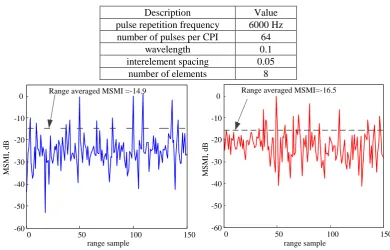
[image:4.595.99.490.377.627.2]A modified sample matrix inversion (MSMI) test statistic is plotted versus range bin for each of the results obtained. The value of range averaged statistic value was our preferred performance measure in this paper, which demonstrates the superiority of interference suppression. The main parameters of the simulation experiment are listed in Table 1.
Table 1. Radar system parameters.
Description Value
pulse repetition frequency 6000 Hz number of pulses per CPI 64
wavelength 0.1
interelement spacing 0.05
number of elements 8
0 50 100 150
-60 -50 -40 -30 -20 -10
0 Range averaged MSMI =-14.9
range sample
M
S
M
I,
d
B
0 50 100 150
-60 -50 -40 -30 -20 -10
0 Range averaged MSMI=-16.5
M
S
M
I,
d
B
range sample
Figure 2. STAP results with GIP. Figure 3. STAP results with the proposed method.
endowed high weight factor in the estimation of covariance matrix, which improved the performance of STAP in heterogeneous environments resultantly.
Conclusion
A covariance matrix estimation method has been proposed to improve the performance of STAP in heterogeneous environments. Different from traditional non homogeneous detectors, the proposed method considers the property of the CUT. Training samples which are similar with the CUT takes higher weight factor, and the weighting coefficients are calculated according to the correlation coefficient between the CUT and training samples. The proposed method improves the performance of interference covariance estimation in heterogeneous environments. Simulation results demonstrate the effectiveness of the proposed method.
Acknowledgments
This work was supported by the Aviation Science Foundation of China under grants 2016ZC07004 and 20172007002.
References
[1] Melvin W L, Scheer J A.:‘Principles of modern radar: advanced techniques’. Edison, NJ: SciTech Publishing, 2013.
[2] Ward J. Space-time adaptive processing for airborne radar [R]. Lincoln Lab, Lexington MA: MIT, 1994, Tech Rep.
[3] Rangaswamy, M., Michels, J.H., and Himed, B.:‘Statistical analysis of the non-homogeneity detector for STAP applications’, Digit. Signal Process., 2004, 14, (3), pp. 253–267, doi:10.1016/S1051-2004(03)00021-6
[4] Liu B, Yin K, Li Y, et al.:‘An improvement in multichannel SAR-GMTI detection in heterogeneous environments’. IEEE Transactions on Geoscience and Remote Sensing, 2015, 52(2), pp. 810–827.
[5] Wu Yifeng, Wang Tong, Wu Jianxin, et al.:‘Robust training samples selection algorithm based on spectral similarity for space–time adaptive processing in heterogeneous interference environments’, IET Radar, Sonar & Navigation, 2015, 9(7), pp. 778-782.
[6] Yang X, Liu Y, Long T.:‘Robust non-homogeneity detection algorithm based on prolate spheroidal wave functions for space-time adaptive processing’, IET Radar, Sonar & Navigation, 2013, 7(1), pp. 47-54.
[7] Zhang, X., Yang, Q., and Deng, W.B.: ‘Weak target detection within the nonhomogeneous ionospheric interference background of HFSWR based on STAP’, Int. J. Antennas Propag., 2013, pp. 1-11, Article ID 382516, doi:10.1155/2013/382516
[8] Fenner D K, Hoover Jr W F. Test results of a space-time adaptive processing system for airborne early warning radar [C]. Proceedings of the IEEE National Radar Conference. Ann Arbor, MI: IEEE, 1996: 88-93.
[9] Wicks, Michael C, ‘A Generalized Inner Product Based Algorithm for Improved Detection and Discrimination of Over Resolved Targets in MIMO Radar’ Synthetic Aperture Radar (EUSAR), 2010 8th European Conference on, 366-369.
[11] Tang B, Tang J, Peng Y N. Detection of heterogeneous samples based on loaded generalized inner product method[J]. Digital Signal Processing, 2012, 22(4): 605-613.
[12] Wicks M C, Rangaswamy M, Adve R, et al. Space-time adaptive processing: a knowledge-based perspective for airborne radar[J]. IEEE Signal Processing Magazine, 2006, 23(1): 51-65.
[13] Capraro G T, Farina A, Griffiths H, et al. Knowledge-based radar signal and data processing[J]. IEEE Signal Processing Magazine, 2006, 23(1): 18-29.
[14] Guerci J R, Baranoski E J. Knowledge-aided adaptive radar at DARPA[J]. IEEE Signal Processing Magazine, 2006, 23(1): 41-50.
[15] Li P, Schuman H, Micheis J H, et al. Space-time adaptive processing (STAP) with limited sample support[C].Proceedings of the IEEE Radar Conference, Piscataway: IEEE, 2004: 366-371.
[16] Yan H, Zheng M J, Wang R, et al. Clutter suppression for multichannel wide-area surveillance systems via Kalman filtering[J]. IET Radar, Sonar & Navigation, 2013, 7(3): 246-254.