2018 2nd International Conference on Modeling, Simulation and Optimization Technologies and Applications (MSOTA 2018) ISBN: 978-1-60595-594-0
The Multi-source and Multi Operation Domain Coordinated Control
Strategy of Power Grid
Wei-chun GE
1, Qi-li HUANG
2, Jian-xin ZHU
3, Jian-guo WANG
4,
Qun CHEN
5and Gui-ping ZHOU
1,*1
State Grid Liaoning Electric Power Co., Ltd., Shenyang 110004, China
2
State Grid Corporation of China. Beijing, 100031 China
3
Shenyang Shijie Electrical Appliance Co., Ltd. Shenyang 110000 China
4
Northeast Electric Power University. Jilin, 132012 China
5Tsinghua University. Beijing, 100084 China
*Corresponding author
Keywords: Multiple sources and multiple operation domains, Control strategy, Normal domain,
Abnormal domain, Emergency domain, Criterion.
Abstract. Renewable energy power has randomness and volatility, in order to ensure the safe and stable operation of power grid, it is necessary to improve the regulation ability of power network flexible, so as to improve the absorptive capacity of the renewable energy. In this paper, through the research of multi domain coordination scheduling strategy of power grid, and proposes an automatic generation control method based on multi power supply and multi energy storage integration each other, which brings battery energy storage and heat storage electric control into AGC control system, ac-cording to the different period of power grid operation, adopting different control strategies, to improve the flexible adjustment ability maximization, a substantial increase in grid renewable energy consumptive capacity. The practical application shows that the proposed method can improve the power consumptive ability effect is remarkable for the high proportion of access to clean energy.
Introduction
With the rapid development of wind power and photovoltaic, the proportion of clean energy connected to the grid has increased year by year. The installed capacity of new energy in Liaoning Power Grid has exceeded one-third of the total installed capacity of the grid, and the power generation has exceeded one-fifth. With the rapid growth of clean energy installed capacity, the problem of new energy consumption has become very prominent, and power grid regulation faces new challenges; the traditional dispatch operation control mode cannot meet the new grid operation requirements; in the new power market development environment, only relying on more Source coordination and power balance have been unable to meet the requirements of power grid peaking, frequency modulation and various types of power generation customers; energy storage technology has played a role in improving grid regulation capability, enhancing grid flexibility and meeting the needs of various types of power users. Important role; battery energy storage can stabilize the wind power fluctuations, and can realize peak clipping and valley filling for the power grid. The large-capacity electric heat
storage at the power plant end cangreatly improve the flexible adjustment capability of the thermal
power unit, and the flexible electric heating method for distributed heat storage can be completely Realize low-altitude heat storage and improve grid peak-lowering capacity. However, these energy storage technologies cannot perform their maximum role without the coordinated operation of the grid.
the actual nonlinearity relationship. The literature [2] proposes to consider the minimum model of dynamic adjustment cost of wind farms and AGC units. The predicted value of the net load increment is allocated by the equivalence cost rule to reduce the system operating cost and improve the system wind power consumption capacity. Literature [3] aims at the coordinated operation of conventional energy and wind power to minimize wind power. By combining the lower-level dispatching wind power as the upper-level dispatching automatic power generation control (AGC) virtual unit, the real-time coordinated control of two-stage dispatching wind power in the same control area is proposed. Architecture and put it into practice. In literature [4], the coordinated control strategies of non-AGC units, BLO-type and BLR-type AGC units in the context of large-scale wind power access can improve the grid's ability to accept large-scale wind power through good coordination at different time levels. Therefore, the tri-state AGC with thermal power, heat storage and battery as the main participants is proposed, which has the function of better cutting peaks and filling the valley and absorbing new energy. In literature [5], in order to realize the AGC optimal joint frequency modulation control, this paper studies the relationship between the multi-region AGC optimal joint frequency modulation model and the regional adjustment marginal cost. In the case of considering the support constraint of the tie line, a new ARMC-based multi-region AGC optimal joint frequency control strategy is proposed. The linear theory is combined with the improved dynamic model of the interconnected system to prove the stability and optimality of the proposed control strategy and determine the range of control parameters. In literature [6], we use equilibrium game theory to establish a scientific clean energy heating operation mechanism based on the principle of maximum
social benefit, so as to maximize the benefits ofwind farm, heat storage and power grid, and establish
a market participation model. However, further research is needed on the investment in heat storage capacity. In literature [7], in order to alleviate the contradiction between wind power consumption in the “Three North” area and improve the utilization rate of clean energy, it is proposed to establish a combined heat and power dispatching platform in the provincial power grid dispatching organization, and use the internet to communicate with the users of electric heat storage and heat. The power supply and the electric heat storage and heat supply are jointly optimized and dispatched, so that the electric heat storage device is activated during the grid abandonment period, and the wind power storage heat supply is realized. Establish a wind power storage and heat trading strategy that takes into account the multi-party economy ensure the economic benefits of wind power enterprises and heating enterprises, improve the level of wind power consumption, and promote the sustainable development of wind power supply.
These results are concentrated on two factors, energy storage and grid automatic power generation control AGC coordination, wind farm and grid automatic power generation control AGC
coordination [8], wind power and photovoltaic coordinated scheduling [9], etc., instead of the various
The comprehensive coordination of factors [10] does not reflect the coordination of energy storage
with multi-source and multi-operational domains of power grids, power grids and wind farms [11].
Multi-source and Multi-running Domain Coordinated Operation Control
Method for Dividing Grid Operation Control Domain
The grid operation is usually divided into three periods: peak, waist load and trough. The main contradictions of grid operation in three periods are different, and the control strategies adopted are different. In order to highlight different stages of grid operation, different regulation strategies are
needed [12-13]. For example, in the heating period in winter, the main goal is to heat and absorb wind
power; in the summer season, to reduce water and electricity as the main target, this article is aimed at heating and absorbing wind power in the northern winter dry and windy seasons. To save water and electricity as the goal, the grid operation is divided into normal domain, abnormal domain and emergency control domain; abnormal domain and emergency control domain control usually corresponds to peak and valley periods; each domain has two states of entry and exit.
The power grid is divided into three operating domains [14-15], which are determined according to
the nature of multi-source [16-18]. Hydropower and thermal power are conventional power sources,
with large capacity and low power generation cost. The regulation speed can meet the normal regulation requirements of grid frequency and tie line; the energy storage capacity is not large enough, the construction cost is high, and the grid frequency and the normal adjustment requirements of the tie line cannot be met. However, in view of the unfavorable situation that the power grid faces the abandonment of wind power, the wind power can be abandoned for a short time. When the wind power is not abandoned, the energy storage is not put into operation. Therefore, the energy storage period that is used to eliminate wind power is defined as the abnormal regulation domain; when the grid does not have any adjustment capability, only the clean energy is abandoned. Because nuclear power and photovoltaic are predictable, only wind power is random. Therefore, the wind power is discarded first, and the wind power is regarded as the isolation belt, and the nuclear power is discarded. The photovoltaic power is large, and it is difficult to completely abandon the light. Therefore, the clean energy consumption is equivalent to the wind power consumption. Therefore, the elimination of clean energy to meet the safe and stable operation period of the grid is defined as the emergency control domain.
Normal domain Anomalous domain Emergency domain Hydropower and
thermal power
Energy storage
[image:4.595.117.475.76.140.2]Wind power, nuclear power and photovoltaic
Figure 1. The principle block diagram of power grid operation domain division.
The three domains adjust the normal domain of the power grid by adjusting water and thermal power; control the abnormal domain of the power grid by adjusting the energy storage; and control the emergency domain of the power grid by starting the abandoned clean energy strategy; the three domains completely cover the various periods of the grid operation. And the operation mode is a new mode for ensuring heating quality, improving wind power consumption and ensuring safe and stable operation of the grid during the winter heating period in the northern region.
The division of this paper is divided according to the operational characteristics of each source. The normal domain contains power supplies that can be normally regulated. For areas with excess water and electricity, hydropower can be divided into emergency control domains. The anomaly domain is a grid with a large amount of energy storage. There is sufficient adjustment capability to prevent the grid from going directly from the normal operating domain to the emergency control domain.
Grid Operation Control Domain Criterion
The grid operation control is divided into three domains. In different domains, the discriminating conditions are different. According to the discriminating conditions, the current operating domain of the grid is determined.
Normal Domain Criteria
The normal domain is mainly for the power grid to ensure safe and stable operation of the power grid by regulating hydropower and thermal power. The discrimination condition of the normal domain is expressed by the formula (1) or (2).
&1 M S h
P P P P (1) or
&2 S h m
P P P P (2)
&1
P for the grid to increase the margin, the response to the process of adding force, the greater the
value, the stronger the upward adjustment capability of the grid;
&2
P for the grid to reduce the margin, the reaction to reduce the force process, the greater the value,
the stronger the grid's downward adjustment capability;
S
PwithPhis the current output of water and thermal power units;
M
P is the sum of the upper limit of the output of water and thermal power units;
m
P is the sum of the lower limit of the output of water and thermal power units;
Then, the normal domain discrimination condition is as shown in the formula (3) or (4).
&1&1
P (3) or
&2 &1
P (4)
1
peak capacity, and function (4) expresses the unit's load-reducing capacity, that is, the ability to dissipate wind power in a trough.
Abnormal Domain Criteria
The abnormal domain is mainly due to the loss of normal regulation capacity of the power grid. Water and thermal power are at the lower limit. Only by adjusting the battery energy storage and various types of electric heat storage, and adjusting the frequency to ensure the safe and stable operation of the power grid. If the battery energy storage and various types of electric heat storage have a certain scale, it can protect the normal operation of clean energy. Therefore, the battery energy storage and various types of electric heat storage operation areas are defined as the abnormal domain of the power grid, and the basis of the abnormal domain is determined. As shown in (5).
&2 &2
P (5)
Among them: & is less than it is the emergency control margin value set by the grid for the energy 2
storage input, which may be 10MW or 0MW, depending on the actual operation of the grid.
When the condition of (5) is satisfied, the charging mode of the battery and the electric heat storage are activated.
If (6) and (7) are satisfied:
$1 ce c &3
P P P (6)
$2 de d &4
P P P (7)
Among them: Pce with Pc indicates the rated capacity and operational capacity of the heat
storage; Pdewith Pd indicates the rated capacity and operational capacity of the battery energy
storage,& indicates the minimum unit capacity for heat storage, The minimum adjustment unit 3
capacity & indicating the battery charging mode,4 P$1withP$2is the adjustment margin of electric heat
storage and battery energy storage.
When the formulas (5), (6), and (7) are satisfied, the grid is in the abnormal control domain.
Emergency Domain Criteria
The emergency area is that hydropower, thermal power, battery energy storage and various types of electric storage heat have reached the regulation limit. Only by reducing the power generation of clean energy, the grid will ensure safe and stable operation.
The criteria for the grid to enter the emergency domain are shown in equations (8) and (9).
$1 ce c &2
P P P (8) or
$2 de d &2
P P P (9)
Among them: It is a value close to 0 MW, which means that the battery energy storage and
electric heat storage have all been invested.
When equations (8) and (9) are satisfied at the same time, the grid enters the emergency control domain.
Multi-source and Multi-run Domain Control Strategy
Control Strategy
or trough, because the water and thermal power has sufficient adjustment margin, the control strategy is to adjust only the thermal power and the hydropower to ensure the grid safely and stably operation. When the grid runs in the anomalous domain, when the grid is running in the late peak period, the control strategy is followed by water, thermal power, electric storage, and battery charging. When the grid runs in the early peak period, the control strategy is to cut off the electric heat storage. The battery, thermal power, and hydropower are cut off; when the power grid runs in the early peak period, the control strategy is thermal power, hydropower, and battery power generation.
When the power grid is operating in the emergency domain, the control strategy is limited to nuclear power, abandoned wind power, and abandoned photovoltaic. When exiting the emergency domain, the control strategy is to input photovoltaic, restore wind power, and remove nuclear power.
Control Method
The normal domain and the emergency domain can be implemented by conventional methods. For example, the normal automatic power generation control of the power grid can realize the normal domain operation; the emergency domain also has the corresponding wind power automatic power generation control to realize the abandoned wind control. This paper focuses on the abnormal domain control method.
In fact, in the actual operation of the power grid, the normal domain and the abnormal domain are alternated. When the power grid loses its normal adjustment capability, according to the energy storage input quotation, the energy storage equipment with low quotation is put into operation. At this time, the power grid may have a certain capacity. With the adjustment capability, the grid returns to the normal domain; as the load further declines, the grid enters the abnormal domain again, and the energy storage equipment is re-introduced, and the cycle is repeated until the energy storage equipment is fully loaded or the load is restored, and no energy storage is required, and the grid is disconnected from the abnormality. The domain returns to the normal domain; it may also be that after the energy storage is fully invested, the grid does not resume normal operation, and the grid enters the emergency domain to abandon the wind and limit the core.
Analysis of Control Examples
Several typical daily operational data of provincial power grids were selected as examples to analyze and verify the effects of control strategies and methods on the elimination of clean energy.
Analysis of Normal Domain Operation Examples
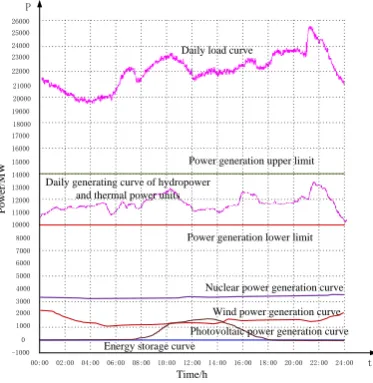
The load curve of a certain day is shown in Figure 2. The output of water and fire power is always between the maximum and minimum values. It is in normal operation all day. The energy storage equipment is in a state of outage all day, and no clean energy is discarded.
Daily generating curve of hydropower and thermal power units
Power generation lower limit
Energy storage curve
Wind power generation curve
00:00 02:00 04:00 06:00 08:00 10:00 12:00 14:00 16:00 18:00 20:00 22:00 24:00 -1000
0 1000 2000 3000 4000 5000 6000 7000 8000 10000 11000 12000 13000 14000 15000 16000 17000 18000 19000 20000 21000 22000 23000 24000 25000 26000
Power generation upper limit Daily load curve
P
t
Nuclear power generation curve
Photovoltaic power generation curve
Time/h
P
o
w
er
/M
[image:6.595.204.391.580.772.2]W
The maximum load of 25,000 MW on that day occurred at 21:16; the minimum load on the day was 20000 MW, which occurred at 04:00; the maximum power of the hydro-thermal power unit was 13,000 MW, and the minimum power was 10000 MW. When the sunrise force value was always between the maximum and minimum values; the equipment was in a state of suspension throughout the day; the maximum wind power of the day was 2100 MW, which occurred at 00:01, and no wind curtailment occurred.
Due to the large margin of the upper and lower limits of the water-fired power, the power grid has the ability to follow the wind power changes to ensure the safe and stable operation of the power grid.
Exception Domain Operation Control Instance
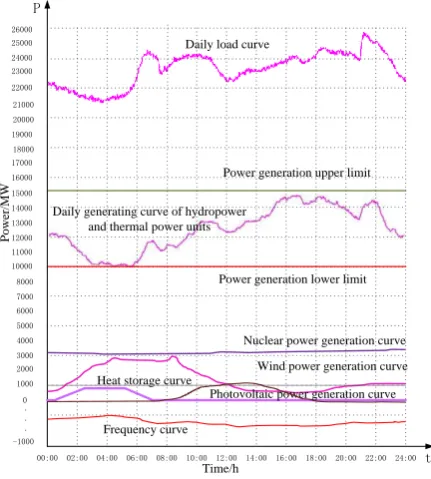
The load curve of a certain day is shown in Figure 3. During the low valley period, the output of the hydro-thermal power generation is close to the lower limit. The grid frequency reaches the upper limit, the heat storage equipment starts to be put into operation, and the battery equipment is also put into operation, maintaining the sum of the output of the hydro-fire power generation. Running near the lower limit, and finally investing all the energy storage equipment, the water and fire power output has a certain reserve margin, the grid frequency is close to the upper limit operation, wind power, nuclear power and photovoltaic are all operating normally, and the grid does not have the phenomenon of abandoning clean energy.
00:00 02:00 04:00 06:00 08:00 10:00 12:00 14:00 16:00 18:00 20:00 22:00 24:00 -1000
0 1000 2000 3000 4000 5000 6000 7000 8000 10000 11000 12000 13000 14000 15000 16000 17000 18000 19000 20000 21000 22000 23000 24000 25000 26000
Power generation upper limit Daily load curve
Heat storage curve
. .
. Frequency curve
P
t Time/h
P
o
w
er
/M
W
Nuclear power generation curve
Photovoltaic power generation curve Power generation lower limit Daily generating curve of hydropower
and thermal power units
[image:7.595.188.404.329.569.2]Wind power generation curve
Figure 3. Example of abnormal domain operation of power grid.
The capacity of the heat storage units of the two power plants reached 540 MW, which increased the grid load of the grid by 540 MW, resulting in an increase of 540 MW in peak shaving capacity. When the grid abandonment wind power is lower than 540 MW, the grid has the ability to ensure that the grid is safe and stable without abandoning wind or abandoning clean energy.
Emergency Domain Operation Control Instance
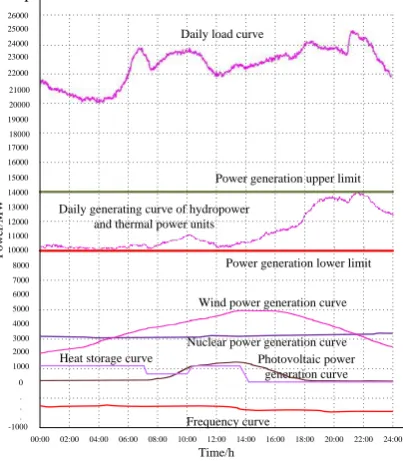
The load curve of a certain day is shown in Figure 4. When the power grid is at 00:00, the output of the water and fire power has all reached the lower limit of the output. At 00:00, the energy storage equipment has been fully invested. The frequency is already close to the upper limit, and the power grid enters the emergency operation control domain. Discard the wind according to the prior plan.
00:00 02:00 04:00 06:00 08:00 10:00 12:00 14:00 16:00 18:00 20:00 22:00 24:00 -1000
0 1000 2000 3000 4000 5000 6000 7000 8000 10000 11000 12000 13000 14000 15000 16000 17000 18000 19000 20000 21000 22000 23000 24000 25000 26000
Power generation upper limit Daily load curve
Heat storage curve
. .
. Frequency curve
P
t
Nuclear power generation curve Photovoltaic power
generation curve
Time/h
P
o
w
er
/M
W
Power generation lower limit Daily generating curve of hydropower
and thermal power units
[image:8.595.195.397.224.455.2]Wind power generation curve
Figure 4. Example of emergency control domain.
The minimum load on the day was about 20,000 MW, which occurred at 03:36; the maximum load on the day was 25,000 MW, which occurred at 21:13; during the period of low load, the hydro-thermal power generation curve was maintained near the minimum output; on the day, the electric storage device of the A and B plants was 00. From 00 onwards, all the inputs have been started. At 00:00 on the same day, the wind power is limited to 600MW, 01:55 is limited to wind power 700MW, and the maximum wind power of the wind power is 1100MW, 05:50. The wind power is completely restored due to peak shaving, 16:38 due to the grid. The reason for the wind power is fully restored. Since the maximum power of the wind power is only 1100MW, which is much smaller than the maximum power of the wind power. Therefore, nuclear power and photovoltaic operate normally, and there is no nuclear power or photovoltaic phenomenon.
The total heat storage capacity of A and B farms is 540MW. During the wind-stricken period, almost all run to 14:00, up to 14 hours, and run from 7:00 to 10:00, and the wind power is 7479MWh, which is close to the whole day 40% of the wind power.
Analysis of Key Factors of Wind Abandonment
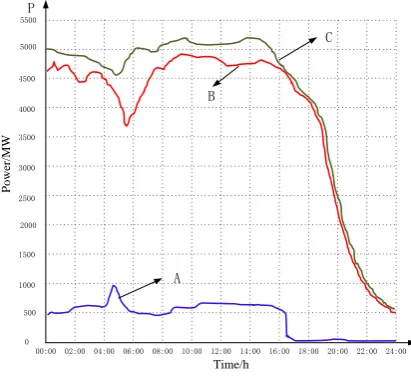
all put into operation. The frequency reached the upper limit and the wind power could only be discarded. It can be seen that the grid operates in different domains, and the ability to absorb clean energy is closely related to the maximum output of wind power and the difference between peak and valley. As shown in Figure 5. A is the wind curve of the day, B is the actual curve of wind power generation, C is the curve of wind power generation; the maximum power of wind power should exceed 5000MW, the grid is difficult to accept, and when the power generation capacity exceeds the peak-to-valley difference, the grid reaches the limit of the wind-eliminating electrode. , began to abandon wind power, no restrictions on nuclear power and photovoltaic.
00:00 02:00 04:00 06:00 08:00 10:00 12:00 14:00 16:00 18:00 20:00 22:00 24:00 0
500 1000 1500 2000 2500 3000 3500 4000 4500 5000 5500
Time/h
P
o
w
er
/M
W
A B
C P
[image:9.595.188.394.191.379.2]t
Figure 5. Abandoned wind curve.
Due to the multi-source and multi-operation domain coordinated control, the application of a large number of energy storage equipment and the deep peak shaving of each thermal power unit, the wind curtailment rate has dropped from 13% in 2016 to 8% in 2017, not in the first quarter of 2018. To 3%. The effect is very obvious.
The control of multi-source and multi-running domain coordinated, each power source is divided into different domains according to its operating characteristics. If the peak capacity of the thermal power unit in the normal domain is calculated according to the operating capacity of 15 million kWh, each increase of 10% will increase 1.5 million. The kilowatt wind power generation space, and in the normal regulation domain, is the deep adjustment of the thermal power unit before the energy storage input; if the power grid has 2 million kilowatts of energy storage, it will form a 2 million kilowatt between the normal regulation domain of the power grid and the abandoned wind power. The barrier will be invested in 2 million kilowatts of energy before abandoning wind power. It is equivalent to increasing the capacity of wind power consumption of 2 million kilowatts.
Conclusion
This paper defines the multi-operation domain, multi-source coordination, multi-operation domain, and criterion and control strategy for the grid in the northern winter heating period. It is applicable to three regions of different regions and different grid operation modes. However, different power sources are suitable for different operation domains. The main operation modes of the power grid covered by the three operational control domains are shown in several actual operating cases. The analysis and control of the three domains show the importance of energy storage to improve the wind power acceptance capability. At the same time, it also indicates the size of the heat storage capacity planning. Multi-factor related, too small, cannot solve the problem of large-scale consumption of clean energy, too large, investment waste.
the object. In fact, only when all wind power is discarded, it is extremely difficult to stop nuclear and abandon photovoltaic.
Acknowledgement
Project Supported by National Key R&D Program of China (2017YFB0902100); National Natural Science Foundation of China (U1766204);
References
[1] Chen Dayu, Zhang Lizi, Ma Li. A New Optimization Method for AGC Market Clearing Considering Energy Storage Systems[J]. Automation of Electric Power Systems, 2014, 38(13):79-84.
[2] He Chengming, Wang Hongtao, Wei Zhongkang, Wang Chunyi. Distributed Coordinated Real-time Control of Wind Farm and AGC Units[J]. Proceedings of the CSEE, 2015, 35(2):302-309.
[3] Xie Xu, Wu Jiping, Luo Yazhou, etc. Real-time Coordinated Control Strategy for Wind Power with Two-level Dispatching in Same Control Area[J]. Automation of Electric Power Systems, 2017, 41(11):114-119.
[4] Wang Songyan, Yu Jilai. Coordinated Disatch Regulation Strategy Between Non-AGC Units andAGC Units With High Wind Power Penetration[J]. Proceedings of the CSEE, 2013, 33(7): 156-163.
[5] Zhang Lei, Luo Yi, Ye Jing, Shao Zhouce, Cai Yu, Optimal Cooperation Frequency Control Strategy of AGC in Multi-areaUnder Tie-line Support Volatility Constraint[J]. Proceedings of the CSEE, 2017, 37(3): 676-684.
[6] Huang Yawei, Li Xinran, Huang Jiyuan, Tan Shaojie. Analysis of Control Methods for AGC with Battery Energy Storage System[J]. Proceedings of the CSU-EPSA, 2017, 29(3):83-89.
[7] Ge Yanfeng, Li Xiaofei, Ge Yangyang, Su Ming, Sun Mingyi, Sun Liyong. Technical Plan for Electric Heat Storage and Heating by Wind EnergyCurtailment Based on Joint Dispatching of Heat and Electricity[J]. Smart Grid, 2015, 3(10): 901-905.
[8] Li Benxin, Han Xueshan, Liu Guojing, Wang Mengxia, Li Wenbo, Jiang Zhe. Thermal unit commitment with complementary wind powerand energy storage system[J]. Electric Power Automation Equipment, 2017, 37(7): 32-37.
[9] Jin Hongyang, Sun Hongbin, Guo Qinglai, et al. Multi-day Self-scheduling Method for Combined System of CSP Plants and Wind Power withLarge-scale Thermal Energy Storage Contained[J]. Automation of Electric Power Systems, 2016, 40(11): 17-23.
[10] Hou Wenting, Wei Hua. A Multi-Source Coordinated Short-Term Dispatch Model Considering the Dispatchability of Nuclear Power Plants[J]. Transactions of China Electrotechnical Society: 1-9[2018-05-31].
[11] Dai Liyuan, Xu Taishan, Wang Maxiang, et al. A Survey of Real Time Control Technology for Multi-source Power Grid Coordination[J]. Electric Power Science and Engineering, 2017, 33(05): 16-23.
[12] Lu Zongxiang, Li Haibo, Qiao Ying.Flexibility Evaluation and Supply/Demand Balance Principle of Power System with High-penetration Renewable Electricity [J]. Proceedings of the CSEE, 2017, 37(01): 9-20.
[14] Ding Ming, Liu Xinyu, Xie Jiaolong, Lin Yujuan. Research on Heat and Electricity Coordinated Dispatch Model of Multi-area for Improving Wind Power Accommodation Ability[J]. Proceedings of the CSEE, 2017, 37(14): 4079-4088+4287.
[15] Wang Kaiwen, Zhu Quansheng, Lü Quan, WANG Haixia.Situation Evaluation of Peak Regulation of Provincial Grid Considering Unconventional Peak Regulation[J]. Power System Technology: 1-9.
[16] Chang Yao, Cheng Lin, Li Hongtao, et al. Distribution System Optimal Power Flow With Various Controllable SourcesBased on Semi-Definite Relaxation[J]. Power System Technology, 2016, 40(08): 2416-2422.
[17] Lv Quan, Liu Yongcheng, Liu Le, et al. Research on Coal-saving Performance and Optimal Configuration of Wind Power Heating Project Considering Wind Power Curtailment Characteristics [J]. Proceedings of the CSEE, 2017, 37(16):4699-4711+4895.