2019 International Conference on Information Technology, Electrical and Electronic Engineering (ITEEE 2019) ISBN: 978-1-60595-606-0
Study on the Application of PostgreSQL in ON-Board Power
Simulating Training Evaluation System
Hui XIE and Liang CAO
No.91388 Troops of PLA, Zhanjiang, Guangdong, 524022, China
Keywords: PostgreSQL, Evaluation system, On-Board power simulating training.
Abstract. In accordance with the application characteristics of On-Board power simulating training evaluation system and the advantages of postgreSQL, propose that using postgreSQL manage the data of On-Board power simulating training evaluation system. Considering the characteristics of postgreSQL, this paper combines with the database design, connection and accession, and studies the application of postgreSQL in On-Board power simulating training evaluation system. It is showed by the research and experiment that applying postgreSQL into On-Board power simulating training evaluation system has important practical significance and promoting value.
Introduction
On-Board power simulating training evaluation system is an essentially data system, which uses all kinds of data to store, contrast,analysis, display and manage. When evaluating the crew’s training level and showing the evaluation results, the data needed to process is plentiful and disordered, such as crew’s basic information,evaluation information and operational information. How to store, use and manage well this data is a challenge, which needs database technology to be applied to On-Board power simulating training evaluation system.
The analysis of On-Board power simulating training evaluation system shows that, the application of On-Board power simulating training evaluation system is mainly for elementary On-Board troops, colleges and testing-training units. But we can’t make the computer platform of every unit the same, so the selected database system must have excellent performance of crossing platform. PostgreSQL not only has excellent crossing platform characteristics, but also has some advantages that other large commercial databases haven’t. So, On-Board power simulating training evaluation system uses postgreSQL system.
This paper studies the application of postgreSQL in On-Board power simulating training evaluation system combining with the design, connection and access of evaluation system database.
PostgreSQL
PostgreSQL[1-4]originated from the Postgre project of University of California, Berkeley, is an advanced object-relation database management system, which not only supports for various functions of relation database, but also has features of object database, such as class and inheritance. Its features cover SQL-2/SQL-92 and SQL-3/SQL-99. Meanwhile, it includes the support of the most abundant data types in the world, some of which are not to be possessed by commercial databases, such as IP types and geometric types. Simultaneously, it is a full-functional free software database and an only free software database management system which supports characteristics such as affair, sub-query, multi-version concurrent control system (MVCC), and data integrity checking. PostgreSQL supports multi-operating system, orients object and has big database performance.
that postgreSQL gives to interface is very abundant, and postgreSQL almost supports all types of database client interface,which is one of the database management systems having the most supporting platform. We can say that postgreSQL is the most powerful, characteristic and complex open source database management system at present.
Database Design
Database design is a process of designing database structure and establishing database on a specific DBMS and on the basis of customer’s requirement, namely the process of converting amateur objects into database objects such as tables and views. The three main steps of database design are conceptual data model design, logical data model design and physical data model design. Next, we’ll study each of these.
Conceptual Data Model Design
Conceptual data model design is to abstract the objects in the real world into the entities with attributes and mutual relations in the information world and establish the conceptual structure[5], which reflects the comprehensive information needs of end users. The content of conceptual data model includes entities and relationships of entities, but does not include attributes of entities.
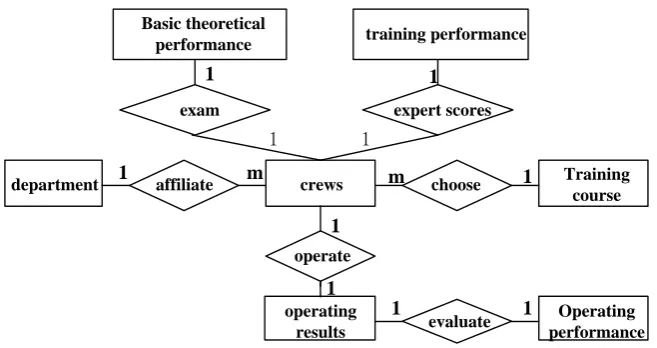
The conceptual structure of database usually adopts Entity-Relation model, so we could also say that the process of conceptual design is the process of establishing E-R model. In the database system of On-Board power simulating training evaluation, entities are crews information, expert information, administrator information, supervisor information, assessment project information, evaluation rule information, rule keyword information, step keyword information, theory performance information, operation performance information, training style performance information, operation result information, marking parameter information, fault information, evaluation level information and various statistical information and so on.
In these entities, there are one-to-many relationship between crews, theoretical performance and operating results, one-to-one relationship between crews and training performance, many-to-many relationship between operating results and operating performance, and one-to-one relationship between crews and comprehensive assessment information. Because of the complexity of database system, this paper only gives the local E-R diagram, as shown in the figure 1.
affiliate
department crews Training
course
Operating performance operating
results
training performance
expert scores
operate
choose
evaluate
1 m
Basic theoretical performance
exam
1 m
1
1
1 1
1 1
[image:2.595.140.469.514.688.2]1 1
Figure 1. The local E-R diagram of the system.
Logical Data Model Design
relational model. In the transition from concept to logic, the following guidelines need to be followed: transforming entities into relationships; transforming connections into relationships; the combination principle of relational schema.
For the E-R model above, the following relational schema can be obtained through the principle of transformation from concept to logic:
Department information (department number, department name).
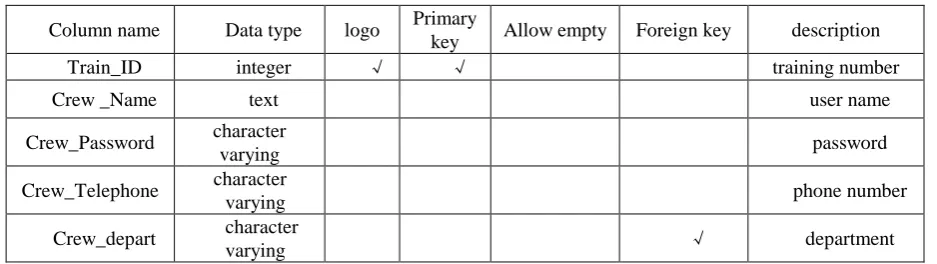
Crews information (crews number, user name, password, phone number, department).
Training program information (training number, training program name, operation limited time). Operation result information (operation result number, crews number, program number, total operation time, divided operation time, false operation number, the matching number of operation sequence, the matching number of keyword for explaining ability, the actual voltage of parameter control, the actual current of parameter control, the actual frequency of parameter control, troubleshooting time).
Basic theory performance information (theory performance number, crews number, true of false performance, blank-filling performance, multiple choice performance, basic theory performance).
Training style performance information (style performance number, crews number, program number, Training style performance).
Operation performance information (operation performance number, crews number, program number, total operation time performance, divided operation time performance, operation result performance, operation sequence performance, false operation performance, operation quality performance, troubleshooting result performance, explaining ability performance, troubleshooting time performance, operation level performance, troubleshooting performance, parameter control performance, operation performance).
Physical Data Model Design
[image:3.595.65.534.529.661.2]Physical data model design is to establish the physical structure suitable for the application environment on a particular DBMS. The content of physical data model[7] mainly includes identifying all tables and columns, defining foreign keys to determine relationships between tables and so on. Its goal is to implement the logical data model using the database schema, and really save data. Then take crews information for example, convert the relational schema of crews information designed above to the physical database schema, as shown in the table 1.
Table 1. The information table of crew.
Column name Data type logo Primary
key Allow empty Foreign key description
Train_ID integer √ √ training number
Crew _Name text user name
Crew_Password character
varying password
Crew_Telephone character
varying phone number
Crew_depart character
varying √ department
Database Connection
On-Board power simulating training evaluation system adopts ODBC (Open Database Connectivity) database access technology to access database.
Configure ODBC Data Source Manager
postgreSQL system. Then configure the ODBC data source manager, which is opened through the path from control panel to administration tool and to data source(ODBC).
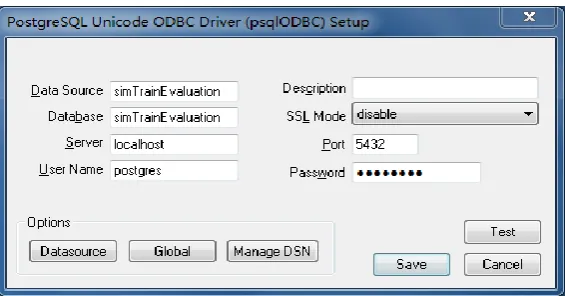
[image:4.595.164.447.252.400.2]Click the add button, enter the wizard interface creating new data source, and select database drive PostgreSQL Unicode. Because this evaluation system uses PostgreSQL, so click finish. Then, enter PostgreSQL Unicode ODBC Driver(psqlODBC)Setup interface, as shown in figure 2. The fill item after Data Source can be set arbitrarily, which is the connection name of database simTrainEvaluation in evaluation system. Description item is the description information that users fill in according to their needs, and the database name simTrainEvaluation of evaluation system is entered in Database item. The server information is entered in Server item, which is localhost here. Port password is entered in Port item, as the same time, user name and password which will be adopted by user to log database are entered in User Name item and Password item. Lastly, click Test, and there will be a interface showing test success.
Figure 2. The build interface of psqlODBC.
Write Qt Program to Achieve Access
On-Board power simulating training evaluation system adopts the Qt programming environment. There are two ways to access database by ODBC in Qt, one of which is to make connection through DSN, and the other is to make connection through host name, user name and password. On-Board power simulating training evaluation system adopts the latter method to access. Take the connection between evaluation system and User table of database simTrainEvaluation for example, the realization program is shown below:
mDatabase = QSqlDatabase::addDatabase(“QODBC”,”simTrainEvaluation_1”); mDatabase.setHostName(“localhost”);
mDatabase.setPort(5432);
mDatabase.setDatabaseName(“simTrainEvaluation”); mDatabase.setUserName(“postgres”);
mDatabase.setPassword(“postgres”); if (!mDatabase.open())
{
QMessageBox::critical(0, qApp->tr(“Cannot open database”), qApp->tr(“Unable to establish a database connection.\n” “This example needs QODBC support. Please read “ “the Qt SQL driver documentation for information how “ “to build it.\n\n”
“Click Cancel to exit.”), QMessageBox::Cancel); }
mJianYuanModel->setTable(mDatabase.driver()->escapeIdentifier(“JianYuan”, QSqlDriver::TableName));
mJianYuanModel->setEditStrategy(QSqlTableModel::OnManualSubmit); mJianYuanModel->select();
}
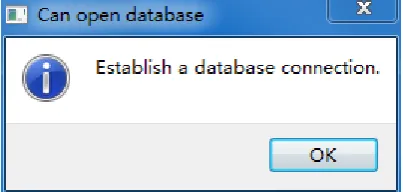
[image:5.595.204.406.184.280.2]In order to visually show whether the database is connected or not, we write program to show the database connection. The running interface is shown in figure 3.
Figure 3. The concrete realization interface of database connection.
Summary
Studies and experiments show that, PostgreSQL can fully meet the data management needs of On-Board power simulating training evaluation system. Both performance and cost, adopting PostgreSQL to manage the data of evaluation system is a best choice. With the continuous development of On-Board power simulating training system, the construction of evaluation system plays an increasingly important role. Applying PostgreSQL into On-Board power simulating training evaluation system has important practical application significance and popularization value, which will make On-Board power simulating training evaluation system have better development.
References
[1] Peng Xiao-ming .The development of object-relational database PostgreSQL. Posts & Telecom Press, Bei Jing, 2001, pp. 5-6.
[2] Peng Zhi-yong, Peng Yu-wei. The kernel analysis of PostgreSQL database. Mechanical Industry Press, Wu Han, 2012, pp. 2-7.
[3] Lv Zi-qi, Huang Ze-chun. Application of PostgreSQL to railway spatial data management, J. Railway Computer Application, 2010, 19(4): 8-10.
[4] Du Xue-feng, Song jia-you. The Application of PostgreSQL in GPS Vehicle Monitor System, J. Journal of Anhui Vocational College of Electronics & Information Technology, 2008, 7(6): 23-24.
[5] Zhuang Qin-sheng. Constructing Conceptual Model of Data Warehouse Based on E-R Schema, J. Computer Engineering and Applications, 2004, (10): 195-198.
[6] Lin Yi. Logical data model design in data warehouse, J. Financial Computer of China, 2006, (05): 42-45.