THE EFFECT OF PRE-QUESTIONING TECHNIQUE ON
STUDENTS’ READING COMPREHENSION ACHIEVEMENT
AT THE SECOND YEAR STUDENTS OF SMPN 29 BANDAR
LAMPUNG
(A Sript)
By
Indah Rizqia Putri Warganegara
FACULTY OF TEACHER TRAINING AND EDUCATION LAMPUNG UNIVERSITY
i
ABSTRACT
THE EFFECT OF PRE-QUESTIONING TECHNIQUE ON STUDENTS’ READING COMPREHENSION ACHIEVEMENT AT THE SECOND YEAR
STUDENTS OF SMPN 29 BANDAR LAMPUNG
By
Indah Rizqia Putri Warganegara
Reading is bringing and getting meaning from printed or written materials. This activity requires the students not only to read the texts but also to understand it. Naturally, reading skill involves several elements such as main idea, supporting detail, inference, vocabulary, and reference. Therefore, this research was conducted from the considerations that the students still got low scores in reading comprehension test. One factor that may influence students’ reading comprehension achievement is the strategy used by the teacher for teaching reading in the class. One of the strategies which is considered applicable for teaching students’ reading comprehension is pre-questioning technique. Pre-questioning is very useful for students to activate their prior knowledge. The students may find form of pre-questioning and it is important for them to comprehend a reading text by having knowledge in general view of the text. The objective of this research was to find out the effect of giving pre-questioning technique on studens’ reading comprehension achievement. The result of this research was useful to support the previous study that has been applied in senior high school and university students.
This research was conducted at the second grade students of SMPN 29 Bandar Lampung. The researcher took VIII D class as try out class and VIII A class as experimental class. The experimental research with one group pre-test and post-test design was applied in this research. In collecting the data, pre-test, treatments, and post-test were administered. Then, the t-test was employed to reach the significant value.
THE EFFECT OF PRE-QUESTIONING TECHNIQUE ON
STUDENTS’ READING COMPREHENSION ACHIEVEMENT
AT THE SECOND YEAR STUDENTS OF SMPN 29 BANDAR
LAMPUNG
By
Indah Rizqia Putri Warganegara
A Script
Submitted in a Partial Fulfillment of The Requirements for S-1 Degree at EESP
in
English Education Study Program
The Language and Arts Education Department of Teacher Training and Education Faculty
FACULTY OF TEACHER TRAINING AND EDUCATION LAMPUNG UNIVERSITY
ii
CURRICULUM VITAE
The writer’s name is Indah Rizqia Putri Warganegara. She was born on September 27th in Bandar Lampung. She is the youngest child of four children from the parents H. Apriyanto Warganegara, S.E., and Hj. Rolina, S.Pd.I. She has two brothers namely Rio Setiawan Warganegara, S.H., Tommy Virlianda Warganegara, S.T., and one sister Tri Lestira Putri Warganegara, S.E., M.M.
Her educational background started at TK Al-Azhar 2 Bandar Lampung in 2000. She continued her study at SD Al-Azhar 1 Bandar Lampung in 2001 and graduated in 2006. In the same year, she studied at SMP Negeri 4 Bandar Lampung and graduated in 2009. Then, she entered SMA Negeri 3 Bandar Lampung and graduated in 2012.
iii
DEDICATION
This script is fully dedicated to: My beloved parents
H. Apriyanto Warganegara, S.E. and Hj. Rolina, S.Pd.I.
My awesome brothers and sisters
Rio Setiawan Warganegara, S.H., Renny Silvia P., S.Kom., Tommy Virlianda Warganegara, S.T., Siska P. Yudowati, S.E., MBA.,
Tri Lestira Putri Warganegara, S.E., M.M.
My beautiful nieces
Janeeta Najla Callysta Warganegara Jasmine Maleeka Amody Warganegara
My fraternities English Department 2012
iv
MOTTO
Unquestionably, by the remembrance of Allah the hearts find satisfaction.
-QS. Ar-Ra’d:28-
v
ACKNOWLEDGEMENTS
The writer would like to acknowledge her deepest gratitude to the Most Gracious and the Most Merciful, Allah SWT who gives endless bless throughout the writer’s life and also enables the writer to finish this script. Shalawat and salaam to the greatest person ever lived, Prophet Muhammad SAW and his family. This script entitled “The Effect of Pre Questioning Technique on Students’ Reading Comprehension Achievement at the Second Year Students of SMPN 29 Bandar Lampung” is submitted as a compulsory fulfillment of the requirement for S-1 Degree at the Language and Arts Education Department of Teacher Training and Education Faculty of University of Lampung.
This script would never come into existence without any supports, encouragements and assistance by several gorgeous persons and institutions. Thus, the writer wants to express her sincere respect and gratitude to:
1. Dr. Muhammad Sukirlan, M.A., as the first advisor, for his valuable advices, kindness, patience, corrections, supports in helping the writer to improve this script to be better.
2. Drs. Ramlan Ginting Suka, M.Pd., as the second advisor who has contributed and given his evaluation, comments, suggestions during the completion of the script.
3. Prof. Dr. Patuan Raja, M.Pd., as the examiner, for his kindness and critical suggestions to the script, thus his contribution had enabled the writer to finish the script rightly.
4. Special appreciations are also due to big family of SMPN 29 Bandar Lampung, especially for Dra. Astusti, M.Pd., as the headmaster, Mrs. Hermentati, S.Pd., as the English teacher, and the students of VIII A class for the cooperation during the research process.
5. My beloved parents, H. Apriyanto Warganegara, S.E. and Hj. Rolina, S.Pd.I. Thank you so much for your endless love, supports, prayers, and encouragements for your little daughter to accomplish everything in life.
vi
7. My beautiful nieces, Janeeta Najla Callysta Warganegara and Jasmine Maleeka Amody Warganegara, for the joy that you bring in this life.
8. My best pals, RUMPI SYAHDU, Devina Nizzu, Devinia Jeniar, Fadilah Sukma Dewi, Iin Indriani, Maya Rosa Almira, Rizky Ayuningtyas, Suci Hati Puji Lestari, Tiara Anggriani, thank you for your generous supports, encouragements, friendship, and amazing experiences of 4 years dedication in English Department.
9. My precious friends, TOBELI GENK, Genialfi Mia Gustama, Nurul Fatmawati, Reihana Sari, Siti Rahmiana, for your cares, jokes, togetherness until this time. Thank you for always being there through my good and bad times.
10.My lovely friends from KKN-PPL Team 2015 of SMAN 1 Batu Brak Lampung Barat, Anis Fitriana, Devi Rahmayani, Emi Fitria, Rinda Maulina, Rian Ayatullah Noorie, Risdiyanto Prayoga, and Trini Marnia Sari. Thank you for the experiences, laughs, tears and adventures for two months in Pekon Balak.
11. My comrades English Department 2012 for the amazing college experiences.
The writer hopes that this research would be a positive contribution to the educational development, the readers, and the other researcher.
Bandar Lampung, August 2016 The writer
vii
CONTENTS
Page
ABSTRACT...i
CURRICULUM VITAE...ii
DEDICATION...iii
MOTTO...iv
ACKNOWLEDGEMENTS...v
CONTENTS...vii
LIST OF TABLES...ix
LIST OF APPENDICES...x
I. INTRODUCTION 1.1. Background of the Research ... 1
1.2. Formulation of the Problem ... 5
1.3. Objective of the Research ... 5
1.4. Uses of the Research ... 6
1.5. Scope of the Research ... 6
1.6. Definition of Terms ... 7
II. LITERATURE REVIEW 2.1. Reading ... 8
2.2. Reading Comprehension ... 10
2.3. Reading Aspects ... 11
2.4. Teaching Reading... 14
2.5. Narrative Text ... 17
2.6. Pre-questioning ... 21
2.6.1. Questioning Strategies ... 21
2.6.2. Pre-questioning Technique ... 22
2.6.3. Schema Theory... 23
2.6.4. Kinds of Pre-questioning ... 24
2.6.5. Pre-questioning Technique in Teaching Reading ... 26
2.7. Procedure of Pre-questioning Technique in Teaching Reading ... 28
2.8. Advantages and Disadvantages of Pre-questioning Technique ... 30
2.9. Theoretical Assumption ... 31
2.10. The Hypothesis ... 32
III. METHODS 3.1. Research Design ... 33
3.2. Population and Sample ... 34
3.3. Variables ... 34
3.4. Instrument of the Research... 35
viii
3.4.2. Validity ... 35
3.4.3. Reliability ... 37
3.4.4. Level of Difficulty... 38
3.4.5. Discrimination Power ... 39
3.4.6. Scoring System ... 40
3.5. Data Collecting Technique ... 40
3.6. Research Procedures ... 42
3.7. Data Analysis ... 43
3.8. Data Treatment ... 44
3.9. Hypothesis Testing ... 44
IV. RESULT AND DISCUSSION 4.1. Result of the Research ... 46
4.1.1. Treatment ... 46
4.1.2. Result of the Pre-Test ... 50
4.1.3. Result of the Post-Test ... 51
4.2. The Finding of The Effect of Pre Questioning Technique on Students’ Reading Comprehensian Achievement ... 53
4.4. Normality Test ... 56
4.5. Hypothesis Testing ... 56
4.5. Discussions ... 58
V. CONCLUSIONS AND SUGGESTIONS 5.1. Conclusions ... 67
5.2. Suggestions ... 68
ix
LIST OF TABLES
Page
Table 3.1. Specification of Try Out Reading Comprehension Test ... ...36
Table 3.2. Specification of Pre Test ... ...41
Table 3.3. Specification of Post Test ... ...42
Table 4.1. Distribution Frequency of Students’ Pre Test Score ... ...50
Table 4.2. Distribution of Students’ Pre Test Achievement in Each Aspect of Reading Comprehension ... ...51
Table 4.3. Distribution Frequency of Students’ Post Test Score ... ...52
Table 4.4. Distribution of Students’ Post Test Achievement in Each Aspect of Reading Comprehension ... ...53
Table 4.5. Improvement from the Pre Test to the Post Test ... ...54
Table 4.6. Improvement from the Pre Test to the Post Test for Each Aspect of Reading Comprehension ... ...55
x
LIST OF APPENDICES
Page
Appendix 1. Lesson Plan 1 ... ...74
Appendix 2. Lesson Plan 2 ... ...80
Appendix 3. Lesson Plan 3 ... ...86
Appendix 4. Try Out ... ...91
Appendix 5. Pre Test ... ....102
Appendix 6. Post Test ... ....112
Appendix 7. The Distribution of Students' Answer of Try Out (Upper Group) ... ....122
Appendix 8. The Distribution of Students' Answer of Try Out (Lower Group) ... ....123
Appendix 9. Level of Difficulty and Discrimination Power of Try Out ... ....124
Appendix 10. The Reliability Analysis of Try Out ... ....126
Appendix 11. The Reliability of Reading Try-out ... ....127
Appendix 12. The Distribution of Students’ Pre-test and Post-test Score... .. 128
Appendix 13. Distribution Frequency of Students’ Pre-test Score...129
Appendix 14. Distribution Frequency of Students’ Post-test Score...130
Appendix 15. Increase of the students’ Reading Comprehension Achievement in the Experimental Class...131
Appendix 16.Students’ Pre-Test Result ... ....132
Appendix 17.Students’ Reading Aspect Score in Pre-Test ... ....133
Appendix 18.Students’ Post-Test Result... ....136
Appendix 19.Students’ Reading Aspect Score in Pre-Test ... ....137
Appendix 20. Normality Test of Pre Test and Post Test... ....140
Appendix 21.Hypothesis Testing ... ....141
Appendix 22.Students’ Answer Sheet of Pre Test ... ....142
Appendix 23.Students’ Answer Sheet of Post Test ... ....145
Appendix 24.Permit Letter of Research ... ....148
1
I. INTRODUCTION
This chapter discusses about background of the research, formulation of the
problems, objective of the research, uses of the research, scope of the research,
and definition of terms.
1.1. Background of the Research
Reading is one of four language skills that should be mastered by the learners. By
reading, the learners will get a lot of important information. Reading can also
open the world and make the learners gain knowledge. Reading itself is the
process of understanding a written or printed text. Grabe & Stoller (2002: 9) state
that reading is the ability to draw meaning from printed page and interpret this
information appropriately. This activity requires the readers not only to read the
texts but also to understand it. It can be said that reading always comes along with
comprehension.
Reading comprehension is a multicomponent, highly complex process that
involves many interactions between readers and what they bring to the text
(previous knowledge, strategy use) as well as variables related to the text itself
(interest in text, understanding of text types) (Klinger, et al 2007:8). Reading
2
and knowledge. Good achievement in reading is very important for the students.
In order to attain good reading ability, students need to use appropriate method in
learning reading.
Based on the researcher’s experience when conducting Field Practice Program
(PPL) at SMAN 1 Batu Brak, it was found out that there were several difficulties
encountered by students in reading activity. In reading, the students still face some
difficulties in determining the main idea, finding supporting details, finding
inference, understanding vocabulary, and finding reference. These aspects are
difficult to master because the students are sometimes bored in solving them, i.e.
sometimes the text is very long and the topic is not suitable for the students. On
the other hands, the students that do not like reading usually choose the simple
text with simple content. The problem might be caused by several factors, internal
and external factor. The internal factor comes from the students such as they lack
of knowledge about the technique that can be used in reading process. The
external factor comes from the teacher such as the teacher usually applies the
same technique in the process of teaching reading.
During reading process, the students only apply the same technique for all types
of reading text. For example, when they want to identify the main idea in a text,
they read the whole text. Finally, the students are confused to identify the
information of the text. It is difficult for them to answer a question from the text.
3
teacher asks one of the students to read aloud and main idea must be found by the
students. Therefore, the teacher should find the technique to overcome this
problem. One of the ways to make teaching reading effective is making the
students become active. The teacher should apply appropriate teaching technique
to establish the effectiveness of English teaching. So that, it will make easier and
enjoyable for student understand the lesson.
One of the techniques in reading is pre-questioning technique. According to
Brown (2001:176) pre-questioning is defined implicitly as some questions which
are provided before the students read the whole text in order to build the students’
interest and motivation, also pre-questioning is very useful to activate the prior
knowledge, thus the students can predict what will be faced by them in reading
text. Theoritically, pre-questioning itself can build the students’ interest and
motivation before students read the text. Moreover, the student can predict what
will be discussed on the text. Narrative text is one of kind of the text that taught at
the second grade of junior high school. Narrative text is a piece of the text which
tells a story and entertains the reader or listener (Mark and Kathy, 2003:8).
Narrative text is more interesting for the students. Most of narrative is fantastic
story, so it will also increase the students’ motivation and interest in reading class.
To strengthen this research, the researcher provides two previous studies that are
related to this research. Rabiula (2014) states in her previous study that this
pre-questioning technique can stimulate and activate students’ schemata which can
4
using several questions before reading the text. She conducted her research which
focused on the effect of pre-questioning technique on students’ reading ability at
the eleventh grade of SMAN 1 Perintis Bandar Lampung in academic year
2013/2014. For data collection instrument, reading tests (pre-test and post-test),
questionnaire, and observation were administered. She found that there was significant difference in students’ reading achievement before and after being
taught trough pre-questioning tehnique. The data showed that the increase
between pre-test and post-test is 1.08. The result of questionnaire showed that
students felt bored to read and they preferred essay questions to multiple choices.
Another previous research conducted by Rusmiati (2013) who investigated the
effect of implementation of pre-questioning strategy to the reading ability of the
second year students of English department of IAIN Ar-Raniry Banda Aceh. She
conducted this research in order to know if the students who were taught using
pre-questioning achieve better performance on reading comprehension as
compared to those who were not. For this purpose, there were two classes taken as
the sample, namely a control group which consists of 29 students and an
experimental group that consists of 25 students. The result of this research showed
that t-test score is higher than t-table score, namely 10,31 > 2,021. It can be
concluded that the students who were taught by using pre-questioning strategy
have a better achievement in reading proficiency than those who were not.
In line with the explanation above, this study is aimed at finding out the effects of
pre-questioning on students’ reading comprehension achievement at Junior High
5
out whether the same result will be achieved in this research or not. After
reviewing two previous researches, those prove that pre-questioning technique can increase students’ reading ability in university and also senior high school. In
addition to support the previous research findings, the researcher applies this
technique in teaching reading in another level of education, that is junior high
school. Besides that, the researcher tries to see which aspects of reading
comprehension significantly improve when pre-questioning technique
implemented in teaching narrative text. Therefore, the researcher decided to
design a problem to be researched with the title: “The Effect of Pre-Questioning Technique on Students’ Reading Comprehension Achievement at the Second
Year Students of SMPN 29 Bandar Lampung.”
1.2. Formulation of the Problem
In reference to the background above, the following problem was: “ Is there any
effect of giving pre-questioning technique on students’ reading comprehension
achievement?”
1.3. Objective of the Research
Based on the statement of the research problem above, the objective of the
6
1.4. Uses of the Research
The uses of this research were:
1. Theoretically, the result of this research is useful for supporting the theory
about the effect of giving pre-questioning technique on students’ reading
comprehension achievement in English subject.
2. Practically, the result of this research may give the information to English
teachers and students on the effect of pre-questioning on students’ reading
comprehension achievement in learning English.
1.5. Scope of the Research
This research was conducted at the second grade of SMPN 29 Bandar Lampung.
The students were expected to be able to comprehend some reading aspects which
are main idea, specific information, reference, inference, and vocabulary. In this
case, the researcher used pre-questioning technique in teaching reading. This
research was focused on the effect of giving pre questioning in teaching reading
comprehension since it played an important part in learning English reading and
get the best achievement. The data of reading comprehension achievement were
taken from the reading comprehension test. There were two tests in reading
comprehension achievement, they were pre-test, the test before pre questioning
was conducted and post-test; the test after it was conducted. Pre-test and post-test
were formulated in objective tests in multiple choices form with four options of
7
test. The researcher used three kinds of narrative text as her focus which are
fables, legend and myth.
1.6. Definition of Terms
There are some terms used in this research and to make them clear and to avoid
misunderstanding, they are clarified as follows:
1. Reading is bringing and getting meaning from the printed or written
materials.
2. Reading comprehension is defined as the level of understanding of the
text. This understanding comes from the interaction between readers and
text where readers gain new information or understand the idea from what
they had read.
3. Narrative text is a piece of the text which tells a story and entertains or
inform the reader or listener
4. Pre-questioning is a teaching technique which consists of some questions
provided before the students read the whole text, in order to build the
reading schemata and background knowledge of the students and also to
rise their interest, and their cognitive aspect to predict what will be faced
8
II. LITERATURE REVIEW
This chapter reviews the theories that support the research. It consists reading,
reading comprehension, reading aspects, teaching reading, narrative text,
pre-questioning, procedure of pre-questioning technique in teaching reading,
advantages and disadvantages of pre-questioning technique, theoretical
assumption and hypothesis.
2.1. Reading
Reading is one of the important skills taught to the students from elementary
school to university. There have been several experts who define reading. Nuttal
(1982: 42) defines reading as the meaningful interpretation of printed or written
verbal symbols. Other linguists, Finichiaro and Bonomo (1973: 199) state that
reading is bringing and getting meaning from the printed or written materials.
Joycey (2006: 2) says that reading is an active skill, where the reader interacts
with the text, and to some extent the writer. Smith (1982: 5-6) says that reading
certainly implies comprehension, and reading is something that makes sense to the
reader. The readers try to understand and get the meaning and information in the
written texts in form of symbols, letters, graphs, etc. Thus, they grasp the writer’s
9
Grellet (1985; 81: 7) states that reading is a construct process of guessing.
Goodman (1976) and Smith (1978) say that reading is an active process of
deriving meaning. Mackey (1979: 15) says that reading is an active process
because it involves an interaction between thought and language. Reading as an
active skill, where the reader interacts with the text, and to some extent the writer.
It means if a reader finds a reading passage is interesting, his/her mind is fully
engaged in trying to understand the reading.
According to Pang (2003: 6) as quoted by Noviyanto (2012) reading is defined as
understanding written texts. He says that reading consists of two related
processes: word recognition and comprehension. Word recognition is defined as
the process of getting how written symbols correspond to one’s spoken language
while comprehension is the process of making the meaning of words, sentences
and connected text. He adds his statement that the reader who has background
knowledge, vocabulary, grammatical knowledge, experience with text and other
strategies can help them understand written texts.
In addition, Howart (2006: 1) says that reading is, of course, just as
communicative as any other form of language. It means that in reading there is an
interaction between the writer and the readers through the texts. The writer tries to
encode the messages to the readers. Then, the readers try to decode the messages
that sent by the writer.
It can be assumed that reading is an act of communication in which information is
10
words when he or she writes something so that the readers are able to understand
the meaning of written text, including: 1). Grapheme (is a letter or a number of
letters that represent a sound (phoneme) in a word), 2). Structure (how
information is organized in a passage), and 3). Semantics (the study of the
meaning of language).
2.2. Reading Comprehension
Reading comprehension is the ability to understand a written passage of text.
Reading comprehension is what allows the reader to interact with the text in a meaningful way. It’s the bridge from passive reading to active reading -- from
letters and words to characters and contexts. It is supported by Caldwell (2008:4)
who states that reading comprehension is the process of extracting and
constructing meaning through interaction and involvement with written language.
Furthermore, Kamil et al. (2011:91) state that in reading comprehension, the
students tend to understand more when it is in the language they know better and
when the text they are reading deals with culturally recognition context.
Smith (1982: 15) states that comprehension in reading is a matter of “making sense” of text, of relating written language to what we know already and to we
want to know. Comprehension can be regarded as a condition where certainty
exists. We comprehend when we have no doubt about alternative interpretation or
decisions in our mind. In addition, Rubin (1993:194) states that reading
comprehension is a complex intellectual process involving a number of abilities
that are word meanings (the accepted meaning of a word) and verbal reasoning
11
process in which readers use their formal schemata (rhetorical structure of
language knowledge) and content schemata (background knowledge of context) in
order to get meaning of printed symbol.
Furthermore, Finnochiaro and Bonomo (1973: 132) suggest that reading
comprehension is ability which depends on the accuracy and speed of grapheme
perception, that is perception of written symbol, control of languae relationship
and structure , knowledge of vocabulary items and lexical combination, awareness
of redundancy, the ability to use contextual clues and recognition of cultural
allusions.
Based on the statements above, it can be inferred that reading comprehension is
two ability which cannot be separated, in reading the students deal with the goal
which is to understand the whole message content of the text, and to understand
the text itself the readers should gather the concept of comprehending first.
Reading comprehension help the students to get the deepest meaning of the text.
2.3. Reading Aspects
According to Mahfoodh (2007: 1), there are five aspects in reading
comprehension, they are:
1. Main Idea
Basically, main idea refers to important information that tells more about
the overall idea of a paragraph or section of a text. Segretto (2002:12)
12
about. The author often states the main idea in the first or last few
sentences of the first paragraph. However, the author may state the main
idea anywhere in the passage. Sometimes the author only suggests the
main idea by leaving clues within the passage. Longer reading passage can
get specific information have more than one main idea. Sometimes the
main idea of a literary passage is called theme.
The example question about main idea can be: What words state the main
idea of the story?
2. Supporting Details
Supporting details are the facts and ideas that explain or prove the topic
sentence or main idea. Furthermore, Segretto (2002) states that supporting
details provide the reader with more information about the main idea or
subject of a passage. They are pieces of information that help the reader to
see the big picture in a text. Detail in a fictional story also support main
ideas about the setting, characters and events in the story.
The question of finding supporting detail is as follow: Who are the
characters of the story?
3. Inference
Ordinarily, inference is about guessing something from the information
which have we read or know. By definition, inference requires that each
reader construct a meaning that makes the text a reflection of her
13
Hastings (2001) state that inference is the output of the interaction
between the readers knowledge and the information in the text. One of
comprehension strategies to make a conclusion about what is not directly
stated in the text based on clues. Sometimes information is not given
directly. The question containing inference meaning can be: What is the
moral value of the story?
4. Vocabulary
As a matter of fact, vocabulary is all the words which exist in a particular
language or subject. Harmer (2004: 153) states that the ability to determine
the meaning of vocabulary items from context is one of the most important
aspects of successful reading. Concerning with the statements, vocabulary
is indeed basic for everyone who wants to develop or to produce
utterances for reading. If they cannot understand the meaning of words in
the text, so they will not catch the information of that text. Reader is
usually found some questions which test the vocabulary ability. For
example of the question is about finding the similarity or antonym of a
word. If readers do not know the meaning of that word, they will find
difficulty in comprehending the text. For example, the question is “Malin
Kundang was a healthy strong boy who was good boats man and
swimmer. The anonym of the word “good” is...”. This question will
14
5. Reference
One of sub process in sentence comprehension is referential
representation; this process identifies the references that words in a
sentence make to external word. Referential representation is aided by
making referents easy to identify. Readers take less tone to identify the
referents of a pronoun when the referent has been mentioned recently in
the text than when it was mentioned earlier (Young, 2011:146). In
addition, Martin (2003:123) states that pronouns are unique in that they
have no inherent meaning; they can be understood only in relation to their
referents. The following question is the example: “...but she was so hungry...” (paragraph 3). The bold word refers to...
Referring to the ideas above, it can be inferred that in order to comprehend a
reading text in the term of narrative text, the aspects proposed by Mahfoodh are
applied because these aspects are fairer in scoring each aspect of reading.
2.4. Teaching Reading
In teaching reading activities, some teachers do not usually teach the strategies
how to comprehend the text, they let the students read the text by themselves then
answer the questions. This phenomenon does not make the students stimulate their
feelings to read and concentration and also gain their skills in comprehending the
texts successfully. Hedge (2003) states that any reading component of an English
15
The ability to read a wide range of texts in English. This is the long-range
goal most teachers seek to develop through independent readers outside EFL/ESL classroom.
Building a knowledge of language which will fasilitate reading ability.
Building schematic knowledge.
The ability to adapt the reading technique according to reading purpose
(i.e. skimming, scanning).
Developing an awareness of the structure of written texts in English.
Taking critical stance to the contend of the texts.
Alyousef (2005: 143) says that in teaching reading, contemporary reading tasks, unlike the traditional materials, involve three-phase procedures: pre-, while-, and post-reading stages. The pre-reading stage helps in activating the relevant schema. For example, teachers can ask students questions that arouse their interest while previewing the text. The aim of while-reading stage (or interactive process) is to develop students’ ability in tackling texts by developing their linguistic and
schematic knowledge. Post-reading includes activities, which enchance learning comprehension using matching exercises. Close exercises, cut-up sentences, and comprehension questions.
According to Richek et al (1996: 156), activities in reading that teachers should
employ to help students improve reading abilities. As follow:
1. Before Reading
Teacher helps students to relate background information in reading, introduce
the students to the text in order to build students’ background knowledge,
gently correct misperceptions, and mention something that students might
16
2. During Reading
Teacher encourages silent reading, ask students to predict what will happen
next, and encourage students to monitor their own comprehension while
reading.
3. After Reading
Teacher checks students’ comprehension and encourage active responses.
Similarly, the above activities can be well applied to teaching students to read
narrative texts.
The aim of teaching is to develop students’ skill so that they can read English
texts effectively and efficiently. In teaching reading, the teacher should provide
technique to the students along with the purpose for reading. The purpose for
reading also determines the appropriate approach to reading comprehension.
Therefore, reading technique should be matched to reading purpose for achieving
an effective reading. For example, if their purpose of reading is to find the specific
information and main idea of the texts, they should apply scanning technique in
their reading process.
In teaching reading, the teacher should provide technique to the students to deal
with various types of reading texts. Therefore, reading technique should be
matched with the purpose of reading so that the students are able to read
efficiently and effectively. As Suparman (2005: 1) states that there are two major
reasons for reading (1) reading for pleasure; (2) reading for information (in order
17
Furthermore Harmer (1987: 70) states the principles behind the teaching reading:
1. Reading is not a passive skill.
2. Students need to be engaged with what they are reading.
3. Students should be encouraged to respond to the content of a reading text, not
just to the language.
4. Prediction is a major factor in reading.
5. Match the task to the topic.
6. Good teachers exploit reading texts to the full.
In short, teaching reading is the process by which individuals are taught to derive
meaning from text. In this process, the teacher should provide appropriate and
possible technique based on the purpose of reading in order to get the
comprehension.
2.5. Narrative Text
Text is a semantic unit that is realized in the form of words, clauses, and
sentences. Derewianka (1992:17) says that text is any meaningful stretch of
language – oral – written. Not all texts are the same. One factor which accounts
for differences in texts is the purpose for which the text is being used. Texts are
structured in different ways to achieve their purposes. The structure of such of a
text would typically move through the following stages: (1) orientation; (2) events
18
Narrative text means classification of literature containing stories that could
happen in the real world, in a time and setting that is possible, and with characters that are true to life, yet drawn from the writer’s imagination. It is categorized as
historical or contemporary based upon the time period of publication
(Contemporary begins at 1960). Experts define categories of realistic fiction using
aspects of theme (e.g., survival friendship diversity, tolerance, environmental
preservation, courage, freedom, justice).
Priyana, et al. (2008:91) say that narrative text entertains and instructs the reader.
It entertains because it deals with the unusual and unexpected development of
events. It instructs because it teaches readers that problems should be confronted,
and attempts made to resolve them. The text incorporates patterns of behavior that
are generally highly valued. Moreover, the purposes of narrative are to entertain
or enlighten, help understand problems and issues that might be encountered in
their own lives empathize with characters engaged in resolving problems and
recognize the complexity of human relationships.
There are some genres of narrative text:
1. Folktales, i.e., very old traditional story from a particular place that was
originally passed on to people in a spoken form, e.g., Aladin.
2. Fairy tales, i.e., a story tells about something amazing, human‟s
imagination, e.g., Snow White.
3. Fables, i.e., traditional short stories that teach moral lesson, especially one
with animals as characters; these stories are considered as one group of
19
4. Legend, i.e., a story from ancient times about people and events that may
or not be true, e.g., Nyi Roro Kidul.
5. Myth, i.e., a story from ancient times, especially one that was told to
explain about natural events or to describe the early history of a place or
people, e.g., The Legend of Toba Lake.
6. Mystery, i.e., a story about something that is difficult to understand or to
explain which crimes and strange events are only explained at the end,
e.g., Sherlock Holmes.
7. Science fiction, i.e., a story that science-oriented. It is not really happened
in real life, e.g., Time Machine.
8. Fantasy, i.e., a story about a pleasant situation that people imagine but it is
unlikely to happen, e.g., Percy Jackson.
9. Historical fiction, i.e., a story about people and events that is in or
connected to the past, e.g., Bumi Manusia.
In a traditional narrative, the focus of the text is on a series of actions:
1. Orientation: (introduction) in which the characters, setting and time of the
story are established. Usually answer who? When? Where? e.g., Mr. Wolf
went out hunting in the forest one dark gloomy night.
2. Complication or problem: the complication usually involves the main
character(s) (often mirroring the complication in real life).
3. Resolution: there needs to be a resolution of the complication. The
complication may be resolved for better or worse/ happily or unhappily.
Sometimes there are a number of complications that have to be resolved.
20
According to Priyana, et al. (2008:91), the narrative text is organized to include:
1) A stage that introduces the main character/s in a setting of time and place; 2) A
sequence of events, which may begin in a usual pattern, is changed in some way
so that the pattern of events becomes a problem for one or more of the characters.
The events are evaluated by the character/s, thus making it clear to the reader that
a crisis has developed; 3) The problem is resolved or attempted to be resolved;
and 4) A stage which makes explicit how the character has changed and what has
been learned from the experience.
For the detail, the example of narrative text can be seen as follow:
The Story of Lake Toba
Once upon a time, there was a man who was living in North Sumatera. He did some gardening and fishing for his daily life. (Orientation)
One day, he caught a big golden fish in his trap. Surprisingly, this fish turned into a beautiful princess. He felt in love with her and proposed her to be his wife. She said; "Yes, but you have to promise not to tell anyone about the secret that I was once a fish, otherwise there will be a huge disaster". The man made the deal and they got married, lived happily and had a daughter. Few years later, this daughter would help bringing lunch to her father out in the field, but she was so hungry and she ate his father’s lunch. Her father got furious, and shouted; “You damned daughter of a fish”. The daughter ran home and asked her mother. (Complication)
The mother started crying, felt sad that her husband had broken his promise. Then she told her daughter to run up the hills because a huge disaster was about to come. When her daughter left, she prayed. Soon there was a big earthquake followed by non-stop pouring rain. The whole area got flooded and became Toba Lake. She turned into a fish again and the man became the island of Samosir. (Resolution)
Concerning the explanation of narrative above, narrative text was chosen as the
focus of the research since on the 2006 curriculum, the students of the second year
of junior high school have to be able to comprehend short text in form of
narrative. In this case, the researcher only used three genres; they were fables,
21
2.6. Pre-Questioning
2.6.1. Questioning Strategies
The most important key to create an interactive learning is the initiation of
interaction from the teacher by using question, Brown (2001:169). Appropriate
questioning can fulfill a number of different functions, such as:
1. Teacher’s questions give students the opportunity to produce language
comfortably without having to risk initiating language themselves.
Sometimes, the sudents feel scary to have to initiate conversation or topics
for discussion.
2. Teacher’s question can serve to initiate a chain reaction of students’
interaction among themselves.
3. Teacher’s questions give immediate feedback about students’
comprehension.
4. Teacher’s questions provide students with opportunities to find out what
they think. As they are involved into responding to questions, they can
discover what their own opinions and reactions are. This self-discovery
can be especially useful for a pre-reading activity.
Perhaps the simplest way to conceptualize the possibilities is to think of a range of
questions, beginning with display questions that attempt to elicit information
22
made and developed by the researcher. The questions that used were guided from
narrative text by considering five reading aspects.
2.6.2. Pre-Questioning Technique
Pre-questionings are questions asked in order to assist the student to understand
the information stated in the text. Brown (2001:176) states that pre-questioning is
some questions which are provided before the students read the whole text, in
order to develop the reading schemata and prior knowledge of the students and
also to rise their interest, and their cognitive aspect to predict what will be faced
by them in the next whole text. The philosophy of pre-questioning is developing the students’ prior knowledge and motivation before students read the text. Prior
knowledge has a large influence on student performance, explaining up to 81% of
the variance in posttest scores (Dochy, Segers & Buehl, 1999).
Pre-questioning is taught by asking questions about a passage and the students
answer the questions, through pre-questioning students set purposes for reading.
Ringler and Weber (1984) in Helmi (2009:13) called pre-questioning is as
enabling activities, because it provides a reader with necessary background
knowledge to organize activity and to comprehend the material. These
experiences involve understanding the purpose(s) for reading and building a
knowledge base necessary for dealing with the content and the structure of the
material. They said that pre-questioning technique elicit prior knowledge, build
background, and focus attention. According to Harmer (1985:153), there are four
23
information, (3) to obtain general comprehension, (4) to gain detail
comprehension. Meanwhile, Brown (2001:176) states that there are two fuctions
of pre-questioning which are to build students’ interest and motivation and to activate students’ prior knowledge.
By giving pre-questioning on reading comprehension, the students will know their
purposes in reading because before reading the whole text there will be several
questions related to the topic given by the teacher and they are required to answer
the questions first. After answering the questions, the students will be more focus
in reading that can help them in comprehending the reading text easily.
2.6.3. Schema Theory
Schema theory is the source of some questions like: How do readers construct the
meaning? How do they decide what to hold on to, and having made that decision,
how do they infer a researcher message? The reader brings information,
knowledge, emotion, experience, and culture that is schemata (plural)-to the
printed word, (Brown, 2001:299).
Schema is a hypotherical mental structure for representing generic concept stored
in memory. Schemata are created through experience with people, objects, and
events in the world. Schemata can be seen as the organized background
knowledge, which leads the reader to expect or predict aspects in their
24
Based on Anderson & Pearson (1984), schemata is the process of connecting
known information to new information takes place through a series of
networkable connections. People has difference schemata to represent all levels of
our experiences, at all levels of abstraction. Finally, schemata are our knowledge.
All of our generic knowledge is embedded in schemata. Brown’s (2001) defined
pre-questioning implicitly as some questions which are provided before the
students read the whole text, in order to build the schemata and to activate the
schemata of the students.
Based on the explanation above, it can be inferred that the use of pre-questioning is to develop readers’ content schemata which are related to the background
knowledge. Schemata also help students to relate the information of prior
knowledge; to determine the importance of information in the reading; to make
inference; and to remember information. Schemata must be build and activate
throughout the reading process.
2.6.4. Kinds of Pre-Questioning
According to Harmer (1985:153), there are some kinds of pre-questioning, they
are:
1. Pre-questioning before reading to confirm expectations
The use of pre-questioning as a tool for placing great emphasis on the
leading stage (where students are encouraged to become interested in the
subject matter of the text), encourages students to predict the content of
the text, and gives them an interesting and motivating purpose for reading.
25
seen cat and dog fight each other? Do you know why they always fight?
2. Pre-questioning before reading to extract specific information
Pre-questioning is as a tool to force the students to extract specific
information from the text. They are going to answer before reading the
text. If they do this, it will be possible for them to read in the required
way, they should see the text only to extract the information the questions
demand. The relevant question can be: Who are the main characters of the
story?
3. Pre-questioning before reading for general comprehension
In this case, pre-questioning is used to help the students to find the main
idea of the text they read. By answering the pre questions given, the
students can take the main point of the text since the pre questions help
them to relate every information they got from the text before make a
conclusion. The following question is usually asked: What is the main idea
of the story?
4. Pre-questioning before reading for detailed comprehension
This kind of pre-questioning intends to give the students some detailed
information that should be found by them in the whole of the text. The
question given for the students can be: What is the best solution to this
problem?
Concerning to the explanation above, it can be inferred that pre-questioning
technique can help the students to gain the comprehension in reading process. By
26
since the pre-questions help them to relate every information they got from the
text.
2.6.5. Pre-questioning Technique in Teaching Reading
Pre-questioning plays a central role in the learning process. If a teacher utilizes
questions effectively, students will discover that the question is a very valuable
learning tool. By the questions, the students can organize their mind to achieve
certain objectives. Students who are given some questions in learning process will
gain their knowledge and develop their awareness. Besides, teacher can also
create an active interactive learning by encouraging students to ask and answer the
questions. As Brown (2001:169) says that the most important key to create an
interactive learning is the initiation of interaction from the teacher by using
question. The questions will provide the stimulus for critical thought and
deep-level understanding. The learners engage and excite in asking questions while
providing them with new insights and ideas about the material that being learned.
Brown (2007:221) says that encouraging students to develop their own strategies
is an excellent means of stimulating the learner tools of interaction. As Qolisoh
(2015) says that in appliying pre-questioning technique, the teacher used
questions or exercise as a tool of measurement in order to know the students’
result after being taught by using pre-questioning technique. The researcher has
step to implement pre-questioning, it has a function as a key way of
27
developed by the researcher. The questions that will be used are guided from
narrative text by considering five reading aspects. The tips are as follows:
a. Selecting the type of question and its level of difficulty
The selection of what type of question to ask depends on the objective of
the lesson, the progress made, and the learning needs of the students. The
teacher decides whether to ask recall, comprehension, application, analysis
or evaluation question.
b. Phrasing the question and delivering it clearly
The question should be a brief and concise, and delivered clearly.
Pre-questioning is a question that presents before the students read the whole
of the text. So, the question must be clearly because it is used to build students’ knowledge before the students read the text.
c. The teacher gives the students some text
The third step to implement this technique is the teacher gives the students
some text. In this research, the teacher focusses in narrative text. So, all
the text that is given by the teacher is narrative text.
d. The teacher asks the student by using pre-questioning technique
Pre-questioning is given by the teacher to build prior knowledge. This
question is given for the student before the student read the text. It has a
function to build prior knowledge. Because this question will help the
students to predict what will they have read.
e. Listening to the students response and providing feedback
The student may respond to the question in four major ways: 1) correctly,
28
When the respond is correct or acceptable, the teacher may give praise
elaborate on the respond, probe, or move to another question. When the
student’ response is incomplete, the teacher may add a statement to make
it correct. When the student’ response is incorrect, the teacher must
decides whether the students is able, with some teacher help to come up
with and acceptable answer or if it best to response by giving the correct
answer.
2.7. Procedure of Pre-Questioning Technique in Teaching Reading
Basically, the materials that used was taken from junior high school handbook and
added from the network entitled The Legend of Nyi Roro Kidul.
The procedures are taken from Balajthy (2003:112) who states that there are four
stages of teaching reading comprehension: (1) Preparation; teacher selects an
appropriate story and chooses key terms/words, (2) Pre-reading; students are
asked to think about the story predictions they are making, (3) Reading; the
students read the story to find out the author told the story, and (4) Post-reading;
the students discuss and compare their probable passage version of the story with the author’s version. The steps can be citied like the followings:
Pre activities
1. The teacher greets the students
2. The teacher checks the students’ attendance list
3. The teacher gives apperception by giving some questions such as:
29
What is the famous beach in there?
Do you know the myth of the place?
While activities
1. The students are shown a picture.
2. The teacher asks the students with several pre-questions to predict what
the author disussess next in the text. The leading questions can be:
From the picture, can you predict the topic of the text?
(finding main idea and vocabulary)
Who are the characters of the story?
(finding supporting detail and reference)
Is the story fiction or nonfiction?
(finding inference meaning)
What does the picture tell you about the story?
(finding inference meaning, reference and understanding vocabulary)
According to the picture, where does the story happen?
(finding supporting detail)
What background do you bring to the story?
(finding inference meaning and understanding the flow of the story)
3. The teacher responses and discussess the certain answer of the students.
4. The teacher writes some difficult words to the students on the whiteboard
5. The students are asked to predict the meaning of words .
6. The teacher gives a sentence oral summary about the content of the text,
such as this text contains a story about The Queen who had a power to
30
7. The teacher asks the students to take the conclusion of the story.
8. Teacher and students combine their conclusion.
9. The teacher delivers the reading passage.
10.The students are asked to read the text.
11.The teacher gives several questions based on the text to check their
comprehension as evaluation.
12.The teacher and students discuss together the evaluation of the text.
Post activities
1. The teacher gives the feedback about the lesson today.
2. The teacher closes the meeting
By implementing this procedure, it was hoped that there would be an effect of students’ reading comprehension achievement after being taught through
pre-questioning technique.
2.8. Advantages and Disadvantages of Pre-questioning Technique
Reading through pre-questioning technique has some advantages and
disadvantages. It can be explained as follows:
The advantages of pre-questioning are as follows:
1. Pre-questioning influences students’ performance (Dochy, Segers and
Buehl, 1999). Students who are passive might become active during
learning process because they are requiered to answer the questions given
31
2. Pre-questioning builds students’ interest and motivation (Brown,
2001:176)
3. Pre-questioning activates students’ prior knowledge therefore the students
can predict what will be faced by them in reading text (Brown, 2001:176)
4. Pre-questioning helps students to get specific information from the text
(Harmer, 1985:153).
On the other hand, questioning has disadvantage as follows: In applying
pre-questioning, the class is not conducive because the students have to answer the
questions given by the teacher. Therefore, the teacher should be able to control the
class so the teaching learning process will run well (Helmi:2009).
Based on the explanation above, it can be concluded that the purpose of the
pre-questioning is to make students aware of the way language that is used to convey
meaning. The form pre-questioning is to deal the students’ prior knowledge. Thus,
the students can predict easily what will be discussed on the text, after they read
and answer the pre-questioning.
2.9. Theoretical Assumption
In accordance with the theories previously presented, this research was focused to
investigate whether pre-questioning had a positive effect on students’ reading
comprehension achievement or not. Reading was very important skill that should
be mastered by the students, so they had to be able to comprehend the text since
32
technique to be used in teaching reading comprehension. It was assumed that
giving pre-questi oning technique on reading comprehension had a significant
effect on students’ reading comprehension achievement since pre-questioning
technique can develop readers’ content schemata which are related to the
background knowledge. Schemata also helps the students to relate the information
of prior knowledge. Schemata must be built to activate students’ prior knowledge
throughout the reading comprehension process. By activating the students’ prior
knowledge, it can help the students to predict what would be discussed in the text.
So the students would know their purpose in reading. By knowing the purpose in
reading and connecting their schemata with the text being read the students were
be able to comprehend the text easily.
2.10. Hypothesis
33
III. METHODS
This chapter deals with design and procedures of the research. This refers to research design, population and sample, variables, data collecting technique, instrument of the reasearch, research procedures, data analysis, data treatment and hypothesis testing.
3.1. Research Design
This research was quantitative study which used One Group Pretest Posttest
Design in order to find out the effect of giving pre-questioning technique on students’ reading comprehension. The design used one class, as the experimental
class which received the treatment of pre-questioning technique. In this research,
pre test (T1) was given before the researcher taught using pre-questioning
technique to measure the students’ reading comprehension before they were given
the treatment. Then, treatment was given in three times by using pre-questioning
technique to see the significat effect of students’ reading comprehension. Post test
(T2) was given after taught the students by using pre-questioning technique to find out the increasing of students’ reading comprehension achievement after they
got the treatment. The design of the research was described as follows:
T1 X T2
Where:
34
X : Treatment by using pre-questioning technique
T2 : The Post tes
(Hatch and Farhady, 2006:131)
3.2. Population and Sample
A population can be defined as the whole subjects of the research. Setiyadi (2006:38)
states research population is all individuals which are being target in research while
research sample is individual who give the data. The population of this research was
the sudents of second year at SMPN 29 Bandar lampung. There were 8 classes in 2nd
grade and consisted of 32-37 students in each class (VIII.A-VIII.H). The sample
was VIII.D class as try-out class and VIII.A class experimental class. The class
was selected randomly by using lottery. It applied based on the consideration that
every student in the population has the same chance to be chosen and in order to
avoid the subjectivity in the research (Setiyadi, 2006: 39). The experimental class
had pre-test, post-test, and the treatment.
3.3. Variables
In order to assess the influence of the treatment in research, variables can be defined as dependent and independent variables. Hatch and Farhady (1982:15) state that the independent variable is the major variable that a resesarcher hopes to investigate and the dependent variable is the variable that the researcher will be observed and measured to determine the improvement of the independent variable. The research consisted of the following variables:
1. Students’ reading comprehension achievement as dependent variable (Y).
35
3.4. Instrument of the Research 3.4.1 Reading Comprehension Test
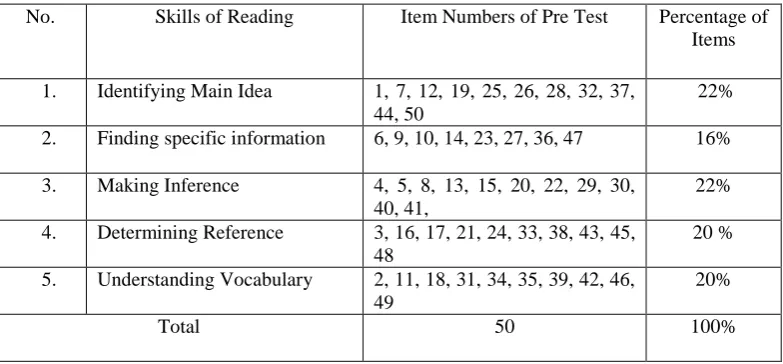
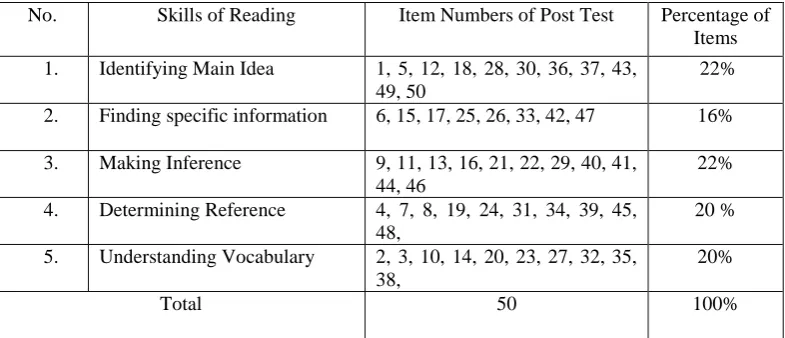
The Instrument of this research was reading comprehension test. The reading test of this research was conducted to find out how far teaching reading comprehension after given the treatment by using pre-questioning technique. Try out test contained 60 items. The test which was used in pre-test was the same with the test which was used in post test, but in the post test the questions were arranged randomly. Multiple choices test was used since its marking is rapid, simple and most importantly reliable, that is, not subjective or influenced by marker judgments (Heaton, 1975:151). Pre-test and post-test contained 50 items of reading in which there were four alternative answers for each (A, B, C, and D), one was the correct answer and the rest were the distracters.
The test was developed by the researcher and discussed with the experts (lectures and advisors) to measure the degree of agreement. The validity of the instruments referred to the content and construct validity in which the question represents five of sort reading skill i.e. detemining idea, finding the detail information, reference, inference and vocabulary (Nuttal, 1985).
3.4.2. Validity
Validity of the instrument was considered in this research. The researcher took content and constructs validity for this research. It was considered that instrument should be valid and in line with reading theory and the material. The validity of the instrument was presented as follows:
36
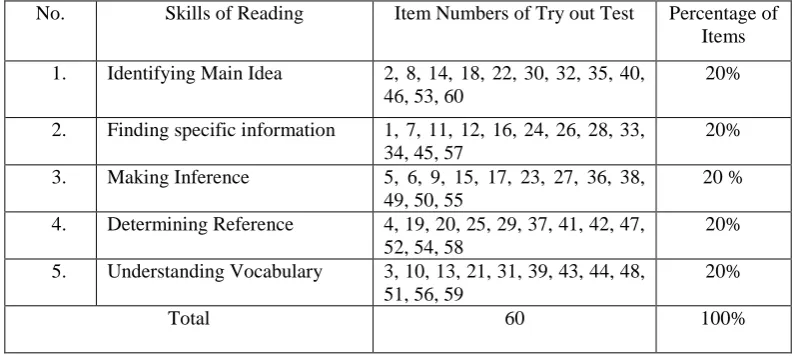
[image:51.595.111.509.446.624.2]validity is adequacy of the sample and simply on the appearance of the test (Hatch and Farhady, 1982:251). Content validity was intended to know whether the test items are good reflection of what will be covered. The test items were adapted from the materials that have been taught to the students. The test should be so constructed as to contain a representative sample of the course (Heaton, 1975:160). This research applied narrative text as the material. These are the following ways to prove whether the test has a good content validity; 1) it is adopted from Educational goal stated on KTSP English Curriculum and syllabus for the second grade of SMP students, 2) It represents the material teach in the class. According to Setiyadi (2006), to fulfill this type of validity the researcher should be aware of all the indicators of the test items and analyze whether the instrument, in this case reading test, have represented the material which will be measure.
Table 3.1. Specification of the instrument
No. Skills of Reading Item Numbers of Try out Test Percentage of Items 1. Identifying Main Idea 2, 8, 14, 18, 22, 30, 32, 35, 40,
46, 53, 60
20%
2. Finding specific information 1, 7, 11, 12, 16, 24, 26, 28, 33, 34, 45, 57
20% 3. Making Inference 5, 6, 9, 15, 17, 23, 27, 36, 38,
49, 50, 55
20 % 4. Determining Reference 4, 19, 20, 25, 29, 37, 41, 42, 47,
52, 54, 58
20% 5. Understanding Vocabulary 3, 10, 13, 21, 31, 39, 43, 44, 48,
51, 56, 59
20%
Total 60 100%
b. Construct validity was concerned whether or not the test performance can
be described psychologically (Hatch and Farhady, 1982:252-253). The
procedure was to determine experimentally what factors are related to test