129
Chapter 18
Vocational High School E-Learning Readiness: A Survey for Industrial
Knowledge Transfer
Abdi Suryadinata Telaga1,a, Rida Indah Fariani1,b
1
Astra Manufacturing Polytechnic, Komp. Astra International Tbk. Gedung B Jl.Gaya Motor Raya No.8, Sunter II, 14330 Indonesia
a
[email protected], [email protected]
Abstract. Indonesia requires highly skilled workers to support and sustain high economic growth. However,
in recent years youth unemployment remains high. The high unemployment rate is attributed to the lack of skills of vocational school graduates. The skills of these graduates do not match the technologies used in the industry. Astra Manufacturing Polytechnic (Polman Astra) aims to remedy the issue by initiating a blended learning program to transfer industrial knowledge for vocational school (SMK) teachers in Greater Jakarta. A descriptive study was conducted to SMKs in North Jakarta to understand school readiness level to implement the program. Furthermore, the research also analyzes the teacher perception of industrial knowledge. Following the questionnaire results, the study reveals that the schools surveyed are generally ready to implement e-learning but require further training. Further results indicate that exposing teachers to industrial knowledge is crucial in order to keep up with the technologies of the industry.
Keywords: highly skilled workers, vocational education, industrial knowledge, blended learning, e-learning
readiness.
I.
Introduction
130
Astra Manufacturing Polytechnic (Polman Astra) as an educational institution has close links to the industry aims to narrow the gap by providing the best industrial practice and the knowledge to SMK teachers. The objective is to provide suitable industrial skills for the SMK teachers in great Jakarta. With greater understanding, the teachers are expected to be able to transfer the industrial knowledge effectively to their student. Therefore, the students could obtain the essential skills to match the latest technologies by the industry. In 2015, Polman Astra implements the program industrial knowledge sharing to 20 SMKs around Greater Jakarta (Jabotabek). However, due to geographical and limited time schedules, implementing the program in each SMK has been a problem. With lowering costs of internet connectivity, the infrastructure has become more affordable for students to be online. Therefore, Polman Astra aims to deliver such materials through the internet. However, infrastructure inequality among SMK pose another challenge to deliver electronic learning (e- learning).
Blended learning is a concept that combines conventional learning and e-learning. According to Mazlouminaya et.al., blended learning have the advantages in pedagogy, accessibility and flexibility, and cost effectiveness compare to full e-learning [5]. Furthermore, blended learning can retain engagement between student and teacher. As a result, Polman Astra decided to deliver the courses through blended learning. While conventional teaching is normally not a problem, the e- learning must be carefully examine to ensure successful implementation of the program. Therefore, in light of inequality among SMKs, a pilot project to assess SMK readiness level has been conducted in 5 SMKs around Greater Jakarta. However, due to scheduling issues, current research data could only be obtained from 2 SMKs involving 29 teachers where both surveyed SMKs located in North Jakarta.
The objective of the research were two-fold:
[1]. To understand the readiness level of SMKs teachers to 1 blended learning concept in terms of
infrastructure, material content, financial and study mentality.
[2]. To recognize teachers’ perception about industrial knowledge transferred to their school. [3]. To our knowledge, the research was the first to utilize blended learning concept to share the best
industrial practices to SMK teachers in Indonesia. The research has contributed to enriching industrial knowledge dissemination methods for SMK teachers. The rest of the paper are organized as follow: Section 2 describes study literature, Section 3 explains research design, Section 4 is dedicated to surveyed results, Section 5 presents data analysis and discussion, and finally Section 6 concludes the implications and limitation of the research.
II.
Literature Review
E-Learning readiness is defined as an organization of physical and mental readiness to conduct and experience e- learning [6]. E-Learning readiness explains organization readiness level in various dimensions to implement e-learning. Researchers have discussed some of the dimensions to measure the readiness level to become the basis construction of e- learning readiness model.
131
Above previous works shared measurement dimensions that can be categorized based on the context and substance [13]. In this research the e-learning readiness dimensions were constructed as follow:
a. Human resources: organization culture, budget, people, self-development, skill/competency, e-learning training, user attitude, and industrial knowledge user perception.
b. Financial aspect: budget. c. Technology.
d. Infrastructure: networking and hardware.
[image:3.595.201.442.280.413.2]The dimension were used to calculate e learning readiness index. The index score represents an organization readiness level to accept and implement e-learning. To measure 11 e- learning dimensions, 42 Likert scale questions and 1 open question about current gadget used were constructed. Each dimension scores and final scores were thoroughly examine to interpret readiness index based on Aydin & Tasci scoring model [7] as depicted in Fig. 1. The model describes that in 1-5 Likert scale, the mean value of 3.4 is defined as the
Fig. 1. E-Learning Readiness index adapted from Aydin & Tasci [7].
expected readiness level. The mean value is defined based on critical level of 4 intervals/5 categories = 0.8. Therefore, the score below 3.4 implies that the organization is not ready to implement e-learning. Scores between 3.4 and 4.2 means that an organization is ready but still require a few improvements. Likewise, score above 4.2 indicates that an organization is ready to implement e-learning.
III.
Research Design
The research was an explorative research with case study to obtain a whole picture of particular context. Within the research, the context was knowledge sharing for vocational technical school in Greater Jakarta. Therefore, the research steps were described as follow: studying related literatures, determining research variables, designing questionnaire, collecting data, analyzing results, and conclusion.
The data used in this research are quantitative data for both primary and secondary data. Primary data were obtained from questionnaire results. Whereas, secondary data were obtained from literatures review of related works. The research was conducted in Greater Jakarta involving 5 SMKs. Those schools are the schools under Astra group supervision. However during first phase because of scheduling issues, the research was only able to obtain data from 2 SMKs in North Jakarta. However, the initial data from these location still provide an indication and important insight of SMK’s readiness level.
132
1. SMK teachers who are able to judge e-learning/blended learning aspects of the school. The teachers under this category are school heads and computer laboratory coordinators.
2. Teachers who have at least 3 years teaching experience in surveyed school.
[image:4.595.179.430.202.519.2]The research used both interviews and questionnaires to recognize school readiness in accepting and implementing blended learning concept. Moreover, the questionnaire was adapted from previous questionnaire and adjusted with SMK characteristic. Questionnaire used Likert scale (1-5) and all questions use Indonesian language to avoid misunderstanding of participants. The translation of some questionnaire
TABLE I
Sample Of Questionnaire Questions
Organization culture 1 2 3 4 5
K1 I understand e-learning.
K2 I understand value and
benefit of e-learning.
K3 I already have
independent learning habit.
K4 Teacher has good
knowledge sharing culture and cooperative.
Budget 1 2 3 4 5
B1 The school has allocated
budget for buying hardware to implement e-learning.
B2 The school has allocated
budget for internet connection.
People 1 2 3 4 5
PE1
PE2
PE3
The school has manpower to facilitate e-learning
implementation. I have enough experience in technology-based learning (i.e. Computer Based Learning, multimedia based learning).
I use internet as learning sources (Youtube, Blog, Tutorial, etc)
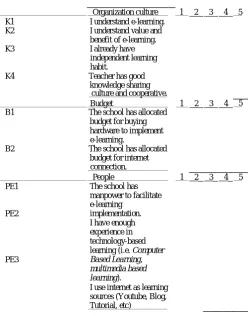
questions are showed in table 1. After all data were collected, the data were processed as follows: a. Calculate average values of all questionnaires in each research variables.
b. Determine readiness index for research variables according to index criteria by Aydin Tascii. c. Determine readiness index for each SMKs
d. Analyze e-learning readiness resulted from point (b) and (c).
IV.
Results and Discussions
133
[image:5.595.186.417.133.320.2]Those results implied that all SMKs in North Jakarta was ready to implement e-learning but required few improvement. The overall readiness index 3.90 was greater than expected readiness level 3.40. Fig. 2 shows the readiness level of each dimension. With the exception in training, other dimensions had readiness index above 3.40. Among eleven dimensions of the research, only training dimension with index score 1.83 that did not meet index score requirement. The results showed that all SMKs are ready to implement e-learning but require e-learning training to be
Fig. 2 SMK dimensions radar chart readiness level.
successfully implement the e-learning. The highest readiness level was self-development dimension that is 4.31 followed by skill dimension with score 4.19. Those scores represented that all SMKs teacher had high maturity to develop their skill in supporting successful e-learning implementation. Furthermore, they also had high computer literacy and already had adequate skill to implement e-learning.
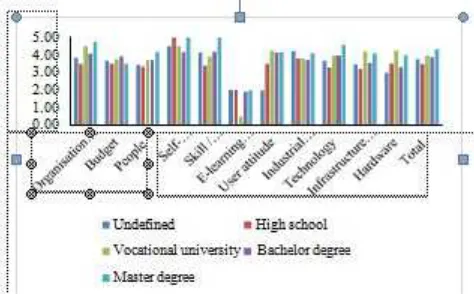
Further results showing dimension analysis based on respondents educational background are depicted in Fig. 3. The results showed that teachers with master degree background were the most optimistic and ready to implement e-learning without needed any improvements with score 4.32. While, teachers with other education background were ready but required few improvements. However, despite of optimistic perception, the high-educated teachers also perceived that e-learning training was mandatory for a successful e-learning implementation. In industrial knowledge user perception, the teachers with “undefined” educational background perceived that the industrial knowledge was important for the student.
The data revealed that the surveyed SMKs in North Jakarta were ready to implement e-learning with few improvements. All the SMK teachers shared the same perception of further training requirement before implementing the e-learning program. Further data in each dimension indicated that self- development had the highest dimension that means all teachers were ready to develop the skill themselves. Whereas, the rest of dimensions unveiled that all teachers required improvement before implementing the program.
134
Fig. 3 Dimension results of respondents’educational background.
[image:6.595.185.426.332.471.2]improvement to be able to deliver the suitable content to the students. This fact was supported with the question no 3 in teacher perception about their industrial knowledge dimension that had score 3.07 as depicted in table 2. The score was below the expected level of readiness. Therefore, transfer knowledge from industry is beneficial to SMK teacher in order to upgrade their skills to comply with industrial requirements.
TABLE II
Industrial Knowledge User Perception Result
No Questions Scor
1 I am interested to give industrial 4.28
2 I think that industrial knowledge could 4.59
3 I think that I have adequate industrial 3.07
4 My superior is fully supportive of 3.59
5 I can easily search and obtain industrial knowledge
material for my students.
3.48
V.
Conclusion
The descriptive research using survey data reveals that the surveyed schools are generally ready to implement e-learning but require further training to be successfully implement the program. Furthermore, the school should focus the improvement on hardware, network, and people to support the e-learning implementation. The study also shows that teachers with master degree background are the most ready teachers to implement e-learning. Furthermore, the teachers agree that they do not have adequate skills required to teach industrial knowledge. Therefore, transfer knowledge is needed to improve the teacher industrial knowledge.
135
References
[1]. -20, "Employment Plan 2014 - Indonesia," G20, Jakarta, 2014. [2]. OECD, "How does INDONESIA compare?," OECD, Jakarta, 2014.
[3]. M. Hasoloan, "Youth Employment in Indonesia," Ministry of manpower and transmigration, Semarang, 2013.
[4]. Newhouse and D. Soeryadarma, "The value of vocational education: High school type and labor market outcomes in Indonesia," The World Bank Human Development Network Social Protection and Labor Division, Melbourne, 2009.
[5]. S. Mazloumiyana, S. M. Shobeirib, M. Farajollahib and M. Mohamadic, "Blended e-Learning: a new approach to environmental education of Iran high schools," in Procedia - Social and Behavioral Sciences, Cypruss, 2012.
[6]. T. Swatman and T. So, " e-Learning Readiness in the Classroom: a study of Hong Kong primary and secondary teachers," in The Fifth IEEE International Conference on Advanced Learning Technologies (ICALT’05), Kaohsiung, 2005.
[7]. H. Aydin and D. Tasci, "Measuring Readiness for e-Learning: Reflections from an Emerging Country," Educational Technology & Society, vol. 8, no. 4, pp. 244-257, 2005.
[8]. A. Tarvid, "Measuring The E-readiness of Higher Education Institutions," Stockholm School of Economics in Riga, Stockholm, 2008.
[9]. S. Chapnick, "Are You Ready for E-Learning," Researchdog, 2000.
[10]. L. E. Akaslan, "Measuring Teachers’Readiness for E-learning In Higher Education Institutions associated with the Subject of Electricity in Turkey," in Global Engineering Education Conference (EDUCON), Amman, 2011.
[11]. A. Saekow and D. Samson, "A study of e-learning readiness of Thailand's higher education comparing to the United States of America (USA)'s case," in 3rd International Conference on Computer Research and Development (ICCRD), Shanghai, 2011.
[12]. K. Kaur and Z. Abas, "An assessment of e-learning readiness at the Open University Malaysia," in International Conference on Computers in Education, Melbourne, 2004.
![Fig. 1. E-Learning Readiness index adapted from Aydin & Tasci [7].](https://thumb-us.123doks.com/thumbv2/123dok_us/8801515.914229/3.595.201.442.280.413/fig-e-learning-readiness-index-adapted-aydin-tasci.webp)