Categorization and Grouping of Devices in Generic
Pervasive Applications
J.Madhusudanan
V.Prasanna Venkatesan
V. Indumathy
Research Scholar, Associate Professor PG Student
Pondicherry University, Pondicherry University Department of CSE
Puducherry Puducherry. Sri Manakula Vinayagar
Engineering College, Puducherry.
A.Kalaiselvi
C.Ramachandran
K.Preathee
PG Student UG Student UG Student
Department of CSE Department of CSE Department of CSE
Sri Manakula Vinayagar Engineering College, Puducherry
Sri Manakula Vinayagar Engineering College, Puducherry
Sri Manakula Vinayagar Engineering College, Puducherry
ABSTRACT
Quick advancement of the pervasive computing era with its underlying sources of contextual data, services and applications persistently attempts to support a variety of independent devices, with different environment, requirements and capabilities. Pervasive computing equipped with many independent collaborating electronic devices like sensors, actuators and complex device capable of sensing, actuating, computing and communicates. These devices belong to different administrative domains and users. As the number of interacting devices grows, there is a need of devices to group with common interest of users. Existing research on grouping approaches dealings with domain specific application, resulting of inflexible and incompatible. In this paper, we propose Device Categorization and capable of dynamic grouping of devices based on a user request. A grouping may contain any number of devices based on the application and its functions need.
Keywords
Inflexible, Incompatible, Device category, dynamic, device grouping
1. INTRODUCTION
Pervasive computing is an emerging trend that makes computers physically available but having stricking effect of invisible to users [1]. Other names given to this trend are Ubiquitous computing and Ambient Intelligence. The concept was introduced by Weiser in 1991. When primarily concerning the objects involved, it is also called physical computing, the Internet of Things, or haptic computing [2][3][4][5]. .
An approach of clustering of devices is done with area wise based on location based system(LBS).Here nodes with different MAC and mobility are grouped under different clusters based on different location[6]. In a Ubiquitous computing environment, independent like sensors, actuators and complex device
are widely spread out into action..How to effectively group the devices is a major challenge for pervasive environment.An idea of grouping of devices by
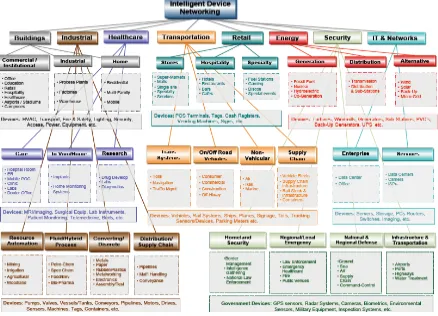
knowledge drawn form ontology that they need for their operation ,is discussed in[7].Panoply,a Java based middleware that assist developers in quickly developing ubiquitous computing application,the grouping of devices is performed based on location,social,task and communication group for mobile application[8].According to Harbour Research[9],Intelligent device is a global and economic phenomenon of unprecented proportions and its Intelligent device hierarchy shown in fig1.
Mobile Phones,PDA‟s,Smarts Human Centric Phones,Web Tablets,GPS…. Mobile
Info 3.5 billion
Appliances Desktop PC‟s Servers,Switches,
Storage… Static info 1.2 billion Appliances Vehicles,Cargo-Containers
Tankers,Trains,Off-Highway, Mobile devices 500 million Supply Chain Assests
Medical Device,HVAC,
Industrial Machinery, Static devices 425 million Distributed Generation..
Embedded Controllers,
Accelerometers,Temp/ Controllers and Smart Sensors 1.75 billion Pressure/Flow Sensors
Meters,Guages… Mixed Signal
Platforms,Micro- Microprocessors and MicroControllers 50 billion Processors,8 bit, Device 16 bit,32 bit… Centric
2. WHAT IS A DEVICE?
Pervasive Computing Systems (PCS) devices are likely to assume many diverse forms and sizes, from handheld units (similar to mobile phones) to near-invisible devices set into „everyday‟ objects (like furniture and clothing). All the objects can able to communicate with one another and act „intelligently‟ according to the environment[10].
A device is characterized as an objects or entity consisting of a set of properties, some internal mechanism, and an interface. The properties provide information about a device such as its purpose, its capabilities, vendor and operating requirements. These are critical information for both system integrators and service programmers. The internal mechanisms are responsible for the operation of the device and unknown to the external world. The gap between the internal mechanism and the external world is bridged by the interface of the device.
It specifies device IO and provides guidance to applications and other services to interact with the device. For example, the digital blood pressure monitor interface is responsible for parsing the byte streams to meaningful data and it is passed to the serial port of the monitor. From a service-oriented perspective, the properties of a device which are existent to its utilization by an external user are its properties and interface. The properties gives information about a device such as its purpose, its capabilities, vendor and operating requirements. The interface defines how a device interacts with its external users and provides ways to access the device either to get information from it and/or to control it[11].
3. CATEGORIES OF DEVICE
Devices can be classified into three categories namely: Sensors: input devices that discover some changes in the environmnet, user actions, human commands etc;
Actuators: output devices that response to process the information by changing the environment via electronic or mechanical means. For example, air temperature control is often done with actuators. However the term refers to devices which deliver information, rather than changing the environment physically.
Complex Device: A complex device which can both accept output from the external user and provide input to the external user. There are many goal for the future development of PCS devices. Many research groups are endeavouring to produce networks of devices that could be small as a grain of sand. The idea is that each one would function independently, with its own power supply, and could also communicate wirelessly with the others. These could be distributed throughout the environment to form dense, but almost invisible, pervasive computing networks, thus eliminating the need for overt devices.
At the other outermost point, augmented reality would involve overlaying the real world with digital information. This approach emphasizes the use of mobile technologies, geographical positioning systems and internet-linked databases to distribute information via personal digital companions. Such devices could come in many forms: children might have them integrated into school bags, whereas adults might use devices more closely resembling personal digital assistants (PDAs).
Ultimately a spectrum of devices may become available. These will range from miniaturized (potentially embedded in surrounding objects) to a variety of mobile (including handheld and wearable) devices. While these could exist as standalone systems, it is likely that many will be interlinked to form more comprehensive systems.
4. GENERIC DEVICE FRAMEWORK
A generic device framework(Fig 2) introduces a general framework for all devices in pervasive computing.A devices which has the common properties can be categorized(eg.mobile device,handheld devices etc., each can be one category).Each category can have a „n; number of device type(eg.for mobile device category PDA,cellphones,setupboxes etc., are device type).A device type have a „n‟ number of device representationincluding user interface class and database class.And the devices has to be dynamically grouped based on the user request.Finally,the devices has to be managed by device manager
.
device category
device
device type
group device manage device
n
m 1
n
m n
m
n m
n
m n
5. GENERIC APPLICATION DEVICE
For a Pervasive computing system, variety of smart devices are dispersed in a real World. For a Generic Device Category,the devices can be categorized based on
in order to perform overall function.We define set of devices called grouping of devices,based on application requirement(Fig4).
pervasive application (eg. Building, industrial etc.,)(Fig 3).
6. GENERIC DEVICE GROUPING
A pervasive system is equipped as collection of available devices that are scattered physically in the pervasive environment. In response to a user request, each device can perform one or more sub functions.Accordin to that particular function, the devices in the physical world arrange themselves such that they work with each otherA grouping of devices can consist of any number of ces . Steps for grouping of devices:
Step1:All devices are in initial state.
[image:3.595.78.516.127.443.2] [image:3.595.309.548.522.688.2]Fig 4: State chart diagram for Grouping of device Fig 3: Generic Device Category based on application(Harbor Research,2008)
initial state of a device
group device set up
execution
and control destroy
group request to configure a group device
device is not part of group/go to initial state
device is part of group execute
request for new group
group device finished with required function
group device destroyed
Step2:A device changes to group device setup when it receives the request from user to perform the sub-function. In this state, a device checks if it knows the sub function. If the request matches with its function the device joins to the group device setup. the process continues until all other sub function of request satisfies.
Step3:When a device becomes a part of group device, it goes to the execution state and execute the controller of
the device.
Step4:After the execution of the grouping device with the the required function it moves to the destroy group state and destroy the group.
Step5:After destroyed the group it goes to the initial state and again process continues for next grouping.
7. SAMPLE APPLICATION
For our Generic Device framework we have taken a Smart Home as a sample application.
7.1 Device Category For Home
DevicesThe devices can be categorized by,devices
which having common characteristics falls in each category.For Smart Home application,home devices are characterized as smart objects,cooling device,mobile device,sensors,electrical and electronic devices.The SmartObject Category includes door,window,curtain as device type(Fig 5).
[image:4.595.84.530.207.492.2]7.2 Sample Device Representation For
Tubelight
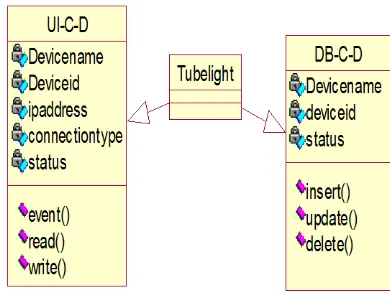
[image:4.595.353.548.557.707.2]In a Smart Home application each device includes user interface class(includes device name,device id etc.,)which defines configuration,characteristics and whether the device in read or write mode.It also includes database class for insertion,deletion and updation of each devices. Fig 6 shows an example for Tubelight.
7.3 Dynamic Device Grouping For Smart
Home
7.3.1 Scenario 1
When User walk into the kitchen and turn on Stove,turn on television with volume low.
Devices:Stove,Television.
Based on the Scenario from the user request,device groups class includes TV and Stove devices as one group to perform the subfunction of the request.The Device group kitchen includes groupname,groupid as attributes and creategroup,executegroup and delelegroup are methods
.
7.3.2 Scenario 2
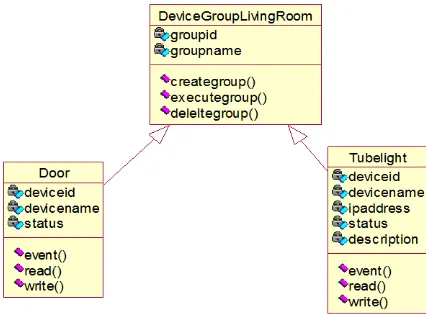
If User in the living room after 10pm,close the door and dim the living room lights.
Devices:Door,Lights
Thus the device grouping can be dynamically performed for smart home application for two sample scenario.
8. CONCLUSION
In this paper, we have proposed a generic device category based on application and capable of supporting dynamic grouping of devices based on user request. We have shown sample Smart Home application, how device category and grouping of devices can be performed in home devices.In the future, we plan to implement a smart home simulator tool for device category and dynamic grouping of devices and it should be a generic one.
9. REFERNCES
[1] Weiser, M. The Computer for the 21st Century, Scientific American, 1991, pp. 66-75.
[2] Greenfield, Adam (2006). Everyware: the dawning age of ubiquitous computing. New Riders. pp. p.11– 12. ISBN 0321384016.
[3] Hansmann, Uwe (2003). Pervasive Computing: The Mobile Word. Springer. ISBN 3540002189.
[4] "World Haptics Conferences". Haptics Technical Committee. http://www.world haptics.org/hapticConferences.htm. Retrieved on 2007-10-13.
[5] Marzano, S., Aarts, E. The New Everyday View on Ambient Intelligence, Uitg. 010 Pub. ISBN-10: 9064505020, 2003.
[6] R.S.Shaji,R.S.Rajesh,B.Ramakrishnan,F.Rajesh,” A Novel Routing and Service Migration Scheme for Communication among Heterogeneous Devices in Pervasive Environment”,IEEE,2011.
[7] Aly. A. Syed‡, Johan Lukkien†, Roxana FrunzaÞ “An architecture for self-organization in pervasive systems,2010 EDAA
[8] Kevin Francis Eustice “Panoply: Active Middleware for Managing Ubiquitous Computing Interactions”,2008.
[9] Sanfrancisco | Zurich “Pervasive Internet & Smart Services Market Forecast”, 2009 Harbor Research, Inc.
[10] POSTnote,”Pervasive Computing” May 2006.http://www.parliament.uk/documents/post/postp n263.pdf
[11] Mobile and Pervasive Computing Laboratory University of Florida,” Device Description Language Specification”,2007.
[image:5.595.60.273.600.757.2]