A New PWL Approximation for the ”Self-Adjustable
Offset Min-Sum” Decoding with a highly
Reduced-Complexity
Abdessalam Ait Madi
LSSC Sidi Mohammed Ben Abdellah University Faculty of Sciences and Technolgy B.P, 2202, Fez, V.N 30000 Morocco
Anas Mansouri
LSSC Sidi Mohammed Ben Abdellah University
National School of Applied Sciences of Fez
Ali Ahaitouf
LSSC Sidi Mohammed Ben Abdellah University Faculty of Sciences and Technolgy B.P, 2202, Fez, V.N 30000 Morocco
ABSTRACT
A new PieceWiseLinear (PWL) function is proposed for the de-coding of the Low-Density-Parity-Check (LDPC) code with the Self Adjustable Offset Min-Sum (SAOMS) algorithm.
Avoiding the use of the non-linear function f(x) = ln 1 +e−|x|in the adjustable offset factor, this linear approx-imation greatly simplifies the hardware implementation with a little BER performance loss.
The proposed solution is new, useful and is successfully tested on decoding regulars (504, 252) and (8000, 4000) LDPC codes. The corresponding Check Node Processing Unit (CNPU) have been designed, described and simulated using Very High Speed integrated circuits Hardware Description language(VHDL). The synthesis results were obtained using an Altera Quartus II soft-ware with cyclone II EP2CF896C6 as the target FPGA device. The designed CNPU is fully parallel and flexible to be used for different block length when a regulars (3, 6) LDPC codes are required.
Keywords:
LDPC , BER, FPGA, BP, PWL, VHDLifx
1. INTRODUCTION
Low-density parity-check (LDPC) code is an Error Correcting Code (ECC) which is used in highthrouput applications such the Digital Video Broadcasting for the second generation digi-tal satellite and terrestrial television broadcasting system (DVB-S2)[1], (DVB-T2)[2].
The LDPC codes [3]can be efficiently decoded with the original belief-propagation (BP) algorithm or the sum-product algorithm (SPA). The BP algorithm is recognized by its good error correc-tion performance [4] but needed many multiplicacorrec-tions to update the check and variable nodes which make it difficult to use for efficient hardware implementation.
Several modified versions of the BP decoding algorithm have been introduced such log-likelihood ratio belief propagation (LLR-BP) in which the multiplications are transformed in ad-ditions. In spite of this considerable simplification, the LLR-BP still shows some difficulties for digital circuit’s implementation. In fact it need the Look-Up Table (LUT) to implement respec-tively the hyperbolic tangent and the involution transform func-tion−ln(tanh(x))in thetanh-ruleand the Gallager’s approach LLR-BP based algorithm.
However the use of the LUTs introduces quantization effects leading to some performance degradation. Some non LUT-based approach has been developed. Among them, the Min-Sum (MS) algorithm [5, 6] which greatly reduces both the
computa-tional and the hardware implementation complexity, is the main approximated version. Despite these achievements in the im-plementation improvement, this simplification introduces non-negligible performance degradation due to the overestimation in the outgoing message from the check to variable node. Ever since, many approaches have been proposed leading to the de-velopment of many reduced-complexity variants of the BP al-gorithm to trade off between the BER performance and hard-ware complexity. The Normalized Min-Sum (NMS) and the Off-set Min-Sum (OMS) [6] are two kinds of schemes used to cor-rect the overestimation by using a fixed multiplying factor or a fixed additive offset factor. The optimal factor can be estimated by simulation or by the so-called Density Evolution (DE) [7]. In order to reduce more the performance degradation, several other approaches have been proposed, such the Degree Matched Min-Sum (DMMS)[8] in which the degree of the check node and offset factor are associated and the Adaptive Offset Min-Sum (AOMS)[9] which adapts the offset factor according to the min-imum magnitude output from the check node. Among the other works, the Self-Adjustable Offset Min-Sum algorithm (SAOMS) have been proposed for the Integrated Service Digital Broadcast-ing via Satellite-Second Generation (ISDB-S2) LDPC decoder [10]. This works shows that the offset value is mainly depen-dent on the difference between the second and the first minimum magnitude of the incoming messages to the check node, thus the offset value is made adjustable during the iterative decod-ing process. A performances comparison of the BP, NMS, OMS, DMMS, AOMS and SAOMS algorithms shows that the latter is an efficient candidate for the ISDB-S2[10]. Then, it was pro-posed that the non-linear functionf(x) = ln 1 +e−|x|
should be computed to update the check nodes. As a result both the computational complexity and the hardware resources were in-creased when compared to the those required for the OMS and the NMS algorithms [10].This non-linear function is then ap-proximated in hardware by using the LUTs or sometimes split into regions in which the behavior can be considered as linear. Motivated by this challenge we propose a new PWL function to transform and replacef(x).This non-linear function is then split on five pieces with a negligible performances loss. This novel approximation provides high BER performance with almost the same area and the computational complexity when compared to the MS. In addition, it can reduce computational complexity and hardware cost design when compared to LLR-BP algorithm. The PWL transformation approximates the continuous function linearly, using line segments to split the non-linear function in the required range. The objective is to estimate a section off(x)
have been proposed with a performances loss cost,as in the case of two linear regions [11], and with a hardware cost for the case of eight regions proposed by Hu et al. [12].
To validate the proposed approach, a new VHDL CNPU design is proposed and simulated. Besides, both of the LUT-based ap-proach and the PWL with two regions CNPU are also designed in the aim of comparison. The comparison of the synthesis results were obtained using an Altera Quartus II software with cyclone II EP2CF896C6 as the target FPGA device.
This paper is organized in the following manner. Section 2 presents the proposed approximation and its computation com-plexity. In the section 3 the simulation results are shown. The CNPU architecture and its FPGA implementation is presented in section 5 and 6. Finally in the section 7 concludes the paper.
2. PROPOSED APPROXIMATION
The check node update equation, in SAOMS algorithm [10] is given by
Lm =
Y
n0∈N(m)\n
sign(Zn0) (1)
max min
n0∈N(m)\n
(|Zn0|)−βo,0
!
Where
• N(m)\n, is the set of indexes ”n0” corresponding to the other Variable Nodes (VNs) connected to the Check Node (CN) ”m” withn06=n.
• Lmis the message coming from the CN, ”m”, to VNs, ”n”.
• Zn0the message coming from the VNs, ”n0”, to the CN, ”m”
• βois the adjustable offset factor given by
βo=γ0f(Zmin2−Zmin1) (2)
whereγ0is the normalization factor, chosen equal to1.25[10] andZmin1andZmin2are the first and second minimum
magni-tude of the incoming messages given by
Zmin1= min
n0∈N(m)(|Zn
0|) (3)
Zmin1= min
n0∈N(m)\min1
(|Zn0|) (4)
and f(Zmin2 −Zmin1) = ln 1 +e−|Zmin2−Zmin1|
. This function is respectivelly implemented with LookUp Table (LUTs) with quantization effects or directly with a high hard-ware cost.
In our approach, five intervals have been limited and in each one the function has been replaced by a linear functionaix+bi. The
different regions and their corresponding functions are grouped in table 1.
In this table, the linear function with the power of two of eachai
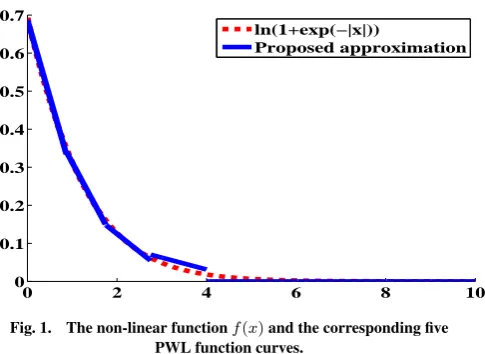
are given. These power of two representations, avoid the use of multiplications and uses only shifts and additions instead, which highly reduces the computation and hardware complexity. Note that all the numbers are represented in fixed-point two’s comple-ment with5bits for the fractionnal part. Figure 1 shows respec-tively the plots of the function and the proposed PWL approxi-mation. One can clearly notice the good agreement between the two functions.
To validate our approach, we first proceed by a computation complexity comparison. For that we use the optimal normaliza-tion factorγ0 = 1.25 = 20+ 2−2chosen to optimize both the
BER performance and hardware implementation [10] . To up-date a CN node one proceeds as follows: For the MS algorithm
0 2 4 6 8 10
[image:2.595.314.557.95.272.2]0 0.1 0.2 0.3 0.4 0.5 0.6 0.7 ln(1+exp(−|x|)) Proposed approximation
Fig. 1. The non-linear functionf(x)and the corresponding five
PWL function curves.
(dc−1)and(dc−2)items are compared serially to seek for the
first and the second minimum valuesZmin1andZmin2. Besides
another comparison is added to choose which minimum value to be used in equation (1) instead ofmin
n0∈N(m)\n(|Zn0|). Note
thatdcis the degree of a given CN node. For the SAOMS
algo-rithm with the PWL approximation (only two regions) proposed in [10], one need2(dc−1)+1comparisons, 5 additions, 4 rights
shift. The first2(dc−1)comparisons are performed in the same
way as in the MS algorithm and the last one is used to select which of0or −1
4x+ 5 8
has to be used instead off(x) calcu-lation. One addition is used to calculate thex=Zmin2−Zmin1
and two other to subtract the offset factor from Zmin1 and
Zmin2. Another addition and the two shifts are used to perform
the productγ0f(x) = 1.25f(x) = (20+ 2−2)f(x).The last
addition and the two remaining shifts are required to calculate −1
4x+ 5
8 = −2
−2x+ 0.625used to performf(x). For the
SAOMS algorithm with a LUT approximation, one need for the same number of comparisons, as in MS algorithm, 4 additions, 2 rights shift and an access to the LUT table. In such case, the same operations are performed in the same order as in SAOMS except that the addition and the two shifts to performf(x)are replaced by a LUT. The access to the LUT is used to read the value of the non-linear functionf(x)forx=Zmin2−Zmin1.
In the proposed algorithm, to update the same CN node, we need
2(dc−1) + 4comparisons in the worst case (x > 4);
how-ever we don’t need more than 3 additions and 5 shifts (in the worst case) to determine the value off(x)rather than the use of the LUT. This computation complexity comparison, for the four algorithms, is summarized in the table 2.
3. SIMULATION RESULTS
A regulars(504,252)and(8000,4000)LDPC code check ma-trices H downloaded from Mackay’s online database [14] are used in the software simulation. The fixed degree node of each VN and CN are three and six, respectively. Encoded bits are binary-phase-shift-keying (BPSK) modulated and transmitted over the simulated Additive White Gaussian Noise (AWGN) channel. The number of maximum iterations is set to16at each Signal to Noise Ratio (SNR) Eb/N0 value. The normalization factorγ0
for both SAOMS and the proposed algorithm is fixed to 1.25. For each SNR value, codeword of length504and8000
Table 1. Piecewise linear function approximation for
f(x) = ln(1 +e−|x|)
[image:3.595.60.281.439.583.2]Region PWL function
[0,0.875] −(2−2+ 2−3+ 2−5)x+ 0.6875
[0.875,1.75] −(2−3+ 2−4+ 2−5)x+ 0.53125
[1.75,2.75] −(2−4+ 2−5)x+ 0.3125
[2.75,4] −2−5x+ 0.15625
[4,+∞[ 0
Table 2. Results of the comparison of the computation complexity
Algorithm Comparisons Additions Shifts Others
MS 2(dc−1) − − −
SAOMS with PWL [10] 2(dc−1) + 1 5 4 −
SAOMS with LUT 2(dc−1) 4 2 1LU T
Proposed 2(dc−1) + 4 7 7 −
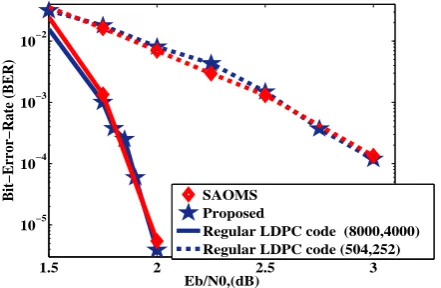
Figure 2 shows the comparison between the proposed PWL ap-proximation and the original SAOMS algorithm. It is clearly seen that there is no more performance degradation for both the regulars(504,252)and(8000,4000)LDPC codes.
Figure 3 shows the comparison performance between the SAOMS with the three approximations: the proposed PWL , PWL with two regions and LUT.
For the (8000,4000) LDPC code decoding, One can see clearly that, in high SNR, the SAOMS algorithm with the proposed ap-proximation have the better performance than one simulated with the two others approximations.
As a result the proposed PWL is better and have nearly exactly the same performances as the original algorithm. The proposed solution can be easily implemented in hardware when compared to the original algorithm.
1.5 2 2.5 3
10−5 10−4 10−3 10−2
Eb/N0,(dB)
Bit−Error−Rate (BER) SAOMS Proposed
Regular LDPC code (8000,4000) Regular LDPC code (504,252)
Fig. 2. Performances of a regular(504,252)and(8000,4000)
LDPC codes with the use of the proposed PWL, a normalization
factorγ0is set to1.25.
4. ARCHITECTURE FOR THE CN PROCESSING
UNIT FOR A REGULAR (3,6) LDPC CODE
This module receives6inputsZi (i=1 to 6) and6outputsLi
(i=1 to 6). To compute the message Li (i=1 to 6) , given by
equation(1) in hardware, we separate the operation into three main steps, sign calculation of the outgoing messageLi(i=1 to
6) and the two minimum magnitudes calculation of the incoming messages according to the equations (3) and (4) and finally, the determination of the Adjustable Offset Factor (AOF) according to the equation(2).
To construct a modular CNPU, the set of blocks will be instan-tiated in parallel manner to carry out the6messagesLi (i=1
Fig. 3. Performances of a regular(504,252)and(8000,4000)
LDPC codes decoded by the SAOMS algorithm with the use of the proposed PWL, PWL with two regions and LUTs approximations,
a normalization factorγ0is set to1.25.
to 6) at the same time. Figure 4 shows a global block diagram of the CNPU unit, which implements the check node equation according to the equation (1). Thecomp magcomputes in a par-allel manner the minimum magnitudes (Zmin1orZmin2)
corre-sponding to the6inputsZi(i=1 to 6). From the sixth inputs of
this CNPU, the sign block computes the signs of the6outputs Li. The two minimum magnitudesZmin1andZmin2are carried
out from themin searchblock.
The difference betweenZmin2andZmin1is performed by using
one adder and one unary minus operators. The final adjustable offset factor (AOF) is computed by using theshift adderblock. This block uses shifts and additions operations to perform the multiplication between thecomp nlfxoutput and the normaliza-tion factorγ0 = 1.25. The AOF is thereafter subtracted from the comp mag outputs by using six adders block to perform
min
n0∈N(m)\n(|Zn0|)−βogiven in equation (1). If the result is
negative themax in zeroyield the null output, otherwise it yield the computed result. The outputsLi(i=1 to 6), with the
Fig. 4. Bloc diagram of the proposed CNPU in parallel configuration.
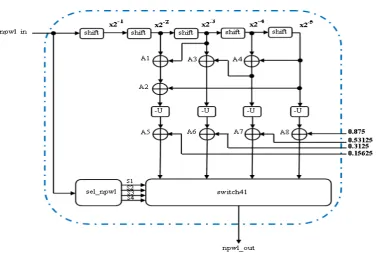
Fig. 5. Bloc diagram of the proposed approximation to replacef(x)with a PWL .
Table 3. The selected PWL according tosel npwlblock functionality
npwl in S1 S2 S3 S4 Selected PWL
≤0.875 1 0 0 0 −(2−2+ 2−3+ 2−5)x+ 0.6875
0.875>et≤1.75 0 1 0 0 −(2−3+ 2−4+ 2−5)x+ 0.53125
1.75>et≤2.75 0 0 1 0 −(2−4+ 2−5)x+ 0.3125
2.75>et≤4 0 0 0 1 −(2−4+ 2−5)x+ 0.3125
[image:4.595.63.542.708.780.2]In our case, the blockcomp nlfxin figure 4 is replaced by another block using the proposed PWL. Its corresponding block diagram is presented in figure 5. The single inputnpwl inof this block is the difference between the second and the first minimum magni-tudesZmin2 andZmin1. The fifth shifters block are combined
with four adders(A1, A2, A3 et A4)and four unary minus oper-ators to perform multiplications by the fourth slopes coefficients used in the first fourth PWL functions shown in the table 1. To add the y-intercepts0.875,0.53125,0.3125and0.15625to the results, four additional adders(A5, A6, A7 et A8)are used. The appropriate PWL is selected via aswitch41block controlled by thesel npwlblock according to the table 3. If the inputnpwl inis greater than4, the outputs ofsel npwlare set to zero and thereby theswitch41output drive zero. If not, one ofsel npwloutput is set to one to select the appropriate linear function, to be used according to the input value.
5. VHDL IMPLEMENTATION OF THE
PROPOSED CNPU
5.1 implementation
The work consists of transforming the two proposed designs into computerized representation by using the VHDL code. The blocks used in these designs are described and tested individu-ally following a modular approach. After checking the eventual errors and warnings in each module, all the elements were wired to produce the required top design. All the used blocks were in-stantiated in a parallel manner to implement the CNPU top de-sign given in Figure 4.
5.2 synthesis
The synthesis results for the proposed design is obtained using an Altera Quartus II software with Cyclone II EP2C70F896C6 as the FPGA target device. The SAOMS with LUT and PWL(with only two regions) uses 907 and 945 FPGA’s total logic elements respectively when the proposed algorithm with a new PWL uses 1081. This small increase of the area cost can easily justified by the performances amelioration in the proposed solution. The maximum frequency, after timing simulation, close178MHz by using one pipelined processing stage.
6. FPGA IMPLEMENTATION VALIDATION
In this hardware implemention functionality validation, the de-coder prototype designed in this paper is based on the regular matrix (10,5). The decoder have10VNs and5CNs. The corre-sponding Variabe Node Processing Units (VNPUs) and CNPUs, tested and validated individualy in ModelSim, are wired to copy exactly the Tanner graph [13].
6.1 Decoder performance within FPGA device
The Log LikeLihood Ratios (LLRs) values generated by a Mat-lab program and stored in hexadecimal file are loaded into input Megafunction Altera RAM:1 port. This LLRs has been applied to the decoder. The last one itertes until finding valid codeword or a maximum iteration is reached. The decoded words are writ-ten into output Megafunction Altera RAM:1 port and thereafter written into hexadecimal file. The BER is obtained, in Matlab, by comparing the code words, generated by the Matlab coding program, and the FPGA decoded words.
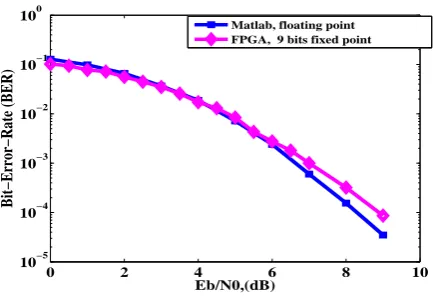
The performance results for both implemented decoders in Mat-lab and VHDL codes are presented in figure 6. At SNRs 6 dB be-low, the hardware decoder and Matlab floating point are in com-plete agreement. At higher SNR’s (6.5 dB and above) the Matlab floating point outperforms the FPGA implementation due to su-perior precision in a floating point representation.
The performance comparison prove that the design has been cor-rectly implemented and run onto FPGA device.
0 2 4 6 8 10
10−5 10−4 10−3 10−2 10−1 100
Eb/N0,(dB)
Bit−Error−Rate (BER)
[image:5.595.321.538.97.246.2]Matlab, floating point FPGA, 9 bits fixed point
Fig. 6. Performances of a regular(10,5)LDPC codes decoded by
the SAOMS algorithm with the use of the proposed PWL,
implemented in Matlab and FPGA device. a normalization factorγ0
is set to1.25and the maximum of iterations is equal to 16.
7. CONCLUSION
In this paper, we propose to transform and replacef(x)by a new PieceWise Linear function to improve the decoding with the pre-vious Self Adjustable Offset Min-Sum (SAOMS).
Avoiding the use of the non-linear function f(x) = ln 1 +e−|x|
in the adjustable offset factor, this linear ap-proximation achieve a good balance between the Bit-Error-Rate (BER) performances and the hardware implementation. The sim-ulations results validate the effectiveness of the proposed approx-imation. The last one is useful and it was successfully tested on decoding regulars (504, 252) and (8000, 4000) LDPC codes. The designed CNPU is fully parallel and flexible to be used for different block length when a regulars (3, 6) LDPC codes are required.
8. REFERENCES
[1] Digital Video Broadcasting (DVB).2004. Second generation framing structure, channel coding and modulation systems for Broadcasting, Interactive Services, News Gathering and other broadband satellite applications. Draft ETSI EN 302 307 V1.1, European Standard (Telecommunications series). [2] Digital Video Broadcasting (DVB).2009. frame structure,
channel coding and modulation systems for second genera-tion digital terrestriel television broadcasting system (DVB-T2). Draft ETSI EN 302 755 V1.1.1 , European Standard (Telecommunications series).
[3] R.G.Gallager. 1963. Low Density Parity Check Codes. MA: MIT Press. Cambridge.
[4] D.J.C.Mackay. Good Error-Correcting Codes Based on very Sparse Matrices. IEEE Transaction on information Theory. Res. 45(Jan. 1999), 399-431.
[5] M.P.C.Fossorier,M.Mihaljevic,H.Imai. Reduced Complex-ity Iterative Decoding of Low DensComplex-ity ParComplex-ity Check codes based on Belief Propagation. IEEE Transaction on Commu-nications. 47(May. 1999), 673-680.
[6] J.Chen,A.Dholakia,E.Eleftheriou,M.Fossorier,X.Y.Hu. Reduced-Complexity Decoding of LDPC codes. IEEE Trans-action On Communications. 53(Aug. 2005), 1288-1299. [7] J.Chen, M.P.C.Fossorier. 2003. Density evolution for
BP-based decoding algorithms of LDPC codes and their quan-tized versions. In Proceedings of the IEEE GlOBCOM’02. [8] S. L. Howard, C. Schlegel, and V. C. Gaudet.
[9] M. Jiang, C. Zhao, L. Zhang, and E. Xu. Adaptive offset min-sum algorithm for low-density parity check codes. IEEE Communications Letters, 10(2006), 483-485.
[10] W.Ji,M.Hamaminto,H.Nakayam,S.Goto. Self-Adjustable Offset min-sum Algorithm for ISDB-S2 LDPC Decoder. IEICE Electronis Express. 7(Aug. 2010), 1283-1289
[11] M.M. Mansour,N.R. Shanbhag. High-Throughput LDPC Decoders. IEEE Transaction on very large integration sys-tems. 11(Dec. 2003), 976-996.
[12] X.Yu.Hu, E.Eleftheriou, D.M.Arnold, A.Dholakia. 2002. Efficient Implementation of the Sum-Product Algorithm for Decoding LDPC Codes. In Proceedings of the IEEE GlOB-COM’01.
[13] R.M.Tanner. A recursive Approach to Low Complexity Codes. IEEE Transaction on information Theory. IT-27(Sep. 1981), 533-547