Enabling mobile commerce through mass
customization
Pousttchi, Key and Selk, Bernhard and Turowski, Klaus
University of Augsburg
2002
Online at
https://mpra.ub.uni-muenchen.de/3623/
Enabling mobile commerce through mass customization
Key Pousttchi, Bernhard Selk and Klaus Turowski
University of Augsburg, Chair of Business Information Systems (Wirtschaftsinformatik II),
Univer-sitätsstraße 16, 86135 Augsburg, Germany, phone: +49(821)598-4431, FAX: -4432,
e-mail: {key.pousttchi| bernhard.selk| klaus.turowski}@wiwi.uni-augsburg.de
Abstract: Mobile commerce as a new degree of electronic commerce arises from the convergence of Internet and mobile communication technologies. In order to be successful in mobile business, it is not sufficient to simply transfer conventional Internet applications or E-Commerce business models on mo-bile devices. Added values for the customer are necessary. Typical informational added values in Momo-bile Commerce originate from ubiquity, context-sensitivity, identifying functions or command and control functions. Mobile devices implicate disadvantages, which can be equalized by individualization. For the simplest devices, this is satisfied with simple features like housings, ring tones or logos. The more up-market the device is, the more the individualization focus is laid on the applications instead of the device itself. In terms of mass customization, the individualization of mobile devices and applications can be categorized as soft customization. Below this level, three kinds of customization have to be distinguished: The first one is device adaptation which means the customization of the device itself. The next one is ap-plication adaptation and describes the customization of the apap-plications through the customer or as self-individualization of the software. The last one is service composition and means the package of services or the customer-individual composition of applications and services, which can be done either by the tomer, by the provider or by collaboration of both. In this paper we show the importance of mass cus-tomization and its techniques for the success of mobile commerce.
Keywords: Mass customization, M-Commerce, mobile added values, point-of-delivery-customization, service composition
1 Introduction
Mobile phones have the highest distribution rate of all IT devices and bid the possibility to reach the customer anytime and anywhere. In order to be successful mobile commerce has to vanquish his own disadvantages. In this paper we show the mass customization technique of individualization which the success of mobile com-merce will be based on, amongst other things. These techniques in cooperation with mobile added values are the basis therefore. The development of rational applica-tions which lead to added values is mandatory for the success of mobile commerce.
Mass customization is a synthesis between mass pro-duction and the propro-duction of highly specialized and individualized products. It aims at the production of individual products with high quality at cost factors typical for mass production and comparable short deliv-ery times (cf. [5]).
Electronic commerce (EC) may be defined as “any form of business transaction in which the parties interact electronically rather than by physical exchanges or direct physical contact” [1].
Mobile Commerce is defined as a subset of EC, on condition that at least one side uses mobile communica-tion techniques for initiacommunica-tion, supply or arrangement of service.
Concerning mobile commerce we differentiate primary between business to business (B2B) mobile commerce and business to consumer (B2C) mobile commerce. Both fields can benefit from mass customization. All applications can be configured more effectively by individualization through mass customization. B2B applications will not be treated as detailed in this paper as B2C applications, because in our point of view mass customization is stronger deputized in B2C than in B2B.
one-click-systems) or mobile advertisement (1:1 marketing, cus-tomer profiles or utilization rights for cuscus-tomer pro-files). In all these examples mobile added values are reached by individualization caused by mass customiza-tion.
Problems of mobile commerce are limited presentation, limited bandwidth and limited handling. These disad-vantages are stronger distinct as in electronic commerce. Mass customization offers solutions to solve these prob-lems, e.g. individualization. Individualization means in the context of this paper the strategic proceeding of an offerer to get preferences and therefore competitive advantage by orientating to the individual characteristics of customer (cf. [4]).
First we will explain mobile added values to see where mass customization techniques as individualization can interfere. Afterwards we show different types of mass customization to see where working points for mass customization are within mobile added values to suc-ceed mobile commerce.
2 Obtaining supplementary informational
added values through mobile added
val-ues
The examination of EC shows that the success of an electronic offer (measured by frequency of use) does not come automatically. In particular, it is not sufficient to simply make a conventional offer available through a web site. Compared to a conventional offer, added val-ues are necessary.
The theory of informational added values terms these added values resulting from EC as informational added values (IAV) and classifies them into seven main types (cf. [3]):
− comparative added values typically result from the exhaustion of the superior electronic presentation potential such as the availability of a first-run film preview on a ticket order website or of customer reviews in a virtual bookshop,
− added values with efficiency impacts cover the increase of efficiency through the use of an EC so-lution, e.g. cost advantages,
− added values with effectiveness impacts cover the increase of effectiveness through the use of an EC solution, e.g. increased customer satisfaction or time advantages over conventional solutions,
− integrative added values come into existence through the composition of different independent products or services to an integrated product or ser-vice (or combination of both), e.g. through portals,
− organizational added values cover the opportunity to build new forms of organization through the use of Internet technology, for instance the creation of virtual companies as temporary, mission-bound networks,
− strategic added values cover advantages that go beyond the operational and tactical level, e.g. the opportunity of worldwide customer acquisition for a small specialized company or protection against the loss of a complete market segment which could be the consequence of lacking Internet presence,
− innovative added values cover the creation of an entirely new product or service (or combination of both) through the usage of Internet technology, e.g. the customer-individual production of bulk articles through mass customization strategies.
Directing our attention back to mobile commerce, we encounter an interesting fate: Analogous to the transi-tion from a conventransi-tional offer to an electronic one, in order to have a successful mobile offer it is also not sufficient to simply port an electronic offer on a mobile device. Gonzales for instance states that “Taking an application wireless involves much more than simply porting an existing Internet site to a browser-enabled phone. Mobile applications differ greatly from ones created for PCs and laptops because their users have a different set of needs and expectations.” [2]. At this point also, added values are needed.
From this fate we conclude that the theory of informa-tional added values can be extrapolated to the transition from EC to mobile commerce. The result of this reflec-tion would be a requirement of supplementary IAV through the use of mobile technology.
Since we defined mobile commerce as a subset of EC using mobile communication technology and mobile devices, the difference of mobile commerce solutions in opposite to the EC ones can only originate in the use of these technologies and so can possible supplementary IAV.
Thus, we have to identify the typical advantages of the use of mobile communication technology and mobile devices in opposite to the exclusive use of not-mobile Internet technology. We will call these advantages mo-bile added values (MAV) and stress as an intermediary result that some or all of these MAV will be the cause for any supplementary IAV of a defined mobile solution in opposite to its non-mobile counterpart.
typi-nearly anytime and anywhere. It permits the reception of time-critical and private information. Thereby and by persistent attendance for transactions it is possible to get e.g. warnings for exchange loss even if the recipient is not reachable by other forms of communication. An-other example for an application is personalized news, e.g. through the service of AvantGo. Internet has to divide information and physical products. Mobile com-merce can consolidate these two parted attributes (cf. [8]). This may e.g. lead to IAV with efficiency or effec-tiveness impacts.
Another typical attribute is context-sensitivity, which describes the delivery of customized products or ser-vices fitting the particular needs of the user in his cur-rent situation. This can e.g. be achieved by determining the location of the user, by analyzing correlations with the location of other users, by direct interaction or by personalized preference profiles. Typical applications based on the MAV of context-sensitivity are location based services. Location based services permit also local and personal advertisement from nearby shops, local news, weather reports, list of events or to post an emergency call (cf. [8]). The MAV of context-sensitivity may e.g. lead to an innovative IAV.
Furthermore, the possibility to authenticate the owner of any mobile device through his subscriber identification is immanent to a cellular phone network. Along with the typical 1:1-attribution of a mobile device to its user (which is perhaps not true for any other technical device except a wristwatch) and the possibility to use further means of authentication on the device, this results in
identifying functions of mobile devices. Possible effects are a high usability for transactions with monetary value (discussed under the keyword of the personal trusted device) or the opportunity to get very exact user profiles based on the behavior of the customer, enabling 1:1 marketing concepts. Identifying functions can result in almost any of the named IAV.
The last characteristic we found are command and con-trol functions of mobile devices. Mobile devices can be used as remote control for individual combinations of other devices using personal, local, or wide area net-working capabilities. In the target device, control may be realized using ubiquitous computing concepts and technologies.
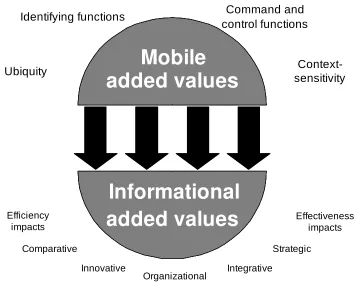
The relation between mobile added values and informa-tional added values is visualized in Figure 1.
Identifying functions
Mobile
Lösungen
Innovative Integrative
Strategic
Organizational
Informationelle
Mehrwerte
Mobile
Lösungen
Ubiquity
Context-sensitivity
Command and
control functions
Mobile
Lösungen
Mobile
added values
Comparative
Informationelle
Mehrwerte
Efficiency impacts
Effectiveness impacts
Informationelle
Mehrwerte
[image:4.595.118.476.405.700.2]Informational
added values
3 Support of mobile added values through
mass customization
Individualization enables individual offers with added values e.g. by entertainment, savings of cost and time, quality and exclusiveness. It is also possible to make an individualized price-policy by price differentiation, an individualized communications-policy by collaborative filtering or an individualized distributions-policy for digitalized products. For physical products mobile commerce is used rather for provision of information or sales promotion than for the sale itself.
Within mass customization we distinguish between hard and soft customization. Hard customization means manufacturing engagement. Soft customization means individualization outside of the manufacturing com-pany. In terms of mass customization, the individualiza-tion of mobile devices and applicaindividualiza-tions can be catego-rized as soft customization.
Different kinds of customization are discussed in litera-ture (cf. [4], [6]), as shown in table 1. In this paper we do not address these kinds of customization, but device adaptation, application adaptation and service composi-tion, which are explained afterwards. Through these three kinds of customization informational added values develop.
3.1 Device adaptation
Device adaptation is differentiated in two specifications. The first one means the possibility to order in advance individual or personal attributes. The second one de-scribes the supplementary individualization of products or services. Concerning devices, individualization as a technique of mass customization can interfere in devices relating points as logos, ring tones or covers. This form of customization is also known as self customization. (cf. [7])
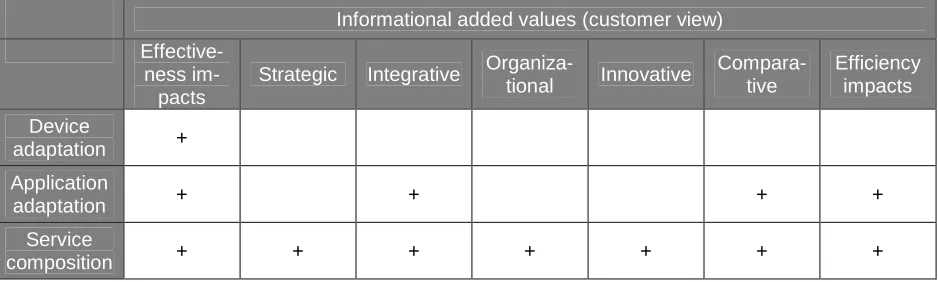
Effectiveness properties are an integral part of device customization. It stems from better device recognition and user satisfaction by individualizing their own de-vices, e.g. ring tones for specific callers.
3.2 Application adaptation
This kind of adaptation allows for individualized per-sonal (graphical) user interfaces to the respective de-vices. It means the customization of the applications running on the devices through the user. The user will be able to change the user interfaces on his own.
Application adaptation causes effectiveness properties, since the achievement of objectives by individualization of software and by controlled information contacts will be improved, e.g. by the service AvantGo.
Soft customization
Engagement in production is not necessary. Individualization takes place outside the manufac-turing companies
Service Customization Supplement of standard products with customer specific services
Supplement with consulting or technical services
Self-individualization Individualization takes place by customer or the product itself
Intelligent components, recorda-ble congratulation card
Point of delivery customiza-tion
Customer specific final produc-tion of prefabricated products by the salesman
Skiing boots (Dynafit, Technica, Nordica)
Hard customization
Engagement in production isnecessary
Modularization Customer specific combination of modules
PC (e.g. Dell), individualized media (e.g. newspaper) Mass production of unique
items
Tools, furniture
Customer specific intermedi-ate or final production
Customer specific intermediate or final production with standard-ized manufacturing for all the rest of stages of production
[image:5.595.57.536.461.706.2]Customer specific design of skis, customer specific layout of clothes
Application adaptation causes an improved achievement of personal objectives, e.g. menu structure. The naviga-tion menu allows for individualizanaviga-tion by setting spe-cific functions to hotkeys.
Furthermore, integrative added values may be achieved. An example for this is the optimized procedure to get an Internet connection. This may be done by connecting single tasks to application managed workflow.
Comparative added values result by improvement, com-pared to conventional offers and can be reached by adequate exhaustion of the electronic presentation po-tential, which comes through the individualization of graphical user interfaces.
The added value efficiency property is also part of ap-plication adaptation, because it causes improvement of profitability. The utilization of individualized software achieves cost and time advantages, e.g. saving time by getting tight and concise customer specific information, e.g. location based advertisement.
Application adaptation also causes informational added values with efficiency properties. This means the re-striction to customer specific content, e.g. information about weather only for specific regions.
3.3 Service composition
Service composition bases on the service customization concept. According to (cf. [6]) service customization is the supplement of a standardized product with customer specific services, e.g. consulting or technical servicing. In this paper service composition means the provision of customer specific service packages e.g. through portals. By limited presentation potential portals become very important in mobile commerce. Originally service
cus-tomization allows customers to add specific services to the product (cf. [7]). Digitalized products are repre-sented mostly in service composition and cause creating of new joint products, since digitalization lightens the individualization of products and services. Individual composition of applications and services can be done either by customer, provider or by collaboration of both.
Service composition reverts to most of the informational added values we have identified in this paper. Effec-tiveness properties as time and cost advantages are given by service packages. This leads to lessened ex-pense, e.g. by booking an journey with different kind of trips as sports trip, culture trip and flight journey as a service package at one tour operator in place of three tour operators, each of them being a specialist in one of these different kinds of tours.
Strategic added values can arise by knowledge head start, e.g. by news services as AvantGo, which makes it possible, to benefit by getting information anywhere and anytime.
Integrative added values in service composition develop common by Internet services, as these services lead to new products, whose technical realization in done by web services.
Innovative added values are also a part of service com-position, since completely new products are possible by service packages, e.g. realized with web services. En-hanced by mobile phones, device manufacturer offer devices with an implemented payment function. Mobile phones can be used for both, for phoning and for pay-ment.
Comparative added values can be reached by an
im-Informational added values (customer view)
Effective-ness im-pacts
Strategic Integrative
Organiza-tional Innovative
Compara-tive
Efficiency impacts
Device
adaptation + Application
adaptation + + + +
Service
[image:6.595.65.534.565.706.2]composition + + + + + + +
proved presentation potential, e.g. portals.
Service composition also leads to efficiency properties, because it causes improvement of profitability. The utilization of service packages achieves advantages of cost and time, e.g. booking of a journey can be done at one and not at e.g. three tour operators. This would be necessary, if the tour operator can not offer all wanted services in a service package.
4 Conclusion
As we showed in this paper, mass customization is adapted to enable mobile commerce especially through service composition. Additional to this, informational added values have to be offered. Without these instru-ments it will be difficult to ensure success for mobile commerce.
First we showed the transfer to electronic commerce by informational added values. Afterwards we explained the transfer from electronic commerce to mobile com-merce by combination of informational added values and mobile added values. From these values we de-duced individualization rudiments, which are important for mobile commerce.
Table 2 depicts the relation between informational added values, as described in chapter 2, and different kinds of customization.
References
[1] ECOM (ed.), Electronic Commerce – An Introduc-tion, http://ecom.fov.uni-mb.si/center/, access: May 15, 1998, 1998.
[2] Gonzalez, J.D.: A Roadmap to Wireless: The State of the Technology. Atlanta 2001.
[3] Kuhlen, R.: Informationsmarkt: Chancen und Risi-ken der Kommerzialisierung von Wissen. 2. Aufl., Universitätsverlag Konstanz, Konstanz 1996. [4] Piller, F.: Mass Customization - Ein
wettbewerbs-strategisches Konzept im Informationszeitalter, Gabler Verlag, München 1998.
[5] Pine II, B. J.: Mass Customization: The New Fron-tier in Business Competition. Boston 1993. [6] Reiß, M.; Beck, T. C.: Fertigung jenseits des
Kos-ten-Flexibilitäts-Dilemmas: Mass-Customization als Strategiekonzept für Massenfertiger und für Einzelfertiger. VDI-Z 136(11/12), S. 28-30. 1994. [7] Turowski, K.; A Virtual Call Center Solution for
Mass Customization. In: R.H. Sprague (Hrsg.): Proceedings of the 32nd Annual Hawaii Interna-tional Conference On System Sciences (HICSS-32), Maui, Hawaii, 1999.
![Table 1: Different kinds of customization according to [4] and [6]](https://thumb-us.123doks.com/thumbv2/123dok_us/8108049.790062/5.595.57.536.461.706/table-different-kinds-customization-according.webp)