http://dx.doi.org/10.4236/am.2014.515227
An Asymptotic Distribution Function of the
Three-Dimensional Shifted van der Corput
Sequence
Jana Fialová
1, Ladislav Mišk
2, Oto Strauch
11Mathematical Institute, Slovak Academy of Sciences,Bratislava, Slovakia 2Department of Mathematics, University of Ostrava, Ostrava, Czech Republic
Email: [email protected], [email protected], [email protected]
Received 25 May 2014; revised 1 July 2014; accepted 15 July 2014
Copyright © 2014 by authors and Scientific Research Publishing Inc.
This work is licensed under the Creative Commons Attribution International License (CC BY). http://creativecommons.org/licenses/by/4.0/
Abstract
In this paper, we apply the Weyl’s limit relation to calculate the limit
( ) (
) (
)
(
)
(
)
(
)
,∑
1∫ ∫ ∫
1 1 10 0 0 0
1
, 1 , 2 , , d d d , ,
lim
N
q q q x y z
N n
F n n n F x y z g x y z
N
−
→∞ =
γ
γ
+γ
+ =where γq
( )
n is the van der Corput sequence in base q, g x y z(
, ,)
is the asymptotic distributionfunction of
(
γ
q( ) (
n ,γ
q n+1 ,) (
γ
q n+2)
)
, and F x y z(
, ,)
=max(
x y z, ,)
, min(
x y z, ,)
and xyz, re-spectively.
Keywords
Sequences, Arithmetic Means, Riemann-Stieltjes Integraion
1. Introduction
In this paper we apply the Weyl’s limit relation [1] (p. 1-61)
( )
[ ]0,1( ) ( )
1
1
d ,
lim N
s n N n
f f g
N
→∞
∑
= x =∫
x x (1.1)q and g x
( )
is the asymptotic distribution function (abbreviated a.d.f.) of xn and s=3. The van der Corput sequence in base q is defined as follows: Let k 0k
n=n q ++n be the q-adic expression of a positive integer n. Then
( )
0 12 1, 0,1, .
k
q k
n n n
n n
q q q
γ = + + + + = (1.2) It is well-known that this sequence is uniformly distributed (abbreviated u.d.), see [1] (2.11, p. 2-102), [2]
(Theorem 3.5, p. 127), [3] (p. 41).
For s=2 a motivation for the study of the distribution function (abbreviated d.f.) g x y
(
,)
of( ) (
)
(
γ
q n ,γ
q n+1)
, n=0,1, is a result of Pillichshammer and Steinerberger in [4] which states that( )
(
)
(
)
1
2 0
2 1
1
1 ,
lim N
q q
N n
q
n n
N γ γ q
−
→∞ =
−
− + =
∑
(1.3)while in J. Fialová and O. Strauch [5] the relation (1.3) was proved applying (1.1) as
(
)
(
)
1 1
2 0 0
2 1
d , q .
x y g x y q
−
− =
∫ ∫
Moreover, in the Unsolved Problems [6] (1.12), the following problem is stated: Find the d.f.
(
1, 2, , s)
g x x x of the sequence
(
γ
q( )
n ,,γ
q(
n s+ −1)
)
, n=0,1, 2,, in[ ]
0,1s. Ch. Aistleitner and M. Hofer [7] gave the following theoretical solution:Theorem 1 Let
T
denote the von Neuman-Kakutani transformation described in Figure 1. Define the s-dimensional curve
{
γ( )
t t; ∈[
0,1)
}
, whereγ
( )
t =(
t T t T,( ) ( )
, 2 t ,,Ts−1( )
t)
. Then the searched a.d.f. is(
1, 2, , s)
{
[ ]
0,1 ;( )
[
0, 1] [
0, 2]
[
0, s]
}
,g x x x = t∈ γ t ∈ x × x × × x
where X is the Lebesgue measure of a set
X
. [image:2.595.204.427.449.717.2]The paper consists of the following parts: After definitions (Part 2) we derive the a.d.f. of
(
γ
q( ) (
n ,γ
q n+1)
)
Figure 1. Line segments containing
(
γq( ) (
n ,γq n+1)
)
1, 2,
Haoshangban (Part 3), the a.d.f. of
(
γ
q( ) (
n ,γ
q n+2)
)
(Part 4), intervals containing( ) (
) (
)
(
γ
q n ,γ
q n+1 ,γ
q n+2)
in diagonals (Part 5) and an explicit form of a.d.f. g x y z(
, ,)
(Part 6). As an application (Part 7) we compute the limit( ) (
) (
)
(
)
(
)
(
)
(
)
1 1 1 1
0 0 0 0
1
, 1 , 2 , , d d d , ,
lim N
q q q x y z
N n
F n n n F x y z g x y z
N
γ
γ
γ
−
→∞
∑
= + + =∫ ∫ ∫
(1.4)for F x y z
(
, ,)
=max(
x y z, ,)
, min(
x y z, ,)
and xyz, respectively, see (0.39), (0.41) and (0.46).2. Definitions and Notations
Let xn, n=1, 2, be a sequence in the unit interval
[
0,1 . Denote)
•( )
#{
; n[ )
0,}
N
n N x x
F x
N
≤ ∈
=
the step distribution function (step d.f.) of the finite sequence x1,,xN in
[
0,1 , while)
FN( )
1 =1. • A function g: 0,1[ ] [ ]
→ 0,1 is a distribution function (d.f.) if(i) g x
( )
is nondecreasing; (ii) g( )
0 =0 and g( )
1 =1.• A d.f. g x
( )
is a d.f. of the sequence xn, n=0,1, 2, if an increasing sequence of positive integers1, 2,
N N exists such that limk→∞FNk
( )
x =g x( )
a.e. on[ ]
0,1 .• A d.f. g x
( )
is an asymptotic d.f. (a.d.f.) of the sequence xn, n=1, 2, if limN→∞FNk( )
x =g x( )
a.e. on[ ]
0,1 .• The sequence xn is uniformly distributed (abbreviating u.d.) if its a.d.f. is g x
( )
=x.• Similar definitions take place for s=2, 3 and s-dimensional sequence xn, n=0,1, 2,, in
[
0,1)
s, cf. [1] (1.11, pp. 1-60).• In the sequel the 3-dimensional interval I we denote by I =IX× ×IY IZ, where IX,IY,IZ are pro- jections on X Y Z, , axes, respectively.
3. a.d.f. of
(
γ
q( ) (
n
,
γ
qn
+
1 ,
)
)
n
=
1, 2,
Let q≥2 be an integer.
Lemma 1 Every point
(
γ
q( ) (
n ,γ
q n+1)
)
, n=0,1, 2,, lies on the diagonals of intervals1 1
0,1 ,1
q q
− ×
(1.5)
1 1
1 1 1 1
1 i,1 i i , i , i 1, 2,
q q+ q+ q
− − × =
(1.6)
Proof. Express an integer n in the base q
1
1 1 0,
k k
k k
n=n q +n−q − ++n q+n
where ni<q and nk >0. We consider the following two cases:
0 0
1 . n < −q 1,
0 0
2 . n = −q 1. Let
0 0
1 . n < −q 1 Then
0
k k
2337
0
1 k k 1
n+ =n q ++n + and by (0.2)
(
)
( )
11 q n q n
q
γ + −γ = . In this case
( )
01 2
2 1 1
. k
q k
n n q q q
n
q q q q q
γ = + + + ≤ − + − += −
Thus such
(
γ
q( ) (
n ,γ
q n+1)
)
lies on the line-segment1 1
, 0,1 .
Y X X
q q
= + ∈ −
(1.7) Let
0 0
2 . n = −q 1 Then
(
)
(
)
(
)
1 1
1
1
1
1
k i i i
k i
n
=
n q
+ +
n q
+ ++ −
q
q
+ −
q
q
−+ + −
q
and ni+1< −q 1, where i=0,1, 2,. Then(
)
1 11
1
k k i1
i0
i0
i0
n
+ =
n q
+ +
n
++
q
++ ⋅ + ⋅
q
q
−+ +
. Thus( )
11 2 1
1 1 i k
q i i k
n n
q q
n
q q q q
γ +
+ + +
− −
= + + + + + ,
(
)
12 1
1
1 i k
q i k
n n
n
q q
γ +
+ +
+
+ = + + , and we have
(
)
( )
2 2 11 1 1 1 1 1
1 1 1
q q i i i i
q
n n
q q
q q q q
γ + −γ = + − − + + + = + − + +
and
( )
1 1
1 1 1
1 i i q
q q
n q
q+ q+ γ
− −
− = + + ≤ and
( )
1 2 3 21 1 2 1 1
1
q i i i i
q q q q
n
q q q q q
γ ≤ − + + −+ + −+ + −+ += − + . Thus such
(
γ
q( ) (
n ,γ
q n+1)
)
lies on the segment1 2 1 2
1 1 1 1
1 i i , 1 i ,1 i , 0,1, 2,
Y X X i
q+ q+ q+ q+
= − + + ∈ − − =
(1.8)
Thus, for 10, terms of the sequence
(
γ
q( ) (
n ,γ
q n+1)
)
lie on the diagonal of the interval1 1
: 0,1 ,1
X Y
I I
q q
× = − ×
(1.9) and for 20, after reduction
(
i+ →1)
i, terms of the sequence(
γ
q( ) (
n ,γ
q n+1)
)
lie on the diagonals of the intervals( ) ( )
1 1
1 1 1 1
: 1 ,1 , , 1, 2,
i i
X Y i i i i
I I i
q q+ q+ q
× = − − × =
(1.10)
These intervals are maximal with respect to inclusion.
Adding the maps (1.7) and (1.8) we found the so-called von Neumann-Kakutani transformation
[ ] [ ]
: 0,1 0,1
T → , seeFigure 1. Because γq
( )
n is u.d., the sequence(
γ
q( ) (
n ,γ
q n+1)
)
has a.d.f. g x y(
,)
of the form1( )
(
(
[ ] [ ]
)
)
[ ]
[ ]
(
)
(
[ ]
( )[ ]
( ))
1, Project 0, 0, graph
min 0, , 0, min 0, , 0, ,
X
i i
X Y X Y
i
g x y x y T
x I y I x I y I
∞ =
= × ∩
= ∩ ∩ +
∑
∩ ∩ (1.11)1
(
)
,
where ProjectX is the projection of a two dimensional set to the X-axis. The sum (1.11) implies
( )
( )
(
) (
)
( )
( )
( )
1
0 if , ,
1 1 1 1 if , ,
1
, if , ,
1
1 if , ,
i i
i i
x y A
y x x y x y B
g x y y x y C
q
x x y D
q−
∈
− − − − = + − ∈
= − ∈
− + ∈
(1.12)
1, 2,
i=
From (1.12) it follows
( )
1
0, if 0, ,
1 1 1
, , if ,1 ,
1 2 1, if 1 ,1 ,
x q
g x x x x
q q q
x x
q
∈
= − ∈ −
− ∈ −
(1.13)
and for q=2, the mean equality misses.
4. a.d.f. of
(
γ
q( ) (
n
,
γ
qn
+
2 ,
)
)
n
=
1, 2,
Let q≥3 be an integer.
Lemma 2 All terms of the sequence
(
γ
q( ) (
n ,γ
q n+2)
)
, n=0,1, 2,, lie in the diagonals of the following intervals2 2
0,1 ,1 ,
q q
− ×
(1.14)
1 1
1 1 1 1 1 1
1 i,1 i i , i ,i 1, 2, ,
q q
q q+ q+ q
− − × + + =
(1.15)
1 1
1 1 1 1 1 1
1 k,1 k k , k ,k 1, 2, ,
q q q q+ q+ q
− − − − × =
(1.16)
Proof. Express an integer n in the base q
1
1 1 0,
k k
k k
n=n q +n−q − ++n q+n (1.17) where ni<q and nk >0. We consider three following cases:
0 0
1 . n < −q 2,
0 0
2 . n = −q 2,
0 0
3 . n = −q 1. Let
0 0
1 . n < −q 2 Then
0
k k
n=n q ++n ,
0
2 k k 2
(
)
( )
2 1q n q n q
γ + −γ = . In this case
( )
01 2
3 1 2
0 k ,
q k
n n q q q
n
q q q q q
γ + − − −
≤ = + + < + += and thus such
(
γ
q( ) (
n ,γ
q n+1)
)
lies on theline-segment
2 2
, 0,1 .
Z X X
q q
= + ∈ −
(1.18) Let
0 0
2 . n = −q 2. Then
(
)
(
)
(
)
1 1
1
1
1
2
k i i i
k i
n
=
n q
+ +
n q
+ ++ −
q
q
+ −
q
q
−+ + −
q
and ni+1< −q 1, then(
)
1 11
2
k k i1
i0.
i0.
i0
n
+ =
n q
+ +
n
++
q
++
q
+
q
−+ +
. Thus( )
11 2 1
2 1 i k
q i i k
n n
q q
n
q q q q
γ +
+ + +
− −
= + + + + + ,
(
)
12 1
1
2 i k
q i k
n n
n
q q
γ +
+ +
+
+ = + + , and we have
(
)
( )
2 2 11 1 1 1 1 1 1 1
2 1 1
q q i i i i
q
n n
q q q q
q q q q
γ + −γ = + + − − + + + = + + − + +
.
Furthermore
( )
1 1
1 1 2 1
1 i i q
q q
n
q q
q+ q+ γ
− −
− − = + + ≤ and
( )
1 2 3 22 1 2 1 1 1
1
q i i i i
q q q q
n
q q q q q q
γ ≤ − + + −+ + −+ + −+ += − + − .
Thus in this case
(
γ
q( ) (
n ,γ
q n+2)
)
lies on the line-segment1 2
1 2
1 1 1
1,
1 1 1 1
1 ,1 , 0,1, .
i i
i i
Z X
q q q
X i
q q q q
+ +
+ +
= + + + −
∈ − − − − =
(1.19)
Let 0 0
3 . n = −q 1. Then
(
)
(
)
(
)
1 1
1
1
1
1
k i i i
k i
n
=
n q
+ +
n q
+ ++ −
q
q
+ −
q
q
−+ + −
q
and ni+1< −q 1, then(
)
1 11
2
k k i1
i0.
i0.
i1
n
+ =
n q
+ +
n
++
q
++
q
+
q
−+ +
. Thus( )
11 2 1
1 1 i k
q i i k
n n
q q
n
q q q q
γ +
+ + +
− −
= + + + + + ,
(
)
12 1
1 1
2 i k
q i k
n n
n
q q q
γ +
+ +
+
+ = + + + , and we have
(
)
( )
2 2 11 1 1 1 1 1 1 1
2 1 1
q q i i i i
q
n n
q q q q q q q q
γ + −γ = + + − − + + + = + + − + +
.
( )
1 1
1 1 1
1 i i q
q q
n q
q+ q+ γ
− −
− = + + ≤ and
( )
1 2 32
1 1 2 1
1 1
q i i i
i
q q q q
n
q q q q
q
γ + + +
+
− − − −
≤ + + + + +
= −
.
This gives
1 2
1 2
1 1 1
1,
1 1
1 ,1 , 0,1, .
i i
i i
Z X
q q q
X i
q q
+ +
+ +
= + + + −
∈ − − =
(1.20)
Summary, if the n satisfies 10, then
(
γ
q( ) (
n ,γ
q n+1)
)
is contained in the diagonal of2 2
: 0,1 ,1
X Z
I I
q q
× = − ×
(1.14) for 20 in the diagonal of
( ) ( )
1 1
1 1 1 1 1 1
: 1 ,1 , , 1, 2, ,
i i
X Z i i i i
I I i
q q
q q+ q+ q
× = − − × + + =
(1.15)
and for 30 in the diagonal of
( ) ( )
1 1
1 1 1 1 1 1
: 1 ,1 , , 1, 2, ,
k k
X Z k k k k
J J k
q q q q + q + q
× = − − − − × =
(1.16).
Proof. Express an integer n in the base q
1
1 1 0,
k k
k k
n=n q +n−q − + + n q+n (1.17) where ni<q and nk >0. We consider three following cases:
0 0
1 . n < −q 2, 0 0
2 . n = −q 2, 0 0
3 . n = −q 1. Let
0 0
1 . n < −q 2 Then n=n qk k+ + n0, n+ =2 n qk k+ + n0+2 and q
(
n 1)
q( )
n 2 qγ + −γ = . In this case
( )
01 2
3 1 2
0 k ,
q k
n n q q q
n
q q q q q
γ + − − −
≤ = + + < + += and thus such
(
γ
q( ) (
n ,γ
q n+1)
)
lies on the line-segment
2 2
, 0,1 .
Z X X
q q
= + ∈ −
(1.18) Let
0 0
2 . n = −q 2. T h e n n n qk k n qi1 i1
(
q 1)
qi(
q 1)
qi1(
q 2)
+ −
+
= + + + − + − + + − a n d ni+1< −q 1, t h e n
(
)
1 11
2 k k i 1 i 0. i 0. i 0
n+ =n q + + n+ + q+ + q + q− + + . Thus
( )
1 12 12 1 i k
q i i k
n n
q q
n
q q q q
γ +
+ + +
− −
= + + + + + ,
(
)
12 1
1
2 i k
q i k
n n
n
q q
γ +
+ +
+
+ = + + , and we have
(
)
( )
2 2 11 1 1 1 1 1 1 1
2 1 1
q q i i i i
q
n n
q q q q
q q q q
γ + −γ = + + − − + + + = + + − + +
Furthermore
( )
1 1
1 1 2 1
1 i i q
q q
n
q q
q+ q+ γ
− −
− − = + + ≤ and q
( )
2 i11 i 22 i 31 1 1i 2 1q q q q
n
q q q q q q
γ ≤ − + + −+ + −+ + −+ += − + − . Thus in this case
(
γ
q( ) (
n ,γ
q n+1)
)
lies on the line-segment1 2 1 2
1 1 1 1 1 1 1
1, 1 ,1 , 0,1, .
i i i i
Z X X i
q q+ q+ q q+ q q+
= + + + − ∈ − − − − =
(1.19)
Let
0 0
3 . n = −q 1. then n n qk k n qi1 i1
(
q 1)
qi(
q 1)
qi1(
q 1)
+ −
+
= + + + − + − + + − and ni+1< −q 1, then
(
)
1 11
2 k k i 1 i 0 i 0 i 1
n+ =n q + + n+ + q+ + ⋅ + ⋅q q− + + . Thus
( )
11 2 1
1 1 i k
q i i k
n n
q q
n
q q q q
γ +
+ + +
− −
= + + + + + ,
(
)
12 1
1 1
2 i k
q i k
n n
n
q q q
γ +
+ +
+
+ = + + + , and we have
(
)
( )
2 2 11 1 1 1 1 1 1 1
2 1 1
q q i i i i
q
n n
q q q q q q q q
γ + −γ = + + − − + + + = + + − + +
.
Furthermore
( )
1 1
1 1 1
1 i i q
q q
n q
q+ q+ γ
− −
− = + + ≤ and q
( )
1 i11 i 22 i 31 1 1i 2q q q q
n
q q q q q
γ ≤ − + + −+ + −+ + −+ += − + . This gives
1 2 1 2
1 1 1 1 1
1, 1 ,1 , 0,1, .
i i i i
Z X X i
q q+ q+ q+ q+
= + + + − ∈ − − =
(1.20)
Summary, if the n satisfies 10, then
(
γ
q( ) (
n ,γ
q n+1)
)
is contained in the diagonal of2 2
: 0,1 ,1
X Z
I I
q q
× = − ×
(1.14), for 20 in the diagonal of
( ) ( )
1 1
1 1 1 1 1 1
: 1 ,1 , , 1, 2, ,
i i
X Z i i i i
I I i
q q
q q+ q+ q
× = − − × + + =
(1.15)
and for 30 in the diagonal of
( ) ( )
1 1
1 1 1 1 1 1
: 1 ,1 , , 1, 2, ,
k k
X Z k k k k
J J k
q q q q + q + q
× = − − − − × =
(1.16).
Composition of the maps (0.18), (0.19) and (0.20) of Z X
( )
forms the second iteration T2 of the von Neumann-Kakutani transformation T X( )
. The diagonals of (1.14), (1.16) and (1.15) yield the following graph of T2 inFigure 2.Here the interval 1 2,1 1
q q
− −
on
X
-axis is decomposed in 11 1 1 1
1 k ,1 k
q q q q +
− − − −
, k=1, 2,, and
the interval 1 1,1 q
−
is decomposed in 1
1 1
1 i,1 i
q q+
− −
, i=1, 2,. On
Z
-axis the interval1 0,
q
is
decomposed in 1k 1, 1k q + q
, k=1, 2, and the interval
1 2 , q q
is decomposed in 1
1 1 1 1
, i i q q+ q q
+ +
1, 2,
i= . Note that for q=2, the interval 0,1 2 2,1
q q
− ×
has a zero length and is missing.
Exchange for a moment the axis
Z
byY
. Similarly as in (1.11), we have that the a.d.f. g x y(
,)
of the sequence(
γ
q( ) (
n ,γ
q n+2)
)
is( )
(
[ ]
[ ]
)
(
[ ]
( )[ ]
( ))
[ ]
( )[ ]
( )(
1)
1
, min 0, , 0, min 0, , 0,
min 0, , 0, .
i i
X Y X Y
i
k k
X Y
k
g x y x I y I x I y I
x J y J
∞ = ∞
=
= ∩ ∩ + ∩ ∩
+ ∩ ∩
∑
∑
(1.21)
[image:9.595.211.420.234.693.2]Decompose
[ ]
0,12 as the following figure shows: Then byFigure 3 we haveFigure 2. Straight lines containing
( ) (
)
(
γq n ,γq n+2)
, n=0,1, 2,.Figure 3.Decomposition of the Vunit square to parts
( )
( )
( )
( )
( )
( )
( )
( )
( )
( )
( )
( )
( )
( )
0 0 0 0 0 0
1
if , ,
2
if , ,
0 if , ,
1 if , ,
2
1 if , ,
if , ,
0 if , ,
1
1 if , ,
,
1 1
1 if , ,
1
if , ,
1
if , ,
1 if , ,
1 1
1 if ,
i i
i i
i
x x y D
y x y C
q
x y A
y x x y B
x x y E
q
y x y F
x y A
x y x y B
q g x y
x x y D
q q
y x y C
q
x y A
q
x y x y B
x x y D
q q
+
∈
− ∈
∈
+ − ∈
− + ∈
∈ ′ ∈
′
+ − + ∈
=
′
− + + ∈
′
− ∈
′′ ∈
′′
+ − ∈
′′
− + + ∈
( )
1
, 1
if , .
i
i i
y x y C
q+
− ∈ ′′
(1.22)
Let q=2.
In this case we find a.d.f g x y
(
,)
from (1.22) omitting D0 = C0 = A0 = B0 =0. In Part 7. Applications we need to find g x x( )
, from g x y(
,)
in (1.22):For q=2
( )
1
0 if 0, ,
4
1 1 1
2 if , ,
2 4 2
,
1 1 3
if , ,
2 2 4
3
2 1 if ,1 .
4 x
x x
g x x
x
x x
∈
− ∈
=
∈
− ∈
(1.23)
For q=3
( )
1
0 if 0, ,
3
1 1 2
, if , ,
3 3 3
2
2 1 if ,1 .
3 x
g x x x x
x x
∈
= − ∈
− ∈
(1.24)
( )
2
0 if 0, ,
2 2 2
, if ,1 ,
2 2 1 if 1 ,1 .
x q
g x x x x
q q q
x x
q
∈
= − ∈ −
− ∈ −
(1.25)
Note that for q=4 the term x−2 q is omitted.
5. a.d.f. of
(
γ
q( ) (
n
,
γ
qn
+
1 ,
) (
γ
qn
+
2 ,
)
)
n
=
1, 2,
Let q≥3 be an integer.
Lemma 3 Every point
(
γ
q( ) (
n ,γ
q n+1 ,) (
γ
q n+2)
)
is contained in diagonals of the intervals2 1 1 2
0,1 ,1 ,1 ,
I
q q q q
= − × − ×
(1.26)
( )
1 1 1
1 1 1 1 1 1 1 1
1 ,1 , , , 1, 2, ,
i
i i i i i i
I i
q q
q q+ q+ q q+ q
= − − × × + + =
(1.27)
( )
1 1 1
1 1 1 1 1 1 1 1
1 ,1 1 ,1 , ,
k
k k k k k k
J
q q q q + q q+ q+ q
= − − − − × − − ×
1, 2, ,
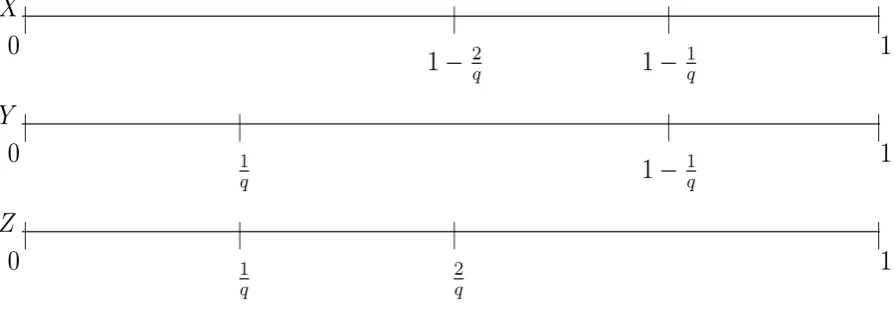
k= (1.28) where I =0 if q=2. These intervals are maximal with respect to inclusion.
Proof. Every maximal 3-dimensional interval
I
containing points(
γ
q( ) (
n ,γ
q n+1 ,) (
γ
q n+2)
)
will be written as I=IX× ×IY IZ, where IX,IY,IZ are projections ofI
to the X Y Z, , , axes, respectively. Moreover if γq( )
n ∈IX then γq(
n+ ∈1)
IY and γq(
n+2)
∈IZ. From u.d. of γq( )
n follows that the lengthsX Y Z
I = I = I . Combining intervals (1.5), (1.14), (1.15), (1.16), (1.6) of equal lengths by following Figure 3. We find (1.26), (1.27), and (1.28).
Now, let T be the union of diagonals of (1.27), (1.28) and (1.26). Again, as in (1.11), the a.d.f. g x y z
(
, ,)
has2 the form(
, ,)
ProjectX(
[ ] [ ] [ ]
0, 0, 0,)
g x y z = x × y × z ∩T (1.29) and it can be rewritten as
(
)
(
[ ]
[ ]
[ ]
)
[ ]
( )[ ]
( )[ ]
( )(
)
[ ]
( )[ ]
( )[ ]
( )(
)
1
1
, , min 0, , 0, , 0,
min 0, , 0, , 0,
min 0, , 0, , 0, .
X Y Z
i i i
X Y Z
i
k k k
X Y Z
k
g x y z x I y I z I
x I y I z I
x J y J z J
∞ = ∞
=
= ∩ ∩ ∩
+ ∩ ∩ ∩
+ ∩ ∩ ∩
∑
∑
(1.30)
To calculate minimums in (1.30) we can use the followingFigure 4 (here q=3):
As an example of application of (1.30) andFigure 4, we compute g x x x
(
, ,)
for q≥3 without using the knowledge of g x y z(
, ,)
,3(
)
2
0 if 0, ,
2 2 1
, , if ,1 ,
1 3 2 if 1 ,1 .
x q
g x x x x x
q q q
x x
q
∈
= − ∈ −
− ∈ −
Proof.
1. Let x 0,1 q
∈ .
Then
[ ]
0,x ∩IZ =0,[ ]
0,x ∩IZ( )i =0,[ ]
0,x ∩IY( )k =0, consequently g x x x(
, ,)
=0.2. Let x 1 2, q q
∈
. Then
[ ]
0,x ∩IZ =0,[ ]
( )
0,x ∩IYk =0,
[ ]
( )
0,x ∩IZi =0, consequently g x x x
(
, ,)
=0.3. Let x 2,1 1
q q
∈ −
. Then
[ ]
( )
0,x ∩IXi =0,
[ ]
( )
0,x ∩IYk =0, consequently
(
)
2 1 2 2, , min 1 , ,
g x x x x x x
q q q q
= − − − = −
.
4. Let x 1 1,1 q
∈ − . Specify ( )k1
X
x
∈
I
, ( )k1Y
x
∈
J
. Then[ ]
0,x ∩IX( )k =0,[ ]
( )
0,x ∩JYk =0 for k>k1. Thus (1.30) implies
(
)
(
[ ]
( )[ ]
( )[ ]
( ))
[ ]
( )[ ]
( )[ ]
( )(
)
1
1
1 1
1 1
1
1
1 1
1 1
1 1
2 1 1 2
, , min(1 ,1 , ) min 0, , 0, , 0,
min 0, , 0, , 0,
2 1 1 1 1 1 1
1 1
3
k
i i i
X Y Z
i k
k k k
X Y Z
k
k k
i i k k k k
i k
g x x x x x I y I z I
q q q q
x J y J z J
x x x
q q q q q q q
=
=
− −
+ +
= =
= − − − − + ∩ ∩ ∩
+ ∩ ∩ ∩
= − + − + − + + − + − +
=
∑
∑
∑
∑
2. x−
For q=2 we have
(
)
1
0 if 0, ,
2
1 1 3
, , if , ,
2 2 4
3
3 2 if ,1 .
4 x
g x x x x x
x x
∈
= − ∈
− ∈
(1.32)
6. Explicit Form of
g x y z
(
, ,
)
Let q≥3 be an integer.
[image:12.595.91.528.96.667.2]Motivated by theFigure 4 we decompose the unit interval
[ ]
0,1 onX
,Y
andZ
axes in theFigure 5Figure 5. Divisions of the unit intervals.
intervals (here q=4):
In this decomposition, for
(
x y z, ,)
∈[ ]
0,13, we have 27 possibilities. We shall order choices of(
x y z, ,)
from the left to the right. Detailed proofs are included only in non-trivial cases.1. Let
2 1 1
0,1 , 0, , 0,
x y z
q q q
∈ − ∈ ∈
. Then
(
, ,)
0 g x y z = .Proof. We have
[ ]
0,x ∩I( )Xi =0,[ ]
0,x ∩JX( )k =0, i k, =1, 2,. Then, by (1.30),(
, ,)
min(
[ ]
0, X , 0,[ ]
Y , 0,[ ]
Z)
g x y z = x ∩I y ∩I z ∩I .
Similarly, in the following cases 2-9. 2. Let x 0,1 2 ,y 0,1 ,z 0,2
q q q
∈ − ∈ ∈
. Then
(
, ,)
0 g x y z = .3. Let x 0,1 2 ,y 0,1 ,z 2,1
q q q
∈ − ∈ ∈
. Then
(
, ,)
0 g x y z = .4. Let x 0,1 2 ,y 1,1 1 ,z 0,1
q q q q
∈ − ∈ − ∈
. Then
(
, ,)
0 g x y z = .5. Let x 0,1 2 ,y 1,1 1 ,z 1 2,
q q q q q
∈ − ∈ − ∈
. Then
(
, ,)
0 g x y z = .6. Let x 0,1 2 ,y 1,1 1 ,z 2,1
q q q q
∈ − ∈ − ∈
. Then
) 2 , 1 , ( min = ) , , (
q z q y x z
y x
7. Let x 0,1 2 ,y 1,1 1 ,z 0,1
q q q q
∈ − ∈ − ∈
. Then
(
, ,)
0 g x y z = .8. Let x 0,1 2 ,y 1,1 1 ,z 1 2,
q q q q q
∈ − ∈ − ∈
. Then
(
, ,)
0 g x y z = .9. Let x 0,1 2 ,y 1 1,1 ,z 2,1
q q q
∈ − ∈ − ∈
. Then
(
)
2, , min ,
g x y z x z
q
= −
.
Proof. We use z 2 1 2
q q
− ≤ − .
10. Let x 1 2,1 1 ,y 0,1 ,z 0,1
q q q q
∈ − − ∈ ∈
. Then
(
, ,)
0 g x y z = .Proof. We use
[ ]
0,x ∩IX( )i =0,[ ]
0,y ∩JY( )k =0,[ ]
0,z ∩IZ =0. Similarly,11. Let x 1 2,1 1 ,y 0,1 ,z 1 2,
q q q q q
∈ − − ∈ ∈
. Then
(
, ,)
0 g x y z = .12. Let x 1 2,1 1 ,y 0,1 ,z 2,1
q q q q
∈ − − ∈ ∈
. Then
(
, ,)
0 g x y z = .Proof. We use
[ ]
0,x ∩IX( )i =0,[ ]
0,y ∩JY( )k =0,[ ]
0,y ∩JY =0.13. Let x 1 2,1 1 ,y 1,1 1 ,z 0,1
q q q q q
∈ − − ∈ − ∈
. Then
(
, ,)
0 g x y z = .14. Let x 1 2,1 1 ,y 1,1 1 ,z 1 2,
q q q q q q
∈ − − ∈ − ∈
. Then
(
, ,)
0 g x y z = .15. Let x 1 2,1 1 ,y 1,1 1 ,z 2,1
q q q q q
∈ − − ∈ − ∈
. Then
(
)
1 2, , min ,
g x y z y z
q q
= − −
.
16. Let x 1 2,1 1 ,y 1 1,1 ,z 0,1
q q q q
∈ − − ∈ − ∈
.
Specify ( )k1
X
x
∈
J
, ( )k2Y
y
∈
J
, ( )k3Z
(
)
(
)
3 3 3
3 3
3 3
1 2 3
3 1 2
1
3 1 2
1
3 2 1
1
3 1 2
3
0 if min , ,
1 1 1 1
min 1 , 1 , if ,
1 1 1
min 1 , if ,
1 1
, , min 1 , if ,
1
1 if ,
1
min 1 , 1 if
k k k
k k
k k
k k k
x y z k k k
q q q q
x z k k k
q q q
g x y z y z k k k
q q
z x k k k
q
z x y k k
q
+
+
+
<
− + + − + − = =
− + + − = <
= − + − = <
+ − + < <
+ − + − <
1 2
3 2 1
,
1 if .
k
z y k k k
=
+ − < <
Proof. First observe that
[ ]
0,z ∩IZ =0, and[ ]
( )
0,x ∩IXi =0. Thus
[ ]
[ ]
[ ]
(
)
min 0,x ∩IX , 0,y ∩IY , 0,z ∩IZ =0 and
(
[ ]
( )[ ]
( )[ ]
( ))
1min 0, , 0, , 0, 0.
i i i
X Y Z
i x I y I z I
∞
= ∩ ∩ ∩ =
∑
Further, for k=1, 2,, we have
[ ]
( )1
1 1
1 1
0 if ,
1 1
0, 1 if ,
1 1
if ; k
X k
k k
k k
x J x k k
q q
k k q q +
>
∩ = − − − =
− <
[ ]
( )2
2
2
2 1
0 if ,
1
0, 1 if ,
1 1
if ; k
Y k
k k
k k
y J x k k
q
k k q q+
>
∩ = − − =
− <
[ ]
( )3
3
3 1
3 1
0 if ,
1
0, if ,
1 1
if ; k
Z k
k k
k k
z J z k k
q
k k
q q
+ +
>
∩ = − =
− <
Thus, using (1.30), we find
(
)
(1 2)(
[ ]
( )[ ]
( )[ ]
( ))
3
min , =
, , k k min 0, Xk , 0, Yk , 0, Zk k k
g x y z =
∑
x ∩J y ∩J z ∩J .17. Let x 1 2,1 1 ,y 1 1,1 ,z 1 2,
q q q q q
∈ − − ∈ − ∈
.
Specify ( )k1 X
x∈J , ( )k2 Y
(
)
1 2
1 2
1 2
2 1
min 1 , 1 if ,
2
, , 1 if ,
1
1 if .
x y k k
q q
g x y z x k k
q
y k k
q
− + − + =
= − + <
− + >
Proof. We have
[ ]
0,x ∩IX( )i ,[ ]
0,z ∩IZ ,[ ]
( )1
1 1
0,z JZk k k
q q+
∩ = − , then
(
)
( )(
[ ]
( )[ ]
( ))
1 2
min ,
, , k k k min 0, Xk , 0, Yk .
g x y z =
∑
≤ x ∩J y ∩J18. Let x 1 2,1 1 ,y 1 1,1 ,z 2,1
q q q q
∈ − − ∈ − ∈
.
Specify ( )k1
X
x
∈
J
, ( )k2Y
y
∈
J
. Then(
)
1 2
1 2
1 2
2 1 2
min 1 , 1 if ,
, , 1 if ,
1
1 if .
x y z k k
q q q
g x y z x z k k
y z k k
q
− + − + + − =
= + − <
+ − − >
Proof. We have
(
)
( )(
[ ]
( )[ ]
( )[ ]
( ))
1 2
min ,
2 2 2
, , min 1 ,1 , k k k min 0, Xk , 0, Yk , 0, Zk .
g x y z z x J y J z J
q q q ≤
= − − − + ∩ ∩ ∩
∑
19. Let x 1 1,1 ,y 0,1 ,z 0,1
q q q
∈ − ∈ ∈
. Then
(
, ,)
0 g x y z = .20. Let x 1 1,1 ,y 0,1 ,z 1 2,
q q q q
∈ − ∈ ∈
.
Specify ( )i1
X
x
∈
I
, ( )i2Y
y
∈
I
, ( )i3Z
z
∈
I
. Then we have(
)
(
)
1 1 1
1 1
1 1
1 2 3
3 2 1
1 1
3 2 1
3 2 1
1
2 3 1
1
2 3
0 if max , ,
1 1 1 1
min 1 , , if ,
1
min , 1 if ,
1 1
, , min 1 , if ,
1 1 1
min 1 , if ,
1
1 if
i i i
i i
i i
i i i
x y z i i i
q
q q q
y z x i i i
q
g x y z x y i i i
q q
x z i i i
q
q q
x z i i
q
+ +
+
+
<
− + − − − = =
− + − = <
= − + − < =
− + − − < =
+ − − < < 1
3 2 1
,
1 if .
i
x y i i i
+ − < <