ORIGINAL RESEARCH ARTICLE
STUDY OF REDUCING THE ENVIRONMENTAL IMPACT OF CO
2EMISSIONS OF FLEXIBLE
PAVEMENT MATERIALS: A CRITICAL REVIEW
*Feras Al Adday
Civil Engineering Department, Faculty of Engineering, Middle East University, Amman-Jordan
ARTICLE INFO ABSTRACT
The main objective of study is to present a summary to the best practical applications and recent investigation results on how to reduce environmental effect of carbon dioxide emissions CO2 in flexibly pavement materials, including extraction of virgin materials, heating material, hauling of materials from quarry to the asphalt plant and then to paving place, mix design. Another production techniques for the manufacturing of modified mixes such as warm mix asphalt (WMA), cold mix asphalt (CMA) and reclaimed asphalt pavement (RAP) mixes are included in this summary. Additionally, assessment tools of life cycle involved, economic and environmental effects, and long-term performance of modified mixes have also been highlight ted in this study. Sustainability gains had showed this study involved a reduction of fuel use, reducedCO2emissions in several stage of HMA production, and possible of using RAP and WAM mixes.
Copyright © 2019,Feras Al Adday. This is an open access article distributed under the Creative Commons Attribution License, which permits unrestricted use, distribution, and reproduction in any medium, provided the original work is properly cited.
INTRODUCTION
Large quantities of air pollutants are associated with the successive stages of infrastructure, operation and maintenance of highway may significantly variationin airquality (Robinson and Thagesen, 2004). Rapid civilizational developments in all sectors of construction are generally responsible for captain climate change and combined with the main effect of highway transportation on carbon emissions of world wideled to a strong pursuit by governments to develop effective strategies to green highway sector, where the transportation sector is one of the most important sources of carbon emissions in the world, around 20% of worldwide emissions. In French, a carbon emissions reached up to 30%, of which 90% are from highway sector (DE Bortoli, 2015). Pavement production process plays a significant role in contributing to the causes attaching to worldwide warming (Albayati et al, 2018). The influence of global warming on the environmental has touched to critical levels. The average global temperature has increased 0.6 oC in the previous century and is anticipated to increase from 1.4 to 5.8 oC in the next century (Bostanci, 2018). The surface course is the upper outer layer of asphalt highway pavement, it is usually made of dense graded of hot mix asphalt (HMA) (Huang, 2010).
*Corresponding author: Feras Al Adday,
Civil Engineering Department, Faculty of Engineering, Middle East University, Amman-Jordan
Asphalt concrete mixture can be characterized as a complex combination that involve of three main parts: aggregate, asphalt binder, and air voids. However, HMA is primarily composed of about 95% aggregates and 5% asphalt binder. (Al-Bayati et al, 2018). HMA mixtures blended at high temperatures in order to be capable to dry the aggregate, increase workability and reduce the asphalt viscosity that lead to good coating of aggregate. Production of HMA mixtures at high temperatures needs high energy usage, increase age-asphalt hardening in the mix plant and result in producing of greenhouse gases (GHG)(A. Tutu, A. Tuffour, 2016).Paved surface courses can include up to 45% of an urban area in the United States, these layers are made of either bitumen concrete or Portland concrete cement. Both of these methods contribute to emissions of (GHG) and climate change at both the metropolitan and worldwide scales (Kaloush et al. 2010). Carbon dioxide refers to the overall amount of all GHG (generally CO2) produced indirectly and directly by a certain process, product, or event (Prowell, 2008). According to the process of preparation of bitumen mixtures (a batch mix plant) by which the raw constituents are blended to produce hot mix asphalt (HMA). Firstly, the aggregates are dried, then moved to a blender where it is blended with the bitumen. After blending, the HMA is moved to a storage bin. From the bin, the HMA mixtures are emptied into trucks, which transport the HMA mixtures to the highway project. According to the
ISSN: 2230-9926
International Journal of Development Research
Vol. 09, Issue, 04, pp. 26883-26889, April, 2019
Article History:
Received 18th January, 2019
Received in revised form 06th February, 2019
Accepted 20th March, 2019
Published online 29th April, 2019
Key Words:
Warm Mix Asphalt, Greenhouse gases, Carbon footprint, Energy consumption, Reclaimed asphalt pavement.
Citation: Feras Al Adday. 2019. “Study of reducing the environmental impact of co2 emissions of flexible pavement materials: a critical review”,
International Journal of Development Research, 09, (04), 26883-26889.
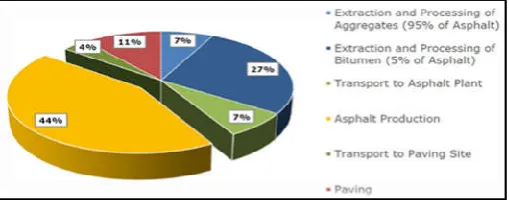
estimates of the Intergovernmental Panel for Climate Change (IPCC), 13% of overall GHGe missions at the global level are produced yearly from the transportation sector (Sreedhara et al, 2016). GHG is measured routinely in terms of carbon dioxide content, although GHG emission comprise many gasses such ascarbon dioxide (CO2), methane (CH4), nitrous oxide (N2O) and hydro fluorocarbon (HFC) escape from air conditioning system. Although water vapor is not usually involved, it is the most copious GHG (Brown, 2009). Sources of main emission related to HMA construction are the dryers, bins, and blenders, which emit a variety of gaseous pollutants and particulate matter (PM). In addition, further emission sources are create at HMA plants involve storage silos, where HMA mixtures is temporarily hold; operations of truck load-out, in which trucks carry and transfer HMA mixtures to the project site; storage tanks of liquid asphalt; hot oil heaters (heating the asphalt-storage tanks); and yard emissions (fugitive emissions from the HMA mixtures in truck beds).Combustion of one gallon of fuel releases approximately 22.3 lbs of CO2(Frederick, 2009).The gaseous emissions emitted from the production process of HMA include the sulfur dioxide (SO2), carbon monoxide (CO), nitrogen oxides (NOx), and volatile organic compounds (VOC), as well as volatile HAP organic compounds(Park, NC, 2000).The overall carbon footprint (OCF) for the construction of highways between aggregates material production, bitumen manufacture, site equipment, and transportation can be illustrated in Figure 1.It can be seen that asphalt processing accounts has 44% of the OCF from extraction of bitumen to installation. Naturally, approximately 60 kg of CO2 are produced per one ton of bitumen produced and laid (Walch et al, 2010).
Fig. 1. Example of a pie chart demonstrations overall carbon footprint distribution for a typical highway pavement project
(Walch et al., 2010)
These gaseous emissions not only contaminate the air and exacerbate the GHG effect but are also injurious to the health of construction and production personnel. The well-known targets for emission reduction and energy preservation will violate if the current situation continues as it is. For these reasons many current researches have concentrated on decreasing carbon emissions throughout the production of HMA mixtures, including the use of cold mix asphalt (CMA), semi-warm mix asphalt (SWMA) and warm mix asphalt (WMA), (Wang, 2017).At high mixing temperatures is typical temperature of HMA is 140–170°C for a 60/70 asphalt penetration grade, and 150–180°C for a 40/50 asphalt penetration grade (Robinson and Thagesen, 2004).At intermediate mixing temperatures (e.g. WAM), where the range of 80-120 °C. At lower temperatures (e.g. CAM), where the range of 60-70 °C, the asphalt stiffness will be at a certain level so not give sufficient compact ability and workability. (O.R. Larsen et al, 2004).The environmental benefits gathered by WMA technologies 10%- 15% smaller carbon footprint
related to HMA(Frank et al, 2011).The results revealed that the use SWMA mixtures reduced some of emissions at values ranging from 58% for CO2 to 99.9% for SO2.One the other hand, CMA production associated with an important reduction in emissions, which offers significant social, environmental and economic benefits. Generally, CMA mixtures are used in highway maintenance and needs a long setting period for good performance and stability of highway (Wang, 2017). The above can be summarized, WMA technology allows the production and paving of WMA mixtures at reduced temperatures produces less emissions and requires fewer energy while the pavement performance will be enhancing gormaintaining (Lou Politano, 2012).Generally, the reduction of emissions from asphalt production is affected by several factors such as the plant condition, climate situations during production and the technology type used (Haopeng Wang et al. 2018). Of these reduction methods is the dry process, Waste plastics (WP) can be added to hot aggregates as a coating material by softening the WP and not by burning. Later does not form evolution of gases during burning process like CO2.For example, a distance of 1 Km single lane asphalt pavement that used WP AS additive need to at least of one ton of WP. A reduction of CO2 in this accounts may be to 3 tons (S. Rajasekaran, 2013). Another methods to reduce the energy consumption and CO2 emissions are reclaimed asphalt pavement (RAP).RAP term refers to old flexible pavement broken for again re-use in new HMA mixes, the main function of RAP in the HMA mixtures are to substitute natural aggregates as well as saving virgin asphalt cement since the RAP mixes already coated with aged asphalt cement. The physical and mechanical properties of RAP depend on the RAP source, content of asphalt, and particlesize of aggregates.RAP is an appreciated substitute source with standard engineering properties (Jamshidi et al, 2017). According to studies and the investigated on asphalt plants, addition of 30% of RAP mixes into the HMA mixes save about 33% of virgin asphalt cement, where if the asphalt cement percent of new HMA mixtures are 5%, it only requires 3.5% of virgin asphalt cement of the total mixes weight (Ning lee et al. 2011). In the past, evaluation of performance and costs was considered a main factor in choosing the pavement type. Newly, sustainable development may be considered most important factor (Prowell, 2008). Sustainability encompass three components are society, economy, and environment. A modern construction systems are often necessary to assess structure projects against the environmental, economic and social of sustainable development requirements (Haifang Wen et al. 2014).Modified Asphalt Research Center defined a sustainable pavement as following a pavement that decreases environmental effects through the decline of raw material resources, energy consumption, and related emissions in the same time to meet with standard performance (Haopeng Wang et al. 2018).
USE WMA TECHNOLOGY
asphalt is made by injection of a small quantity of tap water into hot asphalt pipeline (usually 160 °C to 170 °C)just before the asphalt arrives the mixer. An air gun has been fixed to blow the foaming chamber and pipeline clean after every foam-injection, then the water is quickly evaporated and result in creating a very great amount of foam. Results this research can be summarized as following:
Production of WAM Foam at lower temperatures between 100°C-120 °C lead to energy savings of about 30% and an equal decrease of CO2 emissions.
Improve the working environment for both operators of asphalt plant and asphalt workers as a result from decreases in other GHG emissions and in fume exposure.
In laboratory investigations, the engineering properties of the WAM Foam are equivalent to the HMA mixtures. In the field, rut resistance, surface texture and longitudinal smoothness of WAM Foam sections is identical related to HMA sections.
The same standard equipment for paving and compaction that use in HMA mixes can be used in WAM Foam mixes.
A recent review which highlighted to reduce the CO2emission in WMA mixture have conducted by A. Tutu and A. Tuffour (2016). This study include introducing the several experimental researches about an important advantage related to WMA production. One of the studies state that the lower temperature in WMA manufacture can be reduce CO2emission about 25%. Another research in this study has estimated that the reduction of the production temperatures of HMA mixes by 20˚C could decrease the CO2 emissions from both the asphalt and fuel used in the HMA production by around 44%. Lou Politano (2012) presented a study included trials of the ministry of transportation of Ontario’s (MTO) to apply the WMA technology on Ontario roads. To estimate the environmental advantages of WMA, the emissions quantities and temperature measured at the WMA production plant and pavement locations, and other investigations to calculate WMA performance. MTO accomplished the biggest paving amounts of WMA contract to date in Canada, where a 67,000 tonne of WMA pavement contract on the Queen Elizabeth Way (QEW) in 2011 have paved. This study revealed that GHG emissions is reduced from 4.1 to 5.5 kg CO2equivalent /tone at the WMA production plant, and decreased fuel/energy consumption at the WMA production plant from 20% to 35%. In addition the production of WMA lead to a substantial decrease of asphalt fumes at the pavement location, where asphalt fumes behind the paver decreasing 30% dust, 63% benzene soluble fraction, and 64% opacity. The results also confirmed that combined mixes of WMA and RAP the saves energy and emissions were about 100,500 to 134,000 litres of fuel and l, 274,700 to 368,500 kg CO2 equivalent of GHG emissions.
Another proof of the possibility of reduction the CO2by using WMA mixes has provided by Frank et al, 2011. Three locations were selected to estimateCO2emissions and compare with HMA control mixes. This study displays the environmental advantages appreciated by WMA technologies, where a reduction percent of carbon footprint range from a 10 to 15 related to HMA mixes. As shows this study that the fuel can be saved about 31%, but theCO2 decrease was only 14 % on average.
Use Rap Mixes
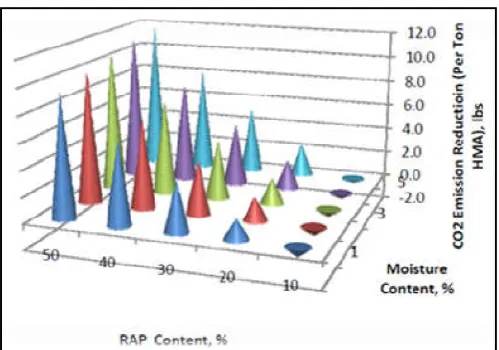
Fig. 3. RAP content with CO2 Emission, Per Ton of HMA
(positive value show that adding RAP to HMA decreases CO2
emission) (Frederick, 2009)
Use Wma Technlogy and Rap Mixes
Santiago and Osborn (2014) conducted a literature review for modern methods to estimating pollutant emissions throughout asphalt mixes production. In addition, field investigations were complemented to quantity emissions throughout asphalt mixes paving processes, where these of investigation included monitoring of asphalt pollutant emissions to estimate the emission reductions associated with the usage of WMA mixes compared to HMA mixes. Highway pavement project involved four investigation sections, two for HMA mixes and two for WMA mixes, where RAP content is changing, the asphalt concrete comprised 15% RAP for HMA and WMA as well20% RAP for HMA and WMA, the asphalt grade was 67-22.The extensive literature review demonstrate that emission reductions associated with the usage of WMA mixes range up to 40% for CO2, 30% for CO, 70% for NOx, 50%for VOCs (volatile organic compounds/blue smoke), and55% for SO2. As for the field data concluded from placement of WMA mixes and HMA mixes at two different projects, emission reductions were detected range up to 67%. Decreases in Benzene soluble fraction (BSF) reached up to 45% and similarly decreases in Total organic matter (TOM) reached up to 50%. Decreases in polycyclic aromatic compounds (PACs) reached up to 46%. the variations in GHG emissions and energy / fuel depletion investigated by T. Muench et al. (2015) where two types of paving materials in flexible pavement are used, use WMA in place of conventional HMA as well as adding RAP into HMA pavement mixes. The obtained results showed that the use of WMA and RAP mixes in only the surface coarse leads to the reasonable savings of 7,140 MgCO2e and yearly energy consumption of 657 TJ for HMA mixes in 2010 applications compared to 1990 (supposing 1,000,000 tons per year paved). These values would be decline to 5-15% if the total layers pavement, transportation, and production equipment are considered. Using composed mixes of WMA and RAP can yield larger decreases.
Calculation Model
In relation to the field investigation of the carbon emission (CE) in the road construction, (Peng Bo et al. 2017) completed study in which the carbon source was identified in eight stages of bituminous pavement construction (stacking, supply, and drying aggregates, asphalt heating, asphalt-aggregate mixing,
asphalt mix transport, asphalt mix paving, and compaction and rolling of mixes. CE were then computed and analyzed of eight stages. Finally the calculation model of CE in the production of asphalt pavement is achieved, the calculation model of CE from coal and heavy weight oil cab be expressed as presented in following formula.
j 3
1 j
j i
i
i =m .Q GWP . EF
GHQ
where GHQi is the GHG from coal or heavy weight oil in thestagei, mi is the consumption of heavyweight oil or coal in thestagei, Qi is the calorific worth of heavyweight oil or coal in thestagei,EFj is the emission factor established on the calorific worth of heavyweight oil or coal in the stage I, and GWPj is theglobal heating potential (used to describe the intensity of relative radiation of GHG) in thestage i. The calculation model of the CE of natural gas cab be expressed as presented in following formula.
j 3
1 j
j i
i
i
=
v
.Q
GWP
.
EF
GHQ
where GHQi is the CE of natural gas in the stage i, Vi is the consumption of the natural gas in the stage i, Qi is the calorific worth of natural gas unit in the i stage, and EFj is the CE factor established on the calorific worth of natural gas in the stage i. In this research, the kind of energy used in warming process of raw materials is a significant reason affecting CE of as phaltpavement production. In addition, the use natural gas as warming energy would be reduced CE in the pavement production, where CE reduced approximately 32% by applying the strategy of change as phalt warming energy and the aggregate.
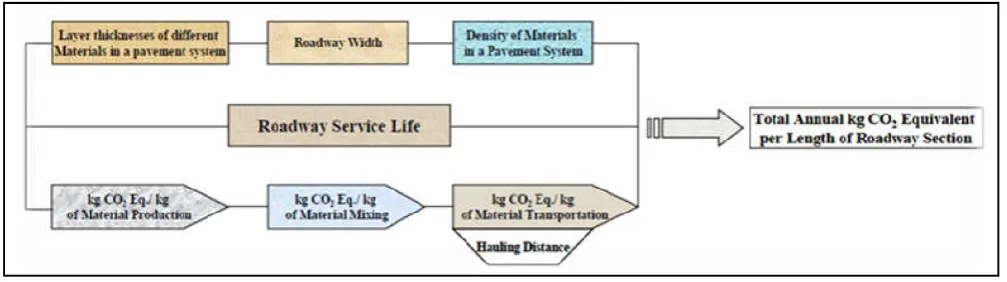
Where: T = thickness of layer, meters; W = width of road, meters; Dn = pavement materials density, kg/meters3; Pn = material production value, kg CO2equivalent /kg material; Mn= material mixing value, kg CO2equivalent /kg material; Di = distance from material production site to application place, kilometers; Tp = transportation from production site to application place value, kg CO2 equivalent /kg material-km; Y = highway life, years. This study presented a procedure on how pavement production contributes to different climate changes related to the total annual kg CO2equivalent. The methodology should confirm to be a valuable tool for highway engineers and designers to check the CO2emissions directly related to the choice of alternative pavement strategies. Operators/users be able to enhance a pavement design depending on organizational requirements in addition to locally climatic conditions, highway maintenance, traffic volumes, and energy requirements.
Fig. 1. Aggregate below roof to decrease moisture content (Stotko, 2011)
Fig. 2. Drier aggregate/burner gas flow direction measures (Stotko, 2011)
The total possible reductions of carbon dioxideCO2 from applied measures up to 2 280 tons CO2/year as well total HFO savings reach to 19 880 GJ/year . These results denote a35% decrease in GHG emissions and a HFO energy saving up to 30%. Chehovits and Galehouse (2010) completed a comparative study on energy usage per unit area and GHG emissions for several process of the production, rehabilitation and preservation of flexible asphaltpavements.
Preservation pavements include HMA overlay, hot in-place recycling (HIR), chip seal, micro surfacing/slurry seal, crack seal, crack filling and fog seal. Investigation results stated that preservation treatments have considerably reduced fuel/energy usage and GHG emissions related to traditional and reconstruction and rehabilitation strategies.The results divided into three groups. The first groupinvolve the new construction, rehabilitation, thin HMA overlay, and HIR have the maximum annualized values spreading from 3,870 to 12,160 BTU/yd2 -yrfuel energy and 0.9 to 2.4 lb/yd2- yr of GHG emissions. The second group comprises micro-surface, crack fill, and chip seal at 930 to 2,565 BTU/yd2-yr fuel energy and 0.13 to 0.35 lb/yd2-yr of GHG emissions. The final group contains fog sealing and crack sealing with 250 to 870 BTU/yd2-yr fuel energy and 0.04 to 0.14 lb/yd2-yr of GHG emissions. The type and amount of materials located per unit area have primary effects on GHG emissions and energy usage for different products.
T. Dorchies 2008 achieved an inventory of fuel consumption and GHG emissions related to highway construction. Investigates include both pavement construction and its maintenance along a service-life of30 years. Different construction types of highway pavement are examined such as HMA, asphalt emulsion technologies, concrete cement pavement, in place pavement recycling (cold pavement), where pavement production process from virgin materials extraction to the service-life of pavement is taken into consideration, these phases involved materials construction, placing of a new pavement, and maintenance workings during its predicted service-life. Inventory results stated that in place pavement recycling using asphalt emulsion as additive is a best method that reduce the GHG effect and energy consumption, where GHG emissions were 5 to 20 kg/t (GHG are expressed in kg of CO2 eqper metric tonne of material). HMA mixes with recycled or without, the GHG was 45 up to 50 kg/t. concrete cement pavement was 140 up to 200 kg/t.
Conclusions
The practical review has stated that RAP and WMA provides important advantages that are compatible with the sustainable pavement concepts. Production process of WMA at temperatures lower 20 OC from HMA considered a promising technique, all of these studies have shown using WMA decrease CO2 emissions with percentages from 15 to 40 related to HMA. As for the RAP in HMA, where most investigations illustrated that 50% RAP as replacement percent in HMA mixes reduce CO2 emissions 10 -20 %.The research has also highlighted to some of the technical procedures for reducing carbon emissions of asphalt plants such as blowing the hot
[image:5.595.37.289.487.542.2]gases in the opposed direction to the aggregate, these results indicate a 35% decrease in GHG emissions. Finally, an assessment tools to evaluate CO2 emissions of pavement production have presented in this review. This tools help the highway engineers to estimate the influence of production and construction of different pavements on climate change.
Acknowledgments
The authors are grateful to the Middle East University, Amman, Jordan for the financial support granted to cover the publication fee of this research article.
REFERENCES
A. de bortoli, 2015.Assessing environmental performance of road projects: the recent development of eco-comparators in france. Laboratoire Ville Mobilité Transport (LVMT), EcoleNationale des PontsetChaussées, Université Paris Est, France. 2015.
Alexander (sandy) Brown, P. Eng, 2009 .Carbon Footprint of HMA and PCC pavement.
Ali Jamshidi, KiyofumiKurumisawa, ToyoharuNawa, Jize Mao , Ben Li. Characterization of effects of thermal property of aggregate on the carbon footprint of asphalt industries in China. Journal of traffic and transportation engineering (English edition) 2017 ; 4 ( 2 ) : pp,1 1 8 -1 3 0 AmjadAlbayati, YuWangb, YanWang, Jonathan Haynes. A sustainable pavement concrete using warm mix asphalt and hydrated lime treated recycled concrete aggregates. Journal homepage: www.elsevier.com/locate/susmat, https://doi.org/10.1016/j.susmat.2018.e00081.
Bob Frank, Brian D. Prowell, Graham C. Hurley, and Randy C. West, 2011. Warm Mix Asphalt (WMA) Emission Reductions and Energy Savings. National Center for Asphalt Technology.
Brian Prowell, 2008. Carbon Footprint: How Does HMA Stack Up?. National asphalt pavement association of IOWA: report. Summer 2008.
Chaohui Wang, Qiang Li, Kevin C. P. Wang, Xiaolong Sun, and Xuancang Wang, 2017. Emission reduction performance of modified hot mix asphalt mixtures. Advances in Materials Science and Engineering, Volume 2017, Article ID 2506381, 11 pages, https://doi.org/10.1155/2017/2506381, March 2017. Gary Frederick, NYSDOT and Mr. Joseph D. Tario,
NYSERDA, 2009. Quantify the Energy and Environmental Effects of Using Recycled Asphalt and Recycled Concrete for Pavement Construction: Phase I Final Report. National Technology Development, LLC. Agreement Number: 10629/C-08-02.
Haifang Wen, Jiang Lu, and Timothy M. Van Reken, 2014. Modeling the Effects on Energy and Carbon Dioxide from the Use of Recycled Asphalt Pavement in Hot. International Journal of Sustainable Transportation. 8:249—261, 2014. ISSN: 1556-8318 print/15568834 onlinc.
HanaaKhaleelAlwan Al-Bayatia, Susan. Tighe, Jessica Achebe, 2018. Influence of recycled concrete aggregate on volumetric properties of hot mix asphalt. Journal homepage: www.elsevier.com/locate/resconrec. Resources, Conservation & Recycling 130 (2018) 200–214.
Haopeng Wang, Xueyan Liu, PanosApostolidis, Tom Scarpas, 2018. Review of warm mix rubberized asphalt concrete: Towards a sustainable paving technology, Journal
homepage: www.elsevier.com/locate/jclepro. Journal of Cleaner Production 177 (2018) 302e314.
Jim Chehovits, Larry Galehouse, 2010. Energy Usage and Greenhouse Gas Emissions of Pavement Preservation Processes for Asphalt Concrete Pavements. Compendium of Papers from the First International Conference on Pavement Preservation.
John Walch, Analyst, Carbon Trust, 2010. A study on Lower Temperature Asphalts Commercialization in the UK. The UK Government's Regional Growth Fund (RGF), 2010. Kamil E. Kaloush, a, Krishna P. Biligiri, Philip White, Jay S.
Golden, Patrick E. Phelan, Han- Seung Lee, (2010), Assessment Tool to Estimate CO2 Emissions of Pavement Production and Construction. International conference on sustainable building Asia.
Kenneth A. Tutu, Yaw A. Tuffour, 2016. Warm-Mix Asphalt and Pavement Sustainability: A Review. Open Journal of Civil Engineering, http://www.scirp.org/journal/ojce. http://dx.doi.org/10.4236/ojce.2016.62008, 2016, 6, 84-93. MarielyMejías-Santiago and Linda V. Osborn, 2014.
Emissions Reductions Associated with the Use of Warm-Mix Asphalt as Compared to Hot-Warm-Mix Asphalt. The US Army Engineer Research and Development Center (ERDC). Geotechnical and Structures Laboratory. ERDC/GSL TR-14-19. June 2014.
Mr. Lou Politano, P, 2012. Warm Mix Asphalt- A Greener Alternative to Hot Mix Asphalt. Ministry of Transportation of Ontario. Transportation Association of Canada. 22001122 Technical Excellence Awards. Environmental Achievement Award.
Ning LEE, Chai-Pei CHOU, Kuan-Yu CHEN, 2011. Benefits in Energy Savings and CO2 Reduction by Using Reclaimed. PhD Candidate. Department of Civil Engineering, National Taiwan University. 2011.
O.R. Larsen, Ø. Moen, C. Robertus2, B.G. Koenders, 2004 Wam foam asphalt production at lower operating temperatures as an environmental friendly alternative to HMA. 3rdEurasphalt & Eurobitume Congress Vienna 2004 – Paper 137.
Oliver Stotko, 2011. Energy and related carbon emission reduction technologies for hot mix asphalt plants. Carbon and Energy Africa (Pty) Ltd. [email protected]. Peng Bo, Fan Xueyong , Wang Xunjie , Li Wenying. Key
steps of carbon emission and low-carbon measures in the construction of bituminous pavement. International Journal of Pavement Research and Technology 10 (2017) 476–487. March 2017.
Pierre T. Dorchies, M.Sc., 2008. The environmental road of the future: Analysis of energy consumption and greenhouse gas emissions. The Quantifying Sustainability in Pavement Rehabilitation Projects Session of the 2008 Annual Conference of the Transportation Association of Canada Toronto, Ontario.
Richard Robinson and Bent Thagesen, 2004. Road Engineering for Development. Second edition. First published 2004 by Spon Press 11 New Fetter Lane, London EC4P 4EE, ISBN 0-203-30198-6 Master e-book. 2004. Richard Robinson and Bent Thagesen, 2004. Road
Engineering for Development. Second edition.ISBN 0-203-30198-6 Master e-book ISBN. Spon Press is an imprint of the Taylor & Francis Group, 2004
American Journal of Engineering Research (AJER), www.ajer.org. Volume-02, Issue-11, pp-01-13. 2013. Sevket Can Bostanci, MukeshLimbachiya, Hsein Kew. Use of
recycled aggregates for low carbon and cost effective concrete construction. Journal homepage: www.elsevier.com/locate/jclepro,
https://doi.org/10.1016/j.jclepro.2018.04.090.
Shashwath Sreedhara, Prathmesh Jichkarb, Krishna Prapoorna Biligiric, 2016. Investigation of Carbon Footprints of Highway Construction Materials in India. Available online at www.sciencedirect.com, Transportation Research Procedia 17 (2016) 291 – 300.
Siksha Swaroopa Kar, Ambika Behl, Anuradha Shukla and Pramod Kumar Jain, 2015. Estimation of Carbon Footprints of Bituminous Road Construction Process. Central Road Research Institute, Delhi, India.
http://dx.doi.org/10.4172/2165-784X.1000198. ISSN: 2165-784X JCEE, an open access journal. Volume 5 • Issue 6 • 1000198.November 01, 2015.
Stephen T. Muench, Eva Martinez Caraballo, and Yen Yu Lin, 2015. Determining Changes in Greenhouse Gas Emissions (1990-2010) due to Pavement Technology. Research Report. Agreement T-4118, Task 73. WA-RD 838.1. Washington State Department of transportation. Office of Research & Library Services. January 2015. Triangle Park, NC, 2000. Hot mix asphalt plants emission
assessment report. United States Environmental Protection Agency, Office of Air and Radiation, Office of Air Quality Planning and Standards. EPA Contract Number 68-D7-0068. December 2000.
Yang H. Huang, 2010. Pavement analysis and design, second edition. University of Kentucky.