ORIGINAL RESEARCH ARTICLE
THE INFLUENCE OF THE TYPE AND DOSE OF MANURE TOWARDS GROWTH AND CROP
YIELD OF ONION (
ALLIUM CEPA
VAR. ASCALONICUM) ON DRY LAND
1, *
Romaldo Martins,
2Domingos C.B.B. Gomes and
3Claudino Ninas Nabais
1
Master of Agriculture at Universidade da Paz, Timor-Leste
2
Professor in Graduate Program for Master in Agriculture Science (M.Agr), Universidade da Paz, Timor-Leste
3
Professor in Graduate Program for Master in Agriculture Science (M.Agr), Universidade da Paz, Timor-Leste
and Director of Research Center, Ministry of Agriculture and Fisheries Department, Timor-Leste
ARTICLE INFO ABSTRACT
Plant onion (Allium cepa var. ascalonicum) is one of the vegetables that are very well known by the public as a flavoring condiment cuisine. To increase the production of onion then the very need for fertilization fertilizer organic, among others. Organic fertilizer has a role in providing the nutrients needed by plants. The use of organic fertilizer is an of the efforts to improve soil fertility, because organic fertilizers is porous, raising the ability of the soil in the hold (tie) water. The application of organic fertilizer in the system cultivation can increase the content of organic matter or C-organic and N content of total land. The purpose of this research is to know the type and dosage of organic fertilizer and their interaction towards growth and crop yield of onion. Experimental design was a randomized Complete Design Group (RAK) consists of two factors and arranged in Factorial, i.e. the first factor is the type of fertilizer treatment consisting of organic: PKS: Cow Manure, PKK2: Goat Manure, PKA: Chicken Manure and the second Factor is the dosage of organic fertilizer, which consists of: DPO0:0 t ha-1 (0 kg swath-1), 10: DPO1 t ha-1 (1.20 kg swath-1): 20 DPO2, t ha-1 (2.40 kg swath-1), DPO3:30 t ha-1 (3.60 kg ha-1). Observation of the growth component, measurement results, results as well as supporting multiple variables. The collected data were analyzed with the analysis Variant (ANOVA) according to the experimental design was used. If there is a real interaction influence against the observed variable is then continued with a different test studies on average use the test double distance Duncan (DMRT) on levels 5% and if only a single factor in a real influence, then proceed with the average difference test with test BNT on levels 5%. Based on research results that different types of manure, not influence against growth and crop yield of onion while given doses of manure increases would boost growth and crop yield of onion Red on the treatment dose of chicken manure with a dose of 30 t ha-1 (3.60 kg/compartments). Not found the interactions between types and doses of manure towards growth and crop yield of onion. It is because this type of fertilizer have not given the decomposition of perfect so that interaction has not occurred.
Copyright © 2018, Muh. Jusman Rau et al. This is an open access article distributed under the Creative Commons Attribution License, which permits unrestricted use, distribution, and reproduction in any medium, provided the original work is properly cited.
INTRODUCTION
Plant onion (Allium cepavar. ascalonicum) is one of the vegetables that are very well known by the public as a flavoring condiment cuisine. Tuber onion contains essential oils that are known to be able to cause the typical aromas and flavors of savory on the cuisine (Suriani, 2011). Tuber onion contains 1.5% protein, fat and carbohydrate 9.2% 0.3%. Other nutritional components contained in the red onion, among others, 50 IU β carotene 30 mg thiamin, 0.04 mg riboflavin,
niacin 20 mg, 9 mg Ascorbic acid, 334 mg potassium, 0.8 mg iron and 40 mg of phosphorus (Meditation and Cahyoo, 2005 in Ida Nur, 2016). In addition to the herbs, shallot bulbs are also sold in the form of processed food such as powdered onion, extracts, essential oils, fried onions even as drugs to lower cholesterol levels, blood sugar, prevent blood clotting, lowering blood pressure and improve blood flow also prevent magh, because onion contains allincompounds and acidic allisin bactericide (Rukmana, 2005). In the last decade the demand for consumption and red onions seedlings in the
ISSN: 2230-9926
International Journal of Development Research
Vol. 08, Issue, 12, pp.24635-24640, December, 2018
Article History:
Received 06th September, 2018
Received in revised form 19th October, 2018
Accepted 21st November, 2018
Published online 26th December, 2018
Key Words:
Manure Types, Doses of Manure, Onion Plants.
*Corresponding Author:Romaldo Martins
Citation: Romaldo Martins, Domingos C.B.B. Gomes and Claudino Ninas Nabais, 2018. “The influence of the type and dose of manure towards growth and crop yield of onion (Allium cepa var. ascalonicum) on dry land”, International Journal of Development Research, 8, (12), 24635-24640.
country has increased, so that East Timor must import to meet those needs. To reduce the volume of imports, an increase in production and the quality of the results of the onion always enhanced through intensification and extensification. In order to meet the needs of onion increasing then the need for breakthrough technology capable of increasing production cultivation of onions through the organic technology approach. Organic farming is capable of increasing productivity of red onion. One of the problems decreased the production of onions which were affected by fertilizer. One of the alternatives that can be done to improve the growth and production of the onion are doing the fertilizing appropriately. Therefore, an alternative to increase productivity of onion that is by using organic fertilizer. Organic fertilizer has a role in providing the nutrients needed by plants. The use of organic fertilizer is one of the efforts to improve soil fertility, because organic fertilizers are acusticus, raising the ability of the soil in the hold (tie) water. The application of organic fertilizer in the system cultivation can increase the content of organic matter or C-organic and N total in the soil (Zulkarnain et al., 2013).
One of the sources of organic materials that are widely available around the farmer is manure. Manure contains a complete nutrient required for plant growth because it contains macro nutrient elements such as nitrogen, phosphorus, and potassium, and micro elements such as calcium, magnesium, and sulfur (Jedeng, 2011). Based on the type of animals there are many different kinds of manure that can be utilized, among others, the manure cows, goats, sheep, horses, and chickens. The fifth such manure has advantages of each of them the content of the elements N, P K which is pretty high. Granting of manure can also improve the physical properties of the soil, that is the capacity of a soil to retain water, the density of the soil mass, and total porosity soil aggregate stability fix and improve the content of humus soil that is desired by the plant (Salvitia et al,. 2016). Adimihardja et al., (2000) States that the granting of the appropriate doses of fertilizer will give a good influence against the growth of plants. However, in General, to increase the production of horticultural plant require organic materials with high doses. Hidayat and Rosliani (1996) States that the granting of manure production can increase significantly in plants of onion with the use of dose 10-30 ton hectares. The low fertility of the land is not offset by the optimum fertilization then will the occurrence of land degradation. One of the efforts to increase the productivity of land is through the addition of organic fertilizers. Therefore, this research needs to be done to know the influence of the granting of this type of organic fertilizer and the dose against growth and crop yield of onion.
RESEARCH METHODS
This experiment was carried out in the plant nursery located in the hamlet of NCBA Malinamuk, Vilage Comoro, Sub District Dom Aleixo, Municipality Dili. Based on the Data Collection Point Geo location On is located at latitude: 8o33 ' 53 "S. Longitude: E 125o31 ' 50 ". Height ± 82.95 m above sea level (A.S.L.) and precision 4 m. the land is low-lying land dry climate. The experiment was carried out starting on June 14, 2018 until 27 October 2018. The results of the analysis of the soil before the experiment the pH of the Alkalis, N a total of lace and organic C-low. The materials used in the experiment was obtained from onion seed Shops, the village of Boaventura BidauAkadiru-Hun, Subdistrict Cristo Rei, District of Dili, cow dung manure by as much as 3600 g Company Coop
obtained from NCBA, fertilizer Chicken Coop retrieved from corporate grace FarmaRailaco 5400 grams and as much manure goats taken from the enclosure in Metinaro goat breeders as much as 7200 grams. The tools used include; plow, hoe, sickle, marker, plastic bucket, a flush (gembor), shovels, measuring cup, scales, analytical scales, meter, a ruler, a rope, a plastic pouch of Raphia, handcounter, stationery writing, soil pH and a digital camera. Observation of variable growth; high plant on four plant samples and the amount of onion leaf plant red onion/sample, the variable component of the result; fresh weight on four plant samples, summing the saplings, fresh heavy economical per hide, on four plant samples, heavy dry performed on four plant samples. The data were analyzed statistically observations with analysis of variants in accordance with the draft used i.e. Full Group of Random Design (RACK). If the influence of real interactions (P < 0.005) of the observed variables, then continued with a different test average value by using the double distance test Duncan 5%. When only a single factor in a real influence, then continued with test Duncan Multi Range Test 5% and LSD 5% (Gomez and Gomez, 1995).
RESULTS AND DISCUSSION
The number of leaves of Plants of onion (strands)
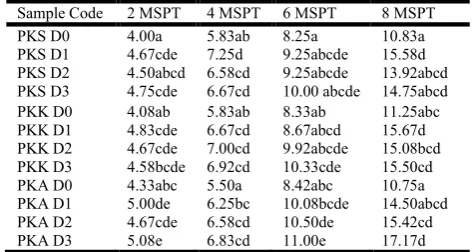
[image:2.595.314.552.547.673.2]The results of the analysis of the multiform prints (Anova) against the number of leaves of onion plants (Appendix 7. f) suggests that the type of manure treatment does not provide any real influence (P > 0.05) on the number of leaves of plants of onion at age 2, 4, 6 and 8 PM MST, the number of leaves While the results of the analysis of variance analyst (Anova) against the treatment doses of manure gives a very real influence (P<0.01) on the number of leaves of plants of onion at age 2, 4, 6 and 8 pm MST. the interaction between the types and doses of manure does not give different real influence (P>0.05) in the amount of leaf plant red onion 2, 4, 6 and 8 MST. To be more clear on table 1.
Table 1. Average number of Leaves Per plant (strands), due to a combination of different types of Manure (JP) and a dose of
Manure (DP) At Some Age a different onion Plants
Sample Code 2 MSPT 4 MSPT 6 MSPT 8 MSPT PKS D0 4.00a 5.83ab 8.25a 10.83a PKS D1 4.67cde 7.25d 9.25abcde 15.58d PKS D2 4.50abcd 6.58cd 9.25abcde 13.92abcd PKS D3 4.75cde 6.67cd 10.00 abcde 14.75abcd PKK D0 4.08ab 5.83ab 8.33ab 11.25abc PKK D1 4.83cde 6.67cd 8.67abcd 15.67d PKK D2 4.67cde 7.00cd 9.92abcde 15.08bcd PKK D3 4.58bcde 6.92cd 10.33cde 15.50cd PKA D0 4.33abc 5.50a 8.42abc 10.75a PKA D1 5.00de 6.25bc 10.08bcde 14.50abcd PKA D2 4.67cde 6.58cd 10.50de 15.42cd PKA D3 5.08e 6.83cd 11.00e 17.17d Description: a number that is followed by the same letter in every different column not reality test DMRT 5%.
the largest leaves at 3.60 kg per dose swath 17.17 strands while the lowest amount of leafNPA 0 kg per dose treatment (a D0) swath i.e. 10.83 strands. This is supported by the theory of Latarang (2004) added that the establishment of a number of very determined by leaf size cells, also in influence by the number of elements of the absorbed by the plant nutrient, nitrogen used plants to form amino acids so that produce chlorophyll used for the process of photosynthesis is absorbed by the roots to serve as food ingredients, chicken manure contain elements N, P, and K and also Ca and Mg. In tighten up by Sumarno (1993) States that nitrogen is indispensable for vegetative growth of plants like roots, stems and leaves as well as stimulating shoots and can add high plants.
High Plant Shallots (cm)
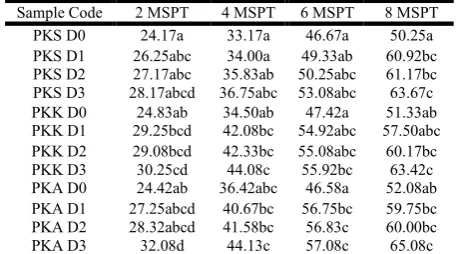
[image:3.595.309.559.325.445.2]The results of the analysis (Anova) variety fingerprints against height plant shallots (attachment 11. f.) indicates that the type of manure treatment gives a real influence on the 4 MST but gives no real influence on plant shallots at the age of 2, 6 and 8 MST, high plant while the results of the analysis of variance analyst (Anova) against the treatment doses of manure gives a very real influence (P<0.01) at the height of the plant the onion at age 2, 4, 6 and 8 MST. the interaction between the types and doses of manure does not give different real influence (P>0.05) in high plant onion at age 2, 4, 6 and 8 MST. For more details can be seen in table 2.
Table 2. Average high Per plant (cm), due to a combination of different types of Manure (JP) and a dose of Manure (DP) At
Some Age a different onion Plants
Sample Code 2 MSPT 4 MSPT 6 MSPT 8 MSPT PKS D0 24.17a 33.17a 46.67a 50.25a PKS D1 26.25abc 34.00a 49.33ab 60.92bc PKS D2 27.17abc 35.83ab 50.25abc 61.17bc PKS D3 28.17abcd 36.75abc 53.08abc 63.67c PKK D0 24.83ab 34.50ab 47.42a 51.33ab PKK D1 29.25bcd 42.08bc 54.92abc 57.50abc PKK D2 29.08bcd 42.33bc 55.08abc 60.17bc PKK D3 30.25cd 44.08c 55.92bc 63.42c PKA D0 24.42ab 36.42abc 46.58a 52.08ab PKA D1 27.25abcd 40.67bc 56.75bc 59.75bc PKA D2 28.32abcd 41.58bc 56.83c 60.00bc PKA D3 32.08d 44.13c 57.08c 65.08c
Description: a number that is followed by the same letter in every different column not reality test DMRT 5%.
Of table 3 shows that the type of treatment doses of fertilizer effect of higher plants against real onion at age 4 MST type manure treatment but is not real influence against high red onion crop plants per sample at age 2 MST, 6 PM MST and 8 PM MST, plant shallots with the highest value there are 8 PM MST on the type of chicken manure (Pa) of 65.08 cm (table 5.3) and on the type of goat manure (Pk) in high crops can be low with the average value of Onion plants high 52. 08 cm. Treatment doses of manure influence very real high against the plant at 2 PM MST, 4 PM MST, 6 PM MST and 8 high-most plants on MST dose 3.60 kg per cm of height whereas the swath of 65.08 plant onion low without treatment doses of 0 kg per (a D0) swath i.e. 50.25 strands (table 5.3). This is supported by the theory of Sumarno (1993) States that nitrogen is indispensable to the growth of vegetative plants like roots, stems and leaves as well as stimulating shoots and high plant and may add to this theory also commands the reinforced by Lakitan (1996), there is a synchronization between the availability of nutrient needs of the plants so that it can help the speed of growing plants. It is also supported by Syarief
(1993), which States that the organic fertilizer which is
inserted into the ground will be decomposed by
microorganisms and nutrient elements released from the decomposition becomes available and are absorbed by plants, thus rooting plant growth will increase especially tall plants.
The Weight of the Fresh Onion Plants
[image:3.595.47.278.418.545.2]The results of the analysis of the multiform prints (Anova) of the weight of fresh plant onion bulbs per sample (attachment 12b) shows that the type of manure treatment gives a real influence (P < 0.01) on the weight of fresh tuber crop onion and also the results of the analysis Analyst prints range (Anova) against the treatment doses of manure gives a very real influence (P < 0.01) on a fresh weight of tuber crops of onion on a per sample. The interaction between the types and doses of manure does not give different real influence (P > 0.05) on a fresh weight of economical plants of onion/sample after harvest. For more details can be seen in Table 3.
Table 3. The value of Different of LSD Results 5% Against the weight of the Fresh Onion Plants/Total Samples At each of these
Factors At Age 8 MSP (gr)
Types of Manure (Gr./plant)
Doses of Manure (Gr./plant) 0
kg/plot (D0)
1.20 kg/plot (D1)
2,40 kg/plot (D2)
3,60 kg/plot (D3) 8 MSP ---gr--- Cow Manure (PKS) 43.83a 51.50a 53.39a 56.29a
A A A A
Goat Manure (PKK) 44.46a 59.06a 61.04a 63.91ab
A A A AB
Chicken Manure (PKA) 45.66a 67.46a 74.04b 87.08c
A A B B
BNT 5% 24.94
Description: Based on variance effect, the effect of the interaction of different types of fertilizers and Manures Dosage. Average followed a similar letter on a line (a, b, c) and columns (A, B, C) of the same is no different of BNT assay based on levels 5%. JPK = Type Of Manure, DPK = Doses of Manure
The number of saplings of Plants of onion (siun)
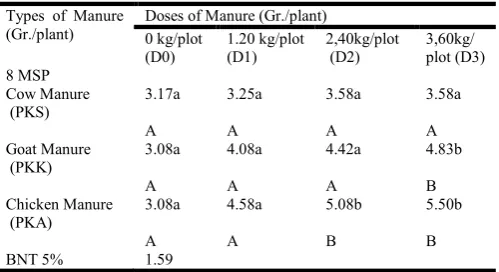
[image:4.595.309.558.221.366.2]The results of the analysis (Anova) variety fingerprints against a heavy amount of economical fresh saplings "suing" plants of onion per sample (Appendix 13. b.) indicates that the type of manure treatment gives a real influence (P<0.01) On the weight of fresh economic number of saplings of plants of onion and also the results of the analysis of the multiform variance analyst (anova) against the treatment doses of manure gives a very real influence (P < 0.01) on a fresh weight of economical amount of onion plants/saplings sample. the interaction between the types and doses of manure does not provide a distinct influence is real (P>0.05) on a fresh weight economical number of saplings of plants of onion/samples after harvest. For more details can be seen in Table 4.
Table 4.The value of Different of BNT Assay Results and 5% Against number of Chicks Plant Onion/Swath on each Factor At
Age 8 MSP (siun)
Types of Manure (Gr./plant)
Doses of Manure (Gr./plant) 0 kg/plot
(D0)
1.20 kg/plot (D1)
2,40kg/plot (D2)
3,60kg/ plot (D3) 8 MSP
Cow Manure (PKS)
3.17a 3.25a 3.58a 3.58a
A A A A
Goat Manure (PKK)
3.08a 4.08a 4.42a 4.83b
A A A B
Chicken Manure (PKA)
3.08a 4.58a 5.08b 5.50b
A A B B
BNT 5% 1.59
Description: based on yout effect, the effect of the interaction of different types of fertilizers and Manures Dosage. Average followed a similar letter on a line (a, b, c) and columns (A, B, C) of the same is no different of BNT assay based on levels 5%. JPK = Type Of Manure, DPK = Doses of Manure.
From table 5.5 shows that the type of manure treatment effect is significant P 0.01) against heavy < fresh number of saplings of plants of onion and fresh weight of the number of saplings of Red bawng kg/plant compartments. Types of chicken manure treatment (Pa) against the weight of fresh fresh economic number of plantlets per onion plant samples. The fresh weight of the number of saplings of plants of onion 3.60 kg/compartments give highest weight 5.50 gr/samples while the lowest found in cow manure treatment (Ps) weighing 3.25 grams/sample (Table 5.5). Treatment doses of manure very real effect against the weight of the amount of fresh onion plants/saplings samples and kg/swath. The fresh weight of the number of saplings of plants of onion the highest achieved at doses of 3.60 kg/swath (D3) 5.50 grams while the lowest on dose 0 kg/swath (a D0) weighing 3.08 g table 5.4. This is supported by the theory of Setyamidjaya (1986) absorption of nutrient elements during the period of growth is not the same, so it needs to be given to the amount gradually to suit the needs of the plant and research Mayun (2007) use of can increase the weight of bulbs on the onion. The number of leaves and broad leaf associated with formation of plantlets and number of bulbs then this effect on the fresh weight of the dry weight of the plant and total plant. The more the number of leaves produced then the chance to produce a dry weight to fresh weight and total plant is also high.
The weight of the Fresh Plant Onion Bulbs/swath (gr)
he results of the analysis of the multiform prints (Anova) of the weight of fresh onion plants bulbs economical/plot show
[image:4.595.39.289.275.411.2]that the type of manure treatment gives a real influence (P<0.01) On the weight of fresh tuber onion crops economically and also the results of the analysis of the multiform variance analyst (anova) against the treatment doses of manure gives a very real influence (P < 0.01) on a fresh weight of economical amount of plant tuber onion/swath. the interaction between the types and doses of manure does not give different real influence (P>0.05) on the weight of fresh tuber onion plants economically Red/swath after harvest. For more details can be seen in Table 6.
Table 5. The value of Different of BNT Assay Results and 5% Against the weight of Fresh Tuber Plant Onion/Swath on each
Factor At Age 8 MSP (g)
Types of Manure (Gr./plant)
Doses of Manure (Gr./plant) 0
kg/plot (D0)
1.20 kg/plot (D1)
2,40 kg/plot (D2)
3,60 kg/plot (D3) 8 MSP
Cow Manure (PKS)
2478ab 30.52abcd 34.55abcd 37.88bcde
A A A B
Goat Manure (PKK)
25.69abc 38.57bbcde 39.80bcde 41.49cde
A B B B
Chicken Manure (PKA)
19.07a 42.82de 43.20de 46.87e
A B B B
BNT 5% 15.81
Description: based on variance effect, the effect of the interaction of different types of fertilizers and Manures Dosage. Average followed a similar letter on a line (a, b, c) and columns (A, B, C) of the same is no different of BNT assay based on levels 5%. JPK = Type Of Manure, DPK = Doses Of Manure
From table 5.6 shows that type of manure treatment effect is significant P 0.01) against heavy < fresh number of tuber plant shallots and fresh weight of the number of tubers plant red onion kg/plot. Types of chicken manure treatment (Pa) against the fresh weight of the economical amount of bulbs plants of onion/swath. The fresh weight of the number of tubers plant onion 3.60 kg/compartments provide the highest weight is 46.87 gr./compartments while the lowest found in cow manure treatment (Ps) with a weight of 30.32 grams/plots (table 5-6). Treatment doses of manure effect very real amount of fresh tuber weight against plant onion/plot and kg/plot. The fresh weight of the number of tubers plant onion highest achieved at doses of 3.60 kg/swath (D3) 46.87 g/compartments while the lowest on dose 0 kg/swath (a D0) with a weight of 19.07 grams table 56. This is in accordance with statement Napitupulu and Winarto (2009) stating that potassium plays a role in improving the vegetative growth of plants such as the formation of tuber enlargement and enlargement, as well as influential in increasing weight of onions Red. Additionally supported by the Damanik et al (2010) stating that potassium is necessary for the process of formation of photosynthesis and can increase the weight of the tuber.
Dry weight of plant Tuber Onion/sample (g)
tuber crops economically heavy onion/sample after process dry with sun rise. For more details can be seen in Table 7.
Table 6. The value of Different of BNT Assay Results and 5% against the dry weight of plant Tuber Onion/Swath on each
Factor At Age 8 MSP (gr)
Types of Manure (Gr./plant)
Doses of Manure (Gr./plant) 0
kg/plot (D0)
1.20 kg/plot (D1)
2,40 kg/plot (D2)
3,60 kg/plot (D3) 8 MSP
Cow Manure (PKS) 21.67a 27.33a 29.75a 33.17a
A A A A
Goat Manure (PKK) 22.58a 36.00a 37.33b 42.08b
A A B B
Chicken Manure (PKA) 22.75a 40.42b 41.00b 48.25b
A B B B
BNT 5% 15.07
Description: based on variance effect, the effect of the interaction of different types of fertilizers and Manures Dosage. Average followed a similar letter on a line (a, b, c) and columns (A, B, C) of the same is no different of BNT assay based on levels 5%. JPK = Type Of Manure, DPK = Doses of Manure
From table 7 shows that the type of manure treatment effect is significant P 0.01) against heavy <keirng economical plant onion bulbs and dry weight of plant tuber red onion economical kg/plot. Types of chicken manure treatment (Pa) against the weight of the fresh plant onion bulbs economical per sample. The weight of the dry economical plant onion bulbs 3.60 kg/compartments provide the highest weight of 48.25 g/samples while the lowest found in cow manure treatment (Ps) with a dose of 2.40 kg/compartments with heavy 27.33 g/sample (Table 5-4). Treatment doses of manure very real effect against dry weight plant onion bulbs/sample and kg/swath. The weight of the dry tuber onion plants the highest achieved at doses of 3.60 kg/swath (D3) 48.25 g while the lowest at doses of 0 kg/swath (a D0) with a weight of 21.67 grams of table 5.4. This is supported by the theory of Gardner, et al, (1991) plant growth associated with the power plant produces dry weight, i.e. in terms of the efficient energy capture sunlight and convert it into carbohydrates in the process of photosynthesis. According to Gardner, et al, (1991) with increased photosynthesis then it will have an effect on the formation of plant tissues in the form of roots, stems, and leaves, all of which it is a major component of the dry weight of the plant.
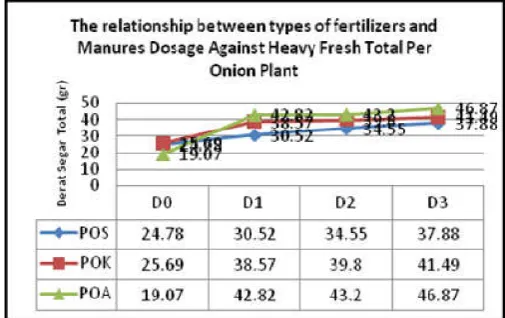
The relationship between types of fertilizers and Manures Dosage Against Heavy Fresh Total Per Onion Plant (Graphic)
The results of the relationship between the dose of fertilizer weighing fresh tuber plant onion/swath on each type of manure (Ps), (Pk), and Pa), is differently to weight fresh total per plant onion/swath served on (graph 5.1) analysis results showed that chicken manure dosing 3.60 kg/swath can produce fresh weight of total plant onion/hide registration (46.87 g), while give doses of cow and goat manure with the same dosage but the results are different too, namely fertilizer goats produce fresh onion plants total weight/swath of 41.49 g and cow manure produce fresh heavy total of 37.88 Gr. for results can be seen more clearly the relationship between the dose of the fertilizer by weight Fresh bulbs of plants of onion/swath on each type of manure (PS), (PK), and the (PA), on the graph 5.1 below. According to research Napitupulu and Winarto (2009) Nitrogen plays a role in increasing protein synthesis, manufacture of chlorophyll of leaves become more green, leaf
color can add rate of photosynthesis, as well as increasing the ratio of the root tip. According to Defensebaseactcomp (2011), a large number of leaves that form a broad meaning the leaves become wider, then the ability to receive light leaves in the process photosynthesis be larger in yield and carbohydrate will goto the translocations bulbs thereby affecting the large and heavy bulbs.
Conclusion
1. The different types of manure does not effect against growth and crop yield of onion while administering doses of manure increases would boost growth and crop yield of onion on the treatment dose of manure cows, goats and chickens.
2. Not found the interactions between types and doses of manure towards growth and crop yield of onion
REFERENCES
Adimihardja, A., I. Juarsah, and U. The Gift. 2000. The influence of usage of various kinds and varying quantities of manure to productivity of land Degraded in the inner Village Ultisols, Jambi. pp. 303-319 in the pros. National Seminar Resources, climate, Soil and fertilizer. Book II. Lido-Bogor, 6-8 Dec. 1999. Land Research Centre and Agroklimat, Bogor.
Damanik, M. M. B., B. E. Hasibuan, Fauzi, Sarifuddin, and h. Hanum. 2010. Soil fertility and fertilization. Medan, North Sumatra: The University.
Defensebaseactcomp, P., and d. Anggorowati. 2011. The influence of various types of Local Microorganisms (Mol) towards the growth and yield of Onion On Alluvial Soil. Faculty of Agriculture University Of Tanjungpura Pontianak.
Gardner, F, P, R, B, R and L Pearce, Mitchell, 1991, Cultivating Plant Physiology, University of Indonesia, Jakarta.
Gomez, K. A. and A. Gomez, A. 1995. Statistical procedures for agricultural research. (IsangSyamsuddin and Justika s. Baharsjah, Pentj). Jakarta: UI.
Hidayat, Y. and R. Rosliani. 1996. Influence of Fertilizer N, P and K on growth and Production of onion Cultivars Sumenep. J. Hort. 5 (5): 39-43.
Lakitan, B. 1996. Plant Physiology and development of plants. PT. Raja GrafindoPersada. Jakarta.
Mayun, I.A., 2007. Effects of Rice Straw Mulch and Manure Cows against the growth and yield of onion in the coastal region. Agritrop, 26 (1), pp. 33-40. Department Of Agricultural Cultivation University Of Udayana.
Meditation and Cahyoo. 2005. Intensification of Onion Farmer. Yogyakarta
Napitupulu, D. and L. Winarto, 2010. Influence the granting of Fertilizer N and K Towards the growth and Production of onion. J. Hort., vol. 20 (1): 27-35, 2010.
Napitupulu, D. and L. Winarto. 2009. influence the granting of Fertilizer N and K Towards the growth and Production of onion. Study Hall agricultural technology North Sumatra, J-Hort. 20 (1): 22-35 2010.
Rukmana, R. 1997. Corn. Canisius. Yogyakarta. 84 pp. Rukmana, R. 2005. The onion: cultivation and Post-harvest
Management. Canisius. Yogyakarta.
SalvitiaDirgantari, Halimursyadah, and Syamsuddin. 2016. The response of growth and yield of onion (Allium ascalonicum) against a combination dose of Manure and
NPK. Scientific Journal Of Agricultural University
Students. Volume 1, number 1, November 2016
Setyamidjaya, D. 1986. Fertilizers and fertilization. Cv. Simplex, Jakarta
Syarief, E. S. 1993. Fertility and cultivation of agricultural land. Publisher Libraries Buana, Bandung.
Thompson, H.C. and W.C. Kelly. 1957. "Vegetable Crops". 5th ed. McGraw Hill Book Co. Inc. New York. 661 p Widowati, L.R., Sri Widati, u. Jaenudin, and w. Hartatik.
2005. influence of Organic Fertilizer Compost enriched with Minerals and fertilizers toward Biological soil properties, Nutrient Absorption and Organic vegetable production. Report of the research project of agribusiness development Program, 2005, TA Land Research.
Zulkarnain, M., Prasetya, b., and Soemarno. 2013. The influence of compost, manure, and custom-bio against the nature of the soil, the growth and yield of sugar cane (Saccharumofficinarum l.) in entisol in the garden Ngrakah-Pawon Kediri. Indonesian Green Technologi Journal. 2 (1): 45-52.