AN ARTIFICIAL BEE COLONY BASED OPTIMIZATION
FOR IMAGE SEGMENTATION IN MARKOVIAN
FRAMEWORK: APPLICATION TO NON DESTRUCTIVE
TESTING IMAGES
MOHAMED BOU-IMAJJANE, MOHAMED SBIHI
Laboratory Of System Analysis, Information Processing And Integrated Management High School Of Technology Sale – Mohamed V University, Rabat, Morocco
E-mail: [email protected]
,
[email protected]ABSTRACT
Image segmentation is a fundamental task in image analysis process. In this paper, we propose a segmentation model using MRF (Markov Random Fields) and a global optimization method based on ABC (Artificial Bee Colony) algorithm. As a Markovian algorithm, ICM (Iterated Conditional Modes) is a segmentation method which takes into account the neighbouring labels of the pixel in calculating the energy function that need to be minimized to obtain the best segmentation. Though, in some cases, this segmentation method may converge to the first encountered minimum during the minimization process. To face out this situation, ABC is so used to improve the energy function optimization process since it gives robust results especially in discrete multivariable optimization problems. The contribution of this work is to propose MRF-ABC algorithm that consists of introducing ABC to optimize Markovian energy function at the convergence point obtained using ICM to adjust the belongingness of pixels in order to improve image segmentation quality for X-ray Non Destructive Testing images.
Keywords: Markov Random Fields, Artificial Bee Colony, Image Segmentation, Potts Energy Function, Non Destructive Testing.
1. INTRODUCTION
Image segmentation is the process of splitting it into homogenous regions formed by pixels that have a similar attributes (color, luminance, intensity,..). This vital task of image analysis is widely used in many industrial and technological fields. In this regard, several methods and algorithms have been developed and discussed by researchers.
Furthermore, the main difficulty in image segmentation task is first to tailor the algorithm to the application and second to have better results in term of quality and processing time.
All over the world, researchers have studied, discussed and proposed many useful image processing methods in several technological and industrial fields to overcome the deficiency encountered by the use of traditional interpretation that require high level competency and expertise. This kind of images has been significantly
increased in recent years. First, Zhang & al. [1] assume that the obtained images from remote sensing provide a lot of details about surface, and which are very useful for multiple purposes.
by using different stages of 2D filtering or 2D wavelet transform capabilities.
Furthermore, Shao & al. [3] discussed an effective method based on potential weld defects tracking in automatic real-time radiographic image sequence of a moving weld. They employ thresholding segmentation and a modified Hough Transform to track the center of the weld defect.
Ayasso & al. [4] propose a method based on non homogeneous Gauss–Markov fields with Potts region labels model to simultaneously restore and to segment images degraded by a known Point Spread Function (PSF) and additive Gaussian noise. A Bayesian estimation framework is then considered to approximate the joint posterior law of all the unknowns (the unknown image, its segmentation (hidden variable) and all the hyper parameters).
Markov Random Fields have been used for long time in image segmentation since they can give accurate results, depending on the considered neighborhood, and probabilities of classes which are obtained by the least a priori information. They can also be combined with other techniques and algorithms to customize them upon the considered application and to improve the performance of results.
In [5], three optimization techniques are compared: Deterministic Pseudo-Annealing (DPA), Game Strategy Approach (GSA), and Modified Metropolis Dynamics (MMD). Those methods are used to perform image classification in a Markov Random Field framework. Besides, a combination of Hidden Markov Random Field and Swarm Particles Optimization is presented in [6]. This model is evaluated on ground truth images and the results are satisfying.
In fact, the principle of image segmentation in the MRF-MAP framework (Markov Random Fields - Maximum A Posteriori), is based on maximizing a posteriori probability of labeling each pixel [7]. This process is translated into a minimization problem of the energy function that may present many local minima in the solution space.
Moreover, image segmentation is considered as a clustering problem where many established techniques were generated and applied to images. The widely used Markovian method is a deterministic optimization called Iterated Conditional Modes (ICM). It is an iterative algorithm that starts with an initial solution based on k-means algorithm, and is improved using a Markovian energy function as a criteria, upon a
predefined neighborhood of the pixel, until a local minimum is reached [5 - 8]. This algorithm offers many advantages in term of convergence time and reasonability of the obtained results in most cases. Therefore, the algorithm stops at the first local minimum and it depends tightly on the initialization step.
To overcome this deficiency, several global optimization methods were introduced in image segmentation since they look for the global optimum and avoid the convergence to the first encountered minimum. A common point of these methods is that they consider many possible solutions at the same time [9]. Among those, Genetic Algorithms that are based on the principle of natural evolution [10 - 11] and Swarm intelligence-based algorithms that are inspired from collective behaviors of social creatures [5-12-13-14].Moreover, Genetic Algorithms and swarm based approaches give better clustering results, and they are less dependent on the initialization phase. As examples of swarm-based optimization, we can mention methods based on bee colony [15-16-17], ant colony [18-19], bird flocks [20].
Artificial Bee Colony (ABC) Algorithm is an optimization method based on the intelligent behavior of honey bee swarm that was introduced recently by Karaboga. The results given by this method encourage researchers to develop more algorithms based on ABC. Such in [15], the performance of ABC is demonstrated in numerical optimization problems.
In this work, a segmentation technique using MRF (Markov Random Fields) and an optimization based on ABC (Artificial Bee Colony) algorithm is proposed. The contribution of this paper consists of the fact that the proposed method combines the robustness of MRF in labeling the pixels taking into account the neighboring system and the ABC optimization of the energy function to overcome the possibility to converge to a local minimum. Experimental results on real world test images and X-ray Non Destructive Testing images show the efficiency of the discussed method since they can help aeronautic field experts to make decisions on materiel serviceability based on image segmentation.
2. PRESENTATION OF USED METHODS 2.1 Markov Random Fields
Markov Random Fields MRF model has been used for image segmentation and classification during last decades [21-22]. It is a spatio-contextual model based segmentation scheme that partitions an image into different clusters with the constraint of Gibbs distribution as prior gray level. Each pixel in an image Y is assumed as a site s denoted by Ys, s belongs to S, where S= M x N represents the set of sites. Y represents a random field and y is a realization of it.
A random field = ( , , . . , ) is a Markov field associated to the neighbourhood systemonly if:
1. P(X = x) ≥ 0 (1)
2. P(x /x , j ∈ S − {i}) = P(x /x , j ∈ ϑ ) (2)
The theorem of Hammersly-Clifford [22] demonstrates that the random field X is a Markov field on S with respect to a neighborhood system V if and only if its distribution P(X=x) is a Gibbs distribution defined by:
P(X = x) = . exp(−U(x)) (3)
Where Z is the partition function or the sum of the numerator over all possible labeling and U(x) is the energy function defined as:
U(x) = ∑ ∑∈ θ . J(x , x ) (4)
With J(a, b) = −1 if a = b; 0 if a ≠ b,
and θ ,θ , . ..are the clique parameters (in our context we use the Ising model with θ =θ = . . . = b .
P(X = x)is called the a-priori probability.
The image segmentation is the label process estimation X from the pixel realization Y. Several approaches uses the estimation using the a-posteriori probability P(X/Y)which is a Gibbs distribution given by:
P( = / = ) = . exp(−U( / )) (5)
Where Zy is the normalization constant and U(x/y)the energy function as presented in [24]:
Equation (6):
( / ) = ∑ [ . ln(σ ) + σμ ) ∑∈ θ . J( , )
The segmentation problem can be stated as the problem of observing vector y and estimating the labels in the perfect image. The Maximum A Posteriori (MAP) estimate is the vector x which maximizesP(X = x/ Y = y)with respect tox.
The image segmentation problem can be approached within the MAP–MRF framework or a classical solution named the Iterated Conditional Modes (ICM) .Despite being computationally efficient, the ICM algorithm has an evident drawback of locally convergences [25].
The Iterated Conditional Modes (ICM) is an algorithm presented by Besag [22-23] as computationally feasible alternative to MAP estimation. The ICM algorithm can be presented as follows:
1. Initialization of x. 2. For i=1 to MN do:
Update the value of x which maximizes the probabilityP(x /x , j ∈ ϑ ).
3. Repeat the steps 2 a number of iterations.
The ICM depends strongly on the initialization phase and it is a perfectly deterministic algorithm. 2.2 Artificial Bee Colony Algorithm
Recently, several Meta heuristics based on swarm intelligence were developed to resolve complex numeric optimization problems. Bee colony optimization is one of those population based algorithms that have proved their efficiency in many applications. This algorithm is inspired from the behavior of honey bees in foraging sources of nectar or pollen.
Every source of food is considered as a solution to the problem and the quantity of nectar contained in each source correspond to a value of the objective called fitness.
In this optimization technique, three types of bees are considered: employed bees, onlookers and scouts. An onlooker is a bee waiting in the hive to choose a best food source based on the information received. a bee going to the food source visited by itself previously is named an employed bee. And a scout is a bee searching for nectar sources randomly.
bees are affected to food sources in order to maximize the collected nectar depending on the quantity of nectar and the distance between the source and bee hive. Every employed bee represents an independent solution to the problem.
In the first step, the algorithm generates SN randomly distributed solutions as an initial population [15, 16]. Each solution ( = 1, 2, … , ), where SN denotes the size of population, constitutes a solution vector to the optimization problem. The variables contained in each vector must be optimized.
Thus, every solution is subjected to research process made by employed bees, the onlooker bees and scout bees, in form of repeated cycles = 1, 2, … , , to find the best source.
The active foragers look for new sources in the neighborhood of the previous source following the expression:
= + − (7)
Where: ∈ {1, 2, … , } (BN is the number of foragers) and the values ∈ {1, 2, … , } are randomly selected indices.
is a random number belonging to the interval [-1, 1] that controls the production of a food source in the neighborhood of . Although k is selected randomly, it has to be different from i.
After the generation of each new food source , and then evaluated by the artificial bee, its performance is compared with that of . If the nectar of this source is equal to or better than the previous source, it is replaced by the new, otherwise the former is retained.
The fitness in this minimization problem is calculated according to expression (8):
( ⃗) = ( ⃗) ( ⃗) ≥ 0
1 + ( ⃗) ( ⃗) < 0 (8)
Such that ( ⃗) is the value of the objective function of the solution ⃗.
Finally, at the end of the research process, Employed bees share information with other bees in the hive through the waggle dance. This information includes the distance, the direction and the profitability of the food source. They assess all information transmitted from employed bees and choose the best sources depending on the
probability associated to this source following this formula:
=
∑ (9)Where is the solution fitness, which is proportional to the amount of nectar source in the position i.
The source of food that is deserted by bees, Scouts replace it with a new source. If during a predetermined cycle number called "limit" a position can’t be improved, so this food source is assumed to be abandoned.
3. PROPOSED MRF-ABC ALGORITHM: 3.1 Hypotheses
As mentioned below, image segmentation using ICM in a Markovian framework may lead to a convergence to the first local minimum of the energy function. This can be caused generally by both the limitation of the processing using ICM and by the noise added to the image in the time capturing the scene (degraded luminance, Gaussian noise,..). To do so, three major hypotheses were adopted for this study:
Hypothesis 1:The described situation may be resolved by introducing an optimization method, in the same Markovian framework, such as Artificial Bee colony to overcome the possibility to converge to local minimum in order to improve the results obtained by ICM segmentation. This combination of ABC optimization in Markovian framework for image segmentation is discussed in this paper as the MRF-ABC algorithm.
Hypothesis 2: In order to simplify the formulation, Markov Random Field attributes are set as follows:
The Ising model in term of energy function;
The neighborhood that takes into account the 8-nearest pixels.
3.2 MRF-ABC Algorithm description
Taking into account the three hypotheses described in the previous section, our proposed MRF-ABC algorithm is based on a linear combination of two methods:
ICM algorithm: that defines a pixel label configuration as a prior segmentation. This step constitutes the input for ABC optimization.
ABC algorithm: which minimizes Markov energy function by modifying the pixel label configuration obtained from ICM segmentation (considered as the input image).
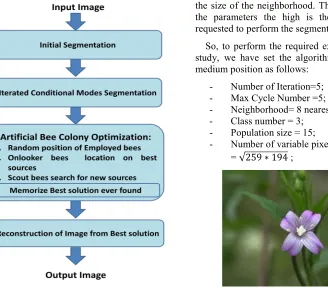
As in ABC optimization process, after a set of population initialization, the process of the best solution research is performed iteratively for a number of cycles. Each cycle consists of three major steps: first the employed bees are located on their food sources. Then, the onlooker bees are placed on food sources that represent better performance in term of nectar amount, its quality and the source distance. Finally, scouts are sent in the search area to look for new nectar sources.
[image:5.612.118.446.417.705.2]The detailed MRF-ABC algorithm for image segmentation can be described in Figure 1.
Figure 1: MRF-ABC Algorithm Flow Chart
Note that by the end of every cycle, the best food source ever found during this cycle is memorized. The optimal solution by MRF-ABC algorithm is the best solution obtained from the food search cycles.
4. EXPERIMENTAL RESULTS 4.1 General image segmentation test
In order to prove the efficiency of the proposed algorithm, we have performed the MRF-ABC algorithm on both real world images and x-ray non destructive testing images.
In this section, obtained results from two true color test images are presented;
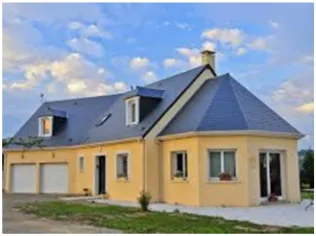
- Image 1: Flower (259x194 pixels). (Figure 2). - Image2: Architecture (259x194 pixels) (Figure 7).
It is important to note that the input parameters of MRF_ABC algorithm are:
- Input image; Class number; Pixel neighborhood; Number of ICM Iteration; ABC max Cycle Number; Bee population size; Number of variable pixel labels; Some manipulations of the script indicate that the results can be greatly improved by increasing the number of variable pixels, the population size or the max cycle number. The effect is inverse if we increase the number of classes or if we decrease the size of the neighborhood. Though, the high are the parameters the high is the processing time requested to perform the segmentation task.
So, to perform the required experiments for this study, we have set the algorithm parameters in a medium position as follows:
- Number of Iteration=5; - Max Cycle Number =5;
- Neighborhood= 8 nearest pixels; - Class number = 3;
- Population size = 15;
- Number of variable pixel labels =√259 ∗ 194;
[image:5.612.331.498.497.705.2]Figure 3: Flower Image Segmented Using ICM
Figure 4: Flower Image Segmented Using MRF-ABC
Algorithm
[image:6.612.120.272.287.400.2]Figure 5: Flower Image Energy Function Using ICM
[image:6.612.343.501.334.452.2]Figure 6: Flower Image Energy Function Using MRF-ABC Algorithm
Figure 7: Original Architecture Image
Figure 8: Architecture Image Segmented Using ICM Iterations
Iterations Markov Energy Function
[image:6.612.104.307.466.664.2]Figure 9: Architecture Image Segmented By MRF-ABC Algorithm
[image:7.612.97.299.276.459.2]Figure 10: Energy Variation for Architecture Image Using ICM Segmentation
Figure 11: Energy Function For Architecture Image Using MRF-ABC Segmentation
The results obtained from both segmentations using ICM only and using MRF-ABC algorithm are shown bellow (Figure 3 and Figure 4 for Flower image and Figure 8 and Figure 9 for Architecture image). Figures 5 and 10 illustrate the variation energy during ICM segmentation iterations for both images.
According to Figures 6 and 11 related to the variation of Markovian energy function during the process of segmenting images using MRF-ABC algorithm show that after some iterations (between 2 and 4), the results obtained are improved since the values of final energy are less than energy values obtained by ICM only.
So, the assumption of this work that Artificial Bee Colony in a Markovian framework can solve the limitation shown by ICM that can be summarized to the fact that ICM minimizes Markovian energy function but it may converges to the first minimum.
Moreover, by visual assessment, segmentation quality using MRF-ABC, for both test images, is better in comparison with ICM in term of the compactness of each pixel class.
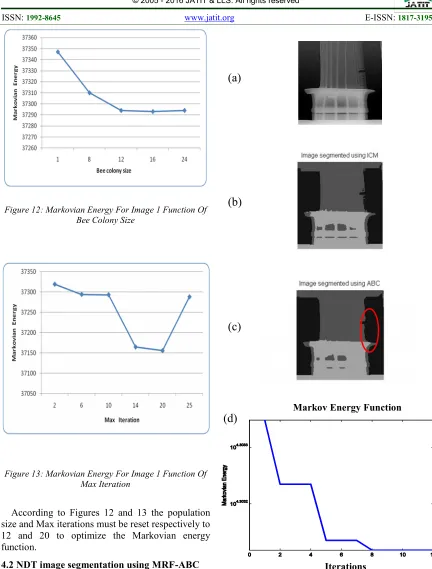
In addition, to optimize the parameters of MRF-ABC algorithm for X-ray Non Destructive Testing image, especially in term of bee colony size and Max iterations, image 1 is considered as a test image to find the parameters that minimize the Markovian energy during segmentation process. Figure 12 shows that the Markovian energy for different segmentations of image 1 decreases where bee colony size varies from 1 to 24.
Also, Figure 13 illustrates that the Markovian energy of image 1 decreases slightly from 2 to 10 Max iterations where it fall down between 10 and 20. The value obtained in Max iteration equal to 25 is due principally to the fact that the algorithm searches randomly for the best solution.
Iterations
Markov Energy Function
[image:7.612.89.300.510.692.2]Figure 12: Markovian Energy For Image 1 Function Of Bee Colony Size
Figure 13: Markovian Energy For Image 1 Function Of Max Iteration
According to Figures 12 and 13 the population size and Max iterations must be reset respectively to 12 and 20 to optimize the Markovian energy function.
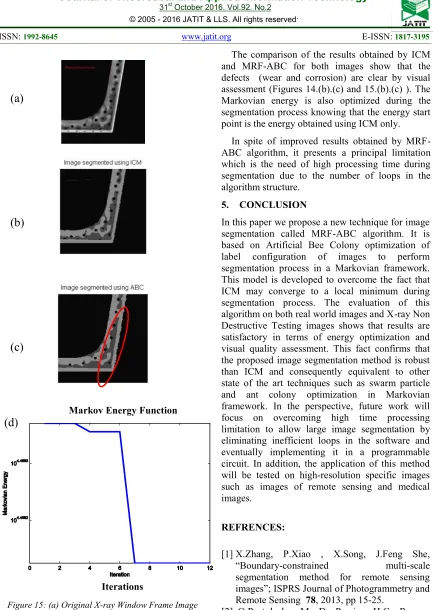
4.2 NDT image segmentation using MRF-ABC Taking into account the most favorable configuration found in section 4.1 (i.e population size =12 and Max iteration = 20), we choose two X-ray Non Destructive Testing images from aeronautics to evaluate our algorithm. The first one concern an unusual wear in an aircraft engine blade and the second is related to a aircraft window frame corrosion.
Figure 14: (a) Original X-ray Turbine Blade Image 220x220 (b) Segmentation Using ICM Algorithm For
Turbine Blade Image
(c) Segmentation Using MRF-ABC Algorithm For Turbine Blade Image (d) Markovian Energy Minimisation During Optimization By MRF-ABC
Algorithm For Turbine Blade Image.
(a)
(b)
(c)
(d)
Iterations
Figure 15: (a) Original X-ray Window Frame Image 220x220 (b) Segmentation Using ICM Algorithm For
Window Frame Image (c) Segmentation Using MRF-ABC Algorithm
(d) Markovian Energy Minimisation During Optimization By MRF-ABC Algorithm For Window Frame Image.
The comparison of the results obtained by ICM and MRF-ABC for both images show that the defects (wear and corrosion) are clear by visual assessment (Figures 14.(b).(c) and 15.(b).(c) ). The Markovian energy is also optimized during the segmentation process knowing that the energy start point is the energy obtained using ICM only.
In spite of improved results obtained by MRF-ABC algorithm, it presents a principal limitation which is the need of high processing time during segmentation due to the number of loops in the algorithm structure.
5. CONCLUSION
In this paper we propose a new technique for image segmentation called MRF-ABC algorithm. It is based on Artificial Bee Colony optimization of label configuration of images to perform segmentation process in a Markovian framework. This model is developed to overcome the fact that ICM may converge to a local minimum during segmentation process. The evaluation of this algorithm on both real world images and X-ray Non Destructive Testing images shows that results are satisfactory in terms of energy optimization and visual quality assessment. This fact confirms that the proposed image segmentation method is robust than ICM and consequently equivalent to other state of the art techniques such as swarm particle and ant colony optimization in Markovian framework. In the perspective, future work will focus on overcoming high time processing limitation to allow large image segmentation by eliminating inefficient loops in the software and eventually implementing it in a programmable circuit. In addition, the application of this method will be tested on high-resolution specific images such as images of remote sensing and medical images.
REFRENCES:
[1] X.Zhang, P.Xiao , X.Song, J.Feng She, “Boundary-constrained multi-scale segmentation method for remote sensing images”; ISPRS Journal of Photogrammetry and Remote Sensing 78, 2013, pp 15-25.
[2] O.Postolache, M. D. Pereira, H.G. Ramos, A.L.Ribeirol, “NDT on Aluminum Aircraft Plates based on Eddy Current Sensing and Image Processing”, IEEE International Instrumentation and Measurement Technology Conference, 12-15 May 2008, pp 1803 - 1808.
(a)
(b)
(c)
(d)
Iterations
[image:9.612.92.525.45.655.2][3] J.Shao , D.Du , B.Chang, H.Shi, “Automatic weld defect detection based on potential defect tracking in real-time radiographic image sequence”, Journal of NDT and E-international, 46 ,2012, pp 14–21.
[4] H.Ayasso, A.M.Djafari, “Joint NDT Image Restoration and Segmentation Using Gauss– Markov–Potts Prior Models and Variational Bayesian Computation”, IEEE Transactions On Image Processing, 19, 2010, pp 2265-2277. [5] M.Berthod, Z.Kato, S.Yu, “Bayesian image
classification using Markov random fields”; J.Image and vision computing, 14, 1996, pp 285-295.
[6] E.Guerrout, R.Mahiou, S.Ait-Aoudia, “Hidden Markov Random Fields and Swarm Particles: a Winning Combination in Image Segmentation”, ScienceDirect IERI Procedia 10, 2014, pp 19 – 24.
[7] S.Z.Li; “Markov Random Field Modelling in Computer Vision”, Proceedings of the European Conference on Computer Vision, Volume B, May 1994, pp 361-370.
[8] J.Besag ; “On the statistical analysis of dirty pictures”, J . Royal Statistic Society B, 68, 1986, pp 259-302.
[9] P.Franti , J. Kivijarvi, “Randomised local search Algorithm for the Clustering Problem Pattern Analysis & Applications”; Springer-Verlag London Limited 3, 2000, pp 358–369.
[10] P.Franti, J.Kivijarvi, T.Kaukoranta, O.Nevalainen, “Genetic algorithms for large scale clustering problems”; The Computer Journal, 40,1997, pp 547–554 .
[11] E.Y.Kim, S.H.Park, H.J.Kim, “A Genetic algorithm-based segmentation of Markov Random Field modeled images”, IEEE Signal processing letters 11, 2000, pp 301–303. [12] Z.Ye, W.Liu, H.Chen, E.Zhao, “A novel
feature selection approach based on swarm intelligence”, International Workshop on Intelligent Systems and Applications, 2009, pp 1–4.
[13] R.N. Khushaba, A. Al-Ani, A.Alsukker, A.Al-Jumaily, “A combined ant colony and differential evolution feature selection algorithm”, Ant Colony Optimization and Swarm Intelligence Volume 5217 of the series Lecture Notes in Computer Science, 2008, pp 1–12.
[14] F.Keshtkar, W.Gueaieb, “Segmentation of dental radiographs using a swarm intelligence approach”, Canadian Conf. Electrical and Computer Engineering, 2006, pp 328–331.
[15] D.Karaboga, B.Basturk, “A powerful and efficient algorithm for numerical function optimization: artificial bee colony (ABC) algorithm”, J. Glob Optim , 39, 2007, pp 459– 471.
[16] D.Karaboga , B.Akay, “A comparative study of Artificial Bee Colony algorithm”, Applied Mathematics and Computation, 214, 2009, pp 108–132.
[17] G.Zhu, S.Kwong, “Gbest-guided artificial bee colony algorithm for numerical function optimization”, Applied Mathematics and Computation, 217, 2010, pp 3166–3173. [18] S.A.Etemada, T.Whiteb, “An ant-inspired
algorithm for detection of image edge features”, Applied Soft Computing, 11, 2011, pp 4883–4893.
[19] S.Ouadfel, M.Batouche, “MRF-based image segmentation using Ant Colony System”, Electronic Letters on Computer Vision and Image Analysis, 2, 2003, pp 12-24.
[20] J.Kennedy, R.Eberhart, “Particle swarm optimization”, Proceedings of the IEEE International Conference on Neural Networks, 4, 1995, pp 1942–1948.
[21] B.N.Subudhi, F.Bovolo, A.Ghosh, L.Bruzzone, “Spatio-contextual fuzzy clustering with Markov random field model for change detection in remotely sensed images”, Journal of Optics and Laser Technology, 57, 2014, pp 284-292.
[22] M.Bou-imajjane, M.Sbihi, “A fusion of remote sensing images segmentation based on Markov random fields and fuzzy c-means models”, Annals of the University of Craiova, Mathematics and Computer Science Series, 42, 2015, pp 175-185.
[23] J. Besag, “Spatial interaction and the statistical analysis of lattice system”, Journal of the Royal Statistical Society, 36, 1974, pp 192-225.
[24] R.C.Dubes, A.K.Jain, S.G.Nadabar, C.C.Chen, “MRF model-based algorithms for image segmentation”, Pattern Recognition Proceedings, 10th International Conference, 1990, pp 808 – 814.