WELL-BEING AND INEQUALITY
IN TRANSITION.
THE CASE OF HUNGARY
Orsolya Lelkes
London School o f Economics and Political Science
Thesis submitted for the degree o f
Doctor o f Philosophy
UMI Number: U178565
All rights reserved
INFORMATION TO ALL USERS
The quality of this reproduction is dependent upon the quality of the copy submitted.
In the unlikely event that the author did not send a complete manuscript and there are missing pages, these will be noted. Also, if material had to be removed,
a note will indicate the deletion.
Dissertation Publishing
UMI U178565
Published by ProQuest LLC 2014. Copyright in the Dissertation held by the Author. Microform Edition © ProQuest LLC.
All rights reserved. This work is protected against unauthorized copying under Title 17, United States Code.
ProQuest LLC
789 East Eisenhower Parkway P.O. Box 1346
POLITICAL $ AND A
I W£-S
>£-S
F
gi
07
A
bstractThe thesis provides a systematic analysis o f social inequalities in Hungary during economic
transition, using nationally representative samples from 1992 and 1998. Beyond the
traditional economic measure o f income inequality it uses a range o f measures, including
‘objective well-being7 (such as employment status, housing quality, social relations) and
‘subjective well-being7 (such as individuals7 self-reported satisfaction).
The analysis shows that the highly educated are well-being rich, since they have higher
incomes, higher chances o f labour market participation, and they are more contented. The
Romany ethnic group are well-being poor, with particularly low levels o f labour market
participation, which cannot be explained entirely by their educational disadvantage.
However, in general a ‘patchwork inequality7 prevails. Inhabitants o f the capital prosper
better and fewer experience social isolation, but they tend to be more dissatisfied with their
neighbourhood. Age plays a varying, but at times major, role. Other things being equal, age
has an inverted U-shaped pattern for income and for labour market participation,
indicating the relative advantage o f middle-aged groups. In contrast, for life satisfaction age
has a pronounced U-shaped pattern.
The determinants of happiness are largely unaffected even by a major societal landslide.
For example unemployment or disability pensioner status is a major source o f unhappiness,
even after controlling for income, both in 1992 and 1998. Religiosity, measured as church-
going, is a positive and stable correlate o f happiness. One exception is the self-employed,
who may be called major winners o f the transition process, as indicated by their growing
life satisfaction.
The empirical results show that objective well-being does matter over and above income, in the sense
that its specific measures contribute significandy and consistendy to life satisfaction
(‘experienced utility7). This suggests that a minimum level o f‘well-being or that o f ‘functionings7
is not just normatively good, as suggested by Sen7s capabilities theory, but also desired by
Ac k n o w l e d g e m e n t s
First o f all I would like to thank my supervisor, John Hills, for his support throughout the
whole period o f my thesis. I have gready benefited from his thorough and critical attention,
and also from his personal encouragement, which has continued over cyberspace as well. I
would also like to thank Pieter Vanhuysse, Howard Glennerster, John Goldthorpe, David
Piachaud and Istvan Gyorgy Toth for their valuable comments on the research design and
their later support I am grateful to Robert MacCulloch for the inspiring discussions on the
economics o f happiness, Tania Burchardt for improving my capabilities as an academic
researcher and for contributing to my well-being, Karen Gardiner for her generous help
with Stata, Peter Robert and Ceema Namazie for their comments on the chapters on
subjective well-being, Abigail McKnight and Wendy Sigle-Rushton for their econometric
advice, and also seminar participants at the LSE Research Laboratory, and conference
participants in Oxford. I am also grateful for the inspiring experience at the European
Consortium for Sociological Research (ECSR) Summer School in Oxford.
I have gready benefited from the overall environment at the ESRC Centre for Analysis o f
Social Exclusion (CASE) at the Research Laboratory o f the London School o f Economics.
I have received enormous support in terms o f research environment and facilities, and
gready enjoyed the centre’s general social atmosphere, and also the uncountable cups o f
tea. I thank all those who made the place what it was for me. I would like to mention the
effective administrative work of Jane Dickson in particular.
I am very grateful for the financial support o f the Titmuss-Meinhardt Award and the
Overseas Research Scheme which enabled me to study at the LSE.
I also thank my brother, Balazs, for his help with information technology at the final stage.
Finally, I thank Pieter, Yang, Catherine, and Sabine for all we shared during this stage o f
Ta b l e o fc o n t e n t s
1. Theoretical and empirical foundations___________________________________________9
1.1 Value judgements and theories o f justice__________________________________________________ 11 1.2 Making Sen(se) in empirical research_____________________________________________________ 17 1.3 Aim and methodological basis o f the thesis________________________________________________ 30 1.4 Main hypothesis and the structure o f the thesis_____________________________________________43
2. Objective measures of well-being during transition. A n overview____________________47
2.1 Objective measures o f well-being and transition: an introduction______________________________ 48 2.2 Well-being and its change: how does Hungary compare?____________________________________ 52 2.3 The Welfare system during transition - ;_____ ;... ' 71 2.4 Conclusion__________________________________________________________________________ 82 Annex 2. Major changes in the Hungarian welfare system, 1985-1998_____________________________ 86
3. Income inequality___________________________________________________________88
3.1 Inequality and transition: existing evidence________________________________________________ 90 3.2 Conceptual and measurement issues_____________________________________________________ 98 3.3 Data_______________________________________________________________________________ 109 3.4 Rising inequality during transition______________________________________________________ 110 3.5 Income and household characteristics___________________________________________________ 118 3.6 Conclusion_________________________________________________________________________ 125 Annex 3. Summary statistics o f income variables _____________________________________________ 128
4. Inequality of well-being, non-income measures___________________________________129
4.1 Choice o f indicators__________________________________________________________________ 130 4.2 Labour market participation____________________________________________________________ 134 4.3 Housing____________________________________________________________________________150 4.4 Social relations______________________________________________________________________ 159 4.5 Conclusion__________________________________________________________________________166
5. Subjective measures o f well-being. A n overview_________________________________ 169
6. H aving' and 'being: objective well-being personal characteristics and satisfaction 207
6.1 Does plenty make people happy?_______________________________________________________ 209 6.2 Satisfaction with incom e______________________________________________________________ 213 6.3 Satisfaction with housing and neighbourhood_____________________________________________ 227 6.4 Satisfaction with family relations_______________________________________________________ 238 6.5 Conclusion__________________________________________________________________________244 Annex 6 _____________________________________________________________ ,__________________247
7. Happiness in transition____________________________________________________249
7.1 Hypothesis and methodology__________________________________________________________252 7.2 Falling satisfaction — but not for all_____________________________________________________ 261 7.3 Life satisfaction equations_____________________________________________________________ 263 7.4 Winners and losers o f transition_______________________________________________________ 274
7. 5 Conclusion___________________________________________________ 278
Annex 7 . ______________________________________________________________________________ 280
8. Well-being in Hungary: patchwork inequality_________________________________283
8.1 What is the Sen-sible measure o f well-being? Normative good and personal preferences__________ 287 8.2 For richer, for poorer? Well-being and income____________________________________________ 292 8.3 Static aspects o f inequality. Is there a single group o f well-being poor and well-being rich?________296 8.4 Dynamic aspects o f inequality: changes over the 1990s_____________________________________ 300 8.5 Future directions for research: ‘social mechanisms’ rather than case studies____________________ 303 8.6 Policy implications___________________________________________________________________ 307
Appendices_________________________________________________________________312
Appendix A. Basic sample characteristics___________________________________________________ 313 Appendix B. Definition o f variables used in the thesis_________________________________________317 Appendix C. Components o f aggregate income variables______________________________________ 322 Appendix D. Income variables: Missing data analysis and imputation ____________________________ 326
F
iguresT
ables1.1 Classification o f major empirical concepts and applications____________________________________ 19 .1.2 Capabilities and their operationalisation in the thesis: indicators o f well-being_____________________ 41 2.1 Human Development Index and its components in selected countries____________________________53 3.1 Income inequality in Hungary, overview o f existing publications________________________________ 94 3.2 Income and the effect o f taxes and benefits ________________________________________________ 102 3.3 Summary measures o f inequality, various definitions o f the population__________________________111 3.4 Inequality and the choice o f equivalence scale, sensitivity analysis_______________________________ 115 3.5 Determinants o f income among households, OLS regression__________________________________ 123 3.6 Comparison o f main determinants o f income among households_______________________________ 124 A.3.1 Major aggregate income variables, descriptive statistics_____________________________________ 128 4.1 Ratio o f employees, as a % o f relevant social groups__________________________________________141 4.2 Employee status and personal characteristics, logit model ________________________________141 4.3 Ratio o f self-employed, as a % o f relevant social groups______________________________________ 143 4.4 Self-employed status and personal characteristics, logit model_________________________________ 144 4.5 Ratio o f unemployed, as a % o f relevant social groups________________________________________145 4.6 Ratio o f unemployed within ethnic groups, % (among people with the lowest level o f education) 146 4.7 Unemployment and personal characteristics, logit m odel_____________________________________ 147 4.8 Tenant status o f individuals, as a % o f relevant social group___________________________________ 153 4.9 Occurrence o f housing quality problems among individuals in specific population groups, %________157 4.10 Marital status o f the adult population, 1992 and 1998________________________________________159 4.11 Family size in 1992 and 1998, distribution among adult individuals_____________________________ 160 4.12 Relational (self)exclusion, measured in % o f relevant social group, 1998___________________ ;_____ 164 5.1 Happiness and satisfaction in Europe_____________________________________________________ 184 5.2 Correlation matrix between various measures o f satisfaction, 1992______________________________ 192 5.3 Correlation matrix between various measures o f satisfaction, 1998______________________________ 192 5.4 Partial correlation o f domain satis fictions with general measures o f life satisfaction________________ 195 5.5 Partial correlation o f domain satisfactions with satisfaction with life up till now for various labour
market groups_____________________________________________________________________________200 5.6 Partial correlation o f domain satisfactions with satisfaction with future prospects for various labour
market groups_____________________________________________________________________________200 5.7 Relationship between domain satisfactions and two measures o f life satisfaction among employees, OLS regression________________________________________________________________________________ 202
6.5 Wealth and satisfaction with income 1998 — OLS regression__________________________________ 224 6.6 Goodness o f fit o f various models o f satisfaction with income_________________________________ 226 6.7 Satisfaction with housing — OLS regression_________________________________________________ 229 6.8 Satisfaction with housing, objective circumstances and personal characteristics — OLS regression 230 6.9 Satisfaction with neighbourhood and housing ownership_____________________________________ 232 6.10 Satisfaction with the neighbourhood and settlement type____________________________________ 232 6.11 Satisfaction with the neighbourhood and reported neighbourhood problems____________________ 233 6.12 Satisfaction with neighbourhood, OLS regression___________________________________________ 234 6.13 Satisfaction with neighbourhood, objective circumstances and personal characteristics - OLS regression _________________________________________________________________________________________ 236 6.14 Housing and satisfaction with housing___________________________________________________ 237 6.15 Goodness o f fit for various models of satisfaction with neighbourhood_________________________238 6.16 Satisfaction with family relationships by marital status________________________________________239 6.17 Satisfaction with family relationships by age, gender and ethnicity_____________________________ 240 6.18 Satisfaction with relations within the family, logit model_____________________________________ 241 6.19 Satisfaction with relations within the family, social contacts and fatalism, logit m o d el_____________ 243 A6.1 Satisfaction with income, ordered logit model______________________________________________ 247 A6.2 Summary statistics o f housing related variables_____________________________________________ 248 7.1 Satisfaction with life up till now by labour market status______________________________________262 7.2 Satisfaction with life by gender, ethnicity and other personal characteristics______________________ 262 7.3 General life satisfaction and objective well-being in 1992 - OLS regression_______________________265 7.4 General life satisfaction and objective well-being in 1998 - OLS regression_______________________266 7.5 General life satisfaction, objective well-being and personality in 1998 - OLS regression_____________ 267 7.6 The effect o f transition on life satisfaction - OLS regression, pooled d ata________________________276 A7.1 Life satisfaction, objective well-being and personality - ordered logit model_____________________ 280 A7.2 Life satisfaction and objective well-being in 1998, OLS estimate______________________________ 282 1. Basic sample characteristics_______________________________________________________________ 313 2. Descriptive statistics o f basic survey variables (unweighted, individual level variables)_______________ 316
1
The primary goal of the thesis is to investigate one o f die main social dimensions o f
economic transition in Hungary, namely how well-being o f various social groups has
changed. The ultimate justification o f such a transition process (if we disregard historical
‘inevitability* as the exclusive reasoning), can only be improvement in the lives o f people.
Two questions arise, however: improvement for whom, and when. The latter issue is
widely discussed in the literature o f transition, identifying a Valley o f tears’ followed by
prosperity (e.g. Przeworski 1991). Most o f the countries o f Central-Europe have already
managed to restructure their polity, the legal foundations o f their economies, and stabilise
their new economic systems. Transition seems to be over. Why does well-being during
transition matter then? One reason is that current and future prosperity o f the people
gready depends on the distributional processes during that period. The other is that better
understanding of social changes would contribute to our knowledge o f the patterns o f
social stratification. Our focus is die distribution o f well-being among various social
groups, thus legal or macro-economic issues, however important they may be, are
considered indirecdy, only through their effects.
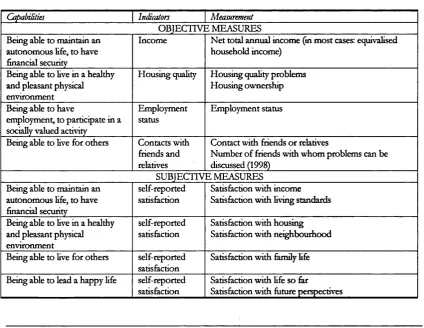
The thesis will investigate two dimensions o f social inequalities during transition: objective
well-being and subjective well-being. It will aim to describe and analyse how specific social
groups have gained or lost during the process, using a set o f indicators. Objective well
being will incorporate income, housing quality, employment status and social relations.
Subjective measures will include specific and general indicators, such as individuals’
satisfaction with various aspects o f their lives, including their incomes, housing conditions
and family relations, and their satisfaction widi their lives as a whole. This will enable us to
get a rather complete picture o f social inequalities, and also, to assess the relative merits o f
diese analytical approaches.
Empirical research inevitably involves value judgements o f some sort, even if this is
concealed or not made explicit. These judgements, if hidden, may limit the interpretation
o f the implications o f such results. Therefore I intend to establish the theoretical
background o f my research first o f all, discussing the role o f value judgements in
philosophies o f distributive justice, followed by a brief account of value choices in the
empirical literature. Finally I will outline the starting position o f my research, the
operationalisation of a theoretical concept.
1.1 VALUE JUDGEMENTS AND THEORIES OF JUSTICE
The theoretical basis o f the thesis is Amartya Sen’s capabilities approach, which is regarded
to be a distinctive contribution to normative economics by many. The reason for this
choice, however, is not primarily this, but the normative and deeply humanistic nature o f
Sen’s work. For Sen, the foundations o f a consistent theory o f the social good lie in a
conception o f what makes a good life for a human being (Sugden 1993). Starting from an
extended critique o f the orthodox position in economics, which may be called ‘revealed
preference welfarism’ he offers an alternative theory o f the social good. This approach also
seems to provide a major theoretical solution for the problem o f interpersonal
comparisons o f well-being. Sen’s theory has strong conceptual connections with Aristotle’s
view o f the human good (Nussbaum 1993; Sen 1993). Both o f these theories are based on
a single objective account o f the human good, or in ethical terminology, human
flourishing1. This account is
*objective in the sense that it isjustifiable by preference to reasons that do not derive merely
from bcal traditions and practices, but ratherfrom feature o f humanness that lie beneath
all local traditions and are there to be seen whether or not th y are in fact recognised in
the local traditions* (Nussbaum 1993, p. 243).
Capabilities and human flourishing
The objective roots o f Sen’s theory seem to be strongly associated with neo-Aristotelian
accounts o f human flourishing. Both capabilities and human flourishing are objective,
because they identify objects o f desire and choice (capabilities and human flourishing,
respectively), which are desirable and choiceworthy, not simply because they are desired or
chosen. ‘It is desired because o f what it is. Its constitution is what makes it good. Thus, a
human goodness is something ontological. It is a state o f being, not a mere feeling or
experience.’ (Rasmussen 1999, p. 3). One o f Sen’s major criticisms against utilitarianism lies
in its disregard o f personal adaptation to circumstances, for example by diminished
expectations. A person with disadvantaged circumstances may not aspire to certain things,
may not choose them, but this should not prevent us from acknowledging these potential
choices as objects o f value. In his theory, Sen claims that having capabilities, which means a
person's ability to achieve and choose from various states o f being, is good per se.
Human flourishing and capabilities offer a view o f the human good that is objective,
individualised and diverse, self-directed and social. Both are individualised and diverse,
because they depend on the individual and his characteristics. In the notion o f human
flourishing the realisation o f a person’s potentialities is not the same as someone else’s, they
are not interchangeable. Sen does not daim that equal states o f capabilities cannot occur by
definition. His account is individualised in the way that he acknowledges personal
diversities, differing abilities in converting resources into states o f being. The self-directed
nature o f human flourishing emphasises the role o f a person’s own effort, the necessity o f
him taking charge o f his own life, beyond the mere possession and use o f needed goods.
Sen’s theory also attaches intrinsic value to the active choice o f individuals in attaining their
current state o f being. Choice, and the ability to choose are valuable, and the value attached
to them distinguishes the capabilities framework from other theories o f justice based on
the possession o f goods. Social interactions, ‘philia’ (friendship) are in the core o f both
accounts, our maturation or ‘full life’ requires a life with others.
Sen however emphasises the differences between his and the Aristotelian approach. He
maintains that the capabilities approach is incomplete, and deliberately so. ‘This (the
Aristotelian) view o f human nature (with a unique list o f functionings for a good human
life) may be tremendously overspecified’ (Sen 1993, p. 47). He rejects urges to be more
radical and specific, ‘by introducing an objective normative account o f human functioning
and by describing a procedure o f objective evaluation by which functionings can be
assessed for their contribution to the good human life’ (Nussbaum, quoted by Sen 1993, p.
108). Sen sees his capability approach primarily as an identification of the ‘space’ o f value-
objects, and does not intend to reach conclusions on how the valuational exercise is to be
completed. Thus, Sen avoids being non-liberal (by not acknowledging that there are
various possible accounts of what “good” is) or paternalistic (believing to be able to set the
standard o f evaluation entirely himself).
Sen’s way o f describing what a good life is, thus, rather indirect, through the identification
of the space o f value objects. His intention is to redirect our attention from resources to
‘states of beings’, from means to ends, from utility to functionings and capabilities.
Functionings, ‘beings and doings’, and capabilities, a set o f functionings a person can achieve,
constitute this evaluative space. ‘Living may be seen as consisting o f a set o f interrelated
“functionings” ’ (1992, p. 30). ‘Being adequately nourished’, ‘avoiding premature mortality’,
‘taking part in the life o f the community’, and ‘being happy* are all examples o f
functionings. Capabilities, in comparison, ‘are notions o f freedom, in the positive sense:
what real opportunities you have regarding the life you may lead’ (1987, p. 36). Capabilities
thus come close to the notion of positive freedom. This definition o f capabilities also
implies that they include opportunities, which may not be valued or chosen by the person.
For example, having the capability o f being adequately nourished, someone can choose to
fast. In this case the lack o f the functioning o f being fed is a result o f the individual’s
choice, and not due to external constraints.
Capabilities and other objects of value
In establishing his theory, Sen draws a conceptual map, relating his position to major
political philosophies. He criticises rights and entitlements, utility, resources and primary
goods as bases o f theories o f distributive justice. Rights are inadequate, because they ignore
consequences o f actions (Sen 1984c), referring to especially Nozick (1974). Utility,
interpreted either as an object o f value in itself (referring to a certain mental state), or as a
valuational device (used to evaluate other objects of value, for example goods possessed)
ignores freedom and concentrates only on achievements (Sen 1992). Equality o f resources,
as presented by Dworkin (1981), ‘overlooks the interpersonal differences in the mapping
from resources to capabilities’ (Sen 1984c). Primary goods, in Sen’s view, lack concern for
what goods do to people, thus represent only means, not ends (1982; 1984b). Sen,
however, stresses how much he has been inspired by John Rawls, and identifies basic
capabilities ‘as natural extension o f Rawls’s concern with primary goods’ (Sen 1982, p. 368).
Sen even asserts that ‘there are good reasons to think that Rawls himself — contrary to the
theory is really after something like capabilities. He motivates the focus on primary goods
by discussing what the primary goods enable people to do”2 (1984c, p. 320).
2
Sen’s capabilities are equal to neither goods nor the utility enjoyed by the individual at their
consumption. They stand in between, as the map portrays (Figure 1). Sen makes clear
distinction between goods (e.g. rice), their material characteristics (giving calories and
nutrition), the functioning o f a person (living without calorie deficiency) and utility (e.g. the
pleasure from consumption) (Sen 1984c). A person’s well-being, the quality of living, is
characterised by his functionings. The freedom to pursue well-being, the real opportunities
the person has, are reflected in his set o f capabilities. Capabilities are thus may be called
Svell-being freedom’, ‘reflecting the person’s freedom to lead one type o f life or another’
(Sen 1992, p. 40).
Figure 1.1. Utility, functionings, capabilities and their sources
Utility ^
I Goods
Psychic state
Material characteristics Functionings
Personal characteristics Capabilities o f a person to function
Environment physical, social, political
Source: (Muellbauer 1987, p. 40)
As mentioned before, Sen emphasises the connection between capabilities and primary
goods, for both provide a basis for assessment o f real opportunities. Primary goods are
‘things that every rational man is presumed to want.’ (Rawls 1971, p. 54). Rawls makes a
distinction between social primary goods and natural goods. Social primary goods are
rights, liberties, and opportunities, and income and wealth. Natural goods are for example
health and vigour, intelligence and imagination. Thus liberties and opportunities seem to be
intrinsic part o f both Sen’s and Rawls’ theory. Rawls explains liberty by reference to three
items: ‘the agents who are free, the restrictions or limitations which they are free from, and
what it is that they are free to do or not to do.’ (p. 177) He discusses liberty mosdy in
connection to constitutional and legal restrictions. Sen’s focus is freedom as positive
freedom, as freedom of individuals to do something. For him, the institutional and political
structure o f a society is relevant only in an indirect way, in its effects o f promoting or
inhibiting individual’s capabilities.
As Sugden notes, however, Sen underestimates the difference between his theory and that
o f Rawls’ (Sugden 1993). The fundamental difference lies in their ways o f thinking about
justice. While Sen aims to develop a substantive account o f the good o f the individual,
Rawls aspires to evaluate rules, using procedural values. Rawls’ justice as fairness is
political, not metaphysical (Rawls 1985). It avoids ‘claims to universal truth, or claims about
the essential nature and identity o f persons’ (p. 223). It does not intend to apply any general
moral conception to the structure of society. According to Rawls, the ‘basic structure’ o f a
modem democracy is realised by means o f social co-operation, one unified system o f social
co-operation. A basis o f such social unity is consensus between individuals who may well
have different values and beliefs. Justice as fairness is ‘supported by what we may call an
“overlapping consensus”, that is, by a consensus that includes all the opposing
philosophical and religious doctrines likely to persist and to gain adherents in a more or less
just constitutional democratic society.’ (pp. 225-226) This theory is based on liberalism as a
political doctrine, which ‘assumes that it is a characteristic feature of a free democratic
culture that a plurality o f conflicting and incommensurable conceptions o f the good are
affirmed by its citizens.’ (p. 248) In contrast, classical utilitarianism, and other conceptions
of justice, for example Plato, Aristode and the Christian tradition as represented by
Augustine and Aquinas all hold that there is but one conception o f the good which is to be
recognised by all persons, so far as they are fully rational.
Criticism o f the foundations of utilitarianism has played a major role in Sen’s work, and
even a brief account o f his contribution to the debate on welfarism would go beyond the
limits o f the thesis. Some major concerns, however, are particularly relevant for the
approach o f this analysis. Sen emphasises that die utilitarian approach is problematic
because o f its focus on a single maximand, utility, disregarding its distribution among
people. Utility itself is problematic, because it does not distinguish between different
sources o f pleasures or pain. Actions, rules, and institutions matter only to the extent they
‘Utilitarianism is not really interested in persons as such, and that a person is viewed by
a utilitarian as nothing other than the place in which that valuable thing called
happiness takes place. It does not ultimately matter how this happiness happens, what
causes it, what goes with it, and whether it is shared by many or grabbed by a few. A ll
that really matters is the total amount of this 'marvellous’ thing, happiness or
desire-fulfilment. ’ (Sen 1984c, p. 308)
Interestingly, in much o f his work Sen focuses mostly on utility as happiness or desire
fulfilment. As Sugden notes in his review o f Inequality Reexamined, Sen ‘says very little about
revealed preference welfarism, effectively treating it as a nonstarter’ (1993, p .1949).
Sen’s attack on utility may sound controversial: while he acknowledges the value o f
happiness as an element of well-being, at the same time he also condems it, being a
measure o f utility. The criticism, however, does not refer to happiness per se, rather its use
as a single object o f value.
I t is quite eay to be persuaded that being happy is an achievement that is valuable, and
that in evaluating the standard of living happiness is an object of value. [ ...] The
interesting question regarding this approach is not the legjtimaty of taking happiness to be
valuable, which is convincing enough, but its exclusive legttimaty. ’ (Sen 1987, p. 8)
One major fault o f using happiness as a unique measure o f well-being may be called the
problem of the ‘adaptive preferences’. A person, who lives in thorough deprivation, may
not aspire for things, which are not attainable for her. Jon Elster (1983), using die tale o f
sour grapes, describes the adaptation process in the following way: aldiough desiring die
grapes, the fox, seeing that he cannot reach them, judges that they are sour. Nussbaum
(2001) criticises the narrow focus of Elster’s argument and says that changes in preferences
can often be a good thing, for example when people adjust to reality rather than sustaining
unrealistic aspirations (she cites her own personal desire to be the world’s best opera
singer). She argues that a substantive theory o f justice and central human capabilities is
essential in order to identify desires (and unrealisable desires). In addition, discrimination
and abuse are violations o f personal liberty even if people adjust to them.
In sum, Sen’s theory o f capabilities is distinct from other theories of justice, both in terms
o f the identification o f the object o f value and also in terms o f its justification. For
utilitarians, it is utility that matters, for libertarians, it is rights, and for egalitarians resources
are the basis o f evaluation. Rawls’ theory o f justice uses the concept o f primary goods.
Sen’s metric is based on capabilities. Sen’s theory o f the social good may be called an end-
state theory, which is distinct from procedural criterion o f fairness, concerned with the
evaluation of rules. Capabilities, and especially functionings seem to provide a suitable base
for empirical comparisons o f inter-personal well-being. The main value o f this conceptual
framework lies in its focus on positive freedom, the realisation o f this freedom, its concern
with ends, not means, the acknowledgement of interpersonal differences in converting
resources into states o f being, and the provision o f an absolutist core for interpersonal
comparisons.
1.2 MAKING SEN(SE) IN EMPIRICAL RESEARCH
Although Sen’s work received wide acclamation for advancing normative theory, many
scholars expressed their scepticism on the empirical applicability o f his theory o f
capabilities. Sen refrains from ‘completing* his framework, by providing a comprehensive
list o f capabilities, or even that o f basic capabilities. He does not give a clear guidance on
empirical application either (see discussion later). Despite the numerous attempts at
empirical conceptualisation, it seems that there is limited success in a comprehensive and
direct application o f his theory. Nolan and Whelan find that ‘the approach has had litde or
no impact on empirical studies which seek to measure and understand poverty* (1996, p.
85). Piachaud argues that ‘Sen’s absolute goals, save that o f physical survival, are too vague
to be o f any theoretical or practical use’ (1987, p. 148). How has Sen influenced the
empirical literature? And how can the existing literature be evaluated in terms o f Sen’s
discussion on the normative basis o f social research?
Existing operationalisation of the capabilities approach predominandy uses functionings as an
approximation of capabilities. Capability has not yet gained scope as a major currency o f
interpersonal comparisons. Empirical literature based on functionings can identify its roots
in existing ‘social indicators’ research and the ‘basic needs approach’. What Sen seems to
have provided, is a theoretical depth to the ‘not deeply founded approach’ (1987, p. 25).
Although these approaches, according to Sen, have the merit o f redirecting attention from
income, from GDP and economic growth to other aspects o f social achievements, they
people actually lead or can lead. Based on this, primarily two major objects o f value can be
distinguished in empirical research: income, and well-being or functionings.
Place of functionings in the field
My main concern related to the extensive literature on quality o f life and living standards is
how it actually relates to Sen’s approach. For this, first I try to draw a map o f the major
empirical concepts and applications based on their choice o f the evaluative space and the
methodology o f evaluation (Table 1), and then discuss briefly a few selected major works.
Literature on both objective and subjective measures o f well-being will be discussed in
more depth in later chapters o f the thesis.
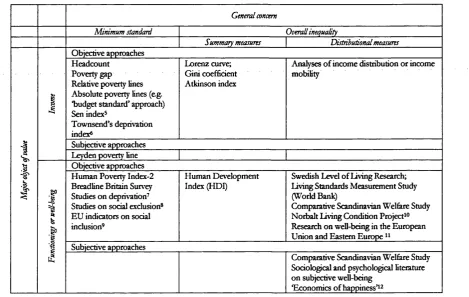
Choices in empirical studies involve firsdy a choice of the object o f value, whether it is
income, or functionings, secondly a choice on the general concern, whether it is a specific
basic standard or overall inequality, and finally, a choice on methodology, whether
aggregate or distributional measures are used, and if any, what weighting method is to be
employed. This classificatory exercise, however, at times proved to be difficult. Studies
often use various measurement units, combining measures o f income, material resources
and functionings, e.g. Swedish Level o f Living Research (Erikson and Aberg 1987), the
Living Standards Measurement Survey o f the World Bank (e.g. Chander, Grootaert and
Pyatt 1980; Grosh and Glewwe 1995). In these ambiguous cases the criterion for
classification was whether there was a detectable intention in the projects to measure
functionings or not. Studies which are based on income often use a commodity-based
standard to define die desirable income level. For example, the so called "budget standard
approach’ in poverty research defines minimum consumption requirements, then after
pricing the goods, translates it to the metric o f income. Such cases are classified as studies
o f income, since they do not focus on the possession o f certain commodities, but only on
levels o f income.
The Breadline Britain Survey was first systematic attempt in Britain to define what
constitutes the minimum standard o f living in the public’s view, and also to assess in what
ways people fail to meet these standards (Mack and Lansley 1985). The specific virtue o f
this approach is that the authors try to measure enforced deprivation3. Mack and Lansky’s
way of identifying social consensus thus includes subjective standards, because households
are asked whether their lack o f a specific item is due to their choice or they cannot afford
it. This approach thus measures resources, not direcdy states o f individuals. The motivation
o f the authors, including their effort to go beyond the single measure o f income, suggests,
however, that this approach may be regarded as an attempt to measure functionings4.
Table 1.1 Classification of major empirical concepts and applications
General concern
Minimum standard Overall inequality
Summary measures Distributional measures
Objective approaches In co m e Headcount Poverty gap Relative poverty lines Absolute poverty lines (e.g. budget standard’ approach) Sen index5 Townsend’s deprivation index6 Lorenz curve; Gini coefficient Atkinson index
Analyses o f income distribution or income mobility
Subjective approaches
Leyden poverty Hne | |
Objective approaches i '
1
& - S % s* fe >Human Poverty Index-2 Breadline Britain Survey Studies on deprivation7 Studies on social exclusion8 EU indicators on social inclusion9
Human Development Index (HDI)
Swedish Level o f living Research; Living Standards Measurement Study (World Bank)
Comparative Scandinavian Welfare Study Norbalt Living Condition Project10 Research on well-being in the European Union and Eastern Europe 11
Subjective approaches
£ Comparative Scandinavian Welfare Study
Sociological and psychological literature on subjective well-being
‘Economics o f happiness’12
Nolan and Whelan start from the hypodiesis that income poverty is inadequate as a
measure o f the extent and nature of poverty, if poverty is conceptualised in term o f
3 This systematic attempt seems valuable in my view, although there are some methodological doubts on the measurement o f involuntary deprivation. As Piachaud notes, a major problem is their treatment o f those households which cannot afford necessities but afford non-necessities (1987, pp. 149-152).
4 Sen regards Mack and Lansky’s work to be related to his approach, but does not specify how (1992, p. 39). 5 For definition, see (Sen and Foster 1997)
6 (Townsend 1979)
7 e.g. (Nolan and Whelan 1996; Layte, Maitre, Nolan and Whelan 2001) 8 e.g. (Burchardt, Le Grand and Piachaud 2002)
9 (Atkinson, Cantillon, Marker and Nolan 2002) 10 (Aasland 1996; Grogaard 1996; Knudsen 1996)
[image:21.595.65.535.253.550.2]exclusion from the life of society because o f a lack o f resources (1996). Instead, they
propose a poverty measure, which takes into account both income and deprivation.
Deprivation is measured by various indicators o f life-style, including household amenities,
housing conditions, nutrition, clothing, and leisure. To account for differences in tastes
across people the authors distinguish ‘enforced lack o f resources’, those items which the
household lacked and said that it was because could not afford them. Their finding is that the
overlap between income poverty and deprivation is weak. ‘About half the households
below income poverty lines were experiencing enforced basic deprivation, while substantial
numbers above those lines reported such deprivation’ (p. 149)13. Thus income is not an
adequate ‘short cut* if someone wants to measure multi-dimensional deprivation. A
possible main explanation is that current income is an inadequate proxy for actual financial
resources. Using both savings and income as an alternative poverty criterion, however, the
authors still find that the explanatory power o f this criterion is weaker than measures of
deprivation, e.g. for explaining people’s experience o f financial strain. The reason for this is
that differences in individuals’ backgrounds, needs and other ‘social assets’ also contribute
to variations in life-styles. According to Nolan and Whelan, this provides a strong case for
die use o f multiple measures o f deprivation. Later the authors applied a similar approach
for cross-country comparison, using the European Community Household Panel Survey
(Layte et al. 2001; Whelan, Layte, Maitre and Nolan 2001).
The Comparative Scandinavian Welfare Study also uses resources, but its primary focus is
much broader, It incorporates measures o f education, health, employment, social relations,
political activities and opportunities to live in harmony with nature (Allardt 1993).
Subjective measures gained equal emphasis to objective ones in the design o f the survey.
The subjective indicators include dissatisfaction/satisfaction widi living conditions,
unhappiness/happiness about social relations and about personal growth.
Subjective approaches measure well-being on the basis o f people’s self-reported states.
They usually investigate individuals’ happiness in general or their satisfaction with particular
aspects o f their lives, such as income, living standards, health or other functionings.
‘Subjective well-being’ has an extensive literature, including economics, sociology and
13 Basic life-style deprivation indicates lack o f food, clothes and basic necessities. This is distinguished from secondary life-style deprivation, which includes items such as leisure activities, and from housing deprivation.
psychology (for a review o f the relevant literature, see chapter 5). The empirical literature
on the ‘economics o f happiness* uses survey measures o f happiness as proxies for utility
(see e.g. Di Telia et al. 2001). Although these studies use this measure o f happiness
exclusively, they could also be interpreted as essential analyses o f a particular, and very
important element o f well-being. The related literature will be discussed in detail in chapter
7.
An early application o f this subjective approach in economics is the so-called Leyden
approach. This has been derived by a research group, which worked at the University o f
Leyden in the seventies and eighties (see e.g. Van Praag, Spit and Van de Stadt 1981). The
basic question module is the so-called Income Evaluation Question, which follows: ‘What
monthly income (net o f taxes) would you consider for your household as: very bad, bad,
not bad not good, good and very good?’ The respondent is then supposed to give exact
amounts of these in the local currency. This information is used for the compilation o f an
overall subjective poverty line, and also o f a welfare function.
Sen himself has contributed to die empirical literature in the field o f quality o f life research,
and has applied his capability approach, with paying special attention to the developing
world, especially India. His contribution to quality o f life research included analysis o f
mortality as an indicator o f economic success and failure (Sen 1998), studies o f sex bias in
health conditions, undemutrition and poverty (Kynch and Sen 1983; Sen 1984a; 1985). Sen
in his 1998 study presents a major argument for the use o f measures other than income in
comparative research (1998). He found that Harlem men are overtaken in terms o f survival
even by the Bangladeshis, meanwhile they are many times richer measured as income per
head than the latter group. He does not argue that income should be abandoned in
economic analysis, rather that it should be supplemented by other measures. Sen asserts
that ‘personal income is certainly a basic determinant even o f survival and death, and more
generally o f the quality of life o f a person* (p. 23).
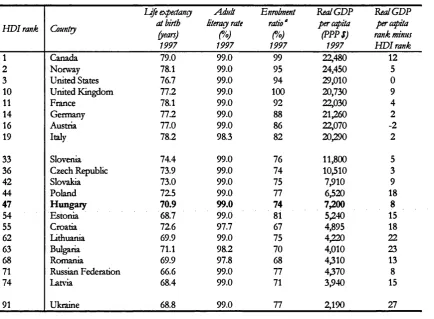
A major, and maybe the most influential explicit application o f Sen*s theory is the Human
Development Index (HDI) (with Amartya Sen’s contribution as a consultant), published
yearly in the Human Development Report by the UNDP starting from 1990, as the now
widely accepted alternative to GD P for comparing human well-being between countries.
choices and the level o f their achieved well-being’ (UNDP 1990, p. 10). The measurement
o f human development focuses on three essential elements o f human life: longevity,
knowledge and decent living standards. These elements are described by means o f life
expectancy at birth, illiteracy and school enrolment, and GDP per capita. (HDI is a
composite index based upon the weighted average of these indicators.) The H D I rankings
o f countries may differ significandy from their ranking based upon GDP per capita.
The HDI index is a simplified approach to tackle and measure the selected three elements
o f well-being, and represents a compromise for the sake of ensuring comparability and
accessibility o f data. Life expectancy, illiteracy and school enrolment may be called
measures o f ‘basic capabilities’. GDP per capita, however is a rather indirect approximation
o f capabilities. Thus, similarly to the classic psychological approach of Maslow (1970), the
conceptual choices o f the HD I imply a hierarchy o f needs, where the satisfaction of
physical needs is essential prior to the appearance o f social, emotional and other higher-
ranked needs. These elements o f well-being, nevertheless, do not provide a full description
o f human development, as also acknowledged by the report. ‘Additional choices, highly
valued by many people, range from political, economic and social freedom to opportunities
for being creative and productive, and enjoying personal self-respect and guaranteed
human rights.’ (UNDP 1990, p.10) Another shortfall o f this measurement is the lack o f
concern o f a society’s human freedom, first o f all o f the fact if individuals live in a
democratic or an authoritarian polity. This is also revealed in the first report, indicating that
the exploration o f links between human freedom and human development is indeed
necessary in the future.
Most criticism o f die construction of the H D I has targeted the income component.
Ravallion, for example, challenges the implicit trade-offs built into the H D I between
income and longevity (1997). The calculation o f the income index in the formula is based
upon the assumption o f decreasing utility o f income and the diminishing returns to
transforming income into human capabilities. Therefore a world average income ($5,990, $
based on PPP, purchasing power parity) is taken as a threshold level and any income above
this level is discounted. In response to these, the UNDP has revised its methodology for
discounting income. The new formula14 does not discount income as severely as the one
earlier, and it discounts all income, not just the income above a certain level (UNDP 1999a,
p. 159). As a result, rising income gets recognition as a potential means for further human
development. The new methodology, however, brought some problems o f comparability
with indices of previous years15.
The definition of human well-being used in the H D I does not seem to be adequate for the
characterisation and comparison o f industrial countries. Probably as a response to this
problem a special index was introduced in 1998, the human poverty index for industrial
countries (HPI-2). The dimensions o f deprivation defined as the basis of this index are
quite similar to those reflected in the HDI — longevity, knowledge, a decent standard o f
living, plus social exclusion. The standards o f measurement are adjusted to these countries,
for example deprivation in knowledge is measured by the percentage o f people who are
functionally illiterate, which is more adequate measure than simple illiteracy in these
countries. The incorporation of social exclusion, measured simply as the rate o f long-term
unemployment, also reflects social norms o f industrial countries, where participation in the
labour market is increasingly perceived as a criterion o f social inclusion (e.g. Atkinson et al.
2002).
Since 1990, the launch o f the first Human Development Report, the concept o f H D I as a
measurement o f human development has been significandy extended. By 1999 the United
Nations Development Programme published various indicators beyond the human
development index; a gender-related development index and a gender empowerment
measure, and two types of human poverty index, for developing and for industrial
countries, as mentioned above (UNDP 1999a). The incorporation o f die gender
perspective is the first step within this comparative framework to actually indicate the
distribution of capabilities widiin societies. These gender indices confirm the existing
results o f previous empirical research on relative deprivation o f women in most societies.
Economic historians have expanded the use o f the H D I as well, by applying it as an
indicator o f development in a historic perspective. For example Crafts has compiled the
HDI for 16 advanced economies since 1870 and argues that conventional measures o f
economic growth seriously understate the rate o f improvement in living standards (Crafts
1997).
Although starting from a different basis, the recommendations o f the United Nations (UN
and ILO 1954; Drewnowski and Scott 1966), the Swedish Level o f Living Research16
represents one potential implementation o f Sen’s capability concept (Erikson and Aberg
1987; Erikson 1993). The research is based on a one-country longitudinal survey especially
designed for its purposes and describes the changes in living conditions between 1968 and
1981. These inequalities are outlined in distributional terms as well, between different social
groups, thus providing a detailed analysis o f relative well-being based upon various group
characteristics like gender, age, occupational group and region. The study has used
descriptive indicators, thus was based on actual situation o f individuals, irrespective o f their
satisfaction with their current situation. The indicators incorporated both economic
resources (income and wealth), and other components such as health, employment,
education, housing, social integration and political resources.
A few studies have used non-monetary dimension o f well-being for evaluating transition
countries, but it is far from becoming a widely used exercise. A major international
comparative study was implemented through the NORBALT Living Condition Project,
which comprises national reports from five different regions in the three Baltic states o f
Estonia (Grogaard 1996), Latvia (Aasland 1996), and Lithuania and two Russian areas
(Knudsen 1996). The surveys were conducted on a standardised methodological base, thus
allowing comparisons between the areas. There is a limited dynamic analysis included in the
project, in case of Lithuania, where a rather similar survey was conducted in 1991 and
1994. In another international comparative study, for Central-Asia, Falkingham uses
capability-based indicators for measuring well-being (Falkingham 1999). Her research is
based on existing data, first o f all the national Human Development Reports and UNICEF
data. The recent study by Micklewright and Stewart focuses on a population subgroup,
16 Level o f living’ is a specific term used in the Swedish Level o f Living Research. The designers o f the research wanted to emphasise its difference from standard o f living, because level o f living’ uses not only resources, but also states and achievements o f individuals. Standard o f living is however, fir from being a well-defined concept, and various ‘divergent and rival views’ co-exist within it In Sen’s terminology, capabilities can be actually used for the assessment o f living standards, thus there seems to be no contradiction between the standard o f living and capabilities (Sen 1987).
children, and compares their level o f well-being in the European Union to that o f the
applicant countries (2000). They use measures o f economic welfare, health and education.
None of these studies, however, seems to share the main concern o f the Swedish Level o f
Living Research, namely the comparison o f well-being between various socio-economic
groups.
Analysis of what? Specification of the object of value
The use o f capabilities seems to be especially relevant for die analysis o f the countries o f
Central-Eastern Europe for various reasons. First of all, capabilities are valuable per se. It is
the human condition and the choices people have which are the final test o f the social
consequences o f transition. Secondly, income is an inadequate indicator o f well-being
during a major dislocation. Crucially change in economic system could produce a step
change in the relationship between income and well-being. So before and after change,
difference in income correlates with well-being, but not over transition itself. In addition,
income may not be able to explain individual differences in well-being, such as health state
or nutrition. Income analysis faces serious difficulties related to the intra-household
allocation o f resources. Individual level indicators o f well-being avoid external judgements
on this matter, and may be particularly useful in countries with intense cultural diversities.
Income may only partially reflect the effects of substantial economic changes, like the
restructuring of the labour market, the redistribution o f wealth and privatisation o f state
assets, the reorganisation o f social services or changes in the relative prices of goods (e.g.
due to cutbacks in price subsidies). Point-in-time income data inevitably show transient
shocks as well, disregarding households’ ability to pool over time and their ability to adjust
their consumption patterns (Comia, Fajtli, Motivans, Panicda and Sborgi 1996). Income
indicators may be deficient for describing resources themselves, due to measurement
failures. Problems relating to hidden income, resulting for example from black market
activities or own production, or tax evasion may substantially distort available data in
certain countries.
Capabilities thus seem to have great potential to evaluate Eastem-European changes. The
question o f how to do this immediately arises. Sen proposes three alternative approaches
for the evaluation o f capability sets (Sen and Foster 1997; Sen 1999b). The first is the
Sen calls this ‘the most immediate and full-blooded way* (1999b, p. 81). The second, the
“supplementary approach” uses both traditional procedures of income comparisons, but
supplements them by capability considerations, ‘often in rather informal ways’ (p. 82). This
means either the direct comparison of functionings, or that o f variables other than income,
which are expected to influence capabilities. Lastly, the “indirect approach” remains
focused on incomes, appropriately adjusted. It uses various equivalence scales to equalise
family incomes in terms o f capability achievement. For example, ‘family income may be
adjusted downward by illiteracy or upward by high levels o f education’ (p. 83). Sex bias
within the family could also be assessed.
The “indirect approach” has the advantage o f using income, which, beyond being familiar,
allows more articulation and easier interpretation. The difficulties, however, are not
negligible. In order to define die equivalence scale, we need to identify the relevant
capabilities, and their influence on income, the conversion rate. This and die definition o f
the relative weights on how various capabilities influence incomes necessitates certain
judgements. In this sense this approach is not different from the direct comparison o f
capabilities or functionings.
Sen also emphasises that the primary object o f evaluation should be capabilities, not
functionings. The valuable informational content o f capabilities, as representatives o f
positive freedom, is acknowledged by most scholars in the field, however the complexity
seems to be a major barrier o f its widespread empirical application. Discussions o f the
freedom o f choice are rather formalised and theoretical (e.g. Pattanaik and Xu 1990; Arrow
1995). A full empirical application would need to investigate all potential choices o f people,
including those they are not aware of due to their diminished expectations. W ho could
detect such capabilities? It seems doubtful than any external viewer can make a judgement
on this, being able to identify those options which are not known but realistically attainable
by an individual. Also, how could such an exercise avoid paternalism, and arbitrary
discretion? A more limited exercise, the mapping o f the well-known options by individuals
would avoid such problems, but it would inherently bring biased outcome due to individual
variations o f consciousness and rationality. Also, the information content o f such
investigation would increase to great complexity. This would also raise issues like whether
realised capabilities are to be given specific weight and if yes, how.
Sen, as discussed before, does not provide a specific account o f what capabilities or
functionings are to be assessed, thus their identification seems to be the prior step of any
evaluative exercise. All what Sen defines are some examples, e.g. o f basic capabilities (1982,
p. 367). Nussbaum derives her list o f ‘basic human functional capabilities’ from an
Aristotelian account o f a good life (Nussbaum and Glover 1995). Although she calls her
list ‘basic’, it incorporates a wide range o f items, including personal intellectual and
psychological factors, for example ‘being able to laugh, to play5 (p.84), and also social and
political elements. Similarly, expert judgement is the basis o f Desai’s list o f basic capabilities
(1995, p. 193). Another way of defining the valuable set is by social consensus. This approach
aims to define contemporary standards, the commonly accepted values in the society. Such
consensus is the basis o f defining primary goods in Rawls’ theory o f justice. In their
empirical work, Mack and Lansley base their analysis o f poverty on an investigation on
social standards regarding the need for particular commodities and the related functionings
(1985).
Sen acknowledges that the use o f functionings (‘the option actually chosen3) can be a way
o f assessing capability sets. (1994, pp. 339-40). Functionings are used as the basis o f most
empirical applications. Erik Schokkaert and Luc Van Ootegem apply Sen’s concept to the
Belgian unemployed (1990). Their identification o f functionings is rather pragmatic; a result
o f factor analysis o f 57 survey questions (elements o f functionings). Their investigation
includes extensive survey o f psychological characteristics o f the unemployed as well. This is
a particularly interesting aspect o f their application, not only because they recognise that
psychological difficulties are often a consequence o f being without a job, but also because
such functionings may be particularly relevant in the context o f richer countries.
Schokkaert and Ootegem refer to Sen17, implying that Sen acknowledges the importance o f
‘psychological’ functionings in richer countries compared to ‘material functionings’, which
may show little variation (1990, p. 432)18.
17 (Sen 1985, p. 46)
In his “supplementary approach”, as mentioned earlier, Sen acknowledges the use o f
income together with functionings or capabilities (Sen 1999b). Such hybrid techniques may
be particularly useful, when ‘data limitations are rather pervasive and apply to resources as
well as functionings’ (1994, p. 338). The supplementary approach has been used by
numerous empirical studies, like the Swedish Level o f Living Survey (Erikson and Aberg
1987), and the Comparative Scandinavian Welfare Survey (Allardt 1993). Chiappero
Martinetti (1996) argues that resources as well as functionings and capabilities should be all
included into the assessment o f the standard o f living. She proposes the use o f ‘fu22y set
theory’, which provides various alternative aggregation procedures for all elements o f well
being into a ‘membership function’ 19. She produces a good visual presentation o f the
problem by her analogy o f an “expert system”, but overall provides a rather partial picture.
Her proposal for the distinction between choice and constraint as a cause for low levels o f
functionings does not seem to be convincing. It is not clear how she can account for ‘taste’,
and distinguish it from unobservable factors. With this, the core o f her argument, the
inclusion o f freedom as a component o f well-being remains unconvincing. This problem
however leads us already to the issue o f evaluation methods.
Methodology of evaluation
The chosen object o f value gready determines what kind of problems we face at the
selection o f the applied methodology. If someone uses the direct approach, trying to
compare functionings or capabilities themselves, he can opt for
“ \total comparison ’ involving the ranking of all such vectors vis-a-vis each other in
terms o f poverty or inequality (or whatever the subject matter is);
partial ranking\ involving the ranking of some vectors vis-a-vis others, but not
demanding completeness of the evaluative ranking;
19 Fuzzy set theory is a theoretical concept introduced in the mid-1960s, which has been extensively used in decision-making support models, and in science, including artificial intelligence and expert systems. Recently it drew attention in inequality and well-being analysis as well The brief, non-formal definition is the following: ‘Fuzzy set theory substitutes the characteristic function o f a crisp set that assigns a value o f either 1 or 0 to each element in the universal set (discriminating between members and nonmembers o f the crisp set), with a generalized characteristic function (called a membership function) which varies uniformly between 0 and 1. Larger values denote higher degrees o f membership’ (Chiappero Martinetti 1996, p. 44). This enables the inclusion o f both qualitative variables measured on an ordinal scale, such as health condition or subjective opinions, but also dichotomic variables with values o f 0 and 1.
‘dintinguished capability comparison \ involving the comparison of some particular
capability chosen as the focus, without looking fo r completeness o f coverage” (Sen 1999b,
p. 82).
Sen expresses his doubts in several cases o f the use o f total ranking, and reveals his
preference for partial ranking20. Gaertner’s attempt to compare vectors of basic
functionings for 130 countries confirms this (Gaertner 1993). He finds for