The London School o f Economics and Political Science
Integer and Constraint Programming methods
for Mutually Orthogonal Latin Squares
PhD Thesis
by
Ioannis Mourtos
UMI Number: U615464
All rights reserved
INFORMATION TO ALL USERS
The quality of this reproduction is dependent upon the quality of the copy submitted.
In the unlikely event that the author did not send a complete manuscript
and there are missing pages, these will be noted. Also, if material had to be removed,
a note will indicate the deletion.
Dissertation Publishing
UMI U615464
Published by ProQuest LLC 2014. Copyright in the Dissertation held by the Author.
Microform Edition © ProQuest LLC.
All rights reserved. This work is protected against
unauthorized copying under Title 17, United States Code.
ProQuest LLC
789 East Eisenhower Parkway
P.O. Box 1346
OF POLITICAL
AND u ,
' ‘'T. ' '
I
H t S E S
F
A b stract
This thesis examines the Orthogonal Latin Squares (OLS) problem from the viewpoint of Integer and
C onstraint programming. An Integer Programming (IP) model is proposed and th e associated poly
tope is analysed. We identify several families of strong valid inequalities, namely inequalities arising
from cliques, odd holes, antiwebs and wheels of th e associated intersection graph. The dimension of
the OLS polytope is established and it is proved th a t certain valid inequalities are facet-inducing.
This analysis reveals also a new family of facet-defining inequalities for the polytope associated w ith
the L atin square problem. Separation algorithm s of the lowest com plexity are presented for particular
families of valid inequalities.
We illustrate a m ethod for reducing problem ’s symmetry, which extends previously known results.
This allows us to devise an alternative proof for the non-existence of an OLS stru ctu re for n = 6, based
solely on Linear Program m ing. Moreover, we present a more general Branch & Cut algorithm for the
OLS problem. T he algorithm exploits problem structure via integer preprocessing and a specialised
branching mechanism. It also incorporates families of strong valid inequalities. C om putational
analysis is conducted in order to illustrate the significant improvements over simple Branch & Bound.
Next, the C onstraint Program m ing (CP) paradigm is examined. Im p o rtan t aspects of designing
an efficient C P solver, such as branching strategies and constraint propagation procedures, are eval
uated by comprehensive, problem-specific, experim ents. The C P algorithm s lead to com putationally
favourable results. In particular, the infeasible case of n = 6, which requires enum erating th e entire
solution space, is solved in a few seconds.
A broader aim of our research is to successfully integrate IP and CP. Hence, we present ideas
concerning th e unification of IP and CP m ethods in the form of hybrid algorithms. Two such
algorithms are presented and their behaviour is analysed via experim entation. T he m ain finding is
th a t hybrid algorithm s are clearly more efficient, as problem size grows, and exhibit a more robust
performance th a n traditional IP and CP algorithm s. A hybrid algorithm is also designed for the
problem of finding triples of M utually Orthogonal Latin Squares (MOLS).
Given th a t the OLS problem is a special form of an assignment problem, th e last p art of th e thesis
considers m ultidim ensional assignment problems. It introduces a model encompassing all assignment
structures, including the case of MOLS. A necessary condition for th e existence of an assignment
structure is revealed. Relations among assignment problems are also examined, leading to a proposed
A cknow ledgm ents
I would like to th an k Dr. G autam M. A ppa for being a creative and p atien t supervisor for the last
three years. A part from being a source of interesting ideas, Dr. A ppa has provided vital personal
support. Most im portant, his example of an intellectual has had strong influence on my perception
of academic attitude.
T he O perational Research D epartm ent of the London School of Economics has been an excellent
academic environm ent for conducting research and a place full of affable people. My special thanks
to B renda Mowlam, whose support and sense of humour always m ade things look much simpler. I
should also m ention Dr. Susan Powell’s m otivation in startin g my P hD and her continuing support
thereafter. I feel also fortunate for having had as fellow PhD students my friends Balazs Kotnyek
and Monica Oliveira.
Dr. D im itris Magos has been a valuable colleague, who soon becam e a close friend. Working with
him has been equally stim ulating and enjoyable. I would also like to th an k Dr. Hugues M archand,
Dr. Jea n ette Janssen, Professor A.D. Keedwell and Professor H.P. W illiam s for their advisory role
in various stages of my study.
T his research has been accomplished under scholarhips awarded by the Bodossaki Foundation
and the In stitu te of S tate Scholarships in Greece. I should also acknowledge the financial support of
P reface
T his thesis considers the problem of M utually Orthogonal L atin Squares (MOLS) from the perspec
tives of Integer Program m ing (IP) and C onstraint Program m ing (C P). In C hapter 1, we present
basic definitions and facts from the theory of Latin squares, emphasising the results related to our
research. A num ber of related fields and applications are discussed in order to illustrate the problem ’s
im portance and to m otivate the following analysis. We also devise and com pare two IP formulations
for the problem of O rthogonal L atin Squares (OLS). Finally, we provide a description of th e convex-
hull of a relaxed problem for n = 2, in the form of families of valid inequalities. This final section
anticipates th e forthcom ing analysis.
The convex hull of integer vectors, which are feasible w ith respect to the IP model, defines the
OLS polytope. Integer points in this polytope have a one-to-one correspondence to OLS structures
of order n. Moreover, it is shown th a t the OLS problem is equivalent to the planar 4-index assign
m ent problem. To sufficiently characterise this com binatorial object, we need to obtain families of,
polyhedrally strong, valid inequalities. This is the aim of C hapter 2. T he m ain m ethod for obtaining
valid inequalities is th e analysis of the intersection graph associated w ith th e IP model. We identify
certain subgraphs of th e intersection graph, study the form of induced inequalities and strengthen
these inequalities via sequential lifting. Specifically, we describe and count all clique inequalities,
all inequalities arising from wheels of a particular type, a family of antiweb inequalities, a family
of composite cliques and two families of odd-hole inequalities. We also prove th a t no odd anti-hole
subgraphs exist.
C hapter 3 applies the tools of polyhedral com binatorics to the OLS polytope. This polytope
exhibits certain irregularities, which can be handled only by exploiting the problem ’s structure. For
example, it is difficult to illustrate a trivial integer vector, i.e. an OLS structure, for every value
of n. After identifying the rank of the constraint m atrix, we are able to establish the dimension
of the OLS polytope. The next step is to identify facets of this polytope. We show which of the
linear constraints defining the problem ’s LP-relaxation give rise to trivial facets. Most im portant,
we examine th e polyhedral properties of the inequalities presented in C hapter 2, in term s of their
dimension and their C hvatal rank. It is shown th a t two families of clique inequalities and th e family
of composite clique inequalities induce facets of the OLS polytope. In this context, we also identify a
new family of facets for th e polytope associated w ith the Latin square problem. Further, we provide
separation algorithm s for clique, lifted antiweb and lifted odd-hole inequalities. These algorithms
determ ine w hether a given fractional LP-solution violates any of these inequalities. Their complexity
is linear in the num ber of variables.
Separation procedures are a prerequisite for th e design of a B ranch &; C ut algorithm . This is
precisely the topic addressed in C hapter 4. At this point, our focus is transferred to algorithm ic
aspects and remains as such until C hapter 7. We should note th a t th e OLS problem is basically
treated as a feasibility problem. Hence, C hapter 4 begins w ith an alternative proof, solely based on
PREFA CE viii
Linear Program m ing, for the non-existence of OLS for n = 6. This instance was the first studied by
L. Euler in the 18th century. To achieve this result, we propose a m ethod for elim inating symmetries.
Afterwards, we present the com ponents of our IP algorithm , namely a problem-specific preprocessor,
a specialised branching rule based on Special Ordered Sets and a cut generator, which utilises the
results of C hapter 3. C om putational results reveal the extent to which each of these components
improves over a B ranch & Bound algorithm. Overall, the B ranch & C ut algorithm accelerates the
solution tim e approxim ately by a factor of 2.
The C onstraint Program m ing approach is illustrated in C hapter 5. After providing a logic proof
for the infeasibility of OLS for n = 2, we review the related literature. Next, we design a CP algorithm
for the OLS problem. This algorithm incorporates various procedures for constraint propagation
w ithin a Forward Checking algorithmic framework. Essentially, it provides an enum erative approach
analogous to our IP algorithm , w ithout solving the LP-relaxation. Problem-specific features allow
this approach to produce favourable com putational results and, in particular, to prove infeasibility
for n = 6 much more rapidly.
C hapter 6 is the culm ination of the previous two chapters in term s of com paring and integrating
IP and C P m ethods. First, we discuss theoretical links between logic and optim isation, along w ith
algorithmic ideas concerning th e integration of IP and CP. Afterwards, we implement these ideas
in the form of two hybrid algorithm for the OLS problem. T he com putational analysis shows th a t
hybrid m ethods exhibit a more balanced performance. Especially one hybrid algorithm performs
b etter for higher orders, a fact th a t allows more general conclusions to be drawn. The final sections
of this chapter present algorithm s for identifying a triple of MOLS. T he algorithm solves the problem
efficiently for up to n = 9 bu t returns no solution for n = 10. T he existence of an MOLS triple for
n = 10 is probably the most famous unsolved instance of MOLS. We show th a t our hybrid algorithm
is more efficient, com pared to traditional IP and C P m ethods. We also provide an estim ate of the
tim e required to enum erate th e entire solution space, in case th e problem is infeasible.
It has been said th a t the inclination of lawyers towards prosecuting is exceeded only by the
propensity of m athem aticians to generalise. Hence, C hapter 7 is m ainly devoted to generalising our
polyhedral analysis to m ultidimensional assignment problems. We introduce an IP model, provide
a necessary condition for the existence of an integer feasible vector and propose a hierarchy among
assignment problems. Establishing the dimension of classes of assignment polytopes unifies and
generalises previously known results. A part from identifying trivial facets, we also prove th a t a
certain family of clique inequalities induces facets of the axial assignm ent polytope. The last section
introduces C P models and discusses m ethods for extending the hybrid algorithm s of C hapter 6 to
C on ten ts
A b str a c t iii
A c k n o w led g m en ts v
P re fa ce vii
1 T h e P r o b le m o f M u tu a lly O rth o g o n a l L a tin S qu ares 1
1.1 D efinitions... 1
1.2 Theory of L atin Squares ... 3
1.2.1 Single Latin S q u a r e s ... 3
1.2.2 M utually O rthogonal Latin S q u a r e s ... 5
1.3 R elated a r e a s ... 6
1.4 Applications of O rthogonal Latin S q u a r e s ... 7
1.5 IP models for the OLS p r o b le m ... 8
1.6 T he convex hull of the OLS polytope for n = 2 ... 10
2 T h e in te r s e c tio n grap h o f th e OLS p ro b le m 13 2.1 The OLS p o l y t o p e ... 14
2.2 The intersection g r a p h ... 15
2.3 The cliques of Ga ... 16
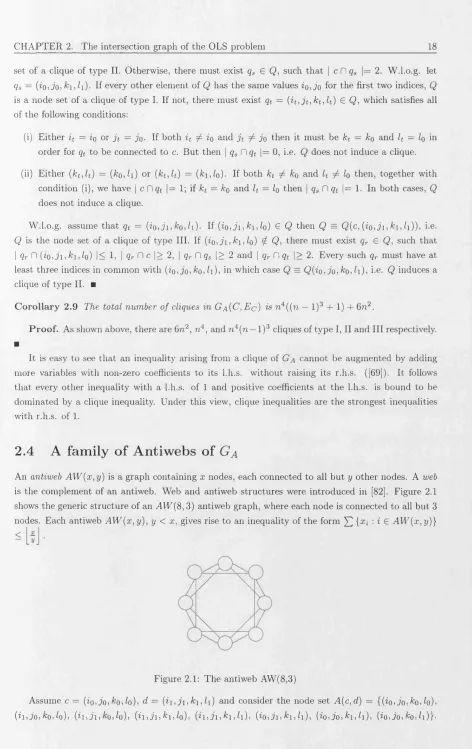
2.4 A family of Antiwebs of Ga ... 18
2.5 The W heels of Ga ... 20
2.5.1 Properties of w h e e l s ... 21
2.5.2 Lifted wheel in e q u a litie s ... 26
2.6 A family of composite cliques of Ga.... ... 29
2.7 The Odd holes of Ga ... 30
2.7.1 Odd holes of type I ... 32
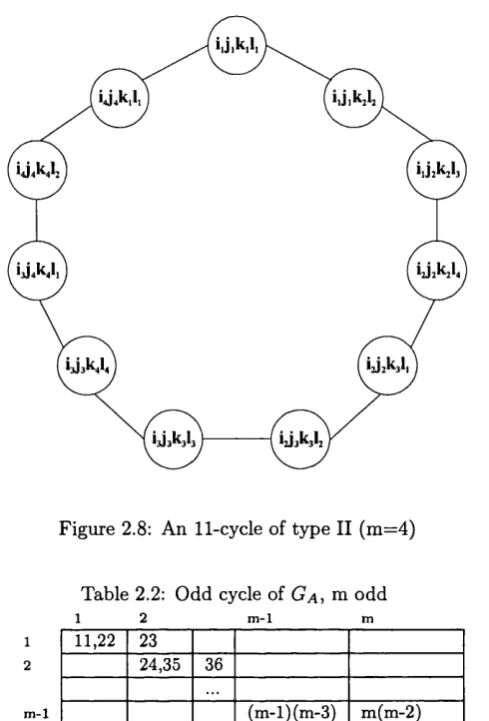
2.7.2 Odd holes of type I I ... 33
2.8 Odd a n tih o le s ... 36
2.9 Concluding r e m a r k s ... 42
3 P o ly h e d r a l ch a ra c ter isa tio n o f th e OLS p o ly to p e 43 3.1 Introduction and preliminaries ... 43
3.2 The dimension of P j... 45
3.3 Dimension of the inequalities defining Pl ... 55
3.4 Clique in e q u a li ti e s ... 56
3.4.1 Dimension and C hvatal rank of clique i n e q u a l i t i e s ... 57
3.4.2 Separation algorithm s for clique inequalities . 61 3.5 Antiweb in e q u a litie s ... 64
3.6 Com posite clique in e q u a li ti e s ... 66
3.7 Odd cycle i n e q u a lit ie s ... 73
3.7.1 Separation algorithm s for odd cycles of type I ... 74
3.7.2 T he dimension of odd cycles of type I I ... 76
3.8 Concluding r e m a r k s ... 87
CON TEN TS x
4 I n t e g e r P r o g r a m m in g a lg o r ith m s 89
4.1 Two Integer Program m ing models for OLS ... 90
4.2 Reducing the solution s p a c e ... 92
4.3 Proving i n f e a s ib il it y ... 94
4.4 A Branch & C ut algorithm for OLS ... 97
4.4.1 P re p ro c e ssin g ... 100
4.4.2 T he branching m ech a n ism ... 101
4.4.3 C utting p l a n e s ... 106
4.4.4 Solving th e L P - r e la x a tio n ... 108
4.5 Im plem entation of th e Branch & C ut a lg o rith m ... 109
4.5.1 M atrix operations ... 109
4.5.2 Control p a ra m e te rs ... 109
4.5.3 “Callback” s u b r o u tin e s ... 110
4.5.4 C ut m a n a g e m e n t... 110
4.6 C om putational a n a l y s i s ... 110
4.6.1 M ethods for solving L P s ... I l l 4.6.2 Branching rules & objective f u n c t i o n s ... I l l 4.6.3 P re p ro c e ssin g ... 112
4.6.4 Q uality of cutting planes ... 113
4.6.5 C ut s tra te g ie s ... 116
4.7 Concluding r e m a r k s ... 118
5 C o n s tr a i n t P r o g r a m m i n g a lg o r ith m s 119 5.1 T he C onstraint Program m ing p a r a d i g m ... 119
5.1.1 Logic Program m ing applied to OLS for n = 2 ... 119
5.1.2 Definitions ... 124
5.1.3 T he constraint g r a p h ... 125
5.1.4 Arc-consistency and its g en e ralisatio n s... 126
5.2 M ethods for solving a CSP ... 129
5.2.1 G enerate &; T e s t ... 129
5.2.2 Chronological B a c k tra c k in g ... 129
5.2.3 Forward C h e c k i n g ... 131
5.2.4 Forward s c h e m e s ... 132
5.2.5 Backward s c h e m e s ... 133
5.2.6 Hybrid m ethods ... 134
5.2.7 Variable and value o r d e r i n g ... 134
5.3 C P algorithm s for the OLS p r o b l e m ... 135
5.3.1 Problem fo rm u la tio n ... 135
5.3.2 Branching s t r a t e g i e s ... 137
5.3.3 Algorithm s &; C onstraint P r o p a g a tio n ... 138
5.3.4 Im plem entation d e ta ils ... 141
5.4 C om putational e x p e rie n c e ... 142
5.4.1 Branching s t r a t e g i e s ... 142
5.4.2 Procedures for C onstraint P ro p a g a tio n ... 144
5.5 Concluding r e m a r k s ... 145
6 I n t e g r a t i n g C o n s tr a i n t a n d I n t e g e r P r o g r a m m in g 147 6.1 Theoretical connections between C P & I P ... 147
6.2 Algorithm ic approaches combining C P & I P ... 149
6.3 Design of hybrid a lg o r ith m s ... 151
6.3.1 Algorithm I P C ... 152
6.3.2 Algorithm C P I ... 154
6.4 C om putational e x p e rie n c e ... 155
6.4.1 Algorithm I P C ... 155
6.4.2 Algorithm C P I ... 156
CONTENTS xi
6.5 An algorithm for triples of M O L S ... 159
6.5.1 IP and CP models for the 3-MOLS p ro b le m ... 160
6.5.2 Algorithm s for the 3-MOLS p r o b le m ... 161
6.5.3 C om putational R e s u lts ... 163
6.6 Concluding r e m a r k s ... 164
7 M u ltid im e n sio n a l A ssig n m e n t P ro b lem s 165 7.1 M athem atical fo r m u la tio n ... 166
7.2 Assignment polytopes and related structures ... 168
7.2.1 General c o n c e p ts ... 168
7.2.2 Two special c a s e s ... 169
7.3 T he (k , s) linear assignment p o ly to p e ... 169
7.4 T he (k , s) assignment p o l y t o p e ... 176
7.5 T he axial assignment p o ly to p e s ... 179
7.6 A family of facets for the axial assignment p o ly to p e s ... 183
7.7 T he planar assignment p o ly to p e s ... 185
7.8 C onstraint Program m ing fo r m u la tio n s ... 192
C hapter 1
T h e P rob lem o f M u tu ally
O rthogonal Latin Squares
It is n atu ral for a thesis focused on M utually O rthogonal L atin Squares to initiate the discussion
by presenting the problem itself. Latin Squares and their extensions define an entire field of finite
algebra, having cross-links to m ultiple areas of m athem atics. Therefore, the related literature is
enormous. An extensive discussion of the subject, involving old and m ore recent developments can
be found in [34, 35, 60]. We restrict ourselves to review only th e aspects, which are relevant to this
work and act as a m otivation for the following chapters.
Section 1.1 provides a num ber of introductory definitions, which will be used throughout the the
sis. Im p o rtan t facts concerning the theory of Latin squares are presented in Section 1.2. Section 1.3
reveals the strong connection of Latin squares to certain areas of discrete m athem atics, while Section
1.4 presents a series of applications. In Section 1.5, we provide and com pare two IP formulations for
the OLS problem. Finally, Section 1.6 dem onstrates the convex hull of all feasible solutions to the
OLS problem for n = 2, thus anticipating th e developments of forthcom ing chapters.
1.1
D efinition s
T he following definitions are obtained from [34], unless otherwise stated.
D e fin itio n 1.1 A L atin square o f order n is a square m atrix o f order n, where each value 0,.., ( n — 1)
appears exactly once in each row and column.
Consider, as an example, th e squares of Table 1.1.
_________ Table 1.1: A pair of O LS of order_4_________
0 1 2 3
1 0 3 2
2 3 0 1
3 2 1 0
0 1 2 3
2 3 0 1
3 2 1 0
1 0 3 2
L i L 2
L atin squares can also be defined as m ultiplication tables (often called the Cayley tables) of
quasigroups. Before defining quasigroups, let us recall the definitions of a group.
C H A P T E R 1. The Problem of M utually Orthogonal L atin Squares 2
D e fin itio n 1.2 A finite group, denoted as a tuple (S',*), is defined as a non-em pty finite set S
together with a binary operation (*), having the following properties:
( i) a * (6 * c) = (a * b) * c, for all a, b, c G S, i.e. operation * is associative-,
( ii) there is an identity elem ent e G S', such th a t a * e = e * a = a, for all a G 5;
( iii) for each a G S , there is an inverse element a -1 G S , such th a t a * a -1 = a -1 * a = e.
An implicit property is th a t, for all a,b G S, it holds th a t a * b G S. As an example, consider
th e group (Zn ,+ ) , where Z n = {0, ...,n — 1} and operator ‘+ ’ stands for addition modulo n. The
m ultiplication table of a group (S', *) is a table, whose rows and columns are labelled w ith the
elements of S and cell (a ,b) contains value a * b. Table 1.2 illustrates the m ultiplication table of the
group {Z4,+ ).
Table 1.2: The m ultiplication table of (Z 4, + )
0 1 2 3
0 0 1 2 3
1 1 2 3 0
2 2 3 0 1
3 3 0 1 2
Hence, th e m ultiplication table of a group is a Latin square. However, not all Latin squares are
m ultiplication tables of groups (see [60, Section 6.2]). It is therefore reasonable to ask w hether there
exists an algebraic structure such th a t its m ultiplication table is a L atin square and, conversely, every
L atin square represents the m ultiplication table of such a structure. T he answer exists in th e class
of quasigroups, which encompasses th a t of groups.
D e fin itio n 1.3 [34, P-16] A set S, on which a binary operation (■) is defined, form s a quasigroup
with respect to that operation if, fo r any a,b G S, it holds that a • bG S and each o f the equations a • x = b and y ■ a = b has exactly one solution in S.
A special category of L atin Squares is the following.
D e fin itio n 1.4 A Latin square is said to be in reduced or standard fo rm i f the elements 0 ,..., (n — 1)
occur in the first row and column in their natural order.
One can perm ute the n columns of a reduced L atin squares in n! ways. It is easy to see th a t the
resulting squares remains L atin and are all distinct. Clearly, none of them is reduced. At each of
these squares, one can also perm ute the last (n — 1) rows in (n — 1)! possible ways, again forming an
equal num ber of distinct L atin squares. Let L n , ln denote th e num ber of L atin squares and reduced
L atin squares of order n, respectively. We have essentially proved the following.
T h e o r e m 1.1 For each n > 2 , the number L n o f Latin squares o f order n is
L n — n\(jn 1)!£ji
A more formal proof can be found in [60, Section 1.2]. Let us now define the concept of Orthogonal
1.2. Theory of L atin Squares 3
D e f in itio n 1.5 Two Latin squares o f order n are called orthogonal (OLS) i f and only i f each o f the
n 2 ordered pairs (0 , 0),..., (n — l , n — 1) appears exactly once in the two squares.
A pair of O LS of order 4 appears in Table 1.1. This definition is naturally extended to sets of
k > 2 L atin squares, which are called M utually Orthogonal (M O LS) if they axe pairwise orthogonal.
E xtending the idea of a reduced L atin square, we call a set of k MOLS reduced or standardised if
elem ents 0 ,.., (n — 1) appear a t the first row of all squares and a t the first column of exactly one
square in n atu ra l order. A concept related to OLS is th a t of a transversal.
D e f in itio n 1.6 A transversal o f a Latin square is a set o fn cells, each in a different row and column,
which contain n pairwise different values.
Denote the squares of Table 1.1 as L \ and L2. For each set of 4 cells in square L2 th a t contain
th e same value, observe th a t the corresponding cells of square L \ form a transversal. An easy to
prove b u t quite significant property of OLS is the following.
T h e o r e m 1.2 [34, Theorem 5.1.1] A Latin square o f order n has an orthogonal mate i f and only if
it can be decomposed into n disjoint transversals.
OLS were introduced by Euler via his famous problem of the 36 army officers [36]. These officers
should belong to 6 distinct ranks, 6 to each one, and are collected from 6 different regiments (6 officers
from each regim ent). The 36 officers can be arranged into a 6 x 6 grid such th a t exactly one officer
of each rank appears in each row and column. By definition, this is a L atin square L \ . Similarly, the
officers can be arranged into another square L2 according to their regim ent, i.e. exactly one officer
from each regim ent appears in each row and column. The num ber of reduced L atin squares of order
6 is known to be 9408. Hence, these arrangem ents can be devised in 6!5! x 9408 ~ 109 ways, which
is th e num ber of L atin squares of order 6. T he question is w hether there exist squares L \ and L2
such th a t all 36 rank-regim ent combinations appear exactly once, i.e. w hether there is a pair of OLS
of order 6. E uler’s belief about the non-existence of such a pair was formally proved by T arry ([81]),
essentially by exhaustive enum eration. Shorter proofs have also been proposed, for example in [80].
It is trivial to show th a t there can exist no pair of OLS for n = 2. M otivated by the non-existence
of OLS for n = 2,6, Euler stated a conjecture th a t no pair of OLS exists if n is an odd multiple of
2. T he falsity of this conjecture was shown in 1959 ([19]) by constructing a pair of OLS for n = 22.
This celebrated result revived the interest in O rthogonal L atin squares and their properties.
1.2
T h eory o f Latin Squares
In this section, we sta te certain theorems regarding L atin squares and OLS, w ithout their proofs.
T he related theory is much broader and is still being augm ented. Hence, only results relevant to our
research are illustrated.
1.2.1 S in gle L atin Squares
Recall th e simple observation th a t a square rem ains L atin after perm uting its columns. In fact, a
L atin square embodies three entities, conventionally corresponding to th e n-sets of rows, columns
and values. A pparently, any of these sets can be perm uted w ithout violating the fact th a t each
value m ust exist exactly once in each row and column. The following statem ent provides a formal
C H A P T E R 1. The Problem of M utually O rthogonal Latin Squares 4
D e fin itio n 1 .7 Let (G, •) and (H, *) be two quasigroups. A n ordered triple (9 ,(f,if) of 1 — 1 mappings
9, (f>, if o f the set G onto the set H is called an isotopism o f (G, •) upon (H, *) if (x 9) * (y</>) = (x •
/o r all x , y £ G. The quasigroups are then said to be isotopic. I f 9 = (f — if such a transformation
is called an isomorphism.
T he definitions of isotopism and isomorphism are obtained from [34]. To avoid confusion, we
have to rem ark th a t numerous textbooks in graph theory and com binatorics (e.g. [17]) assign to
isomorphism the properties of w hat is defined here as isotopism. Clearly, two Latin squares are
called isotopic if they define the m ultiplication tables of isotopic quasigroups. As an example,
consider square L \ of Table 1.1. In order to derive an isotopic square L \, we need to define three
different perm utations for the sets of rows, columns and elements of L \. If we apply the perm utations
^ = (2 3 1 o ) > ^ = (o 3 1 2) and V’ = (0 1 2 3) rows> columns and elements of L \, we obtain
the isotopic square L \ of Table 1.3. For example, notice th a t cell (2,3) of L \, containing value 1, is
m apped to (1,2) in L \, also containing value 1. Similarly, to derive the square L \ of Table 1.3, which
is isomorphic to L\ , we apply the same perm utation 9 = (f = if = (° 3 \ q) to rows, columns and
elements of L \.
Table 1.3: Isotopic and isomorphic squares of L \
3 1 0 2
2 0 1 3
0 2 3 1
1 3 2 0
2 3 0 1
3 2 1 0
0 1 2 3
1 0 3 2
L 1 L j
Hence, isotopy is a property encompassing the inherent sym m etry of L atin squares. A less
obvious form of sym m etry is obtained if we observe th a t th e roles of rows, columns and values are
interchangeable. For example, by interchanging the roles of rows and columns of a L atin square L,
we derive its transpose L T, which is also a Latin square. Since there exist 3! perm utations of the
three entities, each L atin square m ay be used to obtain up to 5 other L atin squares L '. Any such
square L ' is said to be conjugate to L. Notice th a t the conjugate squares of a L atin square L are not
necessarily distinct.
T h e o r e m 1.3 [34, Section I .4J The number o f distinct conjugates o f a Latin square L is always
1,2,3 or 6.
Isotopy and isomorphy are associative and com m utative properties. In this sense, they define
equivalence relations among Latin squares of the same order. Let Qn denote th e set of L atin squares
of order n. Define as isotopy (isomorphism) class th e subset of Vtn formed by a particular Latin
square and all its isotopic (isomorphic) ones. The following theorem s concern th e classification of
m embers of Qn .
T h e o r e m 1.4 Each isotopy class o fQ n splits into disjoint isom orphism classes.
D e fin itio n 1.8 A set o f Latin squares, which comprises all the members o f an isotopy class together
with their conjugates is called a m ain class o f Latin squares.
T h e o r e m 1.5 Qn splits into disjoint m ain classes and each m ain class is a union of isotopy classes.
1.2. Theory of L atin Squares 5
C oro lla ry 1.6 Each m ain class o f Qn , and therefore Qn itself\ splits into disjoint isomorphism
classes.
1.2.2
M u tu a lly O rthogonal Latin Squares
Considering MOLS, a n atu ral question is which is the largest cardinality of a set of MOLS of order
n, usually denoted as N (n ).
T h e o rem 1.7 ([60, T h e o r e m 2.1]) There can be at m ost n —1 M O L S o f order n.
A set of n — 1 MOLS of order n is also called a complete set of MOLS. This bound is attainable
for prim e powers, i.e. num bers n — pm , where p is prim e and m € Z+. A conjecture states th a t this
bound it attainable if and only if n is a prime power [60, p.38]. For nonprim e powers, the problem is
relaxed to th a t of finding recursive constructions of sets of MOLS of order n from sets of MOLS of
lower orders. T he m ost representative m ethod applies the concept of Kronecker product [60, Section
2.3] of two L atin squares of different orders. The result is th e following theorem .
T h e o rem 1.8 I f there is a pair o f O LS o f order m and a pair o f OLS o f order n, there exists a pair
o f O LS o f order m n .
Using this theorem , it is easy to show the existence of OLS for all n, except for the ones th a t are
an odd m ultiple of 2, i.e. for all cases not included in E uler’s conjecture. T he results of [20] prove
th a t E uler’s conjecture is actually false for all n th a t are odd multiples of 2, except for n = 2,6.
Hence, we m ay sta te th e following.
T h e o r e m 1.9 ([60, T h e o r e m 2.9]) There exists a pair o f O LS fo r all orders n € Z + \{ 1 ,2 ,6 } .
It follows th a t N ( n) > 2 for all n € Z + \{ 1 ,2 ,6}. Extending the m ethod of Kronecker product,
two more general statem ents become possible.
T h e o r e m 1.10 Let q\ x ... x qr be the factorisation of n into distinct prim e powers, with q\ < ,..., <
qr . Then N ( n) > <?i — 1.
T h e o r e m 1.11 F o r m ,n > 1, N (m n ) > m in { N (m ), N (n )} .
Numerous recursive constructions of sets of MOLS can be found in [35, C hapter 5].
Research has also been conducted about criteria determ ining w hether a set of k MOLS is ex
tendible to a set of k + 1 MOLS. A generalisation of Theorem 1.2 is the following.
T h e o r e m 1.12 k M O L S o f order n are extendible to k + 1 M O L S o f order n, i f they have n disjoint
transversals in common.
In [35, Sections 2.4-2.6], th e reader may find more elegant considerations of the subject. We only
state a simple, yet im portant, result.
T h e o r e m 1 .13 A set o f n — 3 M O LS o f order n is always extendible to a complete set o f MOLS.
Given th a t the existence of OLS has been resolved for all n, th e next topic to be addressed is
th e existence of triples of MOLS. Quoting from [60, Section 16.5], it is known th a t there are a t least
3 MOLS for all n, such th a t 4 < n < 104, w ith th e exception of n = 6 and, possibly, n = 10. The
existence of 3 MOLS of order 10 is the m ost persistent unsolved instance, exactly because 10 is the
sm allest order for which there exists no complete set of MOLS ([58]). It is also th e smallest order
C H A P T E R 1. T he Problem of M utually Orthogonal L atin Squares 6
1.3
R elated areas
Research on L atin squares is intensive not only because these structures give rise to interesting
puzzles, bu t m ainly because of their relevance to core areas of discrete m athem atics and finite algebra.
T his section presents equivalences between complete sets of MOLS and certain com binatorial objects.
To begin our discussion, let us present the definition of an affine plane.
D e fin itio n 1.9 A n affine plane is a geometric system o f points and lines, satisfying the following
axioms
A 1 There is a unique line joining any two points.
A 2 For a certain point P and a line I not containing P , there is a unique line containing P and not
intersecting I.
A 3 There are fo u r points, no three o f which are on the same line.
Two im portant corollaries are the following.
C o r o lla r y 1.14 In any fin ite affine plane, there exists a positive integer n, such that every line
contains exactly n points and every point is on exactly n + 1 lines. Num ber n is said to be the order
o f the affine plane
C o r o lla r y 1.15 A finite affine plane o f order n contains n 2 points.
T he fundam ental link between finite affine planes and sets of MOLS is revealed by the next
theorem.
T h e o r e m 1.16 A complete set o f M O L S o f order n exists i f and only if a finite affine plane o f order
n exists.
Hence, it follows directly th a t an affine plane of order 6 does not exist. A related concept is th a t
of a projective plane.
D e fin itio n 1.10 A projective plane is a geometric system o f points and lines, satisfying the following
axioms
P I There is a unique line joining any two points.
P 2 A n y two lines intersect at a unique point.
P 3 There are fo u r points, no three o f which are on the same line.
We om it the counterparts of Corollaries 1.14 and 1.15 for projective planes and sta te directly the
m ain result.
T h e o r e m 1.17 A finite affine plane o f order n exists i f and only i f a finite projective plane o f order
n exists.
C o r o lla r y 1.18 A complete set of M O L S o f order n exists i f and only i f a finite projective plane of
1.4. A pplications of O rthogonal Latin Squares 7
Hence, a problem regarding a complete set of MOLS can be tackled by any of its equivalents (see
[58]) and vice versa.
Another related area of combinatorics is (£, m, s)-nets. The study of these structures is m otivated
by the necessity to approxim ate the value of a definite integral in cases where the anti-derivative
of the integrand cannot be determ ined or does not exist. Again, we deliberately om it interm ediate
definitions, which are not related to our purposes. An excellent introduction appears in [60, C hapter
15]. Consider only th a t param eters t , m , s are sufficient to define the properties of a net.
T h e o rem 1.1 9 Let s > 2, b > 2 be integers. There exists a (0,2, s)-n e t in base b i f and only i f there exist s M O L S o f order b.
A more generic object in combinatorics is th a t of a design.
D e fin itio n 1.11 A ssum e a set P o fu points and a collection B o f subsets, called blocks. The system
o f points and blocks is called a design.
If we focus only on blocks of cardinality k, we restrict ourselves to (£) blocks. If only b < (£)
blocks are included, the design is called incomplete. To o btain balance, we require th a t (a) each
pair of points occurs together in a fixed number X of blocks and (b) each point occurs in exactly r
blocks, where r < b . Baaed on these involved preliminaries, we may define the stru ctu re of a balanced
incomplete block design or a (u,b, r, k, A)-design. Blocks and points are naturally m apped to lines and points of a geometric structure.
L em m a 1.2 0 A finite affine plane o f order n gives a (u, b, r, k, X)-design, where u = n 2, b = (n + l) n ,
k = n, r = n + 1 and X = 1.
1.4
A p p lications o f O rthogonal Latin Squares
A part from their theoretical properties, MOLS possess diverse applications. Single Latin squares
are applicable to even more areas. However, we will m ention only th e applications they share with
MOLS.
The m ost well-known application of MOLS is m ultivariate statistical design. These designs are
devised in order to determ ine whether significant differences exist between samples representing
various levels of certain random variables. We present the example given in [60, Section 12.3], where
n varieties of w heat need to be tested w ith n fertilisers and n insecticides. T he inherent assum ption
is th a t all three variables are independent and have exactly the same num ber of levels, i.e. n. In
order to determ ine the extent to which the w heat crops are affected by each fertiliser and insecticide,
all n 3 triples of the form {wheat, fertiliser, insecticide} should be examined. To reduce th e cost of
the experim ent, we may instead test each ordered pair of any two variables exactly once. This would
imply n 2 repetitions of the experim ent, instead of n 3. For n = 4, consider the first L atin square of
Table 1.1 and let its rows correspond to different fertilisers and its columns to different insecticides.
If the elements of each cell correspond to a different w heat variety, it can be seen th a t each wheat
variety is tested exactly once w ith each fertiliser and each insecticide. Designing such an experiment
for t statistical variables requires the use of a set of t — 2 MOLS of order n. Because of Theorem 1.7,
it must be th a t t — 2 < n — 1 or t < n + 1. For example, there can exist no experim ent of 4 variables
C H A P T E R 1. T he Problem of M utually Orthogonal L atin Squares 8
A relevant application is the design of tournam ents. A pair of OLS of order n can be used to
schedule any tournam ent between two team s, of n players each, w ith the following requirements:
• every player from team A plays against each player of team B;
• there are no games played between any two players of the same team ;
• every player plays in each of the n rounds;
• every player plays a t each of the n locations exactly once during th e tournam ent.
To illustrate this via the OLS of Table 1.1, suppose th a t rows and columns correspond to players
of team s A and B, respectively. Values of the first square indicate th e round, where each pair meets,
while values of the second square indicate the location. It is easy to see th a t numerous scheduling
problems could be encompassed in the structure of MOLS.
MOLS have im portant applications in coding theory. A code is defined as a set of n-tuples, or
vectors w ith n coordinates, where each coordinate belongs to a set S of q elements. This defines a
q-ary code o f length n. A code can be used to send messages, be it via a com munication channel or
w ithin a com puter system. T he n-tuples recognised as valid messages by th e code are its codewords.
T he objective when designing a code is to allow for a large num ber of codewords, which differ from
each other sufficiently for errors to be efficiently detected and corrected. T he larger the Hamming
distance d between any codewords (for definitions see [35, C hapter 9]) th e easier to detect errors
and th e sm allest the m axim um num ber of codewords for certain values of n and q. T he notion of
an (n, M , d) q-axy code C implies a code of length n w ith M codewords and minimum distance
between any codewords equal to d. Fixing th e values of n, q, d, the problem is to find a code w ith the
m axim um num ber of codewords M . P aram eter n could be th e bit-length of a network, q the number
of states allowed for each b it and d the desired security level. T he following theorem establishes the
significance of MOLS for the existence of optim al codes.
T h e o r e m 1.21 There exists a q-ary (s, q2,s — 1) code i f and only if there exist s — 2 M O LS of order
q-A dditional optim isation problems in codes and cryptography, which are related to MOLS, are
described in detail in [35, C hapter 9] and [60, C hapter 13]. In fact, the list of application of MOLS
presented here is only a representative sample. Extensive references for miscellaneous applications
can be found in [60, C hapter 16]. The critical aspect is th a t all applications ask for a single pair of
OLS or a single set of k > 2 MOLS.
1.5
IP m odels for th e OLS problem
T his section introduces two Integer Program m ing models for the OLS problem. Let the two squares
be L u L 2 and consider four n-sets / , J, K , L. Suppose th a t I is the row set and J the column set,
while sets K and L are the sets of values for the squares L \ and L 2, respectively. W ithout loss of
generality, it is convenient to assume th a t I = J = K = L = {0, ...,n — 1}. Let variable Xijk be 1 if
value k appears in cell ( i ,j) of square L \. Variable is defined similarly. Since L \ m ust be Latin,
each value k m ust appear exactly once in all n cells of column j, i.e. in all cells defined by different
values of i. Hence, we obtain th e equality constraint i G /} = 1 for all j G J and k G K .
1.5. IP models for the OLS problem 9
i and each cell ( i , j) m ust contain exactly one value k gives rise to two more constraint types. The
result is constraints (1.1)-(1.3) of the model depicted below. Notice th a t th e roles of sets I, J , K , L
are purely conventional. C onstraints (1.4)-(1.6) ensure th a t L2 is also a L atin square. To enforce the
orthogonality condition, we introduce variables z^ki- C onstraints (1.7)-(1.9) guarantee th a t z^ki will
be 1 if and only if b o th variables x ^ k and yiji are 1, i.e. if pair (k , l) appears in cell (i, j) . Finally,
constraints (1.10) model th e fact th a t each ordered pair (k , l) m ust occur exactly once.
m min : i e / , j £ J, k £ K , L £ L }
s.t.
J 2 { ^ i j k - - i e l } = i y j e J , k e K (1.1)
£ { * « * : i 6 = 1-V« 6 I , k € K (1.2)
: k € K } = 1 ,Vi e I , j S J (1.3)
£ ] { y y I : i e 1} = 1, V) e J, I e L (1.4)
'■ j s J } = 1>V» e 1,1 € L (1.5)
^ { y y , : l e ! } = i , V i e / , j e J (1.6)
Xijk > Z ijku'ii £ l , j e J , k £ K ,l e L (1.7)
Viji > Zijki, Vi € I , j £ J , k e K , l £ L (1.8)
Xijk + Viji ^ Zijki “b 1,Vi £ I ) j £ J t k G K , l G L (1.9)
^ \ zjjki '• i £ I , j £ J} = 1, VA; G K , I G L (1.10)
Xijk} Viji ^ {0, lj-, Vi £ I , j £ J , k £ K, I £ L
0 < z^ki < 1 ,Vi £ I , j £ J , k £ K J £ L
This is a model on 2n 3 binary variables and n 4 real variables, which includes 7n 2 + 3n4 constraints.
An alternative model can be derived by directly defining 0 — 1 variables Xijki. A variable Xijki is
1 if pair (k, I) appears in cell ( i ,j) and 0 otherwise. Since each pair m ust occur exactly once among
all cells (i, j ) , th e constraint J 2 i x ijki : i £ I , j £ J } = 1 is valid for all k £ K and I £ L. By taking into account th a t the roles of sets is conventional, therefore interchangeable, we can define 5 more
analogous constraints. T he model illustrated below is attrib u ted to D.Gale (in [29]).
^ ^ { X ijk l i £ I , j £ J } = l ,\ f k e K , l £ L (1.11)
^ ^ { X ijk l i £ I , k £ K } = 1, V? G J ,l £ L (1.12)
T A x i j k i i £ 1,1 £ L ] = 1, V? G J , k £ K (1.13)
j £ J ,k £ K } = 1, Vz G 1,1 £ L (1.14)
J ^ iX ijk l j £ J, I £ L } = 1, Vz G I , k G K (1.15)
E ^ k i k £ K ,l £ L } = l,Vz G I , j £ J (1.16)
Xijki ^ {0, l}Vi G I, j G J, k G K , I £ L
C H A P T E R 1. The Problem of M utually Orthogonal Latin Squares 10
solution is also optim al. Minimising or maximising this objective function is not really im portant,
since our research trea ts O LS as a feasibility problem. This second model involves n 4 binary variables
and 6n 2 constraints.
C om paring the two models, it is clear th a t the first model is larger in term s of b o th variables and
constraints. It follows th a t the associated linear program m ing relaxation would take longer to solve.
Moreover, constraints of a form similar to th a t of (1.7) are known to produce very weak relaxations,
as argued in [68, 1.1]. However, the first model has far fewer integer variables, i.e. n 3 against n 4 of
the second model. Thinking in term s of a Branch & Bound algorithm , it is reasonable to suggest th a t
the second model is more im practical. However, this is not the case. Roughly speaking, the reason
is simply th a t every integer feasible solution to the first model would require 2n 2 integer variables
to be set to 1, in contrast to th e n 2 variables required to be 1 by the second model.
A nother advantage of the second model i / its simplicity and symmetry. This sym m etry reflects
more accurately the inherent sym m etry of th e OLS problem, in term s of the fact th a t all four entities
are indistinguishable. Hence, the second model is the one used throughout the rem ainder of this
thesis.
1.6
T he convex hull o f th e OLS p o ly to p e for
n
— 2
The convex hull of a set of vectors x i ,. .. ,x m is defined as the set of all real points x, for which
there exists non-negative scalars Ai, ...Am, such th a t x = A*£* and A* = 1. Consider the
second IP model of the previous paragraph and recall th a t the integer vectors satisfying constraints
(1.11)-(1.16) have a 1 — 1 correspondence to all pairs of OLS of order n. If we replace '= ’ by '< ’ in
all constraints, we obtain a model, whose solutions are all incom plete OLS of order n. Notice th a t
the zero vector, i.e. an “em pty” pair of OLS, is also a solution to this model. This section illustrates
all inequalities defining the convex hull of the vectors corresponding to incom plete OLS structures
of n = 2. A pair of incom plete OLS of order 2 is illustrated a t Table 1.4.
Table 1.4: A pair of incomplete OLS of order 2
0 1
To derive this convex hull we use the PORTA software ([24]), which accepts as input a set of
integer vectors. T he o u tp u t is a minimal representation of the convex hull of the input vectors in
term s of inequalities, which are facet-defining. The inequalities illustrated for this simple example
anticipate the results of C hapter 2 and could also serve th e purposes of an introduction to th a t
chapter. Any term inology used to characterise each set of inequalities, e.g. cliques of type II, will be
formally defined in C hapter 2.
Let A denote the constraint m atrix of equalities (1.11)-(1.16). T he convex hull of incomplete
pairs of OLS is th e polytope P j = conv{x G { 0 ,1}”4 : A x < e}. Let R = (K x L ) U • • • U ( I x K ) and
C = I x J x K x L be the row and column sets of A, respectively. T he facet-defining inequalities of
1.6. T he convex hull of the OLS polytope for n = 2 11
I) N o n -n e g a tiv itie s
These are defined for all c £ C. For c = &o, lo), the form of such an inequality is:
~~x iojokolo ^ 0
T here exist n 4 such inequalities, or 16 for n — 2.
II) C liq u es o f ty p e I
These are defined for any r £ R. For r = (io,jo), the form of such an inequality for n = 2 is:
x iojokolo "F x iojokoh "F x iojokilo “I” x iojokil\ — 1
T here are 6n 2 such inequalities, or 24 for n = 2.
III) C liq u es o f ty p e II
These are defined for all c £ C. For c = {io,jo,ko,lo), the form of such an inequality for n = 2
is:
x iojokolo “I” x iijokolo ~F x ioj\kolo "F x iojokilo “I” x iojokal\ — 1
Hence, th e left-hand side includes variable x c and all variables having exactly three indices in
common w ith x c. There are n 4 such inequalities, or 16 for n — 2.
IV ) C liq u es o f ty p e III
These are defined for all c,d £ C such th a t |c fl d\ = 1. Assuming c = (io ,jo ,ko ,lo ), d =
( i o , j i , k i , h ) , such an inequality has the form:
x iojokoh "F x iojok\h "F x iojikoli "F x ioj\k\lo — 1
Notice th a t the left-hand side includes variable x c along w ith all variables sharing two indices
w ith x c and three indices w ith x j. There are n 4(n — l )3 such inequalities, or 16 for n = 2.
V ) C o m p o s ite cliq u es
These are defined for all c ,d £ C such th a t |c fld | = 0. For c = (i0, jo, koJo), d = («o, j i , k i, Zi), the form of such an inequality is:
^ ‘ x iojokolo 4” x iijokolo ~F x ioji kolo F- x iojok\lo x iojokoh
x iojok\li "F x iojikoli *F x iojik\lo 4“ x iijokoh "F x i\jok\lo "F x i\j\kolo ^ 2
T he left-hand side includes x c and all variables having two or three indices in common with
C H A PT E R 1. The Problem of M utually Orthogonal L atin Squares 12
V I) L ifted a n tiw eb s
These are defined for all c,d € C such th a t |c fld | = 0. For c = (io, joi &o, fo)> d = (io ,ji, &i, l\),
the form of such an inequality is:
x i o j o k o l o "P 3 ' i o j o k o l i "P x i o j o k i l o P' x i o j o k \ h "P
x i o j i k o l o ”P 3 ' i o j i k o h "P^ioJikdo ~P x i o j i k i h "P
• t ' i i j okol o “I” x i \ j o k o h "P x i i j o k i lo "P x i \ j a k \ l i P
x i i j i k 0 l0 + x i i j i k 0 l\ "P x i i j i k i l0 P^MJifciii 5: 2
Observe th a t the left-hand side includes variables x c and xa-along w ith all variables having all
their indices belonging to c or d. T here are ^ n 4(n — l )4 such inequalities, or a single one for
n = 2.
The last inequality states th a t there can exist no pair of OLS for n = 2. The to tal number
of inequalities defining P j is 89. As mentioned earlier, all these inequalities, along w ith further
C hap ter 2
T h e in tersection graph o f th e OLS
problem
This chapter presents a framework for characterising th e OLS problem from an Integer Programming
(IP) perspective. A first step towards this direction is the form ulation of an IP model for the problem,
i.e. a linear model on integer variables. Such a model was presented in Section 1.5. A relaxation
of this model is derived by requiring the variables to be simply non-negative. This is the problem ’s
linear programming (LP) relaxation. The convex hull of th e feasible solutions of the original model
defines a polytope P j, w ithin the polytope Pl defined by the problem ’s LP relaxation. Although the
feasible points are located w ithin P j, we initially know only th e set of linear inequalities defining Pl.
In order to efficiently characterise and solve th e OLS problem using IP, a t least a p artial knowledge
of polytope P i is required. This knowledge is usually provided in th e form of inequalities, which
are valid for polytope P j bu t not for the polytope Pl- In other words, these inequalities are derived
by enforcing the requirem ent th a t certain variables m ust be integer. Among these inequalities, it is
reasonable to identify the ones, which are not dom inated by any other valid inequality. These valid
inequalities are called maximal. Any maximal valid inequality defines a non-em pty face of Pj and
the set of m axim al valid inequalities contains all of the facet-defining inequalities for P j ([68, p.207]).
A m ongst a num ber of m ethods for identifying families of valid inequalities, one w ith a considerable
record, especially in problems involving a 0 — 1 constraint m atrix, is th a t of studying a graph
associated w ith the IP model. This is the intersection graph, introduced in Section 2.2 (see also
[26, 69]). Subgraphs of this graph exhibiting a particular stru ctu re give rise to strong valid inequalities
for th e set-packing and set-partitioning polytopes (see [8, 18] for a review). In this chapter, a number
of such subgraphs, along w ith the induced inequalities, are identified and analysed for the intersection
graph of our IP model. In particular, cliques, antiwebs, wheels, com posite cliques and odd holes are
presented in sections 2.3-2.7, respectively. Finally, Section 2.8 examines the existence of odd anti
holes and proves th a t such structures do not exist for this particular problem.
C H A P T E R 2. T he intersection graph of the OLS problem 14
2.1
T h e OLS p o ly to p e
Recall th e model introduced in Section 1.5:
^ 2 { x ijk i : i e I , j £ J } = 1 ,Vfc £ K ,l £ L (2.1)
'Y ^ { x ijki : i € I , k £ K ] = l,V j £ J ,l £ L (2.2)
^ i j k i - i e 1,1 e L } = l ,V j £ J ,k £ K (2.3)
^ { x i j k i : j e J, k £ K } = 1, Vz € I , I £ L (2.4)
^ ^{xjjki • j € J)l € L} = 1 ,Vi £ I , k £ K (2.5)
$ > « « : k £ K ,l £ L } = 1, Vi £ I , j £ J (2.6)
Xijki e { 0 ,l}Vi £ I , j £ J , k £ K , l £ L (2.7)
where I , J, A", L are disjoint sets w ith | I |= | J |= | K |= | L |= n.
Given real weights Cijki for every (i, j, k , l) £ I x J x K x L , th e problem of minimizing the function
J 2 i cijkiXijki - i £ I , j € J ,k £ K , I £ L } over the polytope described by constraints (2.1),..., (2.7) is
th e planar 4-index assignment problem or 4P A P n ([2]), which is essentially the optim isation version
of th e O L S problem. To formally define the 4P A P n consider the n 3 triples formed by selecting a
single element from each of the sets I , J, K . Assume th a t sets / , J, AT, L index the rows, columns
and values of squares L \ and L2, respectively. Under this convention, notice th a t a transversal of
square L \ corresponds to n disjoint triples (Definition 1.6). For example, a transversal of square L \
in Table 1.1 is defined by the triples {(0,0,0), (1 ,2 ,3 ), (2 ,3 ,1 ), (3,1,2)}. Hence, the 4P A P n asks for
a m inim um weight collection of n 2 triples, which form n disjoint sets of n disjoint triples. Set L can
be regarded as indexing th e n disjoint sets of triples. It is easy to see th a t, according to Theorem
1.2, the 4P A P n asks for a minimum weight pair of OLS.
Let A denote the coefficient m atrix of constraints (2.1),..., (2.6). We define the polytope P l =
{ x £ R n : A x = e, x > 0} where e = { 1 ,1 ,..., 1}T £ R 6”2. T he convex hull of integer vectors of P l
is defined as P i = conv{x £ {0, l } n : A x = e}. This is the O LS polytope since every integer point
x £ P i is a pair of OLS. P l is also called the linear relaxation of P j. Clearly, P j C P l and the
extrem e points of P / are among the extrem e points of P l. We will sometimes refer to P j as P f in
order to include the concept of order in the notation. Thus, P f — 0 is another way of stating E uler’s
conjecture for n = 6 .
S ubstituting (= ) by (< ) in constraints (2.1),..., (2.6) yields the polytope P i = conv{x £ {0, I }™4 :
A x < e}. T he convex hull of P j, for n = 2, was presented in Section 1.6. Polytopes P i, Pi are
related since P i C P /. Hence, facets of P i are also valid inequalities, b u t not necessarily facets,
for P i. If D denotes a 0 — 1 m atrix, it can be seen th a t P i is a special case of the set-partitioning
polytope P s p p = {x £ {0 , l }9 : D x = e}, while P i is a special case of th e set-packing polytope
P sp = {x £ {0, l }9 : D x < e} (see [8, 69] for details).
There are two problems, each involving three disjoint n-sets, th a t are highly related to the OLS
problem: the planar three-index assignment problem (3P A P n ) and th e axial three-index assignment
problem (3A A P n ). B oth are defined w ith respect to three disjoint n — sets, namely I , J , K, and a
weight coefficient for each triplet ( i , j , k ) £ I x J x K . The 3A A P n is the problem of finding
n disjoint triplets (i.e. a transversal) of minimum weight and constitutes an extension of th e (two-
2.2. T he intersection graph 15
3 A A P n is:
m in Y ^ { c ijk • Xijk : i £ I , j £ J ,k £ K }
'^ 2 { x ijk : i £ I , j £ J } = 1,VA: £ K (2.8)
^~2{xijk : i £ I , k £ K } = 1,Vj £ J (2.9)
SjTJ{ x ijk : j € J, k £ K } = 1, Vz £ I (2.10)
x ijk e {0, l}Vi £ I , j £ J ,k £ K (2.11)
T he 3 P A P n is the problem of finding a minimum weight collection of n 2 disjoint pairs, forming
n sets of n disjoint pairs each. It is equivalent to the problem of finding a minimum weight Latin
squares of order n (see [37]). Its IP formulation is the following.
m in Y ^ { c ijk ■ x ijk : i £ I , j £ J ,k £ K }
s.t. Y , { x i j k : £ -0 = 1 ,V j € J , k £ K (2.12)
Y , { x i j h : j € J } = 1, Vi £ I , k £ K (2.13)
: k £ K } = l,Vz £ I , j £ J (2.14)
x ijk e { 0 ,l}Vi £ I , j £ J , k £ K (2.15)
Polyhedral analysis of 3A A P n and 3P A P n can be found in [9, 10, 76, 38] and [37], respectively.
We extend this analysis in th e general setting of m ulti-index assignment problems in C hapter 7.
2.2
T h e in tersection graph
Let R and C denote the index sets of rows and columns, respectively, of th e 0 — 1 A m atrix. We
refer to a colum n of th e A m atrix as ac for c £ C. The (column) intersection graph Ga( V , E) of a
0-1 A m atrix has a node c for every column ac of A and an edge (cs ,c t ) if and only if aCs • aCt > 1,
i.e. b o th columns cs and ct of A have a +1 entry in at least one common row ([69]).
Let G a ( C ,E c) denote the intersection graph of OLS, where C = I x J x K x L. It is convenient
to label the n 4 columns of th e O LS A m atrix not from 1 to n 4, b u t w ith four indices i , j , k and I
ranging from 1 to n. In this sense, node cs of G a represents th e index set of column s.
D e fin itio n 2.1 The intersection graph o f OLS Ga = (C , E c) has a node c, fo r every c £ C , and
an edge (cs ,ct ) fo r every pair o f nodes cs ,c t £ C such that \ cs D c% |= 2 or 3.
Note th a t an edge (cs ,c t ) £ E c corresponds to columns aCs ,a Ct w ith ac° ■ aCt = 1 or 3. The row
set of the O LS A m atrix is defined as R = (K x L ) U ( I x L) U (J x L) U ( / x J ) U (J x K ) U ( I x K ).
Since | I |= | J |= | K |= | L |= n, | C |= n 4 and | R |= 6n 2. Notice also th a t two nodes are connected
if and only if they have two or three indices in common. T he edge connecting any two nodes can be
characterised by the indices these two nodes have in common. Hence, an edge (ca,c t) can be based
on either a double or a triple ground set, therefore regarded as a double or a triple link, respectively.
We w rite (cs ,c t ) £ M i x M2 or (cs ,ct) £ M \ x M2 x M3, where M i, M2, M3 can be any of th e sets
I , J, K , L, to denote th a t | cs Dct | 2 or 3, respectively. W hen illustrating an edge (cs , c*), the indices,
C H A P T E R 2. The intersection graph of the OLS problem 16
P r o p o s i tio n 2.1 The graph Ga( C , Ec) is regular o f degree 2(3n — l ) ( n — 1).
P r o o f . Consider any c G C. T here are (n — l ) 4 elements of C , which have no index in common
w ith c. For each of the four indices of c there are ( n —l ) 3 elements of C, which share th e same value for
this index b u t have different values for the other three. Therefore, there are 4 (n — l ) 3 elements of C
which have exactly one index in common w ith c. By Def