Version Control Software in the
Open Source Process:
A Performative View of Learning and
Organizing in the Linux Collectif
Maha Iftikhar Ahmed Shaikh
Inform ation System s and Innovation Group D epartm ent o f M anagem ent
London School o f Econom ics and Political Science U niversity o f London
Thesis subm itted in fulfilm ent for the degree o f D octor o f Philosophy
UMI Number: U613377
All rights reserved
INFORMATION TO ALL USERS
The quality of this reproduction is dependent upon the quality of the copy submitted.
In the unlikely event that the author did not send a complete manuscript and there are missing pages, these will be noted. Also, if material had to be removed,
a note will indicate the deletion.
Dissertation Publishing
UMI U61BB77
Published by ProQuest LLC 2014. Copyright in the Dissertation held by the Author. Microform Edition © ProQuest LLC.
All rights reserved. This work is protected against unauthorized copying under Title 17, United States Code.
ProQuest LLC
789 East Eisenhower Parkway P.O. Box 1346
Abstract
This research describes a study o f learning and organizing within the Linux kernel open source collective. For its empirical focus it concentrates on Linux kernel development activities and this collective’s debates about the role of, and need for, an agreed approach to version control software. This is studied over a period o f eight years from 1995-2003. A textual analysis of messages in the Linux Kernel mailing list is used as the primary data source, supported by other contemporary accounts. In this work learning and organizing are understood to be mutually constitutive, where one entails and enables die other. Learning is about interacting with the environment, organizing is about reflecting this in the collective.
The thesis uses the theoretical approach o f actor network theory, Bateson’s levels o f learning and Weick’s concept o f organizing, to analyze learning and organizing in the kernel collective. The analysis focuses on the discourse and interplay between relevant actors (human and non-human), and the ongoing debates among kernel developers over whether to use version control software, and then which version control software to adopt. The persistence and passion o f this debate (it spans the 8 years studied and is ongoing) is evident, and allows a longitudinal study of the
becoming o f learning and organizing. Drawing on actor network theory, the thesis emphasizes the
performative (worked out, lived, ‘in the doing o f , in other words the becoming) character of learning and organizing.
The findings o f the study reveal how learning is understood in the collective and is, to a degree, reflected in its organizing activity. Key themes that emerge include: the organizing o f time and space, maintaining o f transparency and the overall concern with sustaining the assemblage. The thesis offers a distinctive account o f technical actors as an essential part o f the open source process. In conclusion, it re-emphasizes the significance o f code and the agency o f non-human actors.
Acknowledgements
It is impossible to thank all the actors (both human and non-human) who have supported me intellectually and emotionally in the last few years but I will try anyway. Mama and Papa made it possible for me to be at the LSE - THANK YOU! Tony Comford, my supervisor, has got to be the best supervisor ever. His amazing patience, good humour and real nurturing spirit has made this thesis possible. Tony, you really are super and I hope we continue to work together in the future. Farooqi, one o f my closest pals, has bom the brunt o f my horrid moods and uncomplainingly (almost) helped me through this process while doing his own PhD. I would like to thank all my family, especially Chanda and Salman, who provided welcome relief from the stresses of a PhD.
I would like to pay my respects to Claudio Ciborra whose amazing ability to refine ideas made me see possible trajectories that my work could take if only I allowed it to speak to me. Sarah Emery, a friend and manager, created the supportive environment for me to both work and continue with my PhD simultaneously. She is just lovely! Susan Scott is a very giving academic and I will always be grateful for her feedback and interest in my work, and the financial support being her research assistant provided to me. Professor Angell, with many a venti latte from Starbucks, and Nietzsche always cheered me up ©.
Collaboration with Antonio Cordelia developed my understanding o f actor network theory. Steve Smithson, Carsten Sorensen and Edgar Whitley have helped in so many ways and I would also like to thank Shirin Madon and Erica Wagner for their kind encouragement. Thank you Leslie Willcocks for hurrying my thesis over the finish line!
Linda Trautman, you have been a real darling for keeping my spirits high throughout my PhD. You made me feel that I could finish. I would also like to thank all my LSE friends and colleagues for their support and interesting debates. They include Angela Lin, Adel Al-Taitoon, Federico Iannacci, Murat Baygeldi, Evi Kopanaki, Dionysis Demetis, Cameron Lawrence, Carol Hsu, Matthew Smith, Ashu Khanna, Pro Tsiavos, Frederick Wamala, Yingqin Zheng, Mary Darking and Danny Osei-Joehene.
Table of Contents
Abstract... 3
Acknowledgements... 4
Table of Contents ... 5
List of Figures... 8
List of Tables... 9
List of Acronyms... 11
Chapter 1 ...12
Introduction...12
Learning in the Context of Information Systems...13
Domain o f Study... 14
A Brief History o f Open Source... 15
Focus of Study...17
Theoretical and Methodological Orientation of Study...18
Chapter Summaries...19
Chapter 2 ...22
The Study of Open Source...22
Introduction...:... ;... 22
Structure and Process o f Open Source... 23
Motivation...24
Business Models and Economic Aspects o f O S...26
Paradox o f OS...28
Technology in Open Source... 30
Version Control Software...31
Learning and Innovation in Open Source... 35
Organizing and Coordinating in Open Source...37
Licence, Governance and Constitution... 38
Governance and Control... 39
Conclusion...40
Chapter 3 ...42
Learning to Organize a Collective... 42
Introduction...42
Background to Learning in Organizational Learning... 42
Bateson’s Model of Learning... 45
Bateson’s Levels o f Learning...46
Building on Bateson... 50
Constituting an Organization...50
Organizational Memory... 52
Unlearning... 54
Organizing and Learning... 56
Conclusion... 59
Chapter 4 ...60
The Performative Ontology of Actor Network Theory...60
Actor Network Theory... 60
ANT as Ontology...63
Interpretivism...64
Constructivism and Social Constructivism... 66
Ontology of ANT... 69
Constructive Realism or Realistic Realism?...72
Operationalizing the Ontological Concepts of A N T ... 74
Circulating Reference... 75
Centres of Calculation and Immutable Mobiles... 77
Shifting out and Shifting in: Parallel Time Dimensions... 80
Conclusion... 84
Chapter 5 ...85
Ordering the Performance of ‘Reality*... 85
Textual Analysis...85
Discourse Analysis... 86
Research Design... 90
Data Collection... 91
Data Analysis...94
Data Analysis: Coding o f Complete D ata...98
Conclusion... 102
Chapter 6 ...103
The Control Struggle of Version Control in the Linux Collective... 103
Pre-VCS to Partial VCS... 104
Proprietary VCS, enter B K ... 109
Dual VCS the BK“>CVS gateway...115
Garzik’s “SourceForge Syndrome” ... 115
Larry’s Offensive Defence o f B K ... :...117
BK-»CVS Gateway... 118
Postscript - April 6th, 2005 - The breakdown o f B K...123
10 Longest Threads on VCS between 1995-2003, Date order, with Ranking... 125
Chapter 7 ...127
Version Control Software in the Open Source Process...127
Introduction... 127
Organizing Time and Space... 128
Time Wrap: The Linux Collective’s Understanding o f Time and Space... 129
Learning Repository... 136
Conclusion... 138
Sustaining the Assemblage... 139
Mobilization...139
GPL- Constitution...143
Code is Practical...147
Breakdown... 155
Conclusion... 161
Machine Agency: VCS, a Controlling Device... 161
A gency... 162
Control... 167
Ownership... 172
Conclusion... 176
Chapter 8 ...177
Learning and Organizing in the Linux Collectif... 177
Introduction... 177
Transparency... ...178
Organizing...188
Learning...199
Conclusion... ...207
Chapter 9 ... 209
The Creative Space of Learning and Organizing...209
Learning and Organizing...209
Creative Space... 210
Becoming Through the Creative Space...213
Use the Source, Luke, use the Source. Be One with the Code ... 214
Manifestation of Learning and Organizing in OS Collectives... 215
Arguments in Summary... 217
Can we ‘Generalize’ from these Findings?...218
Future Direction and Research... 224
References... 226
List of Figures
Figure 1: The Structure and Focus Areas o f Open Source for this Research...22
Figure 2: The Ladder: A four-level management model o f resource allocation... 28
Figure 3: Source - Louridas, 2006... 35
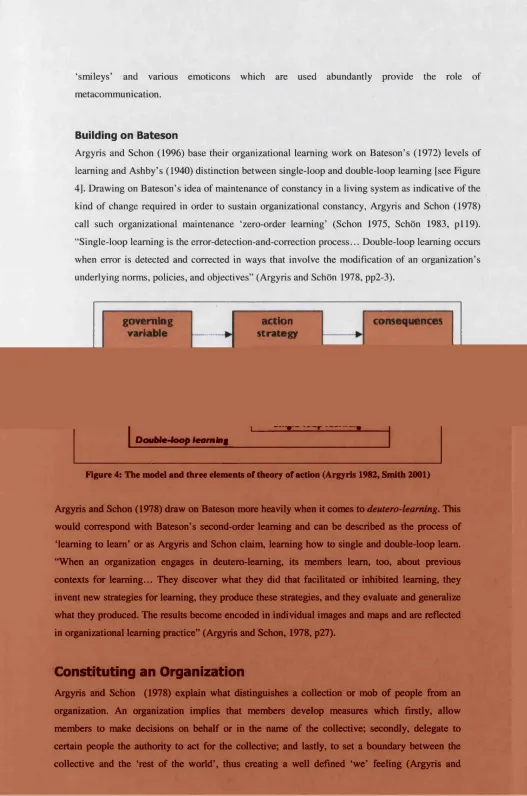
Figure 4: The model and three elements o f theory o f action (Argyris 1982, Smith 2001)...50
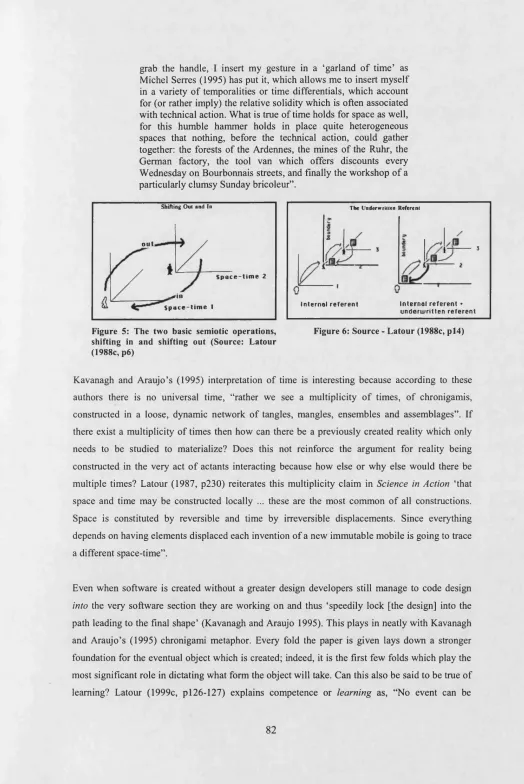
Figure 5: The two basic semiotic operations, shifting in and shifting o u t...82
Figure 6: Source - Latour (1988c, p l4 )... 82
Figure 7: Screenshot o f data analysis in Atlas.ti...95
Figure 8: An Illustration o f Line-by-Line Open Coding for the Pilot Study...97
Figure 9: Linking o f Open Codes to give rise to Axial Codes...98
Figure 10: The Collection of Memos Created and how Grounded they were in the D ata...99
Figure 11: The Code Scheme Manager... 99
Figure 12: An Illustration of Paragraph Coding for the Complete Data... 100
Figure 13: Screenshot indicating the more intense level o f re-memoing...101
List of Tables
Table 1: Macro/Micro Motivation in Open Source (Adapted from Bonaccorsi and Rossi (2004))25 Table 2 Number o f threads and messages collected from the LK M L ... 93 Table 3: Main Analysis Themes and Memo Titles...100
List of Acronyms
ANT Actor Network Theory
BB BitBucket
BK BitKeeper
CoP Communities of Practice
CVS Concurrent Version Systems
GNU Gnu’s Not Unix
GPL General Public License
LKM L Linux Kernel Mailing List OPP Obligatory Passage Point
SCM Source Control Management
Chapter 1
Introduction
I t ’s not the answer but the question
that drives us mad...1
This thesis considers the question of how a particular technical actor (version control software) is implicated in activities o f learning and organizing within an open source project. The work is described as taking a performative view because the emphasis is on what happens or is happening (process), rather than what is achieved or some end state (structure). There is always a balance to be struck between structure and process but this work is biased towards process. Cooper (1976) defines structure as the “invariant pattern o f relationships among functional points in a system, while process is the continuous emergence of new elements from those already existing”. Structure concerns itself with stability or quasi-stability; process, with change. Drawing on this distinction we seek to reveal change in an open source collective in terms o f learning and organizing, in this work taken as an ensemble construct and inextricably linked.
The theoretical perspective used here allows us to construct a framework for analysis that allows us to shed new light on the open source process and how, through the combined agency o f people and other artefacts, interests are aligned and new capacities are imagined, and operationalised, what Callon and Law (1995) call an emergent effect. In this work, drawing as it does strongly on actor-network theory (ANT) and specifically the usage o f Callon and Law, open source activity is characterised as a collectif (or in more standard English a collective) where “a collectif is an emergent effect created by the interaction o f the heterogeneous parts that make it up” (Callon and Law 1995, p485). In conventional ANT terms, we may see this as a socio-technical account, but following Latour (2005b) we may be bolder and state it as just a social account.
This does not mean that people alone are the focus, but that we are concerned with the society of all things. Thus a social understanding of a collectif lays emphasis on tracing all manner of associations. Social does not imply some privileged kind of material that is social, rather it is a “type of connection between things that are themselves not social” - after all a person alone is not performing socially (Latour 2005b, p5). This claim links with the reason why the word collectif has been adopted here over the more common designation o f open source as a community or group. Society and other such words are used so often in everyday language that they too have come to mean some type of material stability rather than emphasising the process o f assembling which is implied in the collecting o f a collectif. Thus, a collectif “will designate the project of
1 The Matrix (1999) - a film directed by the Wachowski brothers: Conversation snippet between Trinity and Neo.
assembling new entities not yet gathered together and which, for this reason, clearly appear as being not made of social stuff’ (Latour 2005b, p75). The idea o f a collective and its binding and evolving force is explained well by Weick (2001) as “collective structures form when self- sufficiency proves problematic” (ppl7) so others must be enticed to participate and help achieve goals. He adds that “people commit to and coordinate instrumental acts (means) before they worry about shared goals. But shared goals do emerge as people search for reasons that justify the earlier interdependent means to which they have become bound” (ppl7). Weick thus uses his idea of sense-making in hindsight to explain why collectives are created and why individuals collaborate. Learning and understanding happen in hindsight, learning is thus the reflective time after an action has been taken.
Learning in the Context of Information Systems
We take a moment here to take a step back and place this work on learning and organizing in the broader context of information systems studies. Boland et al.{1994) discuss how computer-based systems should be developed to support distributed cognition. It is the understanding o f this researcher that version control systems are one such manifestation o f distributed cognition. Huber (1991), talks of information and knowledge synonymously, and as Jones (1995) points out, the work on Artificial Intelligence suggests that “learning may be instantiated not just in information systems, but in information technology itself’. Galbraith (1977) and Pentland (1992) both make similar claims about how cognition and the cognitive approach is a “natural outgrowth o f the information-processing model o f organizations” (Galbraith, 1977).
Domain of Study
Over the last few years open source software development has aroused a growing interest in academic and business communities alike. There is a perceived need to make sense of this seemingly strange and paradoxical phenomenon. What motivates individuals to give their work away freely to others? Why would any business want to release the source code o f its product which could then be appropriated and copied by rivals? These and other pertinent questions have absorbed researchers from many disciplines including software engineering, social psychology, sociology, political economy and business strategy. This research is an attempt to understand a specific, and we argue insufficiently studied question, that of how learning and organizing occurs and is manifested in OS activity. The specific focus o f the empirical work is to comprehend learning and organizing in OS through a study o f the adoption and use o f version control software.
A review of the technology used by the Linux developers initially helped to concentrate the work to find a focus on a specific problematic issue, that o f which version control software the Linux developers would adopt, but later lead to the realization that version control software is itself one o f the strong actors in the network and (potentially) can become the medium [obligatory passage point] through which the collective organizes and developers learn. Oops! Now we have just split the technology from the human and this is not in keeping with the basic premise o f actor network theory, that o f the social and symmetry. However, as will be seen in Chapter 2, we are often forced to start at least by theorizing the technology apart from the human actors because that is how other research in this area has been conducted. Thus, in order to survey the literature on open source and version control software we have acknowledged the distinction. However, we do see it as artificial and we only adopt it so that we can make transparent the lack o f symmetry in other work. Then, as can be seen later in chapter 7 we draw the two rightfully together to theorise the collective as truly a hybrid.
It is not surprising that academics with a software engineering background have shown interest in open source as a software development process, but what is perhaps more surprising is that the wider interest in open source, and here we refer to sociologists, political scientists, management etc has to date often concentrated on software development without noticing the software embodied in the process. There has been little attempt to unpack the software or technology to signify anything more than a necessary facilitator. Even Weber (2004, pi 18) whose ideas we draw on extensively in this work, when discussing the Linux case, states that “technology is a facilitator. For this community in particular, the idea o f a technological fix helped bring the parties together on common ground, but ultimately the solution was going to be a political one”. What Weber, amongst others, seems to miss is that technology or any software is itself a political
artefact. It doesn’t materialize out o f nothing, indeed the (political) effort it takes to be created and moulded is often monumental. But more importantly it behaves (performs) as a political artefact (Winner 1986).
This study then focuses on how a political technological artefact (with its own agency), an
assemblage like version control software, seeks to persuade other different actors to do its bidding
or join its programme and perpetuate its use and existence. We can then ask the question, what do such political actors, within the social hybrid mean for the Linux collective and how it organizes and learns, or more exactly the question that this research addresses is - how does learning and
organizing occur and manifest itself in open source collectives? This is the goal o f the study and
we will draw back to the question throughout this work.
A Brief History of Open Source
We need to reflect briefly on the various designations that the open source phenomenon has achieved. In this thesis, for purposes o f simple English we will speak about open source as the generic domain o f activity, abbreviated to OS, with OSS standing for open source software. However we must acknowledge that there are plenty o f other designations in good currency, and they require us to present a little history. Some comprehensive historical accounts of open source software have been written (Moody 2001, Raymond 1999a, Rosenberg 2000, Weber 2004) and there is no intention here to attempt yet another.
The origins of open source software can be traced back to the hacker culture o f the sixties when software was being sold together with hardware and macros and utilities were freely exchanged in certain user forums (Hars and Ou, 2000). In the early 1980s Richard Stallman, a researcher at MIT started to write a free UNIX system, GNU, and in 1984 founded the Free Software Foundation (FSF) (Ljungberg 2000). His work is recognised as providing the conceptual foundation for open source software as we know it today. Stallman who saw free software as having nothing to do with price but with rights (Stallman 1999a). In keeping with hacker tradition Stallman called his project GNU, a recursive acronym for ‘GNU’s Not UNIX’.
■ The freedom to run the program, for any purpose.
■ The freedom to study how the program works, and adapt it to your needs. Access to the source code is a precondition for this.
■ The freedom to redistribute copies so you can help your neighbour.
■ The freedom to improve the program, and release your improvements to the public, so that the whole community benefits. Access to the source code is a precondition for this2” (Stallman, 1999).
These freedoms were embodied in the copyleft method. Copyleft uses copyright law but “instead of using it as a means o f privatizing software, it becomes a means o f keeping software free” (Ljungberg, 2000). This creates a highly viral clause because the implication is that if a developer uses any part o f GPL-ed code then the code s/he creates is also automatically GPL-ed as well3.
It is clear that a key innovation concerning open source was Stallman’s GNU General Public Licence [GPL] which made it possible “to legally improve and adopt software developed by others...[and] the open source licensing rules are important for learning and for creating derivative works” (Tuomi, 2002, p i 94). Indeed, as we will argue following Weber (2004), licences form the constitution for open source production. The GPL, for example, enshrines the rules o f communication and openness allowed for any software under creation. Tuomi recognizes this but only goes as far as to explain that “an important role o f copyrights ... is that they create norms that act as interfaces between developer communities” (2002, p201) stressing that this is how trust is crucially built up in such communities.
Stallman’s Free Software Movement [FSM], and especially Stallman himself, are generally considered to be fanatical about free software and the GPL. But it was the word ‘free’ that forced a few people in 1997, including Eric Raymond, Bruce Perens, Larry Augustin, Sam Ockman to rename the movement (Perens, 1999). The free in FSM was considered to discourage businesses from taking up OS use and development4. The name ‘open source’ was coined by Chris Petersen and this change in the name was mainly the initiative of Todd Anderson, Chris Peterson, John "maddog" Hall and Larry A ugustin, Sam O ckm an and Eric R aym ond5. This has led to two factions where Stallman leads the FSM and Raymond the Open Source Initiative [OSI]. Perens (1999) explains how Eric Raymond approached him at an invited conference, the Hacker’s
2 It is interesting to note how the basic freedoms are couched, especially in the terms of making changes to the source code. The source is an obligatory passage point for developers if they want to help develop It further.
3 An interesting aside here raises the question that Feller and Fitzgerald named the Berkeley Conundrum (2002, ppl73),
w if users do not actually download and modify the software source code, does it m atter that it's open?’.
4 Libre is the European word for free software and has been adopted by many to avoid any confusion over the meaning of 'free' (Anonymous 2005).
http://www.opensource.org/docs/historv.php
Conference, and then continued his conversation by correspondence in February o f 1997. Raymond had come up with the idea o f renaming free software to open source to make it more business friendly and steer clear of the taboo companies felt at anything to do with the word free.
He began by approaching, what were then, small companies that dealt in Linux products and managed to convince Larry Augustin of VA Research and Sam Ockman. Thus began the open
source movement and the Debian Free Software guidelines were adapted by Perens to become the
open source definition and the name open source was registered as a trademark for the Open Source Initiative [OSI]. The OSI is controlled by Raymond and Perens (1997) and it was, and is, an ‘organization exclusively for managing the Open Source campaign and its certification mark’ (Perens 1999).
The ‘open source’ movement proper was thus initiated by people who were concerned that the word ‘free’ made their software unappealing to businesses. This can now be seen in its modified form on the Open Source Initiative website6 where the definition has been divided into the main arguments it makes about the source code, derived works etc, and serves as the constitution of open source.
Focus of Study
The route chosen here to study the question o f learning is through the ongoing debate among the members o f the Linux kernel developers collective over whether to use version control software, and then which one to adopt. A version management system is software that “manages and keeps track o f the configuration items which are any documents created during a software development
process, and which are found necessary to be placed under configuration control like
requirements documents, data flow diagrams, design documents, source code, and test results”
(Kilpi 1997). This is true o f version control software but it fails to emphasize its many other facets. In the current research the aim is to draw out the more interesting aspects of VCS and to reflect on how contentious and challenging a piece o f software it truly is. It is only able to be so problematic because it has agency, material agency that it exercises to ensure its power and survival. Survival for all actors depends on evolving, adapting, or in a sense, learning.
A significant feature o f version management system implicit in the above definition is that they act as an organizational memory and prima facie as a potential resource for learning, and as a basis for organizing. This debate o f whether and which version control software to adopt within the collective is appropriate as a focus for this research because it has the ability to reveal how, when and why learning and organizing may occur, how learning and learning and organizing
support is understood in the collective. Kogut and Metiu (2001) understand that open source activity exploits the intelligence in a distributed system and it is this ‘intelligence’ to learn, organize and evolve that this research addresses.
Theoretical and Methodological Orientation of Study
In this study a combination o f Actor Network Theory, Bateson’s concept of learning and Weick’s concept o f organizing are used to create a theoretical framework. Actor Network Theory [ANT] with its performative realist ontology sets the scene for studying the ‘process o f learning and organizing’. ANT is important to this study because it doesn’t privilege human actors over material ones and thus provides a better lens to understand the role o f version control software. This is aligned with Weick’s similarly processual ontology o f organizing with the added claim that an understanding [sense-making or learning] only comes to an actor in hindsight and after reflection. Bateson’s simple yet powerfully flexible definition o f learning as a change in behaviour is used because neither ANT nor Weick’s ideas made explicit any exact definition.
The methodology o f this study is strongly guided by ANT. ANT understands that technologies “indeed move through stages, have a chronology; that they may have setbacks that need to be overcome; that how they evolve is a function o f background “macrosocial” factors o f one kind or another as well as other relatively stable conditions in the real world; that there is more technological knowledge around at the end than at the beginning” (Law and Singleton, 2000). What is being studied gathers [and loses] certain features or factors on its journey, and the methods we employ to study also affect what is being studied. There are macro factors that are inscribed in the situation, technology etc but there are macro factors which affect the researcher as s/he gathers data. This is drawing back on Law’s (2004) argument about how reality is created performatively but the methods engaged by researchers to understand this reality are also performative and affect the situation. Can actor network theory deal with both macro and micro issues is a question that has been asked before and often been claimed that there is too heavy a focus on the micro (Constant 1999) but as Law and Singleton (2000) explain in their reply to Constant all actors and especially technology are a product o f the macro factors. To study them a researcher traces the network and this begins to unpack the macro concerns.
Seen from an ANT perspective the software development process needs to be transparent in order for the resources to lend themselves to recombination. The black box o f the socio-technical artefact needs to be thrown open. In the open source process the openness is written into the software through the licence, for example the GPL (Lessig 1999a) and is implicit in the process too. Thus the source code is always available to view, modify and update. This makes resource
recombination easier and maintains that the “open source model relies on mechanisms that effectively support recombinatorial innovation” (Tuomi 2002, p34).
Chapter Summaries
Chapter 1 provides insight into the motivation that provoked this particular study. The focus on open source and more pointedly on learning and organizing was stimulated by a curiosity in this phenomenon and how such widely dispersed actors are able to organize themselves and learn in order to survive. Chapter 2 maps out the main areas of research that have been studied to date in open source and places the current work in context. The main areas o f research such as business models o f open source, P R issues, motivation o f developers and structure questions are discussed before moving onto the four more specific areas related to this research. These four areas are technology in open source, license and governance of open source, learning and innovation in open source, and organizing and coordination in open source.
Chapter 3 introduces the first part o f the theoretical framework, that of learning and organizing, using ideas o f both Bateson and Weick. Bateson’s ideas o f learning and levels o f learning are adopted which help to ‘recognize learning when it happens’ when studying the empirical data. Weick speaks o f organizing as opposed to organization to stress the action and process aspect of his ontology. This helps to focus on movement rather than any stability because the claim is that there is no real stability as reality is constant change and movement.
This focus on process leads naturally into the next chapter, Chapter 4, which discusses the performative nature of learning and organizing using the terminology and methodology o f ANT. The use of ANT is based on a premise that does not privilege human actors over and above material actors and thus allows a study o f the social to emerge. Adopting the more recent approach taken by ANT (Latour 2005b, Latour and Weibel 2005), in particular by Latour, this study explains learning and organizing in open source as a socio-political unfolding over time and across space.
process, both the process of actor realities unfolding and the reality that the researcher feels emerging.
Chapter 6 details the case study o f this research. The study o f the adoption o f version control software in the Linux kernel is told through the voice o f the collective. We enter into the Linux kernel story in 1991 (though very little was discussed about version control software at that time) but the issue o f adoption did substantiate in1995. Data was thus collected from 1995 to 2003 inclusive. The story o f version control adoption leads the reader through the various challenges faced by the kernel collective of license struggles, exclusion from metadata, drive towards hybridicity through a gateway between different VCS, and finally the dubious monopoly (BitKeeper) VCS being snatched away from the collective, forcing them to create their own.
Chapter 7 and 8 together comprise the analysis of the data collected. While Chapter 7 discusses three micro themes o f organizing time and space, sustaining the assemblage and machine agency, Chapter 8 draws all these together through the macro theme o f transparency o f learning and organizing. O f the three themes discussed in Chapter 7 organizing time and space through version control software conveys the message that VCS manages time and space and so allows the collective to revisit time, it has the ability to manage time is necessary and displace control in the collective, and that its capacity to fold time is critically dependent on its ability to hold and manipulate code.
The second theme, that o f sustaining the assemblage, relates how code creates a collective around itself, keeps the collective together and sustains it; the future is hybridization, and not either extreme o f closed or open source because code is practical and there is little room for fanaticism; and finally that technology, in this case VCS, manages the rather delicate balance between learning and organizing in open source. Theme three in Chapter 7 is machine agency. It is an idea which is key to this study because it develops the concept o f the fluid nature o f agency and how it dances between actors. VCS is structured as space in a way that increases the ability o f the macro actor to control the collective, and this is somewhat mitigated through collective ownership o f the software because at the same time it provides transparency, and can be a vehicle for collective learning.
Chapter 8 folds the three themes mentioned above into the larger encompassing theme o f transparent learning and organizing. This chapter explains how efficient organizing and effective collective learning require transparency and openness o f process and structure. VCS thus behaves rather like a marketplace. It then goes on to explain how transparency, through the use of VCS, makes apparent ‘becoming in action’. VCS use in the Linux collective creates a balance between
learning and organizing, which can be understood as ‘evolving organizing’ or learning through
organizing.
Chapter 9 returns attention to the research question o f this work and methodically frames an answer based on the two analysis chapters. It steps through how learning occurs and is manifested in open source collectives and then follows these sections with a focus on organizing and manifestation o f organizing in open source collectives. It then draws organizing and learning together in open source to show how it is only through a combination o f the two concepts that we can better understand how either occurs in such collectives. The link between the two, this research asserts, is in the explanation and transparent unfolding o f becoming which sways the collective towards organizing at times and at other times towards learning. However, the primary carrier o f this process, we stress is code. This brings us back a full circle from studying code to understand learning and organizing to find that is the code that learns along with other actors and that it organizes other actors in the collective around itself.
Chapter 2
The Study of Open Source
Introduction
This chapter presents a literature review o f research in the field o f open source. Figure 1 outlines the structure of the chapter. First we address the broader accounts o f open source before we focus on the specific areas that provide the necessary background for the current work, the technology used in open source development; the effect of the license on the governance structure of a collective; learning and innovation research in open source (developed further in Chapter 3); and studies o f organizing and coordination.
Broad Aspects of Open Source
Structure/Process Motivation Business Models
Paradox within open source
Focus Areas of Research
Technology in Open Source - VCS
License, Governance and C onstitution o f OS
Learning and Innovation in OS
Organizing and Coordination in OS
Figure 1: The Structure and Focus Areas o f Open Source for this Research
Most early literature on open source incarnated the ideology o f ‘hackers’ as central to open source and, as most o f the famous work written was by free/open source programmers and leaders themselves, like Raymond, Stallman and O’Reilly, this forces one to question the objectivity of the work (O'Reilly 1997, O’Reilly 1999a, O’Reilly 1999b, O'Reilly 1999c, Raymond 1998a, Raymond 1999a, Raymond 1999b, Raymond and Trader 1999, Stallman 1984, Stallman 1999b). The desire here has been to steer clear o f the regurgitated ideological fare presented by most of the ‘hackers’ themselves. Indeed the intention is to go beyond the rhetorical accounts of open source as a better way or a model for organizing and subject it to a more detailed and probing study.
[image:23.595.24.549.30.840.2]Since the early period a body o f more independent research has emerged, but still most OS work can be seen, implicitly or explicitly, to reflect a sense o f challenge, a new departure or a radical turn. This fundamental characteristic leads to much writing expressing the phenomenon in terms o f a clash of interests or a battle - for example, in the many detailed accounts o f Microsoft vs Linux (Garcia 2001, Moody 2001, Valloppillil et al. 1998a, Valloppillil et a l 1998b). At other times this sense o f a radical turn is used as a metaphor or exemplar for a wider process o f change in how organisations or markets might work, how organising may be achieved in both societal and organisational terms, and how interests o f producer and consumer are redefined in a digital economy (Ciborra 2000, Markus et a l 2000). In such work it is generally understood that the technical and social aspects are intertwined and so must be dealt with side by side. Still, as an endeavour essentially bound up with technology and a process o f technological production, the actual means used (process) is o f considerable interest.
In most literature the collaboration-based process o f OS is usually seen to stem from the academic background of the early hackers, including Richard Stallman o f MIT and Linus Torvalds at the University o f Helsinki. Thus OS is seen to share many features with academic peer-reviewed work. Eric Raymond presented the most influential early analysis o f the OSS process in his
Cathedral and the Bazaar (1998b). Here he, rather romantically, likened the OS process to a
bazaar where a cacophony o f ideas is exchanged. This famous analogy laid out some guiding principles of the ‘bazaar model’ (essentially a process model not an economic model) concerning how a project begins (by scratching an itch), its reliance on reusability, parallel processing, throw away prototype modelling, and the choice of a successor.
Structure and Process of Open Source
that has inspired much recent research, a quality caught well by Raymond (1998b) “No quiet, reverent cathedral-building here - rather, the Linux community seemed to resemble a great babbling bazaar o f differing agendas and approaches.... out o f which a coherent and stable system seemingly emerges only by a succession o f miracles”.
The ‘community’ concept has been debated by Ciborra (1996) and Markus et al (2000), who suggest rather that OS should be seen as a new organizational form. Yet the word community has become the most persistent way o f describing this phenomenon. Tuomi (2000, 2002), drawing on Fleck’s work, uses a combination of the terms organization and community to explain how OS, and in particular the Linux developers, are a ‘fractal’ organization. Tuomi (2002) describes a fractal organization as a “community o f communities...where people are members o f a broad ‘Linux’ community at the same time joining one or more o f its sub-communities. These communities are organized around central ‘gurus’, ‘old-timers’, and more peripheral novices who have been accepted as legitimate members of the community”. Drawing on Fleck (1979) Tuomi also used the concept o f a collective - a thought collective - defined as a “community o f persons mutually exchanging ideas or maintaining intellectual interaction”.
As explained in Chapter 1, we understand the Linux kernel actively as a collective which “unlike the words ‘group’ or ‘organization’ refers to individuals who act as if they are a group. People who act as if they are a group interrelate their actions with more or less care, and focusing on the way this interrelating is done reveals collective mental processes that differ in their degree of development” (Weick and Roberts 1993, p360).
Motivation
One o f the earliest areas of academic study relating to the structure and process o f OS explored participants motivation (Hars and Ou 2000). Their more elaborate study (Hars and Ou, 2001; 2002) became the basis for many studies that followed (Lakhani et al. 2003), Lakhani and Wolf (Lakhani and W olf 2005), Hertel et al (2003) and Rossi and Bonaccorsi (Rossi and Bonaccorsi 2005b). Hars and Ou (2002) used Deci’s (1975) classification between intrinsic and extrinsic motivation where intrinsic concerns internal psychological factors and extrinsic is about external rewards. They make a comparison between Deci’s and Maslow’s (1959) ideas o f motivation but preferred the former for their study, and most researchers have followed suit.
Low opportunity costs Bonaccorsi and Rossi (2003); Kollock (1999a); Lakhani and Hippel (2003)
Monetary rewards Feller and Fitzgerald (2002); Hertel, eta/.
(2003); Lerner and Tirole (2002b) Reputation among peers Dalle and David (2005); Lerner and Tirole
(2001); Bezroukov (1999)
Future career benefits Lerner and Tirole (2004); Fielding et al (2002); Lee et al (2003); Ljunqberq (2000)
Learning
von Krogh, eta/. (2003b); Dutta and Prasad (2004); Edwards (2001); Lakhani and von Hippel (2003)
Contributions from the community Raymond (2001); Bonaccorsi and Rossi (2003); Roberts et al (2004).
Technological concerns Weber (2004); David and Pfaff (1998) (1998); Pavlicek (2000)
Fillinn a n u n fille d m a r k p f Feller and Fitzgerald (2002); Green (1999);
7u d3)
Bitzer, eta/., (2005); Zeitlyn (2003)
Crowston and Howison (2004); Hars and Ou
(2002)________________
Stallman (1984)
Level Motivation
Lerner and Tirole (Lerner and Tirole 2002a) Feller and Fitzgerald (2002); W ichmann (2002b); Lerner (2002)________________ Lerner and Tirole (2002b); W ichmann (2002b) Hawkins (2002); Lakhani, eta/. (2003); Dahlander (2004)_____________________ Aoki (2001); von Hippel (2002); Fink (2003) Fink (2003); Wichmann (2002c); Lerner (2002); Henkel (2004)_________
Feller and Fitzgerald (2002); Tum a (2005) Fink (2003)_____________________________
Kuster, eta/. (2002); Lerner and Tirole (2002a)
Kuster, eta/., (2002); Franck and Jungw irth
(2 0 0 2)________________
Feller and Fitzgerald (2002)
Feller and Fitzgerald (2002)
lapted from B onaccorsi and Rossi (2004))
Altruism
Sense of belonging to th e comm unity Fight against proprietary softw are
In dependence from price and license policies of larqe softw are com panies Supplying so ftw are-related services Indirect revenue from selling related products
Exploiting R&D activity of other developers and OS firms
Software testing by u sers' comm unity Hiring good Open Source technicians Lowering hardw are costs
Security concerns
Conforming to th e values of th e OS comm unity (n o t betraying th e tru st of other developers)
Code sharing with th e comm unity (reciprocating to sustain cooperation) Fight for softw are freedom (reducing th e m arket sh ares of large softw are com panies)
Affordable softw are for developing countries (reducing digital divide)
[image:26.595.23.553.28.322.2]intrinsic motives that have been discussed in the wider OSS literature: (a) user programmers that actually need a particular software solution, (b) the fun o f play or mastering the challenge of a given software problem, i.e. homo ludens payoff, and (c) the desire o f belonging to the gift society of active OSS programmers” (p i2). Nonetheless, other motivation studies have shown how developers work to gain a reputation (signalling) that could then lead to better job prospects and real financial gain. Head-hunters for software development companies, for example, regularly scan the credits list of OS products in order to discover talent, which could then lead to offers of good jobs and pay (Hars and Ou 2001, Hertel et a l 2003). Others emphasise the concept o f a gift- culture, though this is not without its demands o f reciprocity. The giving o f a gift may seem like an altruistic gesture yet the implication behind gifts is that one day the receiver will have to respond likewise, not to mention the underlying power which comes with the ability to make gifts (Bergquist and Ljungberg 2001, Mauss 1954).
Feller and Fitzgerald (2002) make their own macro/micro distinction when discussing motivation. The micro involves individual level motivation and the macro concerns the collective incentive. Three broad categories of motivation are proposed within the macro/micro division; technological, social-political, and economic. Rossi and Bonaccorsi (2005a, 2005b) interpret the macro issues to indicate firm or organization level motivation for open source software adoption or development and provide a comprehensive overview o f literature in open source motivation [see Table 1].
Business Models and Economic Aspects of OS
Another strand o f research that links to structure and process is that of business models. There is literature on OS in relation to particular markets or environments (Mockus et a l 2002) and the role of media and infrastructure (Potter 2000). Academic studies here try to make sense o f how open source manages to exist as a viable business model (Johnson 2001, Lerner and Tirole 2000, Ljungberg 2000, Weber 2000, Weber 2005b). Some influential business models include Ghosh’s (1998) ‘cooking-pot’ model. It explains that people put into the pot what they have, the cooking pot combining and cloning them, and people then taking out what they need. This cooking pot model is viable if people see that they get more out than they put in, and he notes in particular that what they take out and value is the diversity o f things to be found in the cooking pot. If these conditions generally hold, the cloning of inputs, the valuing found in diverse outputs, then problems o f free riders are not catastrophic, or put more helpfully, positive network externalities are seen. As in other accounts of OS, Ghosh sees reputation as the primary form o f value that drives this process; and quotes Linus Torvalds in support, ‘Yes, you can trade in your reputation for money," said Torvalds, “[so] I don't exactly expect to go hungry if I decide to leave the
University. 'Resume: Linux' looks pretty good in many places”. (Subsequently, we know Torvalds did leave the University and moved to the USA - see Moody (2001) for this and other OS pioneers who have traded their reputation.)
This cooking-pot model may (misguidedly Ghosh suggests) lead us to believe that the trade of ideas on the Internet smacks o f altruism, but he notes, this would be missing the point. He insists that a participant in an OS community is not offering an idea for free, but knows that there will be recompense; the only uncertainty is the exact time of claiming a return. If we have other people doing the same it keeps the pot ‘cooking’, as some are taking and others are adding. Still, everybody knows that if they stop contributing then there will be a time when the pot will run dry (indeed the fate o f most OS projects).
Another model, offered by Benkler (2002), he names commons-based peer production. He suggest that peer-production will thrive where three characteristics are present: modularity to allow parallel work, finegrained work activities to allow participation o f many with a little to give (a little motivation), and finally, integration o f fine grained modules must be efficient, otherwise the integrator will appropriate the residual value (p8). The ‘central characteristic is that groups of individuals successfully collaborate on large-scale projects following a diverse cluster of motivational drives and social signals, rather than either market prices or managerial commands’ (Benkler 2002). This places the commons-based peer production model midway between either extreme and appears to provide a better explanation o f open source production and continued existence.
argues that “a ‘perfectly efficient’ organization has full accountability and predictability and no slack, and therefore no space for new interpretations or practices”.
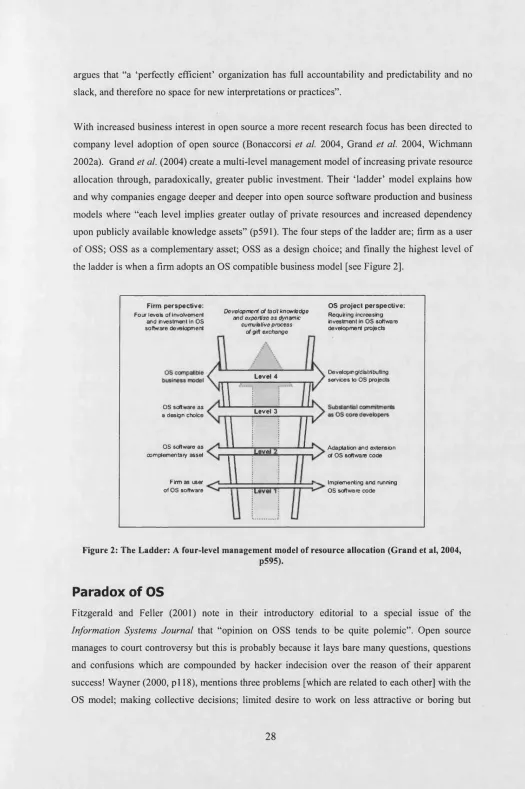
With increased business interest in open source a more recent research focus has been directed to company level adoption o f open source (Bonaccorsi et al. 2004, Grand et al. 2004, Wichmann 2002a). Grand et al. (2004) create a multi-level management model o f increasing private resource allocation through, paradoxically, greater public investment. Their ‘ladder’ model explains how and why companies engage deeper and deeper into open source software production and business models where “each level implies greater outlay o f private resources and increased dependency upon publicly available knowledge assets” (p591). The four steps o f the ladder are; firm as a user o f OSS; OSS as a complementary asset; OSS as a design choice; and finally the highest level of the ladder is when a firm adopts an OS compatible business model [see Figure 2].
Firm p ersp ective: Four levels of involvement
and investment in OS software development
OS project p ersp ectiv e: Requiring increasing investment in OS software development projects
Development of too'f knovriodgo and expertise as dynamic
cunyumtivo process of gift exchange
Develop ing'tiistdbuttng services to OS projects Level 4
OS software as
a design choice Level 3
OS software a s oompiementafv asset
Adaptation and extension of OS software code
Firm as user of OS software
Implementing and running OS software code
Figure 2: The Ladder: A four-level m anagem ent model o f resource allocation (G rand et al, 2004, p595).
Paradox of OS
Fitzgerald and Feller (2001) note in their introductory editorial to a special issue of the Information Systems Journal that “opinion on OSS tends to be quite polemic”. Open source manages to court controversy but this is probably because it lays bare many questions, questions and confusions which are compounded by hacker indecision over the reason o f their apparent success! Wayner (2000, p i 18), mentions three problems [which are related to each other] with the OS model; making collective decisions; limited desire to work on less attractive or boring but
[image:29.595.25.550.28.817.2]needed projects; and maintenance (documentation). He uses an example o f changing a lightbulb to describe the first, ““How many open source developers does it take to change a lightbulb?” The answer is: 17. Seventeen to argue about the license; 17 to argue about the brain-deadedness o f the lightbulb architecture; 17 to argue about a new model that encompasses all models o f illumination and makes it simple to replace candles, campfires, pilot lights, and skylights with the same easy- to-extend mechanism; 17 to speculate about the secretive industrial conspiracy that ensures that lightbulbs will bum out frequently; 1 to finally change the bulb; and 16 who decide that this solution is good enough for the time being”. This illustrates how hard it can be to convince OS developers to decide on the best approach and get to work. Collective decision making processes often suffer from such futility but is there something distinctive and unique about OS?
Other well-cited issues with OS development include the problem that OS developers are more than keen and capable o f producing innovative and exciting software, yet can hardly ever be made to work on a task that is dull, repetitive or not sexy; “fine-tuning a graphical interface, or making sure that the scheduling software used by executives is as bulletproof as possible” (Wayner 2000, p i 18). This draws into the next problem highlighted by Wayner (2000), that o f maintenance and the lack o f documentation which causes developers and users real anxiety. While this is a problem that besets software development in general it does pose some distinct challenges for open source, (e.g. given the primacy o f code).
Maintenance is a slightly different issue in open source if (ideally) the users are the developers and the maintainers too. Indeed it may be easier to explain maintenance as straightforward ‘more development’ if open source projects are kept alive by constant improvement and work. This can be viewed as lifelong maintenance or just development. Clearly the four classic types of maintenance, adaptive, corrective, perfective and preventive (Swanson 1976) all tie into the activities o f open source and are a part o f the open source development process. But as Rodriguez
et al (2004) point out, “maintainers must know what changes [they] should do to the software,
where to do those changes and how those changes can affect other modules of the system. Frequently they do not have enough knowledge to make the best decision and must consult other information sources, but these sources are often unknown or difficult to locate”. This is where they believe that version control software plays an important role.
departure from software engineering principles of production and distribution; and the question of so-called better quality software creation in open source. They examine the trend and analyze whether open source has the potential to apply to areas other than software development. They also question whether a name change from free to open source software will prove to be enough to make such software development attractive to businesses. The latter issue especially leads to the concept o f what Fitzgerald (2006) calls OSS 2.0. Fitzgerald explains that there is a strong trend and evolution o f FOSS towards a more commercially aware and viable hybrid. Indeed, the term open source was introduced in 1997 to create the potential for such business viability, but Fitzgerald provides a finely teased out distinction between FOSS and OSS 2.0 to explain the subtle transition. However, what is less obvious in this work is any comparison between OS and OSS 2.0.
Technology in Open Source
Relatively speaking, the literature on open source is less well developed in considering the technology and tools used. Often they are seen as being simple and obvious choices made on the basis o f needed functionality and posing few substantial issues. Still, open source developers not only create software technology but their process of development is heavily reliant on it for infrastructure, tools and communication e.g. Emacs, GVim, Netbeans, GNU Make etc (Bittman et al. 2001). Some face-to-face interaction does take place but the largest part o f communication is carried out via mailing lists, websites, email and chat group sessions. But, for example, mailing lists perform more than just a facilitation of communication role; when they are archived (e.g. the Linux kernel LKML studied here) they form a collective or organizational memory and can be “searched when someone needs to know whether something is known about a potential bug. In that way the mailing list archives provide a simple but effective form o f community memory” (Tuomi, 2002, p i 93).
In this section we consider in particular version control software (VCS) (Berliner 1990, Fogel 1999, Rochkind 1975, Tichy 1985, van der Hoek 2000), one of the most ubiquitous technical elements in wider OS activity, though, as we shall see in Chapter 6, problematic for Linux. Thus Feller and Fitzgerald (2002, p95) write that VCS [CVS] is the “most mission-critical OSS tool”.
Version control software is part of the basic eyeballing o f bugs and patches that is encouraged in open source and has been proposed as a ‘law’ by Raymond - Linus’s Law - “Given enough eyeballs, all bugs are shallow” (Raymond, 1999). The wider potential and role for VCS is well captured by Louridas (2006, p i 04) as allowing developers to “retrace and restore our
programming past, proceed along two or more development lines in a single project, and coordinate our work with the work o f others in the same project”.
Authors such as Spinellis (2005) and Atkins et al (2002) are emblematic of the tool like lens through which version control software is often understood - simply an unproblematic tool and no more. Robbins (2005) similarly describes various ‘tools’ used by open source collectives but again we have the very apolitical discussion about technology. He does however, provide a useful categorization o f tools consisting broadly o f seven areas; version control (e.g. CVS, Subversion); bug tracking and technical support (e.g. bugzilla, Scarab); technical discussions and rationale (e.g. Mailing lists, project websites); build systems (e.g. Gump, Automake); design and code generation (e.g. ArgoUML, Torque); quality assurance (e.g. Flawfinder); and collaborative development environments (e.g. Sourceforge). Louridas (2006) comes closest to approaching the political dimensions o f technology through his discussion of the issue o f vendor lock-in and how this is a particular concern when adopting version control for a project. He stresses the importance o f version history and how vendor lock-in can leave you bereft o f your past work if the repository is not in a portable format.
Tuomi (2002, p23) goes on to suggest that the drivers for innovation are “often found by looking for tensions and contradictions in existing social practice” and that “technology addresses a need when it releases or reduces some o f the tensions generated in this process”. However, this ignores that technology is often the reason and source o f contradiction and often innovation too. We develop this idea further in this research with a focus on the process o f version control software adoption.
Version Control Software
Software configuration management has been defined as the discipline o f controlling the evolution o f complex software systems. “Configuration management is the controlled way of leading and managing the development o f and changes to combined systems and products during their entire life cycle” (Asklund and Bendix 2002). Configuration management is used by both proprietary software developers and open source but is perhaps more central to the OS process (van der Hoek 2000).
here we describe it as software. This is a more appropriate term because our ANT stance seeks to give it equal status as an actor. The term tool relegates it to a simple artefact which has no agency or control.
UNIX has had a history o f using such tools from the start, the most popular have been RCS [Revision Control System] or SCCS [Source Code Control System] (Koike and Chu 1997a, Koike and Chu 1997b) but CVS [Concurrent Versions System] is the tool which has gained the most popularity in OS and it would now be hard to find an OS project which doesn’t draw on CVS or one of its derivatives (van der Hoek 2000). The UNIX community needed a tool to “manage software revision and release control in a multi-developer, multi-directory, multi-group
environment” (Berliner 1990). Add to this distributed development and one can see just how
integral coordination mechanisms are in geographically distributed development over and above collocated development (Herbsleb and Grinter 1999).
The earliest form o f version control software was the d iff and patch programs. The diff program on its own provided the changes that had been made to a file, or the difference, thus the name diff. Larry Wall then created the patch tool to ameliorate this problem and his work was later added to by Paul Eggert (MacKenzie et al. 2002). Developers now had both the diff and the original patch which enabled them to compare two or more patches line by line for changes. In order to be able to see the entire code a developer could add the diff to the patch and realize the most recent improvements. The diff and patch programs were followed by Marc Rochkind’s Source Code
Control System (SCCS) in 1972 developed at Bell Telephone Laboratories (Bolinger and Bronson
1995). SCCS was an improvement on the diff and patch method because it converted all changes into deltas which could then be strung up together to form the complete software (Rochkind, 1975). The diff and patch tool didn’t provide the flexibility o f being able to access various changes, one could compare two pieces o f code but each delta (patch) was not a separate file with a date stamp and other information.
Walter Tichy’s Revision Control System (RCS) in the early 1980’s was yet a further enhancement in version control software. It allowed for both forward and reverse deltas (both adding and removing changes). Its ‘lock-modify-unlock’ method authorized a developer to lock the tool thus disabling any other developer from making simultaneous changes, to make his changes, and then unlock the tool for others (Fogel, 1999). The locking ensured that no patch was overwritten by two or more developers adding their work at the same time. Improvements offered by RCS in the form o f reverse deltas, branching in versions, and ‘stamping’ o f revisions with unique markers for easy identification o f particular version (Tichy, 1991) were outweighed somewhat by the constraint of locking other developers out. Dick Grune o f Vrije Universiteit in Amsterdam created
patches to add to RCS which became the first form of Concurrent Versions System (CVS), “The initial commit of CVS under itself was on 1985/11/23 23:24:37. I posted the improved scripts to comp.sources.unix (and so implicitly to mod.sources) on June 23, 1986, by sending them to one "Rich" at [email protected]. Two years later Brian Berliner picked it up, turned it into C code, and the rest is history” (Grune, 2003).
Brian Berliner’s enhancements of CVS were created under the GPL so that the community could benefit from this tool (Berliner, 1990). CVS, according to Berliner was a “program...[that] fills a need in the UNIX community for a freely available tool to manage software revision and release control in a multi-developer, multi-directory, multi-group environment. This tool also addresses the increasing need for tracking third-party vendor source distributions while trying to maintain local modifications to earlier releases” (Berliner, 1990). Using an innovative copy-modify-merge model, CVS eradicated the need to lock developers out of the system. Instead, developers would make a personal copy of the program or file, modify and work on that, until they were ready to
j i w u u iu uy a n u m c ig c m e n i c a p c ^ u v t w iiaugc o n u ic acinic in c . vvncn uua
flag the ‘conflict’ and ask the second developer to resolve the issue by choosing aid be allowed. CVS was made “network-aware” in the 1990’s by Jim Kingdon, rs gained “networked access to sources, simultaneous development, and ted merging of changes” (Fogel, 1999).
happens CVS can which change sho so that develope intelligent automa
a number o f other version control programs written between CVS and the iding Arch, Subversion, ClearCase, PRCS7 but for the Linux kernel community it has made an impact. BitKeeper is owned by the company BitMover and was Larry McVoy8 in 1999, in an attempt to create software that would suit the rvalds and the Linux kernel in particular. What sets BitKeeper [BK] apart from version control programs mentioned above is that BK is a proprietary tool and available along with the product (for more detail on BK see Chapter 6).
There have been present time, inch it is BitKeeper th£ created mostly by needs o f Linus To most o f the other source code is not
)er o f advantages over CVS and other tools. It groups changes into changesets he developer to make single changes, and these changesets enable ‘automatic ;o that developers have an easy method o f backtracking to specific changes
2002). It also, somewhat like CVS, allows for a copy o f the master program to be made, called a clone in BK, and it has a push-pull method of control,. However the key attraction of BK is its auto-merging algorithm, though there is still the possibility to perform manual merges as well. A developer can perform two-way as well as three-way merges9 with BK. This tool also allows for metadata to be held along with the patches o f code. Metadata “is information about the data managed by the BitKeeper Software in a BitKeeper Package, such as the ChangeSet file; the messages which annotate modifications o f the data (also known as check in comments, ChangeLog entries, and/or log messages); and all files contained in the top level BitKeeper directory in a BitKeeper Package, in particular the BitKeeper/html directory and the BitKeeper/etc/config file” (Corbet 2002, BitKeeper License version 1.38, created on 28/03/02)10.
F ia tm Platforms
CVS
MS Windows •dientsi. Unix
Comparison of version control systems
Sabveision BitKeepe* S ourctS of* Perfw c*
MS Windows. MS Windows. MS Windows MS Windows. Unix Unix Unix
CtenrCnse
MS Windows, Unix
S y n trfy
MS Windows. Unix Atomic commits NO Yes Yes No Yes Yes Yes Rto'directory
moves renames
No Yes Yes With workaround Not directly Yes Yes
Rle'directory copies No Yes Yes Yes. to a point Yes Yes Yes Remote repository
replication No Yles. via tool Yes No Yes. via tool Yes via tool Yes Repository change
propagation No Yes. via tool Yes No Not Inown Yes via tool Yes Repository
permissions
Limited Yes Yes Limited Yes Yes No
Support for treatment of change sets as atomic
No Partial (no Individual cancellation yet)
Yes No Yes Yes via
branching Yes
Une-wise history tracking
Yes Yes Yes Nctdirecfy Yes Yes Via scripting
Work only on part of the repository
Yes Yes No Yes Yes Yes Yes in projects
User license cost tup to 20 users)
Free Free US$1,750 US$200 US$800 US$4,125 US$2,900
Tuomi does relate learning with creativity (innovation), “Quality control in innovative and continuously evolving projects is essentially about learning. Whereas the traditional models of learning in product development focused on decreasing errors in a given product design, in the case of Linux learning is also creative” (Tuomi, 2002, p i 93). However, he use