Mumbai- Elevated Rail Corridor
Ankit Arun Bhaip
1Nikhil Vaman Darekar
2Tanishque Velji Italia
3Khatri Mohd Shuaib M. Faroukh
4Pankaj Jadhav
51,2,3,4
Student
5Professor
1,2,3,4,5
Department of Civil Engineering
1,2,3,4,5
Shree L. R. Tiwari College of Engineering, Miraroad, India
Abstract— Mumbai has one of the most crowded and overloaded suburban systems in the world. The trains are over-crowded much beyond their rated carrying capacity with headway of around four minutes and are intensively utilized. Lateral expansion by way of laying additional tracks by the side of existing tracks in not feasible due to non-availability of required land strip for most length of the Corridor. Therefore the idea exploiting the airspace above the existing railway came into existence and hence the concept of ‘Elevated Rail Corridor’ was envisioned. This paper first studies the aspects of the difficulties faced by the commuters and then proposes the elevated rail corridor.
Key words: Elevated Railway Corridor, Mumbai Railway, Western Railway, Public Transport, Train Services, Railway Department
I. INTRODUCTION
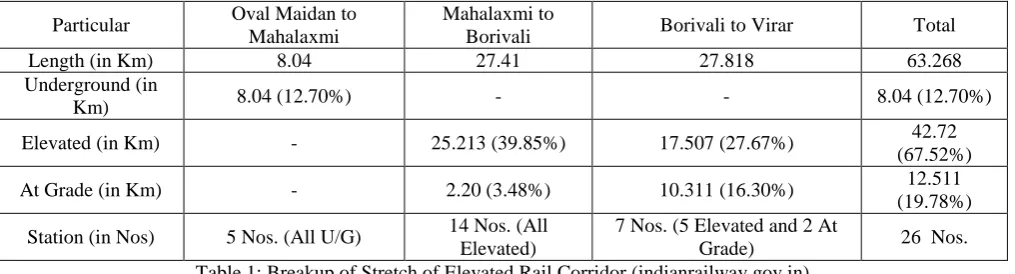
The Western Railway Elevated Corridor, also known as the Oval Maidan-Virar elevated corridor, is a proposed rapid transit corridor, running along the same alignment as the Western Line of the Mumbai Suburban Railway that will link Oval Maidan with Virar. Approximately, 42.72 km of the corridor was proposed to be elevated, 8.04 km would be underground and the remaining 12.52 km at grade. Railway officials announced on 29 September 2012 that a decision had been taken to alter the earlier alignment and go underground for an additional 8.5 km stretch between Bandra and Jogeshwari to avoid having to buy and remove over 100 buildings extant on the planned route. The above concept plan was proposed by the Western Railway, however the proposal was rejected after the feasibility survey since there was a conflict between the State Government and the Western Railway. The Churchgate-Virar elevated corridor was proposed to be built on a public-private-partnership model, for which it was necessary to allow the bidder to earn profit by exploring the commercial potential of land and airspace above the stations. This raised alarm bells as the state government feared it would become a real estate project instead of a transport project. However, since the proposed plan was rejected the following report consists of a concept based on this similar idea.
II. PROBLEMS FACED BY THE MUMBAI WESTERN RAILWAY COMMUTERS
The rapid growth of India’s urban population has put enormous strains on all transport systems. Burgeoning travel demand far exceeds the limited supply of transport infrastructure and services. Public transport, in particular, has been completely overwhelmed. Most bus and train services are overcrowded, undependable, slow, inconvenient, uncoordinated, and dangerous. Moreover, the public ownership and operation of most public transport services has
greatly reduced productivity and inflated costs. India’s cities desperately need improved and expanded public transport service. Unfortunately, meagre government financial assistance and the complete lack of any supportive policies, such as traffic priority for buses, place public transport in an almost impossible situation.
Mumbai is the financial and commercial capital of India. Mumbai wouldn’t have achieved this without the lifeline of the city – its local trains. For any large densely populated urban area, the local trains are essential for a speedy cross-over of a large population over long distances. Lakhs of people travel regularly and commute by local trains over varying distances ranging from 10 to 60 kilometer a day. The Mumbai local railway network branches out through three main lines – Central, Western and the Harbor, each connecting a distinct part of the city to another. It may be considered as one of the best example of strategic management in transport. Most commuters use this means of transport to reach the places of their job, profession, business and educational purposes. Most travelers commuting on a daily basis hold season passes that makes the local train travel even more cost-efficient. Public transport faces severe problems in almost all countries of the developing world, although the situation varies from one country to another, and even from one city to another (Vasconcellos, 2001). Perhaps most important, the lack of financial resources prevents necessary investments in maintaining and upgrading existing bus and rail systems and building new ones. Public transport systems in the Third World are plagued by chronic corruption and inefficiency, overcrowded and undependable service, congested roadways that slow down buses, and an operating environment that is often chaotic and completely uncoordinated.
Fig. 1: Figure Illustrates Share of Passengers Across the Transportation Facilities. (MCGM)
One might expect the much lower incomes in developing countries to assure a huge potential market of public transport riders. In fact, many city residents are so poor that they cannot afford even low fares, and routes are not designed to serve the poor at any rate. Thus, the poor in developing countries suffer even more than those in the Western World from low levels of mobility and accessibility, especially to jobs. In many respects, the situation in India is typical of other developing countries. The most important commonality is India’s low per-capita income only US $2,540 in 2002, less than a tenth of the average incomes of countries in North America and Western Europe (Central Intelligence Agency 2002). With 23 percent of its urban population living in poverty, India has been forced to keep its public transport fares extremely low. That has sharply restricted the operating revenues of all public transport systems, making it difficult to afford even routine maintenance and vehicle replacement, let alone system modernization and expansion. Poverty is not only a problem at the individual level, but also in the public sector, with cities and transport systems desperately lacking the necessary financial resources for investment in infrastructure, vehicles, new technologies, and fare subsidies. The financial problems stemming from India’s low per-capita income are probably the most important challenges facing Indian public transport, but there are many others as well: inefficiency, roadway congestion, traffic accidents, lack of planning, overcrowding, noise, and total lack of coordination of any kind.
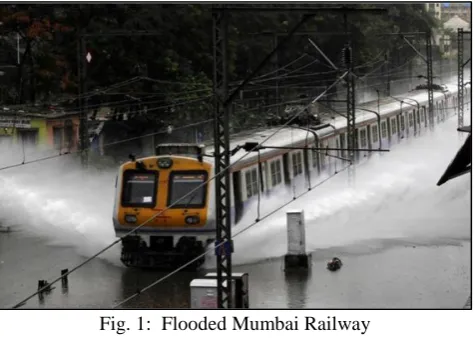
Fig. 1: Flooded Mumbai Railway
But the Mumbaikars, i.e. the people of Mumbai have to face a number of difficulties in their daily local train travel.
distance all the time standing in the compartment. At times they get into first, second or any compartment due to lack of space. As around 22 million passengers travel daily it becomes very difficult to get hold of ticketless travelers and the Indian railways and the government loses a big chunk of their income due to this. At the railway stations, sufficient number of ticket windows, wash rooms- particularly for the ladies travelers, sufficient eating and resting provisions are lacking and as a result of this, during the days of heavy rains, water logging, trains running late, mishaps, the commuters suffer a lot. Over-crowding, illegally crossing the railway tracks, and standing on the foot boards of the doors of the compartments, leads to a lot of accidents during the crowded hours. Occasionally the indicators on the platforms do not function and display the time table and it results in a lot of inconvenience to the commuters.
[image:2.595.310.547.379.544.2]There are reports of around 5-6 accident cases daily in Mumbai alone. While repairing and maintenance of the railway track, 20 mazdoors losses their life every year despite of honking. These accidents also lead to delay in departure and arrival timing of the train. There are several factors which are responsible for increasing number of railway accidents; some outstanding being overaged tracks, wagons, coaches, bridges and signaling system. According to the Khanna Railways Safety Review Committee Report, nearly 25 percent of the total railway track in India is overaged and is due for replacement.
Fig. 2: Heavy Congestion in Rail during Peak Hours The tracks suffer from fatigue and wear and tear in due course of time, and their replacement should be carried on side by side. In several derailments poor condition of tracks had been found responsible. The condition of tracks becomes more significant when one look at the other assets of the Railways.
[image:2.595.49.287.540.709.2]The great example of this kind of situation could be taken from 26th July 2005 when 1 meter of rainfall was measured in single day which equals to the amount of rain which should fall annually. On this day Mumbai railway saw its dark side due to lack and improper maintenance of drainage facilities the flood water reached up to the station formation level.
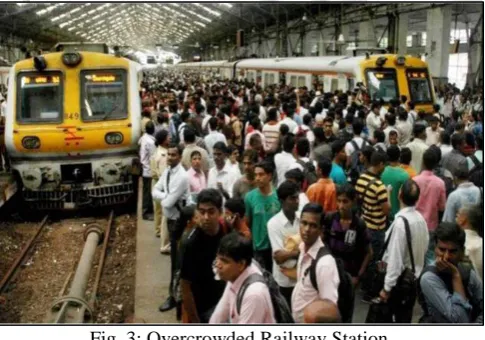
Fig. 4: Flooded Railway Tracks at the Station The main challenge faced by the commuters is to travel during rush hours i.e. around 9:30 in the morning, daily. Due to overcrowding in trains, commuters are forced to stand inside the train and on the foot rails of the doors as they have to reach their destination on time. In order to do so, many of them break the rules and regulations laid down by the Indian Railway, like travelling without a ticket, crossing the railway track without using the foot bridge or subways.
Fig. 3: Overcrowded Railway Station
The rapid growth of India's urban population as in other developing countries has generated an enormous need for efficient public transport services to carry high volumes of passengers through dense, congested urban areas.
[image:3.595.46.290.148.309.2]By 2001 over 285 million Indians lived in cities, more than in all North American cities combined (Office of the Registrar General of India 2001).There has been especially rapid growth of the very largest metropolitan areas such as Mumbai (Bombay), Kolkata (Calcutta), and Delhi, which now exceed 10 million residents each. Chennai (Madras), Hyderabad, Ahmedabad, and Bangalore each have more than 5 million residents.
[image:3.595.47.290.403.573.2]III. ELEVATED RAIL CORRIDOR
A. Oval Maidan-Virar elevated rail corridor project proposed by Western Railway
The 63 km long railway corridor project connecting Oval Maidan in Churchgate to Virar was announced in May 2008 with 24 stations across the stretch. Out of these, 13 stations were proposed to be elevated, 3 on ground level and 8 underground. Western Railways had proposed to make available around 76 acres of railway land to the developer of the project, for commercial exploitation. The railway corridor was to be developed through Public Private Partnership (PPP) on Design, Build, Finance, Operate and Transfer (DBFOT) basis.
The Churchgate-Virar Elevated rail project was one of the large infrastructure projects selected by the PMO’s office in July 2013 for allocation of implementation deadline. Request for Qualification (RFQ) for the Rs.225 billion project was issued on 7 August 2013. The applicants were asked to submit their applications by 20 September 2013. Selection of the applicants was scheduled for 4 October 2013 and the name of the successful bidder was to be announced on 31 December 2013. The concession agreement for the project was expected to be signed before the end of 2013-14.
Ministry of Railways (MOR) was concerned about the capacity constraint on the Corridor and is keen to take suitable measures to augment the system capacity as well as to provide improved services to the commuters.
Lateral expansion by way of laying additional tracks by the side of existing tracks in not feasible due to non-availability of required land strip for most length of the Corridor. MOR has therefore, envisioned a two track elevated Corridor with a capacity of 90,000 PHPDT along Churchgate-Virar section. It is expected that introduction of air-conditioned EMU services will help in addressing the twin issues of capacity constraints well as non-availability of high quality travelling comfort to the commuting public.
Ministry of railways plans to implement the project through private sector partnership on DBFOT basis. There are two existing corridors between Churchgate and
Borivali, one for slow local and other for fast suburban trains, where mainline long distance services are also run between Mumbai Central and Borivali, In addition 5th line (up and down) has been provided in Mumbai Central - Borivali section (except between Mahim and Santacruz) and is generally used for diversion of through trains during peak hours. 5th line between Mahimand Santacruz and 6th line between Mumbai Central to Borivali is under construction, to achieve segregation of suburban and non-suburban traffic. From Central Railway two lines (Harbour Corridor) enter from east side at Mahim and run parallel to Western Railway network upto Andheri, Further extension of Harbour lines upto Goregaon is in progress. Between Borivali-Virar, there were only two lines and two more have been added.
Power blocks during day time necessitating construction of new corridor with short duration traffic and power blocks.
Between Mumbai Central and Churchgate, the space is not available for construction of columns of elevated corridor. There are a number of private buildings between Charni Road and Grant Road right at the edge of railway boundary, necessitating alignment to be taken underground. Proposed corridor also needs to be extending beyond Churchgate, upto Nariman point/ Mantralaya.
On Mumbai Central Borivali stretch, restricted clearance is available between outermost line and railway boundary. 6th line work has also been taken in hand by MRVC. All this require special design and construction methodology to be adopted for the Elevated Corridor. Between Borivali and Virar, there are 4 lines and
adequate land is available inconsiderable length for two future lines. New corridor has to be proposed keeping provision for two future lines. Wherever land is available or can be acquired; at grade alignment is considered preferable. The Corridor passes across Vasai Creek necessitating bridge with special design, spans and headway clearance.
Due to existence of 81 Nos. of FOBs, and 25 ROBs, height of corridor deck has been kept generally more than 15 meter, depending upon floor height/ road level. There are 4 high EHV power transmission lines at Ch.
25770m, 32400m, 38470m and41590m having height of 20.66m, 18.40m, 18.70m and 18.2m above existing rail level respectively. Provision of elevated corridor will need raising / modification of these EHV lines. By keeping the proposed Corridor at grade between Dahisar and south of Bhayandar, raising of two Reliance EHV lines at Ch. 38470m and 41590m has been avoided. Due to height restrictions imposed by Airport authority
of India in Air funnel stretch, the Elevated Corridor has to be brought at grade for a length of 2.2 km between Santacruz and Vileparle - involving acquisition of private land and properties.
Crossing of Elevated Corridor over the existing corridors from east to west and vice versa due to space constraints has been necessitated, to avoid / minimize acquisition of land.
B. Proposed Corridor
Oval Maidan - Virar Elevated Corridor will have a length of 62.268 Km on Oval Maidan -Virar stretch of Mumbai passing
through Churchgate, Charni road, Mumbai
Central,Mahalaxmi, Lower Parel, Elphinston Road, Dadar, Matunga Road, Mahim Junction, Bandra, SantaCruz, Andheri, Jogeshwari, Goregaon, Malad, Kandivali, Borivali, Dahisar, Bhayandar,Naigaon, Vasai Road and Nalasopara.
Particular Oval Maidan to Mahalaxmi
Mahalaxmi to
Borivali Borivali to Virar Total
Length (in Km) 8.04 27.41 27.818 63.268
Underground (in
Km) 8.04 (12.70%) - - 8.04 (12.70%)
Elevated (in Km) - 25.213 (39.85%) 17.507 (27.67%) 42.72
(67.52%)
At Grade (in Km) - 2.20 (3.48%) 10.311 (16.30%) 12.511
(19.78%)
Station (in Nos) 5 Nos. (All U/G) 14 Nos. (All
Elevated)
7 Nos. (5 Elevated and 2 At
[image:5.595.46.554.67.204.2]Grade) 26 Nos.
Table 1: Breakup of Stretch of Elevated Rail Corridor (indianrailway.gov.in)
C. Modified proposal of the Elevated Rail Corridor (Andheri-Virar)
Since the Western Railway’s proposal is just on paper for past 2 years, it’s not viable to execute in near future due to its enormous nature, we came up with a modified proposal of the rail corridor irrespective of the design considerations. The salient features of the proposals are:
1) Route
Andheri-Virar Full elevated, acquiring space around and above the existing railway lines.
2) Length
38 kilometers rail length. 3) Stations
Andheri,Jogeshwari, Goregaon, Malad, Kandivali, Borivali, Dahisar, Mira Road, Bhayandar, Naigaon, Vasai Road, NalaSopara, Virar.
4) Type of Vehicle
A/C locals (First introduced on March 31st, 2016).
5) Revenue Collection
Fast food joints (providing a floor between the existing railway and new elevated railway stations.
Particular Andheri-Borivali
Borivali-Virar Total
Length
(in km) 12 26 38
Elevated
(in %) 32% 68%
(Full Elevated) Stations
[image:5.595.46.551.82.747.2](in Nos.) 6 7 13
Table 2: Breakup of Stretch of Modified Proposal of Elevated Railway Corridor
IV. CONCLUSION
On the basis of available data, it is quite clear that there is a need of elevated in corridor in Mumbai to solve many serious problems of day to day commuters who go to town side for their daily services of place of work for living. It seems that this is one of the most effective solutions that could be made to solve numerous flaws in the current Western Railway System.
REFERENCES
[1] A Course of Railway Engineering: Saxena, S. C. and Arora, S. P.; Dhanpat Rai Sons, New Delhi.
[2] Givoni and Rietvel (2014), “Do cities deserve more railway stations? The choice of a departure railway
station in a multiple-station region”, Journal of Transport Geography 36, 2014.
[3] Kang, Schneider et al., “Development of design and construction of high-speed railway bridges in Germany,” Engineering Structures, volume 163, 2018.
[4] Stevanovic K.V. and Stevanovic M.V. (2013), “New directions in the design of railways stations,” Gradevinar journal volume 8, September 2014.
[5] Woodcock and Martin, “Of Skyrails and Skytrains - Elevated rail in the Australasian urban transport environment,” Australasian Transport Research Forum, 2016 Proceedings.