PAPER • OPEN ACCESS
NFC-based Data Retrieval Device
To cite this article: Mohd Helmy Abd Wahab et al 2018 J. Phys.: Conf. Ser. 1019 012084
View the article online for updates and enhancements.
Related content
THE PC AS A SCIENTIFIC IMAGE PROCESSING WORKSTATION
George H. Jacoby and J. N. Heasley
-A survey on barcode RFID and NFC
P Thanapal, J Prabhu and Mridula Jakhar
-Wave packet retrieval by multi-photon quantum beat spectroscopy in helium
R Pazourek, M Reduzzi, P A Carpeggiani et al.
Content from this work may be used under the terms of theCreative Commons Attribution 3.0 licence. Any further distribution
NFC-based Data Retrieval Device
Mohd Helmy Abd Wahab1, Nur Farezan Mohamed Suhaimi1, Mohamad Farhan Mohamad Mohsin2, Aida Mustapha3, Noor Azah Samsudin3, Radzi Ambar1
1
Faculty of Electrical Engineering, Universiti Tun Hussein Onn Malaysia, 86400 Parit Raja, Batu Pahat, Johor, Malaysia
2
College of Arts and Sciences, Universiti Utara Malaysia, 06010 UUM Sintok, Kedah, Malaysia
3
Faculty of Computer Science and Information Technology, Universiti Tun Hussein Onn Malaysia, 86400 Parit Raja, Batu Pahat, Johor, Malaysia
E-mail: [email protected]
Abstract. This paper describes the design and development of data retrieval system using near field communication (NFC) protocol to read and transfer data from the device storage panel located at the recycle bin. In existing systems, data are manually collected from the storage device using the SD card and sent for upload to regional workstation of the data center, which is located at the central server. The device automatically establishes the NFC connection with the recycle bin panel and once the connection is established, data will automatically be transferred to the device and the current data storage in the recycle bin will be erased. Next, the collected data will be uploaded to the server through regional workstation.
1. Introduction
Wireless data transfer is the transmission of data between two or more points that are not connected by any network cable. The wireless system is also considered as the system for “world without borders” given the advanced technology in Information Technology (IT). Examples of wireless communication systems include radio frequencies, bluetooth device, infrared, and Wireless fidelity (Wi-Fi). Wireless technology is a critical factor in establishing the real potential of information-supported educational activities that occur anytime and almost anywhere [1].
In line with the current campaign by the Malaysian government to support green environment, wireless technology has also been applied in managing recyclable wastes through a reward and redemption system. Many efforts have been done pertaining waste management system, among which is the smart recycle bin [2]. The implementation of the recycle bin is based on reward points for any recyclable wastes thrown in the particular bin. At this stage, the prototype uses Radio-Frequency Identification (RFID) in managing the reward point system to encourage the community to support the campaign of green technology. The point is calculated based on the weight measured by the device panel and the information is stored into the panel itself as well as the RFID card for further usage. Information stored in the panels then need to be collected by the authorized agency to enable end user to check the accumulated points.
2
and requires knowledge in IT and many waste authority collectors are not technology literate people. Therefore, there is a need for a wireless data transfer device for data collection prior uploading to the web-based redemption system at the regional workstation. The aim of this project is to utilize the Near Field Communication (NFC) to read the data from the smart recycle bin by approaching the device to the recycle bin. In it hoped that data collection can be performed in parallel with waste collection time.
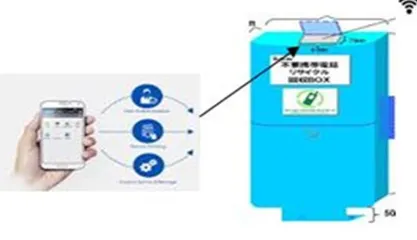
[image:3.595.193.402.274.394.2]According to work presented by [3], NFC is a short range radio frequency technology that exchanges data using a wireless system such as phone and sensor. This method could speed up the process of data collection and reduce missing data if it is being performed manually. It also reduces the hardware failure due to its minimum data interaction requirement. Figure 1 illustrates the Near Field Communication (NFC) system.
Figure 1. Near Field Communication
As illustrated in Figure 1, the NFC component will be attached to the existing device (e.g: smart recycle bin). At the moment, the smart recycle bin store information regarding user transactions and point information into the recycle bin system via the SD card as a storage. At this stage, data is being transferred manually operated by authorized people from the smart recycle bin to the data centre at the regional workstation. This often leads to missing data, failure of hardware, and high training cost to train the waste collector to handle the device. With NFC, data transfer will be easier to handle with very minimal human intervention. Since the device will be embedded with the program to automatically read the data and to establish the connection with the smart recycle, the data will automatically be transferred to the device once the connection is set and the current data storage in the recycle bin panel will automatically be erased. The collected information then will be uploaded to the web-based redemption system, which is located at the regional workstation.
The remainder of this paper is organized as follows. Section 2 presents reviews on related works on NFC-based data transfer. Section 3 presents the hardware design and embedded programming required for developing the NFC-based data transfer. Section 4 presents the evaluation results, and finally Section 5 concludes the research.
2. Related Work
presented by [6] has developed a new NFC and smart phone-based toll collection system. This system proposed a new billing system and payment method, which were based on NFC technology with the support of OBU multi-technology and the smartphone. With this system, the bill could just appear directly on the smart phone. NFC technologies are also used in the medical field for promoting efficient healthcare management. NFC has been used with the assistance of Android-based mobile phone to check whether a patient is given a correct prescription from the hospital [7]. Each medicine also has an NFC tag that acts as a monitoring tool by the doctor using his or her mobile phone.
[image:4.595.83.522.475.657.2]NFC and RFID are two closely related wireless communication technologies that are used globally for a vast number of applications such as access control, asset tracking and contactless payments. Table 1 shows the differences between RFID and NFC. NFC is now available in the majority of mobile phones and this is the most important difference between NFC and RFID.
Table 1. Comparison between NFC and RFID
NFC RFID
Operating Frequency 13.56Mhz 13.56Mhz
Communication Two-way One-way
Standards ISO 14443 ISO 14443, 15693, 18000
Scan Distance Up to 10cm Up to 1m
Scan tag simultaneously No Yes
At present, there are many technologies that have been used in wireless data transfer. The use of technology in wireless data transfer is tabulated in Table 2.
Table 2. Previous Research Technology on Data Transfer
System/Technology Description Year
Android smartphone (Blue-tooth, NFC) [9]
A system that communicated via bluetooth from a smart phone for data collection and sent it simultaneously to the central server for data storage.
2012
Arduino Microcontroller, Wifi Transceiver [10]
Sending data by using UDP (User datagram protocol)
2013
Arduino: using SPI to URT chip on Wifily Board Arduino controller, xbee
mod-ule [12]
The monitoring system for an AGV that needed to read the data to understand the operational status and travelling routes of the vehicles as well as providing the fault alarm and current status of the materials.
2012
4
communication and the ability to communicate without a direct line of sight. NFC is capable of two way communication and can therefore be used for more complex interactions such as card emulation and peer-to-peer (P2P) sharing. However, NFC is limited to communication at close proximity, typically 5cm or less. Only a single NFC tag can be scanned at one time [8].
3. Materials and Methods
This paper proposed for the use of NFC to capture information stored on a tag attached to the Smart Recycle Bin [2]. The device automatically establishes the NFC connection with the recycle bin panel and once the connection is established, data will automatically be transferred to the device and the current data storage in the recycle bin will be erased. Next, the collected data will be uploaded to the server through regional workstation. In order to achieve the objective, two core important components are the hardware design as well as the embedded programs.
[image:5.595.184.406.371.443.2]3.1. Hardware Design
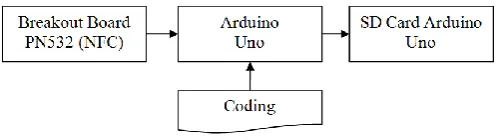
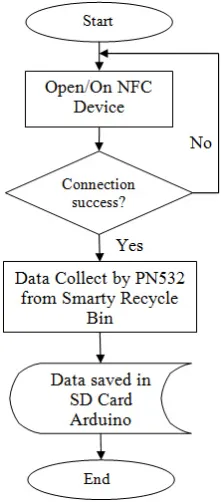
Figure 2 depicts the block diagram of data transfer from the Smart Recycle Bin to the regional workstation using NFC technology. Data retrieval device using NFC is graphically represented in Figure 3, where the device is an integrated of Breakout board PN532 and Arduino Uno. Meanwhile, the overall system flow is shown in Figure 4.
[image:5.595.173.422.504.574.2]Figure 2. Block Diagram of Data Transfer
Figure 3. Block Diagram of Data Retrieval System
Figure 5 (left) shows the Arduino Uno, which is a type of kit used as the device. It is a platform with an open-source electronic prototyping that is flexible and easy to use on software and hardware components [12]. The language supported by this microcontroller is the Arduino programming language, which is a high level C language that is easier to understand and write as compared to other assembly programming languages.
Figure 4. Overall System Flow
Figure 5. Arduino Uno Controller (left) and Breakout Board PN532 (right)
The PN532 supported four different operating modes, which were Reader/Writer mode supporting ISO 14443A, ISO 14443B in Reader/Writer mode only, Card interface mode supporting ISO 14443A and NFCIP-1 mode. The white paper on PN532 is available at
http://www.nxp.com/documents/short_data_sheet/PN532_C1_SDS.pdf.
3.2. Embedded Programs
The device was programmed using the C programming language for embedded system. Several libraries needed to be correctly configured such as the following.
[image:6.595.91.512.406.543.2]6
[image:7.595.170.419.186.317.2]• Arduino IDE: Arduino IDE (Figure 6) is an easy-to-use development kit for beginners, yet flexible enough for advanced users. It runs on multi-platform such as Mac, Windows, and Linux. In this project, Arduino IDE was used to code the data collected with Breakout board PN532.
Figure 6. Arduino IDE
4. Results
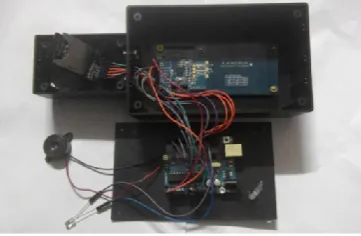
The testing results on the use of NFC-based data retrieval device for the Smart Recycle Bin is shown in Figure 7. Two types of analysis were carried out to evaluate the performance of the prototype from the perspective of the hardware design.
4.1. Device sensitivity analysis
[image:7.595.208.389.477.595.2]In this analysis, sensitivity analysis was done in three different angles as shown in Figure 7. This was to indicate that whether the device could be detected on each angle or vice versa.
Figure 7. Prototype of the Data Retieval Device
Table 3 indicates that the device sensitivity detection had been done based on the angle as illustrated in Figure 8. From the figure, note that angles D and E were more sensitive than angles A and C, and angle B was indicated as not sensitive at all.
4.2. Sensitivity based on Distance
Figure 8. Data Retrieval Device (prototype) with Angle Labeled
Table 3. Sensitivity Analysis Angle Sensitivity
A Less Sensitive
B Not Sensitive
[image:8.595.159.432.406.695.2]C Less Sensitive D/E More Sensitive
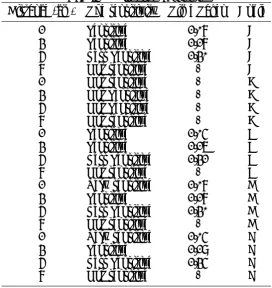
Table 4. Distance Sensitivity
Distance (cm) The sensitivity Time Taken Angle
2 Sensitive 2.08 A
4 Sensitive 2.28 A
6 Less Sensitive 2.40 A
8 Not sensitive - A
2 Not sensitive - B
4 Not Sensitive - B
6 Not Sensitive - B
8 Not sensitive - B
2 Sensitive 2.05 C
4 Sensitive 2.27 C
6 Less Sensitive 2.42 C
8 Not sensitive - C
2 Very sensitive 2.08 D
4 Sensitive 2.28 D
6 Less Sensitive 2.40 D
8 Not sensitive - D
2 Very sensitive 2.05 E
4 Sensitive 2.29 E
6 Less Sensitive 2.45 E
8 Not sensitive - E
5. Conclusions
8
consisted of the use of PN532 and the software used in this project was Arduino IDE. The device was developed to overcome the problems of the current existing system which is manually done to handle the data for the smart recycle bin. By applying the device, the smart recycle bin would require minimum human operation which could reduce the possibility of recycle bin panel malfunction.
Acknowledgments
This project is sponsored by Universiti Tun Hussein Onn Malaysia and partially supported by Research Gates IT Solution Sdn. Bhd.
References
[1] Mathews, JB 2015 Why are Wireless services Important to State and Education Leaders? Atlanta: Southern Regional Education Board
[2] Wahab MHA., Tomari MR, Kadir AA, Jabbar MH 2014 Smart Recycle Bin a Conceptual Approach of Smart Waste Management with Integrated Web Based System. In Proceeding of International Conference on it Convergence and Security 2014. October, 28-30 2014, Beijing, China
[3] Dudwadkar A, Gore A, Nachnani T, Sabhnani H 2013 Near Field Communication in Mobile Phone. International Journal of Engineering and Advanced Technology,131 309–313
[4] Ahson SA, Ilyas M 2012Near Field Communication Handbook. USA: CRC Press
[5] Gopichand G, Chaitanya TK, Kumar RR 2013 Near Field Communication and Its Application in Various Fields.International Journal of Engineering Trends and Technology,44 1305–1309
[6] Dias J, Matos, NJ, Oliveira, ASR 2014 The charge Collector System (A new NFC and smartphone-based Toll Collection Sytem).Procedia Technology, Volume17
[7] Sethia D, Gupta D, Mittal T, Arora U, Saran H 2014 NFC Based Secure Mobile Healthcare System. In Proceedings of the Sixth International Conference on Communication Systems and Networks (COMSNETS). 6-10 Jan 2014, Bangolore, India. pp.1–6
[8] Wan R 2006 Introduction to RFID Technology.IEEE Pervasive Computing, Jan-March 2006, pp. 25–33 [9] Yi WJ, Jia W, Saniie J 2012 Mobile Sensor Data Collector using Android Smartphone. InProceedings of 2012
IEEE 55th International Midwest Symposium on Circuits and Systems (MWSCAS), 5-8 Aug. 2012, Idaho, USA. pp.956–959
[10] Torresen J, Hafting Y, Nymoen K 2013 A New Wi-Fi based Platform for Wireless Sensor Data Collection. In Proceedings of International Conference on New Interfaces for Musical Expression 2013, 27 -30 May 2013, Seoul, Korea, pp.337–340
[11] Ghrairi Z, Hribernik KA, Hans C 2012 Intelligent Wireless Communication devices for Efficient data Transfer and Machine control. InInternational Conference on Communication, Computing and Control Application (CCCA), 6-8 Dec 2012. University of Bremen, Germany
[12] Murphy TE 2012Introduction to Arduino Microcontrolle. Hands-on Research in Complex Systems. 1729 June 2012. Jiaotong University, Shanghai, China