International Journal of Emerging Technology and Advanced Engineering
Website: www.ijetae.com (ISSN 2250-2459,ISO 9001:2008 Certified Journal, Volume 2, Issue 12, December 2012)
64
Evaluation And Implementation Of The Open Shortest Path
First (OSPF) Routing Protocol
G.C NWALOZIE
1, V.N OKOROGU
2, A.C OKAFOR
3, A.O UMEH
41, 2, 3,4
Electronic and Computer Engineering Department, Nnamdi Azikiwe University, Awka.
Abstract-- The Open-Shortest Path First (OSPF) protocol, due to its enviable properties is at the top of the pecking order of routing-protocol solutions as a result of the fact that it provides a better pick of priorities in calculations of its link (bandwidth and delay), better scalability than rival protocols and a reasonable convergence time (which is critical when assessing protocols by merit). This research is aimed at advocating for a particular solution in the midst of other known solutions (protocols), by proving literally and by practical-oriented means why the chosen solution should be embraced and also shedding light on the vital properties of the chosen solution (protocol) and how it could be used with the help of OPNET IT GURU to optimize a Data Network.
Keyword-- Internet Protocol, Routing, Routing protocol and Algorithms
I. INTRODUCTION
The first internet protocol (IP) networks were used for military or research applications. Mostly static routes were used and routing protocols were based on distance vector algorithms, such as Routing Information Protocol (RIP). There was little concern for IP address depletion or IP address summarization. There was no hierarchy in the routing protocol. Reliability of the physical layer was not hidden and its flapping disrupted in the network. Applications were text-based and not delay-sensitive and a single autonomous domain managed the network [1, 2].
The IP networks of today carry mostly commercial traffic. Multimedia applications used today are very delay-sensitive and hence, routing protocols must provide stability, and security, and converge quickly. Today, the Internet is divided into many autonomous systems or domains. Each domain uses its own internal routing protocol. The IP routing protocols in each domain must be carefully designed in order to build a stable and scalable network. Physical instabilities and IP address planning and summarization both inside and between autonomous domains must be taken into account.
As an OSI Network Layer protocol, IP has the responsibility to route packets. It performs this function by looking up a packet's destination IP Network ID in a routing table and forwarding based on the information in the table. But it is routing protocols, and not IP, that populate the routing tables with routing information.
There are three routing protocols commonly associated with IP and the Internet, namely, RIP, OSPF, and BGP [1, 2]. OSPF and RIP are primarily used to provide routing within a particular domain, such as within a corporate network or within an ISP's network. Since the routing is inside of the domain, these protocols are generically referred to as interior gateways protocols.
The Routing Information Protocol version 2 (RIP-2), described in RFC 2453, describes how routers will exchange routing table information using a distance-vector algorithm. With RIP, neighbouring routers periodically exchange their entire routing tables. RIP uses hop count as the metric of a path's cost, and a path is limited to 16 hops. Unfortunately, RIP has become increasingly inefficient on the Internet as the network continues its fast rate of growth. The Open Shortest Path First (OSPF) protocol is a link state routing algorithm that is more robust than RIP, converges faster, requires less network bandwidth, and is better able to scale to larger networks [3]. With OSPF, a router broadcasts only changes in its links' status rather than entire routing tables. OSPF Version 2, described in RFC 1583, is rapidly replacing RIP in the Internet.
Fort and Thorup [4, 5] used weight of the link. Traffic is routed along shortest paths to the destination. The authors described the heuristic for the no-failure case can be adapted to take into account failure scenarios. Their objective is to optimize network parameters with respect to a robustness objective function that requires the evaluation of all possible link failure scenarios.
C.C. Gallacio [6] analysed the optimization of Wide Area Network (WAN) .His main goal is to increase network application performance by decreasing the response time. WAN optimization is about saving time, not bandwidth (although this is a side-effect). WAN optimization can be configured in a non-intrusive manner, allowing your organizations‟ existing QoS and firewall policies to remain in place (no major changes required).
International Journal of Emerging Technology and Advanced Engineering
Website: www.ijetae.com (ISSN 2250-2459,ISO 9001:2008 Certified Journal, Volume 2, Issue 12, December 2012)
65
They found that convergence times in inter-domain routing are on the order of minutes, and that end-to-end loss and latency increase significantly during convergence.This work, analyzes the logical description in dissemination of packets in a network, its implementation (virtually on a router) and its mathematical workability all aimed at improving routing in networks by avoiding routing loops of all kinds in these networks.
II. THE NEED FOR ROUTING PROTOCOLS
[image:2.612.75.280.374.489.2]Routes can change very quickly. Problems with cables and hardware failures can make destinations unreachable through the designated interface. Routers need a way to quickly update routes that does not depend on the administrator to make changes. Routers use routing protocols to dynamically manage information received from their own interfaces and from other routers. Routing protocols can also be configured to manage manually entered routes [3] [7].
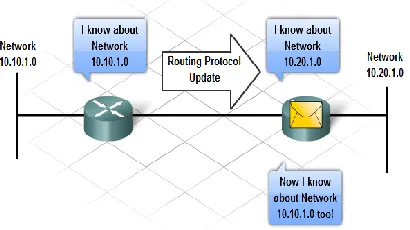
Fig 1 How routing tables of routers are been updated by a routing protocol
Fig 1 shows two routers, lets says router A and router B connected to two different networks with different IP address, 10.10.1.0 and 10.20.1.0 respectively. Router A uses routing protocol to informs router B that it is connected to a Network 10.10.1.0 while Router B tells Router of Network 10.20.1.0. They do this by updating their respective routing tables.
Dynamic routing protocols are usually used in larger networks to ease the administrative and operational overhead of using only static routes. Dynamic routing makes it possible to avoid the time-consuming and exacting process of configuring static routes. Dynamic routing enables routers to react to changes in the networks and to adjust their routing tables accordingly, without the intervention of the network administrator.
A dynamic routing protocol learns all available routes, places the best routes into the routing table, and removes routes when they are no longer valid. The method that a routing protocol uses to determine the best route to a destination network is called a routing algorithm.
There are two main classes of routing algorithms; distance vector and link state. Each type uses a different method for determining the best route to a destination network.
The routing algorithm is very important to dynamic routing. Whenever the topology of a network changes because of reconfiguration or failure, the routing tables in all the routers must also change to reflect an accurate view of the new topology. When all the routers in a network have updated their tables to reflect the new route, the routers are said to have converged. In order for two routers to exchange routes, they must be using the same routing protocol and therefore the same routing algorithm.
III. AN OVERVIEW OF OPEN SHORTEST PATH FIRST
(OSPF)
Open Shortest Path First (OSPF) is a link-state routing protocol that was developed as a replacement for the distance vector routing protocol RIP. RIP was an acceptable routing protocol in the early days of networking and the Internet, but its reliance on hop count as the only measure for choosing the best route quickly became unacceptable in larger networks that needed a more robust routing solution. OSPF is a classless routing protocol that uses the concept of areas for scalability. RFC 2328 defines the OSPF metric as an arbitrary value called cost. The Cisco IOS uses bandwidth as the OSPF cost metric. OSPF's major advantages over RIP are its fast convergence, its scalability to much larger network implementations and its ability to choose the past with the lowest route cost [5] [10].
Electing A DR and BDR
International Journal of Emerging Technology and Advanced Engineering
Website: www.ijetae.com (ISSN 2250-2459,ISO 9001:2008 Certified Journal, Volume 2, Issue 12, December 2012)
[image:3.612.329.556.138.399.2]66
Fig 2 shows how the hello protocol is sent between three routersOspf Link-State Updates
Link-state updates (LSUs) are the packets used for OSPF routing updates. An LSU packet can contain 11 different types of Link-State Advertisements (LSAs), as shown in the figure. The difference between the terms Link-State Update (LSU) and Link-State Advertisement (LSA) can sometimes be confusing. At times, these terms are used interchangeably. An LSU contains one or more LSAs and either term can be used to refer to link-state information propagated by OSPF routers [7] [11].
OSPF Algorithm
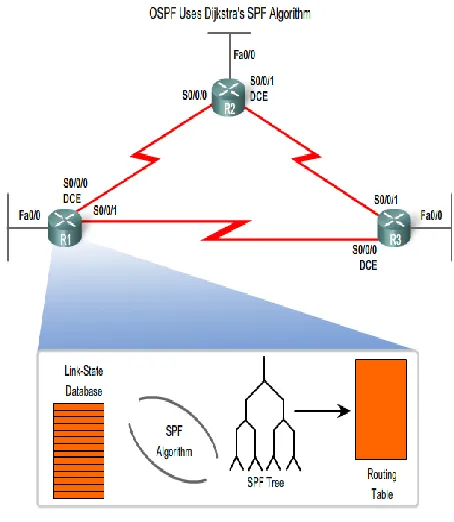
Each OSPF router maintains a link-state database containing the LSAs received from all other routers. Once a router has received all of LSAs and built its local link-state database, OSPF uses Dijkstra's shortest path first (SPF) algorithm to create an SPF tree. The SPF tree is then used to populate the IP routing table with the best paths to each network [3] [12].
Fig 3. Dijkstra's Shortest Path First (SPF) Algorithm
IV. SIMULATION IMPLEMENTATION AND EVALUATION
[image:3.612.58.284.158.332.2]International Journal of Emerging Technology and Advanced Engineering
Website: www.ijetae.com (ISSN 2250-2459,ISO 9001:2008 Certified Journal, Volume 2, Issue 12, December 2012)
67
Description of the actual configuration of the network is described using the OPNET IT GURU 9.1 simulator, which creates a virtual scenario of the modelled network. The mathematical viability of the action of the preferred protocol is tested by simulations on the MATLAB simulator and the results presented and analyzed.Using Opnet in Simulating the Performance a Data Network
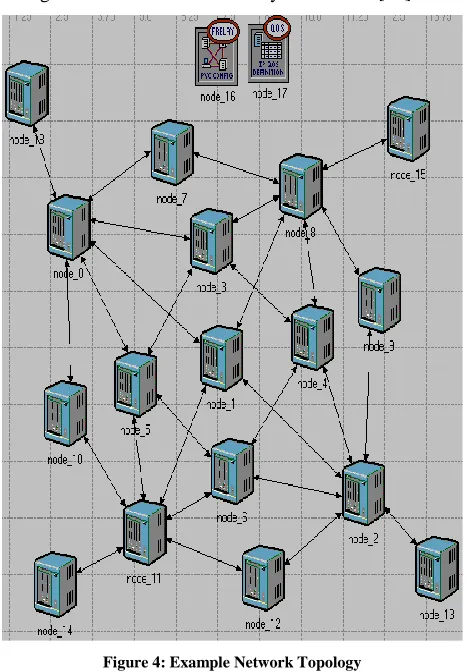
[image:4.612.316.569.307.714.2]A sample data network is given below that was configured in the OPNET IT GURU. The metrics used in this analysis are throughput, delay and IP traffic dropped of the data network designed below. In this module we present our simulation results for an example network topology illustrated in Figure 4. This period value was adopted by the fact that the OSPF module verifies its routing table for recalculation every 60 seconds [12]
Figure 4: Example Network Topology
Three different traffic loads were analyzed. This implies six different simulation scenarios (varying the traffic load and the routing strategy chosen).
The traffic loads correspond to packets transmitted from node_0 to node_13 (since time 250 sec until time 20 minutes, with mean
inter-packets transmitted from node_11 to node_15 (since time 180 sec until time 20 minutes, with mean inter-arrival time
according to Tables 1, 2 and 3.
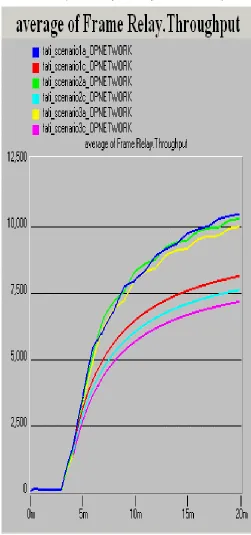
The scenarios 1a, 2a and 3a correspond to the simulations under the adaptive routing strategy (OSPF) while the scenarios 1c, 2c and 3c correspond to the simulations under the conventional routing strategy (RIP) submitted to the packet mean sizes defined in Tables 1, 2 and 3 respectively.
Table i
Packet Mean Sizes – Small traffic Condition (1)
Source Router
Packet Mean
Size(bytes)
Destination Router
node_0 100 node_13
node_11 120 node_15
Table ii
Packet Mean Sizes –Medium Traffic Condition (2)
Source Router Packet Mean Size (bytes)
Destination Router
node_0 180 node_13
node_11 220 node_15
Table iii
Packet Mean Sizes – Large Traffic Condition (3)
Source Router
Packet Mean Size(bytes)
Destination Router
node_0 300 node_13
[image:4.612.52.287.327.663.2]International Journal of Emerging Technology and Advanced Engineering
Website: www.ijetae.com (ISSN 2250-2459,ISO 9001:2008 Certified Journal, Volume 2, Issue 12, December 2012)
68
Table 1 shows a low traffic network condition, while Table ii shows a medium traffic network condition and Table iii shows a high traffic network condition.Performance Enhancement Using
Temporary Ordered Routing Algorithm (TORA) is a distributed routing protocol based on „‟link reversal‟‟ algorithm that finds and maintains routes via local relaxation of link direction. It is designed to discover routes on demand, provide multiple routes to a destination, establish routes quickly, and minimize communication overhead by localizing algorithmic reaction to topology changes when possible. Route optimality (shortest-path routing) is considered of primary importance. TORA is used to further validate the assessments done on MATLAB.
V. SIMULATION RESULTS
Figures 5, 6 and 7 show the results for the six scenarios above described. In terms of network throughput (Fig 5), we can evaluate the network traffic distribution through the network. Routing strategies that better distribute traffic through the network offer higher network throughput. More specifically for the scenarios above described, Figure 5 shows better network throughput achieved by using the adaptive strategy; that is, Scenarios 1a, 2a and 3a (the adaptive routing) present better throughput than scenarios 1c, 2c and 3c (the conventional routing) respectively. These results can be explained by the fact that the adaptive routing strategy is able to select best routes that change (or oscillate) occasioning in better link utilizations and therefore, better average throughput.
[image:5.612.324.575.129.664.2]International Journal of Emerging Technology and Advanced Engineering
Website: www.ijetae.com (ISSN 2250-2459,ISO 9001:2008 Certified Journal, Volume 2, Issue 12, December 2012)
[image:6.612.54.284.132.432.2]69
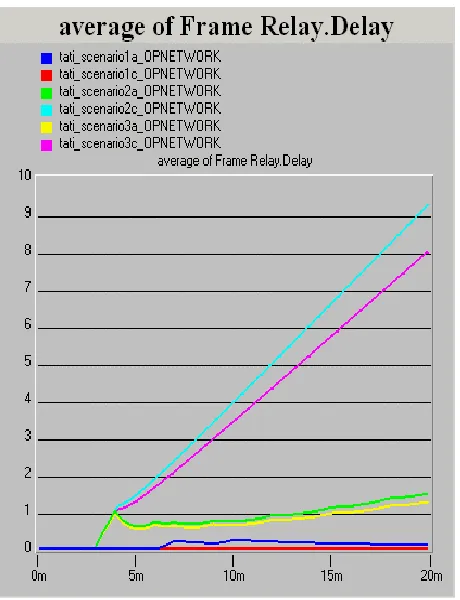
Fig 6 Network Delay (sec) in function of timeIn terms of network delay (Figure 6), we can evaluate the overload introduced by the adaptive routing updating messages. Updating messages fill buffers and could lead to greater delay if sent without restrictions. Results of network delay help the evaluation of these restrictions and of the adaptive approach efficiency.
In particularly, we found that the adaptive routing strategy in scenarios 2a and 3a presented smaller transfer delays than scenarios 2c and 3c respectively. On the other hand, for the scenario 1a the adaptive routing strategy causes larger transfer delay than scenario 1c. These results can be explained by the fact that choosing the best routes according to the link conditions take advantage of forwarding packets through less loaded paths and therefore suffer less transmission delay measurements (like scenarios 2a and 3a). In addition, we found that adaptive strategies are better choices for networks under heavy input traffic loads. Under low input traffic loads the overhead introduced by the updating messages may increase the delay (like scenario 1a).
Intuitively the updating messages introduced by adaptive routing may increase the traffic drop rate. In Figure 7, we can observe that for scenario 1a the traffic drop rate was so much greater than scenario 1c.
[image:6.612.324.567.304.710.2]And considering the results of network delay presented for these two scenarios (1a and 1c), we can conclude that the adaptive routing wasn‟t a good idea in this case. On the other hand, analyzing the results of scenarios 2a, 2c, 3a and 3c, we can observe that the traffic drop rates didn‟t present so much different when comparing the adaptive and the conventional routing approaches. Mostly important, scenarios 2a and 3a presented good increase in network throughput and decrease in network delay when compared with scenarios 2c and 3c respectively. Finally, network performance results are useful to understand the updating messages overloads and to evaluate the efficiency of an adaptive routing strategy for a particular network topology submitted to a network traffic range.
International Journal of Emerging Technology and Advanced Engineering
Website: www.ijetae.com (ISSN 2250-2459,ISO 9001:2008 Certified Journal, Volume 2, Issue 12, December 2012)
70
Analysis of TORA Results
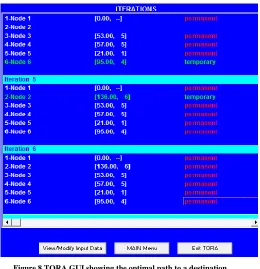
[image:7.612.48.308.210.479.2]As previously stated, TORA [10] is used to determine the most efficient (shortest-path) route to a particular destination, hence optimality is the keyword here. The most efficient routes are calculated using node 1 as our reference.
Figure 8 TORA GUI showing the optimal path to a destination network
The calculation of the most optimal routes begin at iteration 1 and is stretched to iteration 6 when the best path to every network has been calculated and the nodes established as permanent. In generating the most optimal route to a destination, all routes are initially considered as temporary, and when the most trusted route to the destination is detected, it is declared as a permanent route, while others remain temporary.
It is important to note that in the case of any node going down, each router recalculates its OSPF tree, which is its routing map to every destination on the network.
VI. CONCLUSION
The entire work on this research has been on the performance evaluation, and the implementation of the Open Shortest Path First (OSPF) Routing Protocol for data network. Some deductions have been made about the conventional routing protocol (RIP) and its optimized model. This research area is still very open to all interested researchers because of the continuous increase in the size of the internet and there will always be a need for a routing protocol that will route packets faster and more reliably. This research has shown that OSPF can be used to optimise the performance metrics (like throughput, delay and IP traffic dropped) of a data network due to its use of Djisktra Algorithm to find the smallest route cost (shortest path) to a destination network.
REFERENCES
[1 ] Todd Lammle, 2000 “Cisco Certified Network Associate Study
Guide, Second Edition”. .
[2 ] W. Ben-Ameur, N. Michel, E. Gourdin, and B. Liau. 2001
Routing strategies for IP networks. T elektronikk, 2/3:145–158.
[3 ] B. Fortz and M. Thorup. 2000 Increasing internet capacity using
local search. Technical Report IS-MG 2000/21, Universit´e Libre de Bruxelle.
[4 ] B. Fortz and M. Thorup. 2000. Internet traffic engineering by SPF
weights. In Proc. 19th IEEE Conf. on cations (INFOCOM),
pages 519–528.
[5 ] B. Fortz and M. Thorup. 2002 Optimizing OSPF/IS-IS weights in
a changing world. IEEE Journal on Selected Areas in
Communications, 20(4):756–767.
[6 ] C.C. Gallaci, 2005: WAN Optimization. Addison-Wesley.
[7 ] C. Labovitz, A. Ahuja, A. Bose, and F. Jahanian, 2000 Delayed
Internet Routing Convergence. InProc. ACM SIGCOMM, pages
175–187,Sweden,
[8 ] D. Awduche, A. Chiu, A. Elwalid, I. Widjaja, and X. Xiaro. 2000.
A framework for internet traffic engineering. Network Working
Group, Internet Draft .
[9 ] M. Pioro, A. Szentesi, J. Harmatos, A. Juttner, P. Gajowniczek,
and S. Kozdrowski, 2000 .On OSPF related network
optimisation problems, in Proc. IFIP ATM IP.
[10 ]R. Callon. 2000 Use of OSI IS-IS for routing in TCP/IP and dual
environments. NetworkWorking Group, Request for
Comments: 1195.
[11 ]M.A. Rodrigues and K.G. Ramakrishnan.1994 Optimal routing
in data networks,. Presentation at International
Telecommunications Symposium (ITS), Rio de Genero, Brazil
[12 ]OSPF Optimized Multipath (OSPF- OMP) IETF Internet Draft