Journal of Chemical and Pharmaceutical Research, 2016, 8(4):436-443
Research Article
CODEN(USA) : JCPRC5
ISSN : 0975-7384
Implementation of Food Quality Tracking System Based on Internet
of Things
Feng Tianzhong
China Department of Economics and Management, Dezhou University, No.566, Daxue Road, 253000, Dezhou, China
_____________________________________________________________________________________________
ABSTRACT
Food quality tracking system based on Internet of things is an integrated monitoring and management information system, which consists of intelligent database technology, radio frequency identification technology, food safety technology, multimedia and network technology, wired and wireless network technology, as well as other practical high-tech techniques. The system is an organic combination of food safety detection, full track on qualities of agricultural products, network-based integration and management information platform, with crossover technology fields and practical research results. Considering small amounts of data transfer in the agricultural system and relatively less real-time requirements, the system uses GSM /GPRS public wireless network for remote data transfer. The combination of internet of things technology, GSM / GPRS public wireless network technology and Internet significantly reduces the cost of the system, with leading limitless scope of tracking recognition, which enhances the comprehensive performance of the system greatly.
Key words: Internet of things; Food safety; Quality tracing
_____________________________________________________________________________________________
INTRODUCTION
In recent years, food safety incidents have occurred frequently, such as mad cow disease, avian influenza, foot-and-mouth disease, swine hammer infectious diseases and food poisoning, which have not only led to huge economic losses on a global scale, but also seriously endangered people’s health across the world. Thus, food safety management and traceability becomes particularly important. Since the existing methods can’t very well solve the problem of food traceability and evaluation, most people have to make choice by themselves, for most of the agricultural products, especially meat, milk, seafood, fruit, and so on involve the interests of the multitude. It is an important subject that presses for finding an effective method of tracking, management, tracing and evaluating to ensure food safety.
In the current food industry, there are three steps between food production and final consumption, including processing, transportation and stocking. If problems occur at any point in food-handling sequences, it is possible to expose food in the state of insecurity, such as accessing to the source improperly that causes food spoilage. Excellent food safety system can provide seller with advice of delivery order and consumers with food quality and safety report, and manufacturers with market analysis report, etc. Radio Frequency Identification technology based on internet of things provides an effective technology to solve this problem, which can be used to achieve food safety management, tracing and evaluating.
requirements for environment, long service life, encrypting information stored in the data, etc. Its application will bring fundamental change to food safety tracing management[1].
According to the characteristics of the internet of things technology, this paper puts forward the food safety traceability system based on internet of things technology. Starting from varieties breeding to production processing, it labels records with an electronic tag, including all the information in the process of circulation: transportation, packaging, repackaging, and marketing. The information on food supply chain can be automatically obtained and target object are identified easily with data reading and writing at any time and places in the process of circulation, which helps to judge food quality. On the basis of analyzing business process, the use of internet of things technology in each link of food circulation is discussed, among which business model, system construction and implementation of the strategy are centered on.
In the past two years, the notion of internet of things, such as “Smart planet” and “Sensing China”, emerges in an endless stream and “sensor networks”. “M2M” also attracts increasing attention. Different notions indicate different focuses in different application fields, but all of them emphasize automatic data collection, ubiquitous and converged network, intelligent identification, management and control[2].
When it comes to the development of internet of things, the biggest problem is marketing and industry application. Though internet of things is regarded as the third wave of information industry after computer, Internet and mobile communication network, only with large-scale industry application, can the formation of the internet of things industry be promoted, mastering key technology and achieving standardization.
It will produce economic and social benefits to build a modern food logistics system based on internet of things, which can carry out safety inspection, control, forecasting, monitoring, resource and information sharing etc, showing huge practical significance.
All in all, comparing with developed countries, agricultural product logistics in China still falls far behind, and inspection system of safety and quality control of agricultural products that consumers concern lot has not been effectively built. Incorporate is in the following respects: Information technology of the overall agricultural logistics stays at low level; agricultural products market lacks unified planning and designing of information system; information technology varies greatly among the enterprises of the supply chain point. Many companies fail to realize the important influence of information for their own development, let alone using advanced information technology to serve them. There is a lack of a systematic and integrated supervision in agricultural products safety. During the whole process of entire supply chain, from production to final consumers, farmers, industry and regulatory authorities use the corresponding standard control system on agricultural product safety. It is the different standards system in different areas, especially the lack of sharing mechanism between enterprises and regulatory authorities about the control of agricultural products circulation and regulatory information that make the downstream enterprises or consumers difficult to query retrospectively about upstream regulatory information, such as production of agricultural products. Meanwhile, upstream agencies can not track the flow of products too. The supply chain of agricultural products without an unified logistics standard and the quality safety standards leads to high cost and low efficiency in the agricultural trading, which is not conducive to improve the overall effectiveness of the supply chain and safety and quality control of agricultural products[3].
In view of the problems of agricultural products, food safety and quality has become a major event. It is the important part and technical support to build and improve China's food safety security system to improve China’s agricultural products, food safety and quality detection level as soon as possible and the implementation of the State Council “Decision on Further Strengthening Food Safety’’, “Pollution-free Food Action plan” and “Food Safety Action Plan” and the implementation of the “National Agricultural Product Quality Safety Detection System” does have considerable practical significance.
Food quality tracking system based on internet of things is a topic of application research, which is about the goal of building “security system of the quality of agricultural products and agriculture socialization service and management system”
SYSTEM STRUCTURE
the microprocessor is used to develop the wired and wireless interfaces, realizing remote communication. And LAN monitoring center is equipped with a dedicated server, accomplishing the front end unit real-time communication. In order to achieve the movement, remote and centralized management of distributed monitoring and control network, the system uses the typical extended data communication transmission channel.
[image:3.595.217.409.229.312.2]The new digital signal processing (DSP) technology is applied to the development of the high signal-to-noise ratio fast scanning spectrometer to solve the “bottleneck” problem that hinders the application of near-infrared spectroscopy. Application of DSP technology to analytical instruments, [4]as an important part of the analytical instruments, does not only provide the conditions for realizing the automation of theinstrument, but also provides the foundation for the development of intellectualization. The latest information processing technology is applied to aspects that involve the data processing, model building, mixture of “mathematics separation and simultaneous determination” , preferred simultaneous determination and analytical methods, optimization of analysis conditions and process.
Figure 1: Different food number
In detection and transmission aspects, the system uses a flexible fiber optic lighting technology, adapting to the complex shape and location of the test sample; miniaturized wholly fasteners optical designs are used to adapt to the needs of online detection about complicated conditions such as the high vibration, narrow space and so on. To know the details of the design and application of distributed measurement and control modules, please refer to the books the author listed in the end of this article.
1. Internet of Things Reader Application Modules
The system is one of the latest communications technologies, supported by “internet of things technology”. According to the different characteristics of the body, that is to be detected, different electronic tags can be attached to it. When the electronic tag carrier that is to be detected enters the coverage of the wireless reading of the electronic tag, the electronic tag will be activated, and then authenticated[5]. The certified and qualified tags automatically establish a communication relationship with reading and writing data. The data will be identified when the electronic label receives it. If the data consists with the advanced data format, the data will be compiled into a two-dimensional bar code, which is stored in the electronic label’ own flash memory and alarm; if electronic label doesn’t receive agreed data, it will also alarm. The wireless reader systems decode the data transmitted by the electronic tag and compare the decoded information with the information in database server. The matching information will be stored in database server, and the user service system uses this information to provide services to users. After transmitting to the electronic tags, the electronic tag marks the received message with time and then saves it; if not, an incorrect information message is sent to the electronic tags, and there is a warning to the system. The electronic tag marks the received message with time and then also saves it, according to different situations. The system will take corresponding measures to deal with it.
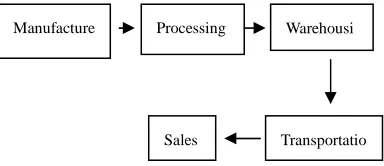
Compared with application modes in other areas, application mode of the internet of things system in managing agricultural products quality is quite different, which involves three essential aspects: initial environment, production process and product quality. The modes are also very different in breeding industry. Associating with pollution-free certified quality management of agricultural products, application of the quality traceability mode that is used by internet of things in planting production and breeding production, processing, circulation and quality of the process is as follow: The basic mode is that the same batch of pollution-free agricultural products is considered as the basic unit of data management[6], information recording, processing and distribution process in a standard format by entering them into computer management database before entering the basic information to the electronic tags with unified numbers. Recognizers can be used to identify the basic information of the electronic tags. Through sample testing, the reliability of the internet of things system management can be inspected by quality supervision departments. With regard to the problem, standard pollution-free agricultural product quality traceability management information modules need to be designed first; and then enter the information of electronic tags subsequently in fixed format of information module; in the end, insert the module information and other information into a computer database so as to establish a relative internet of things agricultural product quality tracking data management system.
Manufacture Warehousi
Transportatio
Sales
2. Complex Supply Chain Network Management Module
In short, the module consists of two parts: The first part is the public information service for agricultural products supply chain; the second part is terminal applications service oriented to the various types of nodes in the supply chain (enterprises, government regulatory authorities, etc.).
Public information service for agricultural products supply chain
Standard database service of agricultural production: first, learning from advanced international and domestic standards; second, establishing an unified standard database; third, using the database service to guide and regulate agricultural production and circulation process; fourth, exchanging agricultural product information safety data to realize safe agricultural products information exchanging and sharing on the supply chain.
Agricultural production safety warning system: various security information data source are integrated for statistical analysis, and early warning and rapid response mechanisms are established.
Terminal applications service oriented to enterprises, government regulatory authorities, etc.
Modern information technology and logistics technology that runs through agricultural products processing, constitute a safe information control system. In order to achieve the purpose of retrospective, bar code technology and radio frequency identification technology combining with automatic identification solutions are used in all aspects of the supply chain. The whole process of the supply chain is under strict control and form a closed loop production, which provides market food with guaranteed quality. Ultimately, the comprehensive quality control of the “pollution-free” are achieved[7]. With increasing complexity and vulnerability of the supply chain network, there is a growing need for real-time analysis and ability of quick adjustment in application sectors so as to make accurate predictions about supply chain and make corresponding responses to maintain stability. Synchronization and robustness are two key indicators in the supply chain network.
Food is a kind of perishable goods, so its circulation process involves a series of transportation and storage. In the process of circulation, food spoilage is not only closely related to time, but also associated with environment in the sectors of the transportation and storage, such as temperature, humidity, illumination, ventilation, etc. Based on the current technical conditions, it is difficult to record environmental parameters of each link in the process of food circulation. Therefore, judgment of food deterioration index mainly depends on shelf life of product. Due to lacking environmental parameters of food in the process of circulation, there will be some differences between shelf life of food of determination and actual deterioration degree.
At present, there are not too many methods of food supply chain security management. Bar code technology for safety traceability, traditional method that is used by some of the food industries, can not realize traceability management. But this method generally adopts artificial method close to read the barcode and can not do real-time rapid access to large quantities of food quality information, and can not provide food in circulation environment information real-time recording.
Modern foodstuff logistics system will record the whole process of effective information in circulation area of raw material and product from starting point of supply chain to the end: modern procurement, transportation, storage, loading and unloading, circulation processing, distribution, etc. After analyzing relationships of modules, network diagram of supply chain can be made. Only with digitized modules, database can be built to store supply data.
Based on all kinds of communication modes, which mainly include NFC, mobile communication, GPS, GIS, computer network, multimedia, automated warehousing, information exchange, database, WEB etc, modern Foodstuff logistics system is mainly composed of the layer of base, support, data, business and application and its application technology[8].
Based on complex network theory, this paper analyzes the properties of the supply chain network, such as the network diameter, node degree distribution, clustering coefficient, etc. A comprehensive integrated management information system is established based on the optimized robustness of the complex network environment of supply chain network.
agricultural security control and early warning mechanisms.
Sensor completes the automatic acquisition of information, such as change of temperature, humidity, pressure and brightness. Entering environment information into a data source for the acquisition and processing is the first problem that must be solved of modern food logistics system. The sensor technology is relatively perfect, and any information that needs perception can be feedback. The field of food logistics network has higher requirements on sensor technology. Sensor must be minimized so that it can be embedded into any objects, which is especially suitable for system-on-chip (SOC) integration. Another advantage that miniaturization of sensor brings is low cost. Data acquisition requires numerous sensors. Only with low cost of sensors, is the construction of the whole network more realistic.
The combination of wireless communication technology and sensor technology form a wireless sensor network, which is the reason why Internet is also called sensor network. The basic function of a node in the network is to converse and process information that is collected by the sensors and then to use wireless communication technology to convey data. Therefore, the constitution of the node can be divided into three basic parts: the sensing unit, the processing unit and the radio frequency unit[9].
The wireless communication can be divided into short-range wireless communication and long-distance wireless communication. Short-range wireless communication can be composed of local area network; Long-distance wireless communication has access to wide area network, such as Internet public network.
Although unified interface specification of Internet is still an open question, there have been some mature industry standards for the research. The current standard for short-range wireless communication includes internet of things, Sigsbee, WIFI and so on, so it is convenient to make up wireless sensor networks with sensor. Configuration of wireless sensor network scale is more flexible, which only requires a local minimum area network to complete one or several information acquisitions in a certain region. A popular local network can complete the acquisition and processing of information in required monitoring area.
The local area network range function of a wireless sensor network is limited, which can not track the whole link for food logistics. For a large range of discontinuous zone can not be effective sensing coverage, only to rely on long-distance communication technology and to make up a wide area network can comprehensively inspect the whole logistics system.Long distance wireless communication network also has available technology and mature network, using GPRS, EVDO, TD-SCDMA and other public network, no need to set up the new network, can finish information exchange efficiently.
functions, which maps the multicast flows from the media platform on the multicast flow ID by assigning IP address for the multicast group and achieves transmission of the broadcast data[10].
The cloud resource platform has a huge media library, which can be scheduled to play as needed and can receive the local FM radio and rebroadcast it. The information, such as, early warning information of Earthquake, weather forecasting, notes on contingency plans to prevent flood disasters etc, can be connected with these systems by dedicated interface, and be given priority to be broadcasted after being converted into voice through TTS.
The terminal consists of three parts: communication decoding module, power module and power amplifier modules, shown in Figure 2.
The terminal receives CDMA RF signals through an antenna, processes the data after filtering and amplifying. After that, it outputs standard audio through the audio decoder, and makes the audio louder by the amplifier. Processing the data based on whether there is an audio output, the terminal provides high or low power for the amplifier to turn it on or off.
After demultiplexing and decoding audio standard audio power amplifier after amplification by speakers for playback. The amplifier chip usually uses in amplifiers car stereos, characterized by the use of DC 12V-15V low voltage power, high conversion efficiency, and output in the form of BTL. It has few periphery components but excellent sound quality, is also very easy to install, and can be used with different amplifier chip depending on the needs of output power. Its battery capacity[11], the capacity of photovoltaic cells, can provide 20-45W of power and last 0.5 to 4 hours. The player terminals design of the (emergency) broadcasting system based on cloud computing and digital 3G is shown in Figure 2.
Emergency Broadcast is an important part of the national emergency response system and refers to broadcasting emergency messages from the government level to the public, providing information services, and helping people in disasters when faced with public emergencies. In the "regulations natural disaster relief“ust promulgated by the
[image:6.595.210.404.247.387.2]State Department, it clearly states that whenever there is a major disaster event, the government should make timely announcements to the public. Public emergencies include natural disasters (such as landslides, earthquakes, tsunamis, etc.), accidents disasters, public health events and social safety incidents.
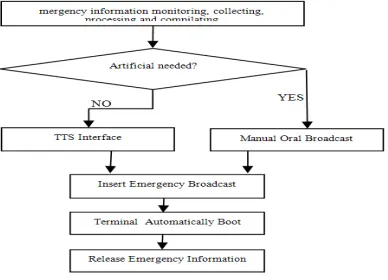
Figure 3: Emergency Broadcast Process
The emergency broadcast system consists of three parts: information gathering, information processing and information release, whose specific procedure is shown in Figure 2. In the level of information gathering, the system senses the earthquakes, weather, landslides and other key data in the monitored areas through the temperature, humidity, pressure and other sensors installed in a variety of key positions. The key data is uploaded to the data center in real time by the monitoring network. According to the relevant data model, the center records, analyzes, compares, and determines whether there is the need for early warning. As in the early warning of earthquakes, the faster but less destructive seismic waves come first and then follow the more destructive but slower seismic waves. There are several to tens of seconds time differences between the two waves. The system can take full advantage of the time difference to broadcast warning, leaving people valuable time to evacuate, reducing casualties and property losses caused by the earthquakes. For earthquakes, landslides, tsunamis and other natural disasters, emergency warning broadcasting generally won’t give people enough time to judge and intervene. In this case, emergency warning broadcasting should be used in such a way that the broadcasting warning platform and the streaming media platform have interaction on data directly. For those non-urgent disasters like short-term meteorological ones, emergency warning broadcasting can be judged by human beings, and verbal warning broadcasting can be used. This system is particularly suited to the automatic emergency warning broadcasting on natural disasters[12].
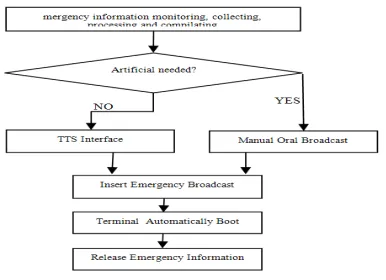
Figure 4: Emergency Broadcast Process
The emergency broadcast system consists of three parts: information gathering, information processing and information release, whose specific procedure is shown in Figure 4. In the level of information gathering, the system senses the earthquakes, weather, landslides and other key data in the monitored areas through the temperature, humidity, pressure and other sensors installed in a variety of key positions. The key data is uploaded to the data center in real time by the monitoring network. According to the relevant data model, the center records, analyzes, compares, and determines whether there is the need for early warning. As in the early warning of earthquakes, the faster but less destructive seismic waves come first and then follow the more destructive but slower seismic waves. There are several to tens of seconds time differences between the two waves. The system can take full advantage of the time difference to broadcast warning, leaving people valuable time to evacuate, reducing casualties and property losses caused by the earthquakes. For earthquakes, landslides, tsunamis and other natural disasters, emergency warning broadcasting generally won’t give people enough time to judge and intervene. In this case, emergency warning broadcasting should be used in such a way that the broadcasting warning platform and the streaming media platform have interaction on data directly[13]. For those non-urgent disasters like short-term meteorological ones, emergency warning broadcasting can be judged by human beings, and verbal warning broadcasting can be used. This system is particularly suited to the automatic emergency warning broadcasting on natural disasters.
The Wireless sensor networks of whole food logistics system include flat network architecture and the hierarchical network architecture, and the use of various network architectures is mainly to meet the needs of networking requirements and managements. The plane structure is more suitable for a local network, and the hierarchical network architecture is more suitable for a wide area network.
Sensor cannot locate position; thus, in order to improve the food logistics information system, it needs to be combined with positioning technology and electronic map. GPS, GSM, CDMA and other mobile communication technology are combined together, which contribute to achieve more rapid and accurate geographic position information of the logistics system.
CONCLUSION
Food quality tracking system based on internet of things is an integrated monitoring and management information system, which consists of “intelligent database technology, radio frequency identification technology, food safety technology, multimedia and network technology, wired and wireless network technology” and other high-tech and practical techniques. The system is an organic combination of food safety detection, full track of the quality of agricultural products, integration and management of network-based information platform, with crossover technology field and practical research results. The demand of technology developing is oriented by United States, Britain and other developed countries, realizing real digitized control and management of quality and safety of agricultural products based on the network of the from the farm to the table.
In order to adapt to the needs and characteristics of modern agricultural management and ensure taking the lead, practicability, reliability, flexibility and low cost of the system, three different network technologies are used to achieve integrated system: centralized and distributed combination, wired network and wireless network combination, combination of LAN and WAN. Given the small amount of data transmission in the agricultural system, relatively less real-time requirements, the most the economical choice is using the GSM /GPRS public wireless network for remote data transmission in this system.
monitoring and logistics management process, from farm to dinner table, application and promotion of the research results will be a strong impetus to China’s agricultural science and technology innovation system, process of agricultural products, quality and safety system and agricultural market information system, which enhance agricultural standardization, level of information technology and modernization of agriculture greatly.
REFERENCES
[1]Liu Chuanju. Research on the digitized production model under the network environment[J], Journal of
Networks, 2011,12-3 :160-163;
[2]Yu Shanshan, based on NET-business supply chain management system design and realization[J]microcomputer,2011,12-3 :168-170;
[3]Liu Chuanju. the cluster greenhouse optimization design of the remote monitoring system under the networkenvironment [J]. Journal of Multimedia .2012 (12): P82-84;
[4]Li Minzhe, Sun Junmao, Cao Xinming, the status quo, debate and suggestions of the safety of agricultural products in China [J]. China Agricultural Science and Technology, 2012, 5 (3) :68-71
[5]Zhangbing Wen, Hao Zhenghong. Safety of agricultural products in China. food safety topics, 2000, (6)
[6]Sanford, V., Pervasive Computing Goes the Last Hundred Feet wit internet of things Systems, IEEE CS and IEEE ComSoc, April-June, 2013.
[7]Wind, G. Creating Business Intelligence from What Were Black Holes of Informationand Data, internet of things World, Sydney, 2011.
[8]Ngai E W T et al.internet of things Research: An Academic Literature Review(1995-2005) and Future Research
Directions[J].International Journal of Production Economics,2012,112( 2) : 510 - 520.
[9]M Karkkainen. Increasing Efficiency in the Supply Chain for Short Shelf life Goods Using internet of things
Tagging [J]. Journal of Multimedia,2011,31( 10) : 529 - 536.
[10] Finkenzeller, K.: internet of things -Handbuch: Grundlagen und praktische Anwendungen induktiver Funkanlagen, Transponder und kontaktloser Chipkarten. 4 Auflage, Hanser, München, 2010
[11] Jedermann, R.; Edmond, J.P.; Lang, W.: Shelf life prediction by intelligent internet of things. In Haasis, H.D.; Kreowski, H.J.; Scholz-Reiter, B. (Eds.): Dynamics in Logistics - First International Conference, LDIC 2011 Bremen, Germany, August 2012Proceedings. Springer, Berlin, 231--238, May 2008