International Journal of Emerging Technology and Advanced Engineering
Website: www.ijetae.com (ISSN 2250-2459,ISO 9001:2008 Certified Journal, Volume 3, Issue 4, April 2013)
299
Performance Improvement by RS Encoding for Different
Modulation Techniques used in WiMAX
Jyoti
1, Jagdev Singh Kainth
2,
Paramdeep Singh
31Student, Ludhiana College of Engineering and Technology, Ludhiana (PB)-India
2Associate Professor, Ludhiana College of Engineering and Technology, Ludhiana (PB)-India 3
Student, Guru Nanak Dev University, Amritsar (PB)-India
Abstract-- WiMAX, the Worldwide Interoperability for Microwave Access, is a telecommunications technology proposed to provide wireless data services over long distances in a variety of ways. The bandwidth and reach of WiMAX make it suitable for the Connecting Wi-Fi hotspots with each other and to other parts of the Internet. Designed by the IEEE 802.16 committee, it provides a wireless alternative to cable and DSL for last mile broadband access. This paper discusses the improvement in BER corresponding to different signal to noise ratio with Reed Solomon Forward Error Correction technique.
Keywords--AWGN, BER, OFDM, Rician and WiMAX.
I. INTRODUCTION
WiMAX is a standards-based technology enabling the delivery of last mile wireless broadband access as an alternative to wired broadband like cable and DSL [1]. This technology can provide broadband wireless access (BWA) up to 30 miles (50 km) [2] for fixed stations, and 3 - 10 miles (5 - 15 km) [3] for mobile stations. The IEEE 802.16 suite of standards (IEEE 802.16-2004/IEEE 802-16e-2005) defines within its scope for PHY layers, any of which can be used with the media access control (MAC) layer to develop a broadband wireless system. [4]
The WiMAX standard 802.16e provides fixed, nomadic, portable and mobile wireless broadband connectivity without the need for direct line-of-sight with the base station. It is different from the previous versions of the standard in the sense that 802.16e adds the feature of mobility to the wireless broadband standard.[5] Connecting Wi-Fi hotspots with each other and to other parts of the Internet, providing a wireless alternative to cable and DSL for last mile broadband access and providing high-speed data and telecommunications services. A WiMAX network uses an approach similar to that of cell phones networks. Coverage for a geographical area is divided into a series of overlapping areas called cells. Each cell provides coverage for users within that immediate vicinity. Figure 1 describes the basic WiMAX system.
Fig1: WiMAX System
II. WIMAXTRANSMITTER
The data from the source is randomized and afterwards, coded and mapped into QAM symbols. The functional blocks that compose the transmitter of the WiMAX is depicted in Figure 2.
Fig2: Block Diagram for WiMAX transmitter
International Journal of Emerging Technology and Advanced Engineering
Website: www.ijetae.com (ISSN 2250-2459,ISO 9001:2008 Certified Journal, Volume 3, Issue 4, April 2013)
300 The signal is converted to the time domain by means of the inverse fast Fourier transform (IFFT) algorithm and finally, a cyclic prefix (CP) with the aim of preventing inter-symbol interference is added.
A. Source
As described in the standard [6], the information bits must be randomized before the transmission. In our case, instead of performing a randomization process, a binary source that produces random sequences of bits is used. The packet size depends on the number of transmitted OFDM symbols and the overall coding rate of the system, as well as the modulation alphabet. The number of transmitted OFDM symbols in one frame is depends on the total
number of transmitted symbols, NTsym, which also includes
the symbols used for the preamble, specified by Ntrain
NOFDM = NTsym − Ntrain
The number of bits to be sent by the source is calculated as:
Spacket = NOFDMRNdataMa
B. Encoder
The encoding process consists of a concatenation of an outer Reed-Solomon (RS) code and an inner convolutional code (CC) as a FEC scheme. That means that first data passes in block format through the RS encoder, and then, it goes across the convolutional encoder. It is a flexible coding process due to the puncturing of the signal, and allows different coding rates. The last part of the encoder is a process of interleaving to avoid long error bursts.
Fig3: The coding process in WiMAX
A variable-rate coding scheme that depends on the channel conditions is designed to offer optimal error protection levels to the users. The FEC options are paired with several modulation schemes to form burst profiles of varying robustness and efficiency.
C. Reed-Solomon encoder
The properties of Reed-Solomon codes make them suitable to applications where errors occur in bursts. Reed-Solomon error correction is a coding scheme which works by first constructing a polynomial from the data symbols to be transmitted and then sending an oversampled version of
the polynomial instead of the original symbols
themselves.[7]
The primitive and generator polynomials used for the systematic code are expressed as follows:
Primitive Polynomial:
p(x) = x8 + x4 + x3 + x2 + 1 Generator Polynomial:
g(x) = (x + λ0)(x + λ1)(x + λ2)...(x+ λ2t-1)
D. Convolutional Encoder
The data bits are further encoded by a binary convolutional encoder, which has a native rate of 1/2 and a constraint length of 7.
E. Puncturing process
Puncturing is the process of systematically deleting bits from the output stream of a low-rate encoder in order to reduce the amount of data to be transmitted, thus forming a high-rate code[8].
Further, data interleaving is generally used to scatter error bursts and thus, reduce the error concentration. Once the signal has been coded, it enters the modulation block[9]. Pilot symbols can be used to perform frequency offset compensation at the receiver. Additionally, as recent results showed [10], they can be used for channel estimation in fast time-varying channels. WiMAX specifications for the 256-point FFT OFDM PHY layer define three types of subcarriers; data, pilot and null subcarrier.
The OFDM physical layer of the IEEE 802.16-2004 standard specifies that transmission must be performed using 256 frequency subcarriers. The IFFT is used to produce a time domain signal, as the symbols obtained after modulation can be considered the amplitudes of a certain range of sinusoids.
International Journal of Emerging Technology and Advanced Engineering
Website: www.ijetae.com (ISSN 2250-2459,ISO 9001:2008 Certified Journal, Volume 3, Issue 4, April 2013)
301 Rayleigh fading is predominant when there is no LOS path between transmitter and receiver but only have indirect path; then the resultant signal received at the receiver will be the sum of all the reflected and scattered waves. Otherwise, Rician fading occurs when there is a dominant LOS component along with non-LOS path in between the transmitter and receiver, i.e. the received signal comprises on both the direct and scattered multipath waves.[12]
III. WIMAXRECEIVER
[image:3.612.315.576.170.694.2]The receiver basically performs the reverse operation as the transmitter as well as channel estimation necessary to reveal the unknown channel coefficients. The block diagram for receiver is as shown in figure4.
Figure 4: WiMAX Receiver system
Firstly, the CP is removed and the received signal is converted to the frequency domain using, in this case, the FFT algorithm. As we already know that an OFDM symbol is composed by data, pilots, a zero DC subcarrier, and some guard bands. Thus, a process to separate all these subcarriers is needed. First, the guard bands are removed, and then, a disassembling is performed to obtain pilots, data, and trainings. The training is used in the channel estimator, which calculates the channel coefficients. The estimated channel coefficients can be used in the demapper to perform an equalization of the data and compensate the frequency selective fading of the multipath propagation channel. Once the data has been demapped, it enters the decoder to recover the originally transmitted signal.
IV. METHOD
In the present work, MATLAB version 2008b has been used to analyze the improvement in performance with Reed Solomon coding. Here, performance has been characterized in terms of bit error rate which is calculated as the ratio of number of bits received with error divided by the total number of bits transmitted variation.
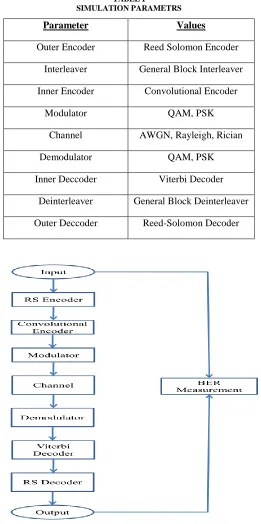
Different parameters considered in simulation are listed
in table 1 and simulation procedure is given in figure 4.
TABLE I
SIMULATION PARAMETRS
Parameter Values
Outer Encoder Reed Solomon Encoder
Interleaver General Block Interleaver
Inner Encoder Convolutional Encoder
Modulator QAM, PSK
Channel AWGN, Rayleigh, Rician
Demodulator QAM, PSK
Inner Deccoder Viterbi Decoder
Deinterleaver General Block Deinterleaver
Outer Deccoder Reed-Solomon Decoder
[image:3.612.66.272.327.422.2]International Journal of Emerging Technology and Advanced Engineering
Website: www.ijetae.com (ISSN 2250-2459,ISO 9001:2008 Certified Journal, Volume 3, Issue 4, April 2013)
302 V. SIMULATION RESULTS
A. Performance Variation in AWGN Channel
The simulation result for variation of BER with Eb/No
over AWGN channel for bpsk, 64qam and qpsk; without and with RS encoding is as shown in figure 5 and figure 6 respectively.
Fig5: Variation of BER Vs Eb/No without encoding in AWGN channel
Fig6:Variation of BER Vs Eb/No with RS encoding in AWGN channel
Table2
COMPARISON OF BER VARIATION OVER AWGN CHANNEL
Modulation Technique BER at
Eb/No=5
BER at Eb/No=10
BER at Eb/No=15
bpsk (without encoding) 0.12 0.032 0.0075 bpsk (with RS encoding) 0.000008 - - 64qam (without encoding) 0.3 0.1 0.04 64qam (with RS encoding) 0.0015 0.000018 - qpsk (without encoding) 0.45 0.18 0.045 qpsk (with RS encoding) 0.005 - -
B. Performance Variation in Rician Channel
The simulation result for variation of BER with Eb/No
over Rician channel for bpsk, 64qam and qpsk; without and with RS encoding is as shown in figure 7 and figure 8 respectively.
Fig7: Variation of BER Vs Eb/No without encoding in Rician channel
International Journal of Emerging Technology and Advanced Engineering
Website: www.ijetae.com (ISSN 2250-2459,ISO 9001:2008 Certified Journal, Volume 3, Issue 4, April 2013)
303 Table3
COMPARISON OF BER VARIATION OVER RICIAN CHANNEL
Modulation Technique BER at
Eb/No=5
BER at Eb/No=10
BER at Eb/No=15
bpsk (without encoding) 0.095 0.009 0.0012 bpsk(with RS encoding) 0.038 0.0004 - 64qam (without encoding) - - 0.004 64qam (with RS encoding) 0.2 0.1 - qpsk (without encoding) 0.5 0.08 0.012 qpsk (with RS encoding) 0.1 0.0052 -
VI. CONCLUSION
Reed Solomon codes are an important sub class of non-binary BCH codes. RS codes correct symbol error rather than bit error. The performance of Reed Solomon convolutional concatenated codes have been investigated considering various modulation schemes. It has been observed that properly chosen error correcting coding scheme can significantly improve the BER performance. The simulation results clearly show significant decrease in
bit error rate for a wide range of Eb/No. It has also been
found that BER for all tested modulation technique
decrease monotonically with increasing values of Eb/No.
Due to excellent burst error correcting capabilities of RS
codes, total BER of RS-CC decreases as Eb/No increases.
REFERENCES
[1] Smura, T. (2005). Competitive potential of WiMAX in the broadband access market: A techno-economic analysis. Proceedings of ITS 2005.
[2] Omerovic, S. (2006). WiMAX Overview. Faculty of Electrical Engineering, University of Ljubljana, Slovenia.
[3] Mandal, A. (2008). Mobile Wimax: pre-handover optimization using hybrid Base Station selection procedure, University of Canterbury. [4] IEEE. Standard 802.16-2004, Part 16, December 2005: “Air
interface for fixed and mobile broadband wireless access system” [5] Nuaymi Loutfi, 2007: “WiMAX Technology for Broadband
Wireless Access”, Wiley, London)
[6] IEEE Standards, (October 2004). LAN/MAN Standards Committee:”802.16 IEEE Standard for Local and Metropolitan Area Networks. Part 16: Air Interface for Fixed Broadband Wireless Access Systems,”
[7] Pathak, S & Batra, S.(2012). Next Generation 4G WiMAX Networks - IEEE 802.16 Standard. Computer Science Conference Proceedings (CSCP), pp. 507–518
[8] Mohamed, M. A., Zaki, F. W., & Mosbeh, R. H. (2010). Simulation of WiMAX Physical Layer: IEEE 802.16 e. International Journal of Computer Science and Network Security, VOL.10 No.11.
[9] Hanzo, L., Ng, S. X., Webb, W. T., & Keller, T. (2004). Quadrature amplitude modulation: From basics to adaptive trellis-coded, turbo-equalised and space-time coded OFDM, CDMA and MC-CDMA systems. University of Southampton Institutional Research Repository ePrints.
[10] Be, E. P. L. (2001). Adaptive Techniques for Multiuser OFDM, Doctoral dissertation, Thesis in Electrical and Computer Engineering James Cook University.
[11] Yonis, A. Z., Abdullah, M. F. L., & Ghanim, M. F. (2012). WiMAX Technology using Speech Recognition Security. International Journal of Electronics & Informatics Vol.1,No.1