Calè, Luisa (2019) Book illustration. In: Haggarty, S. (ed.) William Blake
in Context. Cambridge, UK: Cambridge University Press, pp. 56-69. ISBN
9781107144910.
Downloaded from:
Usage Guidelines:
Please refer to usage guidelines at or alternatively
CHAPTER 6
Book Illustration
Luisa Calè
Blake’s career as a poet and artist coincides with the emergence of ‘illustration’. Since the
end of perpetual copyright in 1774 engravings became a common bibliographic element of
cheap reprints of British poets.1 Before the current visual meaning of ‘illustration’ was
crystallized in the 1810s (as ‘pictorial elucidation’, whether of ‘any subject’, or ‘a literary or
scientific article, book, etc.’), it was recorded in book titles through terms such as
‘embellished with superb engravings’, ‘etchings’, or ‘figures’.2 This terminology emphasizes
the composite nature of the book, pointing to the separate processes involved in producing
different book parts: illustrations were pulled in different printing workshops and added to
the book later. Blake’s corpus challenges this division of labour, its distinctions between the
classical writer and the modern artist, and between invention and reproduction.
In his 1793 prospectus ‘To the Public’ Blake advocated relief etching as a ‘method of
Printing both Letter-press and Engraving in a style more ornamental, uniform, and grand,
than any before discovered, […] a method of Printing which combines the Painter and the
Poet’ (E 692-3). To distinguish his productions from reproductive engravings and emphasize
the connection between writing, miniature, and the medieval aesthetic of the illuminated
manuscript, Blake called this method ‘illuminated printing’. Blake’s prospectus lists each
item by title, genre (‘a prophecy’, ‘a poem’, Songs), mode of production, and size. His works
‘in illuminated printing’ are entered ‘with’ the number of designs; yet, unlike commercial
illustrated editions, this bibliographic detail does not identify something superadded to the
the illuminated books are identified as visual productions and the texts subsumed under the
designs. The corpus of the painter and poet is unified through the engraver’s book
productions, sandwiched between two subjects presented as ‘Historical Engraving’, and the
final two items tagged ‘a small book of Engravings’ (E 693). However, in his commissions to
illustrate the works of other poets Blake moves away from the uniform poetics of illuminated
printing. This chapter explores Blake’s approaches to book illustration, focusing on his visual
responses to Edward Young’s Night Thoughts (1796-7), Robert Blair’s The Grave (1808),
The Book of Job (1805-6, 1821-7), and Dante’s Commedia (1824-7).
Blake’s illustrations to Edward Young’s Night Thoughts (1796-7) and Thomas Gray’s
Poems (1798) emphasize the division of labour between writer, artist, and publisher through a
book composite that staged the separation of media and modes of production. In early 1796
the publisher Richard Edwards disbound the pages of first and second editions of Young’s
Night Thoughts (1742–45), and ‘inserted the letterpress close cut’ into large sheets of paper,
so that Blake could illustrate the wide margins in watercolours.3 Blake illustrated Young’s
nine Nights page by page, producing five hundred and thirty seven watercolours around the
letterpress. Out of his two volumes of watercolours, forty three designs were chosen to be
engraved in an edition of the first four Nights published by Edwards in 1797.4 The
watercolour volumes can be considered as interim objects comparable to the altered books
used in preparing a new edition of a work, where expanded margins allowed authors and
editors more space to write around the text. Collectors also used such extended pages to
obtain more space on which to paste prints, drawings, watercolours, and other extraneous
materials, hence the term ‘extra-illustration’. Although Blake’s Night Thoughts watercolours
share the process of customizing books with the practice of extra-illustration, they are quite
different for their consistent intervention on each page and for the uniform choice of medium.
designs enhance the volumetric effects of the page by placing sleeping figures on top of the
text panel or drawing decorative frames around it that call attention to the point where the
page of letterpress meets the illustrated margin. However, other compositions fail to
accommodate the text and seem to compete for the centre of the page. In such cases, Young’s
text seems to have been superadded: the text panels seem to have been cut through the
designs to insert the letterpress in the middle of Blake’s designs, and the illustration reclaims
primacy over the words. However, the pages of letterpress inserted into the centre of the
designs also remind the reader that a book has been dismantled in order to recycle its pages
and cover the holes in the book of watercolours. By contrast, in the 1797 edition the text
seems superimposed on the engraving, and the reader is encouraged to imagine the
composition continuing beneath the page of letterpress.
Blake’s illustrations to Young are an act of parody in the literal sense of a
composition that is placed next to Young’s poem. Sometimes literalising Young’s allegories,
sometimes extending or amplifying his metaphors and similes into actions and episodes,
Blake creates a cast of characters out of Young’s abstractions and produces a counter-poem
in the margin of the page. Asterisks penciled in the margins of the text identify the
illustration’s textual source. For instance, in Night III Young identifies night as his poetic
domain, inviting bards to take the sun for themselves, inebriated by a ‘wilderness of joy; /
Where Sense runs Savage, broke from Reason’s chain’ (p. 46; WBA Copy 1, obj. 25).
Blake’s surround illustration inverts the negative connotations of Young’s text: joy is
embodied in the figure of a naked woman advancing with arms held up; her unchained anklet
suggests that she stands for emancipation, hailing the reader to break loose from Reason’s
chain, associated with slavery. Hovering above her a personification of Night represented as a
faceless blind figure with disproportionately big masculine hands lifts a dark mantle ready to
its meaning is inverted. Blake’s personification of sensual joy will not be suppressed. Against
Young’s call to reject pleasure, her body can transform the dark world under the mantle of
Night into an implausibly radiant realm of light. This arresting image offers an alternative to
Young’s Miltonic poetics of blindness.
How to represent literary texts in visual form was a pressing problem for
eighteenth-century theorists, who contrasted painting, the art of placing bodies one next to the other in
space, to writing, which represents the development of actions in time. Yet illustration
complicates the distinction between verbal and visual media, as it embodies abstract notions
of painting and poetry in the form of the book as a support for reading and viewing. As a tool
for ordering and turning pages, the book has the potential to become a pre-cinematic medium.
Blake experimented with the book’s capacity to convey the impression of movement by
illustrating a body represented in different moments of an action. In his illustrations to Young
the reader sees impending actions develop as the elongated figure of Time strides across a
page opening and encircles the letterpress upon turning the page (pp. 25-26; WBA Copy 1,
obj. 15-16). More conventional approaches to illustration involve selecting one action
isolated in its pregnant moment; bringing together multiple scenes in one composition known
as a poly-scenic narrative; or producing a series of illustrations.
Blake’s illustrations to Robert Blair’s The Grave, from a watercolour drawing
produced for Thomas Butts to the series of designs engraved by Luigi Schiavonetti for Robert
Cromek’s edition of The Grave: A Poem. Illustrated by Twelve Etchings executed from
Original Designs (1808), present different solutions to the problem of visual narrative. In the
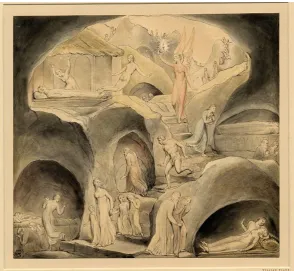
watercolour drawing, Blair’s metaphor of life as a journey offers the narrative device to
impart linear form on a miscellany of episodes, as a downward path subsumes the polyscenic
Fig. 1, The Descent of Man into the Vale of Death, c. 1850 (British Museum
1894,0612.15)
No lateral scenes are found in the corresponding illustration published in the 1808 volume,
where some of those scenes are developed into independent illustrations (p.21; WBA Copy 1,
obj. 8). A page number on the top right margin of the plate identifies the facing page of
letterpress, and a short quotation is added in the caption at the bottom: ‘Tis here we all
meet!’. Instead of being anchored to the text, the illustration reveals the extent of Blake’s
‘invention’: no steps or caves can be found in the facing letterpress, which focuses on ‘this
world… a spacious burial-field unwall’d, / Strew’d with Death’s spoils, the spoils of
animals…’ (p. 21). The short title The Valley of Death inscribed as a caption under the
etching alludes to Psalms 23. 4, a source of Blake’s invention also not found in Blair’s text;
the longer title The descent of Man in the Vale of Death listed in the paratext adds the
downward trajectory.5 These added layers reveal the creative work of titling in reinventing a
Moving from the polyscenic watercolour to the illustrated edition of Blair’s poem,
Blake isolates key turns or episodes in the text as cues for visual inventions. Opening the
volume the reader finds to the left of the first page a frontal image, with a caption including
the title Christ descending into the Grave and lines from the facing text: ‘Eternal King!
Whose potent Arm sustains / the Keys of Hell and Death’ (WBA, Copy 1, obj.3). The
exclamation mark turns the identifying words into an invocation, although the authorial
element that precedes them in the text (‘Thy succours I implore’; p. 3) is left out, thus
repurposing the words to fit the composition. Its perspective from below places the reader
among the damned in the flames of hell. The position at the beginning of the poem suggests
that Christ, whose eyes are averted sideways, needs to be invoked by the reader: his arms
thrust open and slightly forward, bearing the keys of salvation, offer proleptic hope and a way
up towards the illuminated space behind him. Since the image faces the beginning of the
poem at the beginning of the book, we can take this illuminated space as an allegory for the
space of reading. Representing the reader as Viator is a frequent device in Blake’s works
from Night Thoughts to Jerusalem, where the traveler is seen from behind entering a door
leading to a dark interior. Here we are invited to think of the reading experience as an exit to
the journey of life, prepared by the deathbed scenes, which multiply the one found in the
polyscenic watercolour into a series of illustrations placed in interiors punctuating the reading
experience.
Other ways of translating poetic actions in visual form are exemplified by Blake’s
illustrations to Job, a repeated effort that produced two series of watercolours, the Butts set
(c.1805-6, 1821-7) and the Linnell set (1821); reduced versions in a sketchbook (1823); and
finally Illustrations of the Book of Job, in Twenty-one Plates, Invented and Engraved by
William Blake (1826). Blake’s Job combines experiments in the episodic rhythm of the series
The first and last plates share the setting, characters, and broad composition, so they can be
read as a pair. The viewer is encouraged to apply the logic of before and after and infer the
action occurring between the point of time captured by each plate, noticing the changes that
visually sum up the narrative from beginning to end. In the fourth illustration (WBA Copy 1,
obj. 6), a messenger is fast approaching Job and his wife seated in the foreground, while a
smaller messenger can be seen approaching in the background. These messengers seem to be
different instantiations of the same figure captured in different moments of the same action,
while perspective provides a structure that conveys the temporal arc of the story from the past
foreshortened in the background to the present moment at the centre. However, the text
inscribed under the 1826 engraving contradicts this visual impression. The first line,
presented in larger font, reads ‘and I only am escaped alone to tell thee’ (Job 1. 15); below it
in smaller font, Blake excerpts the subsequent line: ‘while he was yet speaking / there came
also another’ (Job 1. 16). The text added around the illustration clarifies that the two figures
represent different messengers and perspective is used to arrange two actions in the same
illustration. What the first messenger has to say is written in yet smaller font above the
illustration. In the Job plates, Blake inverts the page layout explored in the Young
illustrations, where the design encircles a rectangle of letterpress. Here the composition of
text and image on the page is shaped by the visual logic of the engraver. The expectation of
uniform lines of letterpress arranged in a rectangular panel is subverted by the variation in
font size, irregular spacing, and curved lines as the text is broken up into captions arranged
around the illustration, turned into elements of design. The reader’s eye is attracted to the
dark mass of the illustration at the centre of the page, then invited to read the line beneath the
image first, and probably follow down the page, before turning back up to the top. Blake’s
In Illustrations of the Book of Job Biblical excerpts and additional scenes from
different biblical sources are used to illustrate the actions presented in the engravings in the
centre of the page, while sentences from the text of Job are arranged in new sequences
interspersed with quotations from other books of the Bible. This practice of composition
evokes Biblical exegesis engaged in reading the life of Jesus combining sentences taken from
different books of the Gospels, or allegorical reading practices training the reader to interpret
Old Testament episodes as foreshadowing events in the New Testament. Blake’s illustrations
translate these reading practices into adventurous polyscenic compositions. Consider plate 14
(Fig. 2), a composition that divides the engraving in three parts with a Urizenic image of God
the father as master of the elements in the centre, seated on a cloud-shaped frame, marking
[image:9.595.71.304.402.689.2]the bound of the horizon above Job and his family.
Fig. 2, When the Morning Stars Sang Together, pl. 14, in Illustrations of the Books of Job
The Lord’s head is inscribed in the Sun and above him the reader can visualize the time
‘When the morning Stars sang together, & all the Sons of God shouted for joy’ (Job 38. 7).
The Lord’s outstretched arms structure the composition, providing two more partitions for
additional scenes, and pointing to a further layer of narrative outside the main composition. In
the framing border the story of the days of creation is presented in roundel illustrations and
excerpts from Genesis. These roundels evoke the Introduction to Songs of Innocence, and the
page layout of parallel Old and New Testament scenes in the Bible Moralisée.6 This device is
here used to convey elements in the speech of the Lord answering Job out of the whirlwind
(featured in plate 13, WBA, Copy 1, obj. 15), asking him where he was at the time of
Creation. The outstretched arms posture returns in plate 20 (WBA, Copy 1, Obj.22), where
Job takes on the Lord’s Urizenic stance to point at miniaturized episodes of his story hanging
on the walls around him, including a small version of the Lord answering Job in a whirlwind
(plate 13) placed right behind him to mark the lesson learned and the change undergone.
From being the suffering subject of a hermeneutic drama, Job has mastered and appropriated
the Lord’s visionary power. It is his turn to frame the narrative.7 In this powerful
self-reflexive engraving, Blake recreates a classic polyscenic device, which consisted in the
architectural arrangement of key moments in a story captured in pictures hung along the walls
of a gallery or a church.
In the late eighteen hundreds Blake produced series of watercolour illustrations
without any textual reference, from the Paradise Lost series for Butts and Joseph Thomas
(1807-8), to the Dante illustrations (1824-27), which he left unfinished at his death. John
Linnell gave Blake ‘a folio volume of a hundred pages’,8 in which he sketched one hundred
and two illustrations. Unlike the typographical layout arranging the text at the centre of the
of drawings’ (E 778). The literary source is limited to a notation of the relevant Canto in the
corner of the page. Freed from the words on the facing page and the partitions of the book
that shaped the encounter with Young and Blair, Blake has more scope to reinvent and
rearrange Dante’s inventions, revealing his interests through an uneven selection of subjects
(72 for Inferno, 20 for Purgatorio, 10 for Paradiso). Illustrating Canto I of the Inferno, Blake
frames the wood and the allegorical beasts as a picturesque margin in the foreground, and
redirects the eye towards the dynamic blue sky encounter with Virgil (WBA, Copy 1, obj.1).
His political connotations as the apologist of the Roman empire, and the historical
coordinates of Dante’s writing are moved to Canto II, compressed in a powerful Urizenic
portal framed by the temporal power of God and empire above and two captive giants on the
sides (WBA, Copy 1, obj.2). This framing brings to view allusions to empire from a range of
places in Dante’s work to mark the oppressive bound of the horizon that the reader has to
negotiate before entering the door to hell in Canto III (WBA, Copy 1, obj.3). Metamorphosis
and the boundaries of the human form provide the greatest artistic challenge in a series of
eight illustrations dedicated to the punishment of thieves transformed into serpents and back
in Inferno XXIV-V (WBA, Copy 1, obj.49-57). Blake’s response to Dante’s scenes of
metamorphosis reveals the fundamental approach of the artist interested in literature as a
testing ground for the possibilities and limits of visual invention.
Focus on the materiality of the book restores Blake’s illustrations to a wider context
of Romantic print culture. In addition to patterns of reiteration and reuse of iconographical
motifs across illuminated books and commercial illustrations,9 the alternative sequencing of
full plate illustrations in the illuminated books has its correlative in the mobility of illustration
within commercial editions even when page numbers prescribe an illustration’s specific
position facing a relevant page of text. An alternative sequence is proposed at the back of the
Poem’ (p. 33), suggesting they may be detached and enjoyed as a portfolio of prints.
Alternatively, they can be repurposed as illustrations to other books, indicating illustrations’
additional or independent iconographies. Blake’s illustrations to Blair and Job were inserted
in extra-illustrated Bibles alongside reproductive engravings of the Old Masters and
Romantic period print series.10 Placed alongside reproductive engravings that miniaturized
frescoes and historical paintings into the hand-held format that could be inserted into a book,
Blake’s illustrations connect writing to painting, and the order of books to the field of art.
1 W. St Clair, The Reading Nation in the Romantic Period (Cambridge: Cambridge
University Press, 2004), p. 134; F. Bonnell, The Most Disreputable Trade: Publishing the
Classics of English Poetry 1765-1810 (Oxford: Oxford University Press, 2008). On the
shifting semantics of ‘illustration’, see S. Matthews and I. Haywood, ‘Romanticism and
Illustration: Introduction’, in Romanticism and Illustration (Cambridge: Cambridge
University Press, forthcoming 2019).
2 ‘illustration, n.’, 4a and b, OED Online, Oxford University Press, June 2017,
www.oed.com/view/Entry/91580.
3 A. Flaxman, 16 March 1796, British Library, Flaxman Papers, Add. MS 39780, fol. 212r-v;
L. Calè, ‘Blake, Young, and the Poetics of the Composite Page’, Huntington Library
Quarterly , 80. 3 (2017), 453-479. For the watercolours, see British Museum, Department of
Prints and Drawings, 1929, 0713.1-270.
4 E. Young, The Complaint, and the Consolation; or, Night Thoughts, by Edward Young
(London: Edwards, 1797). All Young references will be quoted from this edition, and page
numbers entered in the text.
5 R. N. Essick and M. D. Paley, Robert’s Blair’s The Grave Illustrated by William Blake: A
6 On the Bible Moralisée and the Introduction to Songs of Innocence, see M. Phillips, William
Blake: Apprentice & Master (Oxford: Ashmolean, 2014), pp. 111, 260.
7 H. Fish, The Biblical Presence in Shakespeare, Milton, and Blake (Oxford: Oxford
University Press, 1999), p. 317; M. D. Paley, Traveller in the Evening: The Last Works of
William Blake (Oxford: Oxford University Press, 2003), pp. 256-58.
8 A. Gilchrist, Life of William Blake, ‘Pictor Ignotus’, 2 vols.(London: Macmillan, 1863),
I,
332.
9 Consider Death’s Door, from Blake’s America (1793) to his illustration of Robert Blair’s
The Grave (1808), discussed in S. Makdisi, William Blake and the Impossible History of the
1790s (Chicago: University of Chicago Press, 2003), pp. 181-4.
10 Plates from Blake’s Grave and Job illustrations extra-illustrated in the Kitto and Douai
Bibles, now at the Huntington Library, are catalogued by Robert N. Essick, The Works of
William Blake in the Huntington Collections: A Complete Catalogue (San Marino: The