Citation:
Jones, O and Kerr, MA (2012) Refreshment by the case: Use of multimedia in case study assess-ment. The International Journal of Management Education, 10 (3). pp. 186-200. ISSN 1472-8117 DOI: https://doi.org/10.1016/j.ijme.2012.07.002
Link to Leeds Beckett Repository record: http://eprints.leedsbeckett.ac.uk/4381/
Document Version: Article
The aim of the Leeds Beckett Repository is to provide open access to our research, as required by funder policies and permitted by publishers and copyright law.
The Leeds Beckett repository holds a wide range of publications, each of which has been checked for copyright and the relevant embargo period has been applied by the Research Services team.
We operate on a standard take-down policy. If you are the author or publisher of an output and you would like it removed from the repository, please contact us and we will investigate on a case-by-case basis.
Page | 1 Refreshment by the Case: Use of Multimedia in Case Study Assessment Ollie Jones
Marie Kerr
Leeds Metropolitan University
Faculty of Business and Law
Rose Bowl
1 Portland gate
Leeds
LS1 3HL
0113 812 4865
Ollie Jones MA, MEng, PGCHE is a Teacher Fellow and Principal Lecturer at Leeds Metropolitan University, a part-time member of the University Technology Enhanced Learning [TEL] team and a TEL champion for the Faculty of Business and Law. Prior to joining Leeds Metropolitan University, Ollie was a senior manager in a large multinational business, with experience in operations, supply chain and quality management, and in recruitment of graduates. His research interests are primarily in Assessment, Learning and Teaching (ALT), particularly blended and technology enhanced learning as well as case study pedagogy.
Marie Kerr BEng MBA PGCHE is a Senior Lecturer in the Faculty of Business and Law at Leeds Metropolitan University. Her main teaching interests are Business Strategy, Operations Management and Transferable Skills
Development. Prior to joining Leeds Business School in 2004, she worked for 15 years in manufacturing industry as a Mechanical Engineer and Project Manager. Her most recent industrial experience was as a Programme Manager developing component technology for a US owned automotive corporation. Her research interests include supply chain relationships and ALT matters, including
Page | 2 ABSTRACT
This paper outlines a novel approach to developing, presenting and using a
multimedia case study for the assessment of a large (circa 230 students)
Operations Management module at undergraduate level on a Business Studies
programme.
Engagement, realism and handling complexity are important issues in Operations
Management teaching, learning and assessment. It is argued that traditional text
based case studies do not address these concerns sufficiently and consequently
can encourage surface learning approaches. Consultancy and simulation are
more likely to be effective on these issues with the greater focus on experiential
learning. However the constraints of these techniques restrict use as assessment
options, particularly for large undergraduate programmes.
This paper offers tutors of Operations Management an alternative approach to
facilitating experiential learning using a multimedia case. The action research
reported here develops this multimedia approach, identifies the practical
considerations and the potential for improved student learning outcomes. The
findings indicate that this multimedia approach was engaging, realistic and
challenging hence facilitated greater student interest, understanding and skills.
Page | 3 INTRODUCTION: OUR CONCERNS
Case study teaching and learning is often the most significant pedagogy in
Business and Management education courses and is a long-standing and widely
accepted practice (Hoskin, 1998). However this practice is not without criticism
(e.g. Argyris, 1980) and there are a number of issues and limitations associated
with the use of traditional text based cases particularly with increasingly large and
diverse student cohorts (Brennan & Ahmad, 2005). This research was inspired
by our experience of such problems with the use of case studies, specifically in
the assessment phase of a large (circa 230 students) Operations Management
(OM) module at undergraduate level on a Business Studies programme.
Our four main concerns were:
1. Engagement:- The level of interest in the subject of Operations
Management and students engagement with the assessment case study.
2. Skill Development:- The opportunity for the students to develop relevant
employability skills
3. Realism:- The realism and complexity of the assessment case context
4. Learning Approach:- The learning approach adopted by students during their assessment
Addressing such concerns, an alternative to the text based case which has
become increasingly popular over the last decade is the “live case” (Kennedy,
Page | 4 (Heriot, Cook, Jones & Simpson, 2008). These consultancy approaches involve
students directly in working with an organisation to solve some real business
problem.
However, such consultancy methods also have inherent issues and constraints.
Camarero, Rodriguez & San Jose (2010) highlight difficulties in finding and
sustaining client organisations as well as tutor resource implications in managing
the consultancy process. These issues can only be magnified when dealing with
large student numbers.
Hence this paper outlines a novel approach to addressing these concerns
through developing, presenting and using a single multimedia case study for
student assessment on a large OM module at Leeds Business School.
The multimedia case developed consisted of different elements of information
from a local business, constructed using various media elements such as audio
interviews, videos, pictures and spreadsheets. The case elements were then
uploaded onto the Virtual Learning Environment (VLE). This was designed to
simulate interaction with a client organisation.
Action research provided a useful and appropriate framework to focus and direct
our concerns. Action research is “… a form of self-reflexive enquiry undertaken
by participants in social situations in order to improve the rationality and justice of
their own practices, their understanding of these practices and the situations in which these practices are carried out” (Carr & Kemmins, 1986, p162). Taking
Page | 5 situation aided by reflective iterations in cycles of action and analysis. Hence this
enquiry was undertaken by the module teaching team using this action-reflection
process (McNiff & Whitehead, 2006) over the course of the academic year
2008-2009 for the module concerned. Figure 1. Illustrates the broader approach,
although the research reported here is restricted to just the initiating cycle.
Figure 1: Action-Reflection Cycles of Action Research
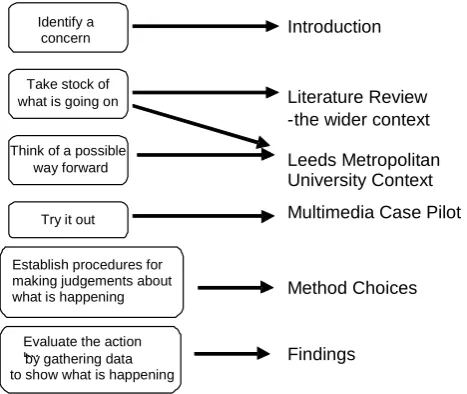
The majority of this paper is structured around the first elements of the action
research process adapted from McNiff & Whitehead (2006) outlined in Figure 2.
Figure 2: Stages of Action Research Contextualised
Finally we reflect on the tutor practice of designing and constructing the
multimedia case and on the data gathered about the student learning and
assessment experience. We conclude with some overall implications for practice
and further research into this area.
To summarise, the three main objectives of this paper are:
1. Does using a multimedia case study allow progress towards alleviating our
concerns on Engagement, Skill Development, Realism and Learning Approach arising from the use of text based cases for assessment?
2. What are the practical considerations of this multimedia case approach?
3. To what extent does this multimedia case approach mitigate the issues
Page | 6 Hence the next section reviews the literature to establish the wider context,
structured around our four main concerns of Engagement, Skill Development,
Page | 7 LITERATURE REVIEW: TAKING STOCK OF THE WIDER CONTEXT
Engagement
Many authors (Kreber, 2001; Rippin, Booth, Bowie & Jordan, 2002; Brennan &
Ahmad, 2005) have outlined the history of using case studies in business and
management education over the last century. In fields such as Business and
Management, it is often the primary mode of instruction (Alexander, O’Neill,
Snyder & Townsend, 1986). This growth in the use of the case study for teaching
has meant that many undergraduate students are exposed to numerous text
based cases each semester.
Generally, recent cases are professionally written and well researched (Wolfe,
1998). To increase engagement and interest, academics have focused on
providing more stimulating and student-orientated case material with some
success (O'Cinneide, 2006). However, in their study of the student experience of
case use, Brennan & Ahmad (2005) found a substantial minority (30%) of their
sample of Marketing and Management students had less than favourable
attitudes towards pedagogy based on text based case studies. Our own teaching
experiences in the increasingly common “massified” higher educational context
concur with this finding. In fact we suggest that the current high level of use of
text based case studies in such contexts can lead to “case-fatigue”.
A broader problem for current Business and Management teaching is that a
Page | 8 range of curriculum subjects. This is of concern not only from a student
satisfaction perspective but also, as Bryson & Hand (2007) point out, engagement
of students is critical for learning outcomes to be achieved.
Interestingly Camarero, Rodriguez & San Jose (2010) note this is evident even
when students participate in a more consultancy based case approach or live
case. When dealing with client businesses, such lack of engagement can
damage tutor-industry relationships, sour reputations and jeopardise future
student consultancy options. This highlights that whilst consulting in a live case is
likely to motivate and engage through the direct contact with businesses and OM
in practice, this is not always true for all students. Hence as well as the resource
implications of live cases as a viable alternative to text based case studies for
teaching and assessment, there are more significant risks associated with failure
for both student and tutor.
Goffin (1998) and Desai & Inman (1994) report a lack of student interest and
engagement in OM in particular. Helms (1989) also found students had little
interest in OM as a subject, noting that many of her students had never been
inside a manufacturing operation or a service facility. She advocates factory
visits as one of the potential remedies by increasing exposure, stimulating interest
and increasing familiarity with terminology and processes. However this is only
practical with relatively small numbers of students. This is especially true when
visiting smaller firms, who form a large part of the UK economy and are a major
Page | 9 Biggs (1996) indicates, in outlining the concept of constructive alignment, that
assessment is amongst students’ key concerns. Hence assessment-related
activity is more likely than any other issue to attract and keep student attention.
Riordan (2005, p54) underlines this, stating “what matters most may not be so
much what the teacher does in front of the students but rather what the teacher asks the students to do”. This shifts the focus from teacher delivery to student
activity. Consequently design of assessment can be seen as a significant lever to
improve engagement of students.
Using cases for assessment purposes is common practice. As Jerrard (2005,
p27) suggests, “it is possible to reflect the real world of business and employment relations by designing case study-based assessment”. Therefore the
development of an assessment design which utilises a case study pedagogy
requiring more activity and interaction from students is a perhaps a significant
step towards more engagement.
Skill Development
In her extensive literature review of industry relevant competencies, Jackson
(2010) highlights the importance of employability skills both for graduates and the
economies of those countries which were part of her study. Significantly Jackson
notes the perceived gap in employability skills is highest in the UK. The gap
between the required skills of practitioners and actual skills of graduates is widely
Page | 10 practical and professional skills development” (Morris, 1997, p42) and the
persistence of this gap between “what is taught and what is relevant to practitioners in their daily jobs” (Visich & Khumawala, 2006, p1).
Richardson (1994) notes that published text based cases, whilst being
professionally presented and well structured, provide little assistance to those
who are developing skills as “information gatherers”. Mintzberg (1990) makes a
similar argument in his discussion of Strategic Management. Jackson (2010)
summarises these skills as “information management” and cites a number of
sources to define this including “Comprehending information in a range of
formats; assessing the quality and relevance of information to decisions and
analysing, evaluating, interpreting and differentiating data” (Field, 2002 as cited
by Jackson, 2010, p36).
Knight & Yorke (2004, p8) attempt to define decision management competency,
stating students need “the ability to handle ambiguous and complex situations”.
Jackson (2010) identifies that there are significant gaps in this competence from
her survey of businesses employing UK graduates. We believe that as well as
being a UK graduate skill gap, this skill has significant resonance for graduates
working as, and with, OM practitioners. For example, Goffin (1998, p426) points
to the “excitement, magnitude and complexity” of OM practice.
Rippin, Booth, Bowie & Jordan (2002) note that one of the aims of using
ambiguous and complex cases is to enable students to develop “sense-making
Page | 11 contradictory and incomplete information, often hidden in a large quantity of case
information and data. In this way, complex cases replicate a real world
experience. Rippin, Booth, Bowie & Jordan (2002) argue that Business and
Management graduates need these skills for employment and that such case
studies allow students to develop these skills.
However an ambiguous and complex case teaching approach often makes
students uncomfortable as Rippin, Booth, Bowie & Jordan (2002) found when
discussing case study teaching with students. Students generally favoured cases
with transparency, simplicity and closure. In addition, Argyris (1980) suggests
that while many academics espoused the benefits of ambiguity in case study
teaching, in reality they demonstrate inconsistency in behaviour often appearing
to favour a pre-determined route to a solution or answer.
Despite these tendencies of students to seek and academics to provide closure,
case studies clearly have the flexibility and potential to explore complexity and
ambiguity. However, Rippin, Booth, Bowie & Jordan (2002) also indicate that this
potential may be reduced as cases have become more narrowly focused on short
text formats with directive narrative.
In the related study of games and simulations, Ryan (2001) identifies a number of
definitions of narrative. One definition which has particular relevance to Business
and Management case studies states “narrative representation consists of a
Page | 12 participate in actions and happenings (events, plot) and undergo change” (Ryan,
2001, p2).
The role and value of narrative in adding interest and potentially increasing
engagement with case studies has long been emphasised. For example, Booth,
Bowie, Jordan & Rippin (2000, p65) suggest that “good cases are characterised
by verisimilitude, relevance, timeliness, and familiarity; a compelling narrative; and some kind of affective hook which will capture the students’ imagination”.
Whilst we acknowledge this, our own experience of using the more traditional text
based case in assessment is that some students appear to either mistakenly, or
deliberately, utilise the narrative contained within the case study as a substitute
for their own analysis.
Another issue of interest in considering narrative is that of dominant voice or
perspective (Currie & Tempest, 2008). Dominant narratives in traditional text
based cases tend to be author-voice or from the “senior management”
perspective. Graeme Currie and Sue Tempest suggest that multi-narrative
accounts are more compatible with the increasing need to encourage students to
adopt a broader stakeholder perspective in evaluating Business and Management
related problems.
Ryan (2001) and Juul (2001) emphasise that narrative is an extensive part of
human experience however, in games and simulations, more onus is placed on
the participant to construct the narrative, than a traditional narrative setting such
Page | 13 Hence a neutral case stance, presenting multiple narratives (rather than a single
privileged one), with minimal author imprint may indicate an important way
forward in encouraging this participant construction already a feature of games
and simulations. We contend that this more active role for the student in
constructing case narrative will increase engagement and drive skill development
appropriate to the multi-stakeholder environment of the OM practitioner.
In her discussion of case studies, Cameron (1999) indicates that the imprint of
authors of cases can have the effect of distancing the case from reality. Given our
concern on the need for greater realism, this further supports our contention
above on the wide benefits of a more neutral case stance requiring some degree
of student narrative construction.
Realism
In his review of OM teaching, Keith Goffin highlighted the need for realism. To
quote one respondent from his study, “the biggest challenge is to be in touch with
reality and know what is relevant to teach” (Goffin, 1998, p445). This finding is
not new with a number of authors concluding that more realism is needed to
improve student perceptions of OM as a subject area (e.g. Adler, 1989).
However it is problematic to reproduce the characteristics of a working situation in
educational material or in classroom learning (Helms, 1989; Nicholson, 1997).
Page | 14 several academics teaching OM across leading European Business Schools
“consider it difficult to assess students’ performance realistically in Operations
Management, as it is such an applied subject” (Goffin, 1998, p443).
Cumming and Maxwell (1999) explore “authenticity” as a commonly applied
concept for introducing more realism in education and assessment.
Svinicki (2004), citing Wiggins (1998), provides six characteristics of an
assessment that would qualify it as authentic. These are as follows:
1.Realistic Application: applying information or skills in a similar manner to application in the real world.
2. Judgment and Innovation: unstructured problem solving where there is no “right” answer and as such requires informed choices.
3. Realistic Action: undertaking typical real world procedures.
4. Realistic Situations: similar to the contexts in which the related skills are
performed in the real world.
5. Skill Range: a wide range of skills related to complex real world problem solving.
6. Feedback: diagnostic information available to assess where and how corrections are needed.
These help define what we mean by realism or authenticity in our context. Firstly,
there is a need to attempt to replicate the environment of OM that graduates
could find themselves in. This should encompass the complexity and open ended
nature of problems. Secondly, assessment should facilitate the actual utilisation
Page | 15 learning (Cumming and Maxwell, 1999). Thirdly, assessment should encourage
similar procedures and diagnostic processes as would be applied by the
experienced OM practitioner.
Hence our concern on the need for greater realism in case studies encompasses
the need both to represent or simulate the richness and complexity of the OM
practitioner’s reality and to engage students in developing appropriate complexity
handling skills in response to that (simulated) reality.
Learning Approach
A student’s approach to learning has a significant impact on his or her level of
engagement and hence, the nature of the learning outcome. Approaches are
often classified as either surface or deep learning. Prosser & Trigwell (1999)
suggest that a surface approach frequently implies rote or piece-meal learning,
without much understanding of purpose or context. This is contrasted with a
deep approach whereby the learner seeks to understand ideas and wider
meanings, driven by curiosity. The strategic learner is alert to assessment
requirements and uses a blend of surface and deep approaches in an attempt to
achieve the best grade possible in the time available.
Ottewill (2003) builds on this, suggesting that Business and Management
students are probably extrinsically rather than intrinsically motivated. Hence a
focus on achieving high grades and enhancing job prospects is more likely than a
Page | 16 more relevant in the current economic conditions in the UK, with rising graduate
unemployment. He proposes that this instrumentality of learners is shown through
symptoms such as a low boredom threshold, high dependency on tutors, a
reluctance to search out learning resources and an “unhealthy preoccupation with summative assessment”, (Ottewill, 2003, p190). He acknowledges though that,
while there are likely to be many students who are towards the instrumental end
of the spectrum, actually student learning approaches and motivations form a
much more complex blend than such a linear idea might imply.
Furthermore, he notes that teaching strategies can influence learning approaches
adopted by students. His concern is focused on the implications for teaching
strategies, in order to avoid the inadvertent reinforcement of instrumentality in the
learner by the teacher through “failing to provide the stimulus for students to
become more expressive in their learning” (Ottewill, 2003, p193). He suggests
that creativity in teaching and learning is required. Communication to students
about other possible motivations for, and benefits from, studying the subject is
also important.
Ottewill does briefly mention the need for varied assessment but does not
emphasise the connection that Biggs (1996) does, in his constructive alignment
methodology, that assessment drives learning in a fundamental way. It is
interesting to consider this lack of emphasis in the light of the “unhealthy
preoccupation” mentioned earlier. We argue here for constructive alignment as a
Page | 17 Therefore teachers in Higher Education should, as Biggs indicates, utilise
assessment as a powerful lever to encourage deep learning by appropriate
assessment (and subsequently module and course) design.
Lundberg, Rainsford, Shay and Young provide a taxonomy of nine different case
designs. Most pertinent to this study is the “Application Case”. This is defined
as a case which “describes the application of a management technique or describes a situation in which the student can apply some known technique”
(Lundberg, Rainsford, Shay & Young, 2001, p460).
Kreber highlights the ultimate task of a case learning approach “is to use one’s theoretical knowledge in the field and apply it to the real life situation” (Kreber,
2001, p222). Rippin, Booth, Bowie & Jordan (2002) suggest where the case
study teaching mode is “case as development concept”, the case is the
experience rather than a proxy for experience. Kreber (2001) takes this idea
further using the conceptual framework of Kolb (1984), proposing that students
learn through the “experiential” approaches of using the case study, using all four
phases of Kolb’s learning cycle. This could imply that the more “real” the
experience, the greater the potential for learning. Camarero, Rodriguez & San
Jose (2010) summarise that the learning activities that are more experiential
increase student learning, motivation, integration of theory and practice and skill
Page | 18 Gurd (2001) and Brennan & Ahmad (2005) argue that to capitalise on the
experiential potential of the case is difficult and costly, making the approach less
suitable for large undergraduate courses. Interestingly, Gurd notes earlier in his
paper that “the shift to on-line education raises new issues for the way cases are taught”, (Gurd, 2001:p1) but does not expand on the potential of such technology
to alleviate the resource concerns he later highlights. We explore in this research
the potential role of the VLE in facilitating experiential learning through
assessment engagement.
Gurd goes on to state “a major issue remains relating to the teaching of cases using new technologies” (Gurd, 2001, p6). He also calls for further academic
research on how well the case approach works as a learning device. He
suggests that while cases are presumed to be beneficial, academics tend not to
examine issues such as “which cases produce the best outcomes”.
In this study, we are attempting to respond to both of Gurd’s challenges whilst
extending our particular focus on assessment. In line with Brown (2004) in her
call for “Assessment for Learning”, we see this as providing the main opportunity
Page | 19 LEEDS METROPOLITAN UNIVERSITY – FACULTY OF BUSINESS & LAW
CONTEXT: DRIVERS AND CONSTRAINTS
The module concerned – Operations Management is a level 5 core module taken
by 230 business and management students in a single semester delivery.
Previously the module had been assessed by asking students to complete an
analysis of a text based case study. Students were asked to apply theory from
the module in order to identify and solve operational problems and to relate these
to the overall performance of the business.
A number of the submissions were descriptive and contained prose taken
verbatim from the case study text. Many students therefore did not apply their
theoretical knowledge gained from lectures to “the real life situation” as advocated
by Kreber (2001) as the ultimate task of a case learning approach.
This possibly indicates a significant number of students taking a surface learning
approach. It seems students lacked sufficient understanding of the relevant
theory to transfer that knowledge to the case situation. As such the previous
assessment design failed to stimulate deep learning approaches in these
students. We contend that it did not provide enough of a “concrete experience”
(Kolb, 1984) to develop experiential learning through the case study as suggested
by Rippin, Booth, Bowie & Jordan (2002) and Kreber (2001). Module evaluations
indicated that students thought the cases “dull” or “boring” and as such the case
Page | 20 At Leeds Metropolitan University (LMU), a typical business undergraduate
studying six subject specific modules in their first year could have been exposed
to over seventy cases of various lengths by the time they reach the start of
second year. Therefore “case fatigue” leading to disengagement was a concern
to the module team as discussed earlier.
Teaching OM using simulations is a common and often successful approach
(Smith, 1990; Goffin, 1998; Sun, 1998), and can assist in alleviating the issues of
engagement, realism, skill development and learning approaches of concern
here. However, whilst the students are studying the OM module, they are
simultaneously participating in a strategic business simulation in another module.
Hence course design issues constrained the choices of the module team in
moving forward to address our concerns.
Live Cases: a dead end!
A number of authors (Kennedy, Lawton & Walker, 2001; Elam & Spotts, 2004;
Heriot, Cook, Jones & Simpson, 2008; Camarero, Rodriguez & San Jose, 2010)
have investigated the use of live cases. Typically these often consist of student
groups working as consultants to real clients on a business problem that relates
to a field or fields of their studies. The main examples, cited above, appear to be
mainly from Marketing education, but there is also one in the OM subject (Heriot,
Page | 21 One significant problem for using this approach is that some subjects are
predominately externally focused, for example Marketing. This allows students to
research, investigate and solve the problem with less client contact and access
than a subject like OM which is predominately internally focused.
All the authors noted above report significant successes for student learning and
engagement. However Camarero, Rodriguez & San Jose (2010) highlight some
issues with the use of live cases:
Motivation – Concerns that students may be initially unmotivated, requiring
additional incentives to engage with the client consultancy process
Too much realism – Concerns that the validity of the information and the
level of complexity may not be appropriate or helpful.
Definition of the assignment - Concerns about the suitability of the client’s
problem.
Company participation – Difficulties in “recruiting” companies and sustaining
their participation during the consultancy scheme
Time devoted by tutors – Concerns about demands on tutor time in
managing and controlling students and their interactions with the client
The above is in addition to the inherent risks and consequences of poor
performance for students, tutors and organisations involved as highlighted in our
discussion in the Literature Review.
A further course-level constraint influencing our research direction is that the
students studying the OM module will in the next and final level of their
Page | 22 those discussed in the literature, but focused more on the application of Strategic
Management.
Hence using either simulations or live consultancy projects were not viable
options open to the module team, and therefore channelled investigation into
other case assessment design options. For any alternatives to be sustainable it
must be able to mitigate some of the issues with live cases raised by Camarero,
Rodriguez & San Jose (2010) whilst delivering benefits such as more opportunity
for experiential, deep learning and student engagement.
Summary
As discussed previously case studies are intended to provide a more realistic
learning opportunity but often fail to deliver this. This affects the development of
desirable employability skills such as handling complexity, the promotion of
deeper, applied learning and the engagement of students. Whilst live cases have
been successfully used to alleviate some of these issues, they are not always
viable or appropriate, and bring issues of their own. Hence there is sufficient
justification for investigating a multimedia case approach in the field of OM
Page | 23 MULTI MEDIA CASE PILOT: A WAY FORWARD
Helms (1989) suggests that OM students visit businesses in order to improve
their engagement, while Heriot, Cook, Jones & Simpson (2008) emphasise the
virtues of live cases for the same reason and to improve student learning. The
multimedia case was designed to combine both approaches by simulating the
experience of a first “site visit” for a graduate working on an operations
improvement project. We enlisted the support of the owner of a local small
business (20th Century Fires1) in allowing the module team access to film the key
processes, interview employees, and gather relevant data and documentation.
The company was encouraged to participate by the offer of consultancy from both
the participating tutors and a selection of high scoring students from the
assessment task.
Based on practitioner experience within the module team, and with reference to
curriculum of the module, a Case Environmental Map was developed by
contemplating what types of media and information an OM graduate might
typically be exposed to. This is outlined in Figure 3.
Figure 3: Multimedia Environmental Map
Page | 24 Following this, an initial “case protocol” (Yin, 1994) was constructed to facilitate
the efficient and effective collecting of data from 20th Century Fires. This
considered tutor time at the site, ensuring elements were not missed, the time
and resource required of the client business and in particular the need to avoid
return visits. The protocol was based on both the Case Environmental Map and
on ensuring that relevant data was available to answer potential assessment
questions. We visited 20th Century Fires (a manufacturing business with
approximately 10 employees) over 2 non-consecutive days and constructed the
case using the elements shown in Table 1 below.
Table 1: Case data collected and compiled
The collected data first had to be edited, and reviewed for clarity and suitability.
Time was allowed for 20th Century Fires to review the material before it was
released to the students. The case elements were then uploaded to Leeds
Metropolitan University’s VLE. The material was presented in a non-linear fashion
so as to ensure students did not follow a pre-determined narrative and included
perspectives from different roles. The case material was released to students in
the VLE after 5 weeks of teaching, 11 weeks prior to the assessment deadline.
To assist the students develop the sense-making skills (Weick, 1995) and to help
them handle the complexity (Knight & Yorke, 2004), an additional question was
added to the assessment task which was to “process map” the operation. This
Page | 25 aspects of the subject as requested by Goffin (1998). The marking criteria for this
assessment was altered from previous years and explicit credit given for this
“process mapping” in recognition of the importance of this “sense-making”
Page | 26 METHODS: EVALUATION OF PROGRESS
The trial development of a multimedia case study for assessment was undertaken
with a view to initiating an action-reflection process, (McNiff & Whitehead, 2006)
focusing on the following research questions:
1. Does using a multimedia case study allow progress towards alleviating our
concerns on Engagement, Skill Development, Realism and Learning Approach arising from the use of text based cases for assessment?
2. What are the practical considerations of this multimedia case approach?
3. To what extent does this multimedia case approach mitigate the issues
that arise when using a live case?
In the traditions of action research, we are not seeking to establish a cause and
effect relationship, but to see if the potential exists to influence outcomes. McNiff
& Whitehead (2006, p9) define Action Research to be a “disciplined systematic
process” as follows:
1. “Take stock of what is going on
2. Identify a concern
3. Think of a possible way forward
4. Try it out
Page | 27 6. Evaluate progress by establishing procedures for making judgements
about what is happening
7. Test the validity of accounts of learning
8. Modify practice in the light of the evaluation”
This paper outlines the steps 1 to 6 from the above list.
The evaluation methods available to us are not sufficient to be able to make
claims of validity on all the concerns. In particular this was only the second time
this module had run as a full 15 credit module and, as mentioned previously, the
assessment questions had been changed for this cohort. Hence there was little
comparative data, or an appropriate basis for comparison in terms of student
performance, especially the learning approach. We believe that in order to
develop the validity of these ideas, more collaborative research is needed to
compare the multimedia case approach to text based case study assessment
within the same subject. This also would include some more robust evaluative
techniques such as thematic analysis, Learning Objectives Questionnaires
(Norton, 2009) and some review of statistical significance in the comparative
data.
Data was gathered from a number of sources using a combination of qualitative
and quantitative sources as espoused by Norton (2009). This consisted of 1
in-depth student interview, 1 focus group of 5 students, 49 module evaluation
questionnaires (primarily quantitative with fields for qualitative comment) from 188
Page | 28 The module evaluation survey used followed a standard University-wide template
and hence did not ask specific questions about the multimedia case assessment.
Hence the results from this survey on the multimedia nature of the assessment
were instigated by student comments which we collated into the three issues of
realism, complexity and suitability as show later in our Findings.
The interviews and focus group used semi-structured questions to establish
responses to the initial concerns, but also to understand the students’ personal
perspectives, and their learning approaches to the assessment task. The key
questions for the interview and focus group were as follows:
Did the case seem more interesting than a traditional written case?
This question was intended to explore engagement and learning approach
as connected concerns.
Did the case appear complex? This question was intended to explore the
concern of skill development with complexity-handling skills as a central
issue.
Did the case reflect reality more closely than a traditional written
case? This question was intended to explore the concern of realism.
It was also hoped that the unstructured part of the process would yield some
comments from students about their learning approach and any information
Page | 29 The qualitative comments from the interview and focus group were compiled
together with the filtered / collated comments about the multimedia case
assessment from the module evaluation survey. These were then deconstructed
into “information units” (Norton, 2009). These units were then mapped where
possible to the four concerns looking for potential influence.
The VLE system itself was a useful source of data however only allowed some
degree of interrogation as to what files within the case the students as a group
accessed and how often. Hence we were able to collect some overall usage
statistics but were not able, for example, to connect individual usage profiles with
assessment grades achieved.
Finally the module team used a series of meetings after the assessment had
been completed in order to reflect and produce some observations of the
experience of setting and marking the multimedia case study. In particular we
wanted to compare the issues that arise when using live cases as indicated by
Camarero, Rodriguez & San Jose (2010) and to see if the multimedia case
approach addressed or mitigated them.
Apart from not completing the action research cycle at this time, the other
limitations of this evaluation phase are that the students were not asked in the
quantitative survey whether they found the multimedia case more interesting and
engaging than a text based case. In retrospect, a specifically designed module
evaluation survey was needed rather than using the University-wide template.
Page | 30 this is further constrained here by not completing the action cycle at this time.
However we believe that this pilot study shows enough promise to warrant a more
Page | 31 FINDINGS
VLE-Usage Statistics
Gibbs & Simpson (2004) propose a number of conditions under which
assessment supports learning. Condition 1 on their list concerns the importance
of “time on task” to student learning. Empirical evidence supports a significant
positive relationship between student time spent undertaking a learning task and
their eventual levels of achievement. Clearly the relationship between effort-in
and quality-out is more complex than this and not all time spent on an
assessment task will be productive in terms of learning (Kember, Ng, Tse, Wong
& Pomfret, 1996). However the use of the VLE here means that we could at least
track basic levels of activity as students accessed the case material. The
VLE-usage statistics show a high level of basic engagement or activity in accessing
the case material, with an average of 8 hits per student for the most popular
element (or file). Table 2 below shows the most popular “hits” in terms of case
elements.
Table 2: Most Popular Hits from the VLE Case Site
Whilst this is not surprising as VLE-hosted material was required viewing for
student assessment (no hard copy material was made available), it does show
that students spent significant amount of time engaging with the assessment task.
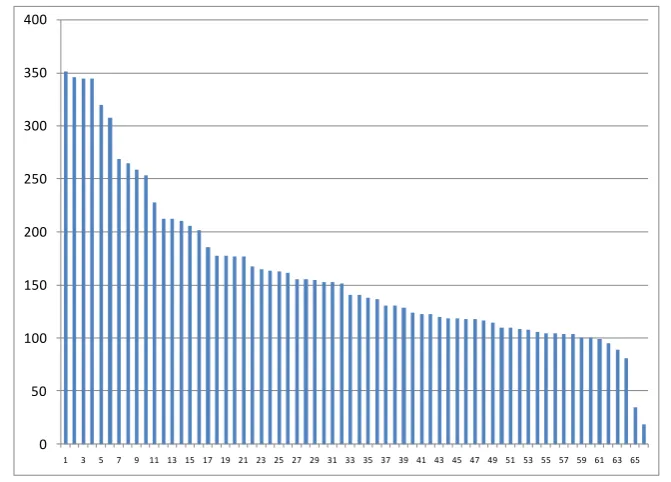
Page | 32 individual case media elements, including case pictures and more detailed
focused data (see Figure 4 below).
Figure 4: Hits from the “Other” Section
Figure 4 shows that based on a cohort size of 188 students, the ten most popular
case elements were accessed at least once. It is interesting to note that students
appeared to be selective in which media elements of the case to access, possibly
indicating some prioritising of the case complexity.
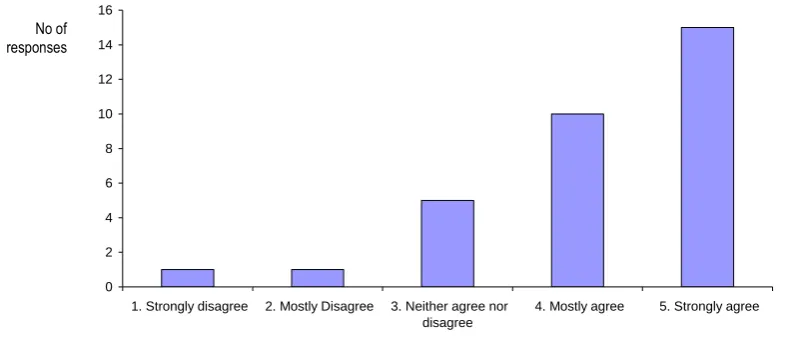
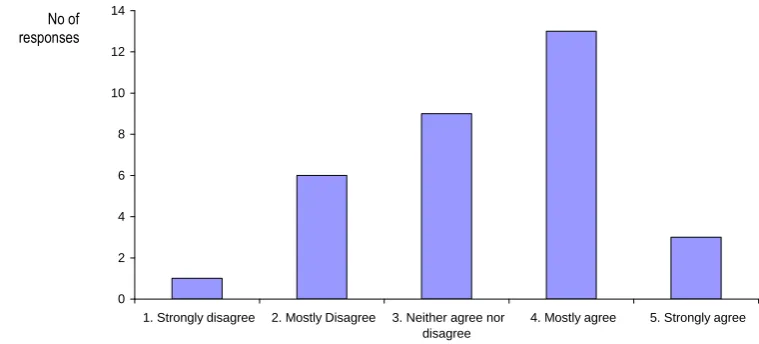
Module Evaluation Survey Data
The quantitative survey data shown in Figures 5a, 5b and 5c below provide some
evidence that the students found the multimedia case approach realistic, complex
and suitable.
Figure 5a: Case Realism Quantitative Survey Data
Figure 5b: Case ComplexityQuantitative Survey Data
Page | 33 Focus Group and Interview Data
Table 3: Qualitative Comment Mapping
Engagement
From Table 3 above summarising key aspects of the qualitative data, it can be
seen that some students appeared to find the case interesting. One student
expressed the view that despite the business sector not being of natural interest
to her, she still found the case engaging.
Skill Development
The qualitative comments supports the quantitative data about the perceived
complexity, enhanced by some (limited) evidence that the complexity was
bounded enough not to the make the assessment task too difficult. This is
supported by the fact that no more students failed the assessment than is usual
across the level, or in a basic comparison to the previous year on this OM module
(2%). The case approach appeared to allow some students to develop the ability
to make connections and handle the complexity. There were a number of
comments in the module survey about the assessment being “hard” or “difficult”,
but only one student wanted to return to a text case. A number of students
suggested reducing the case complexity slightly and being allowed more time for
the assessment. Although not asked directly about information management
skills, students had noticed these were necessary and attached some value to the
Page | 34 Realism
Again the qualitative data supports the quantitative comments about the realism
of the approach, and one student (unprompted) compares traditional narrative
cases unfavourably with the multi-media case approach.
Learning Approach
The comments in the last row of Table 3 offer perhaps a glimpse of different
learning approaches taken by students, but as commented earlier, more research
is required in this area.
Learning Outcomes
As stated previously, because of the lack of truly comparative data, it was not
appropriate to analyse the assessment outcomes by using grade statistics.
Hence in order to explore this further, we attempted to map student performance
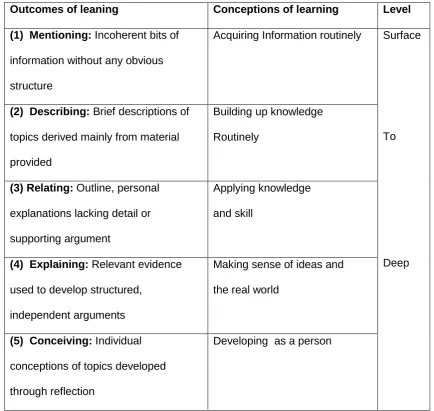
against Entwistle’s map of levels of conceptual learning which show progression
from “reproducing” to “transformation”, (Entwistle, 2000). Table 4 below shows
this mapping.
Table 4: Mapping Learning Outcomes to Conceptions of Learning
The new part of the assignment which asked students to “process map” was
successful in moving almost all students to at least level (3)Relating as shown in
Table 4. That is, they had to apply the relevant knowledge and skills in order to
complete and pass that element of the assessment. In the previous assessment
Page | 35 “process map” task could have been set on a text-based case, this would have
likely been at too simplistic a level and not been authentic to OM practice, where
this procedure is a basic conceptual and practical unit of analysis.
Given the research design limitations of this study, it is difficult to ascertain
whether high levels of learning in the remaining part of the assessment were
achieved. However we did find a significant reduction in level (2) Describing (as
shown in Table 4) in that regurgitation of text from the case was less prevalent,
from at least 25% of papers in the previous year to almost none in this cohort. It
also seems that the introduction of a different type of case study requiring
personal investigation reduced the number of students repeating theoretical
material from text books, although this was less marked. This was perhaps due
to the case study appearing to be a larger constituent of the overall assessment
and learning tasks.
Possibly related to more students finding the case stimulating, we saw a
significant rise in creativity in both recommendations and comments, although
unfortunately these were not often underpinned by analysis. This does appear to
show an increase in level (3)Relating as shown in Table 4 and is in a more
transformative direction, towards deep learning rather than simple repetition. We
also noted more instances of students using evidence that they had found within
the case material to justify a particular statement. This idea of “finding” suitable
evidence correlates with the student who commented that “it was quite hard to get
Page | 36
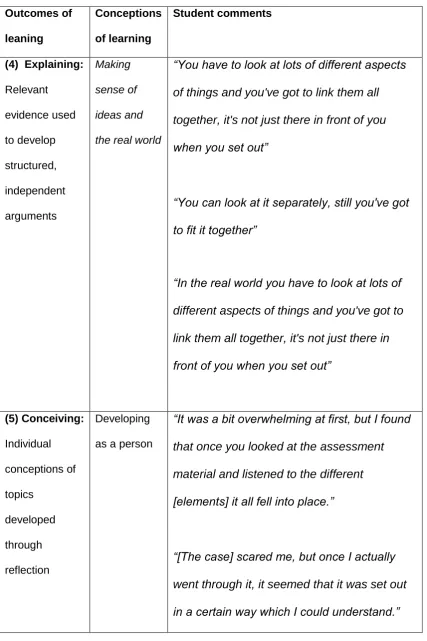
It was possible to map some of the student comments onto levels (4) Explaining
and (5) Conceiving of this framework, as shown in Table 5 below, to highlight
instances where deeper learning may have occurred as a result of using this
approach.
Page | 37 PRACTICE OBSERVATIONS AND REFLECTIONS
We will now discuss the practical considerations of this multimedia case approach
for tutors and students. In an attempt to demonstrate whether this approach
mitigates the issues that arise when using live cases as indicated by Camarero,
Rodriguez & San Jose (2010), these live case concerns will be used here to
structure our own practice observations and reflections.
Motivation – Concerns that students may be initially unmotivated,
requiring additional incentives to engage with the client consultancy process
The multimedia case was made available early in the assessment cycle, but
students were free not to engage with the virtual client case until they decided to
begin their assessment task. This was useful in that students who started later did
not disadvantage themselves as the client interface element of the live case had
already been completed and deposited on the VLE. However due to the amount
of work required in absorbing the various media elements, some students
commented in the focus group that they should not have started just a few days
before the assessment deadline. This was despite repeated guidance from the
module tutors.
Too much realism – Concerns that the validity of the information and the
Page | 38 The advantage of the multimedia case over a client consultancy project is that the
tutor can define and control the limits of the contextual complexity. Indeed it
transpired that deciding what data to include or exclude, and what information to
simplify was an important task. For example the case business, 20th Century
Fires, had two main income and activity streams. The module team decided to
focus the multimedia assessment case on just one of these income streams.
Hence the other business income stream was de-emphasised in presented
material.
It was found to be useful to have one media element, such as meeting minutes,
where fabricated or simulated data could be deposited. This afforded the
opportunity to include implicit information and knowledge gained by the tutor
when visiting the business, or to avoid too many discrete media elements. It was
essential therefore that the case protocol was allowed to develop and change
during our two client visits, especially where significant areas of interest in relation
to the subject became apparent in the business.
Students’ views were mixed on the change in complexity from short and largely
text based teaching cases in tutorial classes to a large assessment multimedia
case, with some finding this an issue and others not.
Definition of the assignment - Concerns about the suitability of the
Page | 39 The multimedia case allowed tutors to focus on areas of the business’s operation
that had resonances with the learning outcomes of the module. It provided
opportunity for students to practice skills, apply techniques, and had appropriate
problems for the level of study.
Company participation – Difficulties in “recruiting” companies and
sustaining their participation during the consultancy scheme
One of the significant benefits of the multimedia case approach is that only one
client company is required to produce the assessment vehicle and this company
is selected by the tutor, rather than by multiple groups of students. This is more
pertinent if the assessment model is to be sustainable as it avoids the same
businesses being contacted year after year by students. Participation of the client
company is restricted to a preliminary discussion and one or two site visits, rather
than a protracted relationship requiring time and resource commitments from the
client. This was initially a concern to a number of companies with whom
preliminary discussions were held.
Time devoted by tutors– Concerns about demands on tutor time in
managing and controlling students and their interactions with the client
The multimedia case means that it is more feasible for students to undertake an
individual assessment on a live case, as finding individual live cases for a large
cohort would be difficult. This therefore reduces the group management role of
Page | 40 much less. Furthermore clients only interact with academic staff, rather than
students, hence reducing potential issues and risks for all parties.
However a key issue emerging from our experiences of case construction was
staff workload. Tasks including multiple site visits and editing the data, especially
voice and video data, were resource intensive, even with the construction of case
protocol prior to data collection. This was due both to the volume of collected
data, and the software editing skills that needed to be learnt by tutors. This was
mitigated slightly by dispersing and sharing the workload amongst the module
team. The client organisation found the case protocol very useful in helping them
manage the access and resources efficiently for the site visits and data collection.
There were technical problems for students accessing some of the case material
on the VLE, all related to the institutional VLE infrastructure and internet browser
settings on student computers, both within the University and externally. In
addition some students complained about the quality and clarity of voice
recordings and the length of the interview pod-casts. From informal
conversations, students also appeared to value the immediacy of the case, in
terms of visibility and access to a range of information and case employees.
Students also suggested that knowing their work could be used to form the basis
of a consultancy report for the case business gave the work more meaning and
improved their motivation. This benefit is therefore a simulated outcome of live
Page | 41 CONCLUSIONS
We conclude by summarising our finding and observations in the practice of
designing, constructing and marking the multimedia case assessment in
comparison to using live cases.
The three main objectives of paper were;
1. Does using a multimedia case study allow progress towards alleviating our
concerns on Engagement, Skill Development, Realism and Learning Approach arising from the use of text based cases for assessment?
2. What are the practical considerations of this multimedia case approach?
3. To what extent does this multimedia case approach mitigate the issues
that arise when using a live case?
The literature supports the view that engagement, realism, and handling
complexity are important in OM, and that traditional text based case studies often
do not provide enough experiential learning to address these concerns. The
research data collected as part of the action research cycle indicated that some
students found the case more stimulating and engaging. Most students found the
case more realistic. Some valued the challenge to develop their skills and
contribute to a consultancy report for the case business. Most students appeared
to view the case as complex, and challenging but on balance were supportive of
Page | 42 The action reflection stages completed offer indications that this approach could
address these concerns but more research is required in this area to validate
these claims, especially whether it leads to different learning approaches taken by
students and improved assessment (hence learning) outcomes.
The live case approach is a proven technique for improving engagement and
experiential learning but has constraints and is not always an assessment option
available to tutors. The multimedia case can offer an alternative by combining the
two approaches of a “site visit” and a live business problem. This multimedia
approach can also offset some of the issues that arise when using live cases.
For VLE-hosted multimedia cases used in teaching or assessment, the VLE
interrogation process could be used for more detailed evaluation of learning, as
this kind of data is not available for text based cases.
Overall, this single case study has provided evidence of the benefits of using
VLE-hosted multimedia case studies in Operations Management. It clearly opens
up options for innovative teaching and assessment with large cohorts of
inexperienced undergraduates, perhaps in other areas of Business and
Management studies and possibly other unrelated subjects. We hope that our
Page | 43 REFERENCES
Adler, P. S. (1989). When knowledge is the critical resource, knowledge
management is the critical task, IEEE Transactions on Engineering
Management, 36(2), 87-94
Alexander, L.D., O’Neill, H.M., Snyder, N.H. & Townsend, J.B. (1986). How
academy members teach the business policy/strategic management course,
Journal of Management Case Studies, 2(4), 334-344.
Argyris, C. (1980). Some Limitations of the Case Method: Experiences in a
Management Development Program, Academy of Management Review, 5(2),
291-298.
Biggs, J. B. (1996). Enhancing teaching through constructive alignment, Higher
Education, 32, 347-364.
Booth, C., Bowie, S., Jordan, J. & Rippin, A. (2000). The Use of the Case Method
in Large and Diverse Undergraduate Business Programmes: Problems and
Issues, International Journal of Management Education, 1(1), 62-75.
Brennan, R. & Ahmad, S. J. (2005). Using case studies in management
education: the student perspective, International Journal of Management
Education, 4(3), 21-30.
Brown, S. (2004). Assessment for Learning, Learning and Teaching in Higher
Education, 1, 81-89
Bryson, C. & Hand, L. (2007). The Role of Engagement in Inspiring Teaching and
Page | 44 Camarero, C., Rodriguez, J. & San Jose, R. (2010). A comparison of the learning
effectiveness of live cases and classroom projects, International Journal of
Management Education, 8(3), 83-94.
Cameron, S. (1999). The Business Student’s Handbook: Developing transferable
skills, FT Pitman Publishing, London.
Carr, M. & Kemmins, S. (1986). Becoming critical: Knowing through action
research, Deakin University Press, Geelong, Victoria.
Cumming, J. J. & Maxwell, G. S. (1999). Contextualising Authentic Assessment,
Assessment in Education, 6(2), 177-194.
Currie, G. & Tempest, S. (2008). Moving towards reflexive use of teaching cases
within the MBA, International Journal of Management Education, 7(1), 41-50.
Desai, K. & Inman, R. A. (1994). Student Bias against POM Coursework and
Manufacturing, International Journal of Operations & Production Management,
14(8), 70-87.
Elam, E. L. R. & Spotts, H. E. (2004). Achieving Marketing Curriculum Integration:
A Live Case Study Approach, Journal of Marketing Education, 26, 50-65.
Entwistle, N. (2000). Promoting deep learning through teaching and assessment:
conceptual frameworks and educational contexts, Paper presented at the TLRP
Conference, Leicester, November
Field, L. (2002). Industry speaks! Skill requirements of leading Australian
workplaces, DEST, Canberra, Australia.
Gibbs, G. & Simpson, C. (2004). Conditions Under Which Assessment Supports
Page | 45 Goffin, K. (1998). Operations management teaching on European MBA
programmes, International Journal of Operations & Production Management,
18(5), 424-451.
Gurd, B. (2001). The Importance and Role of Management Case Studies, The
Management Case Study Journal, 1(1), 1-8.
Helms, M. M. (1989) To Produce Interest in Production, Just Open the Factory
Door, Production & Inventory Management Journal, 30(2), 72-74.
Heriot, K. C., Cook, R., Jones, R. C. & Simpson, L. (2008). The Use of Student
Consulting Projects as an Active Learning Pedagogy: A Case Study in a
Production/Operations Management Course, Decision Sciences Journal of
Innovative Education, 6(2), 463-481.
Hoskin, K. (1998). The mysterious case of the case study: a re-thinking,
Accounting Education, 7, 57-70.
Jackson, D. (2010). An international profile of industry-relevant competencies and
skill gaps in modern graduates, International Journal of Management Education,
8(3), 29-58.
Jerrard, M. A. (2005). Assessing Student Learning and Skills Using the Case
Study Method, Journal of New Business Ideas and Trends, 3(1), 27-36.
Juul, J. (2001). Games Telling stories?- A brief note on games and narratives,
Game Studies, 1(1), 1-12.
Kember, D., Ng, S., Tse, H., Wong, E. T. T. & Pomfret, M. (2001). An examination
of the interrelationships between workload, study time, learning approaches and
Page | 46 Kennedy, E. J., Lawton, L. & Walker, E. (2001). The Case for Using Live Cases:
Shifting the Paradigm in Marketing Education, Journal of Marketing Education,
23, 145-151.
Knight, P. & Yorke, M. (2004). Learning, curriculum and employability in higher
education, Routledge Falmer, London.
Kolb, D. A. (1984). Experiential Learning: Experience as the source of learning
and development, Prentice-Hall, New Jersey.
Kreber, C. (2001). Learning Experientially through Case Studies? A Conceptual
Analysis, Teaching in Higher Education, 6(2), 217-228.
Lundberg, C. C., Rainsford, P., Shay, J. P. & Young, C. A. (2001). Case Writing
Reconsidered, Journal of Management Education, 25(4), 450-463.
McNiff, J. & Whitehead, J. (2006). All You Need To Know About Action Research,
Sage Publications Ltd, London.
Mintzberg, H. (1990). The Design School: Reconsidering the Basic Premises of
Strategic Management, Strategic Management Journal, 11(3), 171-195.
Morris, J. S. (1997). Teaching production and operations management,
Production and Inventory Management Journal, 38(2), 42-47.
Nicholson, A. (1997). Bringing management reality into the classroom - the
development of interactive learning, Journal of Management Development, 16(6),
438-451.
Norton, L. S. (2009) Action Research in Teaching and Learning: A practical guide
Page | 47 O'Cinneide, B. (2006). Developing and testing student oriented case studies: The
production process and classroom/examination experiences with 'entertaining'
topics, Journal of European Industrial Training, 30(5), 349-364.
Ottewill, R. M. (2003). What's wrong with instrumental learning? The case of
business and management, Education + Training, 45(4), 189-196.
Prosser, M. & Trigwell, K. (1999). Understanding Learning and Teaching: The
Experience in Higher Education, Open University Press, Buckingham
Richardson, B. (1994). Towards a Comprehensive View of the Case Method in
Management Development, Industrial and Commercial Training, 26(9), 3-10.
Riordan, T. (2005). Education for the 21st Century: Teaching, Learning, and
Assessment, Change, 37(1), 52-56.
Rippin, A., Booth, C., Bowie, S. & Jordan, J. (2002). A Complex Case: using the
case study method to explore uncertainty and ambiguity in undergraduate
business education, Teaching in Higher Education, 7(4), 429-441.
Ryan, M. (2001). Beyond Myth and Metaphor - The Case of Narrative in Digital
Media, Game Studies, 1(1), 1-14.
Smith, D.J. (1990). The Use of Microcomputer-based Simulation Models in the
Teaching of Operations Management, International Journal of Operations &
Production Management, 10(5), 5-16.
Sun, H. (1998). A game for the education and training of production/operations
management, Education + Training, 40(9), 411-416.
Svinicki, M. D. (2004). Authentic Assessment: Testing in Reality, New Directions
Page | 48 Visich, J. K. & Khumawala, B. M. (2006). Operations Management Curricula:
Literature Review and Analysis, Journal of Statistics and Management Systems,
9(3), 661-687.
Weick, K. E.(1995). Sensemaking in Organisations, Sage Publications Inc,
Thousand Oaks, California.
Wenger, E., McDermott, R. & Snyder, W. (2002) Cultivating communities of
practice: a guide to managing knowledge, Harvard Business School Press,
Westhead, P. & Matlay, H. (2005) Graduate Employment in SMEs: a longitudinal
perspective, Journal of Small Business and Enterprise Development, 12(3),
353-365.
Wiggins, G. (1998). Educative Assessment: Designing Assessments to Inform
and Improve Student Performance, Jossey-Bass, San Francisco.
Wolfe, J. (1998). New developments in the use of cases for learning, Journal of
Workplace Learning, 10(6/7), 320-323.
Yin, R. K. (1994). Case Study Research; Design and Methods, Sage
Page | 49 Figure 1: Action-Reflection Cycles of Action Research
Figure 2: Stages of Action Research Contextualised
Identify a concern
Take stock of what is going on
Think of a possible way forward
Try it out
Evaluate the action byby gathering data to show what is happening
Establish procedures for making judgements about what is happening
Introduction
Literature Review -the wider context Leeds Metropolitan University Context Multimedia Case Pilot
[image:50.595.102.336.375.572.2]Page | 50 Figure 3: Multimedia Environmental Map
Table 1: Case data collected and compiled
Video footage of operation Financial statements
Product photos Photos of equipment, areas and warehouses
Demand data (Excel sheets) Works Order documentation (scanned images)
Layout diagrams Inventory data
Video footage of key processes Text Introduction
Organization diagrams Company website
Audio interviews with staff (podcasted) Meeting minutes (fabricated) Multi-Media Case Case Video Case pictures •Products •Premises •Processes
Case Web Sites
Layout Drawings Staff Interviews Financial Statements Case Description Internal Data Internal Documentation -Media Case Case Video Case pictures •Products •Premises •Processes
Case Web Sites
Layout Drawings Staff Interviews Financial Statements Case Description Internal Data Internal Documentation Multi-Media Case Case Video Case pictures •Products •Premises •Processes
Case Web Sites
Layout Drawings Staff Interviews Financial Statements Case Description Internal Data Internal Documentation -Media Case Case Video Case pictures •Products •Premises •Processes
Case Web Sites
Page | 51 Table 2: Most Popular Hits from the VLE Case Site
Figure 4: Hits from the “Other” Section
Assessment files
VLE Hits
Hits per student RatioVideo Streaming of case 1479 7.9 9%
Introduction 1138 6.1 7%
Assessment case overview 1041 5.5 7%
Ground Floor Layout 673 3.6 4%
2006 Demand profile 422 2.2 3%
Case Website: 399 2.1 3%
Other 10707 57 68%
Total 15859
Individual case media elements No. of Hits
0 50 100 150 200 250 300 350 400