players: A negative case analysis. Psychology of Sport and Exercise, 21. 65 - 77. ISSN 1469-0292 DOI: https://doi.org/10.1016/j.psychsport.2015.04.003
Link to Leeds Beckett Repository record: http://eprints.leedsbeckett.ac.uk/1392/
Document Version: Article
The aim of the Leeds Beckett Repository is to provide open access to our research, as required by funder policies and permitted by publishers and copyright law.
The Leeds Beckett repository holds a wide range of publications, each of which has been checked for copyright and the relevant embargo period has been applied by the Research Services team.
We operate on a standard take-down policy. If you are the author or publisher of an output and you would like it removed from the repository, please contact us and we will investigate on a case-by-case basis.
1 A holistic perspective on career development in UK female soccer players: A negative case
analysis
Adam Gledhill1,2 & Chris Harwood2
1School of Rehabilitation and Health Sciences, Leeds Beckett University, Leeds, LS13HE
2 School of Sport, Exercise, and Health Sciences, Loughborough University, Loughborough,
Leicestershire, LE11 3TU, UK
For correspondence: Adam Gledhill School of Rehabilitation and Health Sciences, Leeds Beckett University, Leeds, LS13HE
2
Highlights
We developed a grounded theory of factors contributing to career/talent development and transitions in UK youth female soccer.
Players and significant social agents must optimally interact to create an effective learning environment
Functionally relevant challenges at an appropriate level are necessary for player development
Role strain is a significant threat to talent development and career transitions in female soccer
3 Abstract
Objectives: The purpose of this study was to examine career experiences of UK-based female youth soccer players from a holistic perspective with a view to producing a grounded theory of factors contributing to career/talent development and transitions in UK youth female soccer.
Methodology: A Grounded Theory methodology (Corbin & Strauss, 2008) was used.
Negative case (Denzin, 1989) former female soccer players (N=13), their best friend (N=13), soccer coaches (N=4), and teachers (N=8) took part in semi-structured interviews about factors associated with talent development and career transitions in female youth soccer. Results: Multiple social agents (players, team-mates, peers, teachers, parents and siblings) need to optimally interact to ensure that an optimal talent development and learning environment is created. This will provide a supportive holistic talent development environment, lead to adaptive player-level changes, and a greater chance of successful athletic and dual career development.
Conclusions: This study presents a rich understanding of the dual careers of players who did not make it in female soccer. By considering their perspectives alongside of a range of important social agents, we have been able to construct a substantive grounded theory of factors contributing to career/talent development and transitions in UK youth female soccer. As a result, these findings may contribute to policy and practice development in UK female youth soccer.
Keywords: Soccer; female soccer; dual career; student athletes; grounded theory; negative
4 Within sport psychology literature, the notion of dual careers (i.e., combining sport and education; sport and employment) has gained momentum to the point where it is now considered an international topic that is visible in research from across the globe, including Europe, North America, and Australia (Stambulova & Ryba, 2014). Given that athletes invest significant time and effort into their sporting and life development careers (O’Neill, Allen, & Calder, 2013; Stambulova & Wylleman, 2014) it is perhaps unsurprising that this body of research has gained such momentum, with scholars aiming to support athletes with attaining an optimal balance that will allow them to successfully navigate key life changes, such as; junior-to-senior career transitions, progression through education, and progression to post-sport careers (e.g., Stambulova, Engström, Franck, & Linnér, 2014). As such, recent research-informed political attention has been given to how young athletes might best be supported with their dual careers (e.g., European Commission, 2012).
Despite the importance of athletes’ dual career investments, how athletes view themselves and their endeavours within their dual career experiences is reported to be under-investigated (Cosh & Tully, 2014). Moreover, studies that have under-investigated dual career experiences have tended to investigate multiple sports and both male and female athletes (e.g., O’ Neill et al. 2013; Stambulova et al. 2014). Whilst providing valuable insights into
dual career experiences, a multi-sport study may not be sensitive to the nuances of an
individual sport within it. One sport that presents quite unique dual career demands on young athletes, is soccer (Christensen & Sørensen, 2009; Larsen, Alfermann, Henriksen &
Christensen, 2013; McCormack & Walseth, 2013).
Recently, female soccer ameliorated on a global scale, with 29 million players across the world (Scott & Andersson, 2013) and greater attention now being paid to the
5 scale. As part of this, FIFA (2014) released its women’s soccer development programme guidelines (2015 – 2018). This document includes key principles for the development of women’s soccer; these principles include sustainable and professionalised competitions for
female soccer, and having an expert knowledge base involved within decision making.. In addition, FIFA’s individual nations have developed bespoke soccer development strategies.
For example the English Football Association (FA) launched their ‘Game Changer’ strategy for developing women’s soccer (2013-2018) in which they cite the effective transition of
youth players to adult players as an important part of the strategy (FA, 2012). Central to these effective transitions is the requirement for a sound knowledge base which can effectively inform policy and procedural decisions.
Of particular interest to this special issue; when experiencing player development centres1 in the UK, female youth soccer players will often be balancing dual careers in
education and sport, as well as attempting to reconcile these within the different stages of adolescence. As a result, these demands may threaten a player’s ability to successfully transition the different stages of their career (e.g., from development to mastery/perfection stages; Wylleman & Lavallee, 2004) or lead to voluntary dropout (e.g., European
Commission, 2012). Considered alongside the aforementioned growth and development of female football in the UK, this suggests that greater understanding of talent development and career transitions of female players in the UK may serve to facilitate the balance of players’ dual careers and, thus, help to keep talented young players in both their soccer and
educational systems. Despite this, little scholarly attention has been paid to these factors in female soccer players (McCormack & Walseth, 2013). This is an important consideration for the body of research given that it further demonstrates historically reported trends that female athletes in general are typically under-represented in sport psychology literature (e.g.,
6 Conroy, Kaye, & Schantz, 2008); that female and male athletes will typically have
qualitatively different developmental experiences (e.g., Gill, 2001); and in order to extend culturally specific understanding, marginalised groups of athletes (such as female soccer players) need to be more visible in dual career research (e.g., Stambulova & Ryba, 2013; 2014).
With this lack of gender-specific understanding in-mind, Gledhill and Harwood (2014) sought to examine the developmental experiences of elite UK female youth soccer players. Using interviews and fieldwork, they highlighted the meaning attached by elite female soccer players to important psychosocial factors such as support from parents, siblings, soccer friends, non-soccer friends and how they impacted on important
developmental factors such as leading a disciplined lifestyle. Moreover, self-regulation and adaptive volitional behaviours were identified as key intra-individual competencies that are central to talent development and career transitions in female soccer players. Finally, using their composite sequence analysis approach, Gledhill and Harwood were able to sequentially structure these developmental experiences which provided a more plausible and
developmental understanding of how the different factors associated with talent development
7 Whilst existing soccer literature allows for inferences to be made about dual careers in soccer, most of these are underpinned by literature examining talent development in soccer and then subsequently extrapolating these findings in to the wider context of career
transitions. This has included identifying psychosocial assets of soccer players who are considered elite in their domain (e.g., Gledhill & Harwood, 2014; Holt & Dunn, 2004; Van Yperen, 2009) and examining the views of those tasked with developing male soccer players to an elite level (e.g., Morgan, McKenna, & Nicholls, 2014) in order to outline personal resources that will facilitate normative career transitions in soccer. Frequently, literature has provided confirmatory findings that support the notion of important player-level assets (e.g., resilience, self-regulation) and/or socio-environmental factors (e.g., parental, peer or sibling support) that may positively influence talent development. Collectively, these factors can be conceptually linked with developmental stages offered in non- soccer specific athlete
transitions models (e.g., Stambulova, 2003; 2009; Wylleman & Lavallee, 2004) to allow scholars to understand how players may make successful career transitions. However, given the significant level-bias towards elite youth or adult soccer players, it is difficult to
understand the differences between those who domake it and those that don’t make it in female soccer. Therefore, to extend current understanding about the complexity of the developmental experiences of female soccer players in the UK from a more holistic perspective, research that examines experiences of lower level players or less-successful players is warranted. One way to address this gap is to adopt a negative case analysis approach (NCA; Denzin, 1989) with female soccer players.
8 view to broadening understanding and encouraging change where required. For this reason; we argue that a better understanding of the developmental experiences of female players who have not advanced to the highest levels of female soccer in the UK (despite having
experienced a female talent development pathway) will extend existing sport psychology literature as it provides the opportunity to produce a grounded theory of talent development and career transitions in female youth soccer.
Whilst grounded theories of talent development in soccer are present in the existing literature (e.g., Holt & Dunn, 2004; Holt & Mitchell, 2006) these are not culturally or contextually sensitive to the experiences of UK female soccer players. Moreover, existing literature on dual careers (e.g., Stambulova & Ryba, 2014) has reported that research adopting a holistic perspective (i.e., combining a whole person, whole career and whole environment approaches) is a challenge that will enable scholars to extend current
understanding. Combining these arguments with recent calls for contextually and culturally specific understanding in sport psychology literature (e.g., Clarke & Harwood, 2014; Stambulova & Ryba, 2014), we contend that a grounded theory approach is warranted. As such, the purpose of this study was to examine career experiences of UK-based female soccer players from a holistic perspective (including sport, studies and adolescent social life) with a view to producing a substantive grounded theory of factors contributing to career/talent development and transitions in UK youth female soccer.
Method
Ontological and epistemological assumptions
In a move away from the dominant positivist/post-positivist perspective in dual career research (Stambulova & Ryba, 2014) we approached this study from an interpretivist
9 clues as to the kind of decisions the players made throughout their developmental
experiences. This perspective is consistent with a relativist ontological position in that there are multiple co-existing realities among individuals (Corbin, 2009).
Grounded theory methodology and methodological congruence
Grounded theory was most useful in this instance where we aimed to generate a substantive theory relevant to this particular area of study with the purpose of offering insight as a basis for future research in an area that has received little empirical or conceptual
analysis (Creswell, 2013; Corbin & Strauss, 2008). We used Corbin and Strauss’ (2008) variant of grounded theory to address the research problem. This variant of grounded theory embraces the constructivist viewpoint in that "concepts and theories are constructed by researchers out of stories that are constructed by research participants who are trying to explain and make sense out of their experiences and/or lives, both to the researcher and themselves" (p.10). Corbin proffers that generating concepts in this way serves to increase understanding of peoples’ everyday lives, whilst also leading to discussion and debate which
can further develop understanding. This mode of concept generation is consistent with our rationale for the adoption of a NCA-based study. Therefore, the selected variant of grounded theory was consistent with the philosophical underpinning and aims of our study, thus demonstrating methodological congruence (Mayan, 2009).
Theoretical sensitivity
10 we used existing literature (e.g., Gledhill & Harwood, 2014; Holt & Dunn, 2004) to: (a) affirm only partial understanding of talent development and career transitions in female soccer; and, (b) develop initial questions and ideas for theoretical sampling.
Sampling and participants
Purposive sampling (Patton, 2002) was initially adopted as grounded theory research begins by recruiting participants who are presumed to be able to provide data that will best address the research problem. Accordingly, after gaining ethical approval from a UK-based
University, participants were invited to take part in a study about women’s soccer and were told that the over-arching aim was to provide recommendations for enhancing the chances that female soccer players would have a successful career within soccer. We sampled 13 female participants (M age = 19.61 ± 1.19) who were initially retrospectively interviewed about their experiences as a developing female soccer player. They had accessed player development centre coaching for between 3-7 years (M = 4.62 years ± 1.85) prior to
withdrawing from competitive soccer. The mean time since withdrawal from soccer ranged from 1-4 years (M=2.28 ± 0.9). Inclusion criteria were that participants were (former) female soccer players aged 18 or over (this is normally the age that access to player development centre coaching at a local or regional level ceases) who have experienced a player
development centre programme but not progressed into either Women’s Premier League, Women’s Super League, or international teams at either age-group or senior international
level. All participants in the study had successfully transitioned through compulsory
11 Data was collected through in – depth, semi – structured interviews with players (n=13, ranging from 42 minutes – 91 minutes). The interview guide was based on previous soccer-specific talent development literature (Gledhill & Harwood, 2014; Holt & Dunn, 2004); and was provided to players prior to the interview so that they could consider the focus and nature of the interview to increase the richness of data (cf. Christensen, 2009). Players were questioned about their experiences of growing up as a female soccer player (e.g., Can you talk to me about what it was like growing up as a girl that was good at soccer?; What challenges did you face as a female soccer player?); Peer-relationships (e.g., Did / How did your friends in / out of soccer help you to develop as a soccer player?); Parents (e.g., Can you talk to me about your parents’ involvement in your soccer career?); Coach relationships
(e.g., Can you talk to me about your relationship with your coach/coaches?; What types of activities did you do at practice?; Did coaches pay equal attention to different aspects of your development, such as technical and psychological?); and the interview guide was refined and developed as interviews progressed. Interview questions consisted of main questions, probe questions, and follow – up questions to ensure accurate understanding of responses (Rubin & Rubin, 2005). Data was recorded and transcribed verbatim.
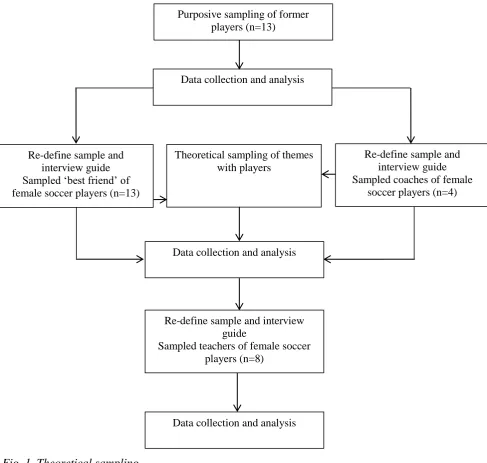
Data collection and analysis was an iterative cycle. Analysis began as soon as the first data were collected (Corbin & Strauss, 2008), with initial analysis leading to further data collection, theoretical sampling and data analysis (Holt & Tamminen, 2010). Throughout the initial 13 interviews with players and the subsequent data analysis, a number of concepts emerged that led to the theoretical sampling of additional social agents who were deemed to have influenced the players’ developmental trajectory (see Fig.1). As emerged relating to the
12 Coaches were qualified to UEFA ‘B’ (n=3) and UEFA ‘A’ (n=1) license level,
coaching experience ranged from 6 – 24 years, and all coaches had experience of coaching male and female players (including coaching female players who have progressed to either youth or senior female international soccer). They were theoretically sampled to glean information about the concepts of coach-player relationships, coach-team mate relationships, coach perceptions of female soccer, and coach perceptions and experiences of working with players of different ability levels. Coaches were interviewed first about their views on female soccer and how it had developed in recent years. Interviews with coaches ranged from 30 – 113 minutes. This initial unstructured element was to develop an interview rapport with the coaches to facilitate the richness of data (Rubin & Rubin, 2005). As the interview progressed, we then discussed the coaches’ behaviours in a more general manner (e.g. “Can you tell me how you try to engage a broad range of abilities in single coaching sessions?”), followed by
progressing the interview on to more specific aspects that the players had raised (e.g. “Have you ever witnessed times when players have been given preferential treatment by coaches because of their advanced playing ability?”).
Interviews with the player’s ‘best friend’ centred on the social experiences of being an
adolescent female to examine the concepts of peer relationships, the nature of peer
relationships, factors affecting these peer relationships and the impact of peer relationships on talent development and career transitions. Interviews ranged from 42 – 45 minutes. These interviews began with the first author posing questions regarding the lived experiences of the peers (e.g. “Can you tell me about your friendship with…during your time at
school/College?”). Questions increased in specificity to the social life (e.g. “Can you talk me through your social lives during your time at school /College?”). Finally questions progressed on to relationship specific questions (e.g. “Did you ever play a role in helping your friend
13 with your friend?”). No data was recorded regarding the length of friendship; however events
recounted indicated that friendships had been in place for at least six years at the time of first interview.
Teachers were qualified to Masters level (n=6) or undergraduate level (n=2), all of which were in either leisure studies, sport and exercise sciences or physical education related areas. Their teaching experience ranged from 5-23 years. All teachers were in possession of a relevant post-graduate level teaching qualification and they had worked with players in teaching and/or pastoral support capacities for two years. They were theoretically sampled to examine the concepts of: teaching talented female soccer players; teacher – player
relationships; teacher – parent relationships; teacher views of female soccer; and the career prospects of female soccer players. Teacher interviews also had an initial unstructured element that centred on the teachers’ experience of working with talented athletes (e.g. “Can you tell me about a time when you have taught or tutored a talented young athlete?”). After
this, interviews progressed on to more specific aspects of the teaching experience (e.g. “Can you talk me through any of the challenges of teaching talented young soccer players?”).
Finally, the interviews progressed on to more specific issues presented during the player interviews (e.g. “How do you try to support talented young soccer players to reconcile their roles as student-athletes?”). Interviews with teachers lasted 37 – 52 minutes.
These additional social agents were sampled to gain a richer understanding of how the different interactions between multiple social agents could impact on talent development and career transitions in female soccer, with the intention of achieving theoretical saturation (Corbin & Strauss, 2008). Data collection was discontinued when it ceased producing new insights (cf. Morse, 1995).
14 We engaged in iterative data analysis with a view to achieving an adequate level of theoretical saturation (Corbin & Strauss, 2008). Three stages of coding were used during data analysis. First, open coding was conducted with the audio and written data to identify the initial concepts and their meaning for talent development and career transitions in female soccer. For example; initial concepts of ‘peers’ perceptions of female soccer’, ‘peers’ role in lifestyle choices’, and ‘soccer peer expectations’ were constructed from the data and
subsequently grouped under the initial category of ‘player - peer interactions’. Through axial
coding, relationships between concepts and categories were explored so that we could form more precise categories. For example; ‘player-peer interactions’ was explored further and broken down into more precise categories of ‘player and team-mate interactions’ (which was refined further still to ‘coach, player and team-mate interactions’) and ‘player and non-soccer peer interactions’ (which was later refined further still to ‘player, non-soccer peer and sibling interactions’). During theoretical integration (Corbin & Strauss, 2008), we re-constructed the
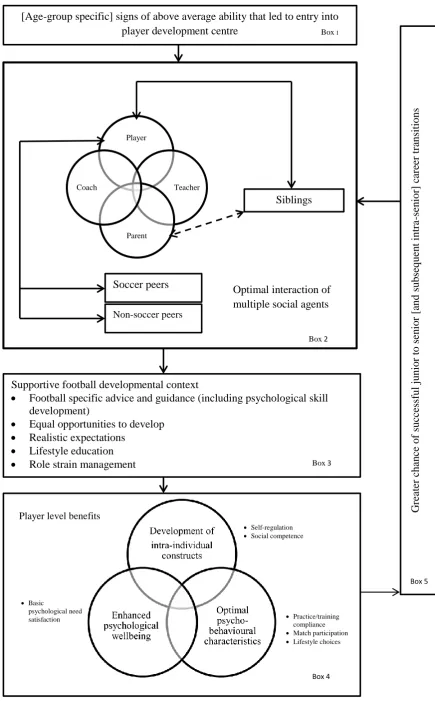
data into the explanatory model (Fig. 2) in which we encapsulated the relationships between the core and underpinning categories.
Memo-writing and diagramming were used to explain and develop relationships between concepts and to aid reflexivity on the part of the researchers (Corbin & Strauss, 2008). Diagramming primarily was used to develop the appearance of the theoretical framework and to organise thoughts about the relational nature of concepts.
15 including the second author (both of whom have extensive experience of grounded theory research), one female soccer coach with extensive experience of playing and coaching women’s soccer in the UK (otherwise unrelated to the study), and one male Head of Sport
Science and Medicine with extensive experience of working with talented female youth soccer players (otherwise unrelated to the study) were also asked to comment on the general presentation of the diagram and the theoretical proposals. Collectively, comments contributed to the final layout of the theoretical framework. These processes were designed to add to the credibility of the research by examining the degree to which participants and other potential ‘end-users’ of the research found it both comprehensible and meaningful (Tracy, 2010).
After producing the final theory and confirming the central proposals, we conducted an extensive review of literature. Initially we focussed this review on studies that
demonstrated positive cases of talent development in soccer (e.g., Gledhill & Harwood, 2014; Holt & Dunn, 2004) or factors considered important for talent development in soccer (e.g., Mills et al. 2012; Morley et al. 2014). This was followed by a broader consideration of wider literature associated with developmental considerations presented through the grounded theory, such as; learning (e.g., Eisenkopf, 2010), self-regulation (e.g., Toering et al. 2009), role strain (e.g., Goldberg & Chandler, 1991), career transitions (e.g., Stambulova et al. 2012) and dual career experiences (e.g., Stambulova et al. 2014). In doing so, this allowed us to permeate into our analysis the second viewpoint of the cultural praxis of athletes’ careers paradigm (Stambulova & Ryba, 2014). This highlights the need for inter- or
trans-disciplinary understanding when interpreting athletes’ lived experiences, as they are too
16 conceptual support to the proposals that an absence of these negative conditions may lead to a greater chance of talent development and successful career transitions in female soccer.
Results
The processes outlined in the method led to the development of a substantive grounded theory of talent development and career transitions in female youth soccer that was
constructed around the core category of optimal social interactions enhancing the chances of successful talent development and career transitions. In the context of this study, we define social interactions as communications or collaborations involving two or more people that can influence the way in which those people work with each other within a talent
development and career transitions social milieu. This core category is underpinned by two categories: (1) Developing a supportive soccer talent development context; and (2)
Developing the player. With reference to these categories, the first part of the results demonstrates the experiences of players and other social agents influential in talent
development and career transitions in female youth soccer. In keeping with the interpretivist nature of the study, we have used multiple sub-headings and rich quotes from multiple participants to piece together the implicit meaning (Cresswell, 2013) of these experiences for the career transitions of female soccer players in the UK. We adopted this tactic being
mindful of the following: the need for clearly articulating the multidimensionality of career transitions (Stambulova & Alfermann, 2009) on intra-individual and socio-cultural levels; and in an attempt to answer calls for a greater interactional understanding (i.e., between the player and their environment) of developmental experiences in soccer (e.g., Mills et al. 2012). Finally, the grounded theory and key theoretical proposals are presented at the end of the results.
17 Between the ages of 13-15 years, it was clear that normative behaviours in the
players’ social circle pointed towards more of an ‘adult’ lifestyle which players were drawn
in to. By 15 years old, many of the players in our study had started to place greater value on their ‘normal teenage’ identity as opposed to their ‘soccer’ identity. This was primarily due to
the normative social behaviours of non-soccer peers and, where applicable, the player’s older sibling (s). As players moved between 15-17 years old, players and their best friends began to place greater emphasis on going out drinking with friends. Players reported doing this on the night before training or games and sporadically missing training or games because of their resultant ‘hangover’. This would often be disguised to parents by telling parents that they “felt ill” [Jordana] as players reported that often their parents “Didn’t have a clue what I was doing because I just said I was staying at a friend’s [house]” (Leigh-Anne; Bryony).
From 14-16, players also experienced significant role overload from their teachers as the important General Certificate of Secondary Education (GCSE) examinations took priority in education. Given the importance of the GCSEs for one’s educational future, teachers engendered or enforced the ‘student’ role identity of the players, often drawing on parents to
reinforce this. As such, it was during this age that players further developed their non-soccer role identity, despite them still being actively involved in soccer.
From 16-18 years, players were socialized further still into non-soccer role identities, despite many of them wanting to – at 16 – still focus attention on playing football.
Specifically, players cited teachers discussing that “girls can’t be professional soccer players yet as there isn’t a structure for it” (Jemima), parents invariably supporting the standpoint of
teachers and prioritizing education over soccer, and, in some cases, coaches emphasizing the importance of education (e.g. “If I ever said I was struggling with school work, my coach
18 support the teacher’s requirements for educational success, even to the extent of banning
players from attending training or games unless they had caught up with work.
Teachers highlighted different approaches to student support between elite and non-elite players from the point of view of facilitating their soccer involvement. The teachers’
professional outlook appeared to be underscored by the playing level of the student-athlete and the teacher’s perception of whether the player had a chance of ‘making it’:
“I work differently with the girls who are representing [youth international team] to those who aren’t because I know they are the ones who might make some sort of career out of it…plus there’s no point me trying to stop them going off to camps because they’ll just go anyway and I know that their mum or dad will support them in that decision. It is easier for me to get the parents on side if their daughter doesn’t
play for one of the top teams or play at youth international level because then I can justify their education and can reconcile the greater value of it against their football. Yes, I would love for them all to make it because that is their passion, but I know that most of them won’t so I have to meet that demand for them as well, as much as they don’t like it sometimes.” (Michaela).
Jack (a teacher) demonstrated a different perspective that highlights the role demand of teachers and the impact of institutional demands on teachers’ decision making:
“It’s great that we have some talented student-athletes. Good for the marketing for
[College]. But they have to realise that they are students first and athletes second. I have to get them through their qualifications and if I don’t, I get my boss on my back. Most – if any – of these [players] won’t have anything like a professional career so I need to make sure that the end result for them, and me, isn’t a fail statistic. If soccer
19
Player, non-soccer peer and sibling interactions, social competence, and role strain
The following passages provide evidence of the female players’ inability to manage
the role conflict that emerged between their role as a female soccer player and their role as an adolescent female. Players had witnessed the lifestyle of youth international players (usually their team-mates or close friends within soccer) and did not want to have to give the
commitment required to maintain that lifestyle:
Leigh-Anne: “I mean like, I saw what the [international] girls had to do to play there; keeping food diaries, training every day, away from their family playing all the time, ‘don’t do this, don’t do that’; no way was that for me!”
Maladaptive lifestyle choices (e.g., prioritising social life, nights out drinking over soccer as they entered early – mid teenage years) were key indicators of a lack of discipline, lack of sacrifice and, thus, a lack of social competence:
Leigh-Anne: “I could have been like ‘no, I want to concentrate on this [my soccer]’ but I didn’t, I’m quite easily led in a way and I just wanted to be like everybody else…”
All players reported having non-soccer friends who were focussed on leading a ‘normal teenage lifestyle’ involving lots of nights out drinking. This impacted on the role
strain experienced by players as there was a degree of role conflict between the ‘female soccer player’ role, and the ‘adolescent female’ role. Developing players tended to be encouraged by peers to ‘follow the crowd’. Some players felt they lacked a peer social
support network that would help them to lead a disciplined lifestyle. For example, when asked if she felt she had that type of support, Bryony responded with “no, not
really…sometimes my team-mates were even worse than my friends outside soccer for that!”
20 Melanie: “I think my best memory is a house party at mine when we were about 13. My parents weren’t there so we had loads of friends round and raided the spirits
cabinet. We did not feel well after that! Then I remember the first time we went into town together. We were about 16 and because we were bigger than a lot of people our age, we could get in everywhere, but Bryony’s big sister came with us just in case
[laughs]. We thought that if we had some older people with us it would make it easier to get in places.”
Other players appeared concerned about their peers’ perceptions of their sexual orientation, a perception that players felt was created by them playing soccer. The passage below from Leigh-Anne demonstrates how these factors combined to influence her lifestyle choices:
Interviewer: Did you ever find it difficult being a teenage girl that was good at soccer?
Leigh-Anne: “Ha ha! Fucking hell yeah! Nobody played soccer near me! Everyone thought that girls that played soccer were just lezzers [a colloquial term to indicate peers believe female soccer players are homosexual] which when I look back now doesn’t matter; but at 13, 14, 15 it’s hard if all your mates are saying that…and all my
mates just wanted to get pissed. I think I had my first drink when I was about 13 because that’s what all my mates did. When I got to like 15 or 16, everyone just
wanted to get out into town so that we could seem like we were more grown up. By the time I was 18 I was just playing soccer for fun really and I didn’t really need to work that hard to be good”
Player, coach and team-mate interactions; psychological wellbeing, opportunities to
21 Coaches and players in our study reported coach level behaviours that players
perceived as inequality of opportunity, thus threatening a player’s psychological wellbeing. Players referred to this perceived inequality of opportunity as coaches having ‘favourites’
within the team. These favourites were perceived to be the youth international or regular first-team players:
Jordana: “when you’re looking at players like [first-team player] and they’re pretty
much allowed to do what they want, you kind of think ‘well, why should I bother?’ The coach definitely had his favourites and a lot of us just felt left out most of the time because we weren’t as good as them. I hardly ever had any one-one feedback
from my coach because he was always more bothered about getting the best players sorted out, but if I ever did anything wrong he’d bollock me…but if they missed training cos they basically couldn’t be arsed for whatever reason, he never said anything to them.”
Interviewer: How did you feel about that?
Jordana: “It was weird for me. Like I played soccer since I was like 10 and I’ve always been pretty good to be fair…well alright, better than a lot of people
(laughs)…but like when I played at the centre, I started and went straight into the first
team after the first training session, and thought ‘this is great’ but then I’ll always remember the coach’s first team-talk…he said to us that we had to make sure that we
got the ball to either [youth international player] or [international rep squad player] as much as we could because we were playing [the best team in the league]. I just thought that we may as well all just fuck off home and leave them to it! … I just felt like I was rubbish, like the coach didn’t trust us with the ball when he kept saying just
22 Some of the players in the study that had been highlighted as ‘better’ players by their
coaches reported a lack of concern about their lifestyle choices at the time because they knew they were technically more competent than their counterparts.
Melissa: “I knew I was better than a lot of the other players so wasn’t too worried and I knew that the coaches wouldn’t say anything to me”
Interviewer: Can you give me an example of what you mean by that?
Melissa: “Well, like when I went on the lash [a colloquial term to indicate a night out
drinking alcohol with friends] one student night and got absolutely smashed [a colloquial term to indicate becoming inebriated]. I texted my coach the next morning and said that I couldn’t make training cos I was ill. He asked if I was ill or if I’d been out. I just said a bit of both really and his first response was asking me if I’d still be ok to play the day after because it was a big game and he needed me there.”
Interviewer: So how did this approach from your coach make you feel then? Melissa: “To be fair, I knew I could pretty much get away with what I wanted. As long as I turned up and performed, I don’t think he was too bothered. Yeah, it was like
that for a few of us because we were better players so the coaches gave us a bit more leeway than some of the players that weren’t as good”
In order probe this notion further, we asked Geoff (coach) if he had ever witnessed or even adopted such approaches:
“[After pausing for thought and making eye-contact] Yes. The prestige of having a
23 The coach and player-level findings from this study suggest that coaches were viewed as, and felt, technically and tactically competent or confident; yet were less-so with the psychosocial development of their players. For example, Eleanor highlighted how her coach would tell her frequently “you need to be more confident”, but did not offer any advice about
how she may develop this confidence, nor did he ever explain to her why he felt she lacked confidence beyond saying she was quiet. Similarly, Bryony commented how her coach told her “you need to be less scared when you’re a goalkeeper” but was unable to support her development, telling her “it is something that will come to you eventually”. Michael articulated some of the problems facing coaches in girls’ soccer:
“I think a key problem is that we don’t have the expertise, is that the right word? Yes
expertise or probably the knowledge…to be able to provide everything the girls need. Don’t get me wrong, I’m a coach and I’m a bloody good coach. Put me on the grass and I’m happy, but am I a sport psychologist or a lifestyle consultant or whatever
else? No. Do we have the potential to offer everything a player needs? With my contacts, yes. With the money we get? …I would love to, but it goes back to what I said earlier, the money needs to go to coaching the players.”
Players reported a perception that the higher level players had unrealistic expectations and/or could not communicate their expectations in an appropriate manner. In addition; at different points in their career, players perceived themselves to be less competent than either team-mates and/or opponents whilst still wanting to be the best. The following passage from Anne-Marie encapsulates these issues:
24 barking at you for misplacing a pass in training, or … because you scored an own goal,
you are going to doubt yourself; aren’t you? ”
Perceptions of football career opportunities and player-teacher interactions
There was a perceived lack of career opportunities in the UK. Lizzie articulated the lack of soccer career opportunities, particularly for young female soccer players, and how this impacted on her career transitions:
“[After starting College] When I wasn’t in College or in lessons, I’d work…it wasn’t that I didn’t want to go; give me a choice of football or work and I’d pick football any
day, but I didn’t get paid [like male players of the same age and standard] and I needed the money…I understood when the coaches didn’t pick me because I couldn’t go to training.”
As a result, players felt a sense of role ambiguity when questioned by significant social agents (e.g., teachers) why they might prioritise soccer. As players were unable to cite any tangible reasons other than enjoyment or social interaction, teachers would often encourage student-players to ascribe greater value to their ‘student’ role rather than their ‘soccer player’ role. Often this was achieved through emphasizing the importance of education for long-term career planning, economic stability and quality of life. As a result of these interactions, the role identity and value with the ‘soccer player’ was diminished as the role identity and value of ‘student’ increased. For example, Jordana discussed an experience she had with her
progress tutor at College which resulted in a wholesale alteration in her role values:
“I was in a disciplinary meeting with my progress tutor part way through my first year
in College. He said to me that I was in danger of being kicked out because I was too far behind on my coursework and my grades weren’t up to scratch. That for me was like ‘time to make a decision’. He talked me through [asked] why I was missing so many
25 explained this to him, he basically said that if I wanted to make anything of myself then football had to go. I spoke to my parents about it and they agreed that education was my priority so I quit football pretty much altogether.”
Coaches were also asked their opinions about the potential opportunities for a sustainable career in female soccer. Michael provided a useful insight into his perception of career opportunities.
“The problem for our girls is where do they go when they leave us? For a lot of them there is nowhere to have a career. The good ones might get picked up by a FAWSL [Football Association Women’s Super League] club if they’re lucky, others will go get a scholarship in America. We’re lucky we’ve had a few get to [youth
international] so they’ll probably have a playing career if they want, especially now
how the FAWSL is going [progress of professionalization of the FAWSL]. Outside the FAWSL they can’t make a living playing football. Trying to make a professional career as a coach is not much easier because of the culture in men’s football...”
Theoretical proposals
26 (TDLE). As a parallel process, optimal bi-directional interactions need to take place between players and siblings, and between players and peers both in soccer and out of soccer. Players, coaches, teachers and parents need to interact to lay the foundation for manageable, effective dual career participation for female soccer players. This is in order to provide access to valuable resources for learning and subsequent career/talent development. Soccer peers are noteworthy in the talent development environment for creating an effective motivational climate which challenges players at an appropriate level, with players of differing levels being important ‘learning assets’ for their team-mates. Non-football peers and siblings have
an apparently significant role to play in helping talented female soccer players develop an enhanced level of social competence through appropriate levels of social motivation which determines their degree of sacrifice and discipline. Ubiquitous from all participants in our study was that, if one (or more) interaction (s) within the social environment becomes sub-optimal (e.g., breakdown in player and teacher relationship because of educational under-performance), the player level outcome will be a reduction in the likelihood that they will progress to an elite level in soccer, but may enhance their career development in other areas (e.g., progressing their education career).
The second key proposal (Boxes 3 and 4; Fig 2) is that the optimal multi-agential interactions cited above will result in a perceived need supportive talent development environment (STDE). We define a STDE as an environment where players perceive they have sufficient access to football specific advice and guidance; they will have opportunities to develop; will be faced with realistic expectations and functionally relevant challenges from their coaches, soccer-peers and teachers; they will have access to appropriate lifestyle
intra-27 individual psychosocial assets (e.g., self-regulation), will experience enhanced psychological wellbeing, and will display more adaptive psycho-behavioural characteristics (e.g., training and rehabilitation adherence, volitional reflective behaviours, and lifestyle management).
The final proposal (Box 5; Fig 2) is that for talent development and successful career transitions to continue throughout a player’s senior career, the factors cited above must continue to function in a cyclic nature where internal and external resources adapt to reflect the demands of the playing level.
Discussion
28 contextually sensitive substantive grounded theory of career transitions and talent
development in UK female soccer.
Our player-level findings mirror those reported in contemporary career transitions literature (e.g., Pummell, Harwood, & Lavallee, 2008; Stambulova et al. 2014; Stambulova & Wylleman, 2014) in as much as players struggled to balance the demands of soccer, their academic studies and their private life. By also concurrently considering the perspectives of multiple social agents alongside those of the player; we aim throughout this discussion to present a deeper understanding of how and why players may struggle to reconcile these roles. Throughout the discussion we elucidate considerations congruent with achieving positive developmental outcomes and close by offering applied implications which we feel will aid long-term career/talent development and transitions in UK female soccer players. By discussing findings in this manner, we respond to research calls (e.g., Stambulova & Ryba, 2014) by demonstrating a greater understanding of what UK female youth soccer players’
careers are, how they depend on the contexts the players belong to, and how we can help players to optimise their holistic career development.
Adolescent females have historically been demonstrated to have multidimensional self-identities (e.g., Goldberg & Chandler, 1991). These self-identities vary based on sport and non-participation, presenting the potential for role strain and difficulties in managing multiple roles (e.g., O’Neill et al. 2013). Role strain is made up of role under load, role
overload, role conflict and role ambiguity. The multi-agential relationships within a player’s TDLE have the potential to create significant role strain as well as impacting on a soccer players’ role identity and values. We suggest that these player-level difficulties may in part
29 teacher. This had a residual impact on the player because of the way teachers then interacted with players and their parents (e.g., suggesting that players give up soccer in favour of
academic studies; encouraging parents to enforce withdrawal from soccer). This suggests that the interactions between players, teachers and parents became transition barriers
(Stambulova, 2003; 2009) for players’ soccer careers, but better aided their normative transitions in their education careers. From this, the expectations and behaviours of teachers and parents had shaped the players’ values (Schwartz, 2006) away from soccer towards more socially appreciated roles (cf. Roccas & Sagiv, 2010); such as being an effective student who engages in optimal life planning (e.g. planning their non-soccer career). When combined with the perception from players, coaches and teachers about the lack of opportunities for playing careers or professional careers (e.g., in coaching roles) upon finishing their playing careers (cf. McCormack &Walseth, 2013); these interactions with significant social agents resulted in soccer players becoming role under-loaded in their ‘soccer player’ role. These findings are consistent with recent dual career research (Stambulova et al. 2014) which highlighted that athletes who did not see their sport as a viable, economically stable career placed greater value on their educational studies.
As players became role under-loaded in their role of soccer player, this contributed to a role overload in their role as a ‘normal’ adolescent female. By being given permission to miss training and games, or facing no sanctions for missing these voluntarily, high-level players placed less value on leading a disciplined soccer lifestyle. This finding is stark given the widely held notion of lifestyle discipline being a determinant of talent development in soccer (e.g., Morley et al. 2014). As a result, players would focus more on enjoying a ‘normal’ mid-late adolescent teenage life of socialising with friends. This change in role
emphasis, particularly in mid-late adolescence, created an increased sense of role ambiguity
30 adopting. When non-soccer peers and siblings began to have more of an influence on the soccer players in our study, this would often result in role conflict as the soccer players were no longer clear about which role they would prefer to fulfil: Soccer player or ‘normal’
adolescent female (cf. Wylleman & Lavallee, 2004). When this occurred, they attempted to fulfil both roles, which typically resulted in sub-standard performances during training or games; and subsequently being dropped from the team. When this happened, players decided to de-select themselves initially from training before withdrawing from soccer altogether.
Whilst existing literature (e.g., Wylleman & Lavallee, 2004) discusses how multiple transitions through adolescence, education and sporting careers can create difficult life
situations for athletes, examination of existing soccer literature indicates that role-strain is not yet widely understood. Our findings are oppositely congruent with dual career research with elite athletes which reported that they were required to focus their attention in two areas of achievement whilst concomitantly balancing their academic, sporting and social roles
(Bruner, Monroe-Chandler, & Spink, 2008). Therefore, to support the propositions within our grounded theory we contend that greater scholarly consideration of role strain in UK female soccer would make a noteworthy contribution to the literature.
Coaches in this study demonstrated an “it is what they do with a ball that is important” attitude. We interpreted this coach philosophy as a contributing factor in the
lifestyle choices displayed by players and impacting on basic psychological need satisfaction (e.g., Deci & Ryan, 2000). Supporting this element of the grounded theory, we suggest that by allowing the ‘high performers’ to miss training or games when coaches or players deemed
it unnecessary for them to attend, a series of events occurred. The coaches were thwarting the players’ psychological need for relatedness by indirectly encouraging them to remove
31 not develop through training or games any more. Conversely, in the ‘low performers’, their
need for relatedness appears thwarted by being distanced from significant members of the group that could have been a learning asset or role model (i.e., the ‘high performers’), their need for autonomy was thwarted by feeling they were not afforded the same freedom of choice and the perceived incongruent disciplinary sanctions that were placed on them should they miss training or games, and their need for competence was thwarted by the sense that they were not good enough to play with the ‘high performers’. Essentially when players perceived themselves less ‘soccer competent’, their motivation for involvement decreased (cf.
Quested et al., 2013).
Further negative social interactions occurred with soccer peers. These typically happened when players subjectively (e.g., I think they’re better than me) or objectively (e.g., youth international player) recognised their peers as more competent. This appeared to result in players using behavioural disaffection (e.g., Curran et al. 2013) as a reactive avoidance coping strategy. Players consciously, markedly reduced efforts in training or competition to avoid selection against a difficult team as well as self-deselecting for competitive games because they did not want to feel over-whelmed and over-shadowed by their international team-mates, and were often pre-occupied with the ramifications of making performance related mistakes (e.g., Larsen et al. 2013).
Coach level data suggested that it was often difficult to fully integrate all players in training sessions due to organisational stressors (e.g., lack of resources) and the range of technical ability within a group. As mid-late adolescent players are still learning soccer through the development and into the mastery career stage (Wylleman & Lavallee, 2004), and given the emphasis placed by coaches on the needs for technical and tactical skill
32 a noteworthy consideration to counteract issues of low resources and a wide range of
abilities.
The CPF offers that learning is intimately related to the information available to the learner and how the learner may interpret that information in a performance environment which – in turn – is linked to the functional difficulty of a task. Three key posits arise from this: (a) learning cannot occur in the absence of information from which one can learn; (b) learning will be reduced in the presence of too much or too little information; and (c) the optimal amount of information differs as a function of the technical ability of the learner and the difficulty of the task to be learned (Guadagnoli & Lee, 2004). We suggest that, in
allowing high performers to miss training, coaches were removing a valuable learning
resource for lower performers. As opposed to letting high performers have ‘time off’, coaches could have increased the degree of contextual interference for them by increasing the
functional task difficulty (e.g. via tactical overload in a small-sided game). To support this aspect of the theoretical proposals, drawing on literature from education settings that has demonstrated the role of peers in enhancing academic achievement and motivation (e.g., Eisenkopf, 2010) we argue this would have challenged higher performers further whilst also maintaining their presence as a learning resource from which lower performers could
develop. We contend that enhancing this capacity to learn may facilitate dual careers in soccer and education.
We are cognisant here of not solely attributing unsuccessful attempts at junior to senior career transitions to socio-contextual factors. Through their reported developmental behaviours (e.g. “nights out on the town” with peers before training or games), players in this
33 During mid-adolescence, girls demonstrate a marked increase in the importance of peers and social relationships and will have a tendency to seek close relationships with their peers (Visek, Harris & Blom, 2013). We suggest this tendency meant players fell short of the social competence (encompassing cognitive, affective and behavioural elements) required to make successful career transitions. This can be evidenced by players recognising that their
lifestyles were not those required of an elite level player, yet did not apply that learning to make adaptive changes in social interactions (Semrud-Clikeman, 2007).
The impact of social competence on career/talent development is not a new
phenomenon and has previously been shown to be related to dropout from male youth soccer (e.g., Ommundsen & Valgum, 1991). However, little is known about how social competence can be developed in female soccer players to facilitate dual careers. Therefore, we suggest that a player education programme centered on the development of social competence may serve to increase the chance of successful junior to senior career transitions. We would however echo that those working with mid-adolescent female soccer players must remain mindful of the potential impact of the need for strong social relationships on the player (Visek et al. 2013) when considering such a programme.
Applied implications
Based on the propositions of the grounded theory, four prominent applied
implications have emerged from this study. First; we have been mindful through this paper to avoid communicating a message that soccer is more important than education. However, we do suggest that the two should mutually co-exist from an early age in aspiring female soccer players. Existing literature suggests that consideration of dual career development can reduce dropout and aid junior to senior career transitions in sport (e.g., Larsen et al. 2013;
34 need for collaborations between national governing bodies, player development centres and education providers that can facilitate the dual career development of female soccer players in the UK.
Second; role strain emerged as a central threat to athletic and dual career transitions in female soccer. We recommend the development of player education programmes that aid players in managing role strain. Moreover, given that role strain was partly founded on the players’ inability to make independent informed decisions that would benefit their
career/talent development, and that reflective skills are a differentiating factor between elite and non-elite players (e.g., Toering et al, 2009), we also forward the inclusion of reflective thinking skills within player education.
Third, educational programmes aimed at helping coaches, parents and teachers better understand dual careers in female youth soccer players would be a worthwhile future
direction. We contend that these social agents have unintentionally collaboratively
contributed to the players’ crisis transitions (Stambulova, 2003) by fostering an environment
whereby by the player has perceived a mismatch between their available resources and the demands of their within-career transition. This is particularly important for those working with talented female soccer players in the 14-18 age range as it appears this age range is where a player’s multiple social identities demonstrate the greatest conflict. Further, we
35 MacDonald, & Côté, 2008); we suggest that a collaborative, in-situ field-based learning, critical friend approach (cf. Cropley, Miles & Peel, 2012) where coaches work with other professionals (e.g., sport psychologists) and focussing specifically on the (counter) transference of coach education into coaching behaviours may be noteworthy. This collaborative working alliance approach (cf. de Haan, 2011) to reflective practice that
embraces both reflection in action as well as reflective on action may be fruitful in enhancing research informed coaching practices.
Limitations
The first limitation was the absence of parent data. Without this, we are dependent on the views of players about their individual player-parent dyads. In defence of this; during data collection players often appeared concerned about the impact on their relationships with their parents should the parents be invited to interview and topics such as players’ adolescent
lifestyles and social relationships be discussed, so we deemed it unethical to sample parents. A second limitation was the reliance on retrospective interviews. Retrospective interviews can be subject to recall error or bias (Patton, 2002) which may distort the veracity of findings. In order to minimise this concern, we triangulated data from players and the multiple social agents as well as adopting appropriate types of probe questions during interviews. Future research may seek to adopt more prospective approaches to research that incorporate
behavioural observations in order to further minimise the risk of recall error or bias. The final limitation is that the grounded theory makes proposals about the conditions of an optimal learning and talent development environment which, when met, offer a greater chance of effective within-career transitions in female soccer. However the key proposals of the theory have yet to be tested. As such, further applied research examining the application of this theory via the experience of currently successful female soccer players, is warranted.
36 To our knowledge this is the first study that has adopted a combined grounded theory and negative case analysis perspective to examine factors contributing to career/talent
development and transitions in UK youth female soccer. It has forwarded the importance of multi-agential social interactions and how they may serve to form the basis for a STDE in female soccer. These interactions ultimately impact on a player’s developmental choices and, thus, their chances of a successful transition from the development to mastery stage of their soccer career. We contend that a broader scale examination of players’ perceptions of female
specific soccer talent development environments will serve to enhance our understanding of the challenges faced by adolescent female soccer players and may assist in scholarly
understanding of factors affecting junior to senior career transitions in female soccer.
Acknowledgements
The authors would like to thank XXXXXXXXXXXXXXXXXXXXXXXXXX for their informative comments and for stimulating debate around earlier versions of this manuscript.
References
Blom, L.C., Visek, A.J., & Harris, B.S. (2013). Triangulation in youth sport: Healthy
partnerships among parents, coaches and practitioners. Journal of Sport Psychology in Action, 4, 86-96.
Bloor, M. (2001). Techniques of validation in qualitative research: A critical commentary. In R. M. Emerson (Ed.), Contemporary field research (pp. 383-396). Prospect Heights, IL: Waveland Press.
37 Christensen, M.K. (2009). “An eye for talent”: Talent identification and the “practical sense”
of top – level soccer coaches. Sociology of Sport Journal, 26, 365 – 382.
Christensen, M.K., & Sørensen, J.K. (2009). Sport or school? Dreams and dilemmas for talented Danish football players. European Physical Education Review, 1, 115 – 133. Clarke, N.J., & Harwood, C.G. (2014). Parenting experiences in elite youth football: A
phenomenological study. Psychology of Sport and Exercise, 15, 528 – 537. Corbin, J. (2009). Taking an analytic journey. In J.M. Morse, P.N. Stern, J. Corbin,
B.Bowers, K.Charmaz, & A.E. Clarke, Developing grounded theory: The second
generation (pp. 35-53). Walnut Creek, CA: Left Coast Press.
Corbin, J., & Strauss, A. (2008). Basics of qualitative research (3rd. Ed.). London: Sage Cosh, S., & Tulley, P.J. (2014). “All I have to do is pass”: A discursive analysis of student
athletes’ talk about prioritising sport to the detriment of education to overcome
stressors encountered in combining elite sport and tertiary education. Psychology of
Sport and Exercise, 15, 180 – 189.
Creswell, J.W. (2013). Qualitative inquiry and design: Choosing among five approaches (3rd ed.). London: Sage
Cropley, B., Miles, A., & Peel, J. (2012). Reflective practice: Value, issues, and
developments within sports coaching. Sports Coach UK original research. Leeds, UK: SCUK
Curran, T., Hill, A.P., & Niemiec, C.P. (2013). A conditional process model of children’s
behavioural disaffection in sport based on self-determination theory. Journal of Sport &
Exercise Psychology, 35, 30-43.
38 Denzin, N.K. (1989). The research act: A theoretical introduction to sociological methods
(3rd ed.). Englewood Cliffs, NJ: Prentice Hall.
Eisenkopf, G. (2010). Peer effects, motivation and learning. Economics of Education Review,
3, 364 – 374.
Erickson, K., Bruner, M., MacDonald, D., & Côté, J. (2008). Gaining insight into actual and preferred sources of coaching knowledge. International Journal of Sport Science and
Coaching, 3, 527-538.
European Commission (2012). EU guidelines on dual careers of athletes: Recommended
policy actions in support of dual careers in high-performance sport. Retrieved
15/03/2015 from http://ec.europa.eu/sport/policy/societal_role/dual_careers_en.htm Fédération Internationale de Football Association. (2014). Women’s football development
programmes and guidelines 2015-2018. Retrieved from
http://www.fifa.com/mm/document/footballdevelopment/women/01/57/10/97/womensf ootballdevprogr_e.pdf
Football Association. (2012). 'Game Changer'. Retrieved from
http://www.thefa.com/news/2012/oct/game-changer-womens-football
Gill, D.L. (2001). In search of feminist sport psychology: then, now, always. The Sport Psychologist, 15, 363 – 449.
Gledhill, A., & Harwood, C. (2014). Developmental experiences of elite female youth soccer players. International Journal of Sport and Exercise Psychology, 12, 150 – 165.
Goldberg, A. D., & Chandler, T. J. L. (1991). Sport participation among adolescent girls: Role conflict or multiple roles? Sex Roles, 25, 213-224.
Guadagnoli, M.A., & Lee, T.D. (2004). Challenge point: A framework for conceptualizing the effects of various practice conditions in motor learning. Journal of Motor
39 Holt, N.L., & Dunn, J.G.H. (2004). Toward a grounded theory of the psychosocial
competencies and environmental conditions associated with football success. Journal of
Applied Sport Psychology, 16, 199 – 219.
Holt, N.L., & Mitchell, T. (2006). Talent development in English professional football.
International Journal of Sport Psychology, 37, 77 – 98.
Holt, N.L., & Tamminen, K.L. (2010). Moving forward with grounded theory in sport and exercise psychology. Psychology of Sport and Exercise, 11, 419-422
Larsen, C.H., Alfermann, D., Henriksen, K., & Christensen, M.K. (2013). Successful talent development in soccer: The characteristics of the environment. Sport, Exercise, &
Performance Psychology, 2, 190 – 206.
McCormack, C., & Walseth, K. (2013). Combining elite women’s soccer and education:
Norway and the NCAA. Soccer & Society, 14, 887- 897
Morley, D., Morgan, G., McKenna, J., & Nicholls, A.R. (2014). Developmental contexts and features of elite academy football players: Coach and player perspectives. International
Journal of Sport Science and Coaching, 9, 217-232
Morse, J. M. (1995). The significance of saturation. Qualitative Health Research, 5, 147 -149.
Ommundsen, Y., & Valgum, P. (1991). The influence of low perceived soccer and social competence on later dropout from sport: A prospective cohort study of young boys.
Scandanavian Journal of Science and Medicine in Sports, 1, 180 – 188.
O’Neill, M., Allen, B., & Calder, A.M. (2013). Pressure to perform: An interview study of
Australian school-age athletes’ perceptions of balancing their schools and sporting lives. Performance Enhancement and Health, 2, 87 – 93.
40 Pummell, B., Harwood, C., & Lavallee, D. (2008). Jumping to the next level: A qualitative examination od within-career transition in adolescent event riders. Psychology of Sport
and Exercise, 9, 427 – 447.
Quested, E., Ntoumains, N., Vildarch, C., Haug, E., Ommundsen, Y., Van Hoye, A., ... Duda, J.L. (2013). Intentions to drop-out of youth soccer: A test of basic needs theory amng European youth from five countries. International Journal of Sport and Exercise Psychology, 11, 1-13
Roccas, S. & Sagiv, L. (2010). Personal values and behaviour: Taking the cultural context into account. Social and Personality Psychology, 4, 30-41.
Rubin, H.J., & Rubin, I.S. (2005). Qualitative interviewing: The art of hearing data (2nd ed.) Thousand Oaks, CA: Sage.
Semrud-Clikeman, M. (2007). Social competence in children. New York, NY: Springer Science + Business Media
Schwartz, S. (2006). Basic human values: Theory, measurement, and applications. Revue
Francaise de Sociologie, 47, 929-968.
Scott, D., & Andersson, H. (2013). Women’s soccer. In A.M. Williams (Ed.). Science and
Soccer: Developing Elite Performers (pp. 237-258). Abingdon, Oxon: Routledge.
Stambulova, N. (2003). Symptoms of a crisis-transition: A grounded theory study. Svensk
Idrottpsykologisk Fӧrenings Årsbook, 2003, 97-109.
Stambulova, N. (2009). Talent development in sport: A career transitions perspective. In E. Tsung-Min Hung, R. Lidor, & D. Hackfort (Eds.). Psychology of Excellence (pp. 63-74). Morgantown, WV: Fitness Information Technology.
Stambulova, N.B., & Alfermann, D. (2009). Putting culture into context: Cultural and cross-cultural perspectives in career development and transition research and practice.
41 Stambulova, N., Engstrӧm, C., Franck, A., Linnér, L., & Lindahl, K. (2014). Searching for an
optimal balance: Dual career experiences of Swedish adolescent athletes. Psychology of Sport and Exercise, xxx, 1-11.
Stambulova, N., Franck, A., & Weibull, F. (2012). Assessment of transition from junior to senior sports in Swedish athletes. International Journal of Sport & Exercise Psychology, 10, 1-17.
Stambulova, N.B., & Ryba, T.V. (2014). A critical review of career research and assistance through a cultural lens: Towards a cultural praxis of athletes’ careers. International
Review of Sport and Exercise Psychology, 7, 1 – 17.
Stambulova, N., & Wylleman, P. (2014). Athletes’ career development and transitions. In A.
Papaioannou, & D. Hackfort (Eds.). Routledge companion to sport and exercise
psychology (pp. 605-621). London: Routledge.
Strauss, A., & Corbin, J. (1998). Basics of qualitative research: Techniques and procedures
for developing grounded theory (2nd ed.). Newbury Park, CA: Sage.
Tamminen, K.A., & Holt, N.L. (2010). Improving grounded theory research in sport and exercise psychology: Further reflections as a response to Mike Weed. Psychology of
Sport and Exercise, 11, 405 – 413.
Toering, T.T., Elferink – Gemser, M.T., Jordet, G., & Visscher, C. (2009). Self – regulation and performance level of elite and non – elite youth soccer players. Journal of Sports
Sciences, 27, 1509 – 1517
Tracy, S.J. (2010). Qualitative quality: Eight ‘big-tent’ criteria for excellent qualitative
research, Qualitative Inquiry, 16, 837-851.