Citation:
Whitaker, L and Petróczi, A and Backhouse, SH and Long, J and Nepusz, T (2016) The role of the Self in assessing doping cognition: Implicit and explicit measures of athletes’ doping-related prototype perceptions. Psychology of Sport and Exercise, 24. 159 - 167. ISSN 1469-0292 DOI: https://doi.org/10.1016/j.psychsport.2016.02.005
Link to Leeds Beckett Repository record: http://eprints.leedsbeckett.ac.uk/2323/
Document Version: Article
The aim of the Leeds Beckett Repository is to provide open access to our research, as required by funder policies and permitted by publishers and copyright law.
The Leeds Beckett repository holds a wide range of publications, each of which has been checked for copyright and the relevant embargo period has been applied by the Research Services team.
We operate on a standard take-down policy. If you are the author or publisher of an output and you would like it removed from the repository, please contact us and we will investigate on a case-by-case basis.
The role of the Self in assessing doping cognition: Implicit and explicit measures of athletes’ doping-related prototype perceptions
L. Whitaker a, A. Petróczi b, S.H. Backhouse a, J. Long a, T. Nepuszbc
a Institute for Sport, Physical Activity and Leisure, Leeds Beckett University, Leeds, UK; b
School of Life Sciences, Kingston University, Kingston Upon Thames, UK; c Sixdegrees Ltd,
Budapest, Hungary
Author Note
Correspondence concerning this article should be addressed to Dr Lisa Whitaker, Institute for Sport, Physical Activity and Leisure, Leeds Beckett University, Headingley Campus, Leeds, LS6 3QS, UK.
Abstract
Objectives: To examine athletes’ implicit and explicit prototype perceptions of performance enhancing substance (PES) users and non-users.
Design: A cross-sectional mixed-method study.
Methods: Competitive athletes from 39 sports (N=226; mean age= 27.66±9.74 years; 59% male) completed four self-report questions and two Brief Implicit Association Tests online, assessing prototype favourability and similarity of PES users and non-users.
Results: Athletes explicitly associated themselves with a non-user (M= 3.13±0.92) more than a PES user (M= 0.56±0.88) and perceived a non-user (M= 89.92±14.98) more favourably than a PES user (M= 13.18±21.38). Indexing behaviour on self-reports, doping contemplators did not differ from ‘clean’ athletes in their perceptions of PES user prototypes while dopers perceived PES users favourably and similar to themselves. In comparison, doping
contemplators paired the concept of 'dopers' easier with themselves than with others, while clean athletes and dopers had no preference for either pairing (D = -0.33, -0.08 and 0.01, respectively). All groups demonstrated some degree of preference for ‘good and doper’, moving from slight to moderate to strong preference in the groups of clean athletes, dopers and contemplators, respectively (D = -0.20, -0.37 and -0.80, respectively).
Conclusions: Results suggest that doping contemplators may have a positive bias towards doping which is not endorsed in self-reports. Implicit preferences, along with the disparity between the implicit and explicit measures of athletes’ doping-related prototype perceptions advance understanding of doping behaviour and make a unique contribution to research methodology. Factors influencing the interplay between explicit and implicit endorsements of PES user prototypes warrant further research.
Key words: Mental representation; stimulus-response compatibility; sport; performance
Introduction
Since the introduction of the World Anti-Doping Agency’s (WADA) social science research programme in 2005, the number of individuals conducting research in the area of anti-doping has grown. Building on an initial focus on athletes’ attitudes towards doping, there has been a switch in focus to other doping risk and protective factors. Yet one factor that has received little attention thus far - but may help to increase understanding and the prevention of doping behaviour - is an individual’s prototype perceptions.
Drawing upon the tenets of the Prototype Willingness Model (PWM; Gibbons, Gerrard, & Lane, 2003), prototype perceptions represent the images of the type of person an individual thinks engages in a particular behaviour (e.g., the ‘typical’ doper). These
prototypes form when people make comparisons with others to evaluate opinions and behaviour (Scott, Mason, & Mason, 2015). Prototypes for any given behaviour are distinct and are made up of both positive and negative attributes (Ouellette, Hessling, Gibbons, Reis-Bergan, & Gerrard, 2005). According to the PWM, there are two aspects of prototype
perceptions that influence an individual’s willingness to engage in risky behaviour: prototype favourability (how favourable/unfavourable the overall evaluation of the image is) and prototype similarity (how similar an individual feels they are to the image). When
considering whether to engage in a behaviour, people compare themselves to their images of the prototype and the positive and negative attributes that are associated with it. The more favourable and similar to themselves a prototype is perceived to be, the more likely an individual will engage in the behaviour (Zimmermann & Sieverding, 2010). Accordingly, if an athlete perceives the image of a performance enhancing substance (PES) user (an
individual who uses prohibited substances) favourably and/or believes they themselves are similar to a PES user, theoretically they will be more willing to dope themselves.
because they may help to identify those who are vulnerable to doping. For example, if an athlete perceives a PES user to consist of many positive characteristics, they may aspire to become like them, which could lead to doping (Whitaker, Long, Petróczi, & Backhouse, 2012).
As individuals, we develop self-schemas from our past experiences that we use to process self-related information (Cross & Markus, 1994). The schemas that we develop influence our sensitivity to information and our ability to predict our future selves within a specific domain (Cross & Markus, 1994). Our possible selves provide an important link between motivation and our self-concept and represent how we see ourselves in the future including our ideal self, along with our hopes and fears (Markus & Nurius, 1986). Possible selves also represent what an individual perceives to be attainable and therefore act as a goal to strive towards (Stevenson & Clegg, 2011). If an athlete’s hoped for self reflects the
prototype of a PES user, an individual may be motivated to strive to become like a PES user. Alternatively, an athlete may fear becoming like a PES user and as a result be less willing to dope.
Typically, prototype perceptions have been investigated solely with the use of self-report measures (e.g., Blanton et al., 2001; Spijkerman, van den Eijnden, Vitale, & Engels, 2004; Thornton, Gibbons, & Gerrard, 2002). Not only have studies identified that individuals hold distinct prototypes of the type of person they think engages in a particular behaviour (e.g., condom users/non-users; Blanton et al., 2001), they also indicate that prototype perceptions predict willingness to engage in risky behaviours (e.g., smoking, alcohol use, unsafe sex). For example, positive associations have also been made between prototype perceptions and adolescents’ intentions to smoke and drink in the future (Spijkerman et al., 2004). Similarly, perceived social images were significantly related to young adults’
on (Thornton et al., 2002). However, the inherent limitation in self-report methodology lies with the assumption that respondents are willing and able to report what they think and how they feel. Proponents of implicit assessments argue that despite the deceptively reassuring feeling of cognitive certainty most people experience, what is available to conscious self-examination is only a small fraction of what is in the mind (Nosek, Hawkins, & Frazier, 2011). For example, social projection, attribute substitution and heuristical decision making happens outside conscious awareness (Kahneman, 2003; Robbins & Krueger, 2005), meaning self-reported and automatic motivations or preferences can differ widely (McClelland,
Koestner, & Weinberger, 1989; Nosek, 2007). This intriguing characteristic calls for alternative measurement processes in order to capture the mental processes that happen outside conscious control.
Because implicit measurements do not require respondents to make explicit connections or evaluations about the target construct (e.g., doping attitude or PES user prototypes), they are assumed to be able to tap into people’s subconscious and uncontrolled thought processes. Response time-based implicit tests, such as the Implicit Association Test (IAT) variants (Greenwald, McGhee, & Schwartz, 1998) utilise the stimulus-response compatibility (SRC) concept whereby the speed by which one is able to perform the task is influenced by compatibility between (a) the stimuli and the required response (S-R) and/or (b) features of the stimuli (S-S) (de Houwer, 2001; Kornblum, Hasbroucq, & Osman, 1990). Inferences are made from the response times of each S-R pair to determine which pairing represents the compatible S-R pair and which is the incompatible S-R pair (e.g., ‘doping and cheating’ vs. ‘doping and fair’, or vice versa). The easier pairing, which is performed quicker, is presumed to be subconsciously preferred by the respondent.
conscious awareness (De Houwer & Moors, 2007; Fazio & Olson, 2003). Under the right conditions, people can have accurate introspection into their implicit attitudes (Cooley, Payne, Loersch, & Lei, 2015). Yet, implicit measures can be constructed in multiple ways, with the retrieval process being influenced by both external and internal factors as well as the interaction between them. In turn, this makes them quite malleable (Payne & Cameron, 2013; Payne & Gawronski, 2010; Petróczi, 2013). Recognising the importance of capturing both implicit and explicit thought processes when dealing with socially sensitive issues such as doping in sport, there is an increasing trend of employing both indirect measures and direct assessments, such as self-report questionnaires, whilst also accounting for socially desirable responding (Gucciardi, Jalleh, & Donovan, 2010). With regards to researching doping behaviour, a handful of IAT test variants have been developed and tested, focusing on attitudes and automatic associations (for a review, see Brand, Wolff, & Baumgarten, 2015; Petróczi, 2013).
(B-IAT) combined with self-report measures and hair analysis to investigate doping behaviour/attitudes.
To our knowledge, there have been no studies that have assessed athletes’ prototype perceptions using direct and indirect measures. An individual’s self-concept can influence the association between two concepts measured using an IAT (Greenwald et al., 2002). However, Ratliff and Howell (2015) examined the role of implicit and explicit prototypes on
engagement in risky sun-related behaviour (e.g., using sunbeds, use of high SPF sun cream) and demonstrated that implicit prototypes were more predictive of white American women’s risky sun-related behaviour than explicit prototypes. Thus it is assumed that the speed at which the IAT task can be performed is influenced by whether the relevant descriptor (e.g., PES user) is readily accessible in the working self-concept (Cross & Markus, 1994). If the descriptor is readily available in the working self-concept, response latencies on the IAT will be faster (Fazio, 1990).
It is important to identify both implicit and explicit prototype perceptions because self-reported and automatic preferences can differ widely (Nosek, 2007). Prototype
perceptions may help to identify athletes who are more willing to dope, which is important for targeting prevention and education. Prototype perceptions also offer an alternative approach to investigating doping vulnerability (Whitaker, Long, Petróczi, & Backhouse, 2014; Whitaker et al., 2012), rather than focusing on attitudes (which dominate the literature). Although attitudes influence doping, literature shows that athletes in general - even doping users - display unfavourable attitudes towards doping (e.g., Petróczi & Aidman, 2009). Equally, attitudes toward an object/behaviour (e.g., doping), constitute a more abstract
intentions/willingness to dope. We hypothesise that individuals reporting use of PES and/or contemplating future use will directly (explicit measures) and indirectly (implicit measures) perceive PES users as more favourable and similar to themselves than individuals who have not used PES and have no intentions/willingness to use PES in the future. With this approach, we aim to make a unique contribution to doping research methodology and advance anti-doping by expanding the pool of known cognitive antecedents of the anti-doping decision via explicit and implicit prototype perceptions. The rationale is that goals related to one's Self (prototypes perceptions leading to possible selves) may play an important role in initiating goals and formulating goal-pursuing strategies (Read & Miller, 1989). Acknowledging the limitations associated with self-awareness and self-reports, this study utilises both explicit and implicit assessments of athletes' perceptions about PES user vs. non-user prototypes. Such combination also offers the opportunity to investigate the similarities and discrepancies between the explicit and implicit manifestations of these prototypes; and the interplay
between the method (explicit and implicit retrieval) and the effect of the Self through abstract evaluations and Self-related similarity assessments.
Method
Participants
The study involved 226 competitive athletes with a mean age of 27.66 ± 9.74 years. At the time of the study, participants were competing at a range of performance levels from club/university level to elite level. Specifically, 31% were club/university, 18% county, 20% national and 29% international level. In addition, participants represented 39 sports with the highest proportions of participants being from cycling, athletics and hockey. Prior to
utilised to increase the reach of the study. When participants opened the survey link provided by gatekeepers, they were provided with an online information sheet that informed them of the purpose of the study, the voluntary and anonymous nature of the study and that consent was implied once the questionnaire had been submitted.
Procedure
Data for this study were collected as part of a larger project investigating the suitability of the prototype-willingness model to predict athletes’ willingness to dope
(Anonymous, 2014). First, participants completed the explicit measures via an online survey using a closed survey platform (Survey Monkey). A web-link at the end of the survey then directed participants to the implicit measures where the IAT tests were conducted using a bespoke Java application developed by TN. This ordering was adopted because researchers advocate that IAT’s are beyond deliberate conscious control (Gawronski, LeBel, & Peters, 2007) and assess associations which are developed over a long period of time (e.g., Boldero, Rawlings, & Haslam, 2007), suggesting that priming of IAT responses would not occur.
Measures
A combination of implicit and explicit measures were utilised to investigate athletes’ doping-related prototype perceptions. The implicit and explicit measures were both designed to tap into prototype similarity (athletes’ self-identification with a PES user) and prototype favourability (an individual’s attitudes towards a PES user and non-user).
Implicit measures
may come into play when conducting a repetitious task. The B-IAT uses simplified instructions, which require the participant to focus on two out of four categories during each combined task (Sriram & Greenwald, 2009).
Before a combined trial, participants were shown two category labels along with their examples, whilst being instructed to respond to the items from the focal categories with one key (E) and to respond to any other stimuli with an alternative key (I). Prior to the test beginning, participants placed their fingers on the relevant keys and used the space bar to start the test. Once the test had started, a red cross appeared in the centre of the screen when a word had been incorrectly categorised and the participant would have to re-categorise the word. All participants took part in a practice B-IAT first, so that they could get used to the protocol before completing the task. This was to ensure that errors were limited, as a high error rate would result in the data being excluded from the study. In addition, instructions informing participants to sort the words into the correct category as fast as possible without making a mistake preceded the test.
test. For a more detailed description on the methodology, see the review by Petróczi (2013). The attributes included in the B-IAT were ‘me’ (I, me, myself, mine) and ‘others’ (them, they, others, their). In the second B-IAT, the target categories and focal points remained the same (‘doper’ and ‘non-doper’). However, the attributes included were ‘good’ (love,
pleasant, happy, enjoyable) and ‘bad’ (failure, horrible, harmful, terrible). This B-IAT aimed to determine athletes’ prototype favourability of PES users and whether athletes would associate dopers as being good or bad. Response times below 300 and above 3000 milliseconds were capped in line with IAT convention (Greenwald et al., 1998). Mean latency scores and differences along with D-scores were calculated in line with the scoring algorithm recommendations made by Greenwald et al. (2003). D-scores < 0 indicate stronger associations between ‘me’ and ‘doper’/‘good’ and ‘doper’ while D-scores > 0 indicate stronger associations between ‘others’ and ‘doper’/‘bad’ and ‘doper’. Absolute scores
between -0.15 and 0.15 are considered to represent no preference to either association, 0.16 to 0.35 represent a slight preference, 0.36 to 0.65 represent a moderate preference and values > 0.65 represent a strong preference for ‘me’ and ‘doper’ (Sriram & Greenwald, 2009).
Explicit measures
Based on previous research (e.g., Zimmermann & Sieverding, 2010), four self-report questions were used to assess participants’ prototype favourability and similarity (two for each). To assess favourability, respondents were asked to indicate their overall evaluation of an athlete who uses/does not use banned substances from 0 to 100 (0= highly unfavourable, 100= highly favourable). In comparison, similarity was assessed on a five-point scale where respondents were asked: “do the characteristics that describe an athlete who uses banned substances describe you (0= definitely not, 4= definitely yes)?”
Norms, PES use and social desirability) are described in detail in (Anonymous, 2014).
Data analysis
SPSS 22.0 for Windows was used to conduct data analysis. Dependent t-tests were used to assess the differences in latency times between the separate blocks within each B-IAT (‘me’ and ‘doper’/‘good’ and ‘doper’ versus ‘others’ and ‘doper’/‘bad’ and ‘doper’) while correlations between implicit and explicit prototype perceptions and social desirability hits were conducted using Spearman’s Rank. Similarly, differences in implicit and explicit
prototype perceptions between cluster groups were analysed using Kruskal-Wallis 2 whereas pairwise comparisons were conducted using Mann Whitney U with Bonferroni correction due to violation of assumptions. However, due to the lack of a non-parametric equivalent,
interaction effects were calculated using mixed model ANOVA with syntax modified for calculating single main effects. The level of significance was set at p = 0.05 while effect sizes
reported represent eta squared and partial eta squared. Effect sizes for Kruskal-Wallis 2 were
calculated by dividing the chi square value by n-1 (Lenhard & Lenhard, 2015). Two-step cluster analysis was conducted using log-likelihood as the distance measure and Akaike’s information criterion as the clustering criterion in order to determine the doping groups. Results
Before presenting the implicit and explicit prototype perceptions findings, it is necessary to provide some insight into how the doping cluster groups were determined to enable comparisons to be made between PES users, contemplators and clean athletes.
Doping cluster groups
Differences in prototype perceptions were assessed according to four doping
behaviour-related variables: 1) previous PES use, 2) current PES use, 3) intentions to use PES in the next 12 months and 4) willingness to use PES in the next 12 months.
athletes (self-reported having never used PES and displayed no intention or willingness to dope; n= 179), 2) dopers (self-reported PES use; n= 12) and 3) contemplators (self-reported having never used PES but displayed intentions or willingness to dope; n= 35). The cluster quality was very good (average silhouette= 0.9/1.0) but owing to the nature and prevalence of the target behaviour, cluster sizes differ greatly with the ratio of 14.92 between the smallest and largest cluster. Of the four indicators (when determining the cluster groups), PES use intention was the factor that differentiated between the groups the most (predictor importance index= 1.0/1.0); followed by past use (0.44/1.0), future willingness to use (0.23/1.0) and current use (0.22/1.0) of PES. In order to check the validity of the clusters, we compared the groups according to doping attitude, PES subjective norms and perceptions of other athletes’ willingness to use PES using a condition resembling the so-called "Goldman dilemma" (Goldman, Bush, & Klatz, 1984) where athletes are asked if they would use a drug that guaranteed sporting success but would result in their death in 5 years’ time.
In line with previous literature, explicitly expressed attitudes toward doping were most
lenient in the group of athletes who admitted doping use (M= 3.08 0.28), compared to the
clean athletes and doping contemplators (M= 1.40 0.85 and M= 1.29 0.86, respectively;
F(2,223)= 18.14, p< .001, 2= .14). Equally, the Goldman dilemma-inspired hypothetical scenarios showed a similar pattern. Under the assumption that the hypothetical performance enhancing drug is undetectable but guaranteed to win, dopers predicted that the vast majority of the athletes would use the drug (M= 79.83 23.69%), followed by contemplators (M=
42.46 27.37%) and then clean athletes (M= 32.89 27.36%). The difference was
dopers scored much higher (M= 6.58 4.83) compared to clean athletes and contemplators
(M= 0.89 1.79 and M= 0.66 1.63, respectively; F(2,223)= 45.52, p< .001, 2= 0.29), whereas no difference was detected in subjective norms relating to nutritional supplements
(M= 13.29 4.39, M= 13.34 4.15 and M= 15.08 4.40 for dopers, clean and
contemplators, respectively; F(2,223)= 0.96, p= .384, 2= 0.01). All pairwise differences
between dopers and the other two groups were significant at p< .001 level and there was no statistically significant difference between clean athletes and contemplators in any of the outcome measures used for validation of the clusters. There was no age difference between
the three groups (F(2,223)= 0.321, p= .726; 2=0.01); or the proportion of individual vs. team
sports (2= 2.839, p=.235). All together, these results offer reassurance that the clusters are indeed, qualitatively different in their approach to doping. Thus it is reasonable to assume that if perceptions of PES user prototypes are linked to doping-related behaviour (past, current or intended) differences, they would manifest and be detected in the related measures between the doping cluster groups.
Explicit measures
Prototype similarity
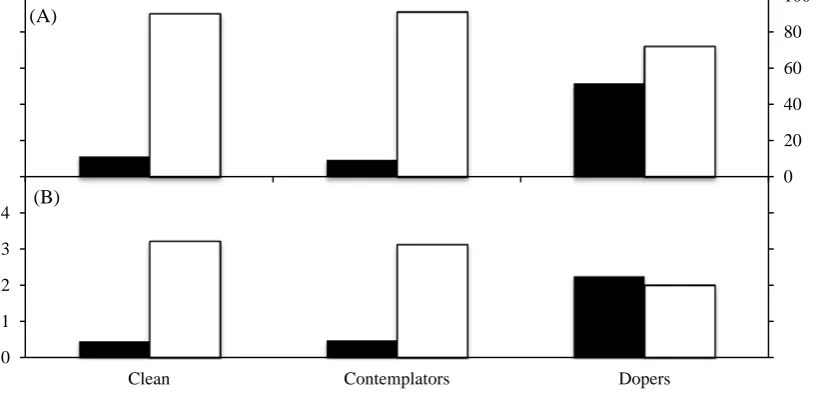
On average, athletes perceived themselves as more similar to a non-user (M= 3.13
0.92) than a PES user (M= 0.56 0.88). Differences emerged in athletes’ perceptions of their
difference in non-user similarity between the clean athletes and the contemplators (p= 1.00). -Insert figure 1 here-
Prototype favourability
Similarly, athletes perceived non-users (M= 89.92 14.98) as more favourable than
PES users (M= 13.18 21.38). Group differences also emerged in perceived PES user
favourability (2= 14.97, p= .001, 2= .07) and non-user favourability (2= 7.17, p= .028, 2=
.03) between the clean athletes, contemplators and dopers (Figure 1). Post-hoc tests revealed that dopers perceived PES users as significantly more favourable than contemplators (p= .002) and clean athletes (p< .001). However, perceptions of PES user favourability did not significantly differ between clean athletes and contemplators (p= 1.00). In comparison, clean athletes perceived non-users as significantly more favourable than self-reported dopers (p= .022), yet contemplators did not significantly differ in their favourability perceptions of non-users from self-reported dopers (p= .072) or clean athletes (p= 1.00).
Implicit measures
Prototype similarity
Implicit association of PES user similarity was based on response latency measures where ‘doper’ was paired with ‘me’ and ‘others’. Figure 2 shows the average latency scores for ‘me and doper’ and ‘others and doper’. A significant difference was observed between the mean latency scores for ‘me and doper’ and ‘others and doper’ (t(225)= 3.04, 95% CI: -108.96 to -23.23; p= .003, d= .215). Mean latency scores were faster when ‘me and doper’ (M= 960.09 ± 287.95 ms) were paired together compared to ‘others and doper’ (M= 1035.18 ± 324.64 ms). This suggests that on average, athletes find it easier to pair words associated with ‘me’ and ‘doper’ together than they do words associated with ‘others’ and ‘doper’.
The mean D-score demonstrated that participants had no preference for either
user similarity B-IAT between self-reported dopers, contemplators and clean athletes (2=
6.05, p= .049, 2= .03). However, post-hoc tests showed that the groups did not significantly
differ. Nevertheless, although the mean D-scores for clean athletes (M= -0.08 0.61) and
dopers (M= 0.01 0.51) were close to zero (indicating no preference), the contemplators
mean D-score (M= -0.33 0.52) suggests they have a slight preference for ‘me’ and ‘doper’
(Figure 3). These findings contradict expected findings where dopers were anticipated to demonstrate greater identification with a PES user compared to clean athletes.
-Insert figure 2 here-
Prototype favourability
Implicit association of attitudes towards PES users was based on response latency measures where ‘doper’ was paired with ‘good’ and ‘bad’. Figure 2 shows the average latency scores for ‘good and doper’ and ‘bad and doper’. A significant difference was
observed between the mean latency scores for ‘good and doper’ and ‘bad and doper’ (t(225)= -5.36, 95% CI: -244.65 to -113.05; p< .001, d= .463). Mean latency scores were faster when ‘good and doper’ (M= 970.10 ± 343.21 ms) were paired together compared to ‘bad and doper’ (M= 1148.95 ± 423.70 ms). These findings suggest that on average, athletes found the association between ‘good’ and ‘doper’ easier than ‘bad’ and ‘doper’.
-Insert figure 3 here-
The patterns in the D-scores replicated the mean latency scores and indicated that participants portrayed a slight preference (D= -0.30) for ‘good’ and ‘doper’. Figure 3 shows the D-scores according to cluster groups. Dopers (D= -0.37) portrayed moderate preferences for ‘good’ and ‘doper’ while contemplators (D= -0.80) portrayed strong preferences for ‘good’ and ‘doper’. Like the B-IAT representing PES user similarity, there were significant differences in D-scores relating to athletes’ prototype favourability of PES users between
revealed that contemplators had a significantly greater preference for ‘good’ and ‘doper’ compared to clean athletes (p= .001). However, dopers did not significantly differ from clean athletes (p= 1.00) or contemplators (p= .522).
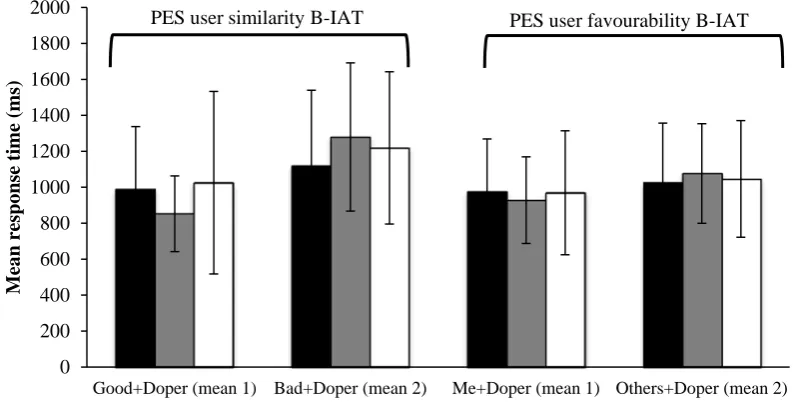
Comparing response times by test blocks and athlete groups (Figure 4) showed no interaction effect between reaction times in test blocks and athlete groups when ‘doper’ was
combined with self-reference (me vs. others, F(2,223)= 1.32, p= .270, 2= 0.01) but revealed a statistically significant interaction when the ‘doper’ target concept was paired with
‘good’/’bad’ affective attributes (F(2,223)= 5.37, p= .005, 2= 0.05). Single main effect test
showed no statistically significant differences between the groups in either blocks; but there was a significant difference between test block 1 and 2 in the clean (p= .001) and
contemplator group (p< .001), with significantly slower response times in block 2 (doper + bad). The observed difference in the doper group was not significant (p= .175).
-Insert figure 4 here-
Explicit - implicit relations
A significant but weak relationship was found between PES user similarity and the self-identification with a PES user B-IAT D-score (r= .142, p= .033). In contrast, there was no relationship between non-user similarity and the B-IAT D-score (r= -.042, p= .533).
Similarly, there were no significant relationships between the implicit and explicit prototype favourability measures, between PES user favourability and the attitudes towards a PES user B-IAT D-score (r= -.049, p= .464), or between non-user favourability and the B-IAT D-score (r= .011, p= .867).
In addition, the relationships between the explicit prototype perceptions measures and total number of hits scored on the social desirability scale were practically non-existing (PES user favourability r= -.050, p= .459; PES user similarity r= -.068, p= .310; non-user
relationships between the implicit prototype perceptions measures (D-scores) and total number of hits scored on the social desirability scale (PES user similarity B-IAT r= .014, p= .834; PES user favourability B-IAT r= .037, p= .585).
Overall results
In summary, explicit measures revealed that on average, athletes associated
themselves with a non-user more than a PES user and perceived a non-user more favourably than a PES user. In addition, dopers perceived a PES user more favourably than
contemplators or clean athletes. They also perceived themselves as more similar to a PES user than contemplators or clean athletes. In comparison, the implicit measures indicated that on average, athletes had no subconscious preference for ‘me’ and ‘doper’ or ‘others’ and ‘doper’, but contrary to expectations, did have a slight preference for ‘good’ and ‘doper’ over ‘bad’ and ‘doper’. Generally, these findings indicate that athletes did not associate PES users with themselves or others but they did associate PES users more with ‘good’ than ‘bad’. Behavioural choice/intention influenced the explicit endorsements of PES user/non-user prototypes and the affective implicit association, but not the self-referenced combinations. Discussion
This paper aimed to examine athletes’ prototype perceptions of PES users and non-users using, for the first time, a combination of implicit and explicit measures. The
status, we highlight the key methodological issues that could have had an effect on participants’ performance in the B-IATs independent of their PES-related behaviour or intention. It is important to note that we have chosen to focus more heavily on the B-IAT findings, not because we think that they are less valid or reliable than the self-report findings but because if we can understand them correctly, they offer an alternative insight into doping prevention.
The influence of behavioural choices on prototype perceptions
Out of the three cluster groups, the results of this study were most revealing about the contemplators. Unexpectedly, findings indicated that contemplators did not differ from the clean athletes in their self-reported perceptions of PES users and non-users. However, the B-IAT results revealed that contemplators had a slight preference for ‘me’ and ‘doper’ and a strong preference for ‘good’ and ‘doper’. These findings are comparable to previous research involving doping deniers (athletes who self-reported as clean but hair analysis indicated PES use) where deniers scored similar to clean athletes on explicit measures regarding attitudes towards doping but performed the IAT easier than clean athletes when presented with doping words (Petróczi et al., 2010; Petróczi et al., 2011).
‘doper’ and ‘good’ and ‘doper’ compared to the clean athletes and dopers (particularly on the attitude towards dopers B-IAT).
The explicit findings relating to dopers and clean athletes were in the expected direction. Self-reported dopers perceived PES users favourably and similar to themselves whereas the clean athletes perceived non-users as more favourable and similar to themselves. However, the implicit findings produced mixed results. Despite the D-score for the prototype favourability B-IAT being in the expected direction (greater association when ‘doper’ and ‘good’ were paired together), self-reported dopers demonstrated a weaker preference for ‘good’ and ‘doper’ than the contemplators. Equally, clean athletes demonstrated a slight preference for ‘good’ and ‘doper’ over ‘bad’ and ‘doper’, which was not expected. The PES user similarity B-IAT produced even more unexpected results. Like previous research (Petróczi et al., 2010; Petróczi et al., 2011), the D-scores did not differentiate between self-reported dopers and clean athletes with both groups demonstrating no preference for ‘me’ and ‘doper’ or ‘others’ and ‘doper’. In addition, the contemplators demonstrated only a slight preference for ‘me’ and ‘doper’. Nevertheless, mean latency response times for all three groups were quicker when ‘me’ and ‘doper’ were paired together. This may have resulted from the inclusion of the self in the category labels and self-related information tending to have a dominant position in the memory (Popa-Roch & Delmas, 2010), making it easier for the athletes to complete the B-IAT when ‘me’ and ‘doper’ were paired together.
have self-relevant active and endorsed schema (Cooley et al., 2015) - in this case, for PES users; and (2) how closely the stimuli used in the implicit test matches to the labels by which the construct is stored in people’s minds (Petróczi, 2013). The observed pattern, showing that behavioural position had an effect on the B-IAT with affective valence (good vs. bad) but not on the self-referenced pairing, suggests that either participants did not have active,
available self-schema for doping use or - which is more likely - users and contemplators had such schema but they did not conform to the more socially determined labelling. In both cases, the implicitly retrieved prototype identification was most likely created on demand rather than representing individuals’ automatic preferences retrieved from their memory.
Test construct and procedure effects on the implicit measures
Due to the inconsistent implicit findings, it is important to consider whether athletes’ underlying prototype perceptions influenced performance on the B-IATs or whether other factors could have played a role. One possibility is that the order of tasks could have
influenced performance on the B-IATs. Although the two B-IATs were randomised, athletes were presented with ‘good and doper’ or ‘me and doper’ stimuli before they were presented with ‘bad and doper’ or ‘others and doper’. Performance on the second combined task (‘bad and doper’ or ‘others and doper’) may have been compromised because the first task (‘good and doper’ or ‘me and doper’) preceded it. IAT effects can be biased towards the first
association (Nosek et al., 2007) because participants may find it hard to switch focus from the first task to the second. One way of combatting this would have been to randomise the order in which the paired tasks were presented to participants so that some participants received ‘others and doper’/‘bad and doper’ first rather than all participants being presented with ‘me and doper’/‘good and doper’ first.
categories, they produce better results than when ‘bad’ or ‘others’ are used (Sriram & Greenwald, 2009). Self-related information usually has a dominant position in the memory (Popa-Roch & Delmas, 2010), making it is easier to categorise stimuli that relate to the self than others. Equally, people tend to be more drawn towards positive valence rather than negative (Nosek, Bar-Anan, Sriram, & Greenwald, 2013; Sriram & Greenwald, 2009). Therefore, in the absence of stored evaluations to be retrieved, this may explain why reaction times were faster when ‘me and doper’ or ‘good and doper’ were paired together rather than ‘others and doper’ or ‘bad and doper’.
Another possible explanation is that the IAT effects were influenced by the strategies individuals adopted to complete the tasks. If an individual does not have relevant self-schemas in their memory to draw upon, the strategy used to complete the task is created on the spot (Cross & Markus, 1994). For example, IAT effects can occur as a result of
differences in salience between categories rather than associations between categories
(Rothermund & Wentura, 2004). When the target and attribute categories are associated with a figure/ground asymmetry (Rothermund & Wentura, 2004), the compatible block of the IAT will consist of two salient categories assigned to the same response key (Rothermund & Wentura, 2010). In this study, it may have been that because ‘doper’ rather than ‘non-doper’ was the focal category, it became more salient. Alternatively, there may have been an environmental effect due to media representations of athletes. When an athlete is caught doping, they are highlighted in the media as ‘bad’ whereas non-dopers are not made visible for being clean. Salience is closely linked to familiarity and valence of categories
focus attention on the salient category. However, when the incompatible block occurs, one salient and one non-salient category will be assigned to the same key, meaning the recoding strategy cannot be utilised. Attention then has to be diverted away from the salient category (‘me’ or ‘good’) to the non-salient category (‘others’ or ‘bad’) thus, increasing response times. Overall the results highlight the importance of understanding how responses on the timed response-stimulus compatibility tasks are influenced by the Self; and as Cooley and colleagues (Cooley et al., 2015) suggested, evaluation of the Self influences the explicit endorsement of the implicit thoughts.
Limitations and future research
As with any research, this study is not without its limitations. First, the online nature of the study means that the survey was not conducted in a controlled environment and this could be a confounding factor. Having said this, research suggests the accuracy and reporting of sensitive information can be increased via online surveys so this may also serve to enhance the accuracy of the information obtained (Kreuter, Presser, & Tourangeau, 2008). Second, the sampling method and recruitment strategies utilised prevent us from identifying the response rate and may have resulted in some bias within the sample. Specifically, those athletes who chose to respond to the survey may be different from athletes who chose not to respond (Nulty, 2008). Nevertheless, participants represented a variety of competition levels and sports, suggesting that a suitable range of perceptions were captured. In addition, the sample represents the largest sample included in a doping-related IAT study, highlighting another strength of the research.
than B-IATs. However, less is known about B-IATs, therefore, we have chosen to focus our methodological discussion on this element of our study design. B-IATs are still in their infancy particularly within the doping domain and concerns exist around what they actually measure (Greenwald & Nosek, 2008; Payne & Gawronski, 2010; Petróczi, 2013). IAT effects may be influenced by the order in which the paired tasks are presented (Nosek et al., 2007). Equally, it is suggested that B-IATs could still be susceptible to recoding processes meaning IAT effects do not represent associations between categories but instead may be produced according to salience, familiarity or valence of categories (Rothermund & Wentura, 2010). As a result, caution needs to be taken when interpreting the findings from this study.
cocaine use (Vargo & Petróczi, 2013; Vargo, Petróczi, Shah, & Naughton, 2014).
The observed pattern draws attention to some potentially essential aspects in future research. Most importantly, careful examination of the test performance and factors that might have determining influence on the test outcomes is warranted before results are interpreted as evidence or predisposition for a certain behaviour (Petróczi et al., 2015). A sensitive area like doping, where a potentially strong influence from the environment (i.e., prevailing social norms), the Self and evaluation of the Self and contradicting evaluation of the target concept (i.e., doping is effective thus good for performance but it is against the rule thus cheating) are likely present, offers an excellent testing field for researching the
phenomenology of implicit social cognitive measures. Therefore, with continuous advancement of IAT methodology, consideration should be given to the increased incorporation of implicit measures within anti-doping research (Brand et al., 2014a).
Researchers embarking on using implicit measurements should approach the task with open minds and embrace the notion that explicit and implicit co-exist with their own validity. That is, implicitly retrieved thoughts are not more valid, or more true, than the explicitly expressed and reported thoughts or introspectively assessed feelings. Tempting as it may be to see them in such way, implicit doping attitudes are not "true reflections" devoid of socially desirable responding. Equally, explicitly reported perception evaluations cannot be treated as solid baseline measures against which outcomes from other assessments are validated. Rather, explicit and implicit measures are based on and influenced by the construction and retrieval process and therefore they represent different manifestations (Petróczi, 2013).
presented. Second, the impact of salience, familiarity and valence of categories on the IAT effect should be acknowledged. Finally, the order in which direct and indirect measures are presented should be counterbalanced to prevent the possibility of one measure affecting performance on the other (Nosek et al., 2007).
Conclusion
Inconsistencies exist in athletes’ implicit and explicit doping-related perceptions despite the measures being designed to tap into the same constructs. Doping contemplators may have an unconscious bias towards doping which is not captured via self-report.
Alternatively, performance on the B-IATs may not have resulted from athletes’ underlying prototype perceptions. At present, it is still debated what the IAT actually measures.
However, in an area which is dominated by research derived from self-report measures, the use of IATs in combination with self-report measures is undoubtedly valuable for future doping research whilst contribute to a better understanding of the underlying mechanisms of the implicit measurements. Further research is warranted to determine whether implicit measures can help identify vulnerable athletes who may be contemplating using PES in the future; and under what circumstances can it be used for such purpose. The methodological lessons learned in this study will be informative to other researchers in the field. Researchers wishing to utilise IATs need to ensure that their IAT is carefully designed to reduce possible extraneous influences that could affect the interpretation of the IAT effect. Future research into the functionality of the implicit tests and factors that influence the disparity between explicit and implicit endorsements of PES user prototypes are warranted to determine how they can contribute to understanding doping behaviour.
References
Anonymous. (2013). Details omitted for double-blind reviewing.
Blanton, H., Vanden Den Eijnden, R. J. J. M., Buunk, B. P., Gibbons, F. X., Gerrard, M., & Bakker, A. (2001). Accentuate the negative: Social images in the prediction and promotion of
condom use. Journal of Applied Social Psychology, 31(2), 274-295. doi:
10.1111/j.1559-1816.2001.tb00197.x.
Boldero, J. M., Rawlings, D., & Haslam, N. (2007). Convergence between GNAT-assessed
implicit and explicit personality. European Journal of Personality, 21(3), 341-358. doi:
10.1002/per.622
Brand, R., Heck, P., & Ziegler, M. (2014a). Illegal performance enhancing drugs and doping in
sport: a picture-based brief implicit association test for measuring athletes' attitudes. Substance
Abuse Treatment, Prevention and Policy, 9, 7. doi: 10.1186/1747-597x-9-7.
Brand, R., Wolff, W., & Baumgarten, F. (2015). Modeling doping cognition from a dual process
perspective. In V. Barkoukis, L. Lazuras & H. Tsorbatzoudis (Eds.), The Psychology of Doping in
Sport (pp. 33-43). Oxon: Routledge.
Brand, R., Wolff, W., & Thieme, D. (2014b). Using response-time latencies to measure athletes? doping attitudes: the brief implicit attitude test identifies substance abuse in bodybuilders.
Substance Abuse Treatment, Prevention, and Policy, 9, 36.
http://www.biomedcentral.com/content/pdf/1747-1597X-1749-1736.pdf.
Cooley, E., Payne, B. K., Loersch, C., & Lei, R. (2015). Who Owns Implicit Attitudes? Testing a
Metacognitive Perspective. Personality and Social Psychology Bulletin, 41(1), 103-115. doi:
10.1177/0146167214559712
Cross, S. E., & Markus, H. R. (1994). Self-schemas, possible selves, and competent performance.
Journal of Educational Psychology, 86(3), 423-438. doi: 10.1037/0022-0663.86.3.423.
De Houwer, J. (2001). A Structural and Process Analysis of the Implicit Association Test.
Journal of Experimental Social Psychology, 37(6), 443. doi: 10.1006/jesp.2000.1464
De Houwer, J., & Moors, A. (2007). How to define and examine the implicitness of implicit
measures. In B. Wittenbrink & N. Schwarz (Eds.), Implicit measures of attitudes (pp. 179-195).
London: Guilford Press.
Fazio, R. H. (1990). A practical guide to response latency in social psychological research. In C. Hendrick & M. S. Clark (Eds.), Research methods in personality and social psychology (Vol. 11, pp. 74-97). Newbury Park, CA: Sage.
Fazio, R. H., & Olson, M. A. (2003). Implicit measures in social cognition research: Their
meaning and use. Annual Review of Psychology, 54(1), 297-327. doi:
10.1146/annurev.psych.54.101601.145225
Gawronski, B., Lebel, E. P., & Peters, K. R. (2007). What do implicit measures tell us?
Scrutinizing the validity of three common assumptions. Perspectives on Psychological Science, 2,
181-193.
Gibbons, F. X., Gerrard, M., & Lane, D. J. (2003). A social reaction model of adolescent health
risk. In J. M. Suls & K. A. Wallston (Eds.), Social Psychological Foundations of Health and
Illness (pp. 107-136). Oxford: Blackwell.
Goldman, B., Bush, P., & Klatz, R. (1984). Death in the locker room: steroids and sports.
Greenwald, A. G., Mcghee, D. E., & Schwartz, J. L. (1998). Measuring individual differences in
implicit cognition: the implicit association test. Journal of Personality and Social Psychology,
74(6), 1464-1480.
Greenwald, A. G., & Nosek, B. A. (2008). Attitudinal dissociation: What does it mean? In R. E.
Petty, R. H. Fazio & P. Briñol (Eds.), Attitudes: Insights from the new implicit measures. (pp.
65-82). New York, NY, US: Psychology Press.
Greenwald, A. G., Rudman, L. A., Nosek, B. A., Banaji, M. R., Farnham, S. D., & Mellott, D. S. (2002). A unified theory of implicit attitudes, stereotypes, self-esteem, and self-concept.
Psychological Review, 109(1), 3-25.
Gucciardi, D. F., Jalleh, G., & Donovan, R. J. (2010). Does social desirability influence the
relationship between doping attitudes and doping susceptibility in athletes? Psychology of Sport
and Exercise, 11(6), 479-486. doi: 10.1016/j.psychsport.2010.06.002
Kahneman, D. (2003). A perspective on judgment and choice: mapping bounded rationality.
American Psychologist, 58(9), 697-720. doi: 10.1037/0003-066x.58.9.697
Kornblum, S., Hasbroucq, T., & Osman, A. (1990). Dimensional overlap: cognitive basis for
stimulus-response compatibility--a model and taxonomy. Psychological Review, 97(2), 253-270.
Kreuter, F., Presser, S., & Tourangeau, R. (2008). Social desirability bias in CATI, IVR and web
surveys. Public Opinion Quarterly, 72(5), 847-865.
Lenhard, W., & Lenhard, A. (2015). Calculation of effect sizes. http://www.psychometrica.de/effect_size.html
Markus, H., & Nurius, P. (1986). Possible selves. American Psychologist, 41(9), 954-969. doi:
10.1037/0003-066x.41.9.954.
Mcclelland, D. C., Koestner, R., & Weinberger, J. (1989). How do self-attributed and implicit
motives differ? Psychological Review, 96, 690-702. doi: 10.1037/0033-295X.96.4.690.
Nosek, B. A. (2007). Implicit–Explicit Relations. Current Directions in Psychological Science,
16(2), 65-69. doi: 10.1111/j.1467-8721.2007.00477.x
Nosek, B. A., Bar-Anan, Y., Sriram, N., & Greenwald, A. G. (2013). Understanding and using the brief implicit association test: I. Recommended scoring procedures. Retrieved from SSRN website: http://ssrn.com/abstract=2196002
Nosek, B. A., Greenwald, A. G., & Banaji, M. R. (2007). The implicit association test at age 7: A
methodological and conceptual review. In J. A. Bargh (Ed.), Social psychology and the
unconscious: The automaticity of higher mental processes (pp. 265-292). London: Psychology Press.
Nosek, B. A., Hawkins, C. B., & Frazier, R. S. (2011). Implicit social cognition: from measures
to mechanisms. Trends in Cognitive Sciences, 15(4), 152-159. doi:
http://dx.doi.org/10.1016/j.tics.2011.01.005
Nulty, D. D. (2008). The adequacy of response rates to online and paper surveys: what can be
done? Assessment & Evaluation in Higher Education, 33(3), 301-314. doi:
Ouellette, J. A., Hessling, R., Gibbons, F. X., Reis-Bergan, M., & Gerrard, M. (2005). Using
images to increase exercise behavior: Prototypes versus possible selves. Personality and Social
Psychology Bulletin, 31(5), 610-620. doi: 10.1177/0146167204271589.
Payne, B. K., & Cameron, C. D. (2013). Implicit social cognition and mental representation. In D.
Carlston (Ed.), Oxford Handbook of Social Cognition (pp. 220-238). New York, NY: Oxford
University Press.
Payne, B. K., & Gawronski, B. (2010). A history of implicit social cognition: Where is it coming
from? Where is it now? Where is it going? In B. Gawronski & B. K. Payne (Eds.), Handbook of
implicit social cognition: Measurement, theory, and applications. (pp. 1-15). New York, NY, US: Guilford Press.
Petróczi, A. (2013). The doping mindset- Part II: Potentials and pitfalls in capturing athletes'
doping attitudes with response-time methodology. Performance Enhancement & Health, 2(4),
164-181. doi: http://dx.doi.org/10.1016/j.peh.2014.08.003.
Petróczi, A., & Aidman, E. (2009). Measuring explicit attitude toward doping: Review of the
psychometric properties of the Performance Enhancement Attitude Scale. Psychology of Sport
and Exercise, 10(3), 390-396. doi: 10.1016/j.psychsport.2008.11.001
Petróczi, A., Aidman, E. V., Hussain, I., Deshmukh, N., Nepusz, T., Uvacsek, M., . . . Naughton,
D. P. (2010). Virtue or pretense? Looking behind self-declared innocence in doping. PLoS ONE,
5, e10457. doi: 10.1371/journal.pone.0010457
Petróczi, A., Aidman, E. V., & Nepusz, T. (2008). Capturing doping attitudes by self-report
declarations and implicit assessment: A methodology study. Substance Abuse Treatment,
Prevention, and Policy, 3:9. doi: 10.1186/1747-597X-3-9
Petróczi, A., Backhouse, S. H., Barkoukis, V., Brand, R., Elbe, A.-M., Lazuras, L., & Lucidi, F. (2015). A call for policy guidance on psychometric testing in doping control in sport.
International Journal of Drug Policy. doi: http://dx.doi.org/10.1016/j.drugpo.2015.04.022
Petróczi, A., & Haugen, K. K. (2012). The doping self-reporting game: The paradox of a
‘false-telling’ mechanism and its potential research and policy implications. Sport Management Review,
15, 513-517. doi: 10.1016/j.smr.2012.04.002
Petróczi, A., Uvacsek, M., Nepusz, T. S., Deshmukh, N., Shah, I., Aidman, E. V., . . . Naughton, D. P. (2011). Incongruence in doping related attitudes, beliefs and opinions in the context of
discordant behavioural data: In which measure do we trust? PLoS ONE, 6(4), e18804. doi:
10.1371/journal.pone.0018804
Pitsch, W., & Emrich, E. (2011). The frequency of doping in elite sport: Results of a replication
study. International Review for the Sociology of Sport, 45(5), 559-580. doi:
10.1177/1012690211413969
Popa-Roch, M., & Delmas, F. (2010). Prejudice implicit association test effects: The role of
self-related heuristics. Zeitschrift für Psychologie/Journal of Psychology, 218(1), 44-50. doi:
10.1027/0044-3409/a000007.
Ratliff, K. A., & Howell, J. L. (2015). Implicit prototypes predict risky sun behavior. Health
Read, S. J., & Miller, L. C. (1989). Inter-personalism: Toward a goal-based theory of persons in
relationships. In L. A. Pervin (Ed.), Goal Concepts in Personality and Social Psychology (pp.
413-472). Hillsdale, NJ: Erlbaum.
Robbins, J. M., & Krueger, J. I. (2005). Social projection to ingroups and outgroups: A review
and meta-Analysis. Personality and Social Psychology Review, 9(1), 32-47. doi:
10.1207/s15327957pspr0901_3.
Rothermund, K., & Wentura, D. (2004). Underlying processes in the implicit association test:
dissociating salience from associations. Journal of Experimental Psychology: General, 133(2),
139-165. doi: http://dx.doi.org/10.1037/0096-3445.133.2.139
Rothermund, K., & Wentura, D. (2010). It's brief but is it better? An evaluation of the brief
implicit association test. Experimental Psychology 57(3), 233-237. doi:
10.1027/1618-3169/a000060
Scott, K. A., Mason, M. J., & Mason, J. D. (2015). I'm not a smoker: Constructing protected
prototypes for risk behavior. Journal of Business Research. doi:
http://dx.doi.org/10.1016/j.jbusres.2015.03.021.
Spijkerman, R., Van Den Eijnden, R. J. J. M., Vitale, S., & Engels, R. C. M. E. (2004). Explaining adolescents' smoking and drinking behavior: The concept of smoker and drinker
prototypes in relation to variables of the theory of planned behavior. Addictive Behaviors, 29,
1615-1622. doi: 10.1016/j.addbeh.2004.02.030
Sriram, N., & Greenwald, A. G. (2009). The brief implicit association test. Experimental
Psychology, 56, 283-294. doi: 10.1027/1618-3169.56.4.283.
Stevenson, J., & Clegg, S. (2011). Possible selves: students orientating themselves towards the
future through extracurricular activity. British Educational Research Journal, 37(2), 231-246.
doi: 10.1080/01411920903540672.
Thornton, B., Gibbons, F. X., & Gerrard, M. (2002). Risk perception and prototype perception:
Independent processes predicting risk behavior. Personality and Social Psychology Bulletin,
28(7), 986-999.
Vargo, E. J., & Petróczi, A. (2013). Detecting cocaine use? The autobiographical implicit
association test (aIAT) produces false positives in a real-world setting. Substance Abuse
Treatment, Prevention & Policy, 8(1), 1-13. doi: 10.1186/1747-597x-8-22
Vargo, E. J., Petróczi, A., Shah, I., & Naughton, D. P. (2014). It is not just memory: Propositional
thinking influences performance on the autobiographical IAT. Drug and alcohol dependence,
145, 150-155. doi: 10.1016/j.drugalcdep.2014.10.008
Whitaker, L., Long, J., Petróczi, A., & Backhouse, S. (2014). Using the prototype willingness
model to predict doping in sport. Scandinavian Journal of Medicine and Science in Sports, 24(5),
e393-e405. doi: 10.1111/sms.12148
Whitaker, L., Long, J., Petróczi, A., & Backhouse, S. H. (2012). Athletes’ perceptions of
performance enhancing substance user and non-user prototypes. Performance Enhancement and
Health, 1, 28-34. doi: 10.1016/j.peh.2012.03.002
Zimmermann, F., & Sieverding, M. (2010). Young adults' social drinking as explained by an
augmented theory of planned behaviour: The roles of prototypes, willingness, and gender. British
Figures
Figure 1: (A) Mean scores for prototype favourability (0 = highly unfavourable, 100 = highly favourable); (B) mean scores for prototype similarity (0 = definitely no, 4 = definitely yes)
Figure 2: Mean latency scores and standard deviation (in milliseconds) for each B-IAT
0 20 40 60 80 100
0 1 2 3 4
Clean Contemplators Dopers
PES user Non-user (B)
(A)
600 700 800 900 1000 1100 1200 1300 1400 1500 1600
Good+Doper (mean 1) Bad+Doper (mean 2) Me+Doper (mean 1) Others+Doper (mean 2)
Mean latency in
ms
[image:32.595.88.479.487.724.2]0 200 400 600 800 1000 1200 1400 1600 1800 2000
Good+Doper (mean 1) Bad+Doper (mean 2) Me+Doper (mean 1) Others+Doper (mean 2)
Mean response time
(ms)
Clean Contemplator Doper
[image:33.595.91.481.113.323.2]PES user similarity B-IAT
Figure 3: Mean D-Scores for each B-IAT per cluster group
Figure 4: Mean latency scores and standard deviation (in milliseconds) for each B-IAT per cluster group
-0.9 -0.8 -0.7 -0.6 -0.5 -0.4 -0.3 -0.2 -0.1 0 0.1
Mean D-score
Clean Contemplator Doper
PES user favourability B-IAT
[image:33.595.84.482.438.641.2]