Citation:
Wu, J and Lodorfos, G and Zhang, H and Wen, J (2018) Contracting for Innovation: The difference in a case with fast-changing industrial background in China. Journal of Global Information Technology Management. ISSN 1097-198X DOI: https://doi.org/10.1080/1097198X.2018.1423838
Link to Leeds Beckett Repository record:
http://eprints.leedsbeckett.ac.uk/4393/
Document Version: Article
The aim of the Leeds Beckett Repository is to provide open access to our research, as required by funder policies and permitted by publishers and copyright law.
The Leeds Beckett repository holds a wide range of publications, each of which has been checked for copyright and the relevant embargo period has been applied by the Research Services team.
We operate on a standard take-down policy. If you are the author or publisher of an output and you would like it removed from the repository, please contact us and we will investigate on a case-by-case basis.
Contracting for Innovation: The difference in a case with fast-changing industrial background in China
Huayao Zhanga, Jing Wenb, Junjie Wuc1, George Lodorfosd
a.b. College of Economics and Management, Zhejiang University of Technology, Hang Zhou China. c. d. Leeds Business School, Leeds Beckett University, Leeds, UK
Author contact information Short biography Professor Huayao Zhang
College of Economics and Management Zhejiang University of Technology Hangzhou, China
Email: [email protected]
Huayao Zhang ([email protected]) is a Professor of College of Economics and Management at Zhejiang University of Technology. He received his Ph.D. from Xi’an Jiaotong University, China. His current research focuses on technological economics, with a particular interest in capability upgrading of enterprises in emerging economies.
MS Jing Wen
College of Economics and Management Zhejiang University of Technology Hangzhou, China
Email: [email protected]
Jing Wen ([email protected] ) is a PhD candidate of College of Economics and Management at Zhejiang University of Technology. Her research interest focuses on market and institutional effects on enterprise technological innovations.
*Dr Junjie Wu (Corresponding author) Leeds Business School
Leeds Beckett University Leeds, UK
Email: [email protected] Tel. 0044 113 8124792
Junjie Wu ([email protected]) is a Reader at Leeds Business School, Leeds Beckett University, UK. Her broad research publications span the fields of Accounting, Finance, Economics and International Business. Her current research focuses include SME related issues and Social Responsibility Investment.
Dr George Lodorfos Leeds Business School Leeds Beckett University Leeds, UK
Email: [email protected]
George Lodorfos ([email protected]) is a Professor, the Dean of Leeds Business School at Leeds Beckett University, UK. His broad research publications include papers in journals of management but also in journals of marketing with particular focus on, the impact of innovation on productivity performance, the impact of technology on the sustainable growth of businesses and the factors that influence consumers’ e-purchasing behaviour.
1
Corresponding author: Junjie Wu, Leeds Business School, Leeds Beckett University Email: [email protected]
Contracting for Innovation: The difference in a case with fast-changing industrial background in China
Abstract
Conventional contracting nowadays has disadvantages for fast-changing high-tech industries
due to technology and market uncertainty. Observations found that cooperation between firms
often operates in more innovative ways which were defined by Gilson et al. (2009) as
‘Contracting for Innovation’. However, their study was conducted in a developed market (i.e.
the US) and thus the findings can hardly be used to explain what is observed in emerging
markets which have significantly different industrial and market backgrounds. Using
qualitative interviews from a case study, this paper aims to investigate contracting for
innovation practices in a Chinese strategic alliance. Our findings suggest new functions
compared to those in Gilson et al. (2009). This research has enriched ‘Contracting for
Innovation’ theory against the background of emerging market with highly uncertain industrial
environments.
Keywords
Contracting for innovation; strategic alliance; uncertainty; relation specific investment;
1. Introduction
“We want to do something together but we don’t know whether the partner to be
capable. The contract just let us believe the partner has capabilities to do it.”
“Contract is not important, what important is we have to work cooperatively.”
Rapid technology developments force many companies in fast-changing high-technology
industries to form strategic alliances (Hagedoorn, 1993; Powell and Walter, 1998; Gomes et al.,
2016; Dattée et al., 2017) to rapidly acquire complementary resources and cope with highly
uncertain industrial environments (Santangelo, 2000). Strategic alliances normally sign formal
contracts at the start of their cooperation to set out formally enforceable obligations, including
ex ante and ex post risk allocation provisions for parties involved. After that, contracting
practice developments may vary depending on specific industrial and firm situations. For
example, in a fast-changing high-tech industry, formal contracts could bring hold-up problems
and high switching costs because the inflexibility would hinder alliances in adapting rapid
changes in technology and market. As such, many high-tech strategic alliances practically use
innovative approaches of contracting practices. This phenomenon was defined as ‘Contracting
for Innovation’ by Gilson et al. (2009). The two quotes above are frequent messages we heard
from our interviews carried out in China – proof of contracting innovation practice appearing
in China. Investigation of these to enrich the ‘Contracting for Innovation’ theory became one
of our motivations for conducting this study.
Conventional contracting (i.e. a formal contract) is traditionally used to bind partners of
parties freely investing in relation-specific assets based on transaction cost theory (Williamson,
1975), however both parties are inevitably being ‘held-up’: under some unexpected and/or
imperfect situation, the formal contract may not be completed. In this circumstance, one party
might take advantage of the contract (i.e. engage in opportunistic behaviors). The hold-up
problem and opportunism would be intensified when environmental uncertainty is strong
(Lafontaine and Slade, 2007). In other words, opportunistic behaviors and hold-up problems
could be serious if no innovative contracting strategies and approaches are being operated in a
fast-changing industry.
Thus in practice, many high-tech firms are using different forms of informal contracting to
prevent or minimize opportunistic behaviors and resolve hold-up issues. As mentioned earlier,
Gilson et al. (2009) undertook pioneering research in this field which observed three cases in
the US and found that these new ‘contracting for innovation’ agreements contain no formal
enforceable obligations on either party, rather informally emphasizing mutual dependencies
and transparencies, information exchange, and learning from each other towards a long and
on-going collaboration. In so doing, these firms are motivated by mutually shared benefits and a
common understanding of market pressure. They create novel ways of collaborations following
an iterative pattern to overcome continuing uncertainties and ‘hold-up’ problems. The results
of Gilson et al. (2009) suggested that a formal contract normally serves as a platform for the
parties involved to develop subsequent informal contracting practices over the process of their
cooperation.
Although Gilson et al. (2009)’s study provided insights on contracting for innovation in the US,
we argue that their findings are not best placed to explain the innovative contracting practices
in Chinese strategic alliances compared to those in the cases of Gilson et al. (2009), because
the Chinese market has some different features to those found in a mature market such as in
the US (Mockler et al., 1999; Fang et al., 2016). The different characteristics of emerging
markets2 may lead to different behavioral modes for partners in an alliance who consider
contracting for innovation to grab market opportunities while avoiding or minimizing
opportunistic risks and hold-up issues (Williamson, 1975; Lavie, 2006; Lafontaine and Slade,
2007;). We further argue that ‘contracting for innovation’ is created by people participating and
therefore the role of trust between parties involved should not be overlooked. We therefore aim
to investigate (via qualitative interviews) different practices of ‘contracting for innovation’ in
high-tech strategic alliances operating in China and explain why they have some differences
from the results of Gilson et al. (2009). We have initially examined one case. In this paper, we
report the findings from this case and provide in-depth contextual discussion to help understand
the differences. We see our research as a response to the call by Gilson et al. (2009) for more
research to help prove their ‘plausible’ findings. We conclude with confidence that our research
results do shed additional light on the complexities of this phenomenon.
The paper is organized as follows: in Section 2, we provide a critical literature review to serve
as the theoretical foundation of this study. The introduction of the case and data collection are
carried out in Section 3. In Section 4, the case analysis is facilitated by introducing the industrial
status and specific technology involved (mobile phone lens technology) and the alliance. The
data analysis and results are shown in Section 4. In Section 5, we compare our findings with
these in Gilson et al. (2009). The conclusion, theoretical contributions etc. are summarized in
Section 6.
2
2. Literature review
2.1 RBV and competitive advantage in strategic alliance
Resource-based View (RBV) is one of the most influential theories of strategic alliance in the
last three decades. RBV aims to answer the question of why firms have different resources, and
how to obtain them in order to have competitive advantages (Wernerfelt, 1984; Barney, 1991).
According to RBV, firms are heterogeneous with regard to their resources/capabilities (Teece
et al., 1997), but not enough to obtain or sustain all competitive advantages; however,
competitive advantages can be gained through participating in a longtime, stable and mutual
trust relationship with strategic alliances (Barney, 1991; Peteraf, 1993). Two widely-cited
definitions of strategic alliance express it as:
“… [an] independently initiated interfirm link that involves exchange, sharing or
co-development” (Gulati, 1995, p.86); and
“… [a] purposive strategic relationship between independent firms that share
compatible goals, strive for mutual benefits, and acknowledge a high level of mutual
dependence” (Mohr and Spekman, 1994, p.135).
These definitions emphasize that value (i.e. competitive advantage) can be created in alliances
through investing in specific relationships to obtain resource complementarity,
knowledge-sharing and effective governance (Adegbesan and Higgins, 2011).
cooperation (Asanuma, 1989; Mohr and Spekman, 1994). The excess profits obtained from
strategic cooperation are defined as relational rents (Schoemaker, 1990; Hagedoorn, 1993), i.e.
competitive advantages which are created through cooperation. Resource complementarity is
a fundamental channel for keeping competitive advantage. Resource complementarity refers to
a set of differential resources jointly shared by the alliance partners in order to carry out
technologic strategy cooperation, which creates value greater than the total value which
alliance partners could create alone. Dyer and Singh (1998, p.662) defined it as ‘a supernormal
profit’ which can only be ‘created through the joint idiosyncratic contributions of the specific
alliance partners’. Through resource complementarity, specific alliance partners can work
effectively to gain unique relational rent jointly owned between them. The relational rent is
difficult to imitate in other environments and therefore cannot be separated from its original
owners. A higher ratio of complementary resources will lead to higher possibility of relational
rents within a strategic alliance (Dyer, Singh, 1998).
Knowledge sharing is another important channel for keeping competitive advantages.
Knowledge sharing means transferring and reorganising knowledge between cooperative
companies, or a paradigm by which alliances can create specificity of knowledge through their
interactions (Miles et al., 1999). Knowledge sharing can effectively standardise the behavior
of technologic strategy partners and improve knowledge transfer efficiency (Dyer and Singh,
1998). As Dyer and Singh (1998) stressed, relational rent can be created between alliances
through information communication and knowledge sharing. The more invested in knowledge
sharing the alliances is, the higher the relational rents would be.
Another important channel for creating relational rent is relation-specific investment. In the
asset specificity that Williamson (1985) identified in inter-firm relationships are site specificity,
physical specificity and human specificity, within which investing in human asset specificity
through communication could be time-consuming but is a kind of material relation-specific
investment (Gilson et al., 2009). According to assets specificity theory (Amit and Schoemaker,
1993; Dyer and Singh, 1998), the increase in relation-specific assets/investment can reduce the
costs in the value chain, expand product differentiation, and accelerate the product development
cycle. As a result, relational rents are created (Williamson and Oliver, 1991). More investment
in relation-specific assets can increase the willingness for cooperation, which would increase
relational rent (Lavie, 2006; Gulati et al., 2009). Relation-specific assets/ investment also relate
to the duration of safeguards in governance: generally speaking, the longer the governance
arrangement lasts (i.e. the length of the formal contract), the higher relation-specific
assets/investment are (Dyer and Singh, 1998).
Effective governance can also lead to competitive advantages. Alliances normally sign a formal
contract at the time of partnership established which provides “formal safeguards and
determine the distribution of common benefits ex ante” (Lavie, 2006, p. 646). Although the
formal contract is part of the alliance’s governance arrangements, according to Dyer and Singh
(1998) that effective governance should include the ability to implement self-enforcement
governance, either in a formal or informal way without involvement of a third party. Effective
alliance governance plays a key role in generating relational rents as it sets out good inter-firm
routines which can facilitate knowledge sharing and effective communication (Lavie, 2006).
Effective governance can reduce transitional costs and stimulate the value creation of an
alliance (Williamson and Oliver, 1991). The failure of a strategic alliance may not result from
lack of complementary resources, but a lack of effective governance (Wei and Long, 2011). As
improve performance (Schoemaker, 1990). Dyer and Singh (1998) argued that with higher
integration in terms of governance, the more relational rents would be generated. However, a
signed formal contract is not able to cover all ongoing developments (Williamson, 1975, cited
in Lavie, 2006); in this regard, informal safeguards and trust-building are found to be important
in preventing opportunistic behavior from alliance partners (Dyer and Singh, 1998).
2.2 Dynamic capabilities and contracting for innovation in technological alliance
From the discussion above, one can see that RBV focuses on inter-firm relationships and
emphasizes building competitive advantage through creating relational rents from scarce
firm-specific resources. In addition, RBV also encourages firms to explore innovative strategies to
develop new capabilities by exploiting firms’ existing resources through external networks
(Wernerfelt, 1984). Therefore, from a resource-based perspective, firms/alliances succeed not
only just because they set out successful investment strategies but also because they can explore
and implement innovative ways of cooperation to lower costs significantly without
compromising the quality of products (Teece et al., 1997). This situation particularly applies
in fast-changing, high-technology industries because some of their assets (e.g. tacit know-how
and reputation) are “simply not readily tradeable” (Teece et al., 1997, p.514).
Along with rapid development of new and complex technologies in the last two decades, the
high-tech industry has been very fragile, with incredible uncertainty and risks, and faces huge
challenges in finding innovative ways to sustain itself. As such, scholars such as
Leonard-Barton (1992) and Teece et al. (1997, p.516) used the term ‘dynamic capabilities’ to describe
whether these industries/firms have the ability to “integrate, build, and reconfigure internal and
alliances with dynamic capabilities would adapt novel strategies and approaches to maintain
their competitive advantage amid furious global competition (Anand et al., 2010). For
high-tech companies, to keep dynamic capabilities and their cutting-edge high-technologies means they
must think proactively, do business innovatively and respond quickly to changing market
demand.
Changes in behaviors and business models in the technology industry have challenged the
conventional theory of vertical integration, which defines the boundary of upstream and
downstream firms in the supply chain, and required changes from traditional practices of
contracting to what Gilson et al. (2009) labelled ‘contracting for innovation’. Observing three
cases in the US (Deere-Stanadyne, Apple-SCI and Warner-Lambert-Ligand), Gilson et al.
(2009, p.437) found that many previously in-house transactions are now outsourced through
agreements between firms or even overseas alliances to avoid uncertainty in the market (Prado
et al., 2009), and this kind of collaboration, on one hand, causes ‘unavoidable mutual
vulnerabilities’ to alliance partners; however on the other hand, it motivates them to find novel
ways of collaboration, including new contractual governance, to overcome continuing
uncertainties and ‘hold-up’ problems. They named this phenomenon the vertically
disintegrated economy.
According to Gilson et al. (2009), unlike conventional contracting, which explicitly sets out
formally enforceable obligations including risk allocation provisions for parties involved, the
new ‘contracting for innovation’ agreements contain no formal enforceable obligations on
either party, rather informally emphasizing mutual dependencies and transparencies,
information exchanges and learning from each other towards a long and ongoing collaboration.
(1) the contracted ‘product’ is a high-tech one that can hardly be specified
beforehand/ex ante;
(2) none of the parties involved can develop this product alone or develop it
cost-effectively;
(3) the transactions will be iterative, which requires continuing communication,
co-design, mutual specification and development through monitoring and learning the
partner’s capabilities (Gilson et al. identified these as the relation-specific
investments).
Gilson et al. (2009, p.449) argued that these iterative and cooperative contracts can play an
important role in linking participants as a ‘coordination cascade’- “an innovation by one party
that requires coordination with a second party, whose response then requires adjustment by and
further coordination with the first party”. 3
The Deere-Stanadyne case in Gilson et al. (2009) has similarities and differences with the case
in this paper and these will be discussed later. In sum, their pioneering research highlighted
three important elements in contracting for innovation in technologic alliance collaborations:
(1) formal contracting can be important to facilitate informal contracting structures
which guides the participants’ expectations for capability, cooperation, and trust;
(2) the structure of the innovative contracts mainly depends on whether there is
foreseeable cooperation in the long run; if yes, then co-design of the prototypical design
and adaptation has to address ongoing 'hold-up' problems associated with
relation-specific investment;
(3) in the process of project operation, the alliances must generally rely on informal
arrangements to constrain opportunistic behaviors through value created by
renegotiation. In short, both formal contracts with constraints on parties involved and
informal agreements with no substantial constraints play important roles in
safeguarding against opportunist behaviors and reducing hold-up risks in alliance
collaborations.
3. Methodology
This research focuses on the effects of environmental uncertainty on innovative contracting
behavior in technological alliances. After decades of dramatic development, China, especially
its coastal area, is an ideal place for this kind of research because so many world-class large
companies have come and worked with their local partners in the supply chain for years. In
quite a few of these newly developed areas, such as smartphone parts manufacturing, Chinese
companies working with manufacturing giants (e.g. Apple, Sony and Samsung) have earned
competitive positions in the market to keep their cutting-edge technology. The contracting
practices within this environment usually have two prominent characteristics:
1) all contracting parties are familiar with the fast development, and their contracts are
more based on expectations than on realities;
2) the industrial supporting environment is convenient for iterated communications and
more challenging contracts tend to be found. In other words, the contracting behavior
observed under this circumstance may embody more environmental effects that are
difficult to find elsewhere.
innovation’ in a Chinese high-tech strategic alliance, a single case study is an appropriate
research design. By applying the case study method, the complexity of the strategic and
practical decisions on the issues investigated can be explained (Ghauri, 2004); that is, the
details of contracting, cooperation and trust building can be more effectively investigated by
case study. The case study design is widely used in management research and has been
developed by scholars such as Eisenhardt (1989) and Doz and Yves (1996) after Strauss (1987).
3.1 Case selection
Similar to the sample selection approach used in Wei et al. (2015), a ‘multilevel approach’ was
used in the study. Level 1 is to consider the location. The Yangtze River Delta and Pearl River
Delta are the two most developed coastal areas in China and have attracted thousands of large
global companies to establish their strategy alliances there. The first author’s affiliation is
located in Yangtze River Delta and he has about 150 MBA students working in different
companies/organizations in this area, which provided a convenience sample for the study.
Level 2 is to consider the industry. After a brief investigation of the 150 MBA students’
companies/organizations, potential cases of contracting for innovation were found from various
industries, such as auto parts, engine and ICT industries. Among them, the ICT industry seems
to be the fastest-developing industry and faces the greatest uncertainty, e.g. smartphone
upgrades in the last decade. The USA, Japan, Korea and more recently China play leading roles
worldwide while leading brands such as Apple, Samsung and Sony produce parts in Chinese
alliances. We thus targeted the ICT industry and five firms were selected in the first round.
After screening their business activities and performance, as well as the background of
last stage the alliance between Sunny Optical Technology Co. (SOT) in China and Omni Vision
(OV) in the USA was selected because their contracting practices are more traceable than in
the other two cases. Specifically, SOT was chosen based on the theoretical sampling principle,
as it conforms to the criteria for a polar case, which represents a theoretically fruitful and
extreme situation (Eisenhardt, 1989).
SOT has about 5,000 employees, of whom 200 are full time R&D personnel and 260 are
installation engineers. The core product of SOT is a mobile phone camera module (CM). SOT’s
parent company, Sunny Group, started to develop and produce lenses in 1991, mobile phone
lenses in 2000 and whole lens modules in 2004. SOT was established in 2006 as a part of the
Sunny Group’s expansion strategy. Omni Vision (OV), the strategic alliance partner of SOT,
which was established in 1995 and is headquartered in central Silicon Valley, exerts great
influence on SOT. OV is the leader in developing high-quality sensors, and the largest sensor
manufacturer, with a one-third share of the world market. The strategic cooperation between
OV and SOT started in 2009. The alliance produces mobile phone CMs jointly: one side (OV)
provides sensors and the other side (SOT) packages sensors with other parts.4
Figure 1 shows the growing trend (total sales, profit and loss) of SOT’s parent company (Sunny
Group) covering the period of our study, which was listed in Hong Kong stock market (Sunny
Optical: HK2382). The sales are mainly composed of those from SOT and the sister company
which produces lenses. The sales of SOT are growing almost at a fixed proportion of the sales
4
of the listed parent company.
<Figure 1 insert here>
Alliance cooperation is prevalent amongst sensor-makers; SOT was selected by OV as its most
important cooperator because of its production capacity. (SOT owned about 60% of the COB
production lines in China as of 2010.) The competitive advantage of a module depends on
matching effects between sensor and CSP, which in turn requires iterative cooperation between
the sensor maker (OV) and the packager (SOT) as early as when the sensor is being designed.
As such, the alliance between OV and SOT would offer us insights into their iterative
cooperation and the details of contracting for innovation, because
(1) SOT serves the newly-developed smartphone industry in a hugely uncertain
environment;
(2) OV is the world's leading chip producer; and
(3) the alliance supplies modules to world-leading brands such as Samsung, Sony and
more Huawei.
Additionally, if OV intended to exert pressure on contracts for innovation on SOT, then how
did SOT respond to this and how did both parties interact in the on-going process of cooperation
to overcome what literature identified as hold-up issues? We therefore believe that the contracts
between OV and SOT can enrich our understanding of the idea of ‘Contracting for Innovation’
raised by Gilson et al. (2009).
The chief marketing manager of SOT (recently promoted to the position of vice general
manager) is one of the MBA students supervised by the first author of this paper, and
participates in all negotiations of contracts with OV. This vital contact allowed us to get access
to rich information and key insights into the contracting and collaborating practices. The
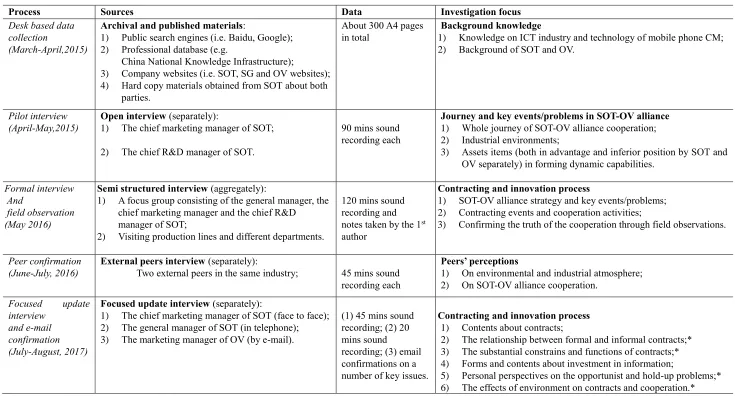
process of data collection and analysis can be summarized into five steps:
(1) Desk-based data collection
Before collecting primary data, we used the public search engines (Baidu and Google and other
databases) to compile basic information on the ICT industry and mobile phone camera module
(CM) technology. After this, we searched the websites of SOT about their strategies, values,
business module, products, procedures, financial performance, marketing, R&D, suppliers and
clients, international cooperation partners and events, comments from stakeholders, etc. We
also accessed some hardcopy materials about OV and SOT during this stage. In total, the
information collected would have filled more than 300 pages of A4 size paper in normal type.
After a brief analysis of this information, we obtained an overall view of the ICT industry and
technology of mobile phone CMs, and the background of OV and SOT. Based on this
knowledge, an initial pilot interview outline was developed.
(2) Pilot interview
After forming an initial understanding of SOT’s business, we carried out a pilot interview with
two SOT managers separately, the marketing and R&D managers (both are chief managers in
their departments). The main aim of the pilot interview was to understand more about SOT’s
our formal interviews. The time spent on the two interviews was 90 minutes each. We took
them separately to ensure neither was influenced by the other. The focus in the interview with
the chief marketing manager was on the issues relating to the market uncertainty of mobile
phone CM industry; the intention of OV and SOT’s strategic cooperation, the market positions
of each side, the relational and institutional environments of SOT and the successes and
problems of this cooperation in terms of marketing performance. At the interview with the chief
R&D project manager, our interest was generally on the technologic strengths and weaknesses
of each side; the impact of the cooperation relating to technologic development, the problems
they encountered and the communication methods used to resolve these problems, and the
extent of satisfaction as a result of these exchanges and communications on both sides. After
this pilot interview, we had a clear understanding of the total journey of the OV-SOT alliance;
the industrial environment of mobile phone CMs, and the dynamic capabilities of both OV and
SOT. This understanding helped us pick out the problems requiring further focus in the formal
interviews.
(3) Formal interviews and field observations
After finalizing the interview outlines, the formal interview was carried out in the form of a
focus group. The interviewees included the General Manager of SOT, and the two managers in
the pilot. The rationale for selecting these three was that they are key personnel in SOT,
responsible for strategic issues (the General Manager), production (the R&D Chief Manager)
and sales (the Marketing Chief Manager). From the pilot interview, we learned more in relation
to technology and marketing aspects, but not at a strategic level. Two advantages of the focus
group format are that the participants can inspire each other from conversing as a group, and
discussion provided a whole picture of the OV-SOT alliance cooperation and event details for
us to analyze. The focus interview lasted for two hours and was recorded with a recording pen.
The first two authors also had an opportunity to visit the site, production lines and different
departments, and were given some internal documents to help understand some of the issues
discussed at the focus interview.
(4) Peer confirmation
After collecting data from SOT, we arranged two short interviews (each around 45 minutes)
with two external peers (one is an independent director and another is a general manager) from
other enterprises in the same (ICT) industry. The purpose of the external interviews was: (1) to
understand the environmental and industrial atmosphere from other viewpoints and (2) to
collect peers’ perceptions on the OV-SOT cooperation, not only to achieve data triangulation
but also to independently assess the value of the alliance. Satisfactorily, the peers’ observations
complemented the facts from the SOT data collection.
(5) Focused update interviews
We carried out focused update interviews recently during the stage of paper revision after
receiving constructive comments from anonymous reviewers. During the period between 20
July and 15 August, 2017, the first author interviewed the general manager (same person as in
the formal interview) and the vice general manager (previously market manager) of SOT by
telephone. On the vice general manager’s recommendation, we also contacted the market
manager of OV by e-mail with a number of questions, and received prompt and satisfactory
The focused update interviews concentrated on the issues around contracting and innovation
in the OV-SOT alliance, covering the contents of the contracts, the relationship between formal
and informal contracts and their substantial constrains and functions, the forms and contents of
relation-specific investment for innovation purpose, the interviewees’ personal perspectives on
opportunism and hold-up affairs, and the effects influenced by environment and cooperation.
The focused update interviews not only confirmed our perceptions but also provided us with
much more details about their contracting practices which support and add value to the
‘Contracting for Innovation’ theory in Gilson et al. (2009). Before the interviews, we had been
concerned some issues in relation to hold-up and opportunism might be sensitive; however,
both parties were very open and frank to talk about these issues. This allows us to grasp the
essence of their interactions on the matters. Table 1 specifies the process and contents in each
step of data collection.
<Table1 insert here>
4. Results
4.1 Industrial environment and alliance of OV-SOT
The last decade has witnessed the explosive development of the world smartphone industry
SOV is associated with, accompanying with large uncertainties. These uncertainties are mainly
caused by unknown future technological development, and in some circumstances, today’s
technological advantages could quickly become tomorrow’s technological burdens. One can
Samsung and Huawei) have had ups and downs in the world market. Generally, a fast and
newly-developed industry would bring uncertainty to suppliers because production lines and
supply chain need time to take shape. If product demands quickly fade out, the huge
investments on equipment will become sunk costs. This kind of industrial uncertainty requires
technological firms to working with innovative strategies.
Global industrial uncertainty alarms Chinese firms, even though the smartphone industry in
China has been in a strong position in the last decade and is still expanding currently. Compared
to its counterparts worldwide, China has invested much more in domestic companies in order
to attract foreign investment and also provided the industrial supporting policies mentioned
earlier. It is in this industrial environment that SOT and OV developed their strategic
cooperation in 2009. Both parties want to establish a closer and flexible cooperation
relationship, whereby SOT can obtain quantities of chips whenever they want from OV, of
quality superior to other suppliers. It is SOT which takes the risks of market volatility.
Only when a lens from SOT is perfectly matched with the sensors from OV can the whole be
used as a constructed CM. Complicated adjustment is thus needed after the lens and chips have
been assembled, which requires close communications and coordination between SOT and OV:
e.g., SOT needs to contact the chip manufacturers directly, discussing potential components in
the design stage and identifying specific parameters. Thanks to the early market entry of SOT
and OV’s investment in the Chinese market, both sides have a good understanding of each
other’s businesses. Also, because the chip and the lens are two important parts in the lens
module, the interaction and communications between SOT and OV are frequent and intensive,
The alliance partnership with OV has brought SOT huge profits. The general manager of SOT
regards the formation of the alliance with OV as “absolutely the right decision”, which led
SOT’s business to develop rapidly. The marketing manager of SOT stressed:
“Environmental uncertainty brought OV and SOT together. Otherwise I don’t think
we need to form a strategic alliance with other companies, and I also knew OV would
not choose us as their partner. The uncertainty also ties us firmly and we have to
cooperate closely. In my opinion, the environmental uncertainty plays the
fundamental role in acquiring competitive advantages for both sides.”
The remark of the marketing manager from SOT reflects the reality that environmental
uncertainty is the vital factor in the forming of the OV-SOT alliance and the close cooperation
relationship - a kind of relational rent as indicated in Dyer and Singh (1998) and Lavie (2006).
In the process of forming the alliance and sequent cooperation, there has been a two-way
communication mechanism in operation with which one can see the development of
contracting for innovation in the alliance. The process also showed that relational investments
and institutional resources stressed by theory of dynamic capabilities (e.g. Teece et al., 1997)
demonstrate key roles in generating competitive advantage. In the following part, we will
reveal the influence of environmental uncertainty on OV-SOT contracting practice for
innovation with the consideration of contribution of RBV and dynamic capabilities.
4.2 Contracting for alliancing and innovation
A fast-expanding market is a double-edged sword, especially for the ICT industry with its large
investments on equipment. From SOT’s perspective, the primary reason for forming the
strategic alliance with OV is for fast development. “Without the cooperation with OV, we
would not have developed so quickly,” said the marketing manager. However, SOT knows
clearly that market expansion also means potential risk. The SOT managers interviewed
explained the investment dilemma in this industry: on one hand, the ICT industry has a long
investment recovery period because of extensive investment; on the other hand, the volatility
in the industry often causes turbulence in market demand and technique changes. Therefore,
any investment in this sector faces high risks. Module suppliers often face a tough choice:
though the market is expanding all the time, there is no way to be sure that their customers will
stay loyal when better products available elsewhere. However, SOT believes that collaborating
with OV would lower the risk thanks to OV’s established international reputation in the sensor
market (a core part for not only CMs but the whole mobile phone.)
From the viewpoint of OV, its venture in China depends on selecting the correct partner to
maximize profits and minimize risks, and cooperating with SOT can help achieve this ambition.
As SOT’s general manager said, OV wanted to choose a Chinese enterprise which not only had
a major market share, but also long-term development potential and competitive advantage. By
contracting with SOT, OV can obtain the production capability and meanwhile avoid taking
high risks on equipment investment. The general manager described the key driving force in
the formation of strategic alliances as:
“Investing heavily in equipment may cause high market risks, which could lead to the
market change in the CM industry. This is the real reason for both OV and SOT choose
alliancing to avoid investing into each other’s domain.”
As a result, SOT’s choice of a strategic alliance with OV has mitigated market and investment
risks. Two points support this claim: firstly, due to the explosive growth in smartphone demand,
the demand for CM exceeds the supply. An insufficient supply of chips could cause a bottleneck
in development, because of substantial investment in chip production lines. The formation of
the strategic alliance can guarantee a stable supply. Secondly, the strategic alliance brought the
assembler (SOT) and the chip manufacturer (OV) together, and as a result, SOT’s reputation
has been upgraded, which has helped to guarantee a more optimistic and stable demand. In
short, in a fast-changing industrial environment, stabilising market demand through strategic
alliance by sharing risks plays a key role in obtaining competitive advantage for the OV-SOT
alliance.
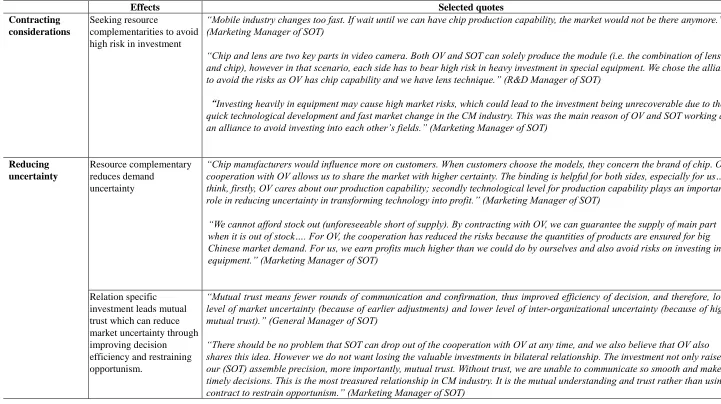
To sum up, environmental uncertainty and high investment in equipment are the main driving
forces for SOT and OV to form the strategic alliance in order to avoid high risks. The binding
effects of sharing the other partner’s reputation and production capability have effectively
reduced environmental uncertainty through the contract arrangement. This contract
arrangement has later proved to have the function of generating competitive advantages for
both parties.
(2) Relation-specific investments and cooperative innovation
For both OV and SOT, alliancing offers a great opportunity to learn from each other through a
R&D manager of SOT. As he noted, with the requirement for testing lenses and chips, the
complicated assembly process requires a great deal of communication from both sides. As such,
the formation of the alliance has provided a platform for close communication, which can
benefit both sides greatly, not just in producing the best quality of modules, but also
accumulating knowledge of business.
Solving the technique bottleneck of encapsulation requires timely communication between
R&D departments on both sides. As modules are assembled in SOT, most communications and
cooperation are also carried out there. During the cooperation, SOT received significant
technical support. OV and SOT engineers' visiting each other has been routine for some time.
As a result, productive communication with OV helped SOT greatly improve their assembly
precision, which in turn boosted their profit as well as reputation, which in turn has made them
the largest lens module producer in China and a good profitable company. In other words, SOT
has gained satisfactory relational rents from the alliance partnership with OV, and the alliance
achievements have also attracted others (e.g. Samsung and Sony) to develop strategic alliance
relationships with SOT.
From OV’s perspective, the benefits from the alliance do not stop at the minimum of ex ante
production risk but extend to product improvements. For example, chip designing in OV now
requires communication with SOT before the design is finalised. In this way, OV can easily
learn from the phone makers which are their preferred products. This is a very effective way
for OV to learn the Chinese market, resulting a stable market share in China. The marketing
manager of OV frankly expressed by email that the two-way learning process and iterative
Another benefit through routine communication is that mutual trust has been established
between SOT and OV, both in the increase of inter-firm transactions and strength of personal
relationships between key individuals. As the market manager of SOT stressed:
“Despite (formal) contracts legally put constrains on both sides, however if no
established mutual trust, no one dare to put ‘big bets’ based on the ‘legally
effective’ written paper and we still would maintain transaction volumes at a
risk-controllable level. In contrast, because we trust each other and care about our
relationship, verbal promises play more and more important roles. ……Except for
purchase agreements, no other formal written contract is necessary. This is
because we are in the (highly uncertain) industrial environment, informal oral
agreements are more effective.”
The general manager of SOT also summarised: “We started the collaboration with the
motivation of sharing risks but surprisingly ended up achieving amazing mutual trust”. The
cooperation of OV and SOT through extensive exchange of feedback on the market's uncertain
conditions and mutual respect have enhanced competitive advantages on both sides. It has
helped to make use of resources complementarily on both sides to meet the increasing demand
and prevent opportunist behaviors. In other words, the cooperation has brought technological
effects and reduced environmental uncertainty by strengthening the capabilities of the two
partners and enabling them to face future challenges/risks. This finding supports the results
found in Mount et al. (2015, p. 32) that there is “a strong relationship between recognitive
capacity, network management and knowledge creation and exploration during later
collaboration stages”. The mechanisms and relative quotes related to market uncertainty and
<Table 2 insert here>
4.3 The role of contracts in safeguarding opportunism
(1) Contracts constitution
As we were informed by the marketing manager of SOT, there are at least three types of
contracts signed between OV and SOT. The first signed is a ‘Memorandum’ at the very
beginning which only states the intention of cooperation as an alliance (or on-going
relationships if satisfied) for the first two years, with no formally enforceable obligations.
According to the manager, the memorandum is a ‘soft’ (implicit) document as it does not oblige
either party to supply or to purchase anything from the other. The second type is the strategic
‘Agreement’ (or ‘Protocol’) which sets out mutual agreed terms and conditions for supply and
purchase, including particular product quantities, discount prices and delivery times, for a
period (e.g. one year). This agreement (contract) has ‘hard’ enforceable obligations on both
parties specifying ex ante duties and possible ex post outcome, which assumes an efficient
cooperation with good performance. The final type is the ‘Purchase agreement’ which sets out
more detailed purchase transactions for a short purchase circle (e.g. three months). By our
understanding, the ‘Contract’ discussed in Lafontaine and Slade (2007) and Gilson et al. (2009)
is similar to our strategic ‘Agreement’ in OV-SOT alliance; as such hereafter our
discussion/analysis of formal contract refers to the second type contract mentioned (i.e. the
‘Agreement’), however, describing the other two types of contracts will help readers
With regards to informal contracts, although there seems to be no explicit statement in Gilson
et al.'s study (2009), from reading relevant literature and conducting interviews, we can define
it as a kind of promise occasionally agreed (either orally or in writing) to commit to some
transactions/activities. Despite it being reached informally, without enforceable obligations,
and possibly incomplete, however, on most occasions, informal agreements can be committed
to as they are reached based on mutual trust on each other’s behaviors/attitudes.
From the discussion above, one can see a formal contract serves as a proactive contract, which
has the characteristics of imperfection, with consideration of contingent factors, and is open
for future supplement. In our case, the formal contract between OV and SOT was initially only
signed for one year. After the first year, OV and SOT came to discuss, revise and renew it for
another year. The contract has never been renewed since, though the collaboration continues
as usual to this day purely based on the agreed principles set in the contract. To quote the
marketing manager, “We trust each other so it is not necessary to sign a new contract”.
(2) Functions of contracts
How can the formal agreements enforce or constrain both sides? Let us discuss them further.
The first agreement was signed shortly after the memorandum, after a number of exchanges
and on-the-spot visits. OV believed that SOT would be their best partner in China and they
shared the same judgments on market trend. In order to ‘settle’ the cooperation, the first
agreement was signed, serving as a promised good plan to do business jointly. After the first
year's cooperation, they learned more about each other’s capabilities and characters and had
strong confidence in one another; thus the second agreement was signed with larger purchasing
thought of as a much more ambitious ‘blueprint’ for a prosperous future. In the words of the
marketing manager:
“We (OV and SOT) had strong feeling that we can do good business together, but we
are not sure how much the other party can offer and their capabilities. So the first
agreement is like a promise by declaring what can we offer and how can we do?
After one year cooperation, both sides proved to be good partners with a lot of
potential, and thus why don’t we do something much more ambitious together?”
The marketing manager of SOT further explained that the formal agreement indeed includes
contents relating to constraints in the cooperation (e.g. testing equipment and mutual technique
support). This is because both parties understand these constraints are necessary and help
guarantee achieving the shared aims and purpose; thus the parties are willing to obey and invest
in relation-specific investments (e.g. iterative communications and personnel training). On the
other hand, the formal agreement leaves quite a big space on both sides to be flexible, i.e. to
cooperate if favourable, or exit if not. The fact that the alliance continues their cooperation thus
far as in the past and will obviously be continuing on even without a currently valid agreement
reveals that the function of a formal contract between OV and SOT is not to constrainfor
cooperation, but to inform of unperceived capabilities (the first round) and blueprint planning
(both the first and second round).
The formal contract between OV and SOT also plays the role of trust fostering. An example
given by the marketing manager can be a good illustration of this: though the agreement set
out purchasing amounts and associated discount prices, at the early stage when trust had not
the agreed amounts were reached (and suggested paying back the difference after the amount
was reached.). However, the proposal has never been actioned, as OV quickly learned the
potential of SOT. After a market assessment, OV realized that there would be no problem in
finishing the agreed amount, and thus charged only the agreement price even before the
agreement amounts were reached. This example proved that though a formal contract was in
place, it is up to the parties involved to implement the contract, and it might not become a
constraint on the other party, if trust has been built between parties.
Along with trust building in the OV-SOT alliance and familiarity with the partner’s capabilities
and working character, more and more informal contracting appeared to help routine operations
and transactions. Interestingly, these informal agreements normally have a specific purpose to
achieve certain tasks. Following the normal logic, they should be in more formal forms as these
have less uncertainty, but trust has gradually been fostered between the parties, thus more
efficient informal contracts are enough. This reality shows that whether formal or informal
contracts are applied depends on the level of trust. Once trust is fostered, informal contracts
are more effective than formal ones. In other words, in our case an informal contract is not a
supplement to formal ones, but rather are the different outcomes of different trust levels. Once
mutual trust is fostered, decision efficiency based on informal contracts will be improved,
which can be seen as one side of governance effects in reducing environmental uncertainty.
To sum up, the OV-SOT formal contracts served as a promise signal or positive gesture of
cooperation when they wanted to cooperate with the other party. The purpose of contracting is
not for constraining the parties, but establishing a common blueprint. Once mutual trust has
been built and the cognitive uncertainty has been removed, more efficient informal contracts
purchase agreements are usually zero-sum transactions, not for mutual advantage. This
difference hints that favourable expectations may be the proper environment for a proactive
agreement.
(3) Opportunism safeguarding
Thanks to good industrial conditions, there has not been any default on the agreement so far.
However, this does not stop SOT thinking of this as a possible problem. According to the
general manager of SOT, the decision - whether SOT continues with the agreement obligation
by bearing costs, or stops the obligation once market demand drops significantly - should be
purely based on economic rather than legal considerations. “No one wants to take your partner
to court because even if you could win the lawsuit, you would lose reputation in the industry,
[and] consequently some business.” The OV marketing manager also agreed: “the contract
with SOT is to express our confidence in the market and the cooperation potential in the form
of a formal document. The promises from both sides in the agreement have predictive features.
It is normal and understandable if they are unable to deliver due to circumstance changing in
the market. We all understand that nature. We can come to reflect and adjust them once that
happens.”
From the development of OV-SOT contracting practice (the evolution from formal to informal
agreements), one can see that contracting for innovation contains mechanisms for benefit
allocation and opportunism safeguarding. This is because the contracting is a continuing and
iterative process, and any unequal benefit allocations can be compensated or adjusted for in the
next round. If mutual trust is established and both sides treat the other party as the best partner,
communication, rather than ending the cooperation. In a similar way, hold-up problems can
also be avoided. “Nobody wants to spend years to find and build a relationship with another
partner. The market would not allow you to do so”, added the SOT marketing manager. In short,
iterative gaming during cooperation can help improve alliance cooperation. Non-cooperation
would lead to high switching costs, because the investment in established trust and competitive
advantages would turn into a sunk cost. In this way, the arrangement of exit free is the best
solution for opportunism and hold-up problems. This can be seen as the other side of
governance effects in reducing environmental uncertainty. Thus, we can summarise OV-SOT
cooperative innovation and contracting mechanisms in Figure 2:
<Figure 2 insert here>
5. Comparison with the findings in Gilson et al. (2009)
Our results reveal similarities and differences with the findings of Gilson et al. (2009). Let us
discuss them in more detail. The OV-SOT case is also an example of vertically disintegrated
cooperation in the upstream and downstream of the supply chain through contracting for
innovation. Specifically, the OV-SOT alliance is closest to the Deere-Stanadyne case in terms
of contracting practices. For example, Deere-Stanadyne’s contract “helps establish and
maintain a long-term supply arrangement but does not obligate either party to supply or to
purchase anything” (Gilson et al., 2009, p.458) and this (by our understanding) is similar to the
“Memorandum” signed between OV and SOT; and even the formal “Agreement” of OV-SOT
is implicit to some extent. Therefore, our case generally supports their findings, but we argue
that our results have shown differences and added value to the pioneering research. Let us
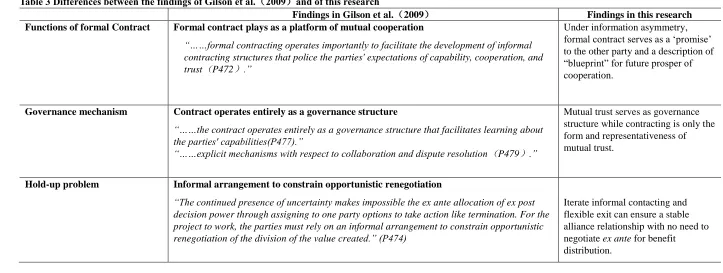
(1) About the formal contract function
Gilson et al. (2009) concluded that formal contracting serves as a platform to develop
subsequent informal contracting and associated mutual trust. In contrast, our findings
confirmed the new functions of formal contracts: under conditions where industrial prosperity
and market uncertainty exist simultaneously and information asymmetry is strong, formal
contracting can play a role as a promise to the other party in order to reassure the other partner
and act as a “blueprint” for future prosperity of cooperation, rather than constraining the
opposite side.
(2) About governance mechanisms
Our case analysis disagrees with the suggestion by Gilson et al. (2009) that formal contracting
is the premise for informal contracting. In our case, when mutual trust has not been established
or not enough, the contract appears in the formal form; while when mutual trust is mature,
informal contracts can replace formal ones. We believe that the forms of contracts applied are
determined by mutual trust, which stresses the key role of trust in the governance mechanism.
In other words, an informal contract is not a supplement to a formal contract in our case: rather,
they play the same role under different trust conditions.
(3) About hold-up problems
According to Gilson et al. (2009), informal arrangements should serve to constrain
findings may suggest differences. The disclosed OV-SOT case is a successful cooperative
alliance in the sense that both sides are very open on sensitive problems (as mentioned earlier),
closely engaged in the whole process, communicate extensively, and they set out the possibility
of free exit but have a strong willingness to continue the alliance cooperation. In this case,
“hold-up” problems are not obvious (at least at the time of interviews), and there is no use of
informal arrangements for purposes of safeguarding. We summarize these points in Table 3:
<Table 3 insert here>
Although the three points are drawn from a single case, they are consistently explained.
Compared to the three cases in Gilson et al. (2009), our story represents successful cooperation
in a strategy alliance in the current economically developing and uncertain mobile phone
market in China. OV and SOT’s positive collaboration has gained mutual trust, which brought
ex post benefits and minimised risks on both sides. The contracting development cannot ignore
this background. With the consideration of this background, we are therefore able to construct
four propositions below:
P1: In a highly uncertain industrial environment, formal contracting can serve as a ‘promise’
of resource commitments to the strategic alliance from the parties involved.
P2: In a highly uncertain industrial environment, mutual trust and related informal
arrangements are the foundation of a sustainable alliance cooperation.
P3: In a highly uncertain industrial environment, industrial prosperity would help foster
P4: In a highly uncertain industrial environment, iterated informal contacting and flexible exit
can ensure a stable alliance relationship with no need to negotiate ex ante for benefit
distribution.
6. Conclusions
Our case study reveals a story of proactive contracting for innovation. OV and SOT come from
the emerging smartphone industry, with high uncertainty in technology and huge demands on
industrial fixed-assets investment. Although good potential for market demand was visible,
both parties opted to work in alliance to obtain complementary resources from the other party
to achieve their strategic aims of maximizing profits, while minimizing costs and uncertainty.
Through the alliance cooperation, SOT has stabilized product demand and market share by
taking advantage of OV’s world reputation as a supplier, while OV has entered into and
stabilized business in the exciting Chinese market by contracting ex ante with SOT (the largest
module producer in China) to mitigate new market risks. During the collaboration, both parties
have experienced extensive information exchange and communication via both formal
contracts and more informal promises and understandings. These innovative channels have
helped build mutual trust between both parties and led to 'win-win' strategic cooperation, with
highly tacit understandings of each other, no opportunistic behaviors committed and ‘hold-up’
problems minimized.
6.1 Theoretical contributions
(1) Extension of “contracting for innovation’ theory to an emerging market like China
alliance cooperation based on high mutual trust under the circumstance of no obvious
opportunistic safeguarding. Their findings have addressed the deficiencies in explaining
cooperative behaviors in other research, such as Williamson and Oliver (1991) and Lafontaine
and Slade (2007). While Gilson et al.’s study was carried out in the US where the market is
comparatively stable, their findings cannot be fully used to explain the phenomena we observed
and argued in the introduction. Our study has found different functions of contracting and the
conditions of cooperation exist in an emerging market where industrial prosperity and market
uncertainty coexist. Our results indicate that ‘Contracting for Innovation’ can be more flexible
and more innovative to best match with different environments. Therefore, our study has added
explanatory power to the theory of ‘Contracting for Innovation’ in explaining strategic alliance
cooperation between upstream and downstream firms in the supply chain.
(2) Development of understanding of offset effects of environmental uncertainty on
strategic alliance
Many studies have carried out research on the environmental uncertainties around strategic
alliances (examples see Dyer and Singh, 1998; Lavie, 2006). Our case provides detailed
descriptions and explanations about the innovation and mechanism of a strategic alliance in a
highly uncertain environment. These descriptions and explanations not only describe/explain
how uncertain risks stimulate firms to create relational rents (i.e. mutual trust), but more
importantly, how established mutual trust helps in turn reduce environmental risk (i.e. binding
effects), and how technological effects and governance effects reduce environmental
uncertainty.
Many research on alliance innovations (e.g. Adegbesan and Higgins, 2011; Dyer and Singh,
1998; Gulati, 1995; Mohr and Spekman, 1994) generally followed views from traditional
studies such as Barney (1991) and Peteraf (1993), though Teece et al. (1997)’s dynamic
capabilities extended firms’ resources to relational and institutional resources, etc. Our case
indicates the basis of the OV-SOT cooperation is OV’s reputation and SOT’s product
capabilities. These factors are rarely mentioned in other studies. As such, our research on one
hand reveals institutional factors (reputation) can help the forming of, and innovation in,
alliances; and on the other hand, production capabilities (rather than unique capabilities)
commonly owned by many firms also can be advantages when forming an alliance. These new
findings have enriched the theories of RBV and the motivation for strategic alliances, and
inspired the understanding of emerging markets where there are distances between foreign and
domestic firms in relation to institutional factors and product capabilities.
6.2 Practical implications
Our results perhaps have two managerial implications: (1) although resource complementarity,
industrial environment and market conditions are important factors to be considered ex ante
when establishing a strategic alliance, ex post contracting for innovation practices including
effective communications, decision making and governance are also determinants of final
success of the alliance. (2) As long as both parties have enough shared interests in the alliance,
it might not be necessary to worry too much about ex post opportunistic problems and hold-up
issues because generally speaking, both sides will work hard to find suitable ways of moving
6.3 Limitations and future research
Although this study has made good contributions to theories and practices, it has three major
limitations. Firstly, this case is located in an emerging and fast-changing industry with obvious
characteristics relating to high uncertainty in technology, growing industrial prosperity and
huge investment in fixed assets (e.g. technical facilities). These industrial and market
constraints would limit our findings' applicability to other industries/cases. Secondly, the
convenience sampling strategy and the biased data5 would limit the representativeness of the
findings. Thirdly, our case operated in China, with the special market conditions mentioned
above; this could be good for our study to contribute to extant literature but it also means our
study has geographical limitations. We think these limitations could motivate future research
directions for the generalization of our findings, but need not compromise the value of our
study.
Acknowledgment
This research is funded by the National Natural Science Foundation of China (Fund No.
71372178), the Key Research Centre of Philosophy and Social Science of Zhejiang Province,
China (Zhejiang Technological Innovation and Enterprise Internationalization Research
Centre), and Key Research Team funds of Zhejiang University of Technology. We are grateful
for the critical and constructive comments from the journal editors and the anonymous
reviewers.
References
Adegbesan, J. A., & Higgins, M. J. (2011). The intra‐alliance division of value created through collaboration. Strategic Management Journal, 32(2), 187-211.
Amit, R., & Schoemaker, P. J. (1993). Strategic assets and organizational rent. Strategic
Management Journal, 14(1), 33-46.
Anand, J., Oriani, R., & Vassolo, R. S. (2010). Alliance activity as a dynamic capability in the face of a discontinuous technological change. Organization Science, 21(6), 1213-1232. Asanuma, B. (1989). Manufacturer-supplier relationships in Japan and the concept of
relation-specific skill. Journal of the Japanese and international economies, 3(1), 1-30. Barney, J. (1991). Firm resources and sustained competitive advantage. Journal of
Management, 17(1), 99-120.
Dattée, B., Alexy, O., & Autio, E. (2017). Maneuvering in poor visibility: how firms play the ecosystem game when uncertainty is high. Academy of Management Journal, amj.2015.0869.
Denzin, N. K., & Lincoln, Y. S (2008)