ROUGH SUBALGEBRAS OF SOME BINARY ALGEBRAS
CONNECTED WITH LOGICS
WIESŁAW A. DUDEK AND YOUNG BAE JUN
Received 5 May 2004 and in revised form 29 October 2004
Properties of rough subalgebras and ideals of some binary algebras playing a central role in the theory of algebras connected with different types of nonclassical logics are de-scribed.
1. Introduction
In 1982, Pawlak introduced the concept of a rough set (see [10]). This concept is funda-mental for the examination of granularity in knowledge. It is a concept which has many applications in data analysis (see [11]). Rough set theory is applied to semigroups and groups (see [7,8]). In this paper, we apply the rough set theory to BCH-algebras, that is, to algebras of type (2, 0) satisfying some simple axioms. Since these algebras play a central role in the theory of many types of algebras connected with different types of nonclassi-cal logics obtained results can be extended to the theory of such algebras. In particular, to the theory of BCK/BCI/BCC-algebras [9], QBC-algebras [4,5], Hilbert algebras [1] and prelogics [2].
2. Preliminaries
Many types of algebras connected with nonclassical logics (cf., e.g., [1,6,9]) have one binary operation∗and one constant denoted by 0 or by 1. This operation with the cor-responding constant is connected by the axiomx∗x=0 (or byx∗x=1) and satisfies the identity (x∗y)∗z=(x∗z)∗y(resp.,x∗(y∗z)=y∗(x∗z)). Moreover, in such algebras one can define a natural partial order for which the constant 0 is the smallest (or minimal) element (resp., 1 is the largest (or maximal) element). In many cases these par-tial orders are dual. Also some algebras are dual. This means that a very important role in the study of such algebras is played by algebras with the constant 0 satisfying the identity
x∗x=0 and may by other simple axioms. One of such algebras is a BCH-algebra. Recall that a BCH-algebrais an algebra (X,∗, 0) of type (2, 0) satisfying the following axioms: for everyx,y,z∈X,
(H1)x∗x=0,
(H2) (x∗y)∗z=(x∗z)∗y,
Copyright©2005 Hindawi Publishing Corporation
S
V
(a) (b) (c)
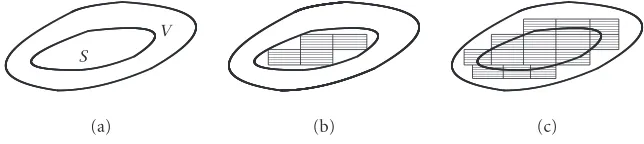
Figure 2.1 (a)S⊂V. (b)E−(S)⊆S. (c)S⊆E+(S).
(H3)x∗y=0 andy∗x=0 implyx=y.
In a BCH-algebraX, the following holds: for allx,y∈X, (u1)x∗0=x,
(u2) 0∗(x∗y)=(0∗x)∗(0∗y).
For any BCH-algebraX, the relation≤is defined byx≤yif and only ifx∗y=0 is a partial order onX. A nonempty subsetSof a BCH-algebraXis said to be asubalgebraof
Xifx∗y∈Swheneverx,y∈S. A nonempty subsetAof a BCH-algebraX is called an idealofXif it satisfies
(I1) 0∈A,
(I2)x∗y∈Aandy∈Aimplyx∈Afor allx,y∈X.
Note that an ideal of a BCH-algebraX may not be a subalgebra ofX. An idealAof a BCH-algebraXis said to beclosedif 0∗x∈Afor allx∈A. Note that every closed ideal of a BCH-algebra is a subalgebra, but the converse may not be true. An idealAof a BCH-algebraX is called atranslation idealofX if whenever x∗y∈Aand y∗x∈A, then (x∗z)∗(y∗z)∈Aand (z∗x)∗(z∗y)∈Afor allx,y,z∈X. Note that{0}andX itself are translation ideals ofX.
LetV be a set andEan equivalence relation onV and letᏼ(V) denote the power set ofV. For allx∈V, let [x]Edenote the equivalence class ofxwith respect toE. Define the functionsE−,E+:ᏼ(V)→ᏼ(V) as follows (seeFigure 2.1): for allS∈ᏼ(V),
E−(S)=x∈V|[x]E⊆S, E+(S)=x∈V|[x]
E∩S= ∅. (2.1)
The pair (V,E) is called anapproximation space. LetSbe a subset ofV. ThenSis said to bedefinableifE−(S)=E+(S) androughotherwise.E−(S) is called thelower approximation ofSwhileE+(S) is called theupper approximation. Obviously, ifxis inE+(S), then [x]
Eis contained inE+(S). Similarly, ifxis inE−(S), then [x]Eis contained inE−(S).
3. Rough subalgebras and ideals
LetE be a congruence relation on a BCH-algebraX, that is,Eis an equivalence rela-tion onX such that (x,y)∈E implies (x∗z,y∗z)∈E and (z∗x,z∗y)∈Efor all
z∈X. We denote byX/Ethe set of all equivalence classes ofXwith respect toE, that is,
[image:2.468.72.394.74.146.2]A special role is played by relations determined by ideals, that is, relationsΘof the form
(x,y)∈Θ⇐⇒x∗y∈U,y∗x∈U, (3.1)
whereU is an ideal. IfUis a translation ideal of X, thenΘis a congruence onX (see [12]). In this case we say also thatΘis acongruence relation related toU.
Theorem3.1. [0]Eis a closed ideal ofX.
Proof. Ifx∈[0]E, then (x, 0)∈E, so (0, 0∗x)=(x∗x, 0∗x)∈E. Hence 0∗x∈[0]E. Letx,y∈Xbe such thatx∗y∈[0]Eand y∈[0]E. Then (x∗y, 0)∈Eand (y, 0)∈E. SinceEis a congruence relation onX, it follows from (u1) that (x∗y,x)=(x∗y,x∗ 0)∈Eso that (x, 0)∈E, that is,x∈[0]E. Therefore [0]Eis a closed ideal ofX. Define an operation∗onX/Eby [x]E∗[y]E=[x∗y]Efor all [x]E, [y]E∈X/E. Ob-serve that (X/E,∗, [0]E) may not be a BCH-algebra, because X/Edoes not satisfy the condition (H3).
Theorem3.2. The following are equivalent:
(1)for allx,y∈X,x∗y∈[0]E, andy∗x∈[0]Eimply(x,y)∈E,
(2)Eis regular, that is,[x]E∗[y]E=[0]E=[y]E∗[x]Eimplies[x]E=[y]E, (3) (X/E,∗, [0]E)is aBCH-algebra.
Proof. (1)⇒(2). Suppose [x]E∗[y]E=[0]E=[y]E∗[x]E. Then [x∗y]E=[0]E=[y∗ x]E, and so (x∗y, 0)∈Eand (y∗x, 0)∈E. It follows from (1) that (x,y)∈E, that is, [x]E=[y]E.
(2)⇒(3). Obvious.
(3)⇒(1). Letx,y∈Xbe such thatx∗y∈[0]Eandy∗x∈[0]E. Then [x]E∗[y]E= [x∗y]E=[0]E=[y∗x]E=[y]E∗[x]E. It follows from (H3) that [x]E=[y]E, that is,
(x,y)∈E. This completes the proof.
For any nonempty subsetsAandBofX, we define
A∗B:= {x∗y|x∈A,y∈B}. (3.2)
Proposition3.3. LetAandBbe nonempty subsets ofX. Then the following hold: (1)E−(A)⊆A⊆E+(A),
(2)E+(A∪B)=E+(A)∪E+(B), (3)E−(A∩B)=E−(A)∩E−(B),
(4)A⊆BimpliesE−(A)⊆E−(B)andE+(A)⊆E+(B), (5)E+(E+(A))=E+(A)andE−(E−(A))=E−(A), (6)E−(A∪B)⊇E−(A)∪E−(B),
(7)E+(A∩B)⊆E+(A)∩E+(B), (8)E+(A)∗E+(B)=E+(A∗B),
(9)E−(A)∗E−(B)⊆E−(A∗B)whenever
Table 3.1
∗ 0 1 2 3 4
0 0 0 0 0 4
1 1 0 0 1 4
2 2 2 0 0 4
3 3 3 3 0 4
4 4 4 4 4 0
The proof ofProposition 3.3is straightforward.
Definition 3.4. A nonempty subsetSofXis called anupper(resp., alower)rough subal-gebra(or, (closed)ideal) ofXif the upper (resp., nonempty lower) approximation ofSis a subalgebra (or, (closed) ideal) ofX. IfSis both an upper and a lower rough subalgebra (or, (closed) ideal) ofX, it is said thatSis arough subalgebra(or (closed)ideal) ofX.
Theorem3.5. Every subalgebraSofXis a lower rough subalgebra if onlyE−(S)= ∅. Proof. LetSbe a subalgebra ofX and letE−(S)= ∅. TakingA=B=SinProposition 3.3(9), we have
E−(S)∗E−(S)⊆E−(S∗S)⊆E−(S), (3.4)
becauseSis a subalgebra ofX. HenceE−(S) is a subalgebra ofX, that is,Sis a lower rough
subalgebra ofX.
The following example shows that the lower approximation of a subalgebra may be the empty set.
Example 3.6. LetX= {0, 1, 2, 3, 4}be a BCH-algebra with the CayleyTable 3.1(see [12]). ThenU= {0, 1, 2}is a translation ideal ofX (see [12, Example 3.3]). LetΘ be a con-gruence relation onX related toU. Then all equivalence classes ofX are [0]Θ=[1]Θ=
[2]Θ= {0, 1, 2}, [3]Θ= {3}, and [4]Θ= {4}. It is not difficult to see thatS= {0, 2}is an
example of a subalgebra ofXfor whichΘ−(S)= ∅.
Theorem3.7. Every subalgebra ofXis an upper rough subalgebra ofX.
Proof. LetSbe a subalgebra ofX. We show thatE+(S) is a subalgebra ofX. Letx,y∈
E+(S). Then [x]
E∩S= ∅and [y]E∩S= ∅. Thus there existax,ay∈Ssuch thatax∈ [x]Eanday∈[y]E. It follows that (ax,x)∈Eand (ay,y)∈Eso that (ax∗ay,x∗y)∈E, that is,ax∗ay∈[x∗y]E. On the other hand,S is a subalgebra of X, soax∗ay∈S. Henceax∗ay∈[x∗y]E∩S, that is, [x∗y]E∩S= ∅. This shows thatx∗y∈E+(S).
ThereforeSis an upper rough subalgebra ofX.
Example 3.8. LetXandUbe as in the previous example. Consider a subsetS= {2, 3}of
Xwhich is not a subalgebra ofX. Then
Θ+(S)=x∈X|[x]
Θ∩S= ∅= {0, 1, 2, 3}, (3.5)
which is a subalgebra ofX.
Lemma3.9 [3, Proposition 3]. LetAbe a subalgebra ofX. ThenAis a closed ideal ofXif and only ify∗x∈X\Awheneverx∈Aandy∈X\A.
Theorem3.10. IfAis a closed ideal ofX, then the nonempty lower approximation ofAis a closed ideal ofX, that is,Ais a lower rough closed ideal ofX.
Proof. LetAbe a closed ideal ofX. ThenAis a subalgebra ofX, and soE−(A) is a subal-gebra ofX(seeTheorem 3.5). Letx,y∈Xbe such thatx∈E−(A) andy∈X\E−(A). If y∗x /∈X\E−(A), that is,y∗x∈E−(A), then
[y]E∗[x]E=[y∗x]E⊆A. (3.6)
Letay∈[y]E. Then for everyax∈[x]E, we haveay∗ax∈[y]E∗[x]E⊆A. Sinceax∈ [x]E⊆AandAis an ideal ofX, it follows from (I2) thatay∈Aso that [y]E⊆A. There-forey∈E−(A), which is a contradiction. Thus, byLemma 3.9, we know thatE−(A) is a
closed ideal ofX.
Proposition3.11. IfΘis the congruence relation onXrelated to{0}, then every subset of Xis definable.
Proof. LetAbe a subset ofX. Note that
[x]Θ=y∈X|(x,y)∈Θ
= {y∈X|x∗y=0, y∗x=0} = {y∈X|x=y} = {x} (3.7)
for allx∈X. Hence
Θ−(A)=x∈X|[x]
Θ⊆A=A,
Θ+(A)=x∈X|[x]
Θ∩A= ∅=A. (3.8)
This completes the proof.
Proposition3.12. IfΘis the congruence relation onXrelated toX, thenXis definable. Proof. It is straightforward, since
[x]Θ=y∈X|(x,y)∈Θ= {y∈X|x∗y∈X, y∗x∈X} =X (3.9)
for allx∈X.
Proof. Obviously 0∈Θ+(A). Ifx∈Θ+(A), then [x]
Θ∩A= ∅. Hence there existsa∈A
such thata∈[x]Θ. SinceAis a closed ideal ofX, we have 0∗a∈A, and so
0∗a∈[0]Θ∗[x]Θ∩A=[0∗x]Θ∩A. (3.10)
Thus [0∗x]Θ∩A= ∅, which means 0∗x∈Θ+(A). Letx,y∈Xbe such thatx∗y∈
Θ+(A) andy∈Θ+(A). Then [y]
Θ∩A= ∅and [x∗y]Θ∩A= ∅. It follows that there
exista,b∈Asuch thata∈[x∗y]Θandb∈[y]Θso that (a,x∗y)∈Θand (b,y)∈Θ.
Then (b,y)∈Θ⇒y∗b∈U⊆A, and (a,x∗y)∈Θimplies (x∗y)∗a∈U⊆A. Since
a,b∈AandAis a closed ideal ofX, it follows from (I2) thaty∈Aandx∗y∈Aso that
x∈A. Note thatx∈[x]Θ, thusx∈[x]Θ∩A, that is, [x]Θ∩A= ∅. Thereforex∈Θ+(A).
This completes the proof.
A map f :X→Yof BCH-algebras is called ahomomorphismif
f(x∗y)= f(x)∗f(y) ∀x,y∈X. (3.11)
Note that the kernel off, denoted by Ker(f), is a translation ideal ofX(see [12, Theorem 3.6]).
Proposition3.14. If f :X→Yis a homomorphism of BCH-algebras, then
fA∗Ker(f)=f(A)⊆fE+(A) (3.12)
for all subsetsAofX.
Proof. Let y∈ f(A). Then y= f(a) for somea∈A. SinceA⊆E+(A) byProposition 3.3(1), it follows thaty= f(a)∈f(E+(A)) so thatf(A)⊆ f(E+(A)). Since 0∈Ker(f), it follows from (u1) that
y= f(a)=f(a∗0)∈ fA∗Ker(f) (3.13)
so that f(A)⊆ f(A∗Ker(f)). Now, ifz∈ f(A∗Ker(f)), then f(x)=zfor somex∈
A∗Ker(f). Hencex=a∗bwitha∈Aandb∈Ker(f). Then
z= f(x)= f(a∗b)=f(a)∗f(b)=f(a)∗0=f(a)∈f(A), (3.14)
and so f(A∗Ker(f))⊆f(A). This completes the proof.
Proposition3.15. Let f :X→Y be a homomorphism ofBCH-algebras. IfΘis the con-gruence relation onXrelated toKer(f), thenf(A)= f(Θ+(A))for all subsetsAofX. Proof. UsingProposition 3.14, we have f(A)⊆ f(Θ+(A)). Let y∈f(Θ+(A)). Theny=
f(x) for some x∈Θ+(A). Hence [x]
Θ∩A= ∅, and so there exists a∈A such that
a∈[x]Θ. Nowa∈[x]Θimplies (a,x)∈Θ, that is,a∗x∈Ker(f) andx∗a∈Ker(f).
Thus f(a)∗f(x)= f(a∗x)=0 and f(x)∗f(a)=f(x∗a)=0. It follows from (H3) that f(x)= f(a) so that y= f(x)= f(a)∈ f(A). Therefore f(Θ+(A))⊆ f(A). This
Remark 3.16. Results presented in this paper are formulated for BCH-algebras, but the axioms (H1), (H2), (H3) defining BCH-algebras and identities (u1), (u2) satisfied by these algebras are not used in all proofs. This means that part of our results is valid for algebras satisfying only two from three axioms defining BCH-algebras.
Acknowledgment
The second author was supported by Korea Research Foundation Grant KRF-2001-005-D00002.
References
[1] W. J. Blok and D. Pigozzi,Algebraizable logics, Mem. Amer. Math. Soc.77(1989), no. 396, vi+78.
[2] I. Chajda and R. Halaˇs,Algebraic properties of pre-logics, Math. Slovaca52(2002), no. 2, 157– 175.
[3] M. A. Chaudhry and H. Fakhar-Ud-Din,Ideals and filters in BCH-algebras, Math. Japon.44
(1996), no. 1, 101–111.
[4] R. Halaˇs and J. Ort,QBCC-algebras inherited from qosets, Math. Slovaca53(2003), no. 4, 331– 340.
[5] ,Standard QBCC-algebras, Demonstratio Math.36(2003), no. 1, 1–10.
[6] K. Is´eki and S. Tanaka, An introduction to the theory of BCK-algebras, Math. Japon. 23
(1978/1979), no. 1, 1–26.
[7] N. Kuroki,Rough ideals in semigroups, Inform. Sci.100(1997), no. 1–4, 139–163.
[8] N. Kuroki and J. N. Mordeson,Structure of rough sets and rough groups, J. Fuzzy Math.5(1997), no. 1, 183–191.
[9] J. Meng and Y. B. Jun,BCK-Algebras, Kyung Moon Sa, Seoul, 1994.
[10] Z. Pawlak,Rough sets, Internat. J. Comput. Inform. Sci.11(1982), no. 5, 341–356.
[11] ,Rough Sets-Theoretical Aspects of Reasoning about Data, Theory and Decision Library. Series D: Systems Theory, Knowledge Engineering and Problem Solving, vol. 9, Kluwer Aca-demic, Massachusetts, 1991.
[12] E. H. Roh, S. Y. Kim, and Y. B. Jun,On a problem in BCH-algebras, Math. Japon.52(2000), no. 2, 279–283.
Wiesław A. Dudek: Institute of Mathematics, Wrocław University of Technology, Wybrze˙ze Wyspia ´nskiego 27, 50-370 Wrocław, Poland
E-mail address:[email protected]
Young Bae Jun: Department of Mathematics Education, Gyeongsang National University, Jinju 660-701, Korea