A Monthly Double-Blind Peer Reviewed Refereed Open Access International e-Journal - Included in the International Serial Directories.
GE- International Journal of Engineering Research (GE-IJER)
Website: www.aarf.asia. Email: [email protected] , [email protected]
Page 15
EFFICIENT CLUSTER HEAD SELECTION SCHEME FOR WIRELESS
SENSOR NETWORKS USING ENERGY AND DELAY CONSTRAINTS
SARANYA.S1, MENAKAMBAL.S2
1
PG Scholar, Nandha Engineering College, India.
2
Assistant Professor, Nandha Engineering College, India.
ABSTRACT
Wireless Sensor Network is made up of autonomous sensors for monitoring physical or
ecological conditions such as pressure, temperature, etc. Wireless Sensor Networks have
limited resources and so it is said as resource constraint network. Since sensor nodes operate
on batteries, energy efficiency is a key issue in designing the network. Clustering is one of the
important methods for prolonging the network lifetime in Wireless Sensor Networks. Cluster
head is elected in each cluster and Cluster head collects all the data from its cluster members
and forward the aggregated data to the base station. In this paper, we propose distributed
clustering scheme. The network is divided into two parts: border area nodes and inner area
nodes. This scheme restricts the cluster head selection only to inner area nodes and thus
intra-cluster communication distance is reduced. Network Simulator-2 (ns-2) shows the
proposed scheme outputs.
KEYWORDS - Aggregated data, Cluster head, Clustering, Energy efficiency, Wireless Sensor Network
I. INTRODUCTION
Modern Wireless Sensor Networks are made up of autonomous sensors that are networked
via low power wireless communication. They are designed and deployed for specific
purposes such as environmental monitoring, healthcare, manufacturing, transportation, home
appliances, etc. Thus the network design should be taken into account for specific intended
application. One of the main design parameter for battery-powered sensor is network lifetime,
since replacement of battery is difficult in many applications.
Clusters are formed to improve the efficiency of Wireless Sensor Network. Cluster head
A Monthly Double-Blind Peer Reviewed Refereed Open Access International e-Journal - Included in the International Serial Directories.
GE- International Journal of Engineering Research (GE-IJER)
Website: www.aarf.asia. Email: [email protected] , [email protected]
Page 16
directly or through multi-hop communication. The communication should be effective to
maximize packet delivery ratio. Hence, Cluster head selection becomes crucial as cluster
head requires more energy for transmission of data while comparing other nodes in the
network.
As energy is major constraint of Wireless Sensor Networks, various energy efficient
routing protocols have been proposed such as LEACH, HEED, etc. The objective of routing
protocol is to improve energy efficiency of the network and to establish reliable transmission
of aggregated data to its base station. One of the most popular cluster-based routing protocols
in Wireless Sensor Network is Low-Energy Adaptive Clustering Hierarchy (LEACH).
LEACH protocol minimizes energy dissipation of sensor networks. It is a cluster based
hierarchical routing protocol. In WSNs, optimal number of clusters is found out in order to
save energy and enhance network lifetime. In this paper, we propose a modification of LEACH’s cluster-head selection algorithm to balance total energy dissipation of sensors. Rest
of this paper is organized as follows. Section II describes the related work. Proposed
approach is described in Section III. Section IV shows experimental results. Lastly we
conclude the paper in Section V.
II. RELATED WORK
In [1], authors have proposed trade-off between energy and delay for data aggregation.
Energy Delay Index for Trade-off (EDIT) protocol is used to improve the network scalability
by considering two different distances such as Euclidean distance and hop-count. Here, two
contradictory parameters namely energy and delay are considered to improve network
efficiency. Various cluster head selection algorithms for Wireless Sensor Networks are
discussed in [2]. Here, various clustering schemes are discussed to improve efficiency of
Wireless Sensor Networks. In [3], performance analysis of LEACH protocol is discussed by
considering load balancing, multi-hop communication and remaining energy of nodes as its
major factors that are used to improve network lifetime.
The behaviour of improved LEACH protocol is discussed in [4] in which multi-hop
communication is used and proved that improved LEACH is more energy efficient than
A Monthly Double-Blind Peer Reviewed Refereed Open Access International e-Journal - Included in the International Serial Directories.
GE- International Journal of Engineering Research (GE-IJER)
Website: www.aarf.asia. Email: [email protected] , [email protected]
Page 17
heads acting as routers. The concept of Trust is introduced for designing cluster head
adjusting procedure. The lifetime of Wireless Sensor Network is increased about 4.81% than
original LEACH protocol when the load of the network is same. LEACH’s stochastic cluster
head selection algorithm is modified by using residual energy of nodes as additional
parameter [6]. Thus they have improved network lifetime through load balancing.
The LEACH protocol is improved further by considering remaining energy of cluster
node, distance from the base station and number of consecutive rounds in which a cluster
node is not elected as cluster head [7]. Here, network lifetime is prolonged by analysing
various parameters such as First Node Dies (FND), Half Node Dies (HND) and Last Node
Dies (LND). In [8], authors have analysed a distributed CH selection algorithm which
considers distance between sensor nodes and base station for balancing energy consumption.
The deterministic cluster head selection technique is proposed to improve the network
efficiency [9]. Here, predefined cluster head is selected based on remaining energy of sensor
nodes. In [10], multiple cluster heads are elected for efficient data transmission which
prolongs network lifetime than clusters with single cluster head.
III. PROPOSED APPROACH
Cluster head selection is a vital issue for clustering algorithms as both intra-cluster
communication distance and inter-cluster communication distance depends upon the position
of cluster head. Critical border surveillance application like military application requires that
border nodes should function for long time. In our proposed scheme, sensor network nodes
are divided into two parts namely border nodes and inner nodes.
A cluster head node positioned at border of cluster has more intra-cluster communication
distance as compared to cluster head role positioned at centre of the cluster. Border area
nodes consume more energy and die early. To improve network efficiency, cluster head
election is restricted only to inner nodes of the cluster and cluster head is rotated among inner
nodes based on residual energy.
Let d is the distance for partitioning of field area. Area starting from boundary of the field
up to distance d is border nodes and remaining area is inner nodes. Value of d is very crucial
A Monthly Double-Blind Peer Reviewed Refereed Open Access International e-Journal - Included in the International Serial Directories.
GE- International Journal of Engineering Research (GE-IJER)
Website: www.aarf.asia. Email: [email protected] , [email protected]
Page 18
available for cluster head role. By this, energy consumption of inner nodes increases leading
to the failure of inner nodes. Thus, inner nodes are elected as cluster head and various studies
are made to improve the network efficiency and packet delivery ratio.
IV. EXPERIMENTAL RESULTS
Lifetime of Wireless Sensor Network is evaluated by electing inner nodes of the cluster as
Cluster head and by establishing multi-hop communication. Following are the details of
experimental setup and simulation result obtained using Network Simulator-2 (ns-2)
4.1 Experimental Setup
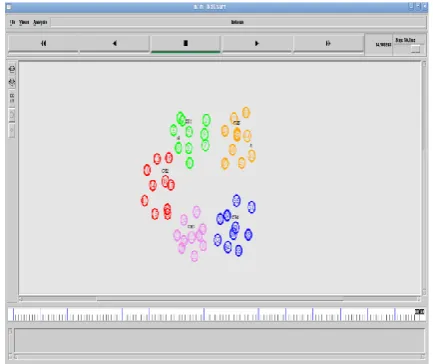
A sensor network topology of 100x100m2 area having 50 nodes is deployed randomly.
The locations of the sensor nodes are deployed by choosing (x,y) locations. The proposed
[image:4.595.200.417.363.545.2]scheme setup is shown in Fig. 1.
Fig. 1: A Sensor Network Deployed with 50 Nodes
4.2 Result
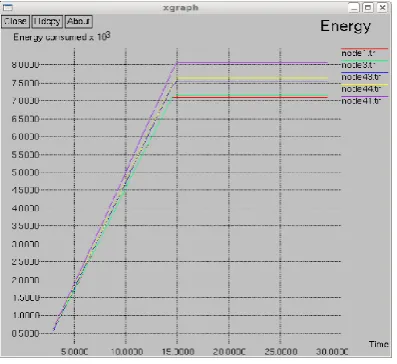
During simulation process, data transmission is done from source to destination. Proposed
scheme outperforms the network efficiency in terms of energy. Fig. 2 shows the improved
A Monthly Double-Blind Peer Reviewed Refereed Open Access International e-Journal - Included in the International Serial Directories.
GE- International Journal of Engineering Research (GE-IJER)
Website: www.aarf.asia. Email: [email protected] , [email protected]
[image:5.595.200.399.86.268.2]Page 19
Fig. 2 Efficient Energy Utilization of Sensor Nodes
The packet delivery ratio is calculated to find efficient data transmission. Fig.3 shows the packet delivery ratio of simulated Wireless Sensor Network.
Fig. 3 Packet Delivery Ratio of Sensor Nodes
V. CONCLUSION AND FUTURE WORK
The objective of maximizing the lifetime of Wireless Sensor Network is achieved by
electing inner nodes of cluster as its cluster head. Intra-cluster communication distance is
reduced during data transmission to balance energy consumption among cluster nodes. Packet
delivery ratio is increased by efficient multi-hop communication. Simulation results
outperform the efficiency of existing network and data gathering rate. In future, multiple
cluster heads may be elected among inner nodes of the cluster for further improvement of
[image:5.595.203.397.343.518.2]A Monthly Double-Blind Peer Reviewed Refereed Open Access International e-Journal - Included in the International Serial Directories.
GE- International Journal of Engineering Research (GE-IJER)
Website: www.aarf.asia. Email: [email protected] , [email protected]
Page 20
REFERENCES
[1] Ankit Thakkar, Ketan Kotecha, “Cluster Head Selection for Energy and Delay
Constraint Applications of Wireless Sensor Network”, IEEE Sensors Journal, Vol. 14,
No. 8, August 2014.
[2] Ramesh.K, Somasundaram.K, “A Comparative Study of Cluster Head Selection
Algorithms in Wireless Sensor Networks”, International Journal of Computer Science
& Engineering Survey, Vol.2, No.4, November 2011.
[3] Xiaoyan Cui, “Research and Improvement of LEACH Protocol in Wireless Sensor
Networks”, IEEE International Symposium on Microwave, Antenna, Propagation and
EMC Technologies for Wireless Communication, 2007.
[4] Wei Bo Hu Hang-ying Fu Wen, “An Improved LEACH Protocol for Data Gathering
and Aggregation in Wireless Sensor Networks, International Conference on Computer
and Electrical Engineering, 2008.
[5] Wang Weichao, Xu Qijian, Du Fei, “An Improvement of LEACH Routing Based on
Trust for Wireless Sensor Networks”, Chinese National Programs for High
Technology Research and Development, No.2009AA01Z204, 2009.
[6] Ma Chaw Mon Thein, Thandar Thein, “An Energy Efficient Cluster-Head Selection
for Wireless Sensor Networks”, International conference on Intelligent systems,
Modelling and Simulation, ISDN-978-0-7696-3973-7, 2010.
[7] Anindita Ray, Debashis De, “Energy Efficient Cluster Head Selection in Wireless
Sensor Network”, 1st International Conference on Recent Advances in Information
Technology, ISDN-978-1-4577-0697-4, 2010.
[8] Sang H.Kang, ThinhNguyen, “Distance Based Thresholds for Cluster Head
Selection in Wireless Sensor Networks”, IEEE Communication Letters, Vol. 16, No. 9,
September 2012.
[9] Akramul Azim, Mohammad Mahfuzul Islam, “Deterministic Cluster Head Selection
for Wireless Sensor Networks”, 25th
IEEE Canadian Conference on Electrical and
Computer Engineering, ISDN-978-1-4673-1433-6, 2012.
[10] Vaibhav V.Deshpande, A.R. Bhagat Patil, “Energy Distributed Clustering for
Improving Lifetime of Wireless Sensor Networks”, International Journal of Emerging