Citation:
Fylan, F and Hughes, A and Wood, JM and Elliott, DB (2018) Why do people drive when they can’t
see clearly? Transportation Research Part F: Traffic Psychology and Behaviour, 56. pp. 123-133.
ISSN 1369-8478 DOI: https://doi.org/10.1016/j.trf.2018.04.005
Link to Leeds Beckett Repository record:
http://eprints.leedsbeckett.ac.uk/4965/
Document Version:
Article
The aim of the Leeds Beckett Repository is to provide open access to our research, as required by
funder policies and permitted by publishers and copyright law.
The Leeds Beckett repository holds a wide range of publications, each of which has been
checked for copyright and the relevant embargo period has been applied by the Research Services
team.
We operate on a standard take-down policy.
If you are the author or publisher of an output
and you would like it removed from the repository, please
contact us
and we will investigate on a
case-by-case basis.
Why do people drive when they can’t see clearly?
Fylan, F. 1*, Hughes, A.2, Wood, J.M.3 and Elliott, D.B.2
1Brainbox Research and Leeds Beckett University 2University of Bradford
3Queensland University of Technology
* Corresponding author, [email protected], 46 Town Street, Gildersome, Leeds LS27 7AA, UK.
Abstract
Purpose: Refractive blur is associated with decreased hazard perception and impairments in driving performance, but little is known about why people who have spectacles to correct their distance vision drive with uncorrected vision.
Methods: We conducted six focus groups. Participants were 30 drivers (mean age 45) who reported having driven uncorrected at least twice in the past six months despite having spectacles to correct their distance vision. Focus groups were audio recorded, transcribed verbatim and analysed thematically.
Results: We identified three themes. 1. Responsibility: participants did not feel obliged to drive with optimal vision and believed that others have a responsibility to ensure drivers maintain clear vision. 2. Safe Enough: participants felt safe to drive uncorrected, did not believe they need to wear spectacles
to see sufficiently clearly and that they would know if their uncorrected eyesight fails to meet minimum standards. 3. Situations: participants discussed how they would drive uncorrected for short and familiar journeys, when they feel alert, in daylight and in good weather.
Conclusions: Beliefs about the importance of driving with clear vision compete with the benefits of not wearing spectacles. Eyecare professionals should provide more direct advice to patients regarding the need to wear their visual correction for driving.
1. Introduction
Uncorrected refractive error is the leading cause of reversible visual impairment worldwide (Van Newkirk et al., 2001). The detrimental effects of optical blur on standard clinical measures, such as visual acuity, are well known. However, functional measures such as reading (Chung et al. 2007), balance control (Anand et al. 2003), quality of life, (Rahi et al. 2008) and driving have also been shown to be negatively impacted in the presence of optical blur that may arise from uncorrected or under corrected refractive error.
The impact of optical blur on driving has received increasing attention, given the potential ramifications for driving ability and safety. While the impact of uncorrected vision on crash risk is unknown, Sagberg (2006) reported that being myopic increased the risk of crash involvement (odds ratio 1.22, 95% confidence intervals 1.02-1.38) and suggested that this was due to insufficient optical correction, which would lead to distance blur. Simulator and closed-road driving studies indicate that while steering accuracy and lane-keeping are relatively robust to even high levels of blur (Brooks et al., 2005; Owens et al., 1999), recognition of night-time road signs, low contrast hazards and pedestrians can be negatively affected by blur and following refractive surgery (Schallhorn et al., 2009; Schallhorn et al., 2010; Wood et al., 2012, Wood et al., 2015). Even low levels of refractive blur increase the time it takes for drivers to recognise pedestrians at night (Wood et al., 2015) and the effects of blur are more marked for night compared to daytime driving performance (Wood et al., 2014). Eye movement studies have provided some insight into how these effects manifest. Drivers with blurred vision exhibit longer reaction times because they fixate on hazards for longer before reacting, make fewer fixations on hazards, and the total duration of fixation is lower, suggesting lower visual attention on the road (Lee et al., 2016).
applies to drivers of all ages. Indeed, blur has a more marked effect on the driving-related ability of younger than on older drivers in both laboratory-based and real-world measures of driving performance (Lee et al., 2015; Wood et al., 2015).
Given evidence suggesting the negative implications of blur or uncorrected or under-corrected refractive error on indices of driving ability and safety, it is surprising that many individuals drive with uncorrected refractive error. In one study uncorrected refractive error accounted for 80% of drivers whose vision failed to meet the legal limit for driving (Keefe et al., 2002), and a market research study in the UK estimated that 26% of motorists drive uncorrected (rarely, sometimes, often or always) and suggested that they have four times the crash risk of those who never drive uncorrected (Opinium, 2016). Some states provide restricted licences that highlight the need to wear glasses when driving, but this is variable across the U.S. states (http://lowvision.preventblindness.org/daily-living-2/state-vision-screening-and-standards-for-license-to-drive/). While there is a similar restriction in the UK, the restriction is rarely
recorded on driving licences.
paid to driving with uncorrected optical blur. This study aimed to develop a better understanding of why people drive without visual correction in order to provide an evidence base to inform the design of interventions to target this behaviour and for eyecare professionals when advising patients about driving.
2. Method
2.1 Participants
Participants were 30 current drivers who reported having driven uncorrected at least twice in the past six months despite having spectacles that include correction for distance vision (either distance vision, progressive or bifocal lenses). They were recruited by a fieldwork agency, briefed to ensure that each group contained a range of ages and socio-economic groups and a balance of genders. The mean age was 45 (± 12 years) and 18 were female and 12 male. Sixteen participants were myopes, seven were hyperopes and seven had a Mean Sphere Equivalent of between -0.50 and +1.00 (Table 1). Fifteen participants had a significant degree of astigmatism (≤-0.75DC) in at least one eye, with 10 having low astigmatism (-0.75 to -1.25DC), three having moderate astigmatism (-1.50 to -2.75DC), and two having high astigmatism (≤-3.00DC). The median amount of astigmatism in the more
astigmatic eye was -0.75DC. The median improvement in visual acuity (VA) between the uncorrected and corrected conditions in these participants was 0.12 logMAR (just over one line), range -0.10 to 0.82 logMAR.
Four participants who reported sometimes driving uncorrected did not reach minimum U.K. driving standard when uncorrected (logMAR > 0.30; Snellen equivalent <6/12). In these four participants, unaided visual acuity (VA) was 0.70 (Snellen 6/30), 0.66 (6/30+2), 0.32 (6/12-1) and 0.34 logMAR (6/12-2). A further participant could be considered borderline for the minimum standard of driving with VA of 0.24 (6/12+3). An additional five participants reported that they had rarely driven uncorrected and three of these did not reach the minimum UK driving standard when uncorrected.
2.2 Procedure
in-depth interviews in a group setting where the dynamics of the group led to drivers disclosing and discussing their thoughts, feelings and experiences in a way that they may not have done in a one-to-one interview. When participants arrived, refractive correction was determined by lensometry and binocular corrected and uncorrected visual acuity was measured using a Thompson logMAR chart (http://thompson-softwear-solutions.com/) by one researcher (AH), a practising optometrist. A 15.6-inch LED-backlit HD laptop monitor with a luminescence of 200 cd/m was used at a testing distance of 3m. The letters were randomised between each measurement and participants were encouraged to guess until 3/5 letters on a line were read incorrectly at which point VA was scored by letter and recorded. Focus groups were facilitated by two researchers (FF and AH). Discussions followed a semi-structured topic guide and covered:
Experiences of wearing spectacles, including what participants like and dislike about wearingspectacles;
Experiences of eye examinations and advice from eye health professionals about driving;
Risk perceptions around not wearing spectacles for driving;
Situations and reasons for not wearing spectacles when driving;
Experiences of not wearing spectacles when driving.Each focus group lasted one hour and, with permission from participants, was audio recorded and transcribed verbatim. The study followed the tenets of the Declaration of Helsinki. All participants were given a full explanation of the nature of the study, what taking part would involve, and how to withdraw from the research. Written informed consent was obtained.
2.3 Data analysis
was externally heterogeneous, i.e. that the themes were fundamentally different from one another. This stage was iterative, with sub-themes merging and moving between themes until a grouping was identified that provided the most parsimonious data structure while capturing the full set of codes. Quotes from the focus groups were selected on the basis that they best illustrated each sub-theme. The number of the focus group (FG1-6) is indicated in brackets after each quote, along with the gender of the participant (M or F), their age group (<40, 41-60, >60), and whether they had started wearing spectacles recently, i.e. within the previous five years (R), or whether they were an established wearer of five years or more (E).
3. Results
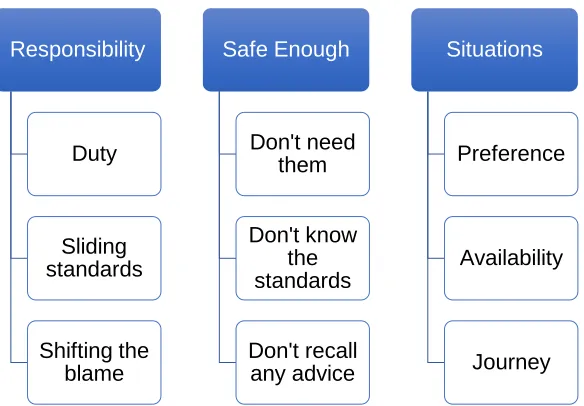
We identified three themes in the data: Responsibility; Safe Enough; and Situations, each with three sub-themes, shown in Figure 1. They are described below and illustrated using quotes from the focus groups.
3.1 Responsibility
This theme describes how participants consider driving with clear vision as a responsibility and that to not do so was considered unacceptable. Despite this, they did not feel obliged to do so. They reported becoming complacent about driving, and this included not ensuring that their vision is as clear as it could be. They believed that others, including driving authorities, have a responsibility to ensure drivers maintain clear vision. The three sub-themes are described below.
Duty
Participants talked about how they considered it unsafe to drive without spectacles and how drivers put themselves and others at risk if they do not have clear vision. They discussed how driving without clear vision is risky, and while risk taking is often an individual decision, they have a duty to drive in a way that protects rather than endangers others on the roads. This means that they have a
responsibility to wear their spectacles while driving so that their vision is as clear as possible.
myself and my passengers but also to other people as well.” (FG2, M, >60, E)
“If you can’t see properly and you don’t wear your glasses you are not only putting yourself at
risk but you are also putting other people at risk.” (FG4, F, 41-60, E)
In all the groups, participants talked about how driving with vision that does not meet the legal standard is equivalent to drink driving, or driving while using a mobile phone. Some discussed how current attitudes towards driving without spectacles are similar to the attitudes people previously held about drink driving: that you know it’s not safe but you do it anyway. Some participants talked about how if somebody were involved in a collision and were not wearing their glasses they should be prosecuted. However, they did not talk about prosecuting people who drive with vision below the minimum standard who are not involved in a collision.
“A bit like drink and driving, isn’t it, do you have a drink and drive? Do you put your glasses on
or not? It’s very much the same.” (FG1, F, 41-60, R)
“It’s a bit like drink driving in the 70s where everybody did it, everybody had six pints when
they weren’t going far. And now you wouldn’t dream of doing it.” (FG6, M, 41-60, E)
Participants also talked about how drivers have a responsibility to have their eyes checked if they have noticed their vision deteriorating. This sense of duty to have the best possible vision was shared by all participants, both those who met the legal visual requirements without correction and those who did not. Even those who met the legal standards discussed how they feel they are a better, safer driver when wearing them.
“You need to get your eyes checked. I think it is having some responsibility, you know you are
adults and you take responsibility.” (FG1, F, 41-60, R)
standards could invalidate your driving insurance.
Sliding Standards
Despite talking about having a responsibility to wear spectacles, participants nevertheless talked about how people, themselves included, don’t always wear them. They recognised that their vision is clearer with spectacles, and this means that they can see road signs better, but wearing them is a personal choice rather than being an essential part of driving. They do not always do their duty to drive with the best possible eyesight.
“A lot of people now have to wear glasses but they will just wing it and think I will be alright; it
doesn’t affect me.” (FG1, M, <40, E)
“I don’t wear them all the time for driving, I have to be honest with you, I don’t know why
because when I do put them on I can see quite sharp.” (FG6, F, >60, E)
During discussions, participants talked about driving more generally and about how they would not pass their driving test if they were required to sit another one. They talked about their vision in the same way as more general driving skills: their vision had been checked during their driving test and both their eyesight and their driving skills have deteriorated since the test. A few participants talked about how they had always worn their glasses when learning to drive and for their driving test but how their driving has become “lazy” and they have slipped into bad habits and they talked about wearing their glasses in the same way: they know they should wear them but do not always do so.
“I don’t think many would pass their test if they had to do it again. I know I would fail mine
because you pick up so many lazy bad habits.” (FG2, F, <40, E)
“You have to wear your glasses for your driving test, you have to be able to read.” (FG3, F,
41-60, R)
have got to read the registration number or you can’t carry on…. Because obviously when
you take your test you have to be able to read that number plate.” (FG5, F, <40, E)
Shifting the blame
This sub-theme is about how participants believe others, rather than themselves, are responsible for ensuring that their vision meets legal standards. Some talked about how the person who tests their vision during the driver licensing process does not stress the need to ensure their eyesight continues to meet this standard. They therefore felt little responsibility to consider their eyesight once they had passed their driving test. The absence of any requirement to have regular eye tests in order to maintain their driver licence (which is the case in the UK) also reinforced that the number plate test is something that they can pass then forget.
“I think you get told on your test [about the legal eyesight standards] but it is easily forgotten
and not reiterated enough.” (FG2, F, <40, E)
Participants talked about how it is the optometrist’s responsibility to indicate whether or not they should be wearing their spectacles for driving. One of the participants who did not meet legal
minimum standards reported that he had not been given this advice by his optometrist and so was not aware that he should not drive without his spectacles. Participants talked about how people may not realise that their eyesight has deteriorated, so it is not sufficient for the optometrist to assume that people already know they need to wear their glasses to drive.
“Opticians should be saying to you that there is a recommendation, here is what it is, this is
what we recommend. And I think people would actually take it on board.” (FG1, F, 41-60, E)
driving.
“They should write it into your insurance [that you need to wear glasses for driving] so your
insurance is fully void if you do have a prescription [but don’t wear your glasses].” (FG1, M,
<40, E)
“When your car tax is due, it should be your eye test is due, and you have to have it or you
will get fined.” (FG2, F, 41-60, R)
3.2 Safe Enough
This theme is about how participants feel safe enough to drive uncorrected, did not believe they need to wear spectacles to see sufficiently clearly and that they would know if their uncorrected vision fails to meet minimum standards, despite being unaware of the legal standards, and about a lack of direct advice from optometrists about the benefits of clear vision for driving. There are three sub-themes, described below.
Don’t need them
This sub-theme is about participants generating reasons for why it is acceptable for them to drive with vision that could be clearer. They discussed how road signs are sharper when wearing their glasses, but as long as they can see the dashboard and the car in front without spectacles, their vision is good enough. A few talked about how it’s not important to be able to read road signs as they can recognise signs without being able to read them.
“Wearing your glasses for driving does make a difference and it does make you realise you
should have them on all the time but my eyes aren’t that bad. I can see road signs, I can see
where I need to be going, but it does sharpen things up.” (FG2, F, 41-60, R)
“Sometimes I might just take them off. I can see the road signs, I just can’t see what it says
Most participants relied on their own judgements about whether their uncorrected eyesight is good enough. Some talked about how they base their decision on feelings of confidence: they feel confident driving without their spectacles so their vision must be good enough. Many talked about how they would know if their eyesight had deteriorated but were unable to give any details of how they would know, but rather relied on a conviction that “I would just know.”
“You would know yourself [if your eyesight isn’t good enough to drive], you use your own
judgement.” (FG3, F, 41-60, E)
“It is safe for me to drive without my glasses because I can see. I know I can see. I wouldn’t
drive if I couldn’t see things and it got blurred, if I sort of thought – what was that?” (FG3, F,
41-60, E)
“[I would wear my glasses] as soon as I start to be a danger to myself and other people
driving but I feel my eyes aren’t that bad.” (FG5, F, <40, R)
A few participants talked about how their optometrist had advised them that they do not need to wear their spectacles when driving. They discussed being told that “they didn’t need them” or that wearing them would be “beneficial”, which they took to mean that they were safe to drive uncorrected. One participant talked about being told that their vision is “borderline” to drive, which he assumed meant that it is his own personal decision and there was no imperative to do so.
“I was told recently mine was borderline without the glasses but I am still driving without
them.” (FG5, M, 41-60, R)
“He sort of advised that it might be more beneficial if I start to wear them for driving but he
Don’t know the standards
Very few participants knew what the legal minimum standards are. When pressed, most suggested that it is being able to see the number plate of the car in front. A few thought it would be sufficient to see the car in front, rather than the number plate. One participant correctly stated that the requirement is to be able to read a number plate at 20m, but when asked to indicate how far 20m is, he greatly underestimated the distance.
“If you can’t see the registration plate of the car in front you definitely need your glasses on.”
(FG1, M, <40, E)
Several participants talked about the eye test involving reading a number plate and how they don’t need to read number plates during their day-to-day driving. They did not talk about how the test is about acuity, and therefore relates to hazard perception, but rather focused on it relating simply to their ability to read number plates.
“Maybe I should wear them all the time because when you put your glasses on you think it’s a
lot clearer but in your mind you are thinking, I don’t need to read number plates, I can see the
car in front.” (FG6, F, >60, E)
Participants discussed how poor their vision would need to be in order to fail to meet the legal standards uncorrected. They suggested that it would be when their vision is completely blurred and they need to squint to focus, or if they couldn’t see any of the road signs.
“If I couldn’t see where the lock was to turn the ignition, I think that is the time to wear
glasses.” (FG6, F, >60, E)
Don’t recall any advice
driving easier.
“I have been going to see the optician for 20 years and I can’t recall once them asking me
about driving.” (FG4, M, <40, E)
“Honestly, I have never been asked about driving.” (FG6, F, 41-60, R)
During the discussions participants indicated they would like to know more about their vision and driving, and would like advice about driving at night. They wanted to receive very clear guidance about whether they should wear their glasses to drive, and how to reduce challenges such as glare. Participants were asked in the focus groups about whether they had been told about tinted lenses to help with night driving and only one recalled a conversation on this topic.
“[I would like advice about tinted lenses because] I do struggle when I am driving on a night. I
don’t drive a lot on a night so when I do drive it is totally different to driving through the day
and it is the glare sometimes off the lights.” (FG3, F, 41-60, E)
3.3 Situations
This theme is about participants’ accounts of the situations where they would and wouldn’t drive without their spectacles. It includes when they would prefer not to wear their spectacles, whether they have spectacles available to wear, and the type of journey. The three sub-themes are described below.
Preference
Most of the participants described certain situations in which they prefer not to wear spectacles. As very few wore contact lenses, this meant that they are uncorrected, including when driving. Many participants talked about disliking their appearance in glasses. These participants often chose not to wear their spectacles for certain situations such as when meeting friends or going on an evening out.
“I wouldn’t like to wear them out…, it’s just the appearance thing, what other people’s
perceptions might be so that is why I don’t really wear them out.” (FG5, M, 41-60, R)
Several participants talked about their spectacles as being uncomfortable, usually because of their weight or the sensation of them on their face or because they steam up or slide down their nose. As a consequence, they often choose not to wear them, and this included when driving.
“They annoy me sometimes and I think it is just nice not to have to wear them.” (FG6, F, >60,
E)
Several participants discussed how they deliberately spend time without their spectacles as they believe this prevents their eyesight from deteriorating further. They likened their eyesight to a muscle that needs exercising, and so if they were to wear their spectacles continuously their prescription would strengthen. Driving without spectacles was simply part of this protective process.
“I put my glasses on and, you know, think – wow, it’s high definition. I should wear them and I
don’t because my eyes are going to deteriorate quicker [if I do].” (FG5, M, 41-60, R)
Availability
Many participants talked about situations when they don’t have their spectacles (or suitable
“If I am doing the school run and I have forgotten to put my glasses on I wouldn’t go back. I
would be fine” (FG2, F, <40, E)
“For me, I forget. I like wearing them and people say they really suit you, so it is just getting
used to it, you know, getting into the habit, getting into the car and putting them straight on.”
(FG6, F, 41-60, R)
A few participants talked about how they do not have prescription sunglasses and so when it is sunny they prefer to wear sunglasses rather than their spectacles.
“In the bright sun I have to put my sunglasses on, I take my glasses off and put my
sunglasses on.” (FG3, F, 41-60, E)
Journey
Participants talked about how they always wear their spectacles for long journeys, on unfamiliar routes, on busy roads and on motorways. The weather and lighting conditions were also important: they would always wear their spectacles in poor weather such as rain, snow or ice, and in the dark. However, a few participants talked about their spectacles making glare worse, so they choose not to wear them for night driving. Finally, fatigue also influences their decision: they always wear their spectacles when they feel tired.
“[I wear them for] driving on a night or if I don’t know where I am going, if you have got road
signs to read.” (FG2, F, <40, E)
“If I am going on a motorway I wear them, but if I am just going local, like this morning I didn’t
have my glasses on and I found my way here. If it was really bad weather and it was snowing
I would have my glasses on.” (FG6, F, <40, E)
have put my glasses in the car.” (FG5, F, <40, E)
Participants described how not wearing spectacles on familiar routes does not present a risk as they know the street signs, they know where pedestrians are likely to cross the road, and so they don’t need to see the signs or to respond quickly to hazards. Similarly, when the roads are quiet, they believe that not being able to see clearly does not introduce too great a risk because they don’t need to respond to other motorists. They would sometimes not wear spectacles for morning journeys when they feel alert and their eyes feel “fresh”.
“You know that route, don’t you. You are aware of what the speed is, you are aware where
people are going to come out of.” (FG6, M, 41-60, E)
“Mine is more of a tiredness thing with the driving and if I’ve been at work all day I put them
on. But first thing of a morning when I am driving to work my eyes are pretty fresh so I don’t
need them.” (FG1, F, 41-60, R)
4. Discussion
We used a qualitative approach to explore why drivers who wear spectacles to correct their distance vision sometimes don’t wear them for driving. Despite believing that they have a responsibility to drive with clear vision, and that doing so is safer, participants did not feel obliged to wear their spectacles for driving. They believed that driving without their spectacles is safe enough, and that they would know if their uncorrected eyesight fails to meet legal minimum standards, despite being unaware of what those standards are. Few recalled any conversations with or advice from their optometrist about driving, and those who did reported that the advice was that wearing spectacles for driving, while beneficial, is a personal choice. They are less likely to wear spectacles in certain situations, such as when they prefer their appearance without spectacles and for short, local, daytime journeys.
Our results show an interesting contradiction between participants’ beliefs about it being safer to wear spectacles for driving and about having a responsibility to wear them, and their behaviour in
dynamic emotional experiences as well as logical or reflective processes underpin behaviour (Ferrer and Klein, 2015). For our participants, the reflective pathway tells them that their vision is clearer and their driving safer when they wear their spectacles and that they have a responsibility to keep other road users safe and so a duty to wear their spectacles. The dynamic pathway tells them that (in certain situations) they feel confident driving without their spectacles, and they will benefit from not wearing them, e.g. because they will feel more attractive or more comfortable, or they will not have the inconvenience of going to fetch them.
Many participants talked about their vision being good enough to drive uncorrected, and indeed, several had small prescriptions, but all had improved acuity when corrected which would lead to improved hazard perception, particularly under night-time driving conditions (Wood et al., 2009, 2010, 2015). Relying on a belief that they would “just know” if their vision was not good enough to drive uncorrected is problematic, especially given that many older drivers lack insight into their own driving ability (Wood et al., 2013). Participants’ discussions indicate that they rely on how confident they feel to determine how safe they are. Confounding confidence with safety is often apparent in young drivers’ accounts, which indicate that they judge how safe a driver is by how confident they appear (Christmas, 2008). We did not find evidence that our participants’ over-confidence in being able to drive uncorrected arises from overconfidence in driving ability generally, or from beliefs that they are better drivers than others (Mathews & Moran, 1986; Alicke & Govourlin, 2005). Rather, it is more likely to arise from their underestimation of the challenges of the driving task. As such our findings support Wohleber and Mathews’ (2016) conclusions that overconfidence in relation to driving when impaired is a distinct construct from overconfidence in general driving ability.
It is interesting that some of the participants talked about how people who are in a collision when not meeting the legal visual standards for driving should be prosecuted. They did not talk about
prosecution for people who were not in a collision, even though the behaviour is the same. This suggests that they base decisions about risk on the consequences of a behaviour. This has been previously reported in young people talking about using mobile phones while driving: it is not the behaviour itself that is of relevance, but rather its outcome (Atchley et al., 2011).
they slip into bad habits regarding more general driving behaviours as well as wearing spectacles. The driving regulations in many countries (including the U.K.) do not require drivers to attend
refresher driving lessons, which could usefully address these bad habits, as well as reinforce the need for clear vision. Many of our participants had not realised that the number plate vision test (used in several countries to test visual acuity) is relevant to their ability to identify and respond to hazards while driving: several talked about how they do not need to be able to read number plates while they are driving, so they are not concerned if they cannot read the number plate of the vehicle in front. Driving instructors and driving examiners, as well as eye care professionals, could usefully assist people to understand the relevance of assessing visual acuity using the number plate vision test, in terms of assessing aspects of visual function that are relevant for hazard perception.
message that it is every driver’s responsibility to ensure their vision is optimally corrected.
Our results also suggest that eyecare professionals should not tell people with refractive errors that they meet the legal driving standards uncorrected and therefore don’t need to wear their glasses for driving. Instead, they should tell people that they meet the legal minimum standards, which does not mean “good vision” and that they could nevertheless put themselves and others at risk if they don’t wear their spectacles. While such conversations will always contain some uncertainty, given the potential lack of agreement between measures of VA undertaken in a clinical environment and the number plate tests (Rae et al., 2016), eyecare professionals could provide more directive advice about the need to wear spectacles or contact lenses while driving.
Many of the participants disliked wearing spectacles and did not feel confident or comfortable while wearing them, which in many cases resulted in them not wearing their spectacles for driving. This suggests that optometrists and opticians could do more to explore with people how they feel about wearing spectacles and to assist them to select spectacles they are happier to wear. Alternatively, they could talk to people about the importance of keeping a pair of spectacles in the car so they do not find themselves in a position where they need them but don’t have a pair available.
The strengths of this study are that we have used a qualitative approach to provide in-depth
understanding about why people drive when they can’t see clearly. Recruiting participants through a fieldwork agency (rather than a University research pool or clinical practice) means that participants include those who do not have a particular interest in vision or in taking part in research, who do not necessarily have their eyes examined regularly, and who are therefore more likely to be typical of the general public. We included people of a range of ages and who had worn spectacles for varying lengths of time. Our participants had a range of spectacle prescriptions, including some whose VA did not meet the legal minimum standards for driving uncorrected and some who were borderline.
spectacles and with larger refractive errors. The inclusion criteria for the study were people who have driven at least twice without their spectacles in the previous six months. While most participants drove without their spectacles regularly, it would be interesting to extend the study to compare those who drive uncorrected routinely with those who do so only occasionally.
Future research should explore eyecare professsionals’ experiences of communicating with patients about driving and identify the messages that they - and patients - believe are more effective in reducing the incidence of driving without spectacles.
4.1 Conclusions
There is a clear need to improve communication between eyecare professionals and the public about driving. Professionals should provide more direct advice about the need to wear visual correction while driving and ensure that people recognise that optical blur affects hazard perception.
Funding
This research did not receive any specific grant from funding agencies in the public, commercial, or not-for-profit sectors.
5. References
Ajzen, I. (1991). The theory of planned behavior. Organizational Behavior and Human Decision
Processes, 50, 179–211.
Alicke, M. & Govorlin, O. (2005). The better-than-average effect. In M. D. Alicke, D. A. Dunning, & J.
Krueger (Eds.), The self in social judgment (pp. 85–106). New York: The Psychology Press.
Atchley, P., Atwood, S., & Boulton, A. (2011) The choice to text and drive in younger drivers:
behaviour may shape attitude. Accident Analysis and Prevention, 43: 134-142.
Braun, V. & Clarke, V. (2006). Using thematic analysis in psychology. Qualitative Research in
Psychology, 3, 77–101.
Brooks JO, Tyrrell R. & Frank TA. The effects of severe visual challenges on steering performance in
visually healthy young drivers. Optometry & Vision Science 2005; 82: 689-697.
Christmas, S. (2008) Feeling safe, itching to drive: pre-learner and learner perspectives on driving
and learning. Road Safety Research Report 86. Department for Transport: London.
Chung, S.T.L., Jarvis, S.H. & Cheung, S.H. (2007). The effect of dioptric blur on reading performance. Vision Research, 47: 1584-1594.
Cristea, M., Paran, F. & Delhomme, P. (2013) Extending the theory of planned behaviour: The role of
behavioural options and additional factors in predicting speed behaviour. Transportation Research
Part F, 21: 122-132.
Department for Transport (2017) Reported Road Casualties Great Britain, annual report: 2016.
Downloaded from
https://www.gov.uk/government/uploads/system/uploads/attachment_data/file/648081/rrcgb2016-01.pdf, 11/03/2018.
Deloitte Access Economics (2012). Fit to drive: a cost benefit analysis of more frequent eyesight
testing for UK drivers. RSA Insurance Group, Kingston. Downloaded from
http://www.fodo.com/downloads/driving/fit-to-drive-cost-benefit-analysis.pdf, 02/03/2018.
Ferrer, R. & Klein, W.M.P. (2015) Risk perceptions and health behavior. Current Opinion in
Gibbons, F.X. & Gerrard, M. (1995). Predicting young adults’ health risk behaviour. Journal of
Personality and Social Psychology, 69, 505–517.
Keeffe, J.E., Jin, C.F., Weih, L.M. McCarty, C.A. & Taylor, H.R. (2002). Vision impairment and older
drivers: who's driving? British Journal of Ophthalmology 86: 1118-1121.
Lee, S.S.Y., Black, A.A., Lacharez, P. & Wood, J.M. (2016) Eye movements and road hazard
detection: effects of blur and distractors. Optometry and Vision Science, 93: 1137-1146.
Lee, S.S-Y, Wood, J.M. & Black, A.A. (2015) Blur, eye movements and performance on a driving
visual recognition slide test. Ophthalmic and Physiological Optics, 35: 522-529.
Matthews, M.L. & Moran, A. R. (1986). Age differences in male drivers’ perception of accident risk:
The role of perceived driving ability. Accident Analysis and Prevention, 18, 299–313.
http://lowvision.preventblindness.org/daily-living-2/state-vision-screening-and-standards-for-license-to-drive/
Opinium (2016). Reported by Direct Line Insurance, downloaded from
https://www.directline.com/media/archive-2016/millions-of-motorists-risk-driving-with-bad-eyesight,
02/03/2018.
Owens D.A. & Tyrrell RA. Effects of luminance, blur, and age on nighttime visual guidance: A test of the selective degradation hypothesis. Journal of Experimental Psychology:Applied 1999; 5: 115-128.
Owlsley, C. & McGwin, G. (2010) Vision and Driving. Vision Research, 50: 2348-2361.
Steinberg, L. (2010) A dual systems model of adolescent risk-taking. Developmental Psychobiology,
52: 216–224.
contrast sensitivity. Eye, 30: 89-94.
Rahi, J.S., Peckham, C.S. & Cumberland, P.M. (2008). Visual impairment due to undiagnosed refractive error in working age adults in Britain. Br J Ophthalmol, 92: 1190-1194.
Rogers, R.W. (1975) A protection motivation theory of fear appeals and attitude change. Journal of
Psychological Interdisciplinary Applications, 91: 93-114.
Sagberg, F. (2006) Driver health and crash involvement: A case control study. Accident Analysis and Prevention, 38: 28-34.
Schallhorn, S.D., Tanzer, D.R., Sanders, M., Sanders, Brown, M, & Kaupp, S.E. (2010). Night driving simulation in a randomized prospective comparison of Visian toric implantable collamer lens and conventional PRK for moderate to high myopic astigmatism. J Refract Surg, 2: 321-326
Schallhorn, S.C., Tanzer, D.J., Kaupp, S.E., Brown, M. & Malady, S.E. (2009) Comparison of night driving performance after wavefront-guided and conventional LASIK for moderate myopia.
Ophthalmology, 116: 702-709.
Steinberg, L., Albert, D., Cauffman, E., Banich, M., Graham, S. & Wollard, J. (2008). Age differences
in sensation-seeking and impulsivity as indexed by behaviour and self-report: Evidence for a dual
systems model. Developmental Psychology, 44, 1764–1778.
VanNewkirk, M.R., Weih, L., McCarty, C.A. & Taylor, H.R. (2001) Cause-specific prevalence of bilateral visual impairment in Victoria, Australia: The visual impairment project. Ophthalmology, 108: 960-967.
Waylen, A. & McKenna, F. (2008) Risky attitudes towards road use in pre-drivers. Accident Analysis
and Prevention, 40: 905-911.
Wohleber, R.W. & Matthews, G. (2016) Multiple facts of overconfidence: implications for driving
Wood, J., Chaparro, A. & Hickson, L. (2009) Interaction between visual status, driver age and
distracters on daytime driving performance. Vision Research, 49: 2225-2231.
Wood, J., Chaparro, A., Carberry, T. & Chu, B.S. (2010) Effect of simulated visual impairment on
night time driving performance. Optometry and Vision Science, 87: 379-386.
Wood J.M., Tyrrell R.A., Chaparro A., Marszalek R.P., Carberry T.P. & Chu B.S. (2012) Even
moderate visual impairments degrade drivers’ ability to see pedestrians at night. Investigative
Ophthalmology and Visual Science, 53:2586–2592.
Wood J.M., Lacherez P. & Anstey K.J. (2013) Not all older adults have insight into their driving
abilities: Evidence from an on-road assessment and implications for policy. J Gerontology: Medical
Sciences, 68:559-66.
Wood, J.M., Collins, M.J., Chaparro, A., Marszalek, R., Carberry, T., Lacherez, P. & Chu, B.S. (2014)
Differential effects of refractive blur on day and night time driving performance. Investigative
Ophthalmology and Visual Science, 55: 2284-2289.
Wood, J.M., Marszalek, R., Carberry, T. Lacherez, P. & Collins, M. (2015) Effects of Different Levels
of Refractive Blur on Night time Pedestrian Visibility. Investigative Ophthalmology and Visual Science,
Table 1. Refractive status of participants. MSE* of
>-0.50 and <1.00
Myopes Hyperopes
(≥+1.00)
N=7
N = 16
N=7 Low Myope
(-0.50 to -2.75)
Moderate Myope (-3.00 to -5.75)
High Myope (≤-6.00)
N=12 N=3 N=1
* Mean Sphere Equivalent
Figure 1: Thematic structure for why people drive without their spectacles.
Responsibility
Duty
Sliding
standards
Shifting the
blame
Safe Enough
Don't need
them
Don't know
the
standards
Don't recall
any advice
Situations
Preference
Availability
[image:26.595.107.399.347.550.2]