Using Parallel Filtering Algorithms to Solve the 0-1
Knapsack Problem on DNA-based Computing
Sientang Tsai
Departmentof Information Management, Southern Taiwan University of Science and Technology, Yuan Kung District,Tainan City, Taiwan, R.O.C.
*Corresponding author: [email protected]
Copyright © 2013 Horizon Research Publishing All rights reserved.
Abstract
It is shown first by Adleman that deoxyribonucleic acid (DNA) strands could be employed towards calculating solution to an instance of the NP-complete Hamiltonian Path Problem (HPP). Lipton also demonstrated that Adleman’s techniques could be used to solve the satisfiability (SAT) problem. In this paper, it is demonstrated how the DNA operations presented by Adleman and Lipton can be used to develop the DNA-based algorithm for solving the 0-1 Knapsack Problem.Keywords
DNA-based Computing, NP-complete Problems, 0-1 Knapsack Problem.1. Introduction
In 1961, Feynman first offered bio-molecular computation, but his idea was not implemented by experiments for a few decades [1]. Adleman [2] in 1994 succeeded to solve an instance of the Hamiltonian path problem in a test tube, just by handling DNA strands. From [5], it was indicated that an optimal solution of every NP-complete or NP-hard problem is determined from its characteristics. DNA-based algorithms had been proposed to solve many computational problems and those consisted of the satisfiability problem [3], the maximal clique [6], three-vertex-coloring [7], the set-splitting problem [8], the set-cover problem and the problem of exact cover by 3-sets [9], the dominating-set [10], the maximum cut problem [11], the binary integer programming problem [12] and the set-partition problem [24]. One potentially significant area of application for DNA algorithms is the breaking of encryption schemes [13,14]. From [15-17], DNA-based arithmetic algorithms are proposed. Furthermore from [18], DNA-based algorithms for constructing DNA databases are also offered.
The rest of the paper is organized as follows. Section 2 introduces DNA models of computation proposed by Adleman and his co-authors in details. Section 3 introduces
the DNA program to solve the 0-1 kapsack problem from solution spaces of DNA strands. Conclusions are drawn in Section 4.
2. DNA Model of Computation
In the last decade there have been revolutionary advances in the field of biomedical engineering particularly in recombinant DNA and RNA manipulating. Due to the industrialization of the biotechnology field, laboratory techniques for recombinant DNA and RNA manipulation are becoming highly standardized. Basic principles about recombinant DNA can be found in [22-26]. In this section we describe eight biological operations useful for solving the 0-1 knapsack problem. The method of constructing DNA solution space for the 0-1 knapsack problem is based on the proposed method in [20,21].
A (test) tube is a set of molecules of DNA (a multi-set of finite strings over the alphabet {A, C, G, T}). Given a tube, one can perform the following operations:
1. Extract: Given a tube T and a short single strand of
DNA, “s”, produce two tubes + (T, s) and – (T, s), where + (T, s) is all of the molecules of DNA in T which contain the strand “s” as a sub-strand and − (T, s) is all of the molecules of DNA in T which do not contain the short strand “s”.
2. Merge: Given tubes T1 and T2, yield ∪(T1, T2), where
∪(T1, T2) = T1 ∪ T2. This operation is to pour two tubes into
one, without any changeof the individual strands.
3. Amplify: Given a tube T, the operation Amplify (T, T1,
T2), will produce two new tubes T1and T2 so that T1 and T2 are a copy of T (T1 and T2 are identical) and T becomes an empty tube.
4. Append: Given a tube T and a short strand of DNA,” s”,
the operation will append the short strand, “s”, onto the end of every strand in the tube T. It is denoted by Append (T, s).
5. Append-head: Given a tube T and a short strand of DNA,
“s”, and the operation will append the short strand, “s”, onto the head of every strand in the tube T. It is denoted by Append-head (T, s).
one DNA molecule, and say ‘no’ if it contains none. It is denoted by Detect (T).
7. Discard: Given a tube T, the operation will discard the
tube T. It is denoted by Discard (T).
8. Read: Given a tube T, the operation is used to describe a single molecule, contained in the tube T. Even if T contains many different molecules each encoding a different set of bases, the operation can give an explicit description of exactly one of them. It is denoted by Read (T).
3. The DNA Algorithms for Solving the
0-1 Knapsack Problem
3.1. Definition of the 0-1 Knapsack Problem
Assume that there are q items. Let S = {item1, item2… itemq}, wi = weight of itemi, pi = profit of itemi, M = maximum weight the knapsack can hold, where wi, pi,and M are positive integers. Determine a subset A of S such that
i q
i pix
∑
=1
is maximized subject to wx M
i q
i i
≤
∑
=1
,
where xi ∈{0, 1}. xi =1 if the ith item in set S is selected for the knapsack and xi = 0 otherwise. Without loss of generality we also assume that wi ≤M for 1≤ i ≤q, so each item fits into the knapsack.
For example, suppose we have three items expressed by a finite set S = {item1, item2, item3}, the weight and profit for each item are listed as Table1. The value of M, the maximum weight that knapsack can carry, is 10 lb. The total subsets of S are, respectively, ∅, {item1}, {item2}, {item3}, { item1, item2}, { item2, item3}, { item1, item3} and
{ item1, item2, item3}. According to the definition above of
the 0-1 knapsack problem, their corresponding binary values of {x3, x2, x1} are subsequently, 000, 001, 010, 100, 011, 110, 101, 111. The feasible solutions satisfying the constraint w1x1 + w2x2 + w3x3 ≤ 10 are ∅, {item1}, {item2},
{item3}, {item1, item2} and {item1, item3}. Clearly the
[image:2.595.312.550.174.429.2]optimal solution is to fill the knapsack with items whose profit is the largest. Then the optimal solution to this problem instance is A = {item1, item3}, because total profit $11 is the maximum satisfied the constraint that the total weight of all selected items doesn’t exceed 10 lb.
Table 1. The 0-1 Knapsack Problem Instance
Item ( itemi ) Weight ( wi) Profit ( pi)
item1 w1=3 lb p1= $ 6
item2 w2=5 lb P2=$ 4
item3 w3=7 lb P3= $ 5
3.2. Construct the Solution Space of DNA Strands for the 0-1 Knapsack Problem
Assume that xqxq-1…x2x1 is a q-bit binary number, which is
applied to represent one of the 2qsubsets of a q-element set S. From [20,21], for every bit xkrepresenting the kth element in
S for 1≤ k ≤ q, two distinct 15-base value sequences are
designed. One represents the value “0” for xk, and the other
represents the value “1” for xk. For sake of convenience in our representation, assume that xk1, which represents the kth item selected in set S, denotes the value of xkto be 1 and xk0, which represents the kth item not selected in set S, denotes the value of xk to be 0. The following DNA-based algorithm is used to construct the solution space for 2q possible subsets of a q-element set S. The result generated by Init (T0, q) for our example in the previous sectionis shown in Table 2.
Procedure Init (T0, q) (1) Append (T1, xq1) (2) Append (T2, xq0)
(3) T0 = ∪(T1, T2)
(4) For k= q –1 downto 1 (4a) Amplify (T0, T1, T2) (4b) Append (T1, xk1) (4c) Append (T2, xk0) (4d) T0 = ∪(T1, T2) End For
End Procedure
Table 2. The Result Generated by Init (T0, q)
Tube The result generated by Init (T0, q)
T0 {x3
1x
21x11, x31x21x10, x31x20x11, x31x20x10, x30x21x11, x30x21x10,
x30x20x11, x30x20x10}
T1 ∅
T2 ∅
Lemma 1: The algorithm, Init (T0, q) is used to construct the solution space of 2qpossible subsets for a q-element set S.
Proof: The algorithm, Init (T0, q), is implemented via
amplify, append and merge operations. Step (1) and Step (2)
are subsequently applied to append DNA sequences, which represent the value “1” for xq and the value “0” for xq respectively, onto the end of every strand in tube T1 and tube T2. This means that subsets containing the qth element appear in tube T1, and subsets not containing the qth element appear in tube T2. Next, Step (3) is used to pour tube T1 and T2
into tube T0. This indicates that DNA strands in tube T0
include DNA sequences of xq= 1 and xq= 0.
Each time Step (4a) is performed, it uses amplify operation to copy the contents of tube T0 into two new tubes, T1 and T2, which are copies of T0. Tube T0 becomes empty. Step (4b) and Step (4c) are used to subsequently append DNA sequences, respectively representing the value “1” for xk and the value “0” for xk, onto the end of every strand in tube T1 and tube T2. This implies that subsets containing the kth element appear in tube T1 and subsets without containing the
From Init (T0, q), it takes (q−1) amplify operations, 2 ×q
append operations, q merge operations and three test tubes to
construct the solution space for a q-element set S. A q-bit binary number corresponds to a subset. A value sequence for every bit contains 15 bases. Therefore, the length of a DNA strand, encoding a subset, is 15 ×q bases, which is comprised of the concatenation of one value sequence for each bit.
3.3. Solution Space of the Value for Every Element of Each Subset for Solving the 0-1 Knapsack Problem of a Finite Set
For the purpose of appending the DNA strands that encode the weight wm or profit pm of all selected items, an element wm (pm) for 1≤ m ≤ q representing the size of weight (profit) of items m can be converted as a n-bit binary number, wm,n,
wm,n-1,…, wm,2, wm,1(pm,n, pm,n-1,…, pm,2, pm,1). Suppose that wm,n (pm,n) is the most significant bit, while wm,1 (pm,1) is the least
significant bit. For every bit wm,k (pm,k) , 1≤m≤q and 1 ≤ k ≤
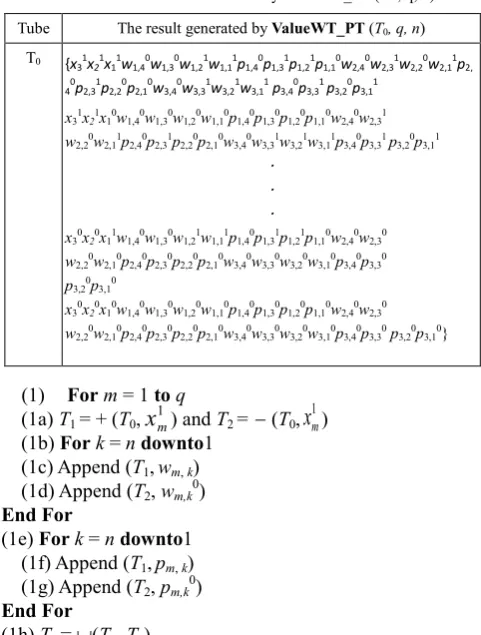
[image:3.595.56.297.433.751.2]n, from [20,21] two distinct DNA sequences are designed. One corresponds to the value “0” for wm,k (pm,k), and the other corresponds to the value “1” for wm,k (pm,k).For the sake of convenience in our representation, assume that wm,k1(pm,k1) denotes the value of wm,k (pm,k) to be 1 and wm,k0(pm,k0) defines the value of wm,k(pm,k) to be 0. The following algorithm is employed to construct the binary values of weight and profit for each element in 2q subsets of a q-element set S. The partial result generated by ValueWT_PT (T0, q, n) for our example in subsection3.1 is shown in Table 3.
Table 3. The Result Generated by ValueWT_PT (T0, q, n)
Tube The result generated by ValueWT_PT (T0, q, n)
T0 {x31x
21x11w1,40w1,30w1,21w1,11p1,40p1,31p1,21p1,10w2,40w2,31w2,20w2,11p2, 40p2,31p2,20p2,10w3,40w3,31w3,21w3,11 p3,40p3,31 p3,20p3,11
x31x21x10w1,40w1,30w1,20w1,10p1,40p1,30p1,20p1,10w2,40w2,31
w2,20w2,11p2,40p2,31p2,20p2,10w3,40w3,31w3,21w3,11p3,40p3,31 p3,20p3,11
. . .
x30x20x11w1,40w1,30w1,21w1,11p1,40p1,31p1,21p1,10w2,40w2,30
w2,20w2,10p2,40p2,30p2,20p2,10w3,40w3,30w3,20w3,10p3,40p3,30
p3,20p3,10
x30x20x10w1,40w1,30w1,20w1,10p1,40p1,30p1,20p1,10w2,40w2,30
w2,20w2,10p2,40p2,30p2,20p2,10w3,40w3,30w3,20w3,10p3,40p3,30 p3,20p3,10}
(1) Form = 1 toq
(1a) T1 = + (T0,
x
1m) and T2 = − (T0,x
1m) (1b) Fork = ndownto1(1c) Append (T1, wm, k) (1d) Append (T2, wm,k0) End For
(1e) Fork = ndownto1 (1f) Append (T1, pm, k) (1g) Append (T2, pm,k0) End For
(1h) T0 = ∪(T1, T2)
End For End Procedure
Lemma 2: The binary value of weight and profit for each element in 2q subsets of a q-element set S can be constructed from the algorithm, ValueWT_PT (T0, q, n). Proof: Refer to Lemma 1.
From ValueWT_PT (T0, q, n), it takes q extract
operations, 4 ×n ×qappend operations, q merge operations and three test tubes to construct the solution space for elements in 2q subsets of a q-element set S. A q-bit binary number corresponds to a choice of items and an n-bit binary number encodes the weight or profit of an item. A value sequence for every bit contains 15 bases. Therefore, the length of a DNA strand, encoding the corresponding weight and profit for 2qpossible choices of q items, is 15 × (4 ×n ×
q) bases which consist of the concatenation of one value sequence for each bit.
[image:3.595.311.550.452.555.2]3.4. The Construction of a Parallel One-bit Adder A one-bit adder is a Boolean function that forms the arithmetic sum of three inputs. It includes three inputs and two outputs. Two of the input bits represent augend and addend, respectively. The third input represents the carry from the previous lower significant position. The first output gives the value of the least significant bit of the sum for augend, addend and previous carry. The second output gives the output carry transferred into the input carry of the next one-bit adder. The truth table of the one-bit adder is shown in Table 4.
Table 4. The True Table of One- Bit Adder
Augend Addend Previous Sum Carry bit bit bit bit bit
0 0 0 0 0
0 0 1 1 0
0 1 0 1 0
0 1 1 0 1
1 0 0 1 0
1 0 1 0 1
1 1 0 0 1
1 1 1 1 1
Suppose that two one-bit binary numbers, αm-1,k and αm,k, represent the first input (addend) and the first output (sum) of a one-bit adderfor 1≤m≤q and 1≤k ≤n,respectively. A one-bit binary number, βm,k, is applied to represent the second input(augend) of a one-bit adder. Two one-bit binary numbers, γm,k-1 and γm,k, are used to represent the third input (previous carry) and the second output (carry) of a one-bit adder respectively. From [20,21], two distinct DNA sequences are designed to represent the value “0” and “1” for every corresponding bit. For the sake of convenience in our representations, assume that βm,k1 contains the value ofβ
m,k to be 1,
and βm,k0 contains the value ofβm,k to be 0. Also suppose that αm-1,k1
denotes the value ofαm-1,k to be 1, and αm-1,k0 defines the value of
αm-1,k to be 0.
Similarly, suppose that αm,k1 contains the value ofα
m,k to be 1,
and αm,k0 denotes the value of αm,k to be 0. γm,k-11 denotes the value ofγm,k -1 to be 1, andγm,k-10 contains the value ofγ
defines the value ofγm,k to be 1, and γm,k0 contains the value ofγ
m,k to
be 0. The following algorithm is proposed to perform the Boolean function of a parallel one-bit adder.
Procedure ParallelOneBitAdder(T0, αm-1,k , βm,k,γm,k-1, m,
k)
(1) T1 = + (T0, αm-1,k1) and T2 = −( T0, αm-1,k1) (2) T3 = + (T1, βm,k1) and T4 = − (T1,β
m,k1) (3) T5 = + (T2,βm,k1) and T6 = − (T2,βm,k1) (4) T7 = + (T3, γm,k-11) and T8 = − (T3,γm,k-11)
(5) T9 = + (T4,γm,k-11) and T10 = − (T4,γm,k-11)
(6) T11 = + (T5,γm,k-11) and T12 = − (T5,γ
m,k-11)
(7) T13 = + (T6,γm,k-11) and T14 = − (T6,γm,k-11)
(8) If (Detect (T7) = =”yes”) then
Append-head (T7, αm,k1) and Append-head (T7, γm,k1) EndIf
(9) If (Detect (T8) = =”yes”) then
Append-head (T8,αm,k0) and Append-head
(T8, γm,k1) EndIf
(10) If (Detect (T9) = =”yes”) then
Append-head (T9,αm,k0) and Append-head
(T9, γm,k1) EndIf
(11) If (Detect (T10) = =”yes”) then
Append-head (T10, αm,k1) and Append-head
(T10,γm,k0)
EndIf
(12) If (Detect (T11) = =”yes”) then
Append-head (T11, αm,k0) and Append-head (T11, γm,k1)
EndIf
(13) If (Detect (T12) = =”yes”) then
Append-head (T12, αm,k1) and Append-head
(T12,γm,k0)
EndIf
(14) If (Detect (T13) = =”yes”) then
Append-head (T13, αm,k1) and Append-head (T13, γm,k0)
EndIf
(15) If (Detect (T14) = =”yes”) then
Append-head (T14, αm,k0) and Append-head
(T14, γm,k0) EndIf
(16) T0 = ∪(T7, T8, T9, T10, T11, T12, T13, T14) EndProcedure
Lemma 3: The algorithm, ParallelOneBitAdder (T0, αm-1,k , βm,k,γm,k-1, m, k), can be applied to perform the Boolean function of a parallel one-bit adder.
Proof: Refer to Lemma 1.
From ParallelOneBitAdder (T0, αm-1,k, βm,k,γm,k-1, m, k), it
takes seven extract operations, eight detect operations, sixteen append-head operations, one merge operation, and fifteen test tubes to compute the addition of three input bits. Two output bits of a one-bit adder encode the sum and the carry to the addition of a bit. A value sequence for every output bit contains 15 base pairs. Therefore the length of a DNA strand, encoding two output bits has 30 base pairs, consists of the concatenation of one value sequence for each output bit.
3.5. The Construction of a Parallel N-bit Adder
The parallel one-bit adder introduced in subsection 3.4 figures out the arithmetic sum of two bits and a previous carry. Similarly, A binary parallel n-bit adder is also directly to perform the arithmetic sum for the two input operands of
n-bit and the input carry by means of performing this one-bit adder n times. The following algorithm is proposed to perform the arithmetic sum for a parallel n-bit adder.
Procedure ParallelAdder (T0,α, β, γ, q, n) (1) Fork = ndownto 1
(1a) Append (T0, α0,k0) EndFor
(2) Form =1 toq
(2a) Append (T0, γm,00)
(2b) Fork =1 ton
(2c) ParallelOneBitAdder (T0, αm-1,k , βm,k , γ m,k-1, m, k)
EndFor EndFor EndProcedure
Lemma 4: The algorithm, ParallelAdder (T0,α, β, γ, q, n), can be applied to perform the Boolean function to a binary parallel adder of n bits.
Proof: Refer to Lemma 1.
From ParallelAdder (T0,α, β, γ, q, n), it takes 7×n ×q
extract operations, (n + q + 2 ×n ×q) append operations, n ×
q merge operations and fifteen test tubes to compute the sum
of weight for elements in 2q subsets of a q-element set S. A
q-bit binary number corresponds to a subset. An n-bit binary number encodes the size of weight for an element in S.
Therefore, (q + 1)×n bits correspond to the sum of weight for
q elements, and one accumulator element (α). q × (n + 1) bits encode the carry of the sum. A value sequence for every bit contains 15 bases. Therefore, the length of a DNA strand, encoding the total weight of selected items, is 15 × n base pairs consisting of the concatenation of one value sequence for each bit.
3.6. Parallel Comparator for Comparing the Sum of Weight Corresponding to Subsets of a Finite Set with Any Given Positive Integer
Any given positive integer, M, can be converted as n
one-bit binary numbers, MnMn-1…M2M1. The main
algorithm in a parallel comparator. MaxiWeight (TM, n) is proposed to construct DNA strands for encoding M. OneBitComparator (T0, TM, T0>, T0=, T0<, q, k) is presented to finish the function of a parallel comparator for one bit and ParallelComparator (T0,TM, T0>, T0=, T0<, q, n) also is proposed to finish the function of a parallel comparator for comparing the total weight of selected items with the capacity of knapsack M. the result of tube TM generated by MaxiWeight (TM, n) is shown in Table 5.
Procedure MaxiWeight (TM, n) For k = ndownto 1
(1a) Append (TM, Mk) EndFor
EndProcedure
Table 5. The Result Generated by MaxiWeight(TM, n)
Tube The result generated by MaxiWeight (TM, n)
TM {M41M30M21M10}
Lemma 5: Any given positive integer M can be constructed with DNA strands from the algorithm, MaxiWeight (TM, n).
Proof: Refer to Lemma 1.
From MaxiWeight (TM, n), it takes n append operations and one test tube to construct the maximum weight. Any given positive integer M corresponds to n one-bit binary numbers. A value sequence for every bit contains 15 bases. Therefore, the length of DNA strands encoding M is 15 ×n
bases comprised the concatenation of one value sequence for each bit.
Procedure OneBitComparator (T0, TM, T0>, T0=, T0<, q,
k)
(1) T0ON = + (T0 , W
q,k1 ) and T0OFF = − (T0 , Wq,k1 ) (2) TMON= + (TM , Mk1 ) and TMOFF = − (TM , Mk1 ) (3) If (Detect (TMON = =”yes”) then
(3a) T0= = ∪ (T0= , T0ON) and T0<= ∪( T0< ,T0OFF)
Else
(3b) T0= = ∪ (T0=, T0OFF) and T0>= ∪ (T0> , T0ON)
EndIf
(4) TM= ∪ (TMON, TMOFF) Endprocedure
Lemma 6: The algorithm, OneBitComparator (T0, TM,
T0>, T0=, T0<, q, k)can be applied to finish the function of a one-bit parallel comparator.
Proof: Refer to Lemma 1.
From OneBitComparator (T0, TM, T0>, T0=, T0<, q, k), it takes two extract operation, one detect operations, three
merge operations and seven test tubes to carry out the
function of a one-bit comparator.
Procedure ParallelComparator (T0, TM, T0>, T0=, T0<, q,
n)
Fork = ndownto 1
(1a) OneBitComparator (T0, TM, T0>, T0=, T0<, q, k) (1b) If (Detect (T0=) = =”yes”) then
(1c) T0 = ∪(T0=, T0)
Else
(1d) Terminate the execution of loop EndIf
EndFor
(2) T0= ∪ (T0, T0<) and Discard (T0>)
EndProcedure
Lemma 7: The algorithm, ParalleComparator (T0, TM,
T0>, T0=, T0<, q, n)can be applied to finish the function of an n-bit parallel comparator.
Proof: Refer to Lemma 1.
From Parallel Comparator (T0, TM, T0>, T0=, T0<, q, n), it takes 2 ×n extract and detect operations, 4 ×n + 1 merge
operations, one discard operation and seven test tubes to carry out the function of an n-bit parallel comparator.
3.7. Search and Calculation of the Maximum Total Profit under the Restriction That the Total Weight Does Not Exceed the Capacity of Knapsack M
The following algorithm is applied to determine which strand has the maximum profit among those chosen items satisfying the constraint of problem. The strand that remains in tube T0 has the greatest binary value of profit after performing this algorithm.
Procedure SearchMaxi (T0, q, n) (1) Fork= ndownto 1
(1a) T0ON = + (T0, P
q,k1) and T0OFF = − (T0, Pq,k1) (1b) If (Detect (T0ON) = =”yes”) then
(1c) T0 = ∪(T0, T0ON) and Discard (T0OFF)
Else
(1d) T0 = ∪(T0, T0OFF)
EndIf EndFor EndProcedure
Lemma 8: The algorithm, SearchMaxi (T0, q, n) can be used to search the strands that encode the maximum value of profit.
Proof: Refer to Lemma 1.
From SearchMaxi (T0, q, n), it takes nextract operations,
n detect operations, 2 × n merge operations and n discard
operations, and three test tubes to carry out the function of searching the maximum total profit subject to the condition that the total weight of selected items must not exceed the capacity of the knapsack.
3.8. DNA Algorithm for Solving the 0-1 Knapsack Problem
Algorithm 1. Solving the 0-1 Knapsack Problem Init (T0, q)
ValueWT_PT (T0, q, n)
ParallelAdder (T0, W, w, z, q, n) MaxiWeight (TM, n)
ParallelComparator (T0, TM, T0>, T0=, T0<, q, n) ParallelAdder (T0, P,p, r, q, n)
SearchMaxi (T0, q, n)
0-1 Knapsack Problem can be solved. Proof: Refer to Lemma 1.
3.9. The Complexity of Algorithm 1
Theorem 2: Suppose that a finite set S is{item1, item2,…,
itemq},The 0-1 Knapsack Problem for S can be solved with O (q × n)biological operations, O (2n)library strands, O (1) tubesand the longest library strands, O(q×n),Where n is the number of bits for representing the size of corresponding weight or profit of element in set S.
Proof: Refer to Algorithm 1.
4. Conclusions
The knapsack problem proved to be the NP-complete problem by restriction has been solved by a number of different algorithms with exponential time complexity in conventional silicon-based computer [27]. Here the proposed algorithm for solving the 0-1 knapsack problem is based on basic biological operations. The number of tubes, the number of biological operations, the number of memory strands and the longest length of memory strands, respectively, are O (1), O (q ×n), O (2n) and O (q×n).
The presented algorithm has several advantages lying in its massive parallelism as described below. First, these biological operations needed in the proposed algorithm are experimentally feasible in lab level [20,21]. Second, the DNA-based algorithms of polynomial time complexity are proposed for searching the maximum profit among a group of items. Third, the Adleman program [20,21] can be applied to generate good DNA sequences for the constructing solution space of our problem. It demonstrates that the proposed algorithm has a lower rate of errors for hybridization. Fourth, the contribution of this study is that DNA-based algorithms developed herein can be applied to solve addition-related problems.
Acknowledgements
I am deeply grateful to Dr. W.L. Chang for his kind and constructive suggestions to improve this research.
REFERENCES
[1] R. P. Feynman. In miniaturization, D.H. Gilbert, Ed., Reinhold Publishing Corporation, New York, 282-296,1961.
[2] L. Adleman. Molecular computation of solutions to
combinatorial problems, Science, 266, 1021-1024, 1994. [3] R. J. Lipton. DNA solution of hard computational problems,
Science, 268, 542-545, 1995.
[4] S. Roweis, E. Winfree, R. Burgoyne, N. V. Chelyapov, M. F.
Goodman, Paul W.K. Rothemund, and L. M. Adleman. A sticker based model for DNA computation, 2nd annual workshop on DNA Computing, Princeton University. Eds. L. Landweber and E. Baum, DIMACS: series in Discrete Mathematics and Theoretical Computer Science, American Mathematical Society, 1-29,1999.
[5] M. Guo, W. L. Chang, M. Ho, J. Lu and J. Cao. Is optimal solution of every NP-complete or NP-hard problem determined from its characteristic for DNA-based computing. Biosystems, Vol. 80, No. 1, 71-82, 2005.
[6] Q. Quyang, P.D. Kaplan, S. Liu, and A. Libchaber. DNA solution of the maximal clique problem, Science, 278,446-449, 1997.
[7] M. Amos. DNA Computation, Ph.D. Thesis, department of computer science, the University of Warwick, 1997. [8] W. L. Chang, M. Guo, and M. Ho. Towards solution of the
set-splitting problem on gel-based DNA computing, Future Generation Computer Systems, Vol.20, Iss. 5, 875-885, 2004.
[9] W. L. Chang and M. Guo. Solving the Set-cover Problem and the Problem of Exact Cover by 3-Sets in the Adleman-Lipton's Model. BioSystems, Vol. 72, No. 3, 263-275, 2003.
[10] W. L. Chang, M. Ho, and M. Guo. Fast parallel molecular solution to the dominating-set problem on massively parallel bio-computing, Parallel Computing (Elsevier Science), Vol. 30, No. 9&10, 1109-1125, 2004.
[11] D. Xiao, W. Li, Z. Zhang, and L. He. Solving the maximum cut problems in the Adleman–Lipton model, BioSystems, Vol. 82, 203-207, 2005.
[12] C. W. Yeh, C. P. Chu and K. R. Wu. Molecular solutions to the binary integer programming problem based on DNA computation, Biosystems, Vol. 83, Iss. 1, 56-66, 2006. [13] Boneh, C. Dunworth, and R. J. Lipton. Breaking DES using
a molecular computer”. In Proceedings of the 1st DIMACS Workshop on DNA Based Computers, 1995, American Mathematical Society. In DIMACS Series in Discrete Mathematics and Theoretical Computer Science, Vol. 27, 37-66, 1996.
[14] L. Adleman, P. W. K. Rothemund, S. Roweis, and E. Winfree. On applying molecular computation to the Data Encryption Standard, The 2nd annual workshop on DNA Computing, Princeton University, DIMACS: series in Discrete Mathematics and Theoretical Computer Science, American Mathematical Society, 31-44, 1999.
[15] F. Guarnieri, M. Fliss, and C. Bancroft.Making DNA add, Science, Vol. 273, 220–223, 1996.
[16] M. Ho. Fast parallel molecular solutions for DNA-based supercomputing: the subset-product problem, BioSystems, Vol. 80, 233–250, 2005.
[17] H. Ahrabian and A. Nowzari-Dalini. DNA simulation of nand Boolean circuits, Advanced Modeling and Optimization, Vol. 6, No. 2, 33-41, 2004 .
[18] A. Schuster. DNA databases, BioSystems, Vol. 81, 234–246, 2005.
Molecular Computation: the Set-Partition Problem, IEEE Transactions on Nanobioscience, Vol. 6, No. 1, 346 – 353, 2007.
[20] R. S. Braich, C. Johnson, P. W.K. Rothemund, D. Hwang, N. Chelyapov, and L. M. Adleman. Solution of a satisfiability problem on a gel-based DNA computer. Proceedings of the 6th International Conference on DNA Computation in the Springer-Verlag Lecture Notes in Computer Science series, 1-27, 2001.
[21] L. M. Adleman, R. S. Braich, C. Johnson, P. W. K. Rothemund, D. Hwang and N. Chelyapov. Solution of a 20-Variable 3-SAT Problem on a DNA Computer. Science, Vol. 296, Iss. 5567, 499-502, 2002.
[22] J. Watson, M. Gilman, J. Witkowski, and M. Zoller.
Recombinant DNA (2nd edition). Scientific American Books, W. H. Freeman and Co., 1992.
[23] J. Watson, N. Hoplins, J. Roberts, and et. al. Molecular Biology of the Gene. Benjamin/Cummings Menlo Park CA, 1987.
[24] G. M. Blackburn and M. J. Gait. Nucleic Acids in Chemistry and Biology. IRL Press, 1990.
[25] F. Eckstein. Oligonucleotides and Anologues. Oxford University Press. 1991.
[26] M. Amos. Theoretical and Experimental DNA Computation. Springer, 2005.