/ 1 " ! i ' / ' " ! i ', ! h i ' M f i i v -i i 1' ! i • • '»»<• • yf ' . ' i - . v i
•
'« ' '/! • 'j • «* i •. ' 1 A ' ,'
/,'•/• ' i " " t'' - ' ' iV'•«"•'>•'
' ' :: ,;;; .. . 1 " . ' i ' t y ) ^ ; " i U i
-..'• ''/ : {V,' ' ' J V •>',','/ , '.'1 }
' ' , ' . . ' ! • ' ' ';. : ' : ! •. • . V '••"' • • V . ' . i -1 v . ' \ ' / ; » ! ' ( •
I l f i l l l l W l i J A I I i l O i l J M A N § f .
i l f i M s ^ I M f ^ p 1 feS H $
:vv, ! ; > . ' ; •,•'>•'. Aw^fUV:.jwwfi^w&wty*: / T v ^ ^ - V < ; V !v\ »
• , ' ' . v > ; • V / ' - ' . i * [
'•, j ' W t t '
li'.i'.) ". i
• V. > * » ' , » • » •'.'•,'• • i ' . r v «, >.l» » » ' . ' . » • \ : '.;•. ..••' t . a •( v | \ > V V
v v
v V ' Si '• • « v
f ? Y V ' 'r' v : V - W ) > • ' • v , ^ ^;" V ' ^ \ » ; V . <,» / . ' ; ••'. >\ i • ."•': : — • »-"ljJ K ,vt W i • V \ u t a f H f v C ' .
• V • r 1 ' A * A* ' ' . ) .
1 ACLM 1Y 1H- C O I / J i m i ; :S(Hl !\'(1.
• . ; . .» .*, . . ' , I ; * • « V * • • ' . • ' I . ' • • • . . ' , • • " . I • • 1 • \ r l f j l
V V » i i V X v V ' l ' . V . ' ! ' > . / ' f ' ' V / > / ' i / . ' ' , ' • f , * i : : ' . ' ', , V 1 ' K S ! ' /.«! • *i\\
• ! • " ' . ' • 2 \ \ • • ' " fci ' ' ' : ' i ) ' v ' V <1 •' • ' J
INI O K M / w l O N 11 CfihfOI IH>Y
u t t i ^ f f i c ! i i M i
\'M\h I W i l l i ] ; • :•
, • \ •.v • - ' ' ' i 1 ' v V i / v • J;»', V i . • \ A \ (v •, , . •
> ' I* • 1 ' « ' ' J '* ! 1 ' s ( y ! • * j \ % \ - V 1 I ' • *. •'» -1 • ' l,• . ' j v ' ! ' • ' , ' > 1 ^% •
1 > ' , » I s i , •• •
<•••. • . ' • j j l > V \ 1
t • ' . ; <•»,'. , \ . . : . • ' • . . ^ \ V .• - " '•». • • > • . - 11 i v \ ' • i . . .• ' • • ' \ » • j . \ S ' s w U
E R r ' J S T A K A A N U 7 H
FACULTY'S USED BOOKS
E-PLATFORM
MUHAINI OTHMAN
DISSERTATION SUBMITTED IN FULFILLMENT
OF THE REQUIREMENTS
FOR THE DEGREE OF MASTER
OF COMPUTER SCIENCE
FACULTY OF COMPUTER SCIENCE
AND
INFORMATION TECHNOLOGY
UNIVERSITY OF MALAYA
KUALA LUMPUR
ABSTRACT
The study was carried out in order to construct a Web-based application of Faculty's
Used Books E-platform. This is done due to communication problems that occur among
sellers and buyers of used university textbooks. This study also recognizes the
e-commerce capabilities and marketing strategies that could assist in developing the
applications. Moreover, this study also embarks on the search of technopreneurship
initiatives in Malaysia to develop a guide to technopreneurship as encouragement for
students to become a technopreneur. The System Development Research Methodology
is the methodology used in the study. The prototype of Faculty's Used Books
E-platform is built using the MySQL relational database, together with PHP and Apache
Web server. The benefits of these technologies are discussed in this paper. The
development of Faculty's Used Books E-platform will improved the communication
between sellers and buyers of used books community and could be a reference to
students of Faculty of Computer Science and Information Technology, University of
ACKNOWLEDGEMENTS
I am thankful to Allah for giving me the courage and strength to complete my
dissertation. Throughout this journey, I am very grateful to received constant supports
and guidance given by many peoples.
Initially, I would like to express my deepest gratitude toward my supervisor Assoc.
Prof. Salimah Mokhtar, for giving me guidance and assistance in completing this
dissertation.
My warmest appreciation to my beloved parents Tuan Haji Othman Ismail and Puan
Hajjah Sarah Awang for their compassion and supports in my time of need. Thank you
for always remembering me in your prayers. For my sister Mahfudzah Othman, thank
you for your kind assistance and contribution.
To my beloved husband, Kardi Sebli, I am deeply grateful for your continuous
encouragement, patience, and gentle understanding of my situation. Thank you for
being there. For my two beloved sons, Muhammad Haziq and Muhammad Syafiq,
thank you for your understanding.
Not to forget my closest friends who always been there to support me. My deepest
appreciation to Suriawati, Yana, Hanayanti, Munirah, Kak Azah, Zubaile, Azizul
Zambri, Zainab, Min, Fida, Tang and many others that I could not mentioned here.
TABLE OF CONTENTS
Page
TITLE PAGE i
ABSTRACT ii
ACKNOWLEDGEMENTS iii
TABLES OF CONTENTS iv
LIST OF FIGURES viii
LIST OF TABLES x
LIST OF ABBREVIATIONS xii
CHAPTER 1: INTRODUCTION
1.1 Overview 1
1.2 Problem Statement 3
1.3 Research Question 4
1.4 Research Objective 4
1.5 Research Scope 5
1.6 Overview of the System Function 5
1.7 Assumption and Limitation 6
1.8 Research Methodology 7
1.9 The Organization of Dissertation 9
CHAPTER 2: LITERATURE REVIEW
2.0 Introduction 11
2.1 E-Commerce Technology 11
2.1.1 E-Commerce Matrix 13
2.1.2 The E-Commerce Evolution 15
2.1.4 E-Commerce Plus Point over Traditional Approaches 19
2.2 Marketing Potential 21
2.2.1 Marketing Opportunities of Communication Patterns 24
2.2.2 Marketing Model 27
2.2.3 Marketing Strategies 28
2.3 E-Commerce Business Model 29
2.3.1 Brokerage Framework For Electronic Commerce 33
2.4 Technopreneurship: Driving Force Behind the Growth of 37 E-Commerce
2.4.1 History of Entrepreneurship Theory 37
2.4.2 Technopreneurship Role toward Economic Growth 40
2.4.3 Technopreneurship Initiatives in Malaysia 41
2.5 The Architecture of Web Applications 46
2.5.1 About MySQL 51
2.5.1.1 The Pros and Cons of MySQL 53
2.5.2 PHP and Apache Web Server 56
2.6 Conclusion 57
CHAPTER 3: METHODOLOGY
3.0 Introduction 58
3.1 System Development Research Methodology 59
3.1.1 Construct a Conceptual Framework 60
3.1.2 Develop System Architecture 72
3.1.2.1 Business Model 72
3.1.3 Analyze and Design the System 75
3.1.3.1 Data Modeling 76
3.1.3.2 Process Modeling 77
3.1.3.3 Web Pages Navigation Link Diagram 78
3.1.4 Built the Prototype System 79
3.2 Conclusion 82
CHAPTER 4: DATABASE DESIGN AND DEVELOPMENT
4.0 Introduction 83
4.1 System Requirement 83
4.1.1 Functional Requirement 83
4.1.2 Non-Functional Requirement 90
4.2 Analyze and Design 92
4.2.1 Data Modeling 92
4.2.2 Process Modeling 96
4.2.3 Web Pages Navigation Link Diagram 103
4.3 Design and Built the Prototype System 104
4.3.1 Build the Faculty's Used Books E-platform database 104
4.3.2 Develop the User Interface and PHP Scripts 108
4.4 Conclusion 113
CHAPTER 5: TESTING, EVALUATION AND CONCLUSION
5.0 Introduction 114
5.1 Testing 114
5.1.1 Stub Testing 115
5.1.2 Unit Testing 118
5.1.3 System Testing 120
5.2 Evaluation 121
5.2.1 System's Effectiveness and Efficiency 121
5.2.2 System's User Interface 127
5.2.3 System's Strengths 130
5.2.4 System's Limitations 132
5.2.5 Future Enhancement and Direction 132
5.3 Conclusion 133
5.3.1 Guide to Technopreneurship 133
5.3.2 Conclusion and Further Research 138
REFERENCES
APPENDIX A: EVALUATION FORM
APPENDIX B: MEMBERS OF NATIONAL INCUBATORS NETWORK (NIN)
APPENDIX C: FRAMEWORK OF .NET TECIINOPRENEUR
LIST OF FIGURES
Page
Figure 1.1: A Process for System Development Research Methodology 8
Figure 2.1: The E-Commerce Matrix 13
Figure 2.2: Volume of E-Commerce, Economist (1999c) 15
Figure 2.3: E-Commerce 4-Stage Model (KPMG, 1999a) 16
Figure 2.4: NECC Structure (MECM, 2000) 18
Figure 2.6: Various possible solutions in a two-way communication medium 23
Figure 2.7: Illustration of different communication patterns in interactive 23 environment
Figure 2.8: Phase model of an electronic market transaction, according to 34 Sierra et al.
Figure 2.9: Architecture of Web applications (Greenspan & Bulger, 2001) 47
Figure 3.1: A Process for System Development Research Methodology 60
Figure 3.2: Longhorn Book Exchange Site 63
Figure 3.3: Books4Exchange.com search book page 64
Figure 3.4: BookSwap site 65
Figure 3.5: Textbookexchange.com search book page 66
Figure 3.6: Textbookexchange.com sell books page 67
Figure 3.7: Phase model of an electronic market transaction, according to 73 Sierra et al.
Figure 3.8: Direct Mediator Auction Model 74
Figure 4.8: Entity Relationship Diagram (ERD) of Faculty Used Books 95
E-platform
LIST OF FIGURES
Page
Figure 4.10: Data Flow Diagram (DFD) - Level 0 for Faculty's Used 99 Books E-platform
Figure 4.11: Data Flow Diagram (DFD) - Level 1 for Process 3.0 100
Figure 4.12: Data Flow Diagram (DFD) - Level 1 for Process 4.0 101
Figure 4.13: Data Flow Diagram (DFD) - Level 1 for Process 5.0 102
Figure 4.14: Data Flow Diagram (DFD) - Level 1 for Process 6.0 103
Figure 4.15: Non-Hierarchical Web Pages Navigation Link Diagram 104
Figure 4.16: Creating database with MySQL in DOS prompt 105
Figure 4.17: Creating table with MySQL in DOS prompt 105
Figure 4.18: Example of phpMyAdmin interface to create a new database 106
Figure 4.19: Example of phpMyAdmin interface to create a User table 107
Figure 4.20: Example of User table with its attributes in phpMyAdmin 107
Figure 4.21: Example of database UsedBook with its tables in 108
phpMyAdmin
Figure 4.22: Faculty's Used Books E-platform Home page 109
Figure 4.23: Faculty's Used Books E-platform Registration page 109
Figure 4.24: Faculty's Used Books E-platform My Account page 110
Figure 4.25: Faculty's Used Books E-platform Promote Book page 110
Figure 4.26: Faculty's Used Books E-platform Order Book page 111
Figure 4.27: Faculty's Used Books E-platform Wish Book page 112
Figure 4.28: Example of PHP script (dbconnect.php) that is used to connect to 112
database UsedBook
LIST OF TABLES
Page
Table 2.5: The new marketing paradigm shift in different direction: from 22
marketplace to marketspace
Table 4.1: Description of entities in Faculty's Used Books E-platform 84
Table 4.2: Attributes of USER entity 84
Table 4.3: Attributes of BOOKS entity 85
Table 4.4: Attributes of WISH BOOK entity S7
Table 4.5: List of entities and its attributes 92
Table 4.6: Description of intersection entities 93
Table 4.7: List of entities and its attributes 94
Table 5.1: Stub Testing Result 115
Table 5.2: Unit Testing Result 118
Table 5.3: System Testing Result 120
Table 5.4 : Number of respondents involved in user acceptance test 121
Table 5.5: Percentage of respondents' feedbacks for Question 1 122 (ease-of-use of the system)
Table 5.6: Percentage of respondents' feedbacks for Question 7 122
(system can produce real-time outputs)
Table 5.7: Percentage of respondents' feedbacks for system's functionalities 123
(Question 8)
Table 5.8: Percentage of respondents' feedbacks for security control 123 (Question 9)
LIST OF TABLES
Page
Table 5.10: Percentage of respondents' feedbacks for Question 11 124
(system is easy to surf and explore)
Table 5.11: Percentage of respondents' feedbacks for Question 15 125
Table 5.12: Percentage of respondents' feedbacks for Question 13 125
Table 5.13: Percentage of respondents' feedbacks for Question 14 126
Table 5.14: Percentage of respondents' feedbacks for Question 16 126 (well organized system's functions)
Table 5.15: Percentage of respondents' feedbacks for Question 16 (system 127 could increase students' awareness of e-commerce capability)
Table 5.16: Percentage of respondents' feedbacks for icons' functionalities 128 (Question 3)
Table 5.17: Percentage of respondents' feedbacks for icons' placement 128 (Question 4)
Table 5.18: Percentage of respondents' feedbacks for overall system's design 129 (Question 5)
Table 5.19: Percentage of respondents' feedbacks for text used in the system 129 (Question 6)
Table 5.20: Percentage of respondents' feedbacks for system's user interface's 130
background color (Question 12)
LIST OF ABBREVIATIONS
ACID Atomic, consistent, independent and durable
ASP Active Server Page
B2B Business-to-Business
B2C Business-to-Consumer
B2E Business-to-Employee
BATIC Business & Technology Innovation Centre
C2B Consumer-to-Business
C2C Consumer-to-Consumer
CASE Computer-aided systems engineering
CGI Common Gateway Interface
DBMS Database Management Systems
DFD Data Flow Diagram
EDI Electronic Data Interchange
ERD Entity Relationship Diagram
FAQ Frequently Asked Question
FCSIT Faculty of Computer Science and Information Technology
GPL GNU General Public License
HTML Hypertext Markup Language
HTTP Hypertext Transport Protocol
IATFEC Inter-Agency Task Force on E-Commerce
ICT Information and Communications Technology
IIS Internet Information Server
ITF International Trade Forum Geneva
JSP Java Server Page
JTDC Java Technopreneur Development Centre
MDC Multimedia Development Corporation
MITI Ministry of International Trade and Industry
MSC Multimedia Super Corridor
MSC-TDF MSC Technopreneur Development Flagship
MSC-TeC MSC Technopreneurship Centre
MSCVC MSC Venture Corporation
MTD MSC Technopreneur Development
NECC National E-Commerce Committee
NIN National Incubator Network
L I S T O F A B B R E V I A T I O N S
PI-IP Hypertext Preprocessor
RBMS Relational Database Management Systems
SMEs Small and Medium Enterprises
SQL Structured Query Language
TeAM Technopreneurship Association of Malaysia
URL Uniform Resource Locator
WWW World Wide Web
CHAPTER 1
INTRODUCTION
1.1. Overview
The birth of Internet open a new path to businesses when businesses started to
realize the potential of electronic commerce technologies has to offer. The Internet
is a unique medium; this allows information to be accessed without geographic
location constraints. As communication tools the Internet has the capability of
delivering messages enhanced by color, sound real or animated images, as well as
two-way interaction. Growth of this communication network has been rapid with the
Internet doubling in size every year since the mid-1990s. At the same time, Internet
also has given business vast opportunity to market their product without the barrier
of space and time. Business can create and transmit advertisements on the Web that
can access by anybody with a computer equipped with appropriate software. Such a
convenience and marketing efficiency, both for the business and potential customer,
is making the Web popular marketing practices all over the world (Kiani, 1998).
The Internet has been called the most effective promotional tool of the century
(Herbig and Hale, 1997).
The transformation of doing business has given a new meaningful name to
entrepreneur that embarks into e-commerce business that they call Technopreneur.
economic activity and employment. Technopreneurship is encouraged among
citizen of developed country such as Malaysia in order to pursue continued
economic growth.
Malaysian brick-and-mortar used book industry is small especially for university
used textbook market. It is difficult to find a brick-and-mortar bookstores that sell
used university textbooks. Most of the stores sell primary and secondary schools
used textbooks and novels and does not have Internet present. It is different in other
country such as United State, where used books is sell not only in brick-and-mortar
stores but also through the Internet. Some example of these stores is Longhorn Book
Exchange (www, longhornbookexchange.com'), Books4Exchange.com
(www.books4exchange.com) and bookswap.com (mvw.bookswap.com). University
student in Australia is provided with a free exchange textbooks Web site service that
help them search and contact seller of books through email notification the Web are
call textbookexchange (www.textbookexchange.com.au).
This study is mainly focusing on the potential of electronic commerce technology
that has to offer in promoting the growth of used university textbook industry
combine with electronic marketing strategies. The outcome of the study will
hopefully benefit the players of this industry which are the buyers and sellers of
used books. This study will also embark in the search of technopreneurship
initiatives in Malaysia to encourage students to become a technopreneur.
1.2. Problem Statement
The rationale of this study is to solve problems that always arise among buyers and
sellers in the used book industry. In the case of buyers, they always have difficulties
to find used textbooks because traditionally the search from brick and mortar
bookstores would be time consuming and a lot of hassle. Furthermore, not all
bookstores sell used books and most of their stock are not up-to-date. While for
seller the problem that arises is their difficulty to sell their used books to targeted
customer because they face the same problem as the buyers, which has difficulty to
locate a bookstore that would buy their used books. The same problem arises which
is about too much hassle and time consuming.
In the context of Faculty of Computer Science and Information Technology (FCSIT)
community, the seller and buyers of the used textbooks are mainly students because
they know that to buy a new textbook is much more expensive. There is a bookstore
in the University but unfortunately they don't sell used books. The same problem
arises among the faculty's community because at the start of semester, there are
many flyers selling or marketing used books at either the faculties or hostels. They
use the most traditional means of marketing, which is using papers and put it up for
everyone to read. But the question here is can they sell their books faster by
marketing this way? What about the cost of the paper and time consuming that they
have to endure by putting up the flyers? Moreover not all students sell their used
books because of the hassle putting up the flyers, which reduce availability of used
books in the market. For the buyers of the books they have difficulty to find used
Furthermore with declining seller participation, buyers have lesser chance to buy
used books that they require.
Another crucial problem is the concern of plagiarism issues among the students.
Many students prefer to photocopy textbooks from their friends who already bought
the textbooks that proof to be an easy way to save time and money. Xeroxing
textbooks is considered a plagiarism and can be sued because it violated the
Copyright law.
In conclusion, the problems is not only about the difficulties marketing used books
to targeted customer and the hassle of finding used books which both are very time
consuming act when done traditionally but about providing alternate way
e-commerce solution to hinder xeroxing of textbook among students .
1.3. Research Question
In this study there are several research questions, which need to be answered:
1. How the utilization of e-commerce technology combine with e-marketing
strategies could benefit business relation, in this case buyer and seller of used
books?
2. How this effort could spark technopreneurship at the faculty?
1.4. Research Objectives
1. Identifying e-commerce technology capabilities and e-marketing strategies for
developing used textbooks platform for FCSIT.
2. Identifying suitable e-business model for FCSIT used textbooks exchange site.
3. Developing a free service prototype Web site of used books for students of
FCSIT using suitable technology and techniques used in the e-commerce
Website development.
4. Develop a guide to technopreneurship
1.5. Research Scope
The scope of this study is to create an e-commerce solution, which will concentrate
on developing Faculty's Used Books E-platform for the Faculty of Computer
Science and Information Technology (FCSIT), University of Malaya community.
This e-commerce solution will be in a form of electronic platform for buyers and
sellers of used textbook and act as intermediary between them. The development of
this platform will utilize commerce technology combine with some suitable
e-marketing strategies for this kind of business.
1.6. Overview of the System Function
The system will be able to assist buyers in finding used books easier and faster with
lower cost and without hassle. While for the seller, the system could easily advertise
their books to targeted buyers. To accomplish this sellers and buyers must register as
user and their personal data will be kept private.
All the registered available used books will be listed in the Web page meaning that
the Web page will assist the seller with their product list. Not only the system act as
communicate with each other by e-mails. The seller must consider the system to be
their own virtual bookstores because they are responsible for updating the books
status data, setting their own price and handling payment and postage.
The buyer also will have their own personal account enabling them to participate.
They could compare books prices among other sellers of the same books title. The
buyers also could fill in wish books list for a used book that is not available so that
sellers can offer the books they wish by sending e-mail notification. Buyer could
either accept or decline offers through the e-mail sendees provided by the system. In
some cases the buyer could also be the seller.
1.7. Assumption and Limitation
1. The business model use is intermediary model where the system acts as "middle
man" between sellers and buyers.
2. There is no money transaction involve because the users are students and does
not have the convenience of credit card or smart card that could be used in
purchasing online.
3. The payment transaction will be done conventionally based upon both parties
agreement through the e-mail. The booksellers will have to handle their own
payment collection and postage.
4. The users of this system are the students of FCSIT University of Malaya.
1.8. Research Methodology
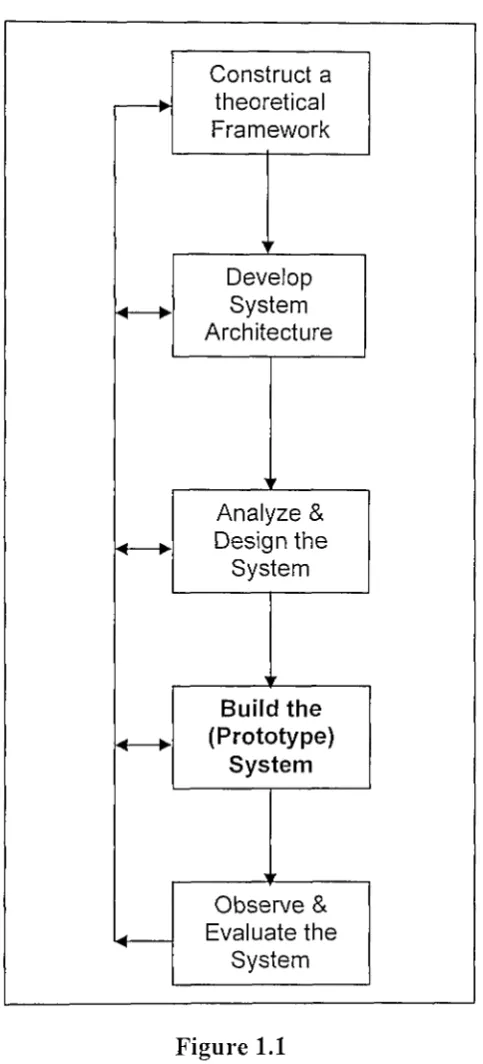
In this study, the development of e-business application will be conducted following
System Development Research Methodology. The System Development Research
process consists of five distinctive phases (refer to Figure 1.1), which are:
1) Construct a Conceptual framework
• Justify a meaningful research question.
• Investigate the system requirements and functionality.
• Understand the processes and procedures of system building.
• Study the disciplines that related for new approaches and idea.
2) Develop a System Architecture
• Develop a unique architecture design for extensibility and modularity.
• Define functionality of the system components and interrelationship among
them.
3) Analyze and Design the System
• Design the database and processes to carry.
• Develop the alternative solutions and choose one best solution.
4) Build the Prototype System
• Learn about the concepts, framework and design through the system building
processes.
• Gain insight about the problems and the complexity about the system.
• Build the prototype system.
• Observe the use of the system by case and field studies
• Evaluate the system by laboratory or field experiments
• Develop the new theories or models base on the observations or experiments
[image:23.602.206.448.137.670.2]of the system's usage.
Figure 1.1 A Process for System Development Research
Methodology
1.9. The Organization of Dissertation
The dissertation will consist of five chapters that will be enlightened below.
1.9.1 Chapter 1
Chapter 1 consists of a brief overview of e-commerce potential and its influence in
business that leads to technopreneurship concept being born. This chapter also lists
out research question, objectives, scope, assumption and limitation. There is also
mentioned an overview of the system functions and methodology used.
1.9.2 Chapter 2
Chapter 2 will highlight the literature review part where the commerce and
e-marketing potential is measured through academic reading and case studies. Several
electronic business models will be identified. It will also mention about the concept
of technopreneurship and their role in e-commerce growth. In this chapter will also
discuss component consist in web application architecture and the software needed
to build it.
1.9.3 Chapter 3
Chapter 3 will be the detail explanation of each methodology step taken. In the first
step of the methodology, which is the conceptual framework, a suitable business
model for Faculty's Used Book E-platform, will be build based on electronic