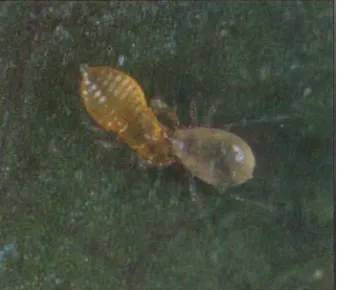
During the 1992 and 1993 field sea- sons, we monitored citrus arthropod pests and natural enemies in the San Joaquin Valley. This monitoring pro- vided important information about the consequences of various Integrated Pest Management (IPM) options used by citrus growers and aided our edu- cation program. We monitored 12 dif- ferent citrus orchards in eastern Fresno, Tulare and Kern counties ranging in size from 8 to 25 acres. In- sects (citrus thrips, fruit-tree leafroller, citrus cutworm, soft scale, armored scale and wasp parasites) and mites (citrus red mite and predatory mites) were sampled throughout the citrus growing season on a twice-weekly, weekly or monthly basis and the population trends were reported in a newsletter. Through this program we observed the seasonal trends in arthro- pod populations, their responses to pesticide applications and their inter- actions with predators and parasites.
We established the project with 10 to 12 pest control advisors (PCAs).
These advisors worked with growers who initially planned to use either a selective pesticide approach or a broad-spectrum pesticide approach to citrus-pest management in the or- chards we were monitoring.
The selective approach used a com- bination of selective pesticides and natural enemies to control pests. Selec- tive pesticides are less toxic to the ben- eficial insects and mites than to the pests when used appropriately. In cit- rus, these pesticides include
microbials (Dipel and Javelin), botani- cals (Sabadilla and Ryania), miticides (Vendex and Omite) and petroleum oils. Selective pesticides can work with natural enemies such as the predatory mite Euseius tulurensis and the para- sitic wasps Aphytis melinus and
Comperiellu bifasciutu to control pests over long periods of time.
sometimes not as effective as broad- spectrum pesticides in reducing pest populations. The broad-spectrum ap- proach depends entirely on these pes-
However, selective insecticides are
Citrus growers are especially con- cerned about scarring of the rind of the fruit caused by insects and mites because scarred fruit is downgraded in the packing house. San Joaquin Valley growers apply pesticides in the spring to protect their navel and Valencia or- anges and sell them in the fresh fruit market the following winter and sum- mer. If scarring is severe, the fruit will be downgraded and processed as juice instead of fresh fruit, and the grower will not recover the cost of pest man- agement. Scarring damage generally occurs early in the season (April to June) when the fruit is first forming. The insect pests that cause this type of damage include various Lepidoptera such as citrus cutworm (Egira [Xylomygesl curidis) and fruit-tree leafroller (Archips argyrospilus), citrus thrips (Scirtothrips citri) and katydid
(Scudderia furcatd. Scarring damage ranges from a shallow ring around the calyx to deep irregular chewed areas; this type of damage is retained as the fruit matures. Citrus red mite (Pano- nychus citri) is also present early in the season. The damage they cause to the fruit looks like silvering or stippling; however, as the fruit matures the stip- pling or silvering usually disappears.
This article discusses the trends in early-season densities of citrus thrips, citrus red mite and predatory mites and their responses to the two differ- ent management programs observed. Katydid and Lepidoptera were gener- ally found in low numbers in the sampled orchards during 1992 and 1993.
Arthropod phenology
pest that is present on the crop throughout the growing season. In March the over-wintering eggs hatch and immature thrips begin feeding on the tender leaves and newly devel- oped fruit. From petal fall until the fruit reaches 25 mm in diameter, the fruit is most susceptible to damage. Cosmetic damage to the fruit can be quite extensive, leaving permanent scabby silvery scars on the rind.
To estimate the citrus thrips popu- lation density, we examined 5 outside fruit per tree and 5 trees in each quad- rant of each orchard (100 fruit per or- chard), starting at least 3 trees in from
Citrus thrips is a multigenerational
Euseius tularensis preys upon a second
instar citrus thrips.
the outside edge. We removed new fruit and looked for live immature cit- rus thrips on the calyx and on the fruit. We recorded the number of fruit infested with one or more live imma- ture thrips out of 100 fruit to obtain the percentage of fruit infested.
We also sampled each orchard for thrips scarring of the green fruit by se- lecting 20 trees (5 from each quadrant of the orchard) during August or Sep- tember. We examined all of the out- side fruit on these trees in the range of 1.5 to 6 feet from the ground. The fruit was rated according to the extent of scarring: 0, no visible damage; 1 or 2, minimal scarring and may be accept- able in the choice grades; 3 or 4, severe scarring and likely to be downgraded from fancy to choice or juice by the packing house.
ten in citrus is Euseius tularensis, a gen- eralist feeder that nourishes itself with pollen, leaf sap and a variety of small arthropods, including citrus thrips and citrus red mite. This predatory mite has the ability to build up natural populations that are quite large, de- pending on the orchard conditions and available food sources. The treat- ment thresholds for citrus thrips and citrus red mite are raised in the pres- ence of the predatory mite because of its effective feeding on these pests. Monitoring for the predatory mite was done weekly by sampling one 5-leaf terminal of 1-year-old foliage from 5 trees randomly selected in the interior of each quadrant of the block (100 leaves per orchard). The number of adult female predatory mites per leaf was counted and recorded.
the field early in the growing season. The predatory mite found most of-
Citrus red mite is usually present in
Feeding by citrus red mite causes the fruit and leaves to become stippled or silvered in appearance. High densities of citrus red mite can develop in water-stressed conditions. We moni- tored citrus red mite throughout the growing season by sampling indi- vidual leaves per tree chosen at ran- dom from the 4 quadrants of the or- chard (100 leaves per orchard). The number of adult female mites per leaf was recorded.
Broad-spectrum approach
Figure 1 shows the densities of cit- rus red mite, citrus thrips and preda- tory mites in the six sites that used a broad-spectrum insecticide approach to citrus thrips control during 1992. In late April, shortly after petal fall, we observed emergence of immature cit- rus thrips on the fruit; the percentage of infested fruit ranged from 3 to 17%. UC IPM Publications 15 and 3303 sug- gest 5% navel fruit infested with im- mature citrus thrips as a treatment threshold when predatory mites are absent or their densities are low. Growers in Sites 3,6 and 12 did not wait for this threshold to be reached to apply a broad-spectrum pesticide. In Site 6, a pre-petal fall, night-time treat- ment of Lorsban was applied. Growers in Sites 7,lO and 11 treated with insec- ticides shortly after petal fall when in- festation of fruit had reached .or sur- passed the threshold of 5%.
The infestation of fruit with citrus thrips can change from 0% to more than 10% in 3 to 4 days. For this rea- son, growers using broad-spectrum pesticides tend to spray as soon as petal fall is declared. Growers cannot spray these insecticides before petal fall during the day because of the haz- ard that broad-spectrum insecticides present to honey bees. The post-petal fall pesticide applications for citrus thrips included Carzol alone and mix- tures of Carzol plus either Lorsban, Cygon or Lannate. Many growers be- lieve that a combination of Carzol for residual kill and Lorsban, Cygon or Lannate for knockdown is needed to control citrus thrips.
spectrum treatments applied close to petal fall reduced citrus thrips to un- detectable levels, and their densities
[image:2.594.213.382.35.180.2]Broad-spectrum pesticide program, 1992 treatment in Site 7 for citrus thrips 4O Site 3 -Orange Cove -citrus thrips
30
Site 10 -Terra Bella
1.1 % heavy scarring 2.6% heavy scarring Citrus red mite
Predato mites
-
4
Loreban,& Canola -
20
Petal fall
Mar23 Apr27 May18 June July20
Site 11 -Jasmine 5 m
2
4
.=
1.1% heavy scarring Petal fall Lorsban &
Mar23 Apr27 May18 June July20
Site 12 - McFariand
0.3% heavy scarring fruit
25 mm
Collection dates
control. An application of Baythroid was made in Site 10; however, there were few immature citrus thrips on the fruit and so this application may not have been warranted.
[image:3.594.37.374.56.295.2]Figure 2 shows the densities of cit- rus thrips, citrus red mite and preda- tory mites in the orchards using a broad-spectrum pesticide program during 1993. In that year, citrus thrips did not appear in significant numbers until several weeks after petal fall (April 29 to May 1,1993). In spite of the fact that citrus thrips densities were low, all of the growers applied Baythroid, Carzol or a Carzol/Cygon combination an average of 4.5 days af- ter petal fall. This indicates that PCAs and growers who use the broad-spec- trum pesticide program tend to apply
Fig. 1. Citrus thrips, citrus red mite and predatory mite population densities in the six orchards initially treated with broad-spectrum pesticides in 1992.
citrus-thrips pesticide 'prays based on a calendar schedule (immediately after petal fall) rather than using the UC Broad-spectrum pesticide program, 1993
Site 11 . Jasmine
1.6% heavy scarring Canol
& Dibrom
u-
Marl5 Apr22 May13 Jun2 Jun28
Site 12 - McFarland
c
& Cygon
Petal fall 2
1
,', ",
~...~~... ~ ... ...
i'
10Mar15 AprZZ May13 Jun2 Jun28
Collection dates
Fig. 2. Citrus thrips, citrus red mite and predatory mite population densities in the six orchards treated with broad-spectrum pesticides in 1993. Sites 3,7,10,11 and 12 were the same orchards sampled in 1992.
remained low for the rest of the season (fig. 1). The citrus thrips in these two sites did not exhibit any signs of resis- tance. In Sites 3,7 and 12, citrus thrips populations increased to treatable lev- els 2 to 4 weeks after the initial control experienced with the post-petal fall applications of Carzol and Cygon, and additional pesticide applications were necessary.
This poor length of residual control suggests that these populations of cit- rus thrips have developed resistance to Carzol and/or the organophosphate insecticides applied, or that treatment timing was improper. In Site 7, Sevin and oil was applied for armored scale control, and this application may have aggravated citrus thrips densities. Veratran was applied as a second
IPM threshold treatment level. Grow- ers rationalize using the calendar spray method because they can't get their spray equipment to all of the or- chards in the short period of time dur- ing which citrus thrips populations de- velop. However, there are consequences to spraying before citrus thrips are de- tected or when their populations are very low. The first poorly timed spray application may select for resistance in the citrus thrips, so that later sprays are even less effective.
Predatory mite densities were un- detectable or were reduced to this level after the first spray was applied in the sites where broad-spectrum or- ganophosphate and carbamate insecti- cides were used just after petal fall (figs. 1 and 2). Predatory mites were very sensitive to field rates of these in- secticides and thus did not assist with citrus thrips control in these sites.
We examined the fruit for scarring due to citrus thrips in late September of 1992 (fig. 1). Sites 6,10,11 and 12, in which thrips populations were low throughout most of the susceptible pe- riod of the fruit, sustained 1.1% or less severe scarring of fruit by thrips. In the two sites in which immature thrips populations on fruit approached the threshold of 5 to 10% infestation dur-
[image:3.594.38.375.341.575.2]Selective pesticide progrsm, 1992
30 -
!4
[image:4.594.48.381.60.300.2] [image:4.594.46.385.327.568.2]Petal fall
...
...
5
rust ps Sie 5b
-
Strathmore Whheavyscarring --- Cltrus red mite 5.7% heavy scarring... Predato mites 25mm - 4
I
--
fruitVeretran
...
Site 4 - Orosi 14.8% heavy scarring
25 rnm
Petal fall
5
4
site 5 - Omsi 16.0% heavy scarring
Collection dates
Fig. 3. Citrus thrips, citrus red mite and predatory mite population densities in the six orchards initially treated with selective pesticides in 1992.
Selective pesticide program, 1993
..
.. m
t
.=
Mar15 Apr22 Yay 13 Jun2 Jun28 ZI 40.-
Siie4-Omsi
.,,-I
1.6% heavy scarringt
Petal fall... ...
c)
l...
V ... ...? ...
+
.-
.._. ...
g
'lMa:kl Z J 1 3 ' ' J i n 2 ' ' J U I ! ~'
5 40 I S i e P b - Yettem
m
t
.-
.=
.Z
40 1 ~ i i e 4 - 0 m s i It
-
5
.,,{
1.6% heavy scarringPetal fall Ventran
{;;Il;!iflA!$
Mar15 Apr22 May 13 J u n l Jun28
Site 8
-
Portewille4.4% heavy scarring -
25 rnrn
fTit
I Veratran -
Veratrsn
W r 1 5 Apr22 May13 Jun2 Jun28
Sie 9
-
Terra Bella4.5% heavy scarring veytran
c
3 , 2 a
0
I
1 =E
E
5 m2
4 r
3 s
i!
2 t
1 5
x
r
5 O
5
4L
3 2 2 1
Fig. 4. Citrus thrips, citrus red mite and predatory mite population densities in the six orchards initially treated with selective pesticides in 1993. Sites 1,4,8 and 9 were the same orchards sampled in 1992.
vere fruit damage was sustained - 2.8%
in Site 3 and 10.2% in Site 7.
In 1993 citrus thrips populations in several of the sites did not build up to damaging levels until the fruit reached 25 mm in size and was no longer sus- ceptible to injury (fig. 2). In Sites 3,6b
and 7, citrus thrips populations re- mained below the 5% infested fruit level throughout the susceptible pe-
riod, and scarring damage ranged from 0 to 3.7% of the fruit. In Sites 10 and 11, citrus thrips densities in- creased above the 5% threshold for one sampling period and scarring damage was 1.4 to 1.6%. In Site 12, scarring damage was 9.9%, and in this site immature citrus thrips densities remained high (more than 5% of fruit infested with immatures) for 3 weeks.
Citrus red mite populations in- creased dramatically in late May to levels ranging from 0.8 to 6.0 adult fe- male mites per leaf in ll of the 12 sites where broad-spectrum pesticides were applied (figs. 1 and 2).
These levels of citrus red mite were below the treatment threshold of 8 adult female mites per leaf established in the UC IPM guidelines (UC IPM Publications 15 and 3303). However, these data demonstrate that broad- spectrum pesticide use aggravated cit- rus red mite populations. This may be because broad-spectrum pesticides eliminated the predatory mites and other natural enemies that feed on cit- rus red mite; or they may have stimu- lated reproduction of the citrus red mite. Citrus red mite populations de- clined rapidly in late July or early Au- gust, probably due to a combination of high temperatures and a virus epi- demic. In Site 6 (1992), the grower ap- plied the miticide Omite with the or- ganophosphate scale spray Supracide to help control mites. However, the miticide treatment was probably not needed, since untreated mite popula- tions declined dramatically at that time of year.
Selective pesticide approach
Figure 3 shows the densities of cit- rus thrips, predatory mites and citrus red mite in the six orchards that were started with a selective program of Veratran for citrus thrips control in 1992. As in the broad-spectrum or- chard program, immature citrus thrips emerged on the fruit in high numbers immediately after petal fall in late April of 1992. Based on UC IPM Publi- cation 15 and 3303 recommendations, the treatment threshold for navels is 10% of fruit infested with immature citrus thrips when more than 0.2 predatory mites per leaf are present. The threshold for Valencias (20% of fruit infested) seen in Site 2 is higher than the threshold for navels because Valencias are not as easily damaged. Five of the six selective program sites had predatory mite densities greater than 1.0 mites per leaf. Generally, 1 to 3 years after growers stop using orga- nophosphate and carbamate insecti- cides on citrus, the predatory mites
I
I
Iand other natural enemies increase. The treatment thresholds for citrus thrips in- festation were reached early in the 1992 field season in Sites 1,5,8 and 9.
In Sites 1 and 2, predatory mite densities reached nearly 1.5 mites per leaf, and a single application of
Veratran was made just after petal fall. Citrus thrips densities on fruit re- mained low in these sites through the rest of the season, and only 2.5% (Site
1) and 0.4% (Site 2) heavy scarring of fruit was found at the end of the sea- son. This suggests that Veratran in combination with predatory mites and other natural enemies can control cit- rus thrips populations. In Site 2, Dibrom was applied for katydid con- trol and Carzol was applied for an ad- ditional citrus thrips treatment. How- ever, the citrus thrips population was very low at the time of the Carzol spray and so this spray was probably unnecessary. The Dibrom and/or Carzol reduced the predatory mite population to undetectable levels. were relatively low until late in the season. Two Narrow Range 415 petro- leum oil treatments were applied in this site for citricola scale control. These oil applications suppressed the predatory mite densities to below 0.5
per leaf and aggravated the citrus thrips population, resulting in 14.8% scarring of fruit. Sites 5,8 and 9 expe- rienced very high citrus thrips popula- tions throughout the period of fruit susceptibility. These orchards had predatory mite densities ranging from 1.3 to 1.7 mites per leaf, and growers made one to four applications of Veratran. However, these two control methods together could not suffi- ciently reduce citrus thrips popula- tions, and heavy fruit scarring ranged from 16.0 to 49.8%.
There are many possible reasons why the Veratran and predatory mites did not successfully control citrus thrips in Sites 5,8 and 9 in 1992. It has been observed in some orchards that citrus thrips populations flare up when growers shift from broad-spec- trum to selective pesticides. This is be- cause natural enemies are rare and re- quire time to build up during the first year after broad-spectrum pesticide
In Site 4, the citrus thrips densities
use is halted. Also, citrus thrips have been shown to reproduce to a greater extent when exposed to low dosages of some pesticides.
Another factor influencing the effi- cacy of a Veratran program is timing of the application. Veratran is a stom- ach poison, and must be ingested by the citrus thrips to poison them. It is most effective when applied when the citrus thrips population is composed primarily of feeding immature thrips, and its toxic effect does not last very long. Site 9 had received broad-spec- trum pesticides the previous season, the timing of the 1992 application ap- pears to have been late, and it rained immediately after the Veratran was first applied in 1992. This combination of problems resulted in poor efficacy of the insecticide. In Sites 5 and 8,
growers had been using selective pes- ticides for several years and did not have severe citrus thrips damage in the years preceding 1992. It is likely that the high citrus thrips population in these sites is a product of factors that we do not yet fully understand. PCAs have observed that some or- chards in the San Joaquin Valley sim- ply have greater citrus thrips pres- sures than others and so may not be predictably controlled by Veratran and predatory mites.
Figure 4 shows the mite and citrus thrips populations in the selective pes- ticide program orchards during 1993. The citrus thrips populations did not develop into significant populations in these sites until 2 to 4 weeks after petal fall. It is interesting to note that in a year when citrus thrips populations developed late in the season, growers who used the selective program tended to wait an average of 7 days longer than those in the broad-spec- trum pesticide program before apply- ing their citrus thrips treatments. This is because PCAs are aware that Veratran has a very short residual ac- tion and it must be applied when thrips are actively feeding.
Sites 1 and 4 had one and two treat- ments of Veratran and very low densi- ties of thrips, and sustained 0% and
1.6% heavy scarring of fruit, respec- tively. Sites 2b, 5b, 8 and 9 had
greater-than-threshold densities of cit-
Feeding by citrus red mite in the early sea- son causes the fruit and leaves to become stippled or silvered. These symptoms usu- ally disappear as the fruit matures.
rus thrips for several sampling periods and sustained 4.4 to 8.0% heavy scar- ring. Sites 8 and 9 had higher levels of predatory mites (0.5 to 1.0 per leaf) and suffered less heavy scarring than sites 2b and 5b. This suggests that predatory mites contribute to citrus thrips control. Oil treatments were ap- plied to Sites 2b and Site 4 for citrus red mite and citricola control, and these oil treatments suppressed preda- tory mite densities to below 0.2 per leaf.
Figure 3 shows that in 1992,34.6% and 49.8% heavy scarring was found in Sites 8 and 9 respectively. However, in 1993 (fig. 4) these same orchards ex- perienced only 4.4% and 4.5% heavy scarring. Thus it may be more difficult in some years than in others to control citrus thrips with a Veratran and natu- ral enemy program.
In the orchards treated with selec- tive pesticides in 1992 (fig. 3) and 1993 (fig. 4), citrus red mite increased to de- tectable levels in only 3 orchards out of 12, with peak densities ranging from 1.0 to 3.0 female mites per leaf. This is in contrast to the broad spec- trum sites (figs. 1 and 2), in which cit- rus red mite populations developed in
the potential need for treatments. In fact, many of the cooperating PCAs supported the idea that citrus red mite is beneficial very early in the season because it provides food for the preda- tory mites before citrus thrips emerge.
Conclusions
In interviews with cooperating PCAs, we found that citrus thrips is
considered to be the most damaging and worrisome early-season pest. The PCAs who used the broad-spectrum approach advised their growers to ap- ply pesticides aggressively as soon as petal fall occurred to minimize citrus thrips infestation of fruit. They did not consider predatory mites to be an im- portant factor in their decision mak- ing. Pesticide resistance was consid- ered to be the main problem that caused failure of this type of approach. The PCAs who used the selective, more integrated approach tried to avoid use of broad-spectrum pesti- cides, delayed treatments with Veratran until thrips infestation thresholds were reached, and allowed predatory mites and other beneficials to aid in control of citrus thrips. These orchards experienced fewer secondary pest problems such as citrus red mite. However, this approach did not work effectively in situations where the cit- rus thrips densities were very high throughout the season.
factors stimulate citrus thrips out- breaks so that we can better predict which orchards can be successfully managed using the selective insecti- cide approach.
Research is needed to find out what
B . Grafton-Cardwell is Assistant IPM Specialist and Research Entomologist in the Department of Entomology, UC River- side, stationed at the Kearney Agricultural Center; A . Eller is Staff Research Associ- ate, UC Riverside, stationed at the Lindcove Research and Extension Center; and N . O‘Connell is UC Cooperative Ex- tension Farm Advisor, Tulare County.
side, for review of the manuscript. This study was conducted with grant support from the USDA-ES Smith-Lever IPM
Project.
The authors thank
I.
Morse, UC River-The “Tooth Fairy” discusses the benefits of healthy teeth with children completing the dental health nutrition education program
Preschool children learn about ‘happy teeth’.
. .
Nutrition program boosts
dental health
of
Orange
County migrant families
Anne Cotter o Margarita Cordoves o Joan Wright
With dental disease one of the top health concerns of California’s mi- grant families, it is imperative to provide these families with informa- tion promoting good dental health. In this pilot project, migrant chil- dren and parents attended a 7-week series of lessons to examine the ef- fect of nutrition education on dental health-related behaviors. By the program’s end, at least 30% of par- ticipating families had decreased consumption of foods considered harmful to children’s teeth and had increased consumption of healthy foods, such as vegetables.
One-third of the nation’s migrant chil- dren live in California. In 1989, this amounted to almost 200,000 children, the majority of whom live in a world of poverty, constant mobility and cul- tural alienation. The most frequent health problem reported for these mi- grant children is dental disease.