Behavioral Literacy – A Theoretical Approach
Carmen Schmitz-Feldhaus, Manfred Wittrock
Department of Special Needs Education & Rehabilitation, University of Oldenburg, Germany *Corresponding Author: [email protected]
Copyright © 2014 Horizon Research Publishing All rights reserved.
Abstract
Many children show a behavior, with regards to certain values or belief systems, in specific social situations, in specific social institutions that are labeled as "inappropriate". These youth are the focus of our concept. Our aim is to figure out whether the reason for the inadequate attitude towards social interactions might have to do with certain aspects we summarize in the construct of Behavioral Literacy. These factors include normative frames of social situations and social institutions, skills to act properly in those situations, the ability to perform a transfer, or the motivation to "fit in". We need to learn more about the background of the inappropriate behavior of children and adolescents in specific social situations to help them to succeed in an inclusive setting. In order to get this information, we started a project called "Behavioral Literacy". It is our understanding that the phenomenon “Behavioral Literacy” has to do with multidimensional factors such as rules, norms, situations, behavior of oneself and of others, and of the frames those factors are related to. Till now there have been several pilot and explorative studies. The first results indicate that some children and juveniles simply don’t know about the demands of specific social situations and/ or social institutions. We need more knowledge driven by research results and we plan to expand our efforts. All over the world, adolescents with severe problems behave or act behaviorally literate in socialsituations. In this article we will describe in detail our preliminary theoretical framework of the concept “behavioral literacy”. Before we conceptualize further studies we would like to share our great interest in this topic with colleagues in different countries.
Keywords
Behavioral Literacy, EBD, Front Behavior, ASD1. Introduction
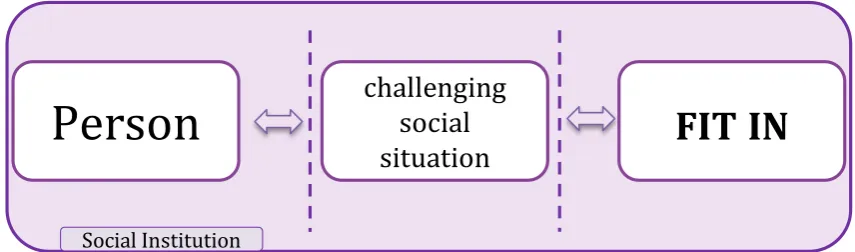
Some students, children and adolescents, with Emotional and Behavioral Disorders (EBD) just don’t fit in regarding challenging social situations (see figure 1).
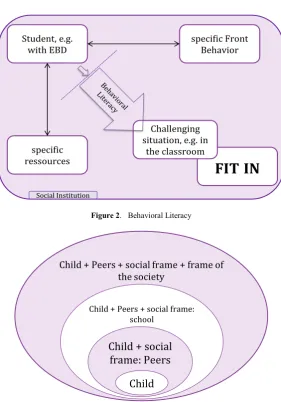
They seem to act like, so to say, a bull in a china shop. But why do they behave that way? All of the students have specific resources (disposition, special skills and abilities, mental possibilities, and a physical appearance. The interaction is a social situation with a specific ethically normative frame. Sometimes the student just doesn’t behave appropriately and in doing so, doesn’t fit in to the social situation. The construct of Behavioral Literacy tries to answer the question, as follows.
FIT IN
Person
challenging
social
situation
[image:1.595.90.518.561.687.2]Social Institution
FIT IN
Student, e.g. with EBD
Challenging situation, e.g. in
the classroom
specific Front Behavior
specific ressources
[image:2.595.163.445.70.473.2]Social Institution
Figure 2. Behavioral Literacy
Child + Peers + social frame + frame of the society
Child + Peers + social frame: school
Child + social
frame: Peers
[image:2.595.161.450.86.272.2]Child
Figure 3. The Different Kinds of Specific Frames within the Systems Figure 2 shows a visualized impression of the problem and
its conditional factors. “Front and/or Masking Behavior” can also be seen, which in our understanding is a specific form of Behavioral Literacy and is the focus of another of our projects.
2. Project Issue
Our day-to-day life is characterized by a large number of social interactions and social situations. Every day we experience situations, sometimes new, but mostly similar to facts that we have already witnessed. For all of those cases, one aspect is the same: we have to read the social frame we face at that moment and we have to read the behavior of the involved persons. In our opinion this is a special social competence and is defined as Behavioral Literacy. This competence, or skill, is important for every day life in preschool, school, and beyond, as well as for families. It is crucial for every person, especially professionals such as teachers, therapists, instructors, and trainers, as well as
parents.
3. Origin & Social Frames
In the theoretical framework of our concept two theories are central:
1) Everything is seen regarding the Frame Analysisand its four aspects by Goffman. We always consider the general frame of the society, the specific frame of the individual, and the frame of social situation. In doing so, we are able to locate, perceive, involve, and label an unlimited amount of specific incidents because they are defined by means of the frames (Goffman, 1974).
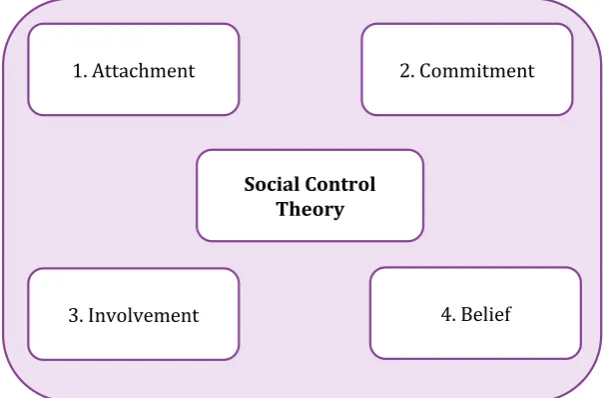
2) The Social Control Theory by Hirschi and the four elements of the bond try to explain why a person becomes delinquent and thus acts against social norms and laws. As the first element Hirschi states “attachment of the individual to others” is the “essence of internalization of norms, conscience, or superego.” On the contrary, someone without attachment to others is “free from moral restraints” and shows psychopathological behavior. “Commitment” is the second element and could be described as a “rational component in conformity.” It, in this way, includes (1) a decision-making and its consequences, (2) a positioning of oneself because of one’s former behavior and (3) the awareness of the first two aspects as well as the effects of the acting. Because time and energy of a person are limited, Hirschi holds the opinion that “involvement” is another important element of the control theory. Some people are just too busy to act inappropriately because they are involved in conventional activities and with all of their plans, social meetings, and work,
the Social Control Theory is “belief” as a “common value system within the society or group”. First of all, the theory assumes that the deviant person believes he is doing wrong. Secondly, belief might be seen as mere words, which in specific circumstances mean nothing and can be ignored. Third, the deviant uses the so-called “technique of neutralization.” He rationalizes the act and is free to realize it. As a keystone of the argument, it can be assumed that there is a “variation in belief in the moral validity of social rules” (Hirschi, 2009, p. 16).
In addition to these two theories three others are important to explain the phenomenon of "Behavioral Literacy":
a) The Social Information Processing has five phases by Dodge which explain the steps a child must go through before he or she can act with competence to social demands such as (1) “encoding situational cues” and (2) “representation and interpretation of those cues.” Here, hypothetically, the child focuses on specific cues and designs an individual explanation of the situation. Phase (3) is the “mental search for possible responses to the situation,” and phase (4) is the “selection of a response.” During the second two phases, the long-term memory of the child is relevant because the child might analyze his or her former experiences and select the one that best fits the circumstances faced at the moment. The fifth phase is the “acting out of the chosen response and monitoring its affects” regarding the interaction (Crick & Dodge, 1994, p. 74).
Social Control Theory
1. Attachment 2. Commitment
[image:3.595.153.456.485.684.2]3. Involvement 4. Belief
Social Information Processing
1. encoding social cues
2. mentally representing and interpreting the cues
3. searching for possible social
responses
4. making a response
decision
[image:4.595.160.450.84.274.2]5. acting out selected responses while monitoring their effects
Figure 5. Social Information Processing
(
5 Phases, Dodge)Emotional Competence
1. Awareness of one´s own emotionen
2. Ability to discern and understand others´ emotions
3. Ability to use the vocabulary of emotion and
expression
4. Capacity for empathic involvement
5. Ability to differentiate internat sujective emotional
experience from external emotional expression 6. Capacity for adaptive
coping with aversive emotions and distressing
circumstances
7. Awareness of emotional communication with relationships
8. Capacity for emotional self-effficay
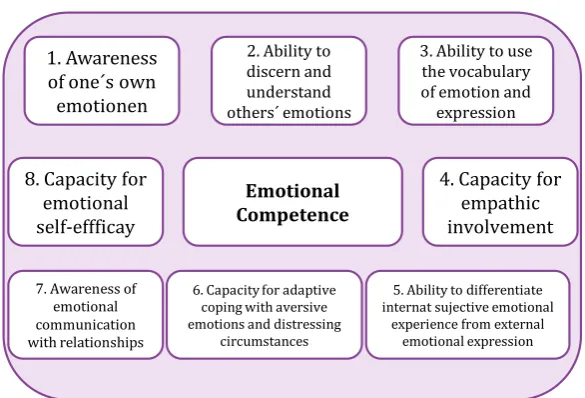
Figure 6. Emotional Competence (8 Skills, Saarni) b) The Emotional Competence with eight skills by
Saarni. The first skill is the “awareness of one’s emotional state.” It is possible that a person could experience more than one emotion at a time, and with regards to inattention or unconscious aspects, the person is not consciously aware of his or her feelings. The second skill is the “ability to discern others´ emotion, based on situational and expressive cues that have some degree of cultural consensus as to their emotional meaning.” The next skill that Saarni poses is the “ability to use the vocabulary of emotion and expression terms.” The skills are seen as connected to the particular culture and have to be available and link to social roles. Skill four is the “capacity for empathic and sympathetic involvement in others´ emotional experiences” and five is the “ability to realize that [the] inner emotional state need not correspond to outer expression”. This
[image:4.595.158.451.305.504.2]particular keywords for the skills, dimensions, phases, aspects and elements.
c) The Sense of Coherence and its three dimensions by Antonovsky for the purpose of screening with regards to the behavioral-literate ability of the person in question. The sense of coherence is the main aspect of the salutogenetic theory and includes the sense of comprehensibility, the sense of manageability and the sense of meaningfulness. It describes a
“[…] feeling of confidence that (1) the stimuli deriving from one’s internal and external environments in the course of living are structured, predictable and explicable; (2) the resources are available to her/him to meet the demands posed by these stimuli; and (3) these demands are challenges, worthy of investment and engagement” (Antonovsky, 1987, p. 19).
5. Definition of Behavioral Literacy
When we started our project there were originally three definitions of the construct Behavioral Literacy, Wittrock writes:“Behavioral Literacy is the capacity to recognize or identify own behavior i.e. what I am doing – which means also admitting that you are doing it and the behavior of others and also managing behavior. That means you have to be able to read a situation i.e. which behavior is appropriate – is it a church or a playground and have the capacity and the motivation to fit in” (Wittrock, 2005, p. 5).
Rock postulates the goal of Behavioral Literacy is the: “Acquisition of core skills that lead to the development of emotional competency in students, including prosocial awareness, fluent interpretation of the behavior of self and others, accurate comprehension of behavioral functions and strategic self-regulation and self-correction to monitor and adjust behavior in accordance with environmental and situational demands” (Rock, 2004, p. 10).
Hess-Rice, as opposed to the definitions mentioned afore accentuates three dimensions relates them to Literacy and points out:
“The operational, cultural, and critical dimensions of literacy apply to comprehensive behavioral literacy, the process of learning to behave and to understand the changing
consists of skill of interacting with adults and peers, i.e. social skills. Social skill instruction with students with EBD is critical because some students either do not have the innate ability to ‘absorb’ social cues or their experiences in social situations have created a skill set that offends others.”
2. The Cultural dimension describes the “skill and attitude of understanding the demands of a certain context and then acting according to the rules governing that context. For example, students need to be able to differentiate a joke said to them in a locker room from a joke in the main office and be able to react according to the unspoken rules of each place. Both the skill and the context and practice of the skill must be encouraged in order to aid students in their behavioral literacy.”
3. The Critical dimension means “Students with EBD need skills in self- determination as well as having teachers and professionals working with them who question the social construction of “normal” behavior and advocate for the needs of their students to be met on all school activities“ (Hess-Rice, 2003, p. 21).
The theoretical background of “Behavioral Literacy” as it has been defined by Hess-Rice is the concept of “Critical Literacy” of the Frankfurt School including Adorno, Habermas and others. The “unique element of critical literacy is social action stemming from readers´ increasing understanding that literacy and who gets to be literate are related to issues of equity and power. […] Regarding languages and texts, definitions of critical literacy usually adopt an expanded definition of “text” to be anything that can be “read” or interpreted” (McDaniel, 2006, 21f).
After several years of studying the concept, we define Behavioral Literacy as the skill of noticing (observing) the frames of different social interactions or social systems and making sense of the coherent implications. Furthermore, it is the capacity to comprehend emotions and expressions of self and others. And it is a skill to handle these information’s regarding one´s own belief system.
The five stages of behavioral literacy are visualized in figure 7.
Behavioral Literacy
5 stages Feldhaus/ Wittrock 1. observing social
frames coherent implications2. be aware of
3. comprehend emotions and
expressions
4. handle information
5. reflect owns´ belief
[image:6.595.165.446.83.262.2]system
Figure 7. The five stages of Behavioral Literacy
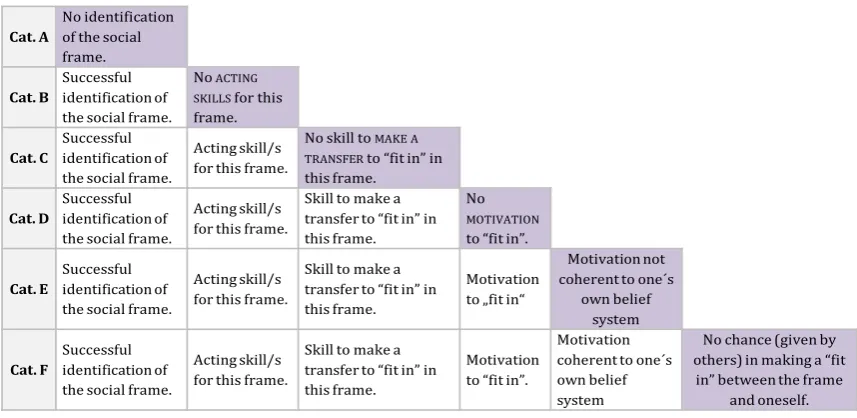
Cat. A No identification of the social frame.
Cat. B Successful identification of the social frame.
No ACTING SKILLSfor this frame.
Cat. C Successful identification of the social frame.
Acting skill/s for this frame.
No skill to MAKE A TRANSFERto “fit in” in this frame.
Cat. D Successful identification of the social frame.
Acting skill/s for this frame.
Skill to make a transfer to “fit in” in this frame.
No
MOTIVATION
to “fit in”.
Cat. E Successful identification of the social frame.
Acting skill/s for this frame.
Skill to make a transfer to “fit in” in this frame.
Motivation to „fit in“
Motivation not coherent to one´s
own belief system
Cat. F Successful identification of the social frame.
Acting skill/s for this frame.
Skill to make a transfer to “fit in” in this frame.
Motivation to “fit in”.
Motivation coherent to one´s own belief system
No chance (given by others) in making a “fit
[image:6.595.88.517.298.507.2]in” between the frame and oneself.
Figure 8. Categorized Description of Students Skills
6. Differential diagnostic aspects: High
Functioning Autism
Or in other words, Behavioral Literacy is a construct to measure the ability to show appropriate behavior in different social interactions. But it has to be considered from another perspective, when dealing with people with high functioning autism. People with Autism Spectrum Disorders “ do not engage in affectively charged interactions with other people” (Bowler, 2007, 51).
7. Categorized Description of Students
Ability Regarding the Concept
“Behavioral Literacy”
In using the concept of Behavioral Literacy, we assume
that there are five main categories or types, which describe or explain the maladaptive behavior of children and juveniles. The important aspects in progress are whether or not the person is successful in his or her attempt to fit in, in the social frame with its rules, norms, and expectations, and the shown behavior.
8. Discussions
We have presented our theoretical framework and or research project at several conferences, nationwide and international, with professionals attending from different academic backgrounds. At all of these (symposiums/ conventions/ forums) we had very inspiring discussions about the importance of being “behavioral literate” in everyday life. This shows in particular for adolescents coming from different cultural backgrounds, making the transition from school to work (or apprenticeships), or spending time in youth correctional facilities. At all (symposiums/ conventions/ forums) we were encouraged to expand our project with a special emphasis on those settings. We have done a couple of surveys in different types of schools (primary, secondary, vocational) and in Youth Detention Centers (Youth Prison).
9. Recommendation
At this time we can offer some recommendations for educational practice or while working with children and adolescents. It is essentially, that all professional persons have to learn to perceive the general and the specific frames in all the social interactions. The Sense of Coherence the three dimensions Comprehensibility, Manageability and Meaningfulness could be used to equip students with knowledge more individually and taking the interests of the students into account. Additionally, Hirschi’s Control theory and its four elements of the bond, attachment to significant others (parents, peers, school), commitment to conventional values, involvement in conventional subsystems/ activities and belief in conventional values/ goals could add to students understanding of the development of specific new repertoire of manners. And that when teachers consider that the attachment to significant others could be a benefit as well as a disadvantage or that boredom triggered by inadequate activities or tasks could be the reason for unwelcome behavior. Furthermore, the cause for the inappropriate manners of some students might be established in their low level of self-esteem, self-control and self-reflexivity.
The recommendation of these three aspects seems to be important for professional work with children and adolescents who are lacking strategies in the area of behavioral literacy.
We are highly interested in coming into contact with colleagues and professionals from all over the world who are willing to share their interests, their opinions and their research within topics like: behavioral literacy, frame analyses, the sense of coherence, and front or masking behavior.
REFERENCES
[1] Antonovsky, A. (1979). Health, Stress and Coping. San Francisco: Jossey-Bass.
[2] Antonovsky, A. (1987). Unraveling the Mystery of Health. How People Manage Stress and Stay Well. London: Jossey-Bass Publishers.
[3] Bowler, D. (2007). Autism Spectrum Disorders. Psychological Theory and Research. Chichester: Wiley. [4] Bronfenbrenner, U., Lüscher, K. & Cranach, A. (1989). Die
Ökologie der menschlichen Entwicklung : natürliche und geplante Experimente. Frankfurt am Main: Fischer.
[5] Crick, N.R. & Dodge, A. (1994). A Review and Reformulation of Social Information-Processing Mechanisms in Children´s Social Adjustment. Psychological Bulletin, 115, 74-101.
[6] Goffman, E. (1959). The presentation of self in everyday life. New York: Anchor Books.
[7] Goffman, E. (1974). Frame Analysis. Cambridge: Harvard University Press.
[8] Hess-Rice, E. (2003). Defining Behavioral Literacy. In Brown, R.; Dixon, A. K. et al. (Eds.). Developing Behavioral Literacy (pp. 21-25). Washington DC: The George Washington University.
[9] Hirschi, T. (2009). Causes of Delinquency. Berkeley: University of California Press/ Transaction Publ. (1st edition 1972).
[10] McDaniel, C. (2006). Critical Literacy. A way of thinking, a way of life. New York: Peter Lang.
[11] Rock, L.M. (2004). Graphic Organizers: Tools to Build Behavioral Literacy and Foster Emotional Competency. Intervention in School and Clinic, 40, 10-37.
[12] Saarni, C. (1999). The Development of Emotional Competence. New York: Guilford Press.
[13] Schmitz, C. & Wittrock, M. (2009). Behavioral Literacy – Ein Zugang zur erfolgreichen Bewältigung von schulischen Anforderungssituationen und Barrieren. In Ricking, H., Schulze, G. , Wittrock, M. (Eds.). Schulabsentismus und Dropout (pp. 206-220). Paderborn: Schoeningh.
[14] Wittrock, M. (2005, May). Entwicklung und Förderung von Literacy & Behavioral Literacy. Paper presented at the Symposium “Children, Young People and Families at Risk”. Oldenburg, Germany.