Munich Personal RePEc Archive
Unbeatable Imitation
Duersch, Peter and Oechssler, Joerg and Schipper, Burkhard
C
University of Heidelberg, University of California, Davis
18 February 2010
Unbeatable Imitation
∗
Peter Duersch
†J¨org Oechssler
‡Burkhard C. Schipper
§February 18, 2010
Abstract
We show that for many classes of symmetric two-player games, the simple de-cision rule “imitate-the-best” can hardly be beaten by any other dede-cision rule. We provide necessary and sufficient conditions for imitation to be unbeatable and show that it can only be beaten by much in games that are of the rock-scissors-paper variety. Thus, in many interesting examples, like 2x2 games, Cournot duopoly, price competition, rent seeking, public goods games, common pool resource games, minimum effort coordination games, arms race, search, bargaining, etc., imitation cannot be beaten by much even by a very clever opponent.
Keywords: Imitate-the-best, learning, symmetric games, relative payoffs, zero-sum games, rock-paper-scissors, finite population ESS, potential games, quasisub-modular games, quasisuperquasisub-modular games, quasiconcave games, aggregative games.
JEL-Classifications: C72, C73, D43.
∗We thank Carlos Al´os-Ferrer, Chen Bo, Drew Fudenberg, Alexander Matros, and John Stachurski for interesting discussions. Seminar audiences at Australian National University, Melbourne University, Monash University, UC Davis, UC San Diego, the University of Heidelberg, the University of Queens-land, and at the International Conference on Game Theory in Stony Brook, 2009, contributed helpful comments.
†Department of Economics, University of Heidelberg
‡Department of Economics, University of Heidelberg, Email: [email protected]
“Whoever wants to set a good example must add a grain of foolishness to his virtue: then others can imitate and yet at the same time surpass the one they imitate - which human beings love to do.” Friedrich Nietzsche
1
Introduction
Psychologists and behavioral economists stress the role of simple heuristics or rules for human decision making under limited computational capabilities (see Gigerenzer and Selten, 2002). While such heuristics lead to successful decisions in some particular tasks, they may be suboptimal in others. It is plausible that decision makers may cease to adopt heuristics that do worse than others in relevant situations. If various heuristics are pitted against each other in a contest, then in the long run the heuristic with the highest payoff should survive.
One of the heuristics in the contest may be a rational, omniscient, and forward looking decision rule. Even if such a rational rule is not currently among the contestants, there can always be a “mutation”, i.e., an invention of a new rule, that enters the pool of rules. A heuristic that does very badly against such a rational rule will not be around for long as it will not belong to the top performers. Being subject to exploitation by the rational opponent in strategic situations would be an evolutionary liability. Consequently, we like to raise the following question: Is there a simple adaptive heuristic that can not be beaten even by a rational, omniscient and forward looking maximizer in large classes of economically relevant situations?
The idea for this paper emerged from a prior observation in experimental data. In Duersch, Kolb, Oechssler, and Schipper (2010), subjects played against computers that were programmed according to various learning algorithms in an Cournot duopoly. On average, human subjects easily won against all of their computer opponents with one exception: the computer following the rule “imitate-the-best”, the rule that simply pre-scribes to mimic the action of the most successful player in the previous round. This suggested to us that imitation may be hard to beat even by forward–looking players.
We shall consider two notions of being “unbeatable”. We call imitation “essentially unbeatable” if during the infinitely repeated game against the some opponent, the oppo-nent cannot obtain, in total, over an infinite number of periods, a payoff difference that is more than the maximal payoff difference for the one–period game. As a weaker notion we consider the concept of being “not subject to a money pump”. We say imitation is not subject to a money pump if there is a bound on the sum of payoff differences an opponent can achieve in the infinitely repeated game.
It would be intractable to explicitly consider how all possible opponents – who may have any arbitrary decision rule – would play against an imitator. That is why we consider thetoughest possible opponent against the imitator in order to obtain an upper bound for how much an imitator can be beaten by any possible opponent. This toughest possible opponent clearly is a dynamic relative payoff maximizer who maximizes the sum of all future differences between her payoff and the imitator’s payoff. The relative payoff maximizer is assumed to be infinitely patient and forward looking and never to make a mistake. More importantly, the dynamic payoff maximizer is assumed to know that she is matched against an imitator. That is, she knows exactly what her opponent, the imitator, will do at all times, including the imitator’s starting value. Finally, the dynamic payoff maximizer is enabled to commit to any strategy including any closed-loop strategy. Although these assumptions are certainly extreme, they make sure that if imitation cannot be beaten by this maximizer, then it cannot be beaten by any decision rule including dynamic absolute payoff maximization or any decision rule that is more myopic or less omniscient.
Our results are as follows. We presentnecessary and sufficient conditions for imitation being subject to a money pump. The paradigmatic example for a money pump is playing repeatedly the game rock–paper-scissors, in which, obviously, an imitator can be exploited without bounds by the maximizer. The main result of this paper is that imitation is subject to a money pumpif and only if the relative payoff game in question contains a generalized rock–paper-scissors game as a submatrix.
Since the existence of a rock–paper-scissors submatrix may be cumbersome to check in some instances, we also provide a number of sufficient conditions for imitation not to be subject to a money pump that are based on more familiar concepts like quasicon-cavity, generalized ordinal potentials, or quasisubmodularity/quasisupermodularity and aggregation of actions.
One such condition is that the game is a symmetric 2x2 game. To gain some intuition for this, consider the game of “chicken” presented in the following payoff matrix.
swerve straight swerve
straight
3,3 1,4 4,1 0,0
Suppose that initially the imitator starts out with playing “swerve”. What should a forward looking opponent do? If she decides to play “straight”, she will earn more than the imitator today but will be copied by the imitator tomorrow. From then on, the imitator will stay with “straight” forever. If she decides to play “swerve” today, then she will earn the same as the imitator and the imitator will stay with “swerve” as long as the opponent stays with “swerve”. Suppose the opponent is a dynamic relative payoff maximizer. In that case, the dynamic relative payoff maximizer can beat the imitator at most by the maximal one-period payoff differential of 3. Now suppose the opponent maximizes the sum of her absolute payoffs. The best an absolute payoff maximizer can do is to play swerve forever.1
In this case the imitator cannot be beaten at all as he receives the same payoff as his opponent. In either case, imitation comes very close to the top–performing heuristics and there is no need to abandon such an heuristic.
Imitate-the-best has been previously studied theoretically and experimentally mostly in Cournot oligopolies. Vega-Redondo (1997) shows that in symmetric Cournot oligopoly with imitators, the long run outcome converges to the competitive output if small mis-takes are allowed. Huck, Normann, and Oechssler (1999), Offerman, Potters, and Son-nemans (2002), and Apesteguia et al. (2007, 2010) provide some experimental evidence. Vega-Redondo’s result has been generalized to aggregative quasisubmodular games by Schipper (2003) and Al´os-Ferrer and Ania (2005). For Cournot oligopoly with imitators and myopic best reply players, Schipper (2009) shows that the imitators’ long run average payoffs are strictly higher than the best reply players’ average payoffs.
The article is organized as follows. In the next section, we present the model and provide formal definitions for being unbeatable. Our main result, which provides a nec-essary and sufficient condition for a money pump, is contained in Section 3. Sufficient conditions for imitation to be essentially unbeatable are given in Section 4. Section 5 provides sufficient conditions for imitation not being subject to a money pump. We finish with Section 6, where we summarize and discuss the results.
1
2
Model
We consider a symmetric2
two–player game (X, π), in which both players are endowed with the same (finite or infinite) set of pure actions X and the same bounded payoff function π : X ×X −→ R, where π(x, y) denotes the payoff to the player choosing the first argument. We will frequently make use of the following definition.
Definition 1 (Relative payoff game) Given a symmetric two-player game(X, π), the relative payoff game is (X,∆), where the relative payoff function ∆ : X ×X −→ R is defined by
∆(x, y) = π(x, y)−π(y, x).
Note that, by construction, every relative payoff game is a symmetric zero-sum game since ∆(x, y) =−∆(y, x).
We introduce two types of players. The imitator follows the simple rule “imitate-the-best”. To be precise, the imitator adopts the opponent’s action if and only if in the previous round the opponent’s payoff was strictly higher than that of the imitator. Formally, the action of the imitator yt in period t given the action of the other player from the previous period xt−1 is
yt =
xt−1 if ∆(xt−1, yt−1)>0
yt−1 else
(1)
for some initial action y0 ∈X.
The second type we consider is a dynamic relative payoff maximizer. The dynamic relative payoff maximizer, from now on call her the maximizer, maximizes the sum of all future payoff differentials between her and the imitator,
D(T) :=
T
X
t=0
∆(xt, yt), (2)
whereyt is known to be given by (1).
Since this sum may become infinite for T → ∞, we assume that the maximizer evaluates her strategies according to the overtaking-criterion (see e.g. Osborne and Rubinstein, 1994, p. 139). Accordingly, a sequence of relative payoffs {∆(xt, yt)}∞
t=0 is strictly preferred to a sequence{∆(x′
t, y
′
t)}
∞
t=0 if limT inf
PT
t=0(∆(xt, yt)−∆(x
′
t, y
′
t))>0.
3
2
See for instance Weibull (1995, Definition 1.10). 3
If we used time-averaging instead of the over-taking criterion, then the maximizer would be indifferent between a sequence of zero relative payoffs and a sequence with a finite number of strictly positive relative payoffs and zero thereafter. Yet, our aim is to pit the imitator against a maximizer who cares even about a finite number of payoff advantages. If we used time discounting instead the over-taking criterion, then the maximizer may prefer a sequence with a large payoff at the beginning over a sequence with an endless cycle of small but positive relative payoffs. However, we believe that money pumps – even if small – are a feature of irrationality that a rational opponent would take advantage of.
It is important to realize just how extreme our assumptions regarding the maximizer are. The maximizer is infinitely patient and forward looking and never makes a mistake. More importantly, she is assumed to know exactly what her opponent, the imitator, will do at all times, including the imitator’s starting value. Although these assumptions are certainly extreme, they make sure that if imitation cannot be beaten by this max-imizer, then it can not beaten by any decision rule including dynamic absolute payoff maximization or any decision rule that is more myopic or less omniscient.
Definition 2 (No money pump) We say that imitation is not subject to a money pump if there exists a bound M ∈ R+ such that for any initial action of the imitator
y0 ∈X,
lim
T→∞sup
T
X
t=0
∆(xt, yt)≤M, (3)
where yt is given by (1).
That is, imitation is not subject to a money pump if it can be beaten only by a finite amount although the game between the imitator and the maximizer runs for an infinite number of periods. In some cases we can show that imitation can in fact not be beaten by more than the payoff differential from a single period.
Definition 3 (Essentially unbeatable) We say that imitation is essentially unbeat-ableif it can be beaten in total by at most the maximal one-period payoff differential, i.e., if M in inequality (3) is at most ∆ := maxˆ x,y∆(x, y).
As in previous studies of imitation (see e.g. Al´os-Ferrer and Ania, 2005; Schipper, 2003; Vega-Redondo, 1997), the concept of a finite population evolutionary stable strat-egy (Schaffer, 1988, 1989) plays a prominent role in our analysis.
Definition 4 (fESS) An actionx∗
∈X is a finite population evolutionary stable strat-egy (fESS) of the game (X, π) if
π(x∗
, x)≥π(x, x∗
) for all x∈X. (4)
In terms of the relative payoff game, inequality (4) is equivalent to
∆(x∗
, x)≥0 for all x∈X.
Already Schaffer (1988, 1989) observed that the fESS of the game (X, π) and the symmetric pure Nash equilibria of the relative payoff game (X,∆) coincide.
3
A Necessary and Sufficient Condition for a Money
Pump
The game rock–paper-scissors is the paradigmatic example for how an imitator can be exploited without bounds by the maximizer. In our terminology, imitation is subject to a money pump.
Example 1 (Rock-Paper-Scissors) Consider the well known rock-paper-scissors game.4
R P S
R P S
0 −1 1 1 0 −1
−1 1 0
Clearly, if the imitator starts for instance with R, then the dynamically optimal strategy of the maximizer is the cycle P-S-R... In this way, the maximizer wins in every period and the imitator loses in every period. Over time, the payoff difference will grow without bound in favor of the maximizer.
We can generalize Example 1 by noting that the crucial feature of the example is that the maximizer can find for each action of the imitator an action which yields her a strictly positive relative payoff.
4
Definition 5 (Generalized Rock-Paper-Scissors Matrix) A symmetric zero-sum game (X, π) is called a generalized rock-paper-scissors matrix if for each column there exists a row with a strictly positive payoff to player 1.
It should be fairly obvious that if a zero–sum game contains somewhere a submatrix that is a generalized rock-paper-scissors matrix, then this is sufficient for a money pump as the maximizer can make sure that the process cycles forever in this submatrix. What is probably less obvious is that the existence of such a submatrix is also necessary for a money pump.
Definition 6 (Generalized Rock-Paper-Scissors Game) A symmetric zero-sum game (X, π) is called a generalized rock-paper-scissors game if it contains a submatrix ( ¯X,π¯) with X¯ ⊆ X and π¯(x, y) = π(x, y) for all x, y ∈ X¯, and ( ¯X,π¯) is a generalized rock-paper-scissors matrix.
This leads us to our main result.
Theorem 1 Imitation is subject to a money pump in the finite symmetric game (X, π) if and only if its relative payoff game (X,∆) is a generalized rock-paper-scissors game.
Recall that according to Definition 2, imitation is subject to a money pump if there exists some initial condition y0 ∈ X such that inequality (3) is violated. The proof of the theorem follows directly from the following three lemmata. We use the following preliminary observation repeatedly in the analysis.
Lemma 1 Consider a symmetric game (X, π) with its relative payoff game(X,∆). The maximizer will never choose an action xt such that ∆(xt, yt)<0.
Proof. Suppose to the contrary that the maximizer chooses an action xt such that
∆(xt, yt) < 0. Then in period t+ 1, the imitator will not imitate her period t action. But then, she could improve her relative payoff in t by setting the same action in t as the imitator without influencing the actions of the imitator in period t+ 1 or any other
future period.
constant if (xt, yt) = (xt+1, yt+1) for all t = 0,1, .... Otherwise, the path is called non– constant. A non–constant finite path (x0, y0), ...,(xn, yn) is a cycle if (x0, y0) = (xn, yn). A cycle is an imitation cycle if for all (xt, yt) and (xt+1, yt+1) on the path of the cycle ∆(xt, yt)>0 andyt+1 =xt. Along an imitation cycle, one player always obtains a strictly positive relative payoff and the other player mimics the action of the first player in the previous round. Thus, an imitation cycle never contains an action profile on the diagonal of the payoff matrix.
Lemma 2 For any finite symmetric game (X, π), imitation is subject to a money pump if and only if there exists an imitation cycle.
Proof. Consider a finite symmetric game (X, π) and its relative payoff game (X,∆).
We show first that if imitation is subject to a money pump, then there is a imitation cycle. Since the game is finite, there can not be infinitely many strictly positive relative payoff improvements unless there is a cycle. To show that such a cycle implies an imitation cycle, suppose by contradiction that there exists a period t such that ∆(xt, yt) ≤ 0. W.l.o.g. assume that ∆(xt+1, yt+1) > 0. This is w.l.o.g. because we assumed a money pump. By equation (1) the imitator will not imitate in t+ 1 the previous period’s action of the maximizer, i.e., yt+1 =yt. But then the maximizer could strictly improve the sum of her relative payoffs already int by settingxt=xt+1. Thus, there must be a cycle with ∆(xt, yt)>0 for all t. The decision rule of the imitator then requires that yt+1 =xt for all t, which proves that such a cycle is an imitation cycle.
The converse is trivial.
Lemma 3 Consider a finite symmetric game(X, π)with its relative payoff game(X,∆). (X,∆) is a generalized rock-paper-scissors game if and only if there exists an imitation cycle.
Proof. “⇐”: If there exists an imitation cycle in (X,∆), let ¯X be the orbit of the
cycle, i.e., all actions of X that are played along the imitation cycle. For each action (i.e., column) y ∈ X¯, there exists an action (i.e., row) x ∈ X¯ such that ∆(x, y) > 0. Hence, ( ¯X,∆), where ¯¯ ∆ is defined by ¯∆(x, y) = ∆(x, y) for allx, y ∈X¯, is a generalized rock-paper-scissors submatrix. Thus, (X,∆) is a generalized rock-paper-scissors game.
payoff to player 1. Let the initial action of the imitator y be contained in ¯X. If the maximizer selects such a row x∈X¯ for which she earns a strict positive relative payoff, i.e., ∆(x, y)>0, then she will be imitated by the imitator in the next period. Yet, at the next round, when the imitator plays x, the maximizer has another action x′
∈ X¯ with a strictly positive relative payoff, i.e., ∆(x′
, x) > 0. Thus the imitator will imitate her in the following period. More generally, for each action y ∈ X¯ of the imitator, there is another action x ∈ X¯, x 6= y of the maximizer that earns the latter a strictly positive relative payoff. Since ¯X is finite, such a sequence of actions must contain a cycle. More-over, we just argued that ∆(xt, yt) >0 and yt+1 = xt for all t. Thus, it is an imitation
cycle.
Theorem 1 is used to obtain an interesting necessary condition for imitation being not subject to a money pump.
Proposition 1 Let (X, π) be a finite symmetric game with its relative payoff game (X,∆). If (X,∆) has no pure saddle point, then imitation is subject to a money pump.
Proof. By Theorem 1 in Duersch, Oechssler, and Schipper (2010), (X,∆) has no
symmetric pure saddle point if and only if it is a generalized rock-paper-scissors matrix. Thus, if (X,∆) has no symmetric pure saddle point, then it is a generalized rock-paper-scissors game. Hence, by Theorem 1 imitation is subject to a money pump.
Corollary 1 If the finite symmetric game (X, π) has no fESS, then imitation is subject to a money pump.
In other words, the existence of a fESS is a necessary condition for imitation not being subject to a money pump. The reason for the existence of a fESS not being sufficient is that there could be a generalized rock-paper-scissors submatrix of the game (“disjoint” from the fESS profile) that gives rise to an imitation cycle. If the initial action of the imitator lies within the action set corresponding to this submatrix, then imitation is subject to a money pump.
Since the relative payoff game of a symmetric zero-sum game is a generalized rock-paper-scissors game if and only if the underlying symmetric zero-sum game is a general-ized rock-paper-scissors game, we obtain from Theorem 1 the following corollary.
4
Sufficient Conditions for Essentially Unbeatable
4.1
Symmetric 2x2 games
In this section, we extend the “chicken” example of the introduction to all symmetric 2x2 games. Note that the relative payoff game of any symmetric 2x2 game cannot be a generalized rock–paper–scissors matrix since latter must by a symmetric zero–sum game. If one of the row player’s off-diagonal relative payoffs is a > 0, then the other must be
−a violating the definition of generalized rock-paper-scissors matrix. Thus Theorem 1 implies that for any symmetric 2x2 game imitation is not subject to a money pump. We can strengthen the result to imitation being essentially unbeatable.
Proposition 2 In any symmetric 2x2 game, imitation is essentially unbeatable.
Proof. Let X = {x, x′
}. Consider a period t in which the maximizer achieves a strictly positive relative payoff, ∆(x, x′
)>0. (If no such periodt in which the maximizer achieves a strictly positive relative payoff exists, then trivially imitation is essentially unbeatable.) By definition, ∆(x, x′
)≤∆. Since ∆(ˆ x, x′
)>0, the imitator imitates x in period t+ 1. For there to be another period in which the maximizer achieves a strictly positive relative payoff, it must hold that ∆(x′
, x)>0, which because of symmetry yields a contradiction as ∆(x′
, x) =−∆(x, x′
). Thus there can be at most one period in which the maximizer achieves a strictly positive relative payoff.
Note that “Matching pennies” is not a counter-example since it is not symmetric.
4.2
Additively Separable Relative Payoff Functions
Next, we consider relative payoff functions that are additively separable in the players’ actions. In this class of symmetric games, imitation is also essentially unbeatable. While additive separability may appear to be restrictive, we will show below that there is a fairly large number of important examples that fall into this class.
Definition 7 (Additive Separable) We say that a relative payoff function ∆is addi-tively separable if ∆(x, y) = f(x) +g(y) for some functions f, g:X −→R.
Proposition 3 Let (X, π) be a symmetric game with its relative payoff game (X,∆). If
Proof. Since ∆ is separable, we have that for all x′′
, x′
, x∈X,
∆(x′′
, x)−∆(x′
, x) = ∆(x′′
, x′
)−∆(x′
, x′
),
which is equivalent to
∆(x′′
, x) = ∆(x′′
, x′
) + ∆(x′
, x) (5)
because ∆(x′
, x′
) = 0 since the relative payoff game is a symmetric zero–sum game.
By induction, equation (5) implies that one large step is just as profitable as any number of steps. Suppose three steps were optimal for the maximizer. By equation (5) the maximizer is no worse off by merging two of the three steps to one larger step. Applying equation (5) again yields the claim.
Thus, if a fESS exist, then the maximizer cannot do better than jumping directly to a fESS x∗
since for all x, y ∈X,
∆(x∗
, y) = ∆(x∗
, x) + ∆(x, y)≥∆(x, y),
where the equality follows from equation (5) and the inequality from the definition of fESS. If the inequality is strict, then once the maximizer has chosenx∗
, the imitator will follow and remain there for ever. Otherwise, if the inequality holds with equality then the maximizer can not improve further his relative payoff.
Finally, in Duersch, Oechssler, and Schipper (2010, Corollary 6), we show that if X
is compact and ∆ upper semicontinuous and additively separable, then a fESS of (X, π)
indeed exists.
The following corollary follows directly from Proposition 3 and may be useful in applications.
Corollary 3 Consider a game(X, π)with a compact action set X and a payoff function that can be written as π(x, y) = f(x) + g(y) +a(x, y) for some continuous functions
f, g:X −→R and a symmetric function a:X×X −→R (i.e., a(x, y) =a(y, x) for all
x, y ∈X). Then imitation is essentially unbeatable.
Properties such as increasing or decreasing differences are often useful for proving the existence of pure equilibria and convergence of learning processes.
Definition 8 LetX be a totally ordered set. A (relative) payoff function ∆has decreas-ing (resp. increasdecreas-ing) differences on X×X if for all x′′
, x′
, y′′
, y′
∈X with x′′
> x′
y′′
> y′
,
∆(x′′
, y′′
)−∆(x′
, y′′
)≤(≥)∆(x′′
, y′
)−∆(x′
, y′
). (6)
∆is a valuation if it has both decreasing and increasing differences.
Our original intent was to study the consequences of ∆(x, y) having either increasing or decreasing differences. However, in Duersch, Oechssler, and Schipper (2010, Lemma 1) we show that for all symmetric two-player zero-sum games, increasing differences is equivalent to decreasing differences. By Topkis (1998, Theorem 2.6.4.), a function is additively separable on a totally ordered setX if and only if it is a valuation. Hence, we have the following corollary to Proposition 3.
Corollary 4 Let (X, π)be a finite symmetric game with its relative payoff game (X,∆). If X is a totally ordered set and ∆ has increasing or decreasing differences or is a valu-ation, then imitation is essentially unbeatable.
Brˆanzei, Mallozzi, and Tijs (2003, Theorem 1) show that a zero-sum game is an exact potential game if and only if it is additively separable. Thus, Proposition 3 implies that imitation is essentially unbeatable in exact potential games. The following notion is due to Monderer and Shapley (1996).
Definition 9 (Exact potential games) The symmetric game (X, π) is an exact po-tential game if there exists an exact popo-tential functionP :X×X −→Rsuch that for all
y∈X and all x, x′
∈X,
π(x, y)−π(x′
, y) = P(x, y)−P(x′
, y),
π(x, y)−π(x′
, y) = P(y, x)−P(y, x′
).
Corollary 5 Let (X, π)be a finite symmetric game with its relative payoff game (X,∆). If (X,∆) is an exact potential game, then imitation is essentially unbeatable.
All of the following examples follow from Proposition 3 or Corollary 3. They demon-strate that the assumption of additively separable relative payoffs is not as restrictive as may be thought at first glance.
Example 2 (Cournot Duopoly with Linear Demand) Consider a Cournot duopoly given by the symmetric payoff function byπ(x, y) =x(b−x−y)−c(x)with b >0. Since
π(x, y)can be written asπ(x, y) =bx−bx2
The following example with strategic complementarities shows that the result is not restricted to strategic substitutes.
Example 3 (Bertrand Duopoly with Product Differentiation) Consider a differ-entiated duopoly with constant marginal costs, in which firms 1 and 2 set prices x and y, respectively. Firm 1’s profit function is given by π(x, y) = (x−c)(a+by−1
2x), for a >0,
b∈ [0,1/2). Since π(x, y) can be written as π(x, y) = ax−ac+ 1 2cx−
1 2x
2
−bcy+bxy, Corollary 3 applies, and imitation is essentially unbeatable.
Example 4 (Public Goods) Consider the class of symmetric public good games de-fined by π(x, y) = g(x, y)−c(x) where g(x, y) is some symmetric monotone increasing benefit function and c(x) is an increasing cost function. Usually, it is assumed that g is an increasing function of the sum of provisions, that is the sum x+y. Various assump-tions on g have been studied in the literature such as increasing or decreasing returns. In any case, Corollary 3 applies, and imitation is essentially unbeatable.
Example 5 (Common Pool Resources) Consider a common pool resource game with two appropriators. Each appropriator has an endowment e > 0 that she can invest in an outside activity with marginal payoff c > 0 or into the common pool resource. x ∈
X⊆[0, e] denotes the maximizer’s investment into the common pool resource (likewisey
denotes the imitator’s investment). The return from investment into the common pool re-source is x
x+y(a(x+y)−b(x+y)
2
), witha, b >0. So the symmetric payoff function is given byπ(x, y) = c(e−x) + x
x+y(a(x+y)−b(x+y)
2
)ifx, y >0 andceotherwise (see Walker, Gardner, and Ostrom, 1990). Since ∆(x, y) = (c(e−x) +ax−bx2
)−(c(e−y) +ay−by2 ), Proposition 3 implies that imitation is essentially unbeatable.
Example 6 (Minimum Effort Coordination) Consider the class of minimum effort games given by the symmetric payoff function π(x, y) = min{x, y} −c(x) for some cost function c (see Bryant, 1983 and Van Huyck, Battalio, and Beil, 1990). Corollary 3 implies that imitation is essentially unbeatable.
Example 8 (Arms Race) Consider two countries engaged in an arms race (see e.g. Milgrom and Roberts, 1990, p. 1272). Each player chooses a level of arms in a compact totally ordered setX. The symmetric payoff function is given by π(x, y) = h(x−y)−c(x) where his a concave function of the difference between both players’ level of arms, x−y, satisfying h(x−y) =−h(y−x). By Proposition 3 imitation is essentially unbeatable.
Example 9 (Diamond’s Search) Consider two players who exert effort searching for a trading partner. Any trader’s probability of finding another particular trader is pro-portional to his own effort and the effort by the other. The payoff function is given by π(x, y) = αxy −c(x) for α > 0 and c increasing (see Milgrom and Roberts, 1990, p. 1270). The relative payoff game of this two-player game is additively separable. By Proposition 3 imitation is essentially unbeatable.
A natural question is whether additive separability of relative payoffs is also necessary for imitation to be essentially unbeatable. The following counter-example shows that this is not the case.
Example 10 (Coordination game with outside option) Consider the following co-ordination game with an outside option (C) for both players of not participating (left matrix).
π =
A B C A
B C
4 −1 0 2 3 0 0 0 0
∆ =
A B C A
B C
0 −3 0 3 0 0 0 0 0
Note that the relative payoff game ∆ (right matrix) does not have constant differences. E.g., ∆(A, B)− (B, B) = −3 6= ∆(A, C) − ∆(B, C) = 0. Thus, by Topkis (1998, Theorem 2.6.4.), it is not additively separable. Yet, imitation is essentially unbeatable. If the imitator’s initial action is A, the maximizer can earn at most a relative payoff differential of 3 after which the imitator adjusts and both earn zero from there on. For other initial actions of the imitator, the maximal payoff difference is at most 0.
5
Sufficient Conditions for No Money Pump
5.1
Relative Payoff Games with Potentials
the previous section, we have shown that if the relative payoff game is an exact potential game, then imitation is essentially unbeatable. It is natural to explore the implications of more general notions of potentials. Besides exact potential games (see Definition 9), the following notions of potential games were introduced by Monderer and Shapley (1996).
Definition 10 (Potential games) The symmetric game (X, π) is
(W) a weighted potential game if there exists a weighted potential functionP :X×X −→
R and a weight w∈ R+ such that for all y∈X and all x, x
′
∈X,
π(x, y)−π(x′
, y) = w(P(x, y)−P(x′
, y)),
π(x, y)−π(x′
, y) = w(P(y, x)−P(y, x′
)).
(O) an ordinal potential game if there exists an ordinal potential functionP :X×X −→
R such that for all y∈X and all x, x′
∈X,
π(x, y)−π(x′
, y)>0 if and only if P(x, y)−P(x′
, y)>0,
π(x, y)−π(x′
, y)>0 if and only if P(y, x)−P(y, x′
)>0.
(G) a generalized ordinal potential game if there exists a generalized ordinal potential function P :X×X −→R such that for all y∈X and all x, x′
∈X,
π(x, y)−π(x′
, y)>0 implies P(x, y)−P(x′
, y)>0,
π(x, y)−π(x′
, y)>0 implies P(y, x)−P(y, x′
)>0.
Note that every exact potential game is a weighted potential game, every weighted potential game is an ordinal potential game, and every ordinal potential game is a gen-eralized ordinal potential game. Monderer and Shapley (1996, Lemma 2.5 and the first paragraph on p. 129) show that any finite strategic game admitting a generalized or-dinal potential possesses a pure Nash equilibrium. Thus, if (X, π) is a finite symmetric game with relative playoff game (X,∆) and the latter is an exact, weighted, ordinal or generalized ordinal potential game, then (X, π) possesses a fESS.
Lemma 4 If(X,∆) does not contain a strict improvement cycle, then it does not contain an imitation cycle.5
Proof. We prove the contrapositive. I.e., if (X,∆) contains an imitation cycle,
then it contains a strict improvement cycle. Let (x0, y0), ...,(xm, ym) be an imitation cycle. From this imitation cycle, we construct a strict improvement cycle as follows: For
t = 0, ..., m−1, we add the element (xt, yt+1) as successor to (xt, yt) and predecessor to (xt+1, yt+1). That is, instead of simultaneous adjustments of actions at each round as in an imitation cycle, we let players adjust actions sequentially by taking turns. The imitator adjusts from (xt, yt) to (xt, yt+1) and the maximizer from (xt, yt+1) to (xt+1, yt+1) for t = 0, ..., m−1. This construction yields a sequential path.
We now show that it is a strict improvement cycle. First, for the imitator, whenever she adjusts in t = 0, ..., m −1, we claim ∆(yt, xt) < ∆(yt+1, xt) = 0. Note that by symmetric zero-sum, ∆(yt, xt) = −∆(xt, yt) < 0 because (xt, yt) is an element of an imitation cycle, i.e., ∆(xt, yt) > 0. ∆(yt+1, xt) = 0 because the imitator mimics the action of the maximizer, yt+1 = xt. Thus ∆(yt+1, xt) = ∆(xt, xt) = 0 by symmetric zero-sum.
Second, for the maximizer, whenever she adjusts int= 1, ..., m, ∆(xt, yt)>∆(xt−1, yt) = 0 because (xt, yt) is an element of an imitation cycle, so ∆(xt, yt) > 0. Moreover, the imitator mimics the action of the maximizer, i.e., yt = xt−1, and thus ∆(xt−1, yt) = ∆(xt−1, xt−1) = 0. Hence (x0, y0),(x0, y1),(x1, y1), ...,(xm−1, ym),(xm, ym) is indeed a
strict improvement cycle.
The converse is not true as the following counter-example shows.
Example 11 Consider the following relative payoff game.6
∆ =
a b c a
b c
0 0 −1 0 0 1 1 −1 0
5
Ania (2008, Proposition 3) presents a similar result according to which if all players are imitators and imitation is payoff improving, then fESS implies Nash equilibrium action. This is different from Lemma 4 as we consider one maximizer and one imitator and focus on the relationship between relative payoff games that possess a generalized ordinal potential and imitation cycles.
6
Clearly, this game is not a generalized rock-paper-scissors game. Thus, by Lemma 2 it does not possess an imitation cycle. However, we can construct a strict improvement cycle (b, a), (c, a), (c, c), (b, c) and (b, a).
Proposition 4 Let (X, π) be a finite symmetric game with its relative payoff game (X,∆). If (X,∆) is a generalized ordinal potential game, then imitation is not subject to a money pump.
Proof. Monderer and Shapley (1996, Lemma 2.5) show that a finite strategic game
has no strict improvement cycle (what they call the finite improvement property) if and only if it is a generalized ordinal potential game. Since this result holds for any finite strategic game, it holds also for any finite symmetric zero-sum game (X,∆).
Lemma 4 shows that if (X,∆) does not contain a strict improvement cycle, then it does not contain an imitation cycle. Thus Lemma 2 implies that imitation is not subject
to a money pump.
If the converse were true, then the class of generalized ordinal potential relative payoff games and relative payoff games that are not generalized rock-paper-scissors games would coincide. Yet, the converse is not true. This follows again from Example 11. It is not a generalized rock-paper-scissors game but due to the existence of a strict improvement cycle it does not possess a generalized ordinal potential by Monderer and Shapley (1996, Lemma 2.5).
For an example of a game whose relative payoff game is a generalized ordinal potential game see again the coordination game with an outside option presented in Example 10. A generalized ordinal potential function is given by
G=
A B C A
B C
−2 −1 −2
−1 0 0
−2 0 0
It is straightforward to check that exact, weighted, and ordinal potential games are generalized ordinal potential games.
5.2
Quasiconcave Relative Payoff Games
Here we show that imitation is essentially unbeatable if the relative payoff game is “qua-siconcave”. The following definition naturally extends the definition of quasi-concave payoff function on convex real-valued spaces to the case of finite, symmetric games. It is the notion of single-peakedness.
Definition 11 (Quasiconcave) A finite symmetric game(X, π)with symmetricm×m
payoff matrix π= (πxy) is quasiconcave (or single-peaked) if for each y∈X, there exists a ky such that
π1y ≤π2y ≤. . .≤πkyy ≥πky+1y ≥. . .≥πmy.
That is, we say a symmetric game is quasiconcave if each column has a single peak. In our companion paper, Duersch, Oechssler, and Schipper (2010, Corollary 4), we show that if X is finite and ∆ is quasiconcave, then a fESS of (X, π) exists.
It is clear from the definition of quasiconcavity that if ∆ is quasiconcave then there exists a total order on the action space. With some abuse of notation, we denote this order also by ≤. If ∆ is quasiconcave, we say that x is between some x′
and x′′
if
x′
≤x≤x′′
orx′′
≤x≤x′
.
Lemma 5 Let(X,∆)be the relative payoff game of the symmetric game(X, π). Suppose ∆ is quasiconcave.
1. If x is between some y and some fESS x∗
, then
∆(x, y) =−∆(y, x)≥0.
2. If x∗
and x∗∗
are fESS, then so are all x between x∗
and x∗∗
.
Proof. (1) Let x be between y and x∗
. By definition of the fESS, ∆(x∗
, y) ≥ 0. By symmetry of payoffs, ∆(y, y) = 0. Part (1) of the lemma follows then by quasiconcavity.
(2) Let x∗
and x∗∗
both be fESS. Thus, ∆(x∗
, x∗∗
) ≥ 0 and ∆(x∗∗
, x∗
) ≥ 0. Since ∆(x∗
, x∗∗
) =−∆(x∗∗
, x∗
), we must have ∆(x∗
, x∗∗
) = 0. By quasiconcavity, ∆(x′
, x∗∗
)≥
0 and ∆(x′
, x∗
)≥0 for allx′
betweenx∗
andx∗∗
. By part (1) of the lemma, ∆(x′
, x)≥0, for all x∈X. Hence, all x′
between x∗
and x∗∗
are fESS as well.
Proof. We will show that the imitator’s play must reach the set of fESS in finitely
many steps, which implies that imitation is not subject to a money pump.
We need the following notation. Let E denote the (finite) set of fESS of (X, π). By Lemma 5 (2), ifx∗
and x∗∗
are two fESS with x∗
≤x∗∗
, then for anyxwithx∗
≤x≤x∗∗
also x is a fESS, where the total order ≤ is induced by quasiconcavity of ∆. Denote
x∗
:= minE, x∗∗
:= maxE the smallest and largest fESS, respectively, where again the max and min are taken with respect to the total order induced by quasiconcavity of ∆. We denote by <the strict part of ≤, i.e., x < x′
if and only if x≤x′
and notx′
≤x.
For any value y ∈ X, y > x∗∗
, we define the following lower bound (which need not always exist),
l(y) := max{x∈X : ∆(x, y)<0, x < x∗
}.
If y is larger than the largest fESS, then l(y) is the largest action lower than the lowest fESS at which relative payoffs are strictly negative. Likewise, for y ∈ X, y < x∗
, we define the following upper bound (which need not always exist),
u(y) := min{x∈X : ∆(x, y)<0, x > x∗∗
}.
Without loss of generality, lety0 > x
∗∗
be the starting value of the imitator. (The case of y0 < x
∗
follows analogously.). Let us consider all possible choices of the maximizer. By Lemma 1, the maximizer will never choose an action xsuch that ∆(x, y0)<0. If the maximizer chooses any xsuch that ∆(x, y0) = 0, then the maximizer will not be imitated and the situation in t = 1 will be identical to t = 0. Thus, from now on we can restrict attention to x∈X such that ∆(x, y0)>0.
We claim that ∆(x, y0)>0 can occur only if x < y0 and l(y0)< x, where the second requirement is empty should l(y0) not exist. To see that we can exclude x≤ l(y0) note that ∆(l(y0), y0)<0 by definition. By quasiconcavity, ∆(x, y0)<0 for all x≤l(y0). To see that we can exclude x≥y0 note that ∆(y0, y0) = 0. By quasiconcavity, ∆(x, y0)≤0, for all x > y0. This proves the claim.
When the maximizer chooses any x such that l(y0) < x < y0, the imitator imitates
x and chooses y1 = x in the next period. Consider the case y1 < x
∗
. We claim that
u(y1) ≤ y0. To see this note that ∆(y1, y0)> 0 (otherwise the imitator would not have imitated) and hence ∆(y0, y1)<0. By quasiconcavity and the definition of fESS we have ∆(x′
, y1)<0 for allx′
≥y0. Hence,u(y1)≤y0. Next, consider the case thaty1 > x
∗∗
Thus, in this first step we have strictly narrowed down the range of the possible choice
y1 of the imitator in period t = 1 to l(y0) < y1 < y0. Since X is finite, when we repeat this step, the imitator must reach the set of fESS in a finite number of steps. Once the imitator has reached a fESS, he has reached a stationary state since then ∆(x, x∗
) ≤ 0 for all x. The imitator will never leave x∗
and the maximizer will never again obtain a positive relative payoff. Since there are only finitely many rounds in which ∆(xt, yt)>0,
imitation is not subject to a money pump.
The following corollary may be useful for applications. Let X ⊂ Rm be a finite
subset of a finite dimensional Euclidean space. A function f : X −→R isconvex (resp. concave) if for any x, x′
∈ X and for any λ ∈ [0,1] such that λx+ (1 −λ)x′
∈ X,
f(λx+ (1−λ)x′
)≤(≥)λf(x) + (1−λ)f(x′
).
Corollary 7 Let (Rm, π) be a symmetric two-player game for which π(·,·) is concave in
its first argument and convex in its second argument. If the players’ actions are restricted to a finite subset X of the finite dimensional Euclidian space Rm, then imitation is not subject to a money pump.
Bargaining is an economically relevant situation involving two players. Our results imply that imitation is not subject to a money pump in bargaining as modeled in the Nash Demand game.
Example 12 (Nash Demand Game) Consider the following version of the Nash De-mand game (see Nash, 1953). Two players simultaneously deDe-mand an amount in R+. If the sum is within a feasible set, i.e., x+y ≤ s for s > 0, then player 1 receives the payoff π(x, y) = x. Otherwise π(x, y) = 0 (analogously for player 2). The relative pay-off function is quasiconcave. If the players’ demands are restricted to a finite set, then Proposition 5 implies that imitation is not subject to a money pump.
Example 13 Consider a symmetric two-player game with the payoff function given by
π(x, y) = x
y withx, y ∈X ⊂[1,2]withX being finite. This game’s relative payoff function
is quasiconcave. Thus our result implies that imitation is not subject to a money pump. Moreover, the example demonstrates that not every quasiconcave relative payoff function is additively separable.
ordinal potential. Moreover, in Duersch, Oechssler, and Schipper (2010, Example 1) we show that there are relative payoff games that are neither generalized rock-paper-scissors games nor quasiconcave.
5.3
Aggregative Games
Many games relevant to economics possess a natural aggregate of all players actions. For instance, in Cournot games the total market quantity or the price is an aggregate. But also other games like rent-seeking games, common pool resource games, public good games etc. can be viewed as games with an aggregate. The aggregation property has been useful for the study of imitation and fESS in the literature (see Schipper, 2003, and Al´os-Ferrer and Ania, 2005). In this section, we will derive results for aggregative games whose absolute payoff functions satisfy some second-order properties.7
We say that (X,Π) is an aggregative game if it satisfies the following properties.
(i) X is a totally ordered set of actions and Z is a totally ordered set.
(ii) There exists an aggregator a:X×X −→Z that is
– monotone increasing in its arguments, i.e. if (x′′
, y′′
)>(x′
, y′
), thena(x′′
, y′′
)> a(x′
, y′
), and
– symmetric, i.e., a(x, y) =a(y, x) for all x, y ∈X.
(iii) π is extendable to Π :X×Z −→R with Π(x, a(x, y)) =π(x, y) for all x, y ∈X.
We say that an aggregative game (X,Π) isquasisubmodular (resp. quasisupermodular) if Π isquasisubmodular (resp. quasisupermodular) in (x, y) onX×Z, i.e., for allz′′
> z′
,
x′′
> x′
,
Π(x′′
, z′′
)−Π(x′
, z′′
)≥0 ⇒(⇐) Π(x′′
, z′
)−Π(x′
, z′
)≥0, (7) Π(x′′
, z′′
)−Π(x′
, z′′
)>0 ⇒(⇐) Π(x′′
, z′
)−Π(x′
, z′
)>0. (8)
7
Quasisupermodularity (resp. quasisubmodularity) is sometimes also called the (dual) single crossing property (e.g. Milgrom and Shannon, 1994).8
We say that an aggregative game (X,Π) is submodular (resp. supermodular) if Π has decreasing (resp. increasing) differences in (x, z) on X×Z. I.e., for allz′′
> z′
,x′′
> x′
,
Π(x′′
, z′′
)−Π(x′
, z′′
)≤(≥)Π(x′′
, z′
)−Π(x′
, z′
). (9)
It is straight-forward to check that if an aggregative game (X,Π) is submodular (resp. supermodular), then it is quasisubmodular (resp. quasisupermodular). The converse is false.
A finite aggregative game is quasiconcave (or single-peaked) if for any x, x′
, x′′
∈ X
withx < x′
< x′′
and z ∈Z,
Π(x′
, z)≥min{Π(x, z),Π(x′′
, z)}.
A finite aggregative game is quasiconvex if for any x, x′
, x′′
∈ X with x < x′
< x′′
and
z∈Z,
Π(x′
, z)≤max{Π(x, z),Π(x′′
, z)}.
It is strictly quasiconvex if the inequality holds strictly. An action x∗
∈X is a fESS of the aggregative game (X,Π) if
Π(x∗
, a(x∗
, x))≥Π(x, a(x∗
, x)) for all x∈X.
The following lemma is the key insight for our result on quasiconcave quasisubmodular aggregative games.
Lemma 6 Suppose (X,Π) is a quasiconcave quasisubmodular aggregative game. If x is between somex′
and a fESS x∗
, then
Π(x, a(x, x′
))≥Π(x′
, a(x, x′
)).
8
It is important to realize that quasisubmodularity in (x, z) where z is the aggregate of all players’
actions is different from quasisubmodularity in (x, y) wherey is the aggregate ofall opponents’ actions.
For instance, Schipper (2009, Lemma 1) shows that quasisubmodularity in (x, z) wherezis the aggregate
of all players’ actions is satisfied in a Cournot oligopoly if the inverse demand function is decreasing. No assumptions on costs are required. It is known from Amir (1996, Theorem 2.1) that further assumptions on costs are required if the Cournot oligopoly should be quasisubmodular in (x, y) whereyis the aggregate
Proof. Suppose thatx′
≤x≤x∗
. The case x′
≥x≥x∗
can be dealt with analogously.
By the definition of a fESS
Π(x∗
, a(x∗
, x′
))−Π(x′
, a(x∗
, x′
))≥0.
By quasiconcavity,
Π(x, a(x∗
, x′
))−Π(x′
, a(x∗
, x′
))≥0.
The result follows then by quasisubmodularity,
Π(x, a(x, x′
))−Π(x′
, a(x, x′
))≥0,
since a(x∗
, x′
)≤a(x, x′
).
Proposition 6 If (X,Π) is a finite quasiconcave quasisubmodular aggregative game for which a fESS exists, then imitation is not subject to a money pump.
Proof. We will show that from any initial action, any relative payoff improving
sequence of actions reaches a fESS in a finite number of steps. Once reached, there are no further improvement possibilities for the maximizer by definition of the fESS.
Note that since the game is quasiconcave, ifx∗
andx∗∗
are fESS, then so is anyx∈X
withx∗
< x < x∗∗
or x∗∗
< x < x∗
. We write E for the set of fESS.
Step 1: Let y0 ∈X be the starting action of the imitator. Assume thaty0 < x
∗
= minE
(the proof for y0 > x
∗∗
= maxE works analogously). We claim that when the imitator switches to a new action y1 6=y0, we must have that y1 > y0. Suppose by contradiction that y1 < y0. By Lemma 1, the imitators would only choose y1 if in the previous period the maximizer chose x=y1 and received a strictly higher payoff than the imitator,
∆(y1, y0) = Π (y1, a(y1, y0))−Π (y0, a(y1, y0))>0. (10)
But this contradicts Lemma 6 as y1 < y0 < x
∗
. Thus, y1 > y0.
• If y1 ∈E, we are done.
• If y0 < y1 < x
∗
, then takey1 as the new starting action and repeat Step 1.
Step 2: We have that y1 > x
∗∗
. We claim that when the imitators switches to a new action y2 6=y1, we must have that y2 < y1. Suppose by contradiction that y2 > y1. By Lemma 1, the imitators would only choose y2 if in the previous period the maximizer chosex=y2 and received a higher payoff, ∆(y2, y1)>0. But this contradicts Lemma 6 as y2 > y1 > x
∗∗
. Thus y2 < y1.
• If y2 ∈E, we are done.
• If y0 < y2 < x∗, then takey2 as the new starting action and repeat Step 1.
• If x∗∗
< y2 < y1, then take y2 as the new starting action and repeat Step 2.
We claim that y2 ≤y0 can be ruled out. Since X is finite, the algorithm then stops after finite periods. Thus the proof of the proposition is complete once we verify this last claim.
Suppose to the contrary that y2 ≤y0. By Lemma 1, the imitators would only choose
y2 if in the previous period the maximizer chose x = y2 and received a strictly higher payoff than the imitator,
∆(y2, y1) = Π (y2, a(y2, y1))−Π (y1, a(y2, y1))>0.
By quasiconcavity, we have
Π (y0, a(y2, y1))−Π (y1, a(y2, y1))≥0.
Sincea(y0, y1)≥a(y2, y1), we have by quasisubmodularity
Π (y0, a(y0, y1))−Π (y1, a(y0, y1))≥0.
But this contradicts inequality (10) and proves the claim.
The following examples present applications of the previous result. The first exam-ple extends the linear Cournot oligopoly of Examexam-ple 2 to general symmetric Cournot oligopoly.
Example 14 (Cournot Duopoly) Let the symmetric payoff function beπ(x, y) =xp(x+
y)−c(x)and assume that π(x, y) is quasiconcave in x. Schipper (2009, Lemma 1) shows that a symmetric Cournot duopoly with an arbitrary decreasing inverse demand function
Example 15 (Rent Seeking) Two contestants compete for a rent v > 0 by bidding
x, y ∈X ⊆R+. A player’s probability of winning is proportional to her bid, x
x+y and zero
if both players bid zero. The cost of bidding equals the bid. The symmetric payoff function is given by π(x, y) = x
x+yv − x (see Tullock, 1980, and Hehenkamp, Leininger, and
Possajennikov, 2004). This game is an aggregative quasisubmodular game (see Schipper, 2003, Example 6, and Al´os-Ferrer and Ania, 2005, Example 2) and π(x, y) is concave in
x. Thus Proposition 6 implies that imitation is not subject to a money pump.
For quasiconvex quasisupermodular aggregative games we can prove an analogous result. We first observe that in a strictly quasiconvex quasisubmodular game a fESS must be a “corner” solution if it exists. It follows that there can be at most two fESS.
Lemma 7 Let(X,Π)be a finite strictly quasiconvex quasisupermodular aggregative game. If x∗
is a fESS, then x∗
= maxX or x∗
= minX.
Proof. Letx∗
be a fESS and suppose to the contrary that there exist x′
, x′′
∈X such that x′
< x∗
< x′′
. We distinguish four cases:
Case 1: If
Π(x′′
, a(x∗
, x′′
))≥Π(x′
, a(x∗
, x′′
)),
then by strict quasiconvexity
Π(x∗
, a(x∗
, x′′
))<Π(x′′
, a(x∗
, x′′
)),
a contradiction tox∗
being a fESS.
Case 2: The case Π(x′
, a(x∗
, x′
))≥Π(x′′
, a(x∗
, x′
)) is analogous to Case 1.
Case 3: If
Π(x′
, a(x∗
, x′′
))≥Π(x′′
, a(x∗
, x′′
)),
then by strict quasiconvexity
Π(x∗
, a(x∗
, x′′
))<Π(x′
, a(x∗
, x′′
)).
By quasisupermodularity,
Π(x∗
, a(x∗
, x′
))<Π(x′
, a(x∗
, x′
)).
a contradiction tox∗
being a fESS.
Case 4: The case Π(x′′
, a(x∗
, x′
))≥Π(x′
, a(x∗
, x′
)) is analogous to Case 3.
Thus, ifx∗
is a fESS, then x∗
= maxX or x∗
Proposition 7 If (X,Π) is a finite strictly quasiconvex quasisupermodular aggregative game for which a fESS exists, then imitation is not subject to a money pump.
Proof. We show that a process of steps that strictly increase the sum of the
maxi-mizer’s relative payoffs must lead to a fESS. Note that only nontrivial steps, in which the maximizer does not repeat her action, can improve the sum of her relative payoffs. Consider a sequence of nontrivial stepsx1, x2, x3 the maximizer may take. Suppose that
x2 < x1 (the case x2 > x1 is dealt with analogously). By Lemma 1 it must hold that
Π(x2, a(x2, x1))≥Π(x1, a(x2, x1)). (11)
To show that the process moves to one of the corners, we need to show that eitherx3 > x1 or x3 < x2. Suppose to the contrary that x2 < x3 ≤x1.9 By Lemma 1 it must hold that
Π(x3, a(x3, x2))≥Π(x2, a(x3, x2)).
Thus, by quasisupermodularity
Π(x3, a(x1, x2))≥Π(x2, a(x1, x2)). (12)
From inequality (11) follows by strict quasiconvexity that
Π(x2, a(x2, x1))≥Π(x3, a(x2, x1)), (13)
with equality only for x3 = x1. Thus for x3 < x1, inquality (13) yields a contradiction to inequality (12). For x3 =x1 the sequence of steps has not improved the maximizer’s sum of relative payoffs since both players obtained the same payoff throughout.
Thus we have shown that with every nontrivial step, the maximizer gets closer to a corner. Since there are only finitely many actions, if the sequence of actions is non-constant, then a corner must be reached in finitely many steps. If the corner is a fESS, then no further changes of actions occur. Otherwise, the other corner may be reached in one additional step. This must be a fESS by Lemma 7 since a fESS is assumed to exist. Once it is reached, no further changes of actions occur.
6
Summary and Discussion
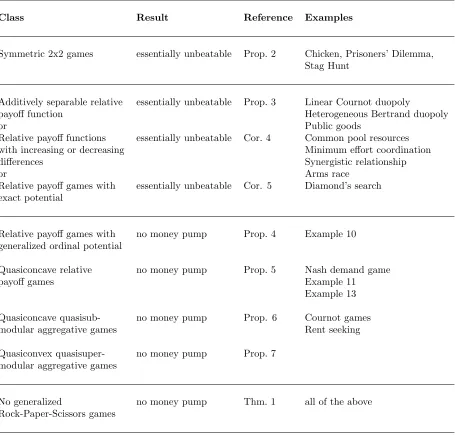
In Table 1 we summarize our results.10
The only class of symmetric games in which imitation can really be beaten is the class of games whose relative payoff function is a
9
The case of x26=x3 is already excluded by the requirement of non-trivial steps. 10
generalized rock–paper–scissors game. While this is a generic class of symmetric games, so is its complement. More importantly, many economically relevant games are contained in this complement. Thus it is fair to say that imitation seems very hard to beat in large classes of economically relevant and generic games.
Table 1: Summary of Results
Class Result Reference Examples
Symmetric 2x2 games essentially unbeatable Prop. 2 Chicken, Prisoners’ Dilemma, Stag Hunt
Additively separable relative essentially unbeatable Prop. 3 Linear Cournot duopoly
payoff function Heterogeneous Bertrand duopoly
or Public goods
Relative payoff functions essentially unbeatable Cor. 4 Common pool resources with increasing or decreasing Minimum effort coordination
differences Synergistic relationship
or Arms race
Relative payoff games with essentially unbeatable Cor. 5 Diamond’s search exact potential
Relative payoff games with no money pump Prop. 4 Example 10 generalized ordinal potential
Quasiconcave relative no money pump Prop. 5 Nash demand game
payoff games Example 11
Example 13
Quasiconcave quasisub- no money pump Prop. 6 Cournot games modular aggregative games Rent seeking
Quasiconvex quasisuper- no money pump Prop. 7 modular aggregative games
No generalized no money pump Thm. 1 all of the above Rock-Paper-Scissors games
the scope of the current paper, we provide here an example that shows how imita-tion can be beaten in a standard Cournot game when there are three players. Let the inverse demand function be p(Q) = 100− Q and the cost function be c(qi) = 10qi. Now consider the case of two maximizers and one imitator. Writing a vector of quan-tities as (qI, qM, qM), it is easy to check that the following sequence of action profiles (0,22.5,22.5),(22.5,0,68),(0,22.5,22.5),(22.5,68,0),(0,22.5,22.5)... is an imitation cy-cle. The two maximizers take turns in inducing the imitator to reduce his quantity to zero by increasing quantity so much that price is below marginal cost. Since the other maximizer has zero losses, she is imitated in the next period, which yields half of the monopoly profit for both maximizers. Clearly, this requires coordination among the two maximizers but this can be achieved in an infinitely repeated game by the use of a trigger strategy. Thus, imitation is subject to a money pump. Recall, however, that we pitted imitation against truly sophisticated opponents. Whether imitation can be beaten also by less sophisticated (e.g. human) opponents remains to be seen in future experiments.
Furthermore, our analysis was based on the assumption that an imitator sticks to his action in case of a tie in payoffs. To see what goes wrong with an alternative tie-braking rule consider a homogenous Bertrand duopoly with constant marginal costs. Suppose the imitator starts with a price equal to marginal cost. If the maximizer chooses a price strictly above marginal cost, her profit is also zero. If nevertheless, the maximizer were imitated, she could start the money pump by undercutting the imitator until they reach again price equal to marginal cost and then start the cycle again. This example shows that our results depend crucially on the details of the imitation heuristics. It would be interesting to exactly characterize the class of simple decision heuristics that are essentially unbeatable in large classes of economically relevant games. We leave this for future work.
References
[1] Al´os-Ferrer, C. and A.B. Ania (2005). The evolutionary stability of perfectly com-petitive behavior,Economic Theory 26, 497-516.
[2] Amir, R. (1996). Cournot oligopoly and the theory of supermodular games, Games and Economic Behavior 15, 132-148.
Orga-nization 65, 472-488.
[4] Apesteguia, J., Huck, S., and J. Oechssler (2007). Imitation - Theory and experi-mental evidence,Journal of Economic Theory 136, 217-235.
[5] Apesteguia, J., Huck, S., Oechssler, J., and Weidenholzer, S. (2010). Imitation and the evolution of Walrasian behavior: Theoretically fragile but behaviorally robust, Journal of Economic Theory, forthcoming.
[6] Brˆanzei, R., Mallozzi, L., and S. Tijs (2003). Supermodular games and potential games,Journal of Mathematical Economics 39, 39-49.
[7] Bryant, J. (1983). A simple rational expectations Keynes-type coordination model, Quarterly Journal of Economics 98, 525-528.
[8] Duersch, P., Kolb, A., Oechssler, J., and B.C. Schipper (2010). Rage against the machines: How subjects play against learning algorithms,Economic Theory, forth-coming.
[9] Duersch, P., Oechssler, J., and B.C. Schipper (2010). Pure saddle points and sym-metric relative payoff games, mimeo, University of Heidelberg and the University of California, Davis.
[10] Gigerenzer, G. and R. Selten (2002). Bounded rationality. The adaptive toolbox, Cambridge, MA: The MIT Press.
[11] Hehenkamp, B., Leininger, W., and A. Possajennikov (2004). Evolutionary equilib-rium in Tullock contests: Spite and overdissipation, European Journal of Political Economy 20, 1045-1057.
[12] Huck, S., Normann, H.-T., and J. Oechssler (1999). Learning in Cournot oligopoly - An experiment,Economic Journal 109, C80-C95.
[13] Leizarowitz, A. (1996). Overtaking and almost-sure optimality for infinite horizon Markov decision processes, Mathematics of Operations Research 21, 158-181.
[14] Milgrom, P. and J. Roberts (1990). Rationalizability, learning, and equilibrium in games with strategic complementarities, Econometrica58, 1255-1277.
[16] Monderer, D. and L.S. Shapley (1996). Potential games,Games and Economic Be-havior 14, 124-143.
[17] Nash, J. (1953). Two–person cooperative games, Econometrica 21, 128-140.
[18] Offerman, T., Potters, J., and J. Sonnemans (2002). Imitation and belief learning in an oligopoly experiment, Review of Economic Studies 69, 973-997.
[19] Osborne, M. (2004). An introduction to game theory, Oxford University Press.
[20] Osborne, M. and A. Rubinstein (1994). A course in game theory, MIT Press.
[21] Schaffer, M.E. (1989). Are profit-maximizers the best survivors?, Journal of Eco-nomic Behavior and Organization 12, 29-45.
[22] Schaffer, M.E. (1988). Evolutionary stable strategies for a finite population and a variable contest size, Journal of Theoretical Biology 132, 469-478.
[23] Schipper, B.C. (2009). Imitators and optimizers in Cournot oligopoly, Journal of Economic Dynamics and Control 33, 1981-1990.
[24] Schipper, B.C. (2003). Submodularity and the evolution of Walrasian behavior, In-ternational Journal of Game Theory 32, 471-477.
[25] Topkis, D. M. (1998).Supermodularity and complementarity, Princeton, New Jersey: Princeton University Press.
[26] Tullock, G. (1980). Efficient rent seeking, in: Buchanan, Tollison, Tullock (eds.), Towards a theory of the rent seeking society, Texas A & M University Press, 3-15.
[27] Van Huyck, J., Battalio, R., and R. Beil (1990). Tacit coordination games, strategic uncertainty and coordination failure, American Economic Review 80, 234-248.
[28] Vega-Redondo, F. (1997). The evolution of Walrasian behavior, Econometrica 65, 375-384.
[29] Walker, J.M., Gardner, R., and E. Ostrom (1990). Rent dissipation in a limited-access Common-Pool resource: Experimental evidence, Journal of Environmental
Economics and Management 19, 203-211.