http://dx.doi.org/10.4236/wjet.2016.42033
Prototype Road Surface Management System
Azad AbdulhafedhUniversity of Missouri, Columbia, MO, USA
Received 11 May 2016; accepted 24 May 2016; published 27 May 2016
Copyright © 2016 by authors and Scientific Research Publishing Inc.
This work is licensed under the Creative Commons Attribution International License (CC BY). http://creativecommons.org/licenses/by/4.0/
Abstract
The Road Surface Management System (RSMS) is a powerful tool that can provide an overview and rough estimate of a roadway system’s condition at the network level and the approximate costs for future improvements in towns and small cities. This helps municipalities and local agencies to ap-ply limited budget resources and provide the greatest road quality benefits. To control the cost of roadway surface deterioration, local agencies and municipalities need to make cost-effective deci-sions regarding the maintenance, rehabilitation, and reconstruction of the roadway network. RSMS can help in assessing the condition of the network, weighing alternatives, and establishing long- term treatment plans and budgets. In this paper, RSMS is used to evaluate a university campus road network in the state of Idaho and to establish the necessary repair methods for 10 selected sections in the campus network.
Keywords
Road Management System, Cost-Effective Alternatives, Inventory Roads
1. Introduction
establish long-term programs and budgets. Although road systems are built at considerable cost, many roads show signs of major distress. If these problems are not corrected, the cost to bring the road to an acceptable con-dition can be many times more expensive than the cost of timely repair. As municipal roads worsen maintenance budgets need to increase. There are more deteriorated streets each year, and the cost per mile for maintenance increases disproportionately. According to the American Association of State Highway and Transportation Offi-cials [1] [2], every $1 spent to keep a road in good condition avoids $6 - 14 needed later to rebuild the same road once it has deteriorated significantly. The Road Surface Management System (RSMS) is a useful tool to identify a road system’s condition and determine the approximate costs for future improvements. RSMS provides a sys-tematic approach for local officials to assess their road system, and to guide future improvement and investment in line with their budget. The RSMS program provides information on the condition, traffic, and importance of roads in a town to create a long term maintenance program. The general road surface management system (RSMS) processing includes the following tasks for the road network [3]:
• Inventory the road system by driving/or walking on the roads and making visual inspections;
• Determine and document the surface distresses condition and drainage condition of each road and entering that data into the program;
• Assign maintenance or repair methods for each condition strategy produced by the program; • Determine costs of maintenance and repair methods;
• Assign repair and maintenance methods to each road; • Establish maintenance and repair priorities;
• Establish long-term financial and budget plans.
2. Methodology
[image:2.595.122.506.477.706.2]The University of Idaho (UI) road campus is used to apply the RSMS approach that was developed by the De-partment of Civil Engineering at the University of New Hampshire. The UI is located in the northern City of Moscow, ID. The methodology used in this paper is implemented using a computer based software package RSMS 11 that addresses the fundamental RSMS tasks, including: identifying the sections and roads in the UI campus network and their importance and the associated traffic volume in a scale of (1 - 5) with 1 the lowest and 5 the highest; inventory the road system by making a field survey of the surface distresses and drainage condi-tions; determining the condition of each road or section, assigning the suitable repair method for each section; determining the cost of each maintenance; rehabilitation or repair method; establishing repair priorities, and planning for long-term budget plans. Further details are shown in the next steps.
3. Identifying the Deteriorated Road Sections
The following 10 roads (sections) were selected and identified for evaluation within the UI campus network system (with total length of 5.88 miles):
Section # 1: 6th Street from Deakin Ave to Perimeter Dr (0.695 miles). Section # 2: Perimeter Dr from Blake Ave to SH8 (1.445 miles).
Section # 3: Stadium Dr from Perimeter Dr to Rayburn Street (0.692 miles). Section # 4: Rayburn Street from Perimeter Dr to SH8 (0.592 miles). Section # 5: Line Street from University Ave to SH8 (0.445 miles). Section # 6: Blake Ave from 6th Street to Taylor Ave (0.502 miles). Section # 7: Deakin Ave from 6th Street to Blake Ave (0.486 miles). Section # 8: Idaho Ave from Deakin Ave to Stadium Dr (0.436 miles). Section # 9: University Ave from Deakin Ave to Line Street (0.329 miles). Section # 10: Sweet Ave from UI 95 to Blake Ave (0.341 miles).
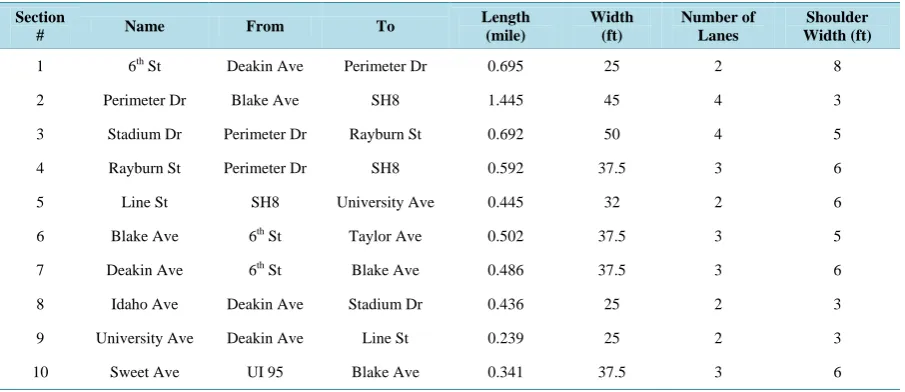
An accurate road inventory is a very important part of any pavement management system (PMS) and it is considered the foundation of the system. The required data for the UI campus network were obtained from the campus maps and facility services, and from field survey of each section and road, including its length, width, number of lanes, shoulder type and its width, the importance of the section in a scale of (1 - 5) with 1 the lowest and 5 the highest, the traffic volume on each section in a scale of (1 - 5) with 1 the lowest and 5 the highest, the speed limits, right-of-way, and the maintenance division [3]. Table 1 shows the 2016 inventory of the identified paved sections of the UI campus road network in Moscow, ID.
The importance of each section in a scale of (1 - 5) with 1 the lowest and 5 the highest, and the rank of the existing traffic volume used by each section in a scale of (1 - 5) with 1 being the lowest and 5 the highest were used in the RSMS as shown inTable 2.
4. Condition Survey for the Existing Surface Distresses and Drainage Conditions of
the Road Sections
[image:3.595.87.540.525.721.2]The purpose of the condition survey is to determine the condition of each section by visually observing the sur-face distresses. The condition survey is crucial to the pavement management system since certain distresses are related to certain causes of pavement deterioration [4] [5]. Due to this direct relationship, RSMS links distress types to the Maintenance, Rehabilitation, and Reconstruction (MR & R) strategies [3] [6] [7]. Gathering the in-ventory and road surface condition and drainage condition for each identified section is done by driving on the roads and/or walking on the roads and collecting visual inspections of the existing distresses and the roadside drainage for each road section, recording the SEVERITY and EXTENT of a distress. The severity is ranked as
Table 1. Inventory of the paved sections in the UI campus road network in Moscow, ID.
Section
# Name From To
Length (mile)
Width (ft)
Number of Lanes
Shoulder Width (ft)
1 6th St Deakin Ave Perimeter Dr 0.695 25 2 8
2 Perimeter Dr Blake Ave SH8 1.445 45 4 3
3 Stadium Dr Perimeter Dr Rayburn St 0.692 50 4 5
4 Rayburn St Perimeter Dr SH8 0.592 37.5 3 6
5 Line St SH8 University Ave 0.445 32 2 6
6 Blake Ave 6th St Taylor Ave 0.502 37.5 3 5
7 Deakin Ave 6th St Blake Ave 0.486 37.5 3 6
8 Idaho Ave Deakin Ave Stadium Dr 0.436 25 2 3
9 University Ave Deakin Ave Line St 0.239 25 2 3
(low, medium, and high) depending on the length, width and the visual shape of the existing cracks and dis-tresses, and the extent is ranked as low for <10% of the road section area, medium for 10% - 30%, and high for >30% as indicated in the RSMS. Decision trees are used to relate the surface distresses of each section with the appropriate strategy. Each distress type (i.e. alligator cracking, potholes, etc.) has a link that relates each se-verity/extent condition with an MR & R strategy. RSMS categorizes each section in term of the strategy repair method and determines its repair options depending on the surface distresses and roadside drainage data input. The type of repair strategies produced by RSMS are the following (No Maintenance, Routine, Preventive, Reha-bilitation, and Reconstruction), and each strategy has several repair options. The following types of distresses were inspected and documented by their level of severity and extent:
1) Alligator Cracks
2) Longitudinal/Transverse Cracks 3) Edge Cracking
4) Patches and Potholes 5) Roughness
6) Rutting
[image:4.595.87.538.510.722.2]7) Roadside Drainage
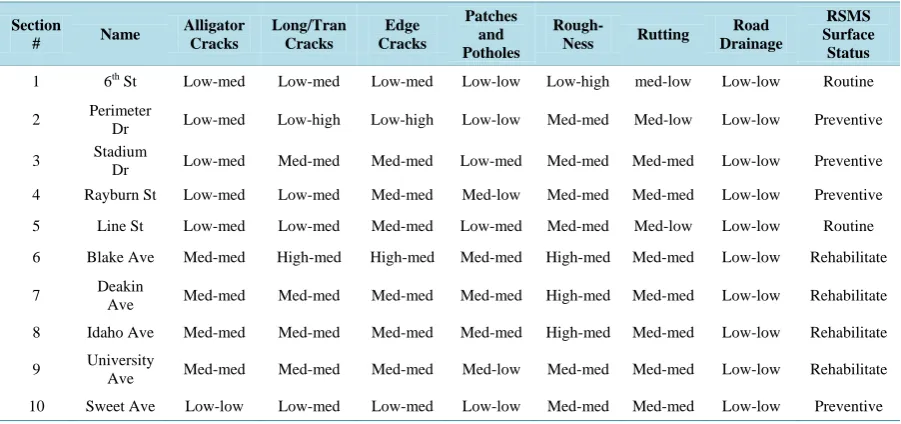
Table 3 shows the condition survey for each section within the UI campus road network, the different types
Table 2. The importance and traffic volume of the road sections.
Section # Name Road surface
type
The importance of the section in (1 - 5) scale
Traffic volume on the section in (1 - 5) scale
1 6th St Paved 1 1
2 Perimeter Dr Paved 1 1
3 Stadium Dr Paved 1 1
4 Rayburn St Paved 3 3
5 Line St Paved 1 1
6 Blake Ave Paved 3 3
7 Deakin Ave Paved 2 2
8 Idaho Ave Paved 4 4
9 University Ave Paved 4 4
10 Sweet Ave Paved 1 1
Table 3. Condition survey of the road sections and RSMS status.
Section
# Name
Alligator Cracks
Long/Tran Cracks
Edge Cracks
Patches and Potholes
Rough-
Ness Rutting
Road Drainage
RSMS Surface
Status
1 6th St Low-med Low-med Low-med Low-low Low-high med-low Low-low Routine
2 Perimeter
Dr Low-med Low-high Low-high Low-low Med-med Med-low Low-low Preventive
3 Stadium
Dr Low-med Med-med Med-med Low-med Med-med Med-med Low-low Preventive
4 Rayburn St Low-med Low-med Med-med Med-low Med-med Med-med Low-low Preventive
5 Line St Low-med Low-med Med-med Low-med Med-med Med-low Low-low Routine
6 Blake Ave Med-med High-med High-med Med-med High-med Med-med Low-low Rehabilitate
7 Deakin
Ave Med-med Med-med Med-med Med-med High-med Med-med Low-low Rehabilitate
8 Idaho Ave Med-med Med-med Med-med Med-med High-med Med-med Low-low Rehabilitate
9 University Ave Med-med Med-med Med-med Med-low Med-med Med-med Low-low Rehabilitate
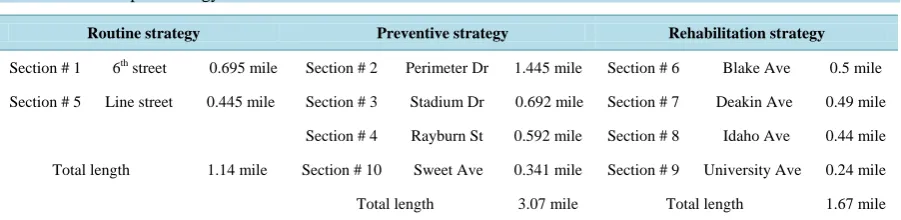
of the existing surface distresses and drainage conditions, and the RSMS surface status. Table 4 identifies the sections by the repair strategy of RSMS. Table 5 shows the repair strategy in term of the percent of total net-work length
5. Assigning the Suitable Repair Method and Cost-Effective Alternative
RSMS assigns appropriate repair options for each category [3] whether for maintenance costs depending on the road surface distresses as follows:
• For routine category, RSMS gives the following options (crack seal, and Patching).
• For preventive category, RSMS gives the following options (sand seal, chip seal, thick overlay >1”, thin overlay 3/4” - 1”, shim with 1” overlay, 2” cold mix overlay with 1” HMA, and mill and fill 1.25”).
• For rehabilitation category, RSMS gives the following repair options (reclaim incl 6” - 8” base 2” binder 1.5” surface, shim with 2” overlay, reclaim pavement revert to gravel, and RAP reclamation).
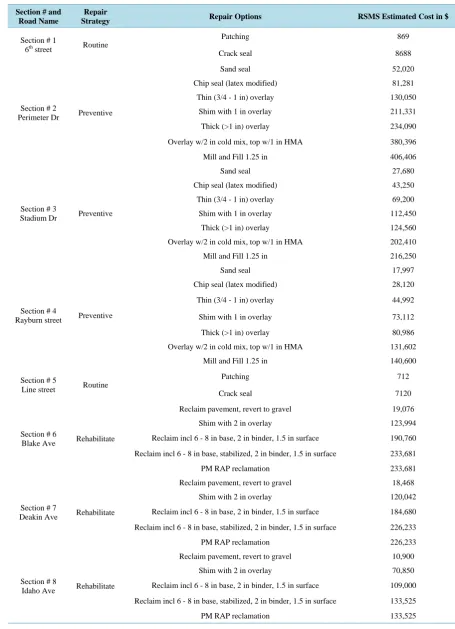
[image:5.595.88.539.480.590.2]Each repair option has an estimated cost and life expectancy that must be the most cost-effective alternative. Table 6 shows the cost of each repair option for all repair categories, and from this list, the suitable repair op-tion can be selected in the next step.
The selection of the repair option for each section is based on the utilization and optimization of many factors [6] [8]-[11] such as:
• Repair cost: choose the option with the lowest market price and cost.
• Best technical solution: choose the option that best addresses and cure the current surface distress condition and structural capacity of the section. This is an important weighing factor.
• Life cycle cost: choose the option that allows providing serviceability over the longest possible life cycle of the road.
• User delay cost: choose the option that minimizes the user delay cost of the road and contribute to the public satisfaction.
• Safety and risk minimization: choose the option that increases safety and minimizes the risk to the public. • Recycling of the materials: choose the option that maximizes the re-use of all materials generated during the
rehabilitation process and maximizes the recycling process.
• Environmental effects: choose the option that best fits the environmental/climatic effects surrounding the road.
Comparing the different alternatives of repair options for each section, especially the cost factor and the best
Table 4. RSMS repair strategy of road sections.
Routine strategy Preventive strategy Rehabilitation strategy
Section # 1 6th street 0.695 mile Section # 2 Perimeter Dr 1.445 mile Section # 6 Blake Ave 0.5 mile
Section # 5 Line street 0.445 mile Section # 3 Stadium Dr 0.692 mile Section # 7 Deakin Ave 0.49 mile
Total length 1.14 mile
Section # 4 Rayburn St 0.592 mile Section # 8 Idaho Ave 0.44 mile
Section # 10 Sweet Ave 0.341 mile Section # 9 University Ave 0.24 mile
Total length 3.07 mile Total length 1.67 mile
Table 5. The repair strategy in term of the percent of total network length.
RSMS 11 Repair Strategy % of Total Network Length
No Maintenance 0%
Routine Strategy 20%
Preventive Strategy 52%
Rehabilitation Strategy 28%
[image:5.595.86.540.481.718.2]Table 6. RSMS estimated cost for the repair options.
Section # and Road Name
Repair
Strategy Repair Options RSMS Estimated Cost in $
Section # 1
6th street Routine
Patching 869
Crack seal 8688
Section # 2
Perimeter Dr Preventive
Sand seal 52,020
Chip seal (latex modified) 81,281
Thin (3/4 - 1 in) overlay 130,050
Shim with 1 in overlay 211,331
Thick (>1 in) overlay 234,090
Overlay w/2 in cold mix, top w/1 in HMA 380,396
Mill and Fill 1.25 in 406,406
Section # 3
Stadium Dr Preventive
Sand seal 27,680
Chip seal (latex modified) 43,250
Thin (3/4 - 1 in) overlay 69,200
Shim with 1 in overlay 112,450
Thick (>1 in) overlay 124,560
Overlay w/2 in cold mix, top w/1 in HMA 202,410
Mill and Fill 1.25 in 216,250
Section # 4
Rayburn street Preventive
Sand seal 17,997
Chip seal (latex modified) 28,120
Thin (3/4 - 1 in) overlay 44,992
Shim with 1 in overlay 73,112
Thick (>1 in) overlay 80,986
Overlay w/2 in cold mix, top w/1 in HMA 131,602
Mill and Fill 1.25 in 140,600
Section # 5
Line street Routine
Patching 712
Crack seal 7120
Section # 6
Blake Ave Rehabilitate
Reclaim pavement, revert to gravel 19,076
Shim with 2 in overlay 123,994
Reclaim incl 6 - 8 in base, 2 in binder, 1.5 in surface 190,760
Reclaim incl 6 - 8 in base, stabilized, 2 in binder, 1.5 in surface 233,681
PM RAP reclamation 233,681
Section # 7
Deakin Ave Rehabilitate
Reclaim pavement, revert to gravel 18,468
Shim with 2 in overlay 120,042
Reclaim incl 6 - 8 in base, 2 in binder, 1.5 in surface 184,680
Reclaim incl 6 - 8 in base, stabilized, 2 in binder, 1.5 in surface 226,233
PM RAP reclamation 226,233
Section # 8
Idaho Ave Rehabilitate
Reclaim pavement, revert to gravel 10,900
Shim with 2 in overlay 70,850
Reclaim incl 6 - 8 in base, 2 in binder, 1.5 in surface 109,000
Reclaim incl 6 - 8 in base, stabilized, 2 in binder, 1.5 in surface 133,525
Continued
Section # 9
University Ave Rehabilitate
Reclaim pavement, revert to gravel 5975
Shim with 2 in overlay 38,838
Reclaim incl 6 - 8 in base, 2 in binder, 1.5 in surface 59,750
Reclaim incl 6 - 8 in base, stabilized, 2 in binder, 1.5 in surface 73,194
PM RAP reclamation 73,194
Section # 10
Sweet Ave Preventive
Sand seal 10,366
Chip seal (latex modified) 16,198
Thin (3/4 - 1 in) overlay 25,916
Shim with 1 in overlay 42,114
Thick (>1 in) overlay 46,649
Overlay w/2 in cold mix, top w/1 in HMA 75,804
Mill and Fill 1.25 in 80,988
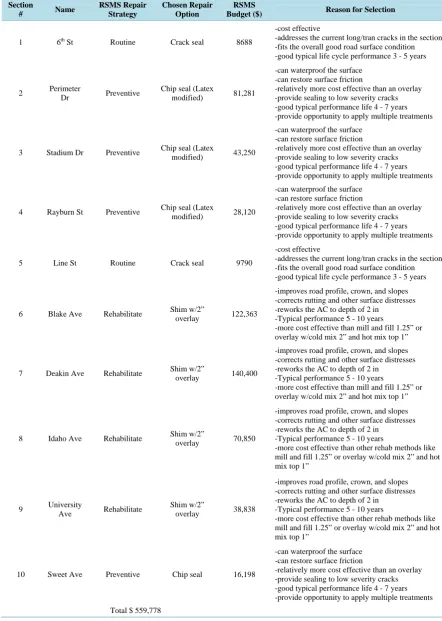
technical solution suitable for each section, and weighing the factors above, the appropriate repair methods and budgets were selected with reasoning of the selection as shown inTable 7.
6. Determining the Cost of Each Repair Method
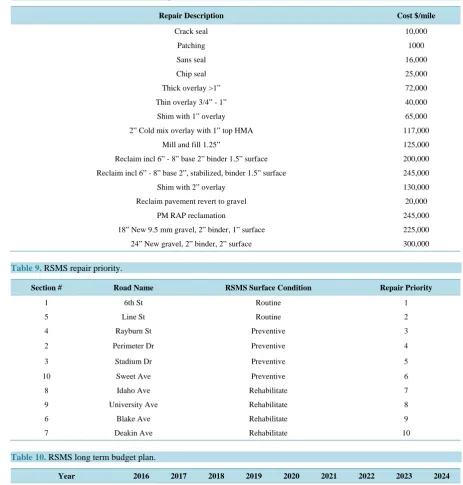
RSMS uses an estimate of the prices and costs of the different repair methods based on 1 mile road length and 20 ft wide road as shown in Table 8. The total cost of each section can be determined based on the actual length and width of the section.
The RSMS costs shown above can be modified by each agency to reflect the most recent market prices within its jurisdiction.
7. Establishing Repair Priorities
Repair strategies must be analyzed based on their technical and economical impacts so that priority program at the network level can be identified and later implemented at the project level. RSMS prioritizes the repair of all sections based on the surface distresses and the drainage conditions. RSMS gives the highest priority value to road sections that need routine maintenance and having poor drainage, and gives the lowest priority value to road sections that have good drainage but need major rehabilitation. In the UI Campus network, the priority was given to the sections that need routine maintenance in the financial plan because it costs less than other strate-gies and to effectively extent the life cycle of these low cost sections. Table 9 shows the repair priority of the sections depending on the repair strategy.
8. Long-Term Financial and Budget Plans
Long-term financial and budget plans are necessary planning tools for any PMS because it can allocate the re-quired resources and budgets per each year in the future planned period. RSMS can prepare long-term financial and budget plans for up to 15 years if the required data were available and entered into the program regarding the repair costs of each section within any number of future years up to 15. Table 10 shows the financial budget plan for the UI network repair from 2016 to 2024 using the estimated costs of repair of the RSMS, depending on the estimated repair methods used by the program.
9. Conclusion
Table 7. Choosing the budget.
Section
# Name
RSMS Repair Strategy
Chosen Repair Option
RSMS
Budget ($) Reason for Selection
1 6th St Routine Crack seal 8688
-cost effective
-addresses the current long/tran cracks in the section -fits the overall good road surface condition -good typical life cycle performance 3 - 5 years
2 Perimeter Dr Preventive Chip seal (Latex modified) 81,281
-can waterproof the surface -can restore surface friction
-relatively more cost effective than an overlay -provide sealing to low severity cracks -good typical performance life 4 - 7 years -provide opportunity to apply multiple treatments
3 Stadium Dr Preventive Chip seal (Latex
modified) 43,250
-can waterproof the surface -can restore surface friction
-relatively more cost effective than an overlay -provide sealing to low severity cracks -good typical performance life 4 - 7 years -provide opportunity to apply multiple treatments
4 Rayburn St Preventive Chip seal (Latex
modified) 28,120
-can waterproof the surface -can restore surface friction
-relatively more cost effective than an overlay -provide sealing to low severity cracks -good typical performance life 4 - 7 years -provide opportunity to apply multiple treatments
5 Line St Routine Crack seal 9790
-cost effective
-addresses the current long/tran cracks in the section -fits the overall good road surface condition -good typical life cycle performance 3 - 5 years
6 Blake Ave Rehabilitate Shim w/2”
overlay 122,363
-improves road profile, crown, and slopes -corrects rutting and other surface distresses -reworks the AC to depth of 2 in
-Typical performance 5 - 10 years
-more cost effective than mill and fill 1.25” or overlay w/cold mix 2” and hot mix top 1”
7 Deakin Ave Rehabilitate Shim w/2” overlay 140,400
-improves road profile, crown, and slopes -corrects rutting and other surface distresses -reworks the AC to depth of 2 in
-Typical performance 5 - 10 years
-more cost effective than mill and fill 1.25” or overlay w/cold mix 2” and hot mix top 1”
8 Idaho Ave Rehabilitate Shim w/2”
overlay 70,850
-improves road profile, crown, and slopes -corrects rutting and other surface distresses -reworks the AC to depth of 2 in
-Typical performance 5 - 10 years
-more cost effective than other rehab methods like mill and fill 1.25” or overlay w/cold mix 2” and hot mix top 1”
9 University
Ave Rehabilitate
Shim w/2”
overlay 38,838
-improves road profile, crown, and slopes -corrects rutting and other surface distresses -reworks the AC to depth of 2 in
-Typical performance 5 - 10 years
-more cost effective than other rehab methods like mill and fill 1.25” or overlay w/cold mix 2” and hot mix top 1”
10 Sweet Ave Preventive Chip seal 16,198
-can waterproof the surface -can restore surface friction
-relatively more cost effective than an overlay -provide sealing to low severity cracks -good typical performance life 4 - 7 years -provide opportunity to apply multiple treatments
Table 8. The RSMS cost of 1 mile road length and 20 ft wide road.
Repair Description Cost $/mile
Crack seal 10,000
Patching 1000
Sans seal 16,000
Chip seal 25,000
Thick overlay >1” 72,000
Thin overlay 3/4” - 1” 40,000
Shim with 1” overlay 65,000
2” Cold mix overlay with 1” top HMA 117,000
Mill and fill 1.25” 125,000
Reclaim incl 6” - 8” base 2” binder 1.5” surface 200,000
Reclaim incl 6” - 8” base 2”, stabilized, binder 1.5” surface 245,000
Shim with 2” overlay 130,000
Reclaim pavement revert to gravel 20,000
PM RAP reclamation 245,000
18” New 9.5 mm gravel, 2” binder, 1” surface 225,000
24” New gravel, 2” binder, 2” surface 300,000
Table 9. RSMS repair priority.
Section # Road Name RSMS Surface Condition Repair Priority
1 6th St Routine 1
5 Line St Routine 2
4 Rayburn St Preventive 3
2 Perimeter Dr Preventive 4
3 Stadium Dr Preventive 5
10 Sweet Ave Preventive 6
8 Idaho Ave Rehabilitate 7
9 University Ave Rehabilitate 8
6 Blake Ave Rehabilitate 9
7 Deakin Ave Rehabilitate 10
Table 10. RSMS long term budget plan.
Year 2016 2017 2018 2019 2020 2021 2022 2023 2024
Planned long-term Budget in $ 559,778 280,273 334,800 340,331 496,072 481,850 382,891 507,691 310,994
References
[1] AASHTO (2011) A Policy on Geometric Design of Highways and Streets. The American Association of State High-way and Transportation Officials, AASHTO Green Book, Washington DC.
[2] NCPP (2016) Retrieved May 17, 2016 from the National Center for Pavement Preservation. www.pavementpreservation.org
[3] RSMS (2016) RSMS User Group. http://www.rsms.info/
[4] Peshkin, S., Krstulovich, W. and Alvarado, M. (2011) Guidelines for the Preservation of High-Traffic Volume Roads: SHRP 2 Renewal Research, Report S2-R26-RR-2.
[5] AASHTO (2008) Transportation System Preservation Research, Development, and Implementation Roadmap. The American Association of State Highway and Transportation Officials, Washington DC.
[6] Haas, R., Hudson, W. and Zaniewski, J. (1994) Modern Pavement Management. Krieger Publishing Company, Mala-bar.
[7] Peshkin, S. and Hoerner, M. (2005) Pavement Preservation: Practices, Research Plans, and Initiatives: NCHRP 20-07, Task 184.
[8] Mubaraki, M. (2014) Proposed Integrated Road Surface Management System for Small Municipalities. Proceedings of the Institution of Civil Engineers, Municipal Engineer, 166, 239-249.http://dx.doi.org/10.1680/muen.12.00047 [9] Bendtsen, H. and Schmidt, B. (2006) Integrating Noise in Pavement Management Systems for Urban Roads. NORDIC
Road and Transport Research Publication, 3, 26-27.
[10] Descornet, G. (1989) A Criterion for Optimizing Surface Characteristics. Transportation Research Record, 1215, 173- 177.