http://dx.doi.org/10.4236/cs.2016.78147
Hybrid Segment Approximate Multiplication
for Image Processing Applications
Jamuna Ramasamy1, Sathishkumar Nagarajan2
1Department of Electronics & Communication Engineering, SNS College of Engineering, Coimbatore, India 2Department of Electronics & Communication Engineering, Sri Ramakrishna Engineering College, Coimbatore,
India
Received 13 April 2016; accepted 1 May 2016; published 16 June 2016
Copyright © 2016 by authors and Scientific Research Publishing Inc.
This work is licensed under the Creative Commons Attribution International License (CC BY).
http://creativecommons.org/licenses/by/4.0/
Abstract
It is critical in terms of approximate computation errors in VLSI multiplier circuits are increasing with technology scaling. The most common method for fast and energy efficient execution of mul-tiplication result is approximation of operands. But this traditional approximate result is not suitable for image processing applications. This paper proposes the two architectures of high ac-curate hybrid segment approximate multiplier (HSAM) and enhanced HSAM for image compres-sion. Existing static segment method based approximate multiplier is not suitable for certain ac-curate applications and dynamic segment method based approximate multiplier is not suitable for cost efficient applications. The proposed work combines the advantages of both static segment method and dynamic segment method to drive the efficiency in accuracy and cost. The proposed approximate multipliers HSAM8 × 8 and EHSAM8 × 8 provide 99.85% and 99.999% accuracy re-spectively for various inputs. The proposed HSAM consumes less energy with small increase of area overhead. The proposed EHSAM consumes less energy without any area overhead. The pro-posed HSAM and EHSAM is improved the speed by 40% and 85% compared to the existing SSM8 × 8 technique.
Keywords
Communication, Timing Synchronization, FPGA, Multipliers, Parallel Processing, Power, Delay
1. Introduction
computing, reduction in energy dissipation and fast execution is possible at all levels of design hierarchy. It is suitable for the applications such as signal processing, image/video processing and machine learning and neu-romorphic systems. This energy efficient VLSI circuits are mainly used in real time applications such as mobile and embedded computing devices to provide reliability and to improve the life span of VLSI systems [2].
Multiplication is the power, area and time consuming operation for large operands [3]. This is the bottleneck in many applications which requires large number of multipliers. But it is one of the basic arithmetic operations in DSP and image processing applications like convolution, correlation, finite Impulse Response, infinite im-pulse response, fast fourier transform, multiply accumulate unit, image compression and signal compression techniques. It is also used for designing arithmetic, image and signal processors [5]. To create a remedy for this power-hungry components, approximate computation is preferred which provides low energy consumption with computational error. DSP applications have more error tolerance than image processing applications. Previous studies provide various techniques to improve energy efficiency with some error tolerance. It can be divided into three types: 1) Aggressive voltage scaling [6][7], 2) Truncation of bits [4] [6]-[8], 3) Inaccurate building blocks usage [9]. In [6], hardware is designed with a scalable effort using aggressive voltage scaling and truncation of bits to support error resilience. In [4], under-designed multiplier for 16 bits is proposed with a simple correction mechanism, during its operation in a critical mode. But the power consumption and computational accuracy is trade-off. It uses inaccurate 2 × 2 partial product generators to achieve minimum dynamic and leakage power with some accuracy loss. Better Signal to Noise Ratio (SNR) is achieved by this proposed multiplier which is not suffering from the overheads of advanced over-scaling techniques.
Z. Babic et al. proposed an iterative logarithmic multiplier [3]. It uses Mitchell’s algorithm without the use of logarithmic approximation. This method uses two parallel circuits for error correction. It affords less computa-tional error with area overhead and high power consumption. In [10], a low error and high performance multi-plexer based truncated multiplier is proposed with a Pseudo carry Compensation Truncation (PCT) scheme. It is implemented on TSMC 0.18 um technology and it provides low Mean Square Error (MSE).
Ritupriya Jha proposed an 8-bit shift and approximate multiplier which is suitable for embedded DSP applica-tions [5]. It is based on Vedic mathematics, the word Vedic derived from vedha which means the store house of all knowledge. It uses Urthva Tiryakbhyam sutra which operates in vertical and crosswise manner. Due to par-allel processing, it increases the speed. But it increases the area when the number of bits is increased. In [11], Mitchell’s logarithmic multiplier is designed using iterative multiplier.
This iterative multiplier is mainly used in convolution process for multiplying the pixels of image with the kernel value. Because of its iteration, it reduced the delay. But this iterative process leads to the accurate result.
An approximate multiplier is presented in [12], which uses the accurate multiplier for MSB and accurate plus approximate multiplier for LSB. Since it provides little computational error, it is suitable for multimedia and wireless applications. In [13], an approximate multiplier is proposed with an approximate adder and an OR gate based error recovery module for error reduction. When compared to the wallace tree, it reduced the critical path delay with the cost of quality degradation. An approximate multiplier using 4:2 compressors is presented in [14]. It is based on recursive multiplication technique. It provides the reduction in power and delay, high accuracy with area overhead.
The rest of this paper is structured as follows. Section 2 explains the multiplier less multiplier. Different types of proposed approximation techniques are presented in Section 3. Section 4 gives the detail discussion about the results like energy consumption, power, delay and area of different approximate multipliers. The case study on image processing applications is given in Section 5. Finally Section 6 concludes the paper.
2. Proposed Multiplier Less Multiplier (MLM)
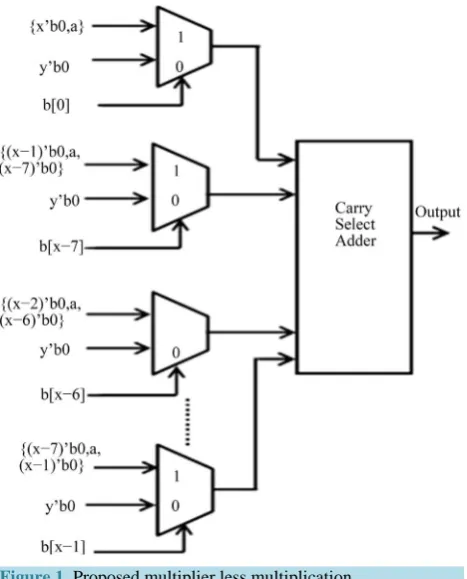
The main components of the proposed multiplier less multiplier (MLM) are shifter, multiplexer and adder. The shifter is used to perform the right shift operation of one of the input operand. The shifted values and zeros are given as the inputs to the multiplexer which select the appropriate values based on the other input operand is al-so called as control operand. One of the inputs of the multiplexer is always zero. If the control operand bit of the multiplexer is zero then the output of the multiplier is zero, otherwise it selects the multiplicand as the output (Figure 1).
Figure 1. Proposed multiplier less multiplication.
low energy consumption. This high speed and energy efficient proposed multiplier is used in the approximate multiplier, which is suitable for mobile, embedded computing and image processing applications.
3. Proposed Approximate Multipliers
Basically two different types of approximation techniques are available. Dynamic Segment Method (DSM) is one of the techniques used for accurate approximate multiplication. It uses the eight bit segment from the lead-ing one position of the operands. To perform these operations, it uses the leadlead-ing one detector (LOD) which in-creases the cost with high accuracy. But the Static Segment Method (SSM) uses the OR gate instead of LOD to reduce the hardware requirement. It provides high accuracy for the LSB segments and low accuracy for MSB segments. If there is one present in the MSB, it uses the MSB segment and excludes the LSB segment which reduces the accuracy. This proposed work combines the advantages of both static segment method and dynamic segment method to drive the efficiency in accuracy and cost. In addition to that the new multiplier less multiplier is used instead of existing multipliers like wallace tree or dadda.
3.1. Hybrid Segment Approximate Multiplier (HSAM)
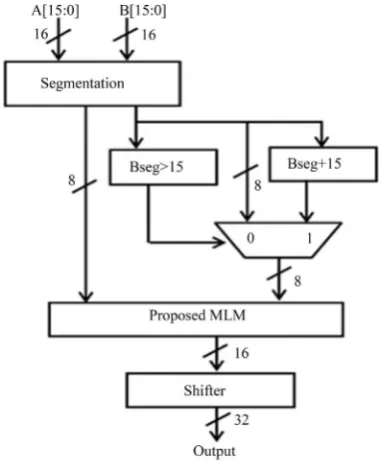
The proposed hybrid approximate multiplier takes m consecutive bits (i.e., an m-bit segment) of an n-bit ope-rand and selected two m-bit segments are applied to MLM method for obtaining cost efficiency. The advantages of both static segment and dynamic segment are combined, which is called as hybrid segment technique. To im-prove the accuracy of an approximate multiplier, hybrid segment technique is used (Figure 2).
It uses LOD and shifters like dynamic segment method, with the slight changes in its logic functions which provides good accuracy and low energy consumption. By reducing LOD and shifters, it reduces the area. It also provides high speed due to the proposed MLM technique.
3.2. Enhanced Hybrid Segment Approximate Multiplier (EHSAM)
Otherwise the input segment is taken as one of the inputs of the proposed multiplier. When compared to the SSM8 × 8, SSM10 × 10 and the HSAM technique, it provides better accuracy, less energy consumption and high speed (Figure 3).
3.3. Working Example for Approximation Method
Two 16 bit operands are given namely
(
) (
2)
10A= 0101 0101 1111 1111 = 22015
(
) (
2)
10B= 0000 0000 1111 1111 = 255
[image:4.595.203.423.224.452.2]Product C = (5613825)10
Figure 2. Proposed Hybrid segment approximate multiplier (HSAM).
[image:4.595.218.409.476.707.2]The multiplication technique used in SSM method is given in steps as follows: Step 1: Segmentation
Step 2: 8 × 8 multiplication
seg 2 10
A =01010101 =85 Bseg=111111112=25510
Let Z=Aseg∗Bseg =01010101 11111111∗ Z = 0101 0100 1010 10112 (16 bit)
Step 3: Expanding the product Step 3: Expanding the product The product is Cssm = Z * (2^8)
Cssm = 0000 0000 0101 0100 1010 1011 0000 00002 (32 bit) = (5548800)10 The accuracy of an approximate multiplier using SSM technique is computed by
( )
CssmAccuracy % 100 98.84% C
= ∗ =
(1)
4. Results and Discussion
The implementation of proposed approximate multipliers is carried out in Xilinx ISE tool and the Kintex-7 FPGA is used as the target platform. To evaluate the performance of the proposed approximate multipliers Cost and accuracy results are compared with the existing works.
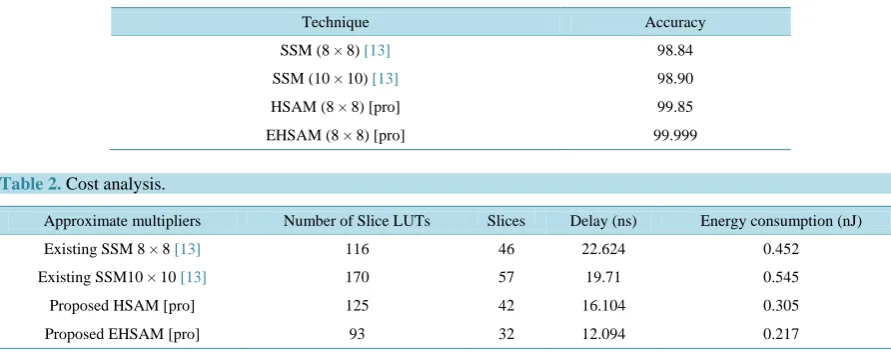
The accuracy of an approximate multiplier is calculated using HSAM and EHSAM technique is computed using Equation (2) and Equation (3). Table 1 shows that comparison results of existing and proposed approx-imate multiplier techniques. The proposed HSAM8x8 and EHSAM 8 × 8 approxapprox-imate multipliers provide 98.85% and 99.999% accuracy respectively for various inputs.
( )
(
output)
Accuracy % = HSAM 8 8× MLM 16 16× ∗100 (2)
( )
(
output)
Accuracy % = EHSAM 8 8× MLM 16 1× ∗100 (3)
The cost analysis of an existing and proposed approximate multiplier is calculated in terms of area, delay and energy. Area of different approximate multipliers is computed in terms of number of slice LUTs and number of occupied slices is depicted in Table 2. To fairly compare the proposed technique, the existing SSM 8 × 8 is tak-en in to account due to approximation of 8 × 8. The proposed HSAM has additional area overhead by 7% but EHSAM reduces the area overhead by 19.8% compared to existing SSM 8 × 8 technique. The proposed HSAM
Table 1. Accuracy analysis of approximate multiplier using various SSM techniques.
Technique Accuracy
SSM (8 × 8) [13] 98.84
SSM (10 × 10) [13] 98.90
HSAM (8 × 8) [pro] 99.85
[image:5.595.87.533.543.719.2]EHSAM (8 × 8) [pro] 99.999
Table 2.Cost analysis.
Approximate multipliers Number of Slice LUTs Slices Delay (ns) Energy consumption (nJ)
Existing SSM 8 × 8 [13] 116 46 22.624 0.452
Existing SSM10 × 10 [13] 170 57 19.71 0.545
Proposed HSAM [pro] 125 42 16.104 0.305
consumes less energy with small increase of area overhead. The proposed EHSAM consumes less energy with-out any area overhead. The proposed HSAM and EHSAM is improved the speed by 40% and 85% compared to the existing SSM 8 × 8 technique. The proposed HSAM and EHSAM is reduces the energy consumption by 70% and 108% compared to the existing SSM 8 × 8 technique.
5. Case Study on Image Processing Applications
The proposed approximate multiplier is suitable for image compression applications. It is simulated using Mat-lab image processing tool box.
5.1. Implementation Flow
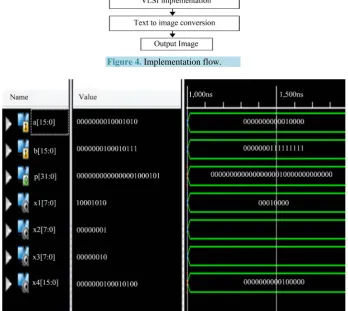
The implementation flow of image processing applications using high accurate static segment based approxi-mate multiplier is shown in Figure 4. Input images are converted into text file using Matlab programming.
The text file is given as the input to VLSI implementation. This is done by Xilinx ISE tool, which provides the text file as output. Finally the output text file is converted into the image using Matlab programming.
5.2. Simulation Output
[image:6.595.139.488.392.703.2]The various approximate multipliers are designed to support two 16 bit inputs and 32 bit output. These multipli-ers are implemented on Spartan 6 with a speed grade-3 using Verilog HDL. The simulation output of novel ap-proximate multiplier is shown in Figure 5. Here a, b are two 16 bit inputs and P is 32 bit product.
Figure 4. Implementation flow.
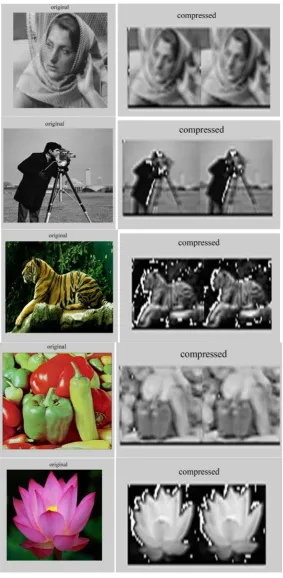
The simulation output of image compression using Matlab tool is shown in Figure 6. Here the column 1 de-notes the original image and column 2 dede-notes the compressed images, which are obtained by proposed ap-proximate multipliers.
6. Conclusion
In this paper, a hybrid segment based approximate multiplier is designed for error critical applications. The pro-posed hybrid approximate multiplier takes m consecutive bits (i.e., an m-bit segment) of an n-bit operand and selected two m-bit segments are applied to MLM method for obtaining cost efficiency. The proposed HSAM has additional area overhead by 7% but EHSAM reduces the area overhead by 19.8% compared to existing SSM 8 × 8 technique. The proposed HSAM and EHSAM is improved the speed by 40% and 85% compared to the exist-ing SSM 8 × 8 technique. The proposed HSAM and EHSAM is reduces the energy consumption by 70% and 108% respectively compared to the existing SSM 8 × 8 technique.
References
[1] Shao, B.T. and Li, P. (2015) Array-Based Approximate Arithmetic Computing: A General Model and Applications to Multiplier and Squarer Design. IEEE Transactions on Circuits and Systems I: Regular Papers, 62, 1081-1090.
[2] Hegde, R. and Shanbhag, N.R. (1999) Energy-Efficient Signal Processing via Algorithmic Noise-Tolerance. Coordi-nated Science Laboratory University of Illinois, Urbana, IL.
[3] Babic, Z., Avramovic, A. and Bulic, P. (2011) An Iterative Logarithmic Multiplier. Microprocessors and Microsystems, 35, 23-33.
[4] Chang, C.-H. and Satzoda, R.K. (2010) A Low Error and High Performance Multiplexer-Based Truncated Multiplier.
IEEE Transactions on Very Large Scale Integration (VLSI) Systems, 18, 1767-1771.
[5] Jha, R. and Paul, R.K. (2015) Swift and Approximate 8 bit Multiplier for Embedded DSP Applications: A Review.
In-ternational Journal of Industrial Electronics and Electrical Engineering, 3, 40-52.
[6] Chippa, V.K., Mohapatra, D., Raghunathan, A., Roy, K. and Chakradhar, S.T. (2010) Scalable Effort Hardware Design: Exploiting Algorithmic Resilience for Energy Efficiency. Proceedings of 47th IEEE/ACM Design Automation
Confe-rence (DAC), Anaheim, CA, 13-18 June 2010, 555-560. http://dx.doi.org/10.1145/1837274.1837411
[7] Mohapatra, D., Karakonstantis, G. and Roy, K. (2009) Significance Driven Computation: A Voltage-Scalable, Variation- Aware, Quality-Tuning Motion Estimator. Proceedings of 14th IEEE/ACM International Symposium on Low Power
Electronics and Design (ISLPED), San Fancisco, 19-21 August 2009, 195-200.
http://dx.doi.org/10.1145/1594233.1594282
[8] Babic, Z., Avramovic, A. and Bulic, P. (2011) An Iterative Logarithmic Multiplier. Microprocessors and Microsystems, 35, 23-33. http://dx.doi.org/10.1016/j.micpro.2010.07.001
[9] Kulkarni, P., Gupta, P. and Ercegovac, M. (2011) Trading Accuracy for Power with an Underdesigned Multiplier Ar-chitecture. Proceedings of 24th Internatioal Conference on VLSI Design (VLSID), 2-7 January 2011, 346-351. http://dx.doi.org/10.1109/vlsid.2011.51
[10] Sunil, M. and Harish, B. (2014) High Performance Multiplexer Based Pseudo-Carry Compensation Truncated Mulip-lier. ISRASE eXplore Digital Library.
[11] Shetty, D.R. and Patil, S. (2013) Improving Accuracy in Mitchell’s Logarithmic Multiplication Using Iterative Multip-lier for Image Processing Application. International Journal of Soft Computing and Engineering (IJSCE), 3, 187-190.
[12] Anand, S. and Saxena, A.K. (2013) Design of Approximate Multiplier for Error-Tolerant Applications. International
Journal of Engineering Research and Applications, 3, 880-883.
[13] Liu, C., Han, J. and Lombardi, F. (2014) A Low-Power, High-Performance Approximate Multiplier with Configurable Partial Error Recovery. Design, Automation and Test in Europe Conference and Exhibition (DATE), Dresden, 24-28 March 2014, 1-4.