© 2017, IRJET | Impact Factor value: 5.181 | ISO 9001:2008 Certified Journal
| Page 1212
OPTIMIZATION OF WEDM PROCESS PARAMETERS ON SS 317 USING
GREY RELATIONAL ANALYSIS
Y. Chandra Sekhar Reddy
1, T. Pratheep Reddy
2, Dr. M. Chandra Sekhar Reddy
31
Student, Dept. of Mechanical Engineering, S.V. College of Engineering, Tirupati, Andhra Pradesh, India
2
Asst. Prof., Dept. of Mechanical Engineering, S.V. College of Engineering, Tirupati, Andhra Pradesh, India
3
Prof. & HOD, Dept. of Mechanical Engineering, S.V. College of Engineering, Tirupati, Andhra Pradesh, India
---***---Abstract -
In the present study, Multi-objective optimizationof Wire Electrical Discharge Machining parameters of SS 317 was performed using grey relational analysis which converts the multi responses into a single grade. Taguchi based L9 orthogonal array is used for plan of experiments. The objectives chosen are the Maximum Material removal rate and Minimum surface roughness using process parameters viz., pulse on time, pulse off time and Peak Current. The optimal machining parameters results better quality and removal rate.
Key Words: SS 317, Wire electric discharge machining, Multiobjective optimization, Grey relational analysis.
1. INTRODUCTION
Need of advanced materials is increasing day to day for structural and engineering applications. Intense research of new Alloys and Composites [1-2] are going on for the requirement.
SS 317 stainless steel is developed primarily for higher strength and corrosion resistance by increasing nickel and molybdenum to the 316 stainless steel. At present, these steels are used as in different applications like desalination plants, valves & fittings, vessels, piping, fasteners, heat exchangers and construction materials as a replacement of austenitic stainless steels
Wire Electric Discharge Machining (WEDM) is a non-conventional machining process utilises thermal energy to machine electrically conductive parts with intricate shapes and hard material with high precision [3]. WEDM is adopted in many industries throughout the world which focused on fast machining with high surface finish and precision.
To achieve a sound and economical product, selection of most appropriate machining parameters are required for machining, for this industries applies various procedures and techniques to estimate the influence of the machining parameters on machining rate and surface quality, which are primary objectives. Machinist experiences are simple and inexpensive, but doesn’t guarantees quality and functionality of product [4].
In the current scenario, optimization plays a vital role in organizations, industries and research to meet the demands of product with best quality with less price [5]. Taguchi method is used to optimize the single objective, but not suitable for the requirement of industries which has multi objectives for a single product [6]. Study of multiple objectives are still an interesting research area. Optimization of multiple objectives are more difficult and tedious compared to single objective optimization. To optimize multi-objective system into single objective, taguchi integrated grey relational analysis was performed and the optimal parameters were determined by using grey relational grade [7-8].
2. LITERATURE SURVEY
Raju et al. [9] studied the effect of Pulse on time, peak current, Servo voltage and wire tension on the surface roughness response on 316L SS using Full factorial design of experiments. It is observed that Pulse on time is the most significant factor that affects surface roughness (Ra), and the peak current, servo voltage and wire tension plays next to the pulse on time on characteristics respectively. Rajesh Khanna et al. [10] also studied and observed that Pulse off time has the most influent parameter on determining response characteristics of SS316.
Rajmohan et al. [11] investigated optimization of process parameters for surface roughness and MRR on SS 304L using taguchi integrated Grey relational analysis, and observed that Pulse off time is the most significant factor that affects the Grey relational grade and Grey relational analysis technique converts the multiple performance characteristics into single performance characteristic and therefore simplifies the optimization procedure. The accuracy can be improved by including more number of parameters and levels. Shunmuga Priyan et al. [12] observed that Pulse on, Pulse off, Servo Voltage and Wire feed has the effect on the Ra in the order on machining of SS 304 using GRA. Pulse off time has opposite effect to pulse on time. MRR decrease with increase of pulse off time, while surface roughness reduces.
© 2017, IRJET | Impact Factor value: 5.181 | ISO 9001:2008 Certified Journal
| Page 1213
time, peak current, servo voltage and wire tension playssignificant role in the characteristics respectively.
From the literature study, it is observed that none of the work has been carried out using SS 317. In the present investigation, an attempt is made to study and determine the optimal machining parameters of WEDM on SS 317 for minimum surface roughness and maximum material removal rate. Pulse on, Pulse off and Peak Current are chosen as the process parameters with a L9 array plan of experiments, to collect the experimental data and to analyse the effect of these parameters on surface roughness and material removal rate. Taguchi integrated Grey relational analysis is chosen for Multi-objective optimization.
3. EXPERIMENTAL DETAILS:
SS 317 is used as target material in the present investigation. Experiments were performed using Electronica Maxicut Wire EDM as shown in “Fig.1.”
Fig -1 Wire Electric Discharge Machine
Fig -2 Material in Fixture
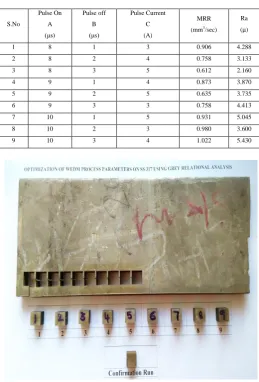
A 0.25 mm dia brass wire was used as an electrode to erode the metal under distilled water. A small gap of 0.025 mm to 0.05 mm is maintained in between the wire and work-piece. The size of the work piece considered for experimentation is 10 * 10 * 10 mm3. The process parameters were being set in the WEDM machine and the experiments were conducted as
per the plan in Table 2. The time required for material removal of workpiece is determined by using stopwatch and the surface roughness is determined by using talysurf instrument and the results were tabulated in Table 2.
[image:2.595.303.569.274.338.2]In this experiment three process parameters are chosen which have more influence on material removal rate and surface roughness and each parameter is set at three levels. The parameters and its levels are shown in Table 1. L9 (33-1 = 9 runs) orthogonal array of experiments was chosen for experimentation, instead of L 27 array (33 =27 runs) to reduce the experimentation cost.
Table 1. Process parameters and levels
Process parameters Levels
Level-1 Level-2 Level-3
Pulse-on (μs) 8 9 10
Pulse-off (μs) 1 2 3
[image:2.595.35.288.356.531.2]Pulse Current (A) 3 4 5
Table 2.
Design of experiments and Responses
S.No
Pulse On
A (μs)
Pulse off
B (μs)
Pulse Current
C
(A)
MRR
(mm3
/sec) Ra
(μ)
1 8 1 3 0.906 4.288
2 8 2 4 0.758 3.133
3 8 3 5 0.612 2.160
4 9 1 4 0.873 3.870
5 9 2 5 0.635 3.735
6 9 3 3 0.758 4.413
7 10 1 5 0.931 5.045
8 10 2 3 0.980 3.600
9 10 3 4 1.022 5.430
[image:2.595.304.564.364.747.2]© 2017, IRJET | Impact Factor value: 5.181 | ISO 9001:2008 Certified Journal
| Page 1214
3. MULTI OBJECTIVE OPTIMIZATION
3.1 Grey relational analysis:
Grey relational analysis (GRA) methodology is used to optimize the process parameters having multi-objectives through grey relational grade. The GRA methodology is as follows :
1. Conduct the experiments as per plan. 2. Normalize the responses.
3. Calculate the grey relational coefficients.
4. Calculate the grey relational grade by averaging the grey relational coefficient.
3.1.1 Normalization:
Convert the original sequences to a set of comparable sequences by normalizing the data. Depending upon the response characteristic, three main categories for normalizing the data is as follows:
3.1.2 Grey relational coefficient and grey relational grade
Grey relation coefficient (αij) is calculated for each of the performance characteristics, which expresses the relationship between ideal and actual normalized experimental results, as shown in “Eq.(4).”
[image:3.595.305.566.119.267.2]Grey relational grade can be calculated by taking the average of is the weighted grey relational coefficient and defined as follows
Table -3: Grey Relational Grades
Expt. No
MRR (mm3/sec)
Ra (μm)
Normalized values
Grey Relational Coefficients
Grey Relational
Grades
MRR Ra MRR Ra
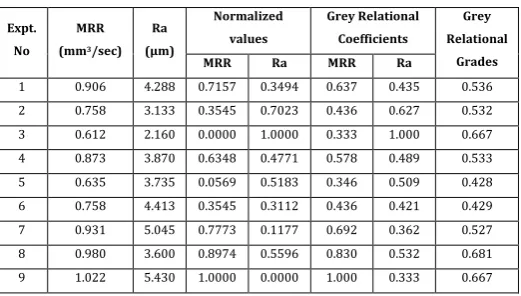
1 0.906 4.288 0.7157 0.3494 0.637 0.435 0.536
2 0.758 3.133 0.3545 0.7023 0.436 0.627 0.532
3 0.612 2.160 0.0000 1.0000 0.333 1.000 0.667
4 0.873 3.870 0.6348 0.4771 0.578 0.489 0.533
5 0.635 3.735 0.0569 0.5183 0.346 0.509 0.428
6 0.758 4.413 0.3545 0.3112 0.436 0.421 0.429
7 0.931 5.045 0.7773 0.1177 0.692 0.362 0.527
8 0.980 3.600 0.8974 0.5596 0.830 0.532 0.681
9 1.022 5.430 1.0000 0.0000 1.000 0.333 0.667
4. ANALYSIS OF VARIANCE
ANOVA was performed to identify the process parameters that significantly affect the time and quality. This is accomplished by separating the total variability of the grey relational grades, which is measured by the sum of the squared deviations from the total mean of the grey relational grade, into contributions by each machining process parameters and the error. An ANOVA table consists of sums of squares, corresponding degrees of freedom, the F-ratios, and the contribution percentages of the machining factors. These contribution percentages can be used to assess the importance of each factor for the interested grades.
Table - 4: Analysis of Variance
Source DF Seq SS Adj SS F - Value P- Value %Contribution
Pulse on 2 0.041539 0.020769 1.57 0.388 55.16%
Pulse off 2 0.004978 0.002489 0.19 0.841 6.62%
Pulse Current 2 0.00223 0.001115 0.08 0.922 2.96%
Error 2 0.026378 0.013189 -- -- 35.11%
Total 8 0.075124 -- -- --
© 2017, IRJET | Impact Factor value: 5.181 | ISO 9001:2008 Certified Journal
| Page 1215
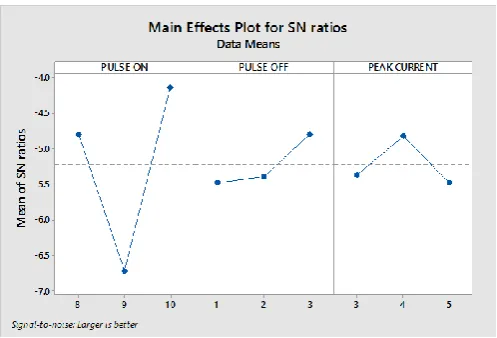
Fig -4: S/N ratio – Grey relational grades.5. CONFIRMATION RUN:
After determining the optimal combination of parameters, the last phase is to verify the MRR, surface roughness by conducting the confirmation experiment. The A3B3C2 is an optimal parameter combination of the machining process by Grey relational analysis. The confirmation test is carried out with the optimal parameter combination A3B3C2, and the results are tabulated in Table.5 and the grey relational grade is increased by 30%. It is clear that the MRR and SR increased greatly with the optimal parameters.
Table 5. Confirmation test results
Type Initial Optimal/Predicted Experimental
Level combination A1B3C3 A3B3C2 A3B3C2
MRR (mm3/sec) 0.612 0.8872 0.855
SR (μm) 2.16 2.12 2.3
GRG 0.667 0.93 0.94
Conclusions:
The effect of process parameters i.e. pulse on-time, pulse off-time, Pulse current on response variables such as material removal rate, surface roughness has been thoroughly studied. The levels of significance of process parameters for each response variable has been investigated using ANOVA.
Pulse on time found to be the most significant factors influencing all responses investigated for both the experiment sets.
The A3B3C2is an optimal parameter combination of the machining process by Taguchi based Grey relational analysis.
The grey relational grade is increased by 30%. It is clear that the MRR and SR increased greatly with the optimal parameters.
REFERENCES
[1] Bala G Narasimha, Vamsi M Krishna and Anthony M Xavior, “A Review on Processing of Particulate Metal Matrix Composites and its Properties,” International Journal of Applied Engineering Research, vol. 8, Number 6, pp. 647-666, 2013.
[2] G. Bala Narasimha, M. Vamsi Krishna and Anthony M Xavior, “A Comparative Study on Analytical and Experimental Buckling Stability of Metal Matrix Composite Columns with Fixed & Hinged Ends” International Journal of Applied Engineering Research, vol. 9, Number 2, pp. 191-196, 2014.
[3] P. Raju, MMM. Sarcar and B. Satyanarayana,“ Optimization of wire electrical discharge machining parameters for surafcae roughness on 316 L stainless steel using Full Factorial experimental design”, Procedia Materials Science, 5, 1670 – 1676, 2014.
[4] P. Bharathi, Tummalapenta Gouri Lalitha Priyanka, G. Srinivasa Rao, Boggarapu Nageswara Rao, “Optimum WEDM Process Parameters of SS304 Using Taguchi Method”, International Journal of Industrial and Manufacturing Systems Engineering , 1(3), 69-72, 2016.
[5] G. Bala Narasimha, M. Vamsi Krishna and R.Sindhu, “Prediction of Wear Behaviour of Almg1sicu Hybrid MMC Using Taguchi with Grey Rational Analysis” Procedia Engineering, vol. 97, Number 2, pp. 555-562, 2014.
[6] Manish Saini, Rahul Sharma, Abhinav, Gurupreet Singh, Prabhat Mangla, Amit Sethi, “Optimizations of machining parameter in wire edm for 316L stainless steel by using taguchi method, anova, and grey analysis”, International Journal of Mechanical Engineering and Technology, Volume 7, Issue 2 pp. 307–320, 2016,M.Vamsi Krishna,
[7] G.Bala Narasimha, N.Rajesh And Anthony M .Xavior, “Optimization of Influencial parameters on Mechanical behavior of AlMg1 SiCu Hybrid Metal Matrix Composites using Taguchi integrated Fuzzy Approach”, Procedia Materials today, vol.2(4), pp.1464-146, 2015.
[8] Munuswamy, U., and T. Pratheep Reddy. "Multiobjective Optimization of WEDM Process Parameters on Al5052/Sic/Gr Hybrid MMC Using Grey Fuzzy." International Research Journal of Engineering and Technology, Vol.03, 8, pp. 1320 -1325, 2016.
[9] P. Raju, MMM. Sarcar and B. Satyanarayana,“ Optimization of wire electrical discharge machining parameters for surafcae roughness on 316 L stainless steel using Full Factorial experimental design”, Procedia Materials Science, 5, 1670 – 1676, 2014.
[image:4.595.36.285.97.266.2]© 2017, IRJET | Impact Factor value: 5.181 | ISO 9001:2008 Certified Journal
| Page 1216
Emerging Research in Management &Technology, Vol. 6(2), pp. 69 -73, 2017.
[11] T.Rajmohan, Gopi Krishna, Ankit Kumar Singh and A.P.V. Swamy Naidu, “Multiple Performance Optimization in WEDM Parameters using Grey Relational Analysis”, Applied Mechanics and Materials Vols. 813-814, pp 357-361, 2015.
[12] M. Shunmuga Priyan , W. Willbert Swin, V. Anand, P. Kelvin, V. Sai Siva, “Investigation of Surface Roughness and MRR on Stainless Steel Machined by Wire EDM”, International Journal of Engineering Research & Technology, Vol. 5 (03), March-2016.