© 2018, IRJET | Impact Factor value: 6.171 | ISO 9001:2008 Certified Journal
| Page 4368
Seismic Evaluation of Building on Plain & Elevated Ground
Md Tauqueer Ahmed
1, Naveen Kumar S
21,2
M. Tech Student Civil Engineering Department PES College of Engineering – Mandya
---***---
Abstract -This research emphasize the seismic evaluation of building on plain & elevated grounds, on elevated ground buildings are comparatively different then the plain ground buildings. Due to various type of structures on sloped ground structures are comes under irregularity and asymmetricity. Structures on slope leads to seismic cases. The damages to the structures are determined and acceptable safety can be provided. For the analysis five types of buildings are modelled on both plain & elevated ground with Seismic zone V & medium Soil (II) using “ETABS 2016” to get the behavior of structure due to change in column height in lower storeys due to elevated ground. The analytical model of the building includes all important components that influence the mass, strength, stiffness and deformability of the structure. To study the effect of infill and concrete shear wall during earthquake, seismic analysis using elastic and method of analyses i.e., linear static (equivalent static method), linear dynamic (response spectrum method) has been performed.
Key Words: “ETABS 2016” Seismic evaluation equivalent
static analysis, response spectrum analysis, shear wall
1. INTRODUCTION
The structures which are design and construct as per earlier code provision do not have satisfied requirements for current earthquakes. Thus many of the structures in seismic areas are suffering from hazards. Therefore the new code provisions are made for such cases.
High rise R.C. framed buildings are getting popular in hilly areas because of increase in land cost and in unavoidable circumstances. Thus the structures in the hilly areas should have adequate strength to avoid the failure of structure during earthquakes.
Indian subcontinent has been experienced with some of the most earthquakes in the world. The youngest mountain series of Himalayas covers whole northeast boundary regions of India. The tectonic activities are still continuing which may result into severe earthquake in future as anticipated by many scientists and researchers. More than 50% of our land is seismically prone and is being visited by earthquakes time and again incurring socio-economic losses in huge proportions and at the same time reminding us the need of earthquake resistant design.
The concepts of earthquake resist The latest seismic zoning map of BIS 1893:2002 shows that 12% of our land area is in zone V i.e., MSK IX or more (it means that more than 50% of
reinforced concrete buildings would suffer large cracks, gaps in walls leading to collapse of parts of buildings whereas masonry and adobe structures may even collapse), 18% in zone IV i.e., MSK VII and 27% in zone III i.e., MSK VII. All these are damaging earthquake Intensities and the structures coming up in these regions has to have special earthquake resistant features.
Therefore it is essential to seismically evaluate the many existing building structures as per code current requirements.
The buildings found inadequate for resisting future earthquake needs to be retrofitted Design needs nonlinear analysis to get damages for different levels of earthquakes. In performance based ideas reactions of building for different levels of motion are specified. In this dissertation, hypothetical high rise buildings (i.e., twenty storeyed with concrete shear wall, concrete core wall, and infill and without infill) assumed in zone v of medium soil site analysed and designed as for load combinations given by code.
1.1. Seismic Design
The general aim of seismic design can be defined as providing adequate safety levels with respect to collapse during exceptionally intense earthquakes as well as with respect to adjacent buildings. Further it aims to protect structures against excessive material damage under the action of moderate intensity earthquakes. Importance is given to safeguard the safety and the comfort of the occupants by limiting the structural response to a predefined tolerable limit. Panic caused due to the earthquake induced shaking among the occupants which can be hazardous, is another aspect to be covered in a good seismic design. Principles underlying the earthquake resistant design of buildings have been to achieve the objectives stated above and striving for better understanding of the structural responses to the earthquake induced ground motions.
a) Analysis Procedures There are two types of analysis procedures, linear and nonlinear. Further the liner analysis is divided into linear static and linear dynamic procedure and nonlinear analysis is divided into nonlinear static and nonlinear dynamic procedure.
© 2018, IRJET | Impact Factor value: 6.171 | ISO 9001:2008 Certified Journal
| Page 4369
damping. The inputs are modelled by an equivalent lateralforces to found same stresses and strains as earthquake may give. From first fundamental frequency of structure using Rayleigh’s method, spectral acceleration Sa is calculated from the appropriate response spectrum, which is, multiply by mass of the building M, results in the equivalent lateral force, V,
The coefficient Ci takes into account to issue order effects, stiffness degradation also force reduction due to inelastic behaviour. These lateral forces are distributed along height of building. The internal forces and displacements are determined using linear elastic analysis. This procedure is used for design purposes and incorporated in more codes. Their expenditure is very less. However their applicability is restricted to regular structure.
c) Linear Dynamic Procedures
In linear dynamic procedure structure is modelled as a multi degree of freedom with linear elastic stiffness matrix and equivalent viscous damping matrix. The input is modelled as time history analysis. Time-history analysis based on a time step-by-step evaluation of building characteristic’s by recording synthetic ground motion. In this case internal forces and displacements are determined by linear elastic analyses.
The scope of this procedure is higher modes can be considered which makes it suitable for irregular structures.
e) Nonlinear Static Procedures In this procedure the modelled incorporate directly to the nonlinear force deformation characteristics of every part of structure due to inelastic reaction of various parts of structure. Several methods of nonlinear static procedure exists Clearly, the advantage of these procedures with respect to the linear procedures is that they take into account directly the effects of nonlinear material response and hence the calculated internal forces and deformations will be more reasonable approximations of those expected during an earthquake. However, only the first mode of vibration is considered and hence these methods are not suitable for irregular buildings for which higher modes become important.
f) Nonlinear Dynamic Procedures In this procedure same modelled is used as in nonlinear static procedure by directly introducing inelastic reaction using finite modelled using a time history analyses elements.
The main difference is seismic input isThis method is most valuable to get internal forces and displacements under seismic input but the calculated responses are very sensitive to individual ground motion used as seismic input.
2.OBJECTIVES OF THE STUDY
The above dissertation study is aim to evaluate hypothetical existing framed with following objectives:
1. Generation of 3D modelled for elastic analysis. 2. Study on the influence of one full brick infill
masonry wall on behaviour of modelled in contact with the bilateral forces.
3. Determination of deflections and storey drifts at each storey using Equivalent Static method, Response Spectrum method
4. Study the influence of central service concrete shear wall in the building.
5. Study the influence of concrete shear wall provided at the corners of the building.
6. To study the effect of vertical irregularity on the fundamental natural period of the building and its effect on performance of the structure during earthquake for different building models selected. 7. To find causes of collapse on plain ground and
elevated ground to resist earthquake.
8. To get the strength of modelled during earthquake.
3. ANALYTICAL MODELLING
The building codes are provide different method of analysis depends upon regularity or irregularity of building. The most codes suggested to use static analysis for symmetric buildings and dynamic analysis for irregular building.
The infill walls present in structures are normally considered as non-structural elements but they interact with frame when subjected to lateral loads.
3.1.Description of the Sample Building
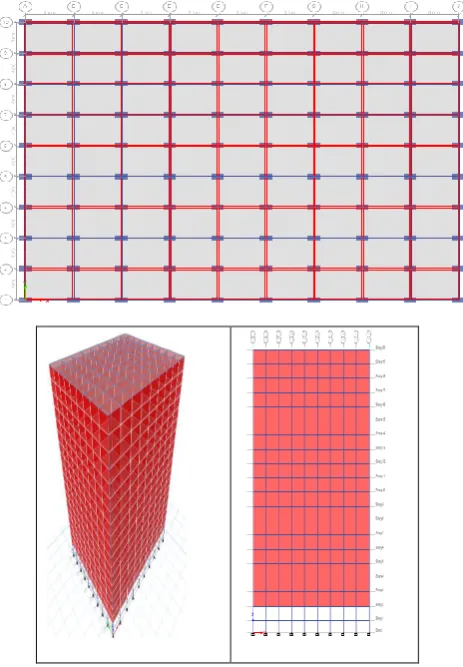
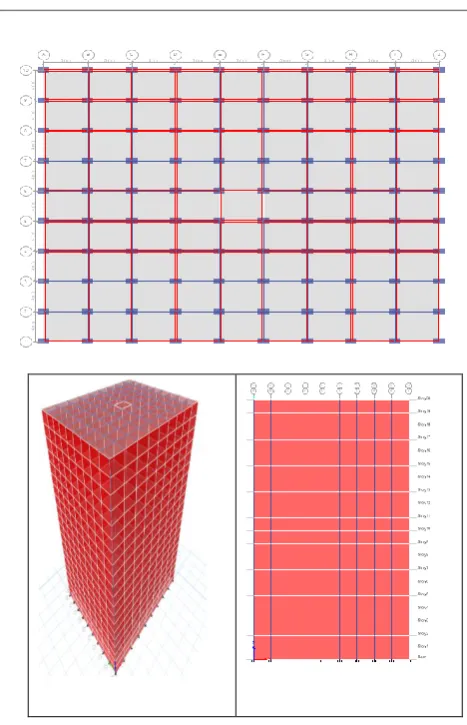
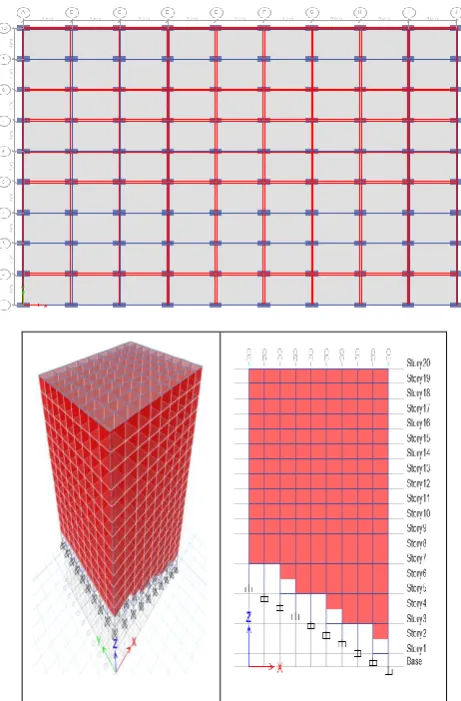
The plan layout for building on a plain and on elevated ground models are shown in below figures.
The angle of elevation of ground is taken as 20 degree for the analysis of building on elevated ground which is not to more or less
Column height of each storey is 3m for all models
Model 1: Building has no walls in the first storey and one brick infill masonry walls (230mm) thick in the upper stories. Building is modelled as bare frame .However, masses of the walls are considered.
© 2018, IRJET | Impact Factor value: 6.171 | ISO 9001:2008 Certified Journal
| Page 4370
Model 3:
Building has no walls in the first storey and brick infill masonry walls (230mm thick) in the upper stories and L-shaped shear walls (230mm thick) are provided at the corners. Stiffness and masses of the walls are considered.
Model 4: Building has no walls in the first storey and one full brick infill masonry walls (230mm thick) in the upper stories, L-shaped shear walls (230mm thick) are provided at the corners and a central service concrete core wall (230mm thick) is provided. Stiffness and masses of the walls are considered.
Model 5: Building has no walls in the first storey and brick infill masonry walls (230mm thick) in the upper stories and shear walls (230mm thick) are provided at the centre and outer walls. Stiffness and masses of the walls are considered.
a) Building Models On Plain Ground
[image:3.595.320.552.102.436.2]
Figure-1: Plan layout, 3D and Elevation view of Model-1.
[image:3.595.58.257.347.686.2]
© 2018, IRJET | Impact Factor value: 6.171 | ISO 9001:2008 Certified Journal
| Page 4371
Figure-3: Plan layout, 3D and Elevation view of Model-3.Figure-4: Plan layout, 3D and Elevation view of Model-4.
Figure-5:Plan layout, 3D and Elevation view of Model-5.
b) Building Models On elevated ground
[image:4.595.57.260.309.641.2] [image:4.595.311.501.554.700.2]© 2018, IRJET | Impact Factor value: 6.171 | ISO 9001:2008 Certified Journal
| Page 4372
Figure-6 :Plan layout, 3D and Elevation view of Model-1.Figure-7: Plan layout, 3D and Elevation view of Model-2.
© 2018, IRJET | Impact Factor value: 6.171 | ISO 9001:2008 Certified Journal
| Page 4373
Figure-9: Plan layout, 3D and Elevation view of Model-4.Figure-10: Plan layout, 3D and Elevation view of Model-5.
3.2.Design Data
Material Properties:
Grade of concrete = M25 (for beams and slab)
= M30 (for column)
Grade of steel = Fe550
Brick density =21.2kN/m3
Member properties
Spacing in x direction = 5m
Spacing in Y direction = 4m
Number of storeys = 20
Bottom storey height = 2.5m
Typical storey height = 3m
Column size = 700mm*1000mm
Beam size = 300mm*450mm
Thickness of shear wall = 230mm
Thickness of masonry wall = 230mm
Load intensities
Live load = 3kN/m^2
Floor fininish = 1kN/m^2
Brick density = 21.2kN/m3
Seismic design consideration
Seismic Zone = V
Zone factor = 0.36
Importance factor = 1
© 2018, IRJET | Impact Factor value: 6.171 | ISO 9001:2008 Certified Journal
| Page 4374
Table 1: Distribution of lateral seismic shear forces forbuilding on plain ground for Model 1
storey number VX(KN) VY(KN)
S20 521.1077 540.9817 S19 1022.326 1061.316 S18 916.6428 951.6017 S17 816.724 847.8722 S16 722.5697 750.1271 S15 634.1801 658.3664 S14 551.5549 572.5901 S13 474.6943 492.7982 S12 403.5982 418.9907 S11 338.2667 351.1675 S10 278.6998 289.3288 S9 224.8973 233.4745 S8 176.8595 183.6045 S7 134.5861 139.719 S6 98.0773 101.8178 S5 67.3331 69.901 S4 42.3534 43.9687 S3 23.1382 24.0207 S2 9.6876 10.0571 S1 0.5467 0.5676
Table 2: Distribution of lateral seismic shear forces for building on plain ground for Model 2
storey number VX(KN) VY(KN) S20 4412.222 3995.125 S19 6099.039 5522.484 S18 5468.548 4951.595 S17 4872.448 4411.846 S16 4310.739 3903.236 S15 3783.42 3425.765 S14 3290.491 2979.434 S13 2831.952 2564.242 S12 2407.804 2180.19 S11 2018.047 1827.277 S10 1662.679 1505.503 S9 1341.703 1214.869 S8 1055.116 955.3737 S7 802.9199 727.0182 S6 585.1141 529.8021 S5 401.6988 363.7253
S4 252.6738 228.788
S3 138.0392 124.99
S2 45.2091 40.9354
S1 3.0837 2.7922
Table 3: Distribution of lateral seismic shear forces for building on plain ground for Model 3
storey number VX(KN) VY(KN) S20 4406.44 4406.44 S19 6107.763 6107.763 S18 5476.37 5476.37 S17 4879.418 4879.418 S16 4316.905 4316.905 S15 3788.831 3788.831 S14 3295.198 3295.198 S13 2836.003 2836.003 S12 2411.248 2411.248 S11 2020.933 2020.933 S10 1665.058 1665.058 S9 1343.622 1343.622 S8 1056.625 1056.625 S7 804.0684 804.0684 S6 585.9511 585.9511 S5 402.2733 402.2733 S4 253.0352 253.0352 S3 138.2366 138.2366
S2 45.832 45.832
S1 3.2955 3.2955
Table 4: Distribution of lateral seismic shear forces for building on plain ground for Model 4
storey number VX(KN) VY(KN) S20 4398.009 4398.009 S19 6103.509 6103.509 S18 5472.557 5472.557
S17 4876.02 4876.02
S16 4313.899 4313.899 S15 3786.193 3786.193 S14 3292.903 3292.903 S13 2834.028 2834.028 S12 2409.569 2409.569 S11 2019.526 2019.526 S10 1663.898 1663.898 S9 1342.686 1342.686 S8 1055.889 1055.889 S7 803.5084 803.5084
S6 585.543 585.543
S5 401.9932 401.9932
S4 252.859 252.859
S3 138.1404 138.1404
S2 45.9309 45.9309
© 2018, IRJET | Impact Factor value: 6.171 | ISO 9001:2008 Certified Journal
| Page 4375
Table 5: Distribution of lateral seismic shear forces forbuilding on plain ground for Model 5
storey number VX(KN) VY(KN) S20 6574.441 6574.441 S19 9214.061 9214.061 S18 8261.554 8261.554 S17 7361.002 7361.002 S16 6512.405 6512.405 S15 5715.763 5715.763 S14 4971.076 4971.076 S13 4278.343 4278.343 S12 3637.566 3637.566 S11 3048.744 3048.744 S10 2511.876 2511.876 S9 2026.964 2026.964 S8 1594.006 1594.006 S7 1213.003 1213.003 S6 883.9552 883.9552 S5 606.8623 606.8623 S4 381.7243 381.7243 S3 208.5413 208.5413
S2 72.5123 72.5123
S1 6.2235 6.2235
Figure-11: Shear forces along longitudinal direction for Model1
Figure-12: Shear forces along Transverse direction for Model 1
Figure-13: Shear forces along longitudinal direction for Model 2
© 2018, IRJET | Impact Factor value: 6.171 | ISO 9001:2008 Certified Journal
| Page 4376
Figure-15: Shear forces along Longitudinal direction forModel3
Figure16: Shear forces along Transverse direction for Model 3
Figure-17: Shear forces along Longitudinal direction for Model4
Figure-18: Shear forces along Transverse direction for Model 4
Figure19: Shear forces along longitudinal direction for Model 5
© 2018, IRJET | Impact Factor value: 6.171 | ISO 9001:2008 Certified Journal
| Page 4377
Table 6: Distribution of lateral seismic shear force forbuilding on elevated ground for model-1
storey number VX(KN) VY(KN) S20 627.2351 604.1056 S19 1230.53 1185.154 S18 1103.324 1062.638 S17 983.0558 946.8054 S16 869.7264 837.655 S15 763.3355 735.1873 S14 663.8831 639.4022 S13 571.3693 550.2999 S12 485.794 467.8802 S11 407.1572 392.1432 S10 335.459 323.0889 S9 270.6993 260.7172 S8 212.8782 205.0282 S7 161.9956 156.0219 S6 100.7501 97.0349
S5 57.7081 55.5801
S4 26.8574 25.867
S3 10.8367 10.4371
S2 2.3347 2.2486
[image:10.595.41.283.131.433.2]S1 0.1122 0.108
Table 7: Distribution of lateral seismic shear force for building on elevated ground for model-2
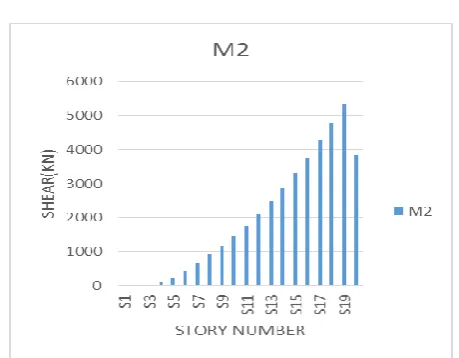
storey number VX(KN) VY(KN) S20 3856.011 3856.011 S19 5330.185 5330.185 S18 4779.175 4779.175
S17 4258.22 4258.22
S16 3767.321 3767.321 S15 3306.476 3306.476 S14 2875.687 2875.687 S13 2474.952 2474.952 S12 2104.273 2104.273 S11 1763.649 1763.649
S10 1453.08 1453.08
S9 1172.566 1172.566 S8 922.1065 922.1065 S7 669.2545 669.2545 S6 422.7526 422.7526 S5 233.1503 233.1503 S4 110.5353 110.5353
S3 41.1901 41.1901
S2 8.3198 8.3198
S1 0.4594 0.4594
Table 8: Distribution of lateral seismic shear force for building on elevated ground for model-3
storey number VX(KN) VY(KN) S20 3849.714 3849.714 S19 5326.864 5326.864 S18 4767.929 4767.929
S17 4248.2 4248.2
S16 3758.456 3758.456 S15 3298.696 3298.696 S14 2868.92 2868.92 S13 2469.129 2469.129 S12 2099.322 2099.322 S11 1759.499 1759.499 S10 1449.66 1449.66 S9 1169.806 1169.806 S8 919.9367 919.9367 S7 671.5691 671.5691 S6 426.537 426.537 S5 232.8105 232.8105 S4 110.2756 110.2756 S3 41.0238 41.0238
S2 8.5272 8.5272
S1 0.5367 0.5367
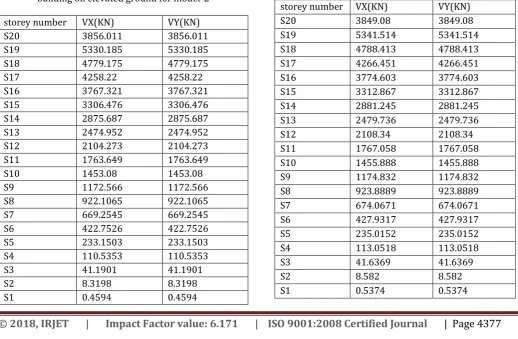
Table 9: Distribution of lateral seismic shear force for building on elevated ground for model-4
storey number VX(KN) VY(KN) S20 3849.08 3849.08 S19 5341.514 5341.514 S18 4788.413 4788.413 S17 4266.451 4266.451 S16 3774.603 3774.603 S15 3312.867 3312.867 S14 2881.245 2881.245 S13 2479.736 2479.736 S12 2108.34 2108.34 S11 1767.058 1767.058 S10 1455.888 1455.888 S9 1174.832 1174.832 S8 923.8889 923.8889 S7 674.0671 674.0671 S6 427.9317 427.9317 S5 235.0152 235.0152 S4 113.0518 113.0518
S3 41.6369 41.6369
S2 8.582 8.582
[image:10.595.38.557.463.802.2]© 2018, IRJET | Impact Factor value: 6.171 | ISO 9001:2008 Certified Journal
| Page 4378
Table 10: Distribution of lateral seismic shear force forbuilding on elevated ground for model-5
storey number VX(KN) VY(KN) S20 3832.446 3832.446 S19 5371.163 5371.163 S18 4815.917 4815.917 S17 4290.957 4290.957 S16 3796.283 3796.283 S15 3331.896 3331.896 S14 2897.795 2897.795 S13 2493.979 2493.979 S12 2120.45 2120.45 S11 1777.208 1777.208 S10 1464.251 1464.251
S9 1181.58 1181.58
S8 929.1956 929.1956 S7 685.0272 685.0272 S6 441.0449 441.0449 S5 241.4563 241.4563 S4 116.5281 116.5281
S3 43.1789 43.1789
S2 9.4159 9.4159
[image:11.595.43.281.124.671.2]S1 0.688 0.688
[image:11.595.40.282.131.673.2]Figure-21: Shear force along longitudinal direction for Model 1
[image:11.595.318.547.309.495.2]Figure-22: Shear force along Transverse direction for Model 1
Figure-23: Shear force along longitudinal direction for Model 2
[image:11.595.318.548.520.699.2]© 2018, IRJET | Impact Factor value: 6.171 | ISO 9001:2008 Certified Journal
| Page 4379
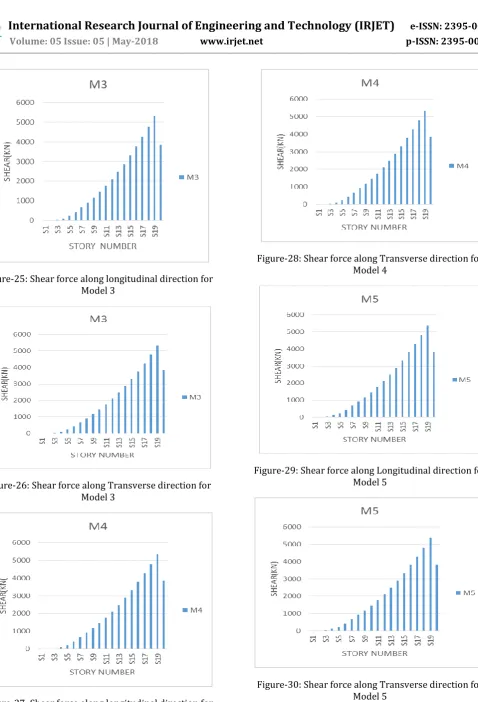
Figure-25: Shear force along longitudinal direction forModel 3
[image:12.595.315.556.57.486.2]Figure-26: Shear force along Transverse direction for Model 3
[image:12.595.319.548.313.481.2]Figure-27: Shear force along longitudinal direction for Model 4
Figure-28: Shear force along Transverse direction for Model 4
Figure-29: Shear force along Longitudinal direction for Model 5
[image:12.595.313.550.522.702.2] [image:12.595.47.278.530.718.2]© 2018, IRJET | Impact Factor value: 6.171 | ISO 9001:2008 Certified Journal
| Page 4380
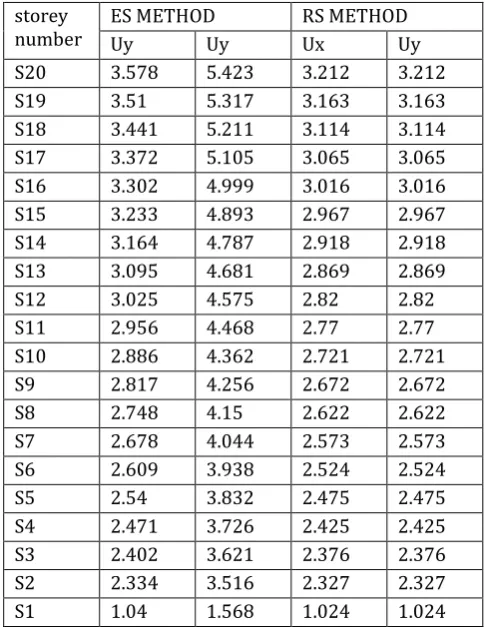
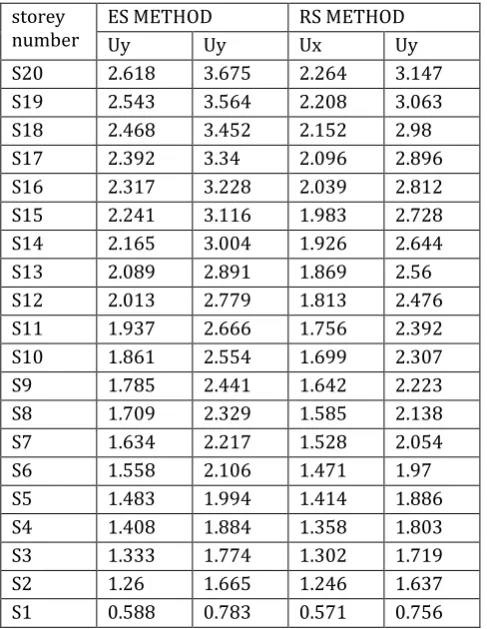
3.3.Lateral Displacements
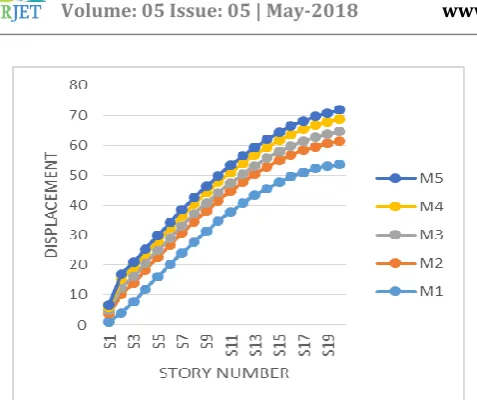
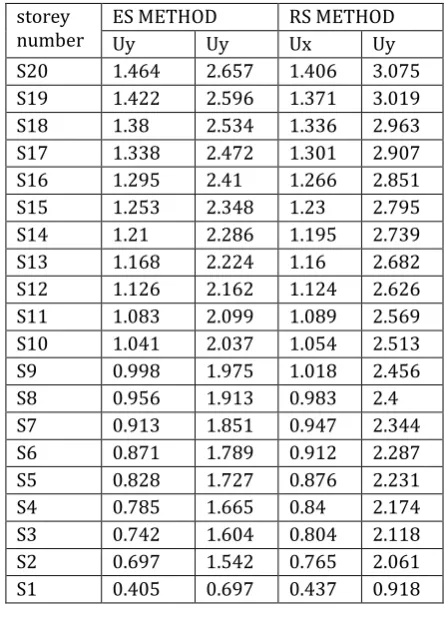
The displacements at every floor level are tabulated in tabulated for E.S. Method and R.S.Method. For better explanation the displacement along Lgtd and Trvs directions are plotted in graphs can be seen in figures-5.1 to 5.8 the lateral displacements are maximum for top stories and gradually reduced for bottom stories as mention in below tables.
a) Lateral Displacement for Models on Plain Ground
Table 11: Lateral Displacements (mm) along Lgtd and Trvs direction for model-1
storey
[image:13.595.35.279.288.602.2]number ES METHOD Uy Uy RS METHOD Ux Uy S20 74.056 69.237 54.688 53.683 S19 72.633 68.268 53.748 53.041 S18 70.895 66.921 52.616 52.159 S17 68.74 65.103 51.227 50.976 S16 66.13 62.806 49.553 49.483 S15 63.067 60.056 47.588 47.687 S14 59.577 56.895 45.333 45.604 S13 55.695 53.371 42.796 43.244 S12 51.467 49.531 39.988 40.622 S11 46.942 45.424 36.921 37.751 S10 42.169 41.092 33.613 34.644 S9 37.201 36.578 30.083 31.315 S8 32.093 31.922 26.356 27.778 S7 26.907 27.163 22.46 24.046 S6 21.717 22.344 18.437 20.135 S5 16.616 17.519 14.352 16.072 S4 11.735 12.764 10.309 11.917 S3 7.261 8.217 6.482 7.796 S2 3.481 4.139 3.153 3.981 S1 0.841 1.059 0.771 1.028
Table 12: Lateral Displacements (mm) along Lgtd and Trvs direction for model-2
storey
number ES METHOD Uy Uy RS METHOD Ux Uy S20 5.634 8.762 5.187 7.602 S19 5.552 8.647 5.128 7.525 S18 5.47 8.531 5.069 7.447 S17 5.388 8.415 5.01 7.369 S16 5.306 8.299 4.951 7.292 S15 5.224 8.183 4.892 7.214 S14 5.142 8.067 4.833 7.136
S13 5.059 7.951 4.774 7.058 S12 4.977 7.835 4.715 6.98 S11 4.895 7.718 4.656 6.903 S10 4.812 7.602 4.597 6.825 S9 4.73 7.486 4.538 6.747 S8 4.648 7.37 4.478 6.669 S7 4.566 7.254 4.419 6.591 S6 4.484 7.138 4.36 6.513 S5 4.401 7.022 4.301 6.435 S4 4.319 6.906 4.241 6.357 S3 4.238 6.791 4.182 6.279 S2 4.156 6.675 4.123 6.201 S1 1.781 2.847 1.773 2.653
Table 13: Lateral Displacements (mm) along Lgtd and Trvs direction for model-3
storey
number ES METHOD Uy Uy RS METHOD Ux Uy S20 3.578 5.423 3.212 3.212 S19 3.51 5.317 3.163 3.163 S18 3.441 5.211 3.114 3.114 S17 3.372 5.105 3.065 3.065 S16 3.302 4.999 3.016 3.016 S15 3.233 4.893 2.967 2.967 S14 3.164 4.787 2.918 2.918 S13 3.095 4.681 2.869 2.869 S12 3.025 4.575 2.82 2.82 S11 2.956 4.468 2.77 2.77 S10 2.886 4.362 2.721 2.721 S9 2.817 4.256 2.672 2.672 S8 2.748 4.15 2.622 2.622 S7 2.678 4.044 2.573 2.573 S6 2.609 3.938 2.524 2.524 S5 2.54 3.832 2.475 2.475 S4 2.471 3.726 2.425 2.425 S3 2.402 3.621 2.376 2.376 S2 2.334 3.516 2.327 2.327 S1 1.04 1.568 1.024 1.024
Table 14: Lateral Displacements (mm) along Lgtd and Trvs direction for model-4
storey
[image:13.595.312.555.322.636.2]© 2018, IRJET | Impact Factor value: 6.171 | ISO 9001:2008 Certified Journal
| Page 4381
S16 2.907 4.3 2.626 3.867 [image:14.595.77.552.40.714.2]S15 2.837 4.193 2.576 3.789 S14 2.767 4.085 2.525 3.712 S13 2.697 3.977 2.475 3.634 S12 2.627 3.869 2.424 3.556 S11 2.556 3.761 2.374 3.479 S10 2.486 3.653 2.323 3.401 S9 2.416 3.545 2.272 3.323 S8 2.346 3.437 2.222 3.245 S7 2.276 3.329 2.171 3.167 S6 2.206 3.221 2.121 3.09 S5 2.136 3.114 2.07 3.012 S4 2.066 3.007 2.019 2.935 S3 1.997 2.9 1.969 2.857 S2 1.927 2.793 1.919 2.78 S1 0.9 1.282 0.902 1.284
Table 15: Lateral Displacements (mm) along Lgtd and Trvs direction for model-5
storey
number ES METHOD Uy Uy RS METHOD Ux Uy S20 2.618 3.675 2.264 3.147 S19 2.543 3.564 2.208 3.063 S18 2.468 3.452 2.152 2.98 S17 2.392 3.34 2.096 2.896 S16 2.317 3.228 2.039 2.812 S15 2.241 3.116 1.983 2.728 S14 2.165 3.004 1.926 2.644 S13 2.089 2.891 1.869 2.56 S12 2.013 2.779 1.813 2.476 S11 1.937 2.666 1.756 2.392 S10 1.861 2.554 1.699 2.307 S9 1.785 2.441 1.642 2.223 S8 1.709 2.329 1.585 2.138 S7 1.634 2.217 1.528 2.054 S6 1.558 2.106 1.471 1.97 S5 1.483 1.994 1.414 1.886 S4 1.408 1.884 1.358 1.803 S3 1.333 1.774 1.302 1.719 S2 1.26 1.665 1.246 1.637 S1 0.588 0.783 0.571 0.756
Figure-31: Displacements of Models on plain ground along Longitudinal direction (Analysis cases: Equivalent Static
[image:14.595.40.286.98.328.2]Method)
Figure-32: Displacements of Models on plain ground along Transverse direction (Analysis cases: Equivalent Static
Method)
Figure-33: Displacements of Models on plain ground along Longitudinal direction (Analysis cases: Response
[image:14.595.41.285.372.687.2]© 2018, IRJET | Impact Factor value: 6.171 | ISO 9001:2008 Certified Journal
| Page 4382
Figure-34: Displacements of Models on plain ground alongTransverse direction (Analysis cases: Response Spectrum Method)
[image:15.595.308.539.130.436.2]b) Lateral Displacement For Models On elevated Ground
Table 16: Lateral Displacements (mm) along Lgtd and Trvs direction for model-1
storey
number ES METHOD Uy Uy RS METHOD Ux Uy S20 56.067 57.215 46.632 54.846 S19 54.412 56.178 45.267 53.853 S18 52.381 54.718 43.622 52.497 S17 49.853 52.733 41.61 50.695 S16 46.789 50.213 39.204 48.437 S15 43.196 47.187 36.407 45.742 S14 39.114 43.702 33.238 42.633 S13 34.603 39.812 29.721 39.136 S12 29.744 35.572 25.89 35.272 S11 24.635 31.04 21.793 31.065 S10 19.402 26.273 17.507 26.544 S9 14.211 21.343 13.161 21.756 S8 9.298 16.347 8.97 16.789 S7 5.002 11.455 5.296 11.831 S6 2.036 7.123 2.716 7.425 S5 0.512 3.769 1.294 4.013 S4 0.015 1.651 0.556 1.853 S3 0.077 0.526 0.191 0.676 S2 0.033 0.092 0.045 0.2 S1 0.005 0.004 0.008 0.045
Table 17: Lateral Displacements (mm) along Lgtd and Trvs direction for model-2
storey number
ES METHOD RS METHOD
Uy Uy Ux Uy
[image:15.595.43.288.377.713.2]S20 1.864 4.347 1.805 4.448 S19 1.815 4.274 1.764 4.388 S18 1.766 4.201 1.723 4.328 S17 1.717 4.128 1.682 4.268 S16 1.668 4.055 1.641 4.208 S15 1.618 3.982 1.6 4.147 S14 1.569 3.909 1.559 4.087 S13 1.52 3.836 1.518 4.027 S12 1.471 3.763 1.477 3.967 S11 1.421 3.689 1.435 3.906 S10 1.372 3.616 1.394 3.846 S9 1.323 3.543 1.353 3.786 S8 1.273 3.47 1.312 3.725 S7 1.224 3.396 1.27 3.665 S6 1.175 3.297 1.229 3.604 S5 1.125 3.21 1.187 3.544 S4 1.075 3.11 1.145 3.483 S3 1.025 3.024 1.103 3.423 S2 0.973 2.925 1.058 3.363 S1 0.313 1.235 0.343 1.433
Table 18: Lateral Displacements (mm) along Lgtd and Trvs direction for model-3
Storey
number ES METHOD Uy Uy RS METHOD Ux Uy
[image:15.595.37.557.399.794.2]© 2018, IRJET | Impact Factor value: 6.171 | ISO 9001:2008 Certified Journal
| Page 4383
Table 19: Lateral Displacements (mm) along Lgtd andTrvs direction for model-4 storey
[image:16.595.49.273.126.435.2]number ES METHOD Uy Uy RS METHOD Ux Uy S20 1.464 2.657 1.406 3.075 S19 1.422 2.596 1.371 3.019 S18 1.38 2.534 1.336 2.963 S17 1.338 2.472 1.301 2.907 S16 1.295 2.41 1.266 2.851 S15 1.253 2.348 1.23 2.795 S14 1.21 2.286 1.195 2.739 S13 1.168 2.224 1.16 2.682 S12 1.126 2.162 1.124 2.626 S11 1.083 2.099 1.089 2.569 S10 1.041 2.037 1.054 2.513 S9 0.998 1.975 1.018 2.456 S8 0.956 1.913 0.983 2.4 S7 0.913 1.851 0.947 2.344 S6 0.871 1.789 0.912 2.287 S5 0.828 1.727 0.876 2.231 S4 0.785 1.665 0.84 2.174 S3 0.742 1.604 0.804 2.118 S2 0.697 1.542 0.765 2.061 S1 0.405 0.697 0.437 0.918 Table 20: Lateral Displacements (mm) along Lgtd and
Trvs direction for model-5
storey
number ES METHOD Uy Uy RS METHOD Ux Uy
S20 0.961 1.51 0.912 1.498
S19 0.931 1.465 0.886 1.462
S18 0.9 1.42 0.861 1.425
S17 0.87 1.375 0.835 1.387
S16 0.839 1.33 0.809 1.35
S15 0.808 1.285 0.783 1.313
S14 0.777 1.239 0.757 1.275
S13 0.746 1.194 0.731 1.238
S12 0.715 1.148 0.705 1.2
S11 0.683 1.103 0.679 1.162
S10 0.652 1.057 0.653 1.125
S9 0.621 1.012 0.627 1.087
S8 0.59 0.967 0.601 1.049
S7 0.56 0.921 0.575 1.012
S6 0.529 0.876 0.549 0.973
S5 0.497 0.83 0.522 0.934
S4 0.466 0.783 0.496 0.895
S3 0.435 0.737 0.469 0.855
S2 0.406 0.688 0.443 0.812
S1 0.244 0.321 0.261 0.371
Figure-35: Displacements of Models on Curve slope ground along longitudinal direction (Analysis cases:
Equivalent Static Method)
Figure-36: Displacements of Models on Curve slope ground along Transverse direction (Analysis cases:
Equivalent Static Method)
Figure-37: Displacements of Models on Curve slope ground along longitudinal direction (Analysis cases:
© 2018, IRJET | Impact Factor value: 6.171 | ISO 9001:2008 Certified Journal
| Page 4384
Figure-38: Displacements of Models on Curve slopeground along Transverse direction (Analysis cases: Response Spectrum Method)
CONCLUSSION
1. As the infills, concert shear and concert core walls are provides which leads to reduces in fundamental natural periods.
2. Storey displacement are found within the specified limit.
3. The maximum displacement notice in model 1 4. The minimum displacement noticed in model 5 5. The masonry infill walls increases the behaviour of
structure during earthquake.
6. The influence of masonry infills may reduce the displacement of structure.
7. The strength of structure can be increases by avoiding soft stories.
8. The presence of central concrete shear wall and concrete shear wall at corners and concrete shear walls on outer side also reduces the seismic effect on structure
REFERENCES
1. Krawinkler Helmut and Seneviratna G. D. P. K. “Earthquake resistant design of structures”, Prentice-Hall of India Private Limited, New Delhi, India.
2. An experimental study on cyclic tests on RC frames [Murthy and Jain, 2000]. “Seismic Response of RC Frame Buildings with Soft First Storeys”, Proceedings of the CBRI Golden Jubilee Conference on Natural Hazards in Urban Habitat, New Delhi, 1997
3. IS: 1893 (Part-I) 2002 (2002): Criteria for Earthquake Resistant Design of Structures, Part-I General Provisions and Buildings, Fifth Revision, Bureau of Indian Standards, New Delhi.
4. 4] Kabeyasawa, 1993; Eberhard and Sozen 1993) “Seismic Performance of Conventional Multi-storey Buildings with Open Ground Storey for Vehicular Parking”, Indian Concrete Journal, February 2004.
5. Lee, H.S., and Woo, W.S., “Effect of masonry infills on seismic performance of a 3-storey RC frame with non-seismic detailing”, John Wiley & Sons Ltd., 2001.
6. Ravi Sinha et al. “Earthquake Resistant Capacity of Reinforced Concrete Frame Buildings”, Technical Project Report, Vol. 2: Indian Institute of Technology, Bombay.
7. David, M. Scott, “Some Recent Key Developments in the Design of Tall Buildings”, Proceedings of National Workshop on High Rise Buildings; Hyderabad 2008.
8. Santha Kumar, A.K., “Design of Ductile Shear Walls for Tall Buildings”.
9. Mahesh Tandon and Vinay Gupta, Prerna Sohal, “Recommendations for the seismic design of high rise buildings”.
10. ATC-72. Proceedings of Workshop on Tall Building Seismic Design and Analysis Issues.
11. https://scholar.google.co.in
AUTHORS PROFILE
Mr. Md Tauqueer Ahmed IV SEM Student, Department of Civil Engineering, PES College of Engineering, Mandya.
Mr. Naveen Kumar S