© 2017, IRJET | Impact Factor value: 6.171 | ISO 9001:2008 Certified Journal
| Page 247
Control and Implementation of a Standalone DG-SPV-BES micro-grid
system Using DSTATCOM
M.SOMNATH REDDY
1, M.RAVIKUMAR
2, J.CHINNAVANNUR SWAMY
3, P.A.PRABHAKARA
41
PG Scholor, Dept of EEE (PE), SSSISE, Andhrapradesh, India
2,3
Assistant Professor, Dept of EEE, SSSISE, Andhrapradesh, India
4
Head of the department, Dept of EEE, SSSISE, Andhrapradesh, India
---***---Abstract:- This paper exhibits a control calculation for isolated sun based photo voltaic (PV) diesel battery hybrid system with incorporated D-STATCOM. The admittance based control calculation is utilized for stack adjusting, music disposal, and responsive power pay under three phase four wire direct and nonlinear loads. The PV cluster is controlled utilizing a most extreme power point following (MPPT) calculation to get the greatest power under eccentric working conditions. The battery vitality stockpiling system (BESS) is incorporated with diesel motor generator set for the organized load administration and power stream inside the system. Further, the proposed system with the assistance of D STATCOM enhances the power quality issues and abatements the aggregate symphonious diversion. A four-leg voltage-source converter with BESS likewise gives impartial current pay. The execution of the proposed independent hybrid system with coordinated D-STATCOM is examined under various stacking conditions created MATLAB/Simulation of the system.
INTRODUCTION
A GLOBAL alteration to renewable energy resources is well suitable to meet the requirement for power in isolated areas, which lack grid and road infrastructure. The support for the use of renewable energy resources is growing as global warming is a main ecological worry, and it compromises an alternative for future energy supply. Among the available renewable energy resources, solar photovoltaic (PV) power generation is purchase wide approval, and it is used for numerous requests such as domestic appliances, isolated missions, data communications, telecommunication systems, hospitals, electric aircraft, and solar cars . The application of the PV power generation is for the aims that it has many advantages such as it gives clean power, is convenient in nature, and can be engaged for numerous small-scale applications. However, making an allowance for the large variations in the output of PV power, it is imperative to incorporate other power sources like a diesel generator (DG) set, battery storage, fuel cells, etc. The performance analysis of standalone systems with PV- and DG-based sources is given in.
The design and operation of standalone DG-SPV-battery energy storage (BES) using a peak recognition based control method is shown in. A character triangle function (CTF)-based control approach and its analysis for four-wire standalone distribution system are verified.
An improved phase-locked loop (EPLL)-based control method is shown in, wherein three EPLLs are used for withdrawal of fundamental active and reactive power components of load currents. However, the simulation studies are presented in. A compound observer-based control method for standalone PV-DG-based system is used in.
However, the authors have providing investigational results, but the control method in is complex and needs modification of internal parameters. Unlike the control method in, the proposed system uses a conductance-based simple control method. Moreover, a comprehensive investigational study is used to validate all the topographies of the system. The proposed system contains of a diesel-engine-driven permanent magnet synchronous generator (PMSG), PV array, and BES. This micro grid is a demonstrative of a typical rural hospital power supply system which needs to ensure continuous and constant power supply for 24 × 7 h.
Therefore, the PMSG driven by a diesel engine safe guards controlled power supply. In order to preserve the efficiency and to decrease the maintenance cost, the DG set is made to function at 80–100% of its full capacity. This is because, under light-load conditions, the efficiency decreases and the maintenance cost also increases as the DG set is exposed to carbon build up. Typically, to avoid these difficulties, the DG is operated by possession a least loading of 80% by means of battery charging or the DG is made to turn ON/OFF dependent upon the loading. However, the turn ON/OFF of the DG set is frequently not suggested.
1) The load might different currently. Therefore, the frequent turn ON/OFF of DG intensifications the mechanical maintenance.
2) The battery life decreases as the discharging current is high for the duration of transient periods.
Besides, the PMSG driven by the diesel engine does not need a separate excitation control. The machine is robust, efficient, brushless construction, and with less maintenance. A battery energy storage system (BESS) is combined to deliver load smoothing in the case of dissimilarities in PV array output power.
© 2017, IRJET | Impact Factor value: 6.171 | ISO 9001:2008 Certified Journal
| Page 248
magnetic storage. The employment of a separate system devised of PV array, DG set, and BESS intends to fulfill the following necessities.
1) To control the point of common coupling (PCC) voltage dependent upon the solar irradiance variations, and load variations and unbalances.
2) There is no obligation for the measurement of load for turn ON/OFF of DG.
3) The power quality of the system is enhanced by dipping the total harmonic distortion (THD) of PCC voltages and DG set currents under standard.
4) To effectively controlled power flow between source and load.
5) The voltage-source converter (VSC) of BESS offers reactive power compensation and maintains the balanced DG currents. This reduces the vibration of shaft and over-heating of machines.
6) It allows neutral current recompense using four leg VSC.
Nowadays, the fast increase in the use of nonlinear loads such as computers, electronics appliances, medical equipment, refrigerators, etc., has highlighted the concern for power quality in the electrical distribution system. These loads insert harmonics and distort the current and voltage waveforms instigating poor power quality problems. The imaginable provision for the mitigation of the power quality difficulties is with presence of custom power devices while meeting the standard. Three-phase four-wire loads are also known to agonize from the problem of neutral current due to nonlinearity and unbalance contemporary in the system. This may harvest huge quantity of neutral current which contains of triplen harmonics.
The neutral current may affect overloading of the distribution system and causes extra heat losses, which may be dangerous and poses a serious danger to the associated equipment. A four-leg VSC is used for neutral current compensation in addition to mitigate the current harmonics with other described advantages.
Moreover, the flexible operation of the system be contingent upon employment of the various control strategies. Some of the control algorithms that have been pragmatic for controlling are multi loop strategy, sliding-mode control, P-controller-based technique, FLC-based control method, and enhanced phase locked technique. The authors are un successful to discuss the power quality and reactive power compensation. The response of these controllers to the unbalance and dynamic conditions is slow.
In this paper, an admittance-based control algorithm is applied for the estimation of reference power component of source currents in the PV-DG hybrid system. The admittance of the load is projected using the active and reactive powers of the load. The conductance (GL) and susceptance (BL) are extracted from the predictable active power and reactive power of the three-phase four-wire loads, respectively.
Nowadays, the rapid increase in the use of nonlinear loads such as computers, electronics appliances, medical equipment, refrigerators, etc., has emphasized the concern for power quality in the electrical distribution system. These loads inject harmonics and distort the current and voltage waveforms causing poor power quality problems. The possible provision for the mitigation of the power quality problems is with inclusion of custom power devices [18] while meeting the IEEE-519 standard. Three-phase four-wire loads are also known to suffer from the problem of neutral current due to nonlinearity and unbalance present in the system. This may produce large amount of neutral current which consists of triplen harmonics. The neutral current may cause overloading of the distribution system and causes additional heat losses, which may be dangerous and poses a serious threat to the connected equipment. A four-leg VSC is used for neutral current compensation in addition to mitigate the current harmonics with other reported advantages [19].
Additionally, the flexible operation of the system depends upon implementation of the various control strategies. Some of the control algorithms that have been applied for controlling are multi loop strategy [20], sliding-mode control [21], P controller-based technique [22], FLC-based control method [23], and enhanced phase locked technique [24]. The authors have failed to discuss the power quality and reactive power compensation. The response of these controllers to the unbalance and dynamic conditions is slow.
© 2017, IRJET | Impact Factor value: 6.171 | ISO 9001:2008 Certified Journal
| Page 249
algorithm. The performance is verified experimental study using digital signal processor (DSP-dSPACE) under both linear and nonlinear loads.
It is a simple mathematical formulation created on sinusoidal Fryze current control. This control approach is based on the Lagrange’s multiplier method and the fundamental principle of the PQ theory where the computation through the Clarke’s conversion is removed. Therefore, it delivers an enhancement in the mathematical calculations. Here, the inputs are the load currents (iLa, iLb,iLc )and load voltages (va , vb,vc), which are further used for the approximation of the active (p) and reactive (q) power components using the formula stated in this paper. The oscillating component of power is eliminated as it is passed through the low-pass filter (LPF) to obtain (Pdc) and (Qdc).These are used for the approximation of the reference conductance and susceptance, thus giving the value for the reference active and reactive power components.
This method enables the abstraction of the fundamental components and compensates independently for the active and reactive powers even when the system includes of harmonics and unbalances at the PCC. The compensation permits balanced source currents to be drawn from the network. A D-STATCOM is added to the existing system to reduce the harmonic further. The controller responds faster beneath the steady-state and dynamic conditions. The control employment is realized using a four-leg VSC with admittance control algorithm.
LITERATURE SURVEY
Z. Jiang has acquainted on Global progress with sustainable power source resources is appropriate to address the issue for control in remote territories, which need grid and street system. The help for the utilization of sustainable power source resources is expanding as an unnatural weather change is a noteworthy ecological concern, and it offers an option for future vitality supply. Among the accessible sustainable power source resources, sun based photovoltaic (PV) control age is increasing wide acknowledgment, and it is utilized for different applications, for example, family machines, remote missions, information interchanges, media transmission systems, doctor's facilities, electric airplane, and sun oriented autos.
A. Naik, R. Y. Udaykumar, and V. Kole, [2] The usage of the PV control age is for the reason that it has many favorable circumstances, for example, it gives clean power, is compact in nature, and can be utilized for different smallscale Applications.
J. Philip et al., [3]. In any case, considering the substantial changes in the yield of PV control, it is basic to incorporate other power sources like a diesel generator (DG) set, battery stockpiling, energy units, and so on. The execution examination of independent systems with PV-and DG-based sources.
J. Philip, B. Singh, and S. Mishra [4] the plan and operation of independent DG-SPV-battery vitality stockpiling (BES) utilizing a pinnacle identification based control approach. J. Philip, B. Singh, and S. Mishra,[5] A character triangle work (CTF)- based control approach and its examination for four-wire independent dispersion system are illustrated.
J. Philip, B. Singh, and S. Mishra [6] An upgraded phase-bolted circle (EPLL)- based control approach, wherein three EPLLs are utilized for extraction of major dynamic and receptive power parts of load streams. In any case, just recreation ponders are exhibited.
J. Philip, K. Kant, C. Jain, B. Singh, and S. Mishra, [7] A composite onlooker based control approach for independent PV-DG-based system is utilized. Be that as it may, the creators have given test comes about, however the control approach is unpredictable and requires tuning of interior parameters. Not at all like the control approach, the proposed system utilizes a conductance-based basic control approach. In addition, an itemized trial contemplate is utilized to exhibit every one of the highlights of the system. The proposed system comprises of a diesel-motor driven lasting magnet synchronous generator (PMSG), PV exhibit, and BES.
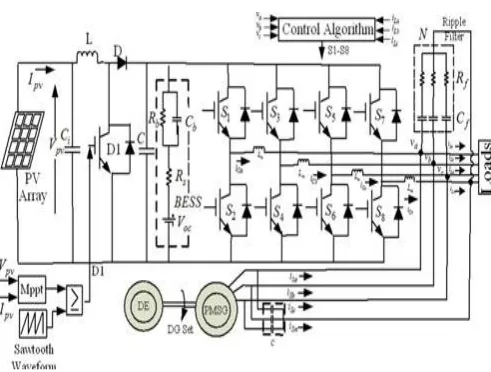
[image:3.595.310.556.407.593.2]PROPOSED SYSYTEM
Fig. 1. Schematic diagram of the proposed system.
© 2017, IRJET | Impact Factor value: 6.171 | ISO 9001:2008 Certified Journal
| Page 250
the heap streams (iLa, iLb, iLc) and load voltages (va, vb, vc ), which are additionally utilized for the estimation of the dynamic (p) and responsive (q) control parts utilizing the recipe specified in this paper. The swaying part of energy is dispensed with as it is gone through the low-pass channel (LPF) to get Pdc and Qdc. These are utilized for the estimation of the reference conductance and susceptance, along these lines giving the incentive for the reference dynamic and responsive power segments. This technique encourages the extraction of the principal parts and repays autonomously for the dynamic and receptive powers notwithstanding when the system contains music and unbalances at the PCC. The pay permits adjusted source streams to be drawn from the system. The controller reacts speedier under the enduring state and dynamic conditions. The control execution is acknowledged utilizing a four-leg VSC with induction control calculation. The execution is confirmed exploratory investigation utilizing computerized flag processor (DSP-dSPACE) under both straight and nonlinear loads.
Solar PV Array
The PV exhibit is basically demonstrated with the arrangement and parallel modules where insolation and encompassing temperature goes about as info [26]. The light-produced current of the PV cluster depends directly on the sunlight based illumination and is additionally impacted by the temperature as appeared in Fig. 2. There are ten modules in arrangement bringing about 205 V under open-circuit condition and 100 modules are associated in parallel for 30-A short out current in the PV cluster. The PV exhibit has been furnished with a MPPT controller to work at the most extreme power point (MPP) at any given temperature and insulation level. The incremental conductance (IC) calculation tracks the voltage and current at the most extreme energy of the sunlight based [27].
SIMULATION RESULTS
The response of a standalone system is analyzed under nonlinear load using sim power system toolbox in MATLAB/ SIMULINK. The performance of the system is observed during line outage in one of the three phases at time t = 1.5 s to 1.56 s, as shown in Fig7.4 (a)
[image:4.595.309.567.83.295.2].
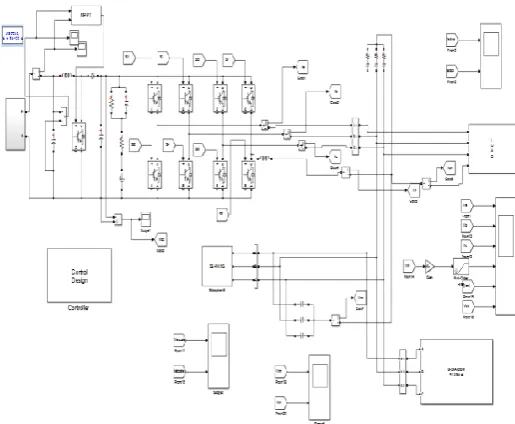
Fig 2.MATLAB/SIMULINK Model for the proposed System without DSATCOM
[image:4.595.317.551.349.499.2]Fig 3.MATLAB/SIMULINK Model for the proposed System with DSTATCOM
Fig.4 Wave forms of the Voltage & Current of the PMSG Source
[image:4.595.38.272.624.758.2]© 2017, IRJET | Impact Factor value: 6.171 | ISO 9001:2008 Certified Journal
| Page 251
[image:5.595.50.276.83.266.2](b)
Fig.5 Performance of the proposed system under unbalance nonlinear load, (a) Load Currents (Ila,Ilb,Ilc) (b)
Leakage currents (Icn,Isn,Iln)
The performance of the system is observed during line outage in one of the three phases at time t= 1.5 s to 1.56 s, as shown in Fig. It is observed that for a subjected load unbalance in the system, the four-leg VSC has the capability of harmonics elimination as the source currents and the source voltages are maintained constant and neutral current compensation is provided while maintaining a zero source neutral current. The neutral current compensation provided by the four-leg VSC is clearly illustrated with the variations in the load neutral current and VSC neutral current waveforms.
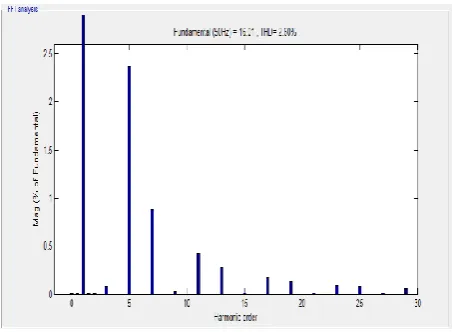
Fig 6 THD values of Source Current
It is observed that for a subjected load unbalance in the system, the four-leg VSC has the capability of harmonics elimination as the source currents and the source voltages are maintained constant and neutral current compensation is provided while maintaining a zero source neutral current. The neutral current compensation provided by the four-leg VSC is clearly illustrated with the variations in the load neutral current and VSC neutral current waveforms. The system maintains its PCC voltage at the desired level. Moreover, it should be noted that even during unbalanced
loading, the supply currents are balanced and sinusoidal there by leading to balanced loading on the DG, which in turn results in reduced maintenance and improved efficiency of DG.
CONCLUSION
The induction based control method has been utilized for a PV-diesel-battery hybrid system with a DSTATCOM for a continuous power supply (UPS) and power quality change. The incremental-based MPPT calculation has conveyed most extreme sun oriented cluster control under unusual states of temperature and insolation radiation. The technique has been shown to dispose of sounds, stack adjusting, and to give nonpartisan current pay by joining four-leg VSC in the system. The PCC voltage and recurrence have been looked after steady. Attractive execution of the system has been seen through MATLAB/Simulation comes about procured for unfaltering state and dynamic conditions under both direct/nonlinear loads.
FUTURE SCOPE
This paper can be stretched out with Adaptive Neuro Fuzzy Interface Systems (ANFIS) rather than PI Controller so that, It can be decrease the Current THD Values, Improves the Power Quality of the Proposed Systems.
REFERENCES
[1] F. Valenciaga and P. F. Puleston, “Supervisor control for a stand-alonehybrid generation system using wind and photovoltaic energy,” IEEETrans. Energy Convers., vol. 20, no. 2, pp. 398–405, Jun. 2005.
[2] C. Liu, K. T. Chau, and X. Zhang, “An efficient wind– photovoltaichybrid generation system using doubly excited permanent-magnet brushlessmachine,” IEEE Trans. Ind. Electron., vol. 57, no. 3, pp. 831–839,Mar. 2010.
[3] W. Qi, J. Liu, X. Chen, and P. D. Christofides, “Supervisory predictivecontrol of standalone wind/solar energy generation systems,” IEEETrans. Control Syst. Technol., vol. 19, no. 1, pp. 199–207, Jan. 2011.
[4] F. Giraud and Z. M. Salameh, “Steady-state performance of a gridconnectedrooftop hybrid wind-photovoltaic power system with batterystorage,” IEEE Trans. Energy Convers., vol. 16, no. 1, pp. 1–7,Mar. 2001.
[5] S.-K. Kim, J.-H.Jeon, C.-H.Cho, J.-B.Ahn, and S.-H. Kwon, “Dynamicmodeling and control of a grid-connected hybrid generation system withversatile power transfer,” IEEE Trans. Ind. Electron., vol. 55, no. 4,pp. 1677–1688, Apr. 2008.
[image:5.595.48.276.461.627.2]© 2017, IRJET | Impact Factor value: 6.171 | ISO 9001:2008 Certified Journal
| Page 252
[7] W. D. Kellogg, M. H. Nehrir, G. Venkataramanan, and V. Gerez, “Generationunit sizing and cost analysis for stand-alone wind, photovoltaic,and hybrid wind/PV systems,” IEEE Trans. Energy Convers., vol. 13,no. 1, pp. 70–75, Mar. 1998.
[8] L. Xu, X. Ruan, C. Mao, B. Zhang, and Y. Luo, “An improved optimalsizing method for wind-solar-battery hybrid power system,” IEEE Trans.Sustain. Energy, vol. 4, no. 3, pp. 774– 785, Jul. 2013.
[9] B. S. Borowy and Z. M. Salameh, “Dynamic response of a standalonewind energy conversion system with battery energy storage toa wind gust,” IEEE Trans. Energy Convers., vol. 12, no. 1, pp. 73–78,Mar. 1997.
[10] S. Bae and A. Kwasinski, “Dynamic modeling and operation strategy fora microgrid with wind and photovoltaic resources,” IEEE Trans. SmartGrid, vol. 3, no. 4, pp. 1867–1876, Dec. 2012.
[11] C. W. Chen, C. Y. Liao, K. H. Chen, and Y. M. Chen, “Modeling andcontroller design of a semiisolatedmultiinput converter for a hybridPV/wind power charger system,” IEEE Trans. Power Electron., vol. 30,no. 9, pp. 4843–4853, Sep. 2015.
[12] M. H. Nehrir, B. J. LaMeres, G. Venkataramanan, V. Gerez, andL. A. Alvarado, “An approach to evaluate the general performance ofstand-alone wind/photovoltaic generating systems,” IEEE Trans. EnergyConvers., vol. 15, no. 4, pp. 433– 439, Dec. 2000.
[13] W. M. Lin, C. M. Hong, and C. H. Chen, “Neural-network-based MPPTcontrol of a stand-alone hybrid power generation system,” IEEE Trans.Power Electron., vol. 26, no. 12, pp. 3571–3581, Dec. 2011.
[14] F. Valenciaga, P. F. Puleston, and P. E. Battaiotto, “Power control ofa solar/wind generation system without wind measurement: A passivity/sliding mode approach,” IEEE Trans. Energy Convers., vol. 18, no. 4,pp. 501–507, Dec. 2003.
AUTHORS:
M.SOMNATH REDDY was pursuing M.Tech from Shri Shirdi Sai Institute of Science & Engineering, Anantapur, AP, India.He is interested in Power Electronics
M.RAVIKUMAR has 3 years experience in teaching in post graduate level and he presently working as Assistant professor in department of EEE, Shri Shirdi Sai Institute of Science & Engineering, Anantapur, AP, India.
J.CHINNAVANNUR SWAMY has 5 years’ experience in teaching in post graduate level and he presently working as Assistant professor in department of EEE, Shri Shirdi Sai Institute of Science & Engineering, Anantapur, AP, India.