Emotion Recognition Based on Efficient
Self Organized Map
Harshada Sonkamble
1Prof. Ujwala.V. Gaikwad
2Terna Engineering College, Nerul
---Abstract-
The face being the primary focus of attention in social interaction plays a major role in conveying identity and emotion. The emotion recognition system is a computer application for automatically identifying a person and its emotion from digital images or video frame from a video source.The proposed automatic facial expression recognition system can detect human face, extract facial features, and recognize facial emotions. The inputs to the proposed system are a sequence of images, still images or webcam images. An input of modified self-organizing map (SOM) is a facial geometric feature including eye, lip and eyebrow feature points.
This system is very efficient in recognizing six basic emotions.
Keywords— facial Expression, geometric facial feature, feature extraction, self-organized map, Emotion Recognition.
1.
INTRODUCTION
The human face plays an important role in verbal and non-verbal communication. Regarding verbal communication, the face is involved in speech and as far as non-verbal communication is concerned, the face communicates through expression of emotions and gestures such as nods and winks. Affective computing is a domain that focuses on user emotions while interacting with computers and applications. The mind of a person may influence concentration, skills of decision making, and solving the different tasks. Affective computing vision is to make systems able to recognize and influence human
emotions in order to enhance productivity and effectiveness of working with computers.
Nowadays, Emotion recognition is well recognized desired features of Intelligent Tutoring Systems, with primary focus on such learner dullness, frustration. An emotion recognition system also used for driver stress testing and psychological diseases [1].
The human-computer interaction (HCI) will be much more effective if a computer is able to recognize the emotion of the human, which can say about the mood of the person. The objective of automatic facial emotion recognition system is to take human facial images containing some expression as input and recognize and classify it into appropriate expression classes such as angry, disgust, fear, happy, sad, and surprise.
Automatic facial emotion recognition systems have been used in applications like human robot interactions, human-computer interactions, virtual reality, etc. In this human facial expressions play an important role. Six basic expressions are happiness, sadness, surprise; fear, anger, and disgust have been considered by Ekman [2].
The automatic facial expression recognition problem is a very challenging problem because it involves in three sub-problems:
1.1 Face Detection
1.2 Facial feature extraction
Facial feature extraction is the method of converting the input into some set of features. Use of feature extraction can help reduce large amounts of data to a comparatively small set which is quicker. It is influenced by several complications like distinction in several images of equivalent facial features, therefore the form of postures, size and angle. Even an individual, the photographs taken in several surrounding is also not like. .
There are two ways to classified feature based approaches. One way is the geometrical feature-based approach which depends on the geometric facial features like position and outline of the eyes, nose,, mouth, eyebrows etc. Another way is the appearance-based approach ,in which the face or specific regions in a face image are used for the feature extraction via some kinds of filters or transformations.
1.3 Expression classification
The next useful block is an Expression classification block that uses the features extracted from the previous block and tries to classify the features based on the similarities between the feature knowledge. Various classifier are used for this purpose like Artificial Neural Nets, linear classifiers.
This paper is organized in five sub sections. Section II describes Literature Survey. Section III gives an overview of Existing system model then Section IV proposed system
model. The paper ends with conclusion in section V.
2.
LITERATURE SURVEYThe human face consists of organs, numerous muscles, skins, and bones. When a muscle contracts, the transformation of the corresponding skin area attached to the muscle result in a certain type of visual effect. Although the claim that there do exist universally basic emotions across genders and races has not been confirmed, most of the existing vision-based facial
expression studies accept the assumption defined Ekman about the universal categories of emotions (i.e., happiness, sadness, surprise, fear, anger, and disgust).
Ekman and Friesen (1976, 1978) were pioneers in the development of measurement systems for facial expression [2]. They suggested universality in facial expressions. These “universal facial expressions” are those representing happiness, sadness, anger, fear, surprise, and disgust. They developed a system named universal categories of emotions which includes happiness, sadness, surprise, fear, anger, and disgust. A human-observer-based system called the Facial Action Coding System (FACS) has been developed to facilitate objective measurement of subtle changes in facial appearance caused by contractions of the facial muscles. The FACS is able to give a linguistic description of all visibly discriminable expressions via 44 action units.
P. Viola, M. Jones (2004), describes a face detection algorithm which is process images at very rapidly and achievs high detection rates. An algorithm start with intergral image, it is a new image representation which is used by detector and features are computed very quickly. Next, It uses is a simple classifier which is built using the AdaBoost learning algorithm (Freund and Schapire, 1995) to select a small number of critical visual features from a very large set of potential features. The las is a method for combining classifiers in a “cascade” which allows background regions of the image to be quickly discarded while spending more computation on promising face-like regions [3].
annotated fiducial points' coordinates of the face image. A multiclass Support Vector Machine (SVM) classifier is used to recognize the facial expressions. Experiments indicate that our proposed method can obtain good classification accuracy [4].
S. Moore, R. Bowden (2011) founds appearance based features by dividing the face image into sub-blocks. They used LBPs and variations of LBPs as texture description. This approach utilizes by dividing face images into sub-blocks and comparing the similarities between these sub-blocks. This is a proven method for accurate facial expression recognition [5].
S. Kherchaoui1, A. Hussein, Alia, Bab Ezzouar (2012), present facial expression recognition system. Identification and classification is performed on the seven basic expressions: happy, surprise, fear, disgust, sadness, anger and a neutral state. This system consists of three main parts. The first step is the detection of the face and facial features to extract the face centered region.Next step consists of a normalization of this interest region and edge extraction. At this step we have a face edge image that we use to calculate the Euclidean distance of all pixels that constitute edges. The third step is the classification of different emotional states of the SVM method [6].
3.
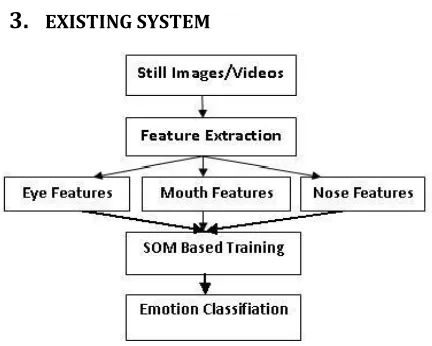
EXISTING SYSTEMFig 1: System Diagram for Existing System
A system is used for classifying the six basic emotions those are anger, disgust, fear, happy, sad,
surprise. It generally enters the video sequences that contain the face, face detection process to segment the face image. Next the feature extraction process will apply on the face image to produce a feature vector that consists of two types of features: geometric features. Finally, a feature vector used as an input into the Kohenen self-organized map to recognize the facial expressions. 3.1. Face detection
The first important step of facial expression recognition is the automatic and accurate detection of the face.
The Paul Viola and Michael Jones' face detection algorithm are used to extract the face region. A face detection algorithm is capable of processing images and achieve high detection rates.
There are three main parts. The first is intergral image which is representation of new images. It allows the features used by detector to be computed very quickly. The next is a simple classifier which is used to select a small number of features from a very large set of features. The third part combines the classifiers in a “cascade” in which background regions of the image are quickly discarded.
3.2. Eye detection and eye features extraction
The eye detection is very important in facial expression because it plays a major role in face alignment and location of other facial features, like lips, eyebrows, nose, etc. First the face is detected, then locate the expected region of the eyes using facial geometry. In face images the eyes are located in the upper part of the face. Removing the top 1/5th part of the face region, take the first 1/3rd vertical part as the expected region of the eyes. It uses Haar-like cascaded features and the Viola–Jones' object detection algorithm to detect the eyes.
3.3 Eyebrow Feature extraction
[image:3.595.54.270.517.690.2]recognition. Eyebrow location is estimated using basic facial geometry, As the eyebrow region will be found slightly above the eye region.
3.4 Nose Features detection
For a frontal face image, the nose lies below the eyes. Facial Geometric is used to estimate the nose location. It is observed that the nostrils are slightly darker than the surrounding nose region. The contour detection method is applied to locate two nostrils contours. The centers of these two contours are considered as the two nostrils. The contour detection algorithm is applied to locate two nostrils contours.
3.5 Lip Feature extraction
A contour detection algorithm is used for lip region extraction. Next step is to detect the lip contour from the estimated lip region. A color based transformation method is used to extract lip from the expected region.
3.6 Facial Expression recognition
Kohonen self-organizing map (KSOM) has a capability of clustering the data in an order that maintains the topology of input data. Because of this property of KSOM, the features data of similar facial expressions (small changes in features) get clustered into closer zones. This in turn makes the classification much better. This property of KSOM motivates us to use it for classifying the features data into six basic expressions.
4.
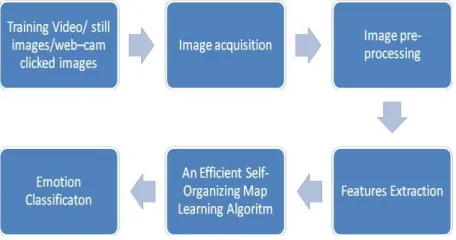
PROPOSED SYSTEMThe proposed system is useful for classifying six basic emotions of human- Happiness, Sadness, Anger, Surprise, Disgust and Fear. The first part of this model is to identify and extract features from the faces and second part is to classify the emotions based on these features using modified Self Organized Map.
Fig 2: System diagram of the proposed training approach 4.1 Image Acquisition
Images used for facial expression recognition are static images or image sequences. An image sequence contains potentially more information than a still image, which are colored or gray-colored images.
4.2 Pre-processing
Pre-processing is normally performed before feature extraction, in order to increase system’s performance. It includes cropping, scaling and smoothing of acquired images to get processed facial images which express a certain emotion.
4.3 Feature Extraction
Generally the most important step in the field of facial expression recognition is the facial feature extraction which based on finding a set of features that conveying the facial expression information. geometric features method is used to extract the facial features geometric features.
In this step 26 features are extracted from the face image by considering the detected face is frontal or near frontal and assuming certain geometric constraints such as: position inside the face, size and symmetry to the facial symmetry axis. Feature points are calculated using Euclidean distance.
4.4 An Efficient SOM algorithm
[image:4.595.304.532.108.228.2]SOM stretches out the map much faster than the conventional SOM. The modified SOM converged much faster than conventional SOM [8].
5. CONCLUSION
An emotion recognition system which is used to classify six different facial emotions, i.e. disgust, happy, sad, surprised and angry,fear. A collection of self-clicked facial images is taken and from each image, twenty six fiducial points are selected to aid in the emotion detection process.
The system is able to automatically detect human faces, extract feature points, and perform facial expression recognition from image sequences. First of all, the method proposed by Viola and Jones was used to detect a face from an image. After a human face is detected, Eye, Nose, Mouth regions are detected.
Finally, modified SOM Training algorithm is used for the classification of the six basic facial expressions (i.e., happiness, sadness, surprise, fear, anger, and disgust). The accuracy and efficiency of this algorithm is expecting better than previous SOM.
REFERENCES
[1] A. Mehrabian, Nonverbal communication, Aldine De Gruyter, 2007.
[2] P. Ekman, W.V. Friesen, J.C. Hager, “Facial Action Coding System”, A Human Face, Salt Lake City, 2002. [3] P. Viola, M. Jones, “Robust Real-Time Face Detetion”, International Journal of Computer Vision, 2004
[4] Lei Gang ; Coll. Of Comput. Sci., Sichuan Univ., Chengdu, China ; Li Xiao-hua ; Zhou Ji-Liu ; Gong Xiao-gang Geometric feature based facial expression recognition using multiclass support vector machines IEEE Granular Computing, 2009,
[5] S. Moore, R. Bowden, Local binary patterns for multi-view facial expression recognition
Centre for Vision Speech and Signal Processing University of Surrey, Guildford GU2 7JW, UK Computer Vision and
Image Understanding 115 (2011) 541–558
[6] S. Kherchaoui1 , A. Houacine2 LCPTS, , El Alia, Bab Ezzouar, Algiers, Algeria, FACIAL EXPRESSION IDENTIFICATION SYSTEM WITH EUCLIDEAN DISTANCE OF FACIAL EDGES. International Conference of Soft Computing and Pattern Recognition 2011
[7] Anima Majumdar, Laxmidharbehera, Venkatesh K. subramania, Emotion recognition from geaometric facial features using Self- organized map, pattern
recognition,(2013),
http://dx.doi.org/10.1016/j.patcog.2013.10.010