http://dx.doi.org/10.4236/ajps.2015.65070
Applicability of the Method of Linear
Dimensions to Estimate Leaf Area in
Improved Genotypes of Coffea arabica
and Coffea canephora
Sebastião Vinícius Batista Brinate, Wagner Nunes Rodrigues, Lima Deleon Martins,
Tafarel Victor Colodetti, Marcelo Antonio Tomaz, José Francisco Teixeira do Amaral
Centro de Ciências Agrárias, Universidade Federal do Espírito Santo (CCA/UFES), Alegre, Brazil Email: [email protected]
Received 18 February 2015; accepted 14 March 2015; published 17 March 2015
Copyright © 2015 by authors and Scientific Research Publishing Inc.
This work is licensed under the Creative Commons Attribution International License (CC BY). http://creativecommons.org/licenses/by/4.0/
Abstract
There are different methods to determinate leaf area in coffee plants; however, methodologies that allow measurement of leaf area accurately and in nondestructive ways are very important, as they are less economically costly and enable measurements on the same leaf over time, making it possible to describe accurate patterns of growth. The objective of this study was to investigate the applicability of the method to estimate leaf area using linear dimensions of leaves for improved genotypes of Coffea arabica L. and Coffea canephora Pierre ex A. Froehner. The experiment was conducted in two separated competition fields, each one following factorial schemes 10 × 2, with 10 genotypes and 2 methods to obtain the leaf area: measuring linear dimensions, and using equ-ation model (estimated leaf area) and leaf area integrator (real leaf area). The genotypes for both Coffea arabica L. and Coffea canephora Pierre ex A. Froehner have different leaf areas, making it possible to discriminate groups of genotypes for both species using the size of their leaves as clas-sification criteria. Even with the differences between genotypes, the pattern of leaf shape remains similar, confirming the applicability of the method to estimate leaf area using linear dimensions of leaves for improved genotypes, such as the model proposed by Barros, without the occurrence of loss of accuracy for the improved genotypes, for both Arabica and Conilon coffee, studied in this experiment.
Keywords
1. Introduction
Regarding the cultivation of coffee, Brazil stands out as the world’s largest producer of this commodity, which is one of the most valuable primary products traded worldwide. This country produces both Arabica coffee (Coffea arabica L.) and Conilon coffee (Coffea canephora Pierre ex A. Froehner) [1]. For years, the value of coffee is only surpassed by the value of fossil oils, being an important source of currency for developing coun-tries and creating jobs for millions of people around the world. In addition, coffee is traded on the major stock exchanges worldwide, such as in London and New York [2].
Due to the importance of its cultivation to the world economy, studies related to coffee production have great relevance, especially for many developing countries that cultivate it. In this context, studies regarding leaf area of coffee plants are useful, since it is possible to gather early information that is normally correlated to the crop yield. Furthermore, analyses of plant growth, considering the increase of leaf area, have been employed in order to explain differences caused by genetic sequences or environmental changes [3], also being a tool to identify promising genotypes [4].
The morphological characteristics of leaves of the two widely grown species of the genus Coffea (C. arabica and C. canephora) are very similar. However, leaves in the same stage of development from those two species generally present different sizes and capacities to capture light. In addition, variations in the values of photosyn-thetic rates, transpiration and stomatal conductance have been reported, which are generally higher for Conilon coffee [5]. Greater total leaf area implicates on higher capacity to intercept solar radiation, which may result in higher photosynthetic rates, highlighting the importance of measuring this growth variable [6].
The anatomy and coffee leaf morphology demonstrates plasticity to environmental factors such as radiation [7] [8], water status [9]-[11] and nutrition [12]-[15]. Thus, it is important to know the coffee leaf traits to understand various physiological processes in the plant.
There are different methods to determinate leaf area in coffee plants; however, the indirect method of mea-suring linear dimensions and the direct method of using leaf area integrators are most widely used in scientific researches.
Estimates of leaf area based on mathematical equations, using linear measurements of dimensions of the leaf surface, are widely used to study leaf area in several plant species. For coffee plants, Barros et al. [16] described a methodology that follows a principle widely used in agricultural research, showing good precision, easing to execute and being nondestructive. Methodologies that allow measurement of leaf area accurately and in nonde-structive ways are very important, as they are less economically costly and enable measurements on the same leaf over time, making it possible to describe accurate patterns of growth [17].
However, methods of measurement of leaf area using linear dimensions are normally based on samples of plants from one or very few genotypes of the studied species, creating the need to validate the equation models when the pool of relevant genotypes changes for that species. This fact is especially important when studying the species that present high genetic variability, which may lead to differences on leaf morphology between ge-notypes. Different studies have already described genetic variability for many traits in C. arabica [18] [19], while C. canephora is known by its higher variability [20] [21] due to its self-incompatibility [22].
For Arabica coffee, methods to estimate leaf area using the leaf dimensions are valid and widely used [16]
[23]-[27], but many of the studies and validations were performed in genotypes from previous generations of the
breeding programs. As new processes of breeding and selections are performed, some morphological traits of the plants may be influenced, making it necessary to check the accuracy of the evaluation techniques [28]. For Conilon coffee, especially due to its high genetic variability, the methods are still incipient.
The objective of this study was to investigate the applicability of the method to estimate leaf area using linear dimensions of leaves for improved genotypes of Coffea arabica L. and Coffea canephora Pierre ex A. Froehner.
2. Materials and Methods
2.1. Experimental Setup
The competition field with genotypes of Coffea arabica L. was located in the region of mountains, with geo-graphic coordinates 20˚45'S and 41˚33'W and altitude of 690 m. The location presents an average annual tem-perature of 22˚C and average rainfall of between 1500 mm per year, with the rainy season from October to April and the dry season from May to September.
The competition field with genotypes of Coffea canephora Pierre ex A. Froehner was located at geographic coordinates 20˚45'S and 41˚29'W, in altitude of 138 m. The location has climate characterized as hot and humid in summer, and dry in the winter, with an average annual rainfall of 1200 mm and annual mean temperature of 24˚C.
The agricultural practices, such as fertilization, weed control and phytosanitary management, were established in accordance with those normally employed in the region, according to their need and following the current recommendations for the cultivation of Arabica coffee [29] or Conilon coffee [30] in Brazil.
The studies for each species of coffee were performed with factorial schemes 10 × 2, with 10 genotypes and 2 methods to obtain the leaf area. Both fields followed randomized block designs, each one with 10 genotypes of the proper species of coffee, with five plants per experimental plot and ten replications.
2.2. Genotypes
Ten genotypes of Coffea arabica L., originated from the breeding programs of institutions that are references in the development of cultivars of Arabica coffee, such as Instituto Agronômico de Campinas (IAC), Empresa de Pesquisa Agropecuária de Minas Gerais (EPAMIG), Fundação Pro-Café (MAPA/PROCAFÉ) and Instituto Agronômico do Paraná (IAPAR), were used in the experiment.
The ten genotypes of Coffea canephora Pierre ex A. Froehner were developed by the breeding program of the Instituto Capixaba de Pesquisa, Assistência Técnica e Extensão Rural (Incaper), which is considered an interna-tional reference for breeding this species of coffee.
The group of genotypes was selected according to their characteristics of high crop yield and frequency of use in plantations of coffee in the southeast region of Brazil.
2.3. Determination of the Real Leaf Area
The leaves were collected from the middle section of the adult plants, along the third reproductive cycle (before harvest of 2013), on both sides of the cultivation row, being collected 10 mature and healthy leaves from the third and fourth pairs of each plant, counting from the apex of each branch.
Immediately after collection, the leaves were placed in humid plastic bags and taken to laboratory to deter-mine the leaf area of each leaf separately.
The real leaf area was obtained using a leaf area integrator (area meter, LI 3100, LI-COR, precision: 0.01 cm2), which uses grid cells of known area to determine the real area of the leaf that goes through the equipment [31].
2.4. Estimative of Leaf Area Using the Method of Linear Dimensions
The same collected leaves, now with known real area, were measured to determine the dimensions of their sheets. The largest dimensions were obtained by measuring the length and width of each leaf using rulers (preci-sion: 0.1 cm).
The method of linear dimensions proposed by Barros et al. [16], for Coffea arabica L., is the most commonly used in Brazil. It estimates leaf area based on the dimensions of a rectangle limited by the leaf blade, adjusted by the equation: A = 0.667*(LW), where A is the leaf area and HW is the result of the multiplication of the greatest length (L) and the greatest width (W) of the leaf.
2.5. Data Analysis
The collected data were subjected to an analysis of variance using the F-test at 5% of probability in order to study the identify differences between genotypes and between methods to obtain the leaf area. The quadratic
component of genotypic variance
( )
φ
g , the coefficient of genotypic determination (H2), the coefficients of ge-5% of probability.
The Pearson’s correlation coefficient was used to study the linear association of the values from the two dif-ferent methods. The analyses were performed using the statistical software GENES [32] [33].
3. Results and Discussion
The overall mean for unitary leaf area for C. arabica was 47.33 cm2 and for C. canephora was 47.08 cm2, but the amplitude and variation for genotypes of C. canephora were higher, resulting in a coefficient of genetic var-iation 9.32% higher than for the group of genotypes of C. arabica (Table 1).
There was no significant effect for the method to estimate the leaf area, showing that the estimate values for leaf area were close enough of the real values to result in statistically similar means. The effect of the genotypic differences however was significant for both studies, demonstrating that the leaves of the genotypes presented some degree of morphologic differences. For both species, it was possible to notice greater effect of the differ-ence between genotypes over the phenotypic variance than the effect of environmental factors, resulting in high estimate values for the coefficients of genotypic determination and variation indexes (Table 1).
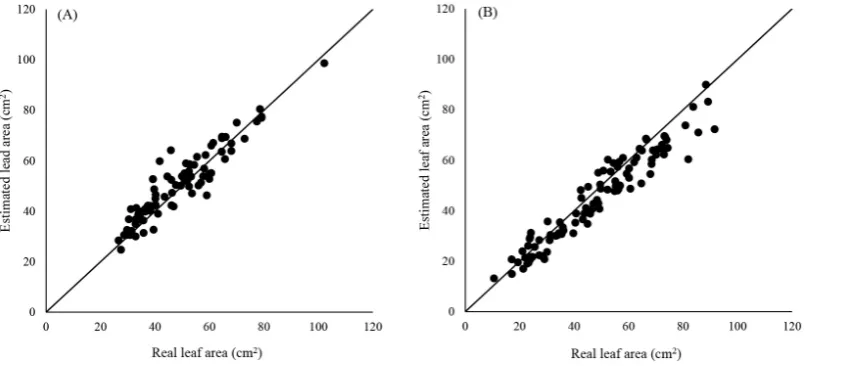
[image:4.595.89.541.352.488.2]Analyzing the leaf area obtained by the method of Barros et al. [16] and comparing it to the real leaf area, it is possible to notice the high level of similarity in the dispersion of the data (Figure 1), resulting in strong positive correlation between those variables.
Table 1. Mean squares (MS); means; estimatives of genotypic variance
( )
φg ; coefficients of genotypic determination (H2 ),
coefficients of genetic variation (CVg) and variation indexes (CVg/CVe) of the leaf area obtained with different methods in
improved genotypes of Coffea arabica L. and Coffea canephora Pierre ex A. Froehner.
Genotype Coffee species
Coffea arabica L. Coffea canephora Pierreex A. Froehner
MSgenotypes 2359.07** 4638.16**
MSmethods 149.19ns 567.84ns
MSinteraction 17.95ns 47.45ns
Mean 47.33 47.08
( )
φg 117.05 229.53H2 99.23 98.97
CVg(%) 22.85 32.17
CVg/CVe 0.93 1.25
*
[image:4.595.98.525.513.696.2]Significant at 5% and **Significant at 1% of probability, by the F test.
Figure 1. Dispersion between the real leaf area and the estimated leaf area by the method of linear dimensions (Barros), for
Differences between the leaf areas of the genotypes were observed for both C. arabica and C. canephora, be-ing possible to discriminate three homogeneous groups regardbe-ing the size of the leaves for each species (Table 2). The group with larger leaves was formed by the genotypes Katipó, IAPAR 59 and Paraíso MG H419-1 for C. Arabica; and singly by the genotype 83 for C. canephora. The genotypes Pau-Brasil MG1, Catuaí Amarelo 24/ 137, Sacramento MG1 and Catuaí Vermelho IAC 144 have smaller leaves considering the species C. arabica, as well as the genotypes 02 and 32 for C. canephora. Tupi 81, Catiguá MG3 and Araponga MG1 formed an inter-mediate group regarding leaf area for C. arabica, while the genotypes 24, 67, 73, 76, 22 and 77 formed the in-termediate group for C. canephora.
This different capacity to express leaf growth in a specific environment is an intrinsic characteristic of each improved genotype. The size of leaves is normally related to the plant adaptation to the environment and the development of larger leaf area can promote the photosynthetic efficiency. Since the photosynthetic rate is af-fected by leaf area and the way the radiation solar is intercepted, it is directly influenced by leaf size and plant architecture [34].
Other studies have reported wide genetic variability and different behavior between genotypes of coffee. Dif-ferent patterns of growth and plant architecture are described for many improved genotypes, as well as difDif-ferent responses for modulated environments, which leaded to changes in the growth of the plant and development of leaf area [13] [21] [35] [36].
Strong and positive correlations between the leaf area estimated by the method of linear dimensions proposed by Barros et al. [16] and the real leaf area were observed for the improved genotypes of C. arabica and C. ca-nephora (Table 3). For C. arabica, the genotype Tupi 81 presented the highest correlation (0.9571), while Ka-tipó had the lowest (0.8972). For C. canephora, the genotype 73 showed the highest correlation (0.9928) and the genotype 153 had the lowest (0.8635).
Overall, the method proposed by Barros et al. [16] is efficient to estimate the leaf area of the improved geno-types of coffee, presenting very high correlations with the real leaf area, and its use is reliable for both species of coffee.
Studies made by Carvalho et al. [5], in order to compare plants of C. arabica and C. canephora regarding the photosynthetic rates and aspects of leaf anatomy, concluded that the basic shape and positioning of leaves are similar for both species of coffee, being described as opposite, crossed, with short petiole, blades with elliptic to elliptic-lanceolate shape and wavy margins. Despite the differences in size, thickness, coloration, among other leaf traits among species of coffee, the pattern of shape for the leaves is similar, which explains the good fit of the model proposed by Barros et al. (1973) even for the species C. canephora to estimate leaf area.
[image:5.595.94.538.519.710.2]Even with the differences in leaf size among genotypes, the leaf shape remained similar, therefore, even if the cultivation conditions allow the genotypes to show different growth rate, the linear dimensions of the leaf blade keep being good variables to estimate its area and the model proposed by Barros et al. [16], maintaining good
Table 2. Means of leaf area of improved genotypes of Coffea arabica L. and Coffea canephora Pierre ex A. Froehner.
Coffea arabica L. Coffea canephora Pierre ex A. Froehner.
Genotype Leaf area (cm2) Genotype Leaf area (cm2)
Katipó 60.85 a 83 71.21 a
IAPAR 59 58.88 a 24 59.82 b
Paraíso MG H419-1 58.08 a 67 57.04 b
Tupi 81 52.51 b 73 53.56 b
Catiguá MG3 50.57 b 76 49.13 b
Araponga MG1 46.63 b 22 48.77 b
Pau-Brasil MG1 41.55 c 77 48.34 b
Catuaí Amarelo 24/137 41.24 c 02 33.93 c
Sacramento MG1 34.48 c 32 25.26 c
Catuaí Vermelho IAC 144 28.45 c 153 23.77 c
Table 3. Correlations between the real leaf area and the estimated leaf area by the method of linear dimensions (Barros), for
leaves of improved genotypes of Coffea arabica L. and Coffea canephora Pierre ex A. Froehner.
Coffea arabica L. Coffea canephora Pierreex A. Froehner.
Genotype Correlation Genotype Correlation
Tupi 81 0.9571 73 0.9928
Catuaí Vermelho IAC 144 0.9417 77 0.9877
Catiguá MG3 0.9406 76 0.9557
IAPAR 59 0.9348 32 0.9128
Catuaí Amarelo 24/137 0.9271 24 0.9055
Araponga MG1 0.9226 02 0.8915
Paraíso MG H419-1 0.9135 22 0.8906
Sacramento MG1 0.9103 83 0.8896
Pau-Brasil MG1 0.9054 67 0.8752
Katipó 0.8972 153 0.8635
accuracy to describe it. These similarities in shape of the leaves were also observed in other studies involving species of coffee [24], which observed that power models based on the combination of length and width of the leaves presented desirable fit to estimate leaf area for eight coffee genotypes.
4. Conclusions
The genotypes for both Coffea arabica L. and Coffe acanephora Pierre ex A. Froehner have different leaf areas, making it possible to discriminate groups of genotypes for both species using the size of their leaves as classifi-cation criteria.
Even with the differences between genotypes, the pattern of leaf shape remains similar, confirming the appli-cability of the method to estimate leaf area using linear dimensions of leaves for improved genotypes, such as the model proposed by Barros, without the occurrence of loss of accuracy for the improved genotypes, for both Arabica and Conilon coffee, studied in this experiment.
References
[1] Companhia Nacional de Abastecimento—CONAB (2014) Monitoring of the Brazilian Harvests: Coffee. CONAB, Brasília. (In Portuguese)
[2] International Coffee Council—ICC (2014) World Coffee Trade (1963-2013): A Review of the Markets, Challenges and Opportunities Facing the Sector. ICO, London.
[3] Peixoto, C.P. (1998) Growth Analysis and Yield of Three Soybean Cultivars in Three Sowing Dates and Three Plant Densities. Ph.D. Thesis, Escola Superior de Agricultura Luiz de Queiroz, Piracicaba. (In Portuguese)
[4] Benincasa, M.M.P. (1988) Plant Growth Analysis: Basic Notions. FUNEP, Jaboticabal. (In Portuguese)
[5] Carvalho, L.M., Silva, E.A.M., Azevedo, A.A., Mosquim, P.R. and Cecon, P.R. (2001) Morphophysiological Aspects of Catuaí-Vermelho and Conilon Coffee Cultivars. Pesquisa Agropecuária Brasileira, 36, 411-416.
http://dx.doi.org/10.1590/S0100-204X2001000300003
[6] Silva, W.Z., Brinate, S.V.B., Tomaz, M.A., Amaral, J.F.T., Rodrigues, W.N. and Martins, L.D. (2011) Methods to Es-timate Leaf Area in Coffee. Enciclopédia Biosfera, 7, 746-759. (In Portuguese)
[7] DaMatta, F.M., Ronchi, C.P., Maestri, M. and Barros, R. (2007) Ecophysiology of Coffee Growth and Production. Brazilian Journal of Plant Physiology, 19, 485-510. http://dx.doi.org/10.1590/S1677-04202007000400014
[8] Baliza, D.P., Cunha, R.L., Castro, E.M., Barbosa, J.P.R.A.D., Pires, M.F. and Gomes, R.A. (2012) Gas Exchange and Adaptive Structural Characteristics of Coffee Plants Grown in Different Levels of Radiation. Coffee Science, 7, 250- 258. (In Portuguese)
the Payback Time of Coffea arabica L. Leaves in Response to Light and Water Availability. Journal of Experimental Botany, 63, 3071-3082. http://dx.doi.org/10.1093/jxb/ers027
[10] Batista, L.A., Guimarães, R.J., Pereira, F.J., Carvalho, G.R. and Castro, E.M. (2010) Leaf Anatomy and Water Poten-tial in the Tolerance of Coffee Cultivars to Water Stress. Revista Ciência Agronômica, 41, 475-481. (In Portuguese)
http://dx.doi.org/10.1590/S1806-66902010000300022
[11] Grisi, F.A., Alves, J.D., Castro, E.M., Oliveira, C., Biagiotti, G. and Melo, L.A. (2008) Leaf Anatomical Evaluations in “Catuaí” and “Siriema” Coffee Seedlings Submitted to Water Stress. Ciência & Agrotecnologia, 32, 1730-1736.
http://dx.doi.org/10.1590/S1413-70542008000600008
[12] Colodetti, T.V., Rodrigues, W.N., Martins, L.D. and Tomaz, M.A. (2014) Differential Tolerance between Genotypes of Conilon Coffee (Coffea canephora) to Low Availability of Nitrogen in the Soil. Australian Journal of Crop Science, 8, 1648-1657.
[13] Martins, L.D., Tomaz, M.A., Amaral, J.F.T., Christo, L.F., Rodrigues, W.N., Colodetti, T.V. and Brinate, S.V.B. (2013) Morphological Changes in Conilon Coffee Clones Submitted to Phosphorus Levels. Scientia Plena, 9, 1-11. (In Portu-guese)
[14] Neves, P.Y. (2009) Zinc Leaf Content, Production, Quality of Grains and Leaf Plasticity of Coffee Trees in Response to Supply of This Nutrient. Ph.D. Thesis, Universidade Federal de Viçosa, Viçosa. (In Portuguese)
[15] Poltronieri, Y. (2011) Leaf Anatomy of Coffee Trees in Zinc Deficiency. Proceedings of the VII Simpósio de Pesquisa dos Cafés do Brasil, Araxá, 22 a 25 de Agosto de 2011, 1-6. (In Portuguese)
[16] Barros, R.S., Maestri, M., Vieira, M. and Bragafilho, L.J. (1973) Determination of the Coffee Leaf Area (Coffea ara-bica L. cv. ‘Bourbon Amarelo’). Revista Ceres, 20, 44-52. (In Portuguese)
[17] Fideles Filho, J., Beltrão, N.E.M. and Pereira, A.S. (2010) Development of a Ruler to Measure Cotton Leaf Area. Re-vista Brasileira de Engenharia Agrícola e Ambiental, 4, 736-741. (In Portuguese)
[18] Ferrão, M.A.G., Fonseca, A.F.A., Ferrão, R.G., Leite, M.S.R.S.F., Caliman, L.F. and Fialho, G.S. (2007) Comportment of Genotypes of Arabica Coffee in the Condition of Low Altitude in the State of Espírito Santo. Proceedings of the V Simpósio de Pesquisa dos Cafés do Brasil, Águas de Lindóia, 1-4. (In Portuguese)
[19] Rodrigues, W.N., Tomaz, M.A., Amaral, J.F.T., Ferrão, M.A.G., Colodetti, T.V., Apostolico, M.A. and Christo, L.F. (2014) Biometrical Studies on Characteristics of Plagiotropic Branches in Coffea arabica L. Cultivated with High Plant Density. Australian Journal of Crop Science, 8, 1239-1247.
[20] Ferrão, R.G., Cruz, C.D., Ferreira, A., Cecon, P.R., Ferrão, M.A.G., Fonseca, A.F.A., Carneiro, P.C.S. and Silva, M.F. (2008) Genetic Parameters in Conilon Coffee. Pesquisa Agropecuária Brasileira, 43, 61-69. (In Portuguese)
http://dx.doi.org/10.1590/S0100-204X2008000100009
[21] Rodrigues, W.N., Tomaz, M.A., Ferrão, R.G., Ferrão, M.A.G., Fonseca, A.F.A. and Miranda, F.D. (2012) Genetic Pa-rameters Estimation in Groups of Conilon Coffee Clones. Coffee Science, 7, 177-186. (In Portuguese)
[22] Lashermes, P., Couturon, E., Moreau, N., Paillard, M. and Louarn, J. (1996) Inheritance and Genetic Mapping of Self- Incompatibility in Coffea canephora Pierre. Theoretical and Applied Genetics, 93, 458-462.
http://dx.doi.org/10.1007/BF00223190
[23] Schmildt, E.R., Amaral, J.A.T., Schmildt, O. and Santos, J.S. (2014) Comparative Analysis of Mathematical Equations to Estimate Leaf Area in Coffee Trees. Coffee Science, 9, 155-167. (In Portuguese)
[24] Antunes, W.C., Pompelli, M.F., Carretero, D.M. and DaMatta, F.M. (2008) Allometric Models for Nondestructive Leaf Area Estimation in Coffee (Coffea arabica and Coffea canephora). Annals of Applied Biology, 153, 33-40.
http://dx.doi.org/10.1111/j.1744-7348.2008.00235.x
[25] Flumignan, D.L., Adami, M. and Faria, R.T. (2008) Leaf Area of Whole and Damaged Coffee Leaves (Coffea arabica L.) Determined by Leaf Dimensions and Digital Imaging. Coffee Science, 3, 1-6. (In Portuguese)
[26] Rey, R. and Alvarez, P. (1991) Evaluation of Different Regression Equations in Estimating Leaf Area of the Coffee Tree in Nursery from Its Linear Dimensions. Agrotecnia de Cuba, 23, 69-74. (In Spanish)
[27] Silva, A.R., Leite, M.T. and Ferreira, M.C. (2008) Coffee Tree Leaves Area Determination and Its Spray Retention Capacity. Bioscience Journal, 24, 66-73. (In Portuguese)
[28] Tavares-Junior, J.E., Favarin, J.L., Dourado-Neto, D., Maia, A.H.M., Fazuoli, L.C. and Bernardes, M.S. (2002) Com-parative Analysis among Methods of Estimating Coffee Tree Leaf Area. Bragantia, 61, 199-203. (In Portuguese)
http://dx.doi.org/10.1590/S0006-87052002000200013
[29] Reis, P.R. and Cunha, R.L. (2010) Arabica Coffee: From Seedling to Harvest. Epamig, Lavras. (In Portuguese)
[30] Ferrao, R.G., Fonseca, A.F.A., Bragança, S.M., Ferrão, M.A.G. and Muner, L.H. (2007) Conilon Coffee. Incaper, Vitória. (In Portuguese)
[32] Cruz, C.D. (2013) GENES—A Software Package for Analysis in Experimental Statistics and Quantitative Genetics. Acta Scientiarum Agronomy, 35, 271-276. http://dx.doi.org/10.4025/actasciagron.v35i3.21251
[33] Cruz, C.D., Regazzi, A.J. and Carneiro, P.C.S. (2004) Biometric Models Applied to Genetic Improvement. Imprensa Universitária, Viçosa. (In Portuguese)
[34] Cunha, A.R. and Volpe, C.A. (2010) Radiometric Relations in Upper Third of the Canopy of the Coffee Tree. Bragan-tia, 69, 263-271. (In Portuguese) http://dx.doi.org/10.1590/S0006-87052010000200002
[35] Prezotti, L.C. and Bragança, S.M. (2013) Accumulation of Dry Mass, N, P and K in Different Genetic Sources of Con-ilon Coffee. Coffee Science, 8, 284-294.
[36] Martins, L.D., Tomaz, M.A., Amaral, J.F.T., Bragança, S.M. and Martinez, H.E.P. (2013) Efficiency and Response of Conilon Coffee Clones to Phosphorus Fertilization. Revista Ceres, 60, 406-411.