Behaviour of Castellated Beams With and Without Stiffeners- A Review
Vishvatej Vijaykumar Kshirsagar
1, Prof S.R.Parekar
2
---***---ABSTRACT:Uses of castellated beam for various structures is rapidly gaining appeal. This is due to increased depth of section without any additional weight, high strength to weight ratio, their lower maintenance and painting cost. The principle advantage of castellated beam is increase in vertical bending stiffness, ease of service provision and attractive appearance.
Castellated beams are fabricated by cutting I section in zigzag way and rejoining it in such a way that the depth of the parent I section is increased. The increase in depth of castellated beam leads to web post buckling and lateral torsional buckling failure when these beams are subjected to loading. There are many other modes of failure like formation of flexure mechanism, lateral torsional buckling, and formation of vierendeel mechanism, rupture of the welded joint in a web post and shear buckling of a web post which needs to be taken care of. Study shows that use of stiffeners in the web portion of beam helps in minimizing these failures. Therefore, a detailed study in respect of number of stiffeners, size of stiffener and there locations in the web portion of castellated beam needs to be carried out. Hence, in the present paper an attempt has been made to review existing literature, concerned with strength of beam using stiffeners. The literature survey indicates that use of stiffeners in web portion of castellated beams helps in increasing the strength and also minimizing the deflection.
INTRODUCTION:
Castellated beams are such structural members, which are made by flame cutting a rolled beam along its centerline and then rejoining the two halves by welding so that the overall beam depth is increased by 50% for improved structural performance against bending. Since Second World War many attempts have been made by structural engineers to find new ways to decrease the cost of steel structures. Due to limitations on minimum allowable deflection, the high strength properties of structural steel cannot always be utilized to best advantage. As a result several new methods aimed at increasing stiffness of steel member, without any increase in weight of steel required. Castellated beam is one of the best solutions.
The responsibility of a Structural Engineer lies in not merely designing the structure based on safety and serviceability considerations but he also has to consider the functional requirements based on the use to which the structure is intended. While designing a power plant structure or a multi-storied building, the traditional structural steel
framing consists of beams and girders with solid webs. These hinder the provision of pipelines and air conditioning ducts, electrical wiring required for satisfactory functioning for which the structure is put up.
[image:1.612.337.548.380.526.2]The re-routing of services (or increasing the floor height at the design stage for accommodating them) leads to additional cost and is generally unacceptable. The provision of beams with web openings has become an acceptable engineering practice, and eliminates the probability of a service engineer cutting holes subsequently in inappropriate locations. Beams with web openings can be competitive in such cases, even though other alternatives to solid web beams such as stub girders, trusses etc are available. This form of construction maintains a smaller construction depth with placement of services within the girder depth, at the most appropriate locations. The introduction of an opening in the web of the beam alters the stress distribution within the member and also influences its collapse behavior.
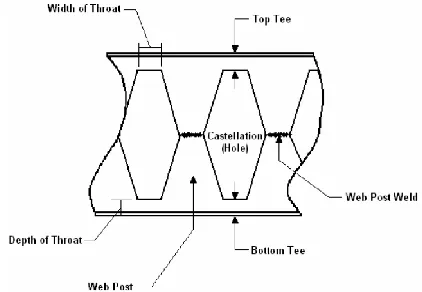
Figure No.1 Terminology
Web Post: The cross-section of the castellated beam where the section is assumed to be a solid cross-section.
Throat Width: The length of the horizontal cut on the root beam. The length of the portion of the web that is included with the flanges.
LITERATURE SURVEY:
Resmi Mohan & Preetha Prabhakaran (2016), In this paper, finite element analysis was performed to compare the deflection of steel beam with and without web openings of ISMB 150 section. ANSYS 14.5 was used for the analysis. Results showed that as compared to solid beam, steel beam with openings, showed more load carrying capacity and lesser deflection. The increase in the depth of the section resulted to increase its strength. Moreover the Openings provided in web portion can help for the allowance of passage of services through the beam without any decrement in strength also the provisions are provided through the web portions, so it will help to reduce the effective floor depth.
Konstantinos Daniel Tsavdaridis & Theodore Papadopoulos (2016), This paper presents a comprehensive finite element (FE) analysis of extended end-plate beam-to-column connections, with both single and multiple circular web openings introduced along the length of the beam while subjected to the cyclic loading proposed by the SAC protocol from FEMA 350 (2000). The three dimensional (3D) FE solid model was validated against FE and experimental results and the chosen configuration was capable of representing the structural behavior of a partially restrained connection, without the necessity to be idealized as fully fixed. The study focuses in the interaction of such connections and the mobilization of stresses from the column to the perforated beam. It is found that RWS connections with cellular beams behave in a satisfactory manner and provide enhanced performance in terms of the stress distribution when subjected to cyclic loading.
P.D.Pachpor, Dr.N.D.Mittal, et.al. (2011), the solid I section beam with creating hexagonal cavities (openings) has numerous advantages over conventional rolled sections. As they are light weight, strong, cheap and elegant. The opening in the web simplifies the work of the installer and the electrician, since taking pipes across beams presents no problems. The failure pattern and stresses developed under same loading condition are studied. The no of openings is varied as 2, 4 and 6 in selected beam. The shape of opening is considered as hexagonal and circular of same cross sectional area. The support conditions are considered as fixed, hinged &roller. Overall 18 cases are studied for same central point load & span with change of spacing of openings. The maximum Deflection and the maximum VonMises stress are worked out. The comparative study is carried out using software for finite element analysis ANSYS. As the no. of opening increases, the deflection also increases for the same support conditions. The maximum deflection is observed under roller support then fixed or hinged condition due to displacements at the ends. The maximum von mises stress is also less in circular opening as compared
to hexagonal opening of same area. The deflections and maximum von mises stresses .
Siddheshwari A. P,Popat. D.K (2015), the increase in depth of CB leads to web post buckling and lateral torsional buckling failure when these beams are subjected to loading. Study shows that use of stiffeners in the web portion of beam helps in minimizing these failures. Hence, in the present paper an attempt has been made to review existing literature, concerned with strength of beam using stiffeners. Most of the studies have indicated that the failure of web perforated beams has occurred due to local failures in the web portion. However, very little work has been done to avoid failure of castellated beams. The strength enhancement is important in case where load concentration occurs in the beam. Hence providing stiffener can reduce stress concentration at openings.
Mr. Dhanraj K. Shendge & Dr. B.M. Shinde (2015), the review report presents a procedure & software application to optimize the topology, size and shape of castellated beam using finite element analysis. The Castellated beams are produced by cutting and rewelding of hot rolled sections which are made of regularly spaced opening. So for same weight Castellated beam has more height than regular beam. Load carrying capacity of simply supported Castellated steel beams susceptible to web post bucking is studied. FEA method is used to evaluate the load carrying capacity castellated beam. The parameter studies are also carried out in order to assess the cross section classification to compare the ultimate load behavior. Among the main features of these beams can be pointed to architectural features and height which resulting in greater strength and stiffness of the beams without the added weight of the beams. In this paper, the load carrying capacity of castellated beam is reviewed. The unit member with fillet corner opening has a higher load carrying capacity as compared with those with hexagonal, rectangular openings when they have the same opening height, but lower than that with circular opening.
theory. A formula for the calculation of the critical stress coefficient is proposed and a simple method is described to take into account the additional strength provided by the intermediate web-post to the adjacent web panel. This approach considers simple equivalent rectangular plates. The analytical model is validated against finite element results regarding the values of critical stress coefficient obtained through an Eulerian calculation. Then, the ultimate strengths of cellular beams with sinusoidal openings are evaluated through a comparative study with FEM for different parent beam profiles and opening shapes.
B.Anupriya, Dr.K.Jagadeesan (2014), this paper is focused on the investigation behavior of shear strength of CB with and without stiffeners. Stiffeners are introduced diagonally on the web opening along the shear zone, and in the other case stiffeners are provided on the solid portion of the web along the shear zone.It is concluded that stiffeners provided on the opening of the web is more effective than stiffeners provided on the solid portion of the web. Hence, shear stiffeners provided on the opening of the web is effective than the solid portion because when vertical stiffeners are provided on the solid portion of the web, shear across the holes does not have any path to flow and hence shear strength across the holes decreases, so web starts to buckle leading to higher deflection
Hassan Abedi Sarvestani (2017), in this paper hexagonal CBs & typical wide flange beams, in the post-tensioned semi-rigid beam-to-column steel connections of moment-resisting frames has been analyzed under the earthquake simulated by cyclic loading up to 4.4% lateral drift. This study shows that castellated beams with hexagonal openings in the PT semi-rigid steel connection provide higher bending strength and lower weight in comparison with typical wide flange beams. The specimens with hexagonal castellated beams
remained intact and demonstrated adequate strength against web shear buckling, web-post failure under the standard cyclic loading up to 4% lateral drift as compared to typical wide flange beams.
Siddheshwari A. Patil, Popat D Kumbhar (2016), in this paper the analysis of the castellated beam has been studied using the stiffeners. The comparative study of these stiffeners is done by using ABAQUS software. Two different types of stiffener that is stiffeners placed along the transverse direction (transverse stiffeners) and stiffeners placed along the edge of openings are used for the analysis. These two types of stiffeners are chosen in order to increase the strength and to decrease the stress concentration near the web openings. The volume consumed by transverse stiffener is less than the stiffener along the edge of opening. Also, the load carrying capacity of transverse stiffener is considerably more than the stiffener along the opening edge. Hence, the transverse stiffener is more preferable than the stiffener along the edge.
Following three papers were validated over ABAQUS to check their validation. The validation results over ABAQUS were found to be very successful since the percentage difference between them and those of original paper results was well within the prescribed limits.
1. Siddheshwari A. Patil, Popat D Kumbhar (2016), “Comparative Study of Transverse Stiffeners and Stiffeners along the Opening Edge used for Castellated Beam”.
Percentage Difference of Load Carring Capacity in Experiment & ABAQUS Result for Transverse Stiffeners & Stiffeners along the Opening of the Edge
Transverse Stiffener
Stiffener Load Carrying Capacity (KN)
Name Width (mm) Thickness (mm) Experiment Result ABAQUS Result Percentage Difference
A-1 23 5 55.286 57.552 4.10
A-2 23 6 58.091 59.077 1.70
A-3 23 8 62.803 65.289 3.96
Stiffeners Along Opening Of The Edge
Stiffener Load Carrying Capacity (KN)
Name Width (mm) Thickness (mm) Experiment Result ABAQUS Result Percentage Difference
B-1 23 5 51.88 54.731 5.50
B-2 23 6 57.135 59.408 3.98
Figure No 2 Transverse Vertical Stiffener A-1 Figure No 3 Stiffener along Opening of the Edge B-1
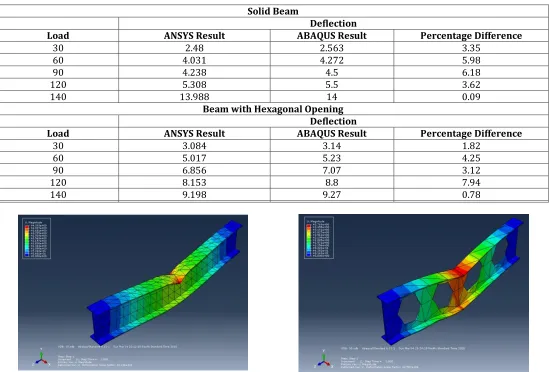
2. Resmi Mohan & Preetha Prabhakaran (2015), “Experimental Analysis To Compare The Deflection Of Steel Beam With And Without Web Openings” .
Percentage Difference of Deflection in Experiment & ABAQUS Result for Solid Beam & Beam with Hexagonal Opening of Various Loads
Solid Beam
Deflection
Load ANSYS Result ABAQUS Result Percentage Difference
30 2.48 2.563 3.35
60 4.031 4.272 5.98
90 4.238 4.5 6.18
120 5.308 5.5 3.62
140 13.988 14 0.09
Beam with Hexagonal Opening Deflection
Load ANSYS Result ABAQUS Result Percentage Difference
30 3.084 3.14 1.82
60 5.017 5.23 4.25
90 6.856 7.07 3.12
120 8.153 8.8 7.94
[image:4.612.331.561.82.234.2]140 9.198 9.27 0.78
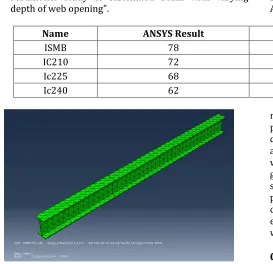
[image:4.612.33.582.312.684.2]3. Wakchaure M.R., Sagade A.V. & Auti V. A. (2012), “ Parametric study of castellated beam with varying depth of web opening”.
Percentage Difference of Load Carring Capacity in Experiment & ABAQUS Result (Ref. Wakchaure M.R., Sagade A.V. & Auti V. A.)
Name ANSYS Result ABAQUS Result Percentage Difference
ISMB 78 79.596 2.05
IC210 72 73 1.39
Ic225 68 68.145 0.21
[image:5.612.47.320.104.368.2]Ic240 62 63.336 2.15
Figure No 6 Load Carring Capacity of ISMB 150 @ Length 1900mm
Figure No 7 Deflection of ISMB 150 @ Length 1900mm
RESEARCH GAP:
Most of the studies have indicated that the failure of web perforated beams has occurred due to local failures in the web portion. However, very little work has been done to avoid failure of castellated beams, it has been suggested to provide stiffener with proper dimensions and locations. The strength enhancement is important in case where load concentration is observed in the beam. The castellated beam is good in carrying distributed loads but fails to carry high concentrated loads. The behavior and failure modes are
necessary to be checked using stiffeners in the appropriate place so that the efficiency of the beam is increased in worst condition of stress concentration. In Indian standards there are no provisions for the stiffeners for castellated beam while it is to be studied in detail from the other codes and guidelines are needed to be developed for the design of the stiffeners. The future scope defined by few researchers in papers give a rough idea of good performance of the castellated beam using stiffeners. Also this performance will enhance strength and torsional behavior when designed with stiffeners.
CONCLUSION:
The study until now was performed on analysing and predicting the behaviour of the castellated beam with different types of opening. Many researchers derived the expressions for deflection, ultimate moment, load carrying capacity and many more. Some questioned regarding the behaviour of the castellated beam with stiffener for shear resistance and design requirements to achieve ductile failure. The optimization of the design for the proper combination of stiffener with castellated beam is not yet completed. Though codal provisions provide design of opening sizes but yet data related to stiffener is not satisfactorily incorporated in the provisions. In this chapter all past literature up till now are studied on castellated beam and its performance under flexure. Beams are compared with and without stiffeners but yet the proper design specification for stiffeners is not included in any of Indian codes.
REFERENCE:
1. B.Anupriya, Dr.K.Jagadeesan, “Shear Strength Of Castellated Beam With And Without Stiffeners Using FEA (ANSYS 14)”, International Journal of Engineering and Technology (IJET), Volume 6, ISSN: 0975-4024, pp. 1970-1981, 2014.
[image:5.612.45.288.411.563.2]3. H.A.Sarvestani, “Cyclic behavior of hexagonal castellated beams in steel moment resisting frames with post-tensioned connections”, Structures, PII: S2352-0124(17)30028-0, pp.243-280, (2017).
4. Konstantinos Daniel Tsavdaridis & Theodore Papadopoulos, “A FE parametric study of RWS beam-to-column bolted connections with cellular beams”, Journal of Constructional Steel Research, Vol. 116, pp.No. 92–113, 2016.
5. P.D.Pachpor, Dr.N.D.Mittal, et.al. “Finite Element Analysis And Comparison Of Castellated & Cellular Beam”, Advanced Materials Research, Vol. 264-265, pp 694-699, 2011.
6. Resmi Mohan & Preetha Prabhakaran, “Finite Element Analysis to Compare the Deflection of Steel Beam with and without Web Openings”, IOSR Journal of Mechanical and Civil Engineering, Pp.No 7-11, 2016.
7. S. Durif & A. Bouchair, “Analytical Model To Predict The Resistance Of Cellular Beams With Sinusoidal Openings”, Journal of Constructional Steel Research, Vol.121 Pp.No.80–96, 2016.
8. Siddheshwari A. Patil, Popat D Kumbhar “Comparative Study of Transverse Stiffeners and Stiffeners along the Opening Edge used for Castellated Beam”, International Journal of Innovative Research in Science Engineering and Technology, Volume 5, ISSN: 2319-8753, pp. 8516-8522, (2016).