R E S E A R C H A R T I C L E
Open Access
New virtual case-based assessment method for
decision making in undergraduate students:
a scale development and validation
Zalika Klemenc-Ketis
1,2*and Janko Kersnik
1,2Abstract
Background:There are many Internet forums where patients can ask medical question and get an answer from doctors. The aim of this study was to develop and validate the rating scale for the assessment of decision-making skills in undergraduate medical students based on such Internet questions.
Methods:This cross-sectional observational study carried out in Medical School of University of Maribor in Slovenia during the family medicine teaching course in the fourth study year. The sample consisted of 159 students. The source of data were the scoring sheets of the students’reports, assesses by two independent researchers. The assessment tool consisted of 10 items on a five-point Likert scale.
Results:Our final sample consisted of 147 (92.5%) students’reports. The ICC for matching of the final total scores on assessment tool of both assessors was 0.742. Cronbach’s alpha of the assessment scale was 0.848. Factor analysis revealed four factors: initial assessment, physical examination planning, planning patient management and patient education/involvement.
Conclusions:This assessment tool can be used for assessing undergraduate students’decision-making based on medical questions asked by real patients in a virtual setting.
Background
Family practice demands continuous decision-making also in patients with early presentation of undifferenti-ated and low intensity of symptoms. Traditional medical teaching prepares students for their medical carriers by studying diseases in their full and typical clinical presen-tations as these represent the majority of hospitalised patients. Family medicine teaching, on the other hand, can offer complementary knowledge, skills and attitudes regarding comprehensive management of patients’ com-plaints and management of diseases in their early stages often combined with somatoform and medically unex-plained symptoms [1,2].
Case-based discussion is a teaching method, which can also stimulate learning of comprehensive patients’ man-agement, patient involvement and information provision
[3] and is very useful in family medicine teaching. Be-cause often there are not enough live family practice pa-tients appropriate for covering all educational aspects of medical education, simulated patients or teaching models are not easy available and affordable [4] and it is also difficult to get a comprehensive verbatim transcript of what was asked and said during everyday office con-sultations, we have to look for alternatives for case-based discussions [3].
Nowadays, more and more teachers use virtual patients or virtual learning modules to stimulate learning of clinical decision-making skills in undergraduate and postgraduate students [5-7]. Namely, virtual patients or e-modules can be easier controlled by teachers and are especially appro-priate to enhance their educational value [8,9].
Case-based discussion evolved as a tool in formative assessment in specialty training [10]. Furthermore, virtual patients and e-modules emerged as tools in assessment as well [11]. Previous studies have shown high acceptance of such educational and assessment methods by students and teachers [5,7,12] and have been acknowledged for a * Correspondence:[email protected]
1Department of Family Medicine, Maribor Medical School, Taborska ulica 8,
2000 Maribor, Slovenia
2Department of Family Medicine, Ljubljana Medical School, Poljanski nasip
58, 1000 Ljubljana, Slovenia
good match with classic teaching and assessment methods [6,11]. However, the assessment of decision-making based on virtual patients is poorly studied and the validity and reliability of methods may vary considerably [13,14].
In the era of modern technology, patients use more and more new sources of information, especially Internet [15,16], often in a form of an always open “walk-in” of-fice. Although the quality of such information may be questionable and is difficult to judge its scientific value, it still can be regarded as a valuable source of patient problems which are presented early and in an undefined way which is typical for family medicine. Answering these kinds of virtual patients’ problems presents an additional challenge not only for doctors but also for students, because an important part of consultation, a non-verbal communication, is missing. Also, the stu-dents are not able to ask additional questions neither can perform any physical examination. So, one must rely solely on decision-making skills based on history pro-vided by patients in the introductory lines.
Such virtual patients’problems were the source of pa-tient material for our study.
At the Maribor University, undergraduate study of medicine lasts for six years. Family medicine is taught in the fourth and sixth year of study (seventh and 11th se-mester) and they are mandatory courses. The curricu-lum in the seventh semester for family medicine consists of lectures, seminar work and individual student assignments. One of the assignments is also a problem-based learning with virtual clinical case scenarios (see below) [17].
The aim of this study was to develop and test the rat-ing scale for the assessment of decision-makrat-ing skills in undergraduate medical students.
Methods
Study design and settings
This was a cross-sectional observational study carried out in Medical School of University of Maribor in Slovenia during the teaching of family medicine in the fourth study year. The study was approved by the ethics committee of the Department of Family Medicine, Maribor Medical School.
The study followed principles in the Declaration of Helsinki.
Sample
A sample consisted of all students who attended classes in family medicine in the study years 2009/2010 and 2010/2011 (N = 159). The inclusion criteria were: a stu-dent of the fourth-year regularly attending classes in family medicine in the study year 2009/2010 and 2010/ 2011, regular attendance to problem-based learning with
virtual cases exercises and attendance to the final assess-ment of problem-based learning with virtual cases.
Problem-based learning with virtual clinical cases
This assignment takes place at the end of the seventh se-mester and takes three hours. Students get various vir-tual clinical cases and are asked to write their decisions, counselling, referrals, interventions, etc. The following teaching methods are used: lecture, small group work, one-to-one teaching and discussion. At the end of this exercise, each student is given its own virtual clinical case scenario and has to solve it and write a short report in a predefined format. The general instruction for stu-dents is that they have to solve these problems as if a pa-tient would come to their practice with the same question as stated in the virtual case scenario. This re-port is than assessed by one teacher who gives the stu-dent a mark. The aims of these assignments are: teaching of practical aspect of patients’ management in family medicine, teaching of primary care approach to patients, holistic management, comprehensive manage-ment, patient involvement strategies and teaching of the approach to patients without clinical examination.
Virtual cases are selected by teachers on the following criteria: new presentation of a problem/symptom, rela-tively detailed description of the problem and at least some information on the patient, not a clear cut prob-lem, but including some vague or psychological symp-tomatology, which makes possible a broad spectrum of diagnoses, and demands holistic and comprehensive management of the patient problem(s). Positive side of virtual cases is, that are all already written, written in patient words and do not damage any ethical perspective of breaking confidentiality.
The virtual clinical cases are taken from the freely available e-forum http://med.over.net/forum5/list.php?4. This is a forum on family medicine where questions can be asked by registered users and is moderated by a spe-cialist in family medicine. The teachers themselves choose the appropriate virtual clinical cases and provide them to students.
Data collection
understand the patient’s problems, developing rapport and responding to patient’s emotions and patient educa-tion and motivaeduca-tion. We could not chose a single theory to base our assessment tool on due to the need to adapt to the virtual nature of clinical cases, due to the fact that the students were not able to talk to the patients who wrote the clinical questions, and to allow for primary care orientation, comprehensive and holistic management as defined in European definition of general practice.
Each student’s report was independently assessed by two teachers (ZKK and JK) by the assessment tool pre-sented below. Then, the mean value of scores of each item was calculated. The final dataset for statistical ana-lysis therefore consisted of the two teachers’mean scores for each item.
Assessment tool
An assessment tool consisted of 10 items: a student 1) asked the appropriate questions regarding patient’s his-tory; 2) proposed the appropriate differential diagnoses; 3) proposed the appropriate clinical examination; 4) proposed the appropriate investigations; 5) proposed the appropriate referrals; 6) proposed the appropriate man-agement; 7) explained the planned investigations and re-ferrals to patient; 8) explained the planned management to patient; 9) explained the probable diagnosis to patient; 10) gave the patient instructions on self-management at home. All items could be graded on a five-point Likert scale: from one (not acceptable) to five (excellent). Max-imum total score of the assessment scale was 50 point and minimal total score point was 5 points.
Data analysis
The data were analysed with the SPSS 13.0 package (SPSS Inc., Chicago, IL). We calculated the descriptive data. For the purpose of determining the level of scores’ matching of both assessors, we calculated the intraclass correlation coefficient (ICC). We calculated the relia-bility of the assessment tool by Cronbach’s alpha co-efficient. We performed factor analysis with principal component analysis extraction method and Quartimax with Keiser normalization rotation method.
Results
Out of 159 students, 12 did not complete the assign-ment. So, the final sample consisted of 147 (92.5%) stu-dents’ reports. There were 82 (55.8%) reports from the study year 2009/2010 and 65 (44.2%) from the study year 2010/2011. There were 95 (64.6%) female students as authors of the reports.
Matching of assessment
The ICC for matching of the final total scores on assess-ment tool of both assessors was 0.742 (Table 1).
Reliability
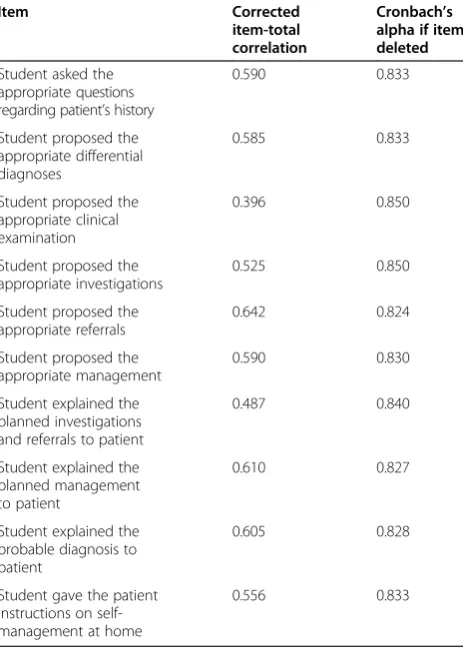
Cronbach’s alpha of the assessment scale was 0.848 (Table 2).
Factor analysis
Factor analysis revealed four factors: initial assessment, physical examination planning, planning patient man-agement and patient education/involvement (Table 3). It explained 78.1% variance: factor 1–planning patient management–explained 28.7%, factor 2–patient edu-cation/involvement – 25.2%, factor 3 – initial assess-ment – 13.3% and factor 4 – physical examination planning–10.9% variance.
Discussion
The tool for the assessment of virtual case-based decision-making showed good psychometric characteris-tics by good interclass correlations and high Cronbach’s alpha. Factor analysis revealed four factors, which are essential to any consultation: initial assessment, physical examination planning, planning patient management and patient education/involvement.
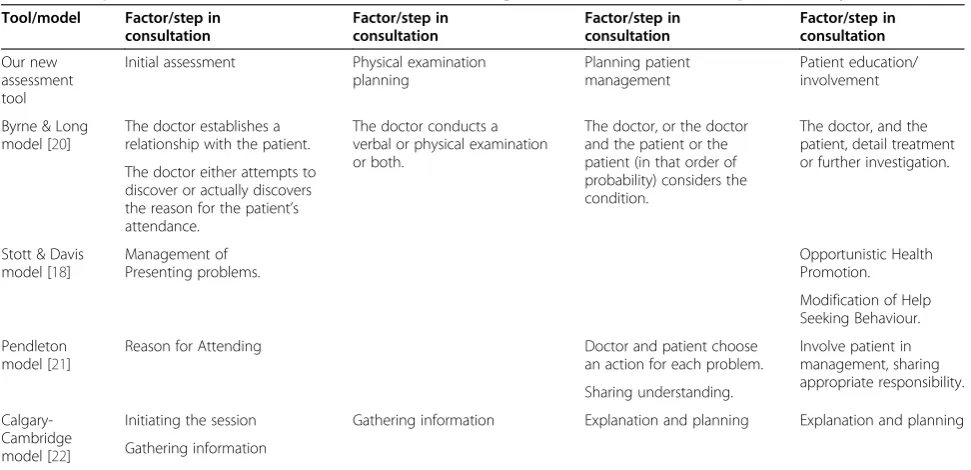
When developing this assessment toll, we used two consultation theories [18,19]. The factors that emerged from our analysis correlate well with the factors from these two theoretical frameworks and also with other consultation theories (Table 4) [18,20-22]. Therefore, we can claim that our tool is comprehensive and cover all essential parts of consultation in family medicine: estab-lishing of initial contact with patient and developing a range of possible early diagnoses [23], physical exa-mination planning and also very important part of con-sultation – patient involving in treatment (planning, explaining of further procedures, giving advices on self-management at home, appropriate actions in case of health status deterioration and rational use of health ser-vices in future). These consultation parts are a basis of each consultation and also present one of the educa-tional aims of family medicine course [24] and now can be assessed by using this newly developed tool.
There have also been several tools for assessment of students developed based on virtual cases or virtual pa-tients [6,7,9,11,14]. A study from USA [11] assessed a class of 155 second year medical students to evaluate problem-based learning using a virtual patient. The re-sults showed good knowledge of students but the study did not evaluate any assessment tool. Another study from Sweden [6] compared the assessment results be-tween virtual patient simulation and regular course exam and found superior results in the group of stu-dents with virtual patients. However, the study did not provide any evaluation of the assessment tools. Yet an-other study from Germany [14] used a case-based online assessment tool by simulating consultations with virtual patients. This tool proved to be both valid and reliable and highly correlated to the results of a written exam. It seems that virtual patients and virtual clinical cases are often used in medical teaching but lack the reliable and valid assessment tools.
This study put forward a new method of teaching and assessing undergraduate students–the medical question asked by real patients in virtual settings without the pos-sibility of further exploration of patients. This medical question was the only peace of information given to stu-dents. Their answers were assessed by the newly devel-oped assessment tool. We demonstrated that it can be used for assessing undergraduate students’ decision-making in virtual cases. Based on this tool, students can be reliably assessed by only one assessor. Although not included in our study, this tool could be used when assessing the students’ consultations and decision-making also in real patients as it covers all essential Table 1 Matching of scores on assessment tool of both assessors
Item Mean score ± SD
(assessor 1)
Mean score ± SD (assessor 2)
ICC 95% lower and higher C. I. for ICC
Student asked the appropriate questions regarding patient’s history
4.0 ± 0.9 4.2 ± 0.9 0.699 0.583, 0.782
Student proposed the appropriate differential diagnoses 4.0 ± 0.9 4.3 ± 0.8 0.782 0.698, 0.842
Student proposed the appropriate clinical examination 3.6 ± 1.2 3.2 ± 1.6 0.693 0.575, 0.778
Student proposed the appropriate investigations 3.8 ± 1.0 3.9 ± 1.2 0.658 0.526, 0.753
Student proposed the appropriate referrals 3.7 ± 1.1 3.7 ± 1.5 0.665 0.535, 0.758
Student proposed the appropriate management 3.9 ± 1.0 3.9 ± 1.2 0.654 0.521, 0.750
Student explained the planned investigations and referrals to patient
3.2 ± 1.3 3.2 ± 1.5 0.720 0.612, 0.798
Student explained the planned management to patient 3.1 ± 1.3 2.8 ± 1.5 0.729 0.624, 0.804
Student explained the probable diagnosis to patient 2.8 ± 1.2 2.5 ± 1.6 0.617 0.470, 0.724
Student gave the patient instructions on self-management at home
3.1 ± 1.2 3.2 ± 1.5 0.604 0.451, 0.714
Total 35.3 ± 7.9 34.8 ± 7.8 0.742 0.642, 0.814
Legend:
SD–standard deviation.
ICC–intraclass correlation coefficient. C. I.–confidence interval.
Table 2 Assessment tool: item analysis
Item Corrected
item-total correlation
Cronbach’s alpha if item deleted
Student asked the appropriate questions regarding patient’s history
0.590 0.833
Student proposed the appropriate differential diagnoses
0.585 0.833
Student proposed the appropriate clinical examination
0.396 0.850
Student proposed the appropriate investigations
0.525 0.850
Student proposed the appropriate referrals
0.642 0.824
Student proposed the appropriate management
0.590 0.830
Student explained the planned investigations and referrals to patient
0.487 0.840
Student explained the planned management to patient
0.610 0.827
Student explained the probable diagnosis to patient
0.605 0.828
Student gave the patient instructions on self-management at home
parts of consultation. It could also be used to assess written assignments where students have to report on patient management and/or decision making. In forma-tive assessment, it could also be used for self-assessment of students [5].
The main strength of this study is good matching of the assessment scores of both assessors. Similar studies [26,27] on portfolio assessment also showed good match-ing between independent assessors and their authors
therefore suggested that there is a possibility of redu-cing the number of assessors while maintaining a suffi-cient level of reliability. This holds true also for our instrument which can result in an increased feasibility of this newly developed assessment tool for both stu-dents and assessors. Another strength is also the fact that the tool is based on consultation theories which gives it additional validity besides good validity and reli-ability showed in our study.
Table 3 Assessment tool: factor analysis*
Item Factor 1–planning
patient management
Factor 2–patient education/involvement
Factor 3–initial assessment
Factor 4–physical examination planning
Student asked the appropriate questions regarding patient’s history
0.488 0.171 0.729 0.077
Student proposed the appropriate differential diagnoses
0.396 0.276 0.772 −0.051
Student proposed the appropriate clinical examination
0.372 0.198 0.006 0.813
Student proposed the appropriate investigations
0.760 −0.027 0.226 0.290
Student proposed the appropriate referrals
0.805 0.194 0.025 0.293
Student proposed the appropriate management 0.795 0.161 0.196 −0.153 Student explained the planned
investigations and referrals to patient −
0.016 0.763 0.296 0.224
Student explained the planned management to patient
0.149 0.879 0.107 0.101
Student explained the probable diagnosis to patient
0.317 0.820 −0.058 −0.104
Student gave the patient instructions on self-management at home
0.498 0.528 −0.064 −0.400
*Rotated component matrix using Quartimax method with Kaiser Normalization.
Table 4 Comparison of different consultation models according to the factors found in the present study
Tool/model Factor/step in consultation
Factor/step in consultation
Factor/step in consultation
Factor/step in consultation
Our new assessment tool
Initial assessment Physical examination planning
Planning patient management
Patient education/ involvement
Byrne & Long model [20]
The doctor establishes a relationship with the patient.
The doctor conducts a verbal or physical examination or both.
The doctor, or the doctor and the patient or the patient (in that order of probability) considers the condition.
The doctor, and the patient, detail treatment or further investigation. The doctor either attempts to
discover or actually discovers the reason for the patient’s attendance.
Stott & Davis model [18]
Management of Presenting problems.
Opportunistic Health Promotion.
Modification of Help Seeking Behaviour.
Pendleton model [21]
Reason for Attending Doctor and patient choose
an action for each problem.
Involve patient in management, sharing appropriate responsibility. Sharing understanding.
Calgary-Cambridge model [22]
Initiating the session Gathering information Explanation and planning Explanation and planning
There are also several limitations of the study. The main limitation is that we did not evaluate the educational value of such virtual cases. The students were not assessed before and after the appropriate education took place. This was due to the inability of the researchers to do so because of the organizational problems in the course. However, the aim of this study was not to test the educational value of this tool but to validate it. Another limitation is also the fact that we did not compare the assessment based on this tool to the classical assessment used in our students.
Further studies should evaluate the educational value of this tool, test it also in real-life clinical cases and compare it to other assessment methods. The tool would be given additional value also by testing it in different learners’ populations (i.e. trainees, continuous medical education) and by testing it among the medical students when they face real patients in FPs’offices.
Conclusions
Medical questions by patients on Internet health forums can be used for assessing clinical decision-making in undergraduate medical students. A tool for assessing clinical decision-making in undergraduate students using medical questions on Internet health forums, presented in this paper, is a valid and reliable tool. It also can be used by only one assessor.
Competing interests
Authors declare they have no competing interests.
Authors’contributions
ZKK and JK conceived the study, participated in its design and coordinated it. ZKK performed the statistical analysis. ZKK and JK interpreted the results. ZKK drafted the manuscript and JK approved its final version.
Received: 17 August 2013 Accepted: 28 November 2013 Published: 3 December 2013
References
1. Krzton-Królewiecka A, Svab I, Oleszczyk M, Seifert B, Smithson WH, Windak A:The development of academic family medicine in central and eastern Europe since 1990.BMC Fam Pract2013,14:37.
2. Svab I:Education in medicine.Zdrav Var2012,51:225–226. 3. Fraser SW, Greenhalgh T:Coping with complexity: educating for
capability.BMJ2001,323:799–803.
4. Tran TQ, Scherpbier A, Van Dalen J, Wright PE:Teacher-made models: the answer for medical skills training in developing countries?BMC Med Educ 2012,12:98.
5. Abendroth M, Harendza S, Riemer M:Clinical decision making: a pilot e-learning study.Clin Teach2013,10:51–55.
6. Botezatu M, Hult H, Tessma MK, Fors UG:Virtual patient simulation for learning and assessment: superior results in comparison with regular course exams.Med Teach2010,32:845–850.
7. Gesundheit N, Brutlag P, Youngblood P, Gunning WT, Zary N, Fors U:The use of virtual patients to assess the clinical skills and reasoning of medical students: initial insights on student acceptance.Med Teach2009, 31:739–742.
8. Cook DA, Triola MM:Virtual patients: a critical literature review and proposed next steps.Med Educ2009,43:303–311.
9. Cook DA, Erwin PJ, Triola MM:Computerized virtual patients in health professions education: a systematic review and meta-analysis.Acad Med 2010,85:1589–1602.
10. Miller A, Archer J:Impact of workplace based assessment on doctors’ education and performance: a systematic review.BMJ2010,341:c5064. 11. Gunning WT, Fors UG:Virtual patients for assessment of medical student
ability to integrate clinical and laboratory data to develop differential diagnoses: comparison of results of exams with/without time constraints.Med Teach2012,34:e222–e228.
12. Samuel SE, Olle OB, Peter PH, Daphne DV, Jonas JS, Lars Owe LOD, Uno UF, Nabil NZ:Integrating virtual patients into courses: follow-up seminars and perceived benefit.Med Educ2012,46:417–425.
13. Bateman J, Allen ME, Kidd J, Parsons N, Davies D:Virtual patients design and its effect on clinical reasoning and student experience: a protocol for a randomised factorial multi-centre study.BMC Med Educ2012,12:62. 14. Waldmann UM, Gulich MS, Zeitler HP:Virtual patients for assessing
medical students - important aspects when considering the introduction of a new assessment format.Med Teach2008,30:17–24.
15. Klemenc-Ketis Z, Kersnik J:Health seeking behaviour in general population with psychological symptoms.Psychiatr Danub2013 [in print]. 16. Klemenc-Ketis Z, Kersnik J:Seeking health advice on the internet in
patients with health problems: a cross-sectional population study in Slovenia.Inform Health Soc Care2013,38:280–290.
17. Klemenc-Ketis Z, Kersnik J:The role of the European academy of teachers in general practice and family medicine in family medicine education in Europe - the experience of the university of Maribor.Acta Med Acad 2012,41:80–87.
18. Stott NC, Davis RH:The exceptional potential in each primary care consultation.J R Coll Gen Pract1979,29:201–205.
19. Cohen-Cole S, Bird J:The Medical Interview: the Three Function Approach. New York: Mosby; 2000.
20. Byrne PS:Long BEL (Eds.): Doctors talking to patients.London: RCGP Publications; 1976.
21. Pendleton D:The consultation. An approach to teaching and learning. Oxford: Oxford Medical Publications; 1984.
22. Kurtz S, Silverman J, Benson J, Draper J:Marrying content and process in clinical method teaching: enhancing the Calgary-Cambridge guides. Acad Med2003,78:802–809.
23. Kaplan RM, Frosch DL:Decision making in medicine and health care. Annu Rev Clin Psychol2005,1:525–556.
24. Allen J, Price E, Svab I, Windak A:EURACT: European academy of teachers in general practice and family medicine.Eur J Gen Pract2012,18:124–125. 25. Kogan JR, Holmboe ES, Hauer KE:Tools for direct observation and
assessment of clinical skills of medical trainees: a systematic review. JAMA2009,302:1316–1326.
26. Michels NR, Driessen EW, Muijtjens AM, Van Gaal LF, Bossaert LL, De Winter BY:Portfolio assessment during medical internships: how to obtain a reliable and feasible assessment procedure?Educ Health (Abingdon)2009, 22:313.
27. Rees CE, Sheard CE:The reliability of assessment criteria for undergraduate medical students’communication skills portfolios: the Nottingham experience.Med Educ2004,38:138–144.
doi:10.1186/1472-6920-13-160
Cite this article as:Klemenc-Ketis and Kersnik:New virtual case-based
assessment method for decision making in undergraduate students:
a scale development and validation.BMC Medical Education201313:160.
Submit your next manuscript to BioMed Central and take full advantage of:
• Convenient online submission
• Thorough peer review
• No space constraints or color figure charges
• Immediate publication on acceptance
• Inclusion in PubMed, CAS, Scopus and Google Scholar
• Research which is freely available for redistribution