Open Access
Research
Fertility of frozen-thawed stallion semen cannot be predicted by the
currently used laboratory methods
P Kuisma
1, M Andersson
1, E Koskinen
2and T Katila*
1Address: 1Department of Clinical Veterinary Sciences, University of Helsinki, 04920 Saarentaus, Finland and 2Department of Animal Sciences, University of Helsinki, PL 28, 00014 Helsingin yliopisto, Finland
Email: P Kuisma - [email protected]; M Andersson - [email protected]; E Koskinen - [email protected]; T Katila* - [email protected]
* Corresponding author
Abstract
The aim of the project was to use current simple and practical laboratory tests and compare results with the foaling rates of mares inseminated with commercially produced frozen semen. In Exp. 1, semen was tested from 27 and in Exp. 2 from 23 stallions; 19 stallions participated in both experiments. The mean number of mares per stallion in both experiments was 37 (min. 7, max. 121). Sperm morphology was assessed and bacterial culture performed once per stallion. In Exp. 1, progressive motility after 0, 1, 2, 3, and 4 h of incubation using light microscopy, motility characteristics measured with an automatic sperm analyzer, plasma membrane integrity using carboxyfluorescein diacetate/propidium iodide (CFDA/PI) staining and light microscopy, plasma membrane integrity using PI staining and a fluorometer, plasma membrane integrity using a resazurin reduction test, and sperm concentration were evaluated. In Exp. 2, the same tests as in Exp. 1 and a hypo-osmotic swelling test (HOST) using both light microscopy and a fluorometer were performed immediately after thawing and after a 3-h incubation. Statistical analysis was done separately to all stallions and to those having ≥ 20 mares; in addition, stallions with foaling rates < 60 or ≥ 60% were compared. In Exp. 1, progressive motility for all stallions after a 2 – 4-h incubation correlated with the foaling rate (correlation coefficients 0.39 – 0.51), (p < 0.05). In stallions with > 20 mares, the artificial insemination dose showed a correlation coefficient of -0.58 (p < 0.05). In Exp. 2, the HOST immediately after thawing showed a negative correlation with foaling rate (p < 0.05). No single test was consistently reliable for predicting the fertilizing capacity of semen, since the 2 experiments yielded conflicting results, although the same stallions sometimes participated in both. This shows the difficulty of frozen semen quality control in commercially produced stallion semen, and on the other hand, the difficulty of conducting fertility trials in horses.
Background
In many countries, artificial insemination (AI) has super-seded natural mating as a breeding method for mares. Use of frozen semen, however, has not gained widespread use in horses, due to low pregnancy rates. In addition to semen quality, many other factors affect the outcome of
AI, including the handling and freezing methods of semen, AI dose, timing of AI and management and fertil-ity of the mares [1]. There is considerable variation between individual stallions in how their semen survives freezing and thawing. Otherwise fertile stallions can pro-duce semen that results in very poor post-thaw pregnancy
Published: 17 August 2006
Acta Veterinaria Scandinavica 2006, 48:14 doi:10.1186/1751-0147-48-14
Received: 15 June 2006 Accepted: 17 August 2006
This article is available from: http://www.actavetscand.com/content/48/1/14 © 2006 Kuisma et al; licensee BioMed Central Ltd.
rates [2]. Tischner [3] estimated that approx. 20% of stal-lions are "good freezers", another 20% are "bad freezers", and the majority of stallions, 60%, produce semen that is affected adversely, but may be freezable using certain tech-niques. Unlike bulls, stallions are not selected for breed-ing on the basis of fertility or semen freezability [1]. Therefore, not much progress is to be expected in the use of frozen stallion semen. For prediction of fertility and for improving freezing methods, it is important to develop reliable techniques to assess the quality of semen in vitro. Many methods exist and are used, but not many studies have examined or showed the connection between labo-ratory test results and fertility of frozen-thawed stallion semen [4], [5]. The relationship between motility, the most frequently used test in horses, and fertility is far from clear [6], [7] and particularly for frozen semen it is not an exact measure of fertilizing potential [8]. In Malmgren's review [9], conflicting correlations were reported between morphology – another commonly used test – and fertility of fresh stallion semen. It is often assumed that the condi-tion of spermatozoa surviving after cryopreservacondi-tion would be similar to the pre-freeze state. There is evidence that also the survivors have been affected [10]. Therefore, assessment and methods of examination applied for fresh semen may not be as useful for frozen semen.
Amann [11] stated that establishing a correlation between different attributes of semen and fertility is not sufficient. The goal is to develop laboratory tests that are predictive of fertility, which is not an easy task to achieve, particu-larly in horses. To determine if a laboratory test is corre-lated with fertility, one must have specific, precise, and accurate laboratory tests and precise and accurate fertility data from an adequate number of females. Tests of several
independent parameters should be made [11-13,7].
Gra-ham [14] listed several attributes that a sperm must pos-sess to fertilize an oocyte, including motility, normal morphology, sufficient metabolism for energy produc-tion, and membrane integrity. Measurement of only a sin-gle attribute will fail to detect sperm defective in a different attribute and will overestimate the number of fertile sperm in the sample.
Obtaining good fertility data is difficult in horses. The number of mares and stallions used is too small, too few mares are inseminated at the appropriate time using ade-quate AI doses, too few semen samples are evaluated in an appropriate manner from each male, and the fertility data of mares is inaccurate [11].
Sperm membranes are particularly vulnerable during freezing [10]. This suggests that tests evaluating sperm membrane integrity should be used in the evaluation of frozen semen. On the other hand, spermatozoa that have survived freezing and thawing may be a selected
subpop-ulation, which has unusually stable membranes. These membranes may also be unresponsive to physiological stimuli. If this is the case, then cryopreservation process may select viable, but relatively infertile sperm [10]. Mem-branes of cryopreserved spermatozoa are less able to with-stand osmotic stress than fresh spermatozoa [15]. Velocity (curvilinear and mean path velocities) and linearity of cry-opreserved spermatozoa are generally reduced [10]. A commonly used selection criterion in commercial stallion
semen production is post-thaw progressive motility of ≥
30–35%.
The aim of the present study was to use economically fea-sible and simple laboratory tests and correlate them with the foaling rates of mares. The pregnancy rates per cycle would have better reflected fertility [16], but they were not available from all mares. The aim of the study was also to analyze the overall quality of commercially produced semen doses.
Materials and methods
Results of frozen semen evaluation tests and foaling rates of mares were compared in 2 experiments. In the first experiment, semen of 27 stallions was tested and in the second experiment semen of 23 stallions; 19 stallions par-ticipated in both experiments. Only stallions having foal-ing data from at least 7 mares were included; the data were also analyzed separately for stallions having ≥ 20 mares.
Frozen semen
First experiment
Semen straws, frozen between 1988 and 1997, were avail-able from 27 commercial stallions from Sweden (22), Fin-land (2), Italy (2), and the USA (1). Twelve of the stallions were American Standardbreds and 15 others represented various breeds of riding horses. Semen from one stallion was frozen in 5-mL straws, from 22 in 2.5-mL straws and from 4 stallions in 0.5-mL straws. The foaling data origi-nated from Finland and Sweden from 1989 to 1998. The mean number of mares per stallion was 37 (min. 7, max. 121). The average foaling rate was 56% (min. 0, max. 86%). Twelve stallions had foaling rates > 60% and 15 had foaling rates < 60%.
Second experiment
max. 86%). Fourteen stallions had foaling rates of > 60% and nine < 60%.
Experiments
In the first experiment, the semen evaluations were per-formed once immediately after thawing, but motility assessment using light microscopy was continued for 4 h. Since the incubation appeared to differentiate sperm more readily than examination immediately after thaw-ing, all tests were carried out 0 and 3 h after thawing in the second experiment. Bacterial culture was performed only in the first experiment and the hypo-osmotic swelling test (HOST) only in the second experiment. The HOST was included in the evaluation tools due to promising results in stallions [17,18]. The morphology was assessed from frozen-thawed spermatozoa once per stallion.
Thawing and incubation
The 0.5-mL straws were thawed at 37°C for 30 sec, the 2.5-mL straws at 50°C for 40 and the 5-mL straws for 45 sec. The semen concentration was measured in a Bürker counting chamber, and the total number of spermatozoa per straw calculated. An insemination dose was one straw when the 2.5- or 5-mL straws were used and from 1 to 10 straws for the 0.5-mL straws. The semen was extended with a warm (+30°C) skim milk extender [19] to a
con-centration of 20–30 × 106 spermatozoa/mL.
The sample for the longevity test was prepared by placing 0.5 mL of extended semen into a 3-mL vial enclosed with a cap. The sample was kept in a water bath at 37°C for 4 h (Exp. 1) or 3 h (Exp. 2). The total and progressive motil-ity and velocmotil-ity were evaluated by light microscope every hour (Exp. 1) or after 3 h (Exp. 2).
Motility
The post-thaw motility was evaluated with a light micro-scope for the percentage of progressively motile spermato-zoa, total motility percentage and a velocity score (from 1 to 3). Motility parameters were measured with an auto-matic sperm analyzer (Hamilton Thorn Motility Analyzer, HTM-S, version 7.2, Hamilton Thorne Research, Beverly,
MA, USA) using video taping [20]. A 7-µL semen sample
was placed into a Makler chamber at a temperature of 37.1°C; 2 chambers were prepared from the same sample. The chamber was placed on the thermostatically control-led stage of the motility analyzer and video recordings made as described by Varner et al. [20]. When the video-tapes were analyzed the analyzer settings were: frames at frame rate 20 – 25/sec, minimum contrast 8, minimum size 6, low/high size gates 0.6 – 1.5, low/high intensity gates 0.6 – 1.5, motile head size 16, non- motile intensity 371, medium VAP (average path velocity) value 30, low VAP value 10, slow cells not motile, and threshold straightness 60. The videotapes were analyzed for the level
of total (TMOT) and progressive motility (PROG), VAP and percentage of rapid sperm (RAP).
Plasma membrane integrity
Plasma membrane integrity was evaluated after thawing, using 3 methods in Exp. 1 and 5 methods in Exp. 2: 1) car-boxyfluorescein diacetate/propidium iodide (CFDA/PI) staining and counting of cells with a fluorescence micro-scope, 2) PI staining and measurement with a fluorometer (Fluoroscan Ascent, Thermo Electron Inc., Milford, MA, USA), 3) resazurin reduction test with a fluorometer, 4) HOST and counting cells with a microscope (only in Exp. 2) and 5) HOST using a fluorometer (only in Exp. 2). In Exp. 1, the tests were performed once immediately after thawing, while in Exp. 2 they were repeated after a 3-h incubation.
For evaluation of plasma membrane integrity with CFDA/ PI staining, the semen was extended with a skim milk extender [19] to a concentration of 50 × 106 spermatozoa/
mL. Aliquots of 20 µL of CFDA stock solution consisting
of 0.46 mg CFDA in 1 mL of DMSO (dimethylsulpfoxide) and 10 µl of PI stock solution (0.5 mg PI in 1 mL of 0.9%
NaCl solution) were taken, mixed with 950 µl of semen,
and incubated for 8 min at 30°C [21]. A 5-µL drop was
placed on a slide and overlaid with a cover slip. The pro-portion of fluorescent cells was counted from 200 cells in a fluorescence microscope (Olympus BH2 with epifluo-rescence optics, Olympus Optical Co., Tokyo, Japan) using oil immersion and a fluorescein filter set.
The second plasma membrane viability test was per-formed using an automatic fluorometer (Fluoroscan Ascent, Thermo Electron Inc., Milford, MA, USA), which reads a 96-well microtitration tray and has an incubation compartment. The interference filter at the excitation path and that of the emission filter showed maximum trans-mission at 544 nm and 590 nm, respectively. For the fluorometric assay, 20 mg of PI was dissolved in 1 L of Beltsville Thawing Solution (BTS) (USDA, Beltsville, MD, USA) and dispensed in 3-mL aliquots. Equal aliquots (50
µL) of BTS diluted semen sample (80 × 106 spermatozoa/
rapidly frozen control sample and the sample to be ana-lyzed, after comparing with the blank values [22].
Resazurin reduction test
For the resazurin reduction test, 400 mg of resazurin was dissolved in 1 L of distilled water. One part of this solu-tion and 9 parts of 0.9% NaCl were mixed [23]. An equal volume of this mixture and diluted sperm were combined and shaken for 2 min, then incubated for 30 min at 34°C and measured with the fluorometer, using the same fluor-ometer settings as in the plasma membrane viability test.
HOST
For the HOST, semen was extended to 4 × 10⁶
spermato-zoa/mL. The hypo-osmotic solution was prepared by dis-solving 1.352 g fructose and 0.735 g Na-citrate to distilled water (150 mOsm, pH 7.2). An aliquot of 0.125 mL of sperm was added to 0.5 mL of solution and the mixture
was incubated for 30–45 min at 37°C. A 5-µL drop was
placed on a slide and overlaid with a cover slip. A total of 200 spermatozoa per sample were evaluated for the pres-ence of bent tails in light microscopy [24] and also ana-lyzed with an automatic fluorometer. For fluorometric determination of the HOST, 0.5 mL of the same hypo-osmotic solution (100 mOsmol/kg) were mixed with 0.125 mL of skim milk-extended semen (concentration
100 × 106 spermatozoa/mL). The fluorometric method
was the same as for PI-stained semen. The mixture was incubated at 37°C and analyzed again after 3 h.
Morphology and bacteriology
The frozen-thawed semen smears were air-dried and stained with Giemsa according to Watson [25]. A total of 100 spermatozoa were evaluated with light microscopy, magnification × 1250, for major abnormalities (underde-velopment, acrosomal granules, other major acrosomal defects, diadem effects, tails bent under the head, dag effects, mid piece defects, and proximal droplets) and minor abnormalities (bent tail, twisted tail, loose normal heads, large heads, loose acrosomes, and mild acrosomal abnormalities) according to Blom [26].
The bacterial culture was performed by spreading a drop of each sample onto half a blood agar plate, using a 10-µL sterile loop. After incubation for 24 and 48 h at 37°C, col-ony forming units (CFUs) were counted and bacterial spe-cies recognized. If more than 100 CFUs were detected per sample, the number was not calculated further.
Statistical methods
Pearson and Spearman correlation coefficients were used to study the association between the parameters. The results were accounted for, if both correlation coefficients were congruent. P-values < 0.05 were considered signifi-cant. The results were expressed as mean ± the standard
error of the mean (s.e.m.). The stallions were divided into 2 groups: foaling rate of mares < 60% or > 60%. The inde-pendent sample t-test was used to test differences in the laboratory test parameters between the 2 groups of stal-lions. Statistical analysis was also performed separately from the material restricted to those stallions having > 20 mares (19 stallions in Exp. 1 and 16 in Exp. 2).
Results
Experiment 1
The percentage of normal spermatozoa varied from 51% to 89%. Major abnormalities accounted for 9.5%, includ-ing head abnormalities in 4.1% (1–12%), tail bent under the head 2.5% (0–6%), and mid piece defects 2.4% (0– 7%); minor abnormalities comprised 10.7% (3–31%) including mainly bent tails 6.9% (1–29%), normal loose heads 1.4% (0–7%), and loose acrosomes 2% (0–5%). There was no association between morphological findings and foaling rate.
A total of 52% of the samples showed no microbial growth, in 41% < 100 CFUs per plate were detected, and in 7% > 100 CFUs per plate. The microbes were mainly coagulase-negative staphylococci or belonged to the fam-ilies Enterococcus, Enterobacteriaceae, or Corynebacteriaceae. There was no association between bacteriological findings and foaling rate.
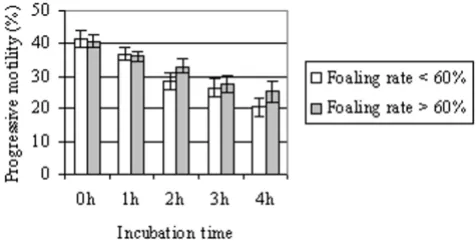
Average CASA motility and s.e.m. were as follows: TMOT 37.0 ± 3.3, PROG 27.6 ± 2.7, and VAP 58.7 ± 2.0; these values did not correlate with fertility. Average progressive motility evaluated in light microscopy showed following changes during incubation: 0 h 40.2 ± 1.7 (min 10, max 60), 1 h 35.0 ± 1.4 (5, 50), 2 h 29.0 ± 1.6 (10, 40), 3 h 24.9 ± 1.7 (10–40), and 4 h 21.0 ± 1.7 (5–40). Progressive motility correlated significantly with foaling rate after 2–4 h of incubation (correlation coefficients 0.39 – 0.51; p < 0.05). Stallions (> 7 mares) with foaling rates of > 60% appeared to retain sperm motility slightly better than stal-lions with foaling rates of < 60%, although the difference was not statistically significant (Fig. 1). Similarly, semen resulting in foaling rates of > 60% showed higher plasma membrane integrity percentages measured with fluorom-eter than semen resulting in foaling rates of < 60%, but the differences were not statistically significant (Fig. 2).
or > 60% are shown in Fig. 3, the difference being signifi-cant (p < 0.05). For all other parameters correlation coef-ficients with fertility were low and non-significant.
When the various parameters were compared with each other, all motility parameters correlated significantly with each other (correlation coefficients varied from 0.44 to 0.81), similarly the plasma membrane integrity tests showed significant correlations between each other (0.37 – 0.83). CFDA/PI staining with light microscopy and with a fluorometer correlated significantly also with progres-sive motility before incubation. The total number of
sperm/AI dose showed a significant negative correlation with the other parameters, except with progressive motil-ity during incubation (3–4 h) and CFDA/PI with light microscopy.
Experiment 2
The average HOST-values were 30.1 ± 1.6 (18–49) before incubation and 21.7 ± 1.6 (9–46) after 3 h of incubation. A significant correlation coefficient of -0.50 with foaling rate (p < 0.05) was demonstrated before incubation. The average CFDA-values obtained in microscopy were 42.9 ± 2.4 (14–66) before incubation and 33.0 ± 1.8 (12–48) after the 3-h incubation. When stallions having > 20 mares were analyzed, CFDA/PI staining with light micro-scopy at 0-h incubation and HOST with fluorometer after a 3-h incubation showed correlation coefficients of 0.5 with foaling rate (p > 0.05). The HOST results in 2 stallion groups divided by their foaling rates are shown in Fig. 4. For other tests, correlation coefficients with foaling rate were low and non-significant. The TMOT and PROG val-ues for stallions with foaling rates < 60% and > 60% are shown in Fig. 5.
When the various parameters were compared, TMOT, PROG, VAP, and RAP correlated after the 0-h and 3-h incubations, correlation coefficients ranging from 0.5 to 0.8. CFDA, HOST and resazurin both by microscopy and fluorometer correlated after the 0-h and 3-h incubations with coefficients of 0.4 – 0.8, but no correlation was dem-onstrated between these parameters and parameters depicting motility. Before incubation, the concentration showed a significant negative correlation with CFDA/PI staining, using both light microscopy and the fluorome-(Exp. 1) Mean (± s.e.m.) sperm concentration and total number of sperm in an AI dose in stallion groups with foaling rates of < 60% or > 60%
Figure 3
(Exp. 1) Mean (± s.e.m.) sperm concentration and total number of sperm in an AI dose in stallion groups with foaling rates of < 60% or > 60%. Number of mares per stallion was > 7.
(Exp. 1) Mean (± s.e.m.) progressive motility in light micros-copy during 4-h incubation in stallion groups with foaling rates of < 60% or > 60%
Figure 1
(Exp. 1) Mean (± s.e.m.) progressive motility in light micros-copy during 4-h incubation in stallion groups with foaling rates of < 60% or > 60%. Number of mares per stallion was > 7.
(Exp. 1) Mean (± s.e.m.) plasma membrane integrity parame-ters in stallion groups with foaling rates of < 60% or > 60%
Figure 2
ter, but this correlation disappeared after the 3-h incuba-tion.
Discussion
No single test was found to be a consistently reliable method for predicting the fertilizing capacity of semen. The results of Exp. 1 could not be repeated, although the stallions and methods used were partly similar. Differ-ences in the outcome of these experiments could be
explained also by different ejaculate batches.
Plasma membrane integrity tests
Some tendency for the plasma membrane integrity tests to be indicators of higher foaling rates was noted in our study. Fluorometers have not been much used in the examination of stallion semen. Although no strong corre-lation with foaling rate was found, the various fluoromet-ric measurements did correlate with plasma membrane integrity in light microscopy and with each other. The use of fluorometers has some advantages in comparison to the use of light microscopy: it requires less time, and more cells in the sample are assessed [14]. In boars [27] and bulls [28], fluorometric measurements significantly corre-lated with fertility parameters.
Neild et al. [29] found no significant connection between the HOST and fertility but a tendency for the HOST to cor-relate with the number or services per pregnancy. We detected both negative and positive correlations, suggest-ing that this test is not suitable for evaluation of frozen-thawed stallion semen.Nie et al. [30] reported lower preg-nancy rates for HOS+ group. Blach et al. [12] found indi-rect evidence that many immotile spermatozoa possessed an intact plasma membrane, which would indicate that these two parameters do not correlate with each other. In our first experiment, plasma membrane integrity with light microscopy correlated with many other parameters, including motility. This is in disagreement with the study of Samper [13] who noted membrane integrity to show extremely poor correlation with motility, particularly in preserved semen. Likewise, in our second experiment cor-relation between motility and plasma membrane integrity was not observed.
Motility
Motility correlated with fertility in our first experiment but not in the second. One explanation can be pre-selec-tion of semen. Most laboratories use 30% as a cut-off value when accepting semen for sale. The most important task of semen tests is to exclude semen of inferior quality, and this had already been done in the laboratories which had exported the semen. Another explanation is the use of different batches from several ejaculates from each stal-lion, but still the question on the accuracy of motility eval-uation as a means of predicting fertility is raised. Semen from a stallion with the highest progressive motility (60%) did not produce any pregnancies in 10 insemi-nated mares. Motility has been claimed by other investi-gators to be a poor predictor of pregnancy rates [6,31].
However, Voss and his coworkers [6] suggested that
although the relationship between motility and fertility is poor in the stallion, spermatozoal motility and the quality of motility are still the most reliable estimates of fertility in practice. On the other hand, Jasko et al. [32] reported significant correlations between motility parameters and
fertility.Newcombe [33] reported that pregnancies per
(Exp. 2) Mean (± s.e.m.) total (TMOT) and progressive motil-ity (PROG) immediately after thawing and after 3-h incuba-tion in stallion groups with foaling rates of < 60% or > 60%
Figure 5
(Exp. 2) Mean (± s.e.m.) total (TMOT) and progressive motil-ity (PROG) immediately after thawing and after 3-h incuba-tion in stallion groups with foaling rates of < 60% or > 60%. Number of mares per stallion was > 7.
(Exp. 2) Mean (± s.e.m.) percentage of sperm positive for hypo-osmotic swelling test (HOST) in stallion groups with foaling rates of < 60% or > 60%
Figure 4
insemination decreased when semen with low motility was used. VAP is not reliable or repeatable according to
Kirk et al. [34]. The motility results immediately after thawing do not necessarily predict the results after incuba-tion, as was seen with progressive motility in our first experiment. Longevity tests may therefore be useful in assessing viability of semen, although Voss et al. [6] sug-gested that longevity may be of limited value in predicting potential fertility. Despite these inconsistencies between studies, motility continues to have value as an easy and economical way for estimating relative cell health.
Sperm numbers and concentration
The total number of sperm/AI dose and concentration correlated negatively with many parameters. This can be explained by the tendency to increase AI dose and thus the concentration – the volume of one straw is limited – when low post-thaw motility is detected to increase the number of progressively motile spermatozoa and consequently the possibility of pregnancy [35]. This practice is only effective to a certain point; Amann [11] presented a dose-response curve showing that fertility ceases to improve as the critical number of spermatozoa needed for maximum fertility of a given male has been reached. High doses and concentration may even decrease fertility. High sperm numbers and concentration provoked more intense inflammatory responses in the uterus [36,37]. Spermato-zoa at higher AI doses arrived in the oviducts later than spermatozoa contained in smaller doses [37]. Fertility dropped when the AI dose contained > 900 × 106 frozen
sperm [35].
Morphology
In our study, the percentage of morphologically normal semen and foaling rates did not correlate, perhaps because semen with a high percentage of morphological abnor-malities is not frozen. Jasko et al. [38,32] showed the per-centage of normal sperm to have a positive correlation with fertility. However, Voss et al. (1981) noted consider-able variation in the morphologic characteristics among stallions and among ejaculates within stallions. They sug-gested that spermatozoal morphology may not be as val-uable in evaluation of potential fertility in the stallion as it is in other large domestic animals.
Problems of fertility studies in horses
Problems confronted in previous fertility studies are also obvious here. The number of mares inseminated per stal-lion was small, the straws were not from the same batch, foaling rates were collected during several years – fertility of stallions can vary between years and decrease with age. Insemination conditions, veterinary skills, management of stud farms, criteria for mare selection, etc. vary consid-erably. Many other factors in addition to semen character-istics influence fertility. Although obtaining pregnancy
rates is difficult, they are more accurate and reliable than foaling rates. However, this does not eliminate other fac-tors affecting fertility, such as management and reproduc-tive performance of mares, their previous reproducreproduc-tive status, and possible genetic factors [32]. A multi-center study by Samper et al. [35] summarized the major factors affecting pregnancy rates of mares bred with frozen semen: the technician, mare age and status, insemination volume, timing of insemination, and number of sperm per dose. Standardizing all these variables is clearly not possible.
Development of freezing methods for stallion semen is dependant on finding dependable correlations between laboratory tests and fertility, which appears very difficult to achieve since the results of different studies in this field tend to be contradictive. The present study was unable to address the question of which laboratory tests would accurately predict fertility of commercially produced stal-lion semen. Objectivity, repeatability, and accuracy are basic requirements for laboratory assays, but many semen analysis tests do not meet these requirements [7]. Quality control of cryopreserved stallion semen remains to be a problem in practice where e.g. flow cytometry is not avail-able. For practical purposes, it would be most important to identify semen samples that are likely to have poor fer-tilizing potential [4]. Nie et al. [30] concluded that evalu-ating fresh spermatozoa offered no advantage for pregnancy over simply inseminating with spermatozoa not selected for any particular characteristics.
The constraints in horse breeding – small numbers of mares per ejaculate and per stallion and the tremendous variations in mare management and insemination – never allow us to carry out trials similar to what the cattle indus-try has done in developing freezing methods and AI tech-niques. Fertility trials of horses are bound to be of little value because of these reasons [16].
References
1. Colenbrander B, Gadella BM, Stout TAE: The predictive value of semen analysis in the evaluation of stallion fertility. Reprod Dom Anim 2003, 38:305-311.
2. Boyle MS: Artificial insemination: assessing stallion semen quality after freezing. Equine Vet J 1996, 28:5-6.
3. Tischner M: Evaluation of deep-frozen semen in stallions. J Reprod Fertil 1979:58-59.
4. Graham JK: Assessment of sperm quality: a flow cytometric approach. Anim Reprod Sci 2001, 68:239-247.
5. Katila T: In vitro evaluation of frozen-thawed stallion semen: A review. Acta vet Scand 2001, 42:201-217.
6. Voss JL, Pickett BW, Squires EL: Stallion spermatozoal morphol-ogy and motility and their relationship to fertility. J Am Vet Med Assoc 1981, 178:287-289.
7. Rodriguez-Martinez H: Laboratory semen assessment and pre-diction of fertility: still utopia? Reprod Dom Anim 2003,
38:312-318.
Publish with BioMed Central and every scientist can read your work free of charge "BioMed Central will be the most significant development for disseminating the results of biomedical researc h in our lifetime."
Sir Paul Nurse, Cancer Research UK
Your research papers will be:
available free of charge to the entire biomedical community
peer reviewed and published immediately upon acceptance
cited in PubMed and archived on PubMed Central
yours — you keep the copyright
Submit your manuscript here:
http://www.biomedcentral.com/info/publishing_adv.asp
BioMedcentral
sperm motility in frozen-thawed stallion semen. Correlation with fertility). Anim Breed Abstr 1990:96-106.
9. Malmgren L: Sperm morphology in stallions in relation to fer-tility. Acta vet Scand 1992, 88:39-47.
10. Watson PF: Recent developments and concepts in the cryop-reservation of spermatozoa and the assessment of their post-thawing function. Reprod Fertil Dev 1995, 7:871-891. 11. Amann RP: Can the fertility potential of a seminal sample be
predicted accurately? J Andrology 1989, 10:89-98.
12. Blach EL, Amann RP, Bowen RA, Frantz D: Changes in quality of stallion spermatozoa during cryopreservation: plasma mem-brane integrity and motion characteristics. Theriogenology
1989, 31:283-298.
13. Samper JC: Evaluation of cryopreserved semen: An alterna-tive assay. Acta vet Scand 1992, 88:59-65.
14. Graham JK: Analysis of stallion semen and its relation to fertil-ity. Vet Clin North Am Equine Pract 1996, 12:119-129.
15. Schweisguth DC, Hammerstedt RH: Evaluation of plasma mem-brane stability by detergent-induced rupture of osmotically swollen sperm. J Biochem Biophys Methods 1992, 24:81-94. 16. Amann RP: Weaknesses in reports of "fertility" for horses and
other species. Theriogenology 2005, 63:698-715.
17. De Albuquerque Lagares M: Bestimmung der osmotischen Resistenz von Hengstsamenzellen (The determination of the osmotic resistance of stallion spermatozoa). Thesis Han-nover 1995.
18. Vidament M, Dupere AM, Julienne P, Evain A, Noue P, Palmer E:
Equine frozen semen freezability and fertility field results.
Theriogenology 1997, 48:907-917.
19. Kenney RM, Bergman RV, Cooper WL, Morse GW: Minimal con-tamination techniques for breeding mares: Techniques and preliminary findings. Proc Am Ass Equine Practnrs 1975,
21:327-336.
20. Varner DD, Scott DV, Johnson L: Use of a computerized system for evaluation of equine spermatozoal motility. Am J Vet Res
1991, 52:224-230.
21. Harrison RAP, Vickers SE: Use of fluorescent probes to assess membrane integrity of mammalian spermatozoa. J Reprod Fertil 1990, 88:343-352.
22. Alm K, Taponen J, Dahlbom M, Tuunainen E, Koskinen E, Andersson M: A novel automatized fluorometric assay to evaluate sperm viability and fertility in dairy bulls. Theriogenology 2001,
56:677-684.
23. Dart MG, Mesta J, Crenshaw C, Ericsson SA: Modified resazurin reduction test for determining the fertility potential of bovine spermatozoa. Arch Andr 1994, 33:71-75.
24. Jeyendran RS, Van der Ven HH, Perez-Pelaez M, Crabo BG, Zaneveld LJ: Development of an assay to assess the functional integrity of the human sperm membrane and its relationship to other semen characteristics. J Reprod Fertil 1984, 70:219-28.
25. Watson PF: Use of Giemsa stains to detect changes in acro-somes of frozen ram spermatozoa. Vet Rec 1975, 97:12-13. 26. Blom E: Sygelige tilstande i konsorganen og sperma som
kas-sationsårsag ved import og eksport af avlstyre til og fra Dan-mark. (Pathological conditions in genital organs and sperm as a cause for the rejection of breeding bulls for import to and export from Denmark). Nord Vet Med 1983, 35:105-30. 27. Juonala T, Salonen E, Nurttila T, Andersson M: Three fluorescence
methods for assessing boar sperm viability. Reprod Dom Anim
1999, 34:83-87.
28. Januskauskas A, Johannisson A, Rodriguez-Martinez H: Assessment of sperm quality through fluorometry and sperm chromatin structure assay in relation to field fertility of frozen-thawed semen from Swedish AI bulls. Theriogenology 2001, 55:947-961. 29. Neild DM, Chaves MG, Flores M, Miragaya MH, Gonzalez E, Aquero
A: The HOS test and its relationship to fertility in the stal-lion. Andrologia 2000, 32:351-315.
30. Nie GJ, Wenzel JGW, Johnson KE: Comparison of pregnancy outcome in mares among methods used to evaluate and select spermatozoa for insemination. Anim Reprod Sci 2002,
69:211-222.
31. Squires EL, Amann RP, Pickett BW: Preservation of stallion semen – Colorado experience. Symp Equine Reprod Denmark
1987:49-54.
32. Jasko DJ, Little TV, Lein DH, Foote RH: Comparison of sperma-tozoal movement and semen characteristics with fertility in
stallions: 64 cases (1987–1988). J Am Vet Med Assoc 1992,
200:979-985.
33. Newcombe JR: Evaluation of the fertilising capacity of frozen-thawed horse semen. Vet Rec 1999, 145:46-47.
34. Kirk ES, Graham JK, Bruemmer JE, Squires EL: Evaluating frozen equine semen by flow cytometry. Anim Reprod Sci 2001,
68:348-349.
35. Samper JC, Vidament M, Katila T, Newcombe J, Estrada A, Sargeant J:
Analysis of some factors associated with pregnancy rates of frozen semen: a multi-center study. Theriogenology 2002,
58:647-650.
36. Kotilainen T, Huhtinen M, Katila T: Sperm-induced leukocytosis in the equine uterus. Theriogenology 1994, 41:629-636.
37. Fiala SM, Pimentel CA, Mattos ALG, Amaral MG, Jobim MIM, Gregory RM, Mattos RC: Sperm transport and uterine inflammatory response after insemination in the mare. 15th Int Congr Anim Reprod Porto Seguro Brazil Abstracts 2004, 2:388.
38. Jasko DJ, Lein DH, Foote RH: Determination of the relationship between sperm morphologic classifications and fertility in stallions: 66 cases (1987–1988). J Am Vet Med Assoc 1990,