R E S E A R C H A R T I C L E
Open Access
Conversion of extrinsic into intrinsic
motivation and computer based testing
(CBT)
Maral Hariri-Akbari
1, Behjat Shokrvash
2, Firooz Mahmoodi
3, Fatemeh Jahanjoo-Aminabad
4, Behzad Yousefi
5and Fariba Azabdaftari
1*Abstract
Background:Because computers are used in many aspects of today’s life, it seems necessary to include them in teaching and assessment processes.
Method:The aims of this cross-sectional study were to construct a multidimensional valid scale, to identify the factors that influenced the nature of student motivation on Computer Based Testing (CBT), to recognize how students self-regulated their activities around CBT, and to describe the efficiency of autonomous versus controlled situations on motivation. The study was carried out among 246 Iranian Paramedical Students of Tabriz Medical Sciences University, Tabriz, Iran; 2013–2014.
The researchers prepared a questionnaire, based on the Self-Determination Theory (SDT), containing 26 items with a five-point Likert scale. It was prepared according to a previous valid questionnaire and by sharing opinions with some students and five professors. The factor analysis was done to perform instructional and exploratory factor analysis.
Results:The Kaiser-Meyer-Olkin(KMO) measure was performed and variables were correlated highly enough to
provide a reasonable basis for factor analysis. The selected 4 factors determined a 60.28% of the variance; autonomy 26.37%, stimulation 14.11%, relatedness10.71%, and competency 9.10%.
Conclusion:A questionnaire was prepared and validated, based on SDT variables. The results indicated that autonomous extrinsic motivation correlated positively with intrinsic motivation and CBT. There was a general positive attitude towards computer-based testing among students. As students became intrinsically motivated through the promotion of autonomous regulation, CBT was recommended as a proper test mode.
Keywords:Computer Based Testing, Motivation, Self-Determination Theory, Student, Iran
Background
The past 45 years has been a period of significant re-forms in the field of education, making assessment an integral part of the psychology of education [1, 2]. With increasing global use of computers for standardized test-ing purposes within high educational institutions [3–5], it is essential for today’s students to leave school with computer and information literacy skills that will enable
them to adapt to a fast changing world [6] and avoid confusion when encountering these tests [7].
With flexibility in time and space, immediate scoring and feedback, and cost efficiency [8], CBT provides a strong in-trinsic testing motivation [9]. A high level of student motiv-ation has also been identified through computer-assisted instructions among senior medical students [10].
As a strong theory of motivation, the self-determination theory has proved to have both theoretical and practical potential for educational researchers and practitioners [11]. What SDT researchers are concerned about is the quality of motivation, intrinsic and extrinsic [11]. Accord-ing to SDT, intrinsic motivation is a person’s most positive * Correspondence:[email protected]
1Department of Basic Sciences, Paramedical School, Tabriz University of
Medical Sciences, Golgasht Ave, Tabriz 5166615739, Iran Full list of author information is available at the end of the article
potential possession, an inherent capacity that makes people look for and learn new things and develop an inte-grative sense of self [12, 13]. In contrast to the idea that extrinsic rewards can undermine intrinsic motivation by diminishing autonomy [14], it is in encouraging circum-stances that intrinsic motivation can find the opportunity to flourish [11]. An extrinsically motivated behavior can be converted into an intrinsic one through the promotion of autonomous regulations [15–17]. While many psych-ology researchers have become increasingly aware of the importance of cultural and contextual variables affecting students’motivation, most of the research and attempts to create educational and technologic testing methods come from western countries, based on the needs and attitudes of Western students and overlook the needs and attitudes of Asian and Middle Eastern students [18]. Among the human subjects studied in a sample of papers chosen from the top psychology journals surveyed in 2008, 96% came from westernized industrial and wealthy societies, and 68% from the U.S.A., in particular [19].
Like many countries in the transitional world, Iranians also have to adopt themselves to the new technology which is based on computer application. Computers are used in every aspect of modern life, including education. Computers are usually used in classroom teaching and science seminars and conferences in Iran. However, it is not normally included in examination processes because of high cost and limited accessibility [20]. It is important to identify the factors that influence the motivation of Iran-ian students in applying CBT [4,6,21]. The present study aimed at constructing a valid scale to identify the kind of motivation and the factors that influence the attitude of Iranian students towards CBT, to explore how these stu-dents self-regulate the activities surrounding CBT through internalizing extrinsic into intrinsic motivation, and to as-sess the efficiency of autonomous versus controlled motiv-ation among Iranian Paramedical Students.
Methods
Assessment development
A cross-sectional study carried out during the fall semes-ter of 2013–2014 with the participation of 246 under-graduate paramedical students of the Tabriz Medical Sciences University taking General English in the fields of nursing, public health, food industries, laboratory sciences, anesthesia, and technology of radiology. All participants were provided with adequate information about the na-ture and reasons of the study, and were told in advance that the information they provided would be kept confi-dential. A consent form was signed by all the participants before the commencement of the study. The question-naires were completed by the participants in class ses-sions, under the supervision of the researcher, using paper and pen. Adequate time (15–20 min) was allocated to all
the participants to fill out the questionnaire. Their ques-tions were answered and their doubts were clarified. Par-ticipants who were reluctant to submit the questionnaire after filling it out were excluded from the study. Then, the questionnaires were collected and subjected to a computer analysis. In analyzing the data, SPSS version 16 was used.
The questionnaire prepared by the researcher was based on SDT to estimate the quality of motivation (intrinsic and extrinsic) using a previous valid questionnaire [22]. It contained 26 items with a five-point Likert scale (ranging from strongly agree = 5, to strongly disagree = 1).
Validity and reliability assessment
The reliability and validity of the questionnaire were de-termined. The qualitative content validity of the ques-tionnaire was judged by five professors of social sciences, language education, statistics, and psychology, and the research deputy of the university. The opinions of some students were also sought in preparing the questionnaire.
Factor analysis
A data reduction statistical technique was used that allowed the simplification of the correlation relationships between variables. Three steps; computation of the cor-relation metrics, the testing of the sampling adequacy, and the reduction of the number of variables; were taken to identify the important factors that influenced the atti-tude of satti-tudents of the Tabriz Medical Sciences Univer-sity towards CBT.
Kaiser-Meyer-Olkin (KMO) and Principal Component Analyses (PCA) were performed to indicate whether there was a reasonable basis for factor analysis and any interrelation between the questionnaire items. The factor analysis was done to perform instructional analysis, and an exploratory factor analysis was done to identify the dimensions of the scale. The reliability was calculated using Chronbach’s Alpha test.
Results
Sample characteristics
The number of 246undergraduate paramedical students, age ranging from 17 to 37 years, M (SD) 19.93 (2.02) participated in the study. All the participants had taken General English course in the fields of nursing, public health, food industries, laboratory sciences, anesthesia, and radiology at the Tabriz Medical Sciences University.
Construct and validity of the questionnaire
significance value (P< 0.001) indicated that the variables correlated highly enough to provide a reasonable basis for factor analysis (Table1).
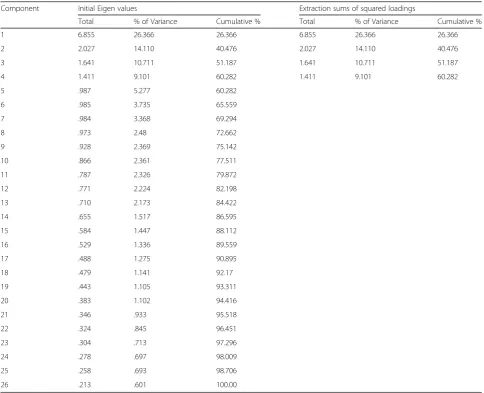
Each factor had an Eigen-value> 1 for computer-based testing. The percentage of total variance was used as an index to determine how well the total factor solution accounted for the represented variables together. The index for the present solution accounted for 60.28%of the total variances for computer-based testing (Table2). An exploratory factor analysis sorted the 26 questions
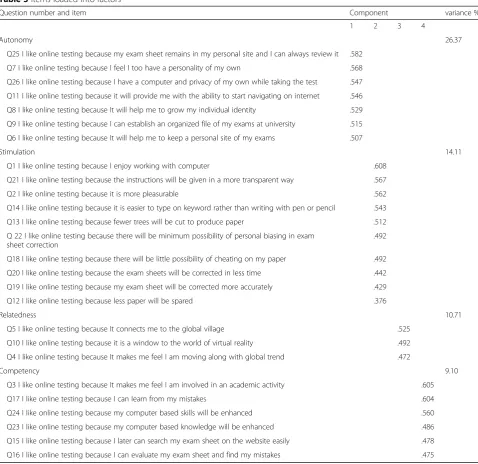
into four factors, autonomy(7 items, variance% = 26.37), stimulation(10 items, variance% = 14.11),relatedness (3 items, variance% = 10.71), and competency(6 items, variance% = 9.10%)were extracted (Table 2). For example, among the items, item 2 was found to have the highest loading −0.582, and item 6 the lowest loading with0.507 (Table 3).
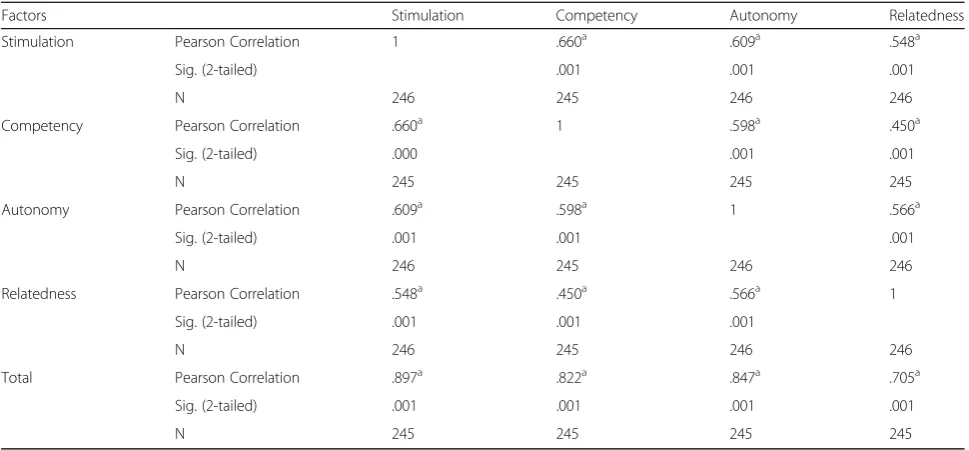
A Pearson product-moment correlation coefficient was computed to assess the relationship between the 26-itemed questionnaire scale/subscales that each stu-dent had completed. The coefficient method indicated a positive interactive correlation between an increase in each factor with the increase in other factors and the totalp< 0.001. (Table4).
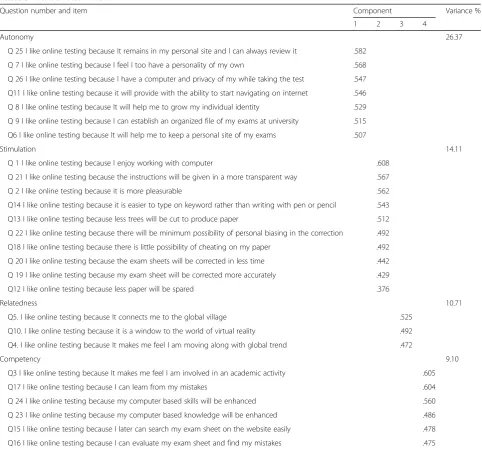
As the number of factors were more than two, rotation was necessary to identify the differences between the ini-tially extracted factors, and to provide a clear picture of items loaded on each factor. Table5 shows Rotated Fac-tor Matrix.
Table 1Kaiser-Meyer-Olkin and Bartlett’s Test results
KMO measure of sampling adequacy .813
Bartlett’s Test of Sphericity Approx. Chi-Square 2191.728
df 325
P-value <.001
Abbreviation: dfdegree of freedom
Table 2Initial Eigen values and extracted sums of squared loadings
Component Initial Eigen values Extraction sums of squared loadings
Total % of Variance Cumulative % Total % of Variance Cumulative %
1 6.855 26.366 26.366 6.855 26.366 26.366
2 2.027 14.110 40.476 2.027 14.110 40.476
3 1.641 10.711 51.187 1.641 10.711 51.187
4 1.411 9.101 60.282 1.411 9.101 60.282
5 .987 5.277 60.282
6 .985 3.735 65.559
7 .984 3.368 69.294
8 .973 2.48 72.662
9 .928 2.369 75.142
10 .866 2.361 77.511
11 .787 2.326 79.872
12 .771 2.224 82.198
13 .710 2.173 84.422
14 .655 1.517 86.595
15 .584 1.447 88.112
16 .529 1.336 89.559
17 .488 1.275 90.895
18 .479 1.141 92.17
19 .443 1.105 93.311
20 .383 1.102 94.416
21 .346 .933 95.518
22 .324 .845 96.451
23 .304 .713 97.296
24 .278 .697 98.009
25 .258 .693 98.706
Reliability of the questionnaire
The reliability of the questionnaire taken by the internal consistency of the 26 item questionnaire based on Chronbach’s Alpha was 0.884; and the factors of auton-omy 0.749, Stimulation 0.719, Competency 0.709, and relatedness 0.557.
Discussion
Based on the self-determination theory and its relevance to CBT, results of this study indicate that Iranian para-medical students were ready to convert their extrinsic-ally motivated behavior into intrinsicextrinsic-ally motivated behavior by promoting autonomous regulations. This
resulted from a general positive attitude among the dents toward computer-based testing. In this study stu-dents converted their extrinsic motivation into intrinsic motivation based on the three basic human psycho-logical needs of autonomy, relatedness, and competency, and one subcategory of intrinsic motivation, stimulation [24, 25]. The four above concepts formed the four fac-tors of the study.
Autonomy with the highest degree of variance presented itself as the most paramount factor in growing self-esteem and identity (I like on line testing because I feel I too have a personality of my own: and online testing will help me to grow my individual identity). Therefore, factor-1 was Table 3Items loaded into factors
Question number and item Component variance %
1 2 3 4
Autonomy 26.37
Q25 I like online testing because my exam sheet remains in my personal site and I can always review it .582
Q7 I like online testing because I feel I too have a personality of my own .568
Q26 I like online testing because I have a computer and privacy of my own while taking the test .547
Q11 I like online testing because it will provide me with the ability to start navigating on internet .546
Q8 I like online testing because It will help me to grow my individual identity .529
Q9 I like online testing because I can establish an organized file of my exams at university .515
Q6 I like online testing because It will help me to keep a personal site of my exams .507
Stimulation 14.11
Q1 I like online testing because l enjoy working with computer .608
Q21 I like online testing because the instructions will be given in a more transparent way .567
Q2 I like online testing because it is more pleasurable .562
Q14 I like online testing because it is easier to type on keyword rather than writing with pen or pencil .543
Q13 I like online testing because fewer trees will be cut to produce paper .512
Q 22 I like online testing because there will be minimum possibility of personal biasing in exam sheet correction
.492
Q18 I like online testing because there will be little possibility of cheating on my paper .492
Q20 I like online testing because the exam sheets will be corrected in less time .442
Q19 I like online testing because my exam sheet will be corrected more accurately .429
Q12 I like online testing because less paper will be spared .376
Relatedness 10.71
Q5 I like online testing because It connects me to the global village .525
Q10 I like online testing because it is a window to the world of virtual reality .492
Q4 I like online testing because It makes me feel I am moving along with global trend .472
Competency 9.10
Q3 I like online testing because It makes me feel I am involved in an academic activity .605
Q17 I like online testing because I can learn from my mistakes .604
Q24 I like online testing because my computer based skills will be enhanced .560
Q23 I like online testing because my computer based knowledge will be enhanced .486
Q15 I like online testing because I later can search my exam sheet on the website easily .478
Q16 I like online testing because I can evaluate my exam sheet and find my mistakes .475
entitled autonomy. The self-determination theory focuses on those aspects of social contexts that make the context more autonomy-supportive instead of being a controlling type [17].
Items in factor2 (stimulation), were concerned with the interest and excitement of the participants in working with computers, involving the items like (easier to type on a keyword than writing on paper, saving time and more accuracy and transparency in correcting exam sheets, less bias in correction, getting exam results soon), and environmental concerns such as (less trees will be cut and less paper will be used). Stimulation is one of the three sub-categories of in-trinsic motivation. The other two are knowledge and accomplishment [24, 25]. The motivation associated with factors1and 2 in this study was extrinsic [11], which converted into intrinsic motivation through in-ternalization regulation [17, 25].
Factor3 addressed relatedness, need to experience a sense of belonging, and attachment to others, people, and networks [17, 25]. As the technology of each age sets the mindset of the time [26], the Iranian student mindset of this age has a tendency toward using com-puters as a tool to become related to the current global trend, (I like CBT because I feel I am related to the glo-bal village, it connects me to the gloglo-bal village, a window to the world of virtual reality, and I move along with the global trend).
Factor4 dealt with competency and accomplishment, meaning, people are actively directed toward growth and meet challenges [17,25]. Both factors 3 and 4 in this study reflected an introjected regulation because the students
under study were proud of themselves and a feeling of worth led to the growth of their self-esteem [23, 27]. It is essential to mention that the items related to the motivation for knowledge (I like online testing be-cause I can evaluate my exam sheet and find my mis-takes; I can learn from my mismis-takes; and my computer-based knowledge will be enhanced), were categorized under the competency factor.
Based on the self-determination theory [23] and its rele-vance to CBT, extrinsic motivation through internalized (in factors1 and 2), and introjected (in factors3 and 4) reg-ulations, correlated positively with intrinsic motivation and CBT among Iranian Premedical students in this study. There was a general positive attitude toward computer-based testing among the students.
Based on the self-determination theory, this study tried to evaluate the effects of autonomy-supportive con-texts on the conversion of non-intrinsically motivated behaviors into intrinsically-motivated behaviors, and the way the feeling of having autonomy rather than being controlled, affected the attitude of the Tabriz Medical Sciences University students towards CBT. The regula-tion of behaviors towards CBT among Iranian students indicated its own specific characteristics. Compared with other students [28, 29], Iranian students approached CBT with a specific attitude due to their social and cul-tural moorings. As the degree of autonomy in initiating and accomplishing their activities is usually rather low and their choices to follow up their individual goals may be somewhat restricted, in the common context of the society they live in, Iranian students prefer to take their tests in a relatively autonomous rather than a controlled Table 4Pearson product-moment correlation coefficient results
Factors Stimulation Competency Autonomy Relatedness
Stimulation Pearson Correlation 1 .660a .609a .548a
Sig. (2-tailed) .001 .001 .001
N 246 245 246 246
Competency Pearson Correlation .660a 1 .598a .450a
Sig. (2-tailed) .000 .001 .001
N 245 245 245 245
Autonomy Pearson Correlation .609a .598a 1 .566a
Sig. (2-tailed) .001 .001 .001
N 246 245 246 246
Relatedness Pearson Correlation .548a .450a .566a 1
Sig. (2-tailed) .001 .001 .001
N 246 245 246 246
Total Pearson Correlation .897a .822a .847a .705a
Sig. (2-tailed) .001 .001 .001 .001
N 245 245 245 245
Abbreviation: Sigsignificanta
situation. This provides them with an opportunity to construct their motivation concerning CBT in terms of their self-esteem and identity.
Similar to the present research, a study at the Univer-sity of Iowa, in the USA [30], and another in Malaysia [3] considered the use of educational technology as an improvement in educational quality, and a means of test-ing which of such technology can increase a participant’s intrinsic motivation and self-efficacy. Another study, also in Malaysia [31], reported a neutral attitude of the stu-dents toward web-based instruction. However, the study was in agreement with the present study with regard to students being stimulated by the task. The students in the study were strongly positive about the convenience
of web-based instruction, because it provided them with the ability to control their pace of learning. According to a pedagogic study done in poor neighborhoods of the world for three decades, economic inequalities were seen as the major obstacle to access equality in education [32]. On the other hand, in an exploration of the degree of school administers’ interests by race, African American school administrators showed a stronger interest in developing and enhancing their abilities by using technology in performing tasks than did Cauca-sian school administrators [33]. Both studies were in agreement with this study, which took social context as a powerful factor in shaping student attitudes to-wards a testing mode.
Table 5Rotated Factor Matrix
Question number and item Component Variance %
1 2 3 4
Autonomy 26.37
Q 25 I like online testing because It remains in my personal site and I can always review it .582
Q 7 I like online testing because I feel I too have a personality of my own .568
Q 26 I like online testing because I have a computer and privacy of my while taking the test .547
Q11 I like online testing because it will provide with the ability to start navigating on internet .546
Q 8 I like online testing because It will help me to grow my individual identity .529
Q 9 I like online testing because I can establish an organized file of my exams at university .515
Q6 I like online testing because It will help me to keep a personal site of my exams .507
Stimulation 14.11
Q 1 I like online testing because l enjoy working with computer .608
Q 21 I like online testing because the instructions will be given in a more transparent way .567
Q 2 I like online testing because it is more pleasurable .562
Q14 I like online testing because it is easier to type on keyword rather than writing with pen or pencil .543
Q13 I like online testing because less trees will be cut to produce paper .512
Q 22 I like online testing because there will be minimum possibility of personal biasing in the correction .492
Q18 I like online testing because there is little possibility of cheating on my paper .492
Q 20 I like online testing because the exam sheets will be corrected in less time .442
Q 19 I like online testing because my exam sheet will be corrected more accurately .429
Q12 I like online testing because less paper will be spared .376
Relatedness 10.71
Q5. I like online testing because It connects me to the global village .525
Q10. I like online testing because it is a window to the world of virtual reality .492
Q4. I like online testing because It makes me feel I am moving along with global trend .472
Competency 9.10
Q3 I like online testing because It makes me feel I am involved in an academic activity .605
Q17 I like online testing because I can learn from my mistakes .604
Q 24 I like online testing because my computer based skills will be enhanced .560
Q 23 I like online testing because my computer based knowledge will be enhanced .486
Q15 I like online testing because I later can search my exam sheet on the website easily .478
Q16 I like online testing because I can evaluate my exam sheet and find my mistakes .475
The results of a study that found Iranian students’ perception on using computers mostly disadvanta-geous [34] came in contrast with the present study which found an overall positive student attitude to-wards CBT. It can partly relate to the nature of the studies. The previous study compared CBT with paper-based testing (PBT) in taking specific exams such as TOEFL and IELTS and evaluated the advan-tages and disadvanadvan-tages of each testing mode over the other. However, the present research based on SDT, evaluated the general student perception on CBT and described how CBT induced the feeling of an autonomous versus controlled situation and caused students become intrinsically motivated while taking the test.
Limitations
The present study has certain limitations:
The computer related skills and literacy of the
students were not evaluated before the distribution of the questionnaires.
The sample size was relatively small, limited to the paramedical students.
Conclusion
In this study, a 26-itemquestionnaire was prepared and validated, based on SDT variables. The results indicated Iranian students were stimulated by CBT, because they felt CBT would provide them with autonomy through which they would be able to demonstrate their compe-tency, and working with computers would relate them to the global trends. Results also indicated autonomous extrinsic motivation correlated positively with intrinsic motivation and CBT. There was a general positive atti-tude toward computer-based testing among satti-tudents. Because the Iranian students became intrinsically moti-vated through the promotion of autonomous regulation, the researchers suggest CBT as an alternative testing mode in taking exams in Iran.
Although the sample size was rather small, the study was the first of its kind to evaluate students’attitude to-wards CBT in the Tabriz Medical Sciences University. The results may provide useful implications for teachers and the university. However, future research based on other theories of motivation with different variables can provide more helpful insights for higher educational centers and those who work on psychology of education.
Additional files
Additional file 1:All raw data as supplementary information. (PDF 533 kb)
Additional file 2:Copy of questionnaire. (DOCX 19 kb)
Abbreviation
BS:Batcher of Science; CBT: Computer Based Testing; KMO: Kaiser-Meyer
Olkin; M(SD): Mean (Standard Deviation); MPH: Master of Public Health; Ms.: Master of Science; N: Frequency; PCA: Principle Components Analysis; PhD: Doctor of Philosophy; SDT: Self-Determination Theory; Sig: Significance
Acknowledgements
The researchers appreciate the valuable contributions of the participant students, Tabriz University of Medical Sciences, and associated Student Research Committee.
Availability of data and materials
The datasets used and/or analyzed in the study (Additional file1) and a copy
of questionnaire (Additional file2) are available at the end of this article.
Authors’contributions
M H-A was involved in designing, acquisition of data, intellectual revision of the manuscript content; BS took part in data interpretation, intellectual revision of the manuscript content; FM and FJ analyzed and interpreted the data; BY offered the concept; and FA developed the conception, and administrated the whole study. All authors agreed with all aspects of work ensuring integrity and accuracy and gave their final approval.
Ethics approval and consent to participate
The proposal, the questionnaire, and the participant consent form were sent to the Deputy of Research Committee of the Paramedical School, a brunch of Tabriz Medical Science University research Committee, and verified. All participants were fully aware of the nature and confidentiality of the study and were told in advance that the information provided by them would be kept confidential. Entering the study was made possible for each participant by signing the consent form. Even those participants who were reluctant to submit the filled questionnaire were excluded from the study.
Competing interests
The authors declare that they have no competing interests.
Publisher’s Note
Springer Nature remains neutral with regard to jurisdictional claims in published maps and institutional affiliations.
Author details
1Department of Basic Sciences, Paramedical School, Tabriz University of
Medical Sciences, Golgasht Ave, Tabriz 5166615739, Iran.2Department of Health Education and Promotion, School of Health, Tabriz University of Medical Sciences, Golgasht Street, Tabriz, Iran.3Doctoral Candidate, Department of Education, School of Education and Psychology, Tabriz University, Tabriz, Iran.4Tehran University of Medical Sciences, Department of Biostatistics and Epidemiology, Tehran, Iran.5Paramedical School, Tabriz University of Medical Sciences, Tabriz, Iran.
Received: 17 May 2017 Accepted: 31 May 2018
References
1. Shavelson RJ, Young DB, Ayala CC, Brandon PR, Furtak EM, Ruiz-Primo MA,
et al. On the impact of curriculum-embedded formative assessment on learning: a collaboration between curriculum and assessment developers. Appl
Meas Educ. 2008;21:295–14.https://doi.org/10.1080/08957340802347647.
2. Herde CN, Wüstenberg S, Greiff S. Assessment of complex problem solving:
what we know and what we don’t know. Appl Meas Educ. 2016;29:265–77.
https://doi.org/10.1080/08957347.2016.1209208.
3. Kuzmina I. Computer-based testing: advantages and disadvantages. Journal
NTU-KPI.2010;1;УДК37.015.3:004.
4. Hensley KK, Examining the effects of paper-based and computer-based
modes of assessment on mathematics curriculum-based measurement. dissertation Doctor of Philosophy. Iowa: University of Iowa; 2015. [citd 2017
Apr 19]:http://ir.uiowa.edu/etd/1627.
5. Hosseini M, Abidin MJZ, Baghdarnia M. Comparability of test results of
computer based tests (CBT) and paper and pencil tests (PPT) among English
language learners in Iran. ProcediaSoc Behav Sci. 2014;98:659–67.http://
6. Care E, Scoular C, Griffin P. Assessment of collaborative problem solving in
education environments. Appl Meas Educ. 2016;29:250–64.https://doi.org/
10.1080/08957347.2016.1209204.
7. Madaus G, Russell M, Higgins J. The paradoxes highstakes testing, how they
affect students, their parents, teachers,principals, schools, and For SocUSA;
2006. P.128–35,175–8.Information Age Publishing, INC. Charlotte,NC.www.
infoagepub.aom.
8. Deutsch T, Herrmann K, Frese T, Sandholzer H. Implementing
computer-based assessment–a web-based mock examination changes attitudes.
ComputEduc. 2012;58:1068–75.https://doi.org/10.1016/j.compedu.2011.11.013.
9. Chua YP. Effects of computer-based testing on test performance and
testing motivation. Comput Human Behav. 2012;28:1580–6.https://doi.org/
10.1016/j.chb.2012.03.020.
10. Hu A, Shewokis PA, Ting K, Fung K. Motivation in computer-assisted
instruction. Laryngoscope. 2016;126(S6):S5–S13.https://doi.org/10.1002/lary.
26040. PMID: 27307270.
11. Deci EL, Ryan RM. Levels of analysis, regnant causes of behavior and
well-being: the role of psychological needs. PsycholoInq. 2011;22:17–22.https://
doi.org/10.1080/1047840X.2011.545978.
12. Vallerand RJ, Reid G. On the causal effects of perceived competence on
intrinsic motivation: a test of cognitive evaluation theory. J Sport Psychol.
1984;6:94–102.https://doi.org/10.1123/jsp.6.1.94.
13. Ryan RM, Lynch MF, Vansteenkiste M, Deci EL. Motivation and autonomy in
counseling, psychotherapy, and behavior change: a look at theory and
practice. Couns Psychol. 2011;39:193–260.https://doi.org/10.1177/
0011000009359313.
14. Ryan RM, Deci EL. Self-determination theory and the facilitation of intrinsic
motivation, social development, and well-being. Am Psychol. 2000;55:68.
https://doi.org/10.1037/0003-066X.55.1.68.
15. Vansteenkiste M, Lens W, Deci EL. Intrinsic versus extrinsic goal contents in
self-determination theory: Another look at the quality of academic
motivation. Educ Psycho. 2006;41:19–31.https://doi.org/10.1207/
s15326985ep4101_4.
16. Malle BF. Attribution theories: how people make sense of behavior. In:
Chadaee D, editor. Theories in social psychology: Wiley-Blackwell; 2011. p. 72–95.http://s3.amazonaws.com/academia.edu.documents/34105779/ Malle_2011.
17. Deci EL, Ryan RM. The importance of autonomy for development and
well-being. Self-regulation and autonomy. Chapter 2: in Sokol BW, Grouzet FME, Müller U. Social and developmental dimensions of human conduct.
Cambridge University press. USA.2013.p.19–46; doi:https://doi.org/10.1017/
CBO9781139152198.
18. Wang F. Motivation and English achievement: an exploratory and
confirmatory factor analysis of a new measure for Chinese students of
English learning. NAmerJ Psychol. 2008;10:633–46.http://sdtheory.s3.
amazonaws.com/SDT/documents/2008_WangFX_NAJP.pdf
19. Diamond J. The world until yesterday: What can we learn from traditional
societies?. Penguin. USA.2012. p.8.ISBN-13: 978–0143124405.http://www.
adaptivecycle.nl/images/Pattynama_10430423_The_world_until_Yesterday.pdf.
20. Rezaie M, Golshan M. Computer adaptive test (CAT): Advantages and
limitations. Int J Educ Investig. 2015;2-5:128–37.www.ijeionline.com.
21. Azabdaftari F, Gharehaghaji N, Akbari MH. Motivation in learning English
among the paramedical sciences students in Iran: finding a job or grabbing
a culture? Res Dev. 2014;3:9–13.https://doi.org/10.5681/rdme.2014.004.
22. Schmidt R, Boraie D, Kassabgy O. Foreign language motivation: internal
structure and external connections. University of Hawai'i working papers in English as a second Language 1996;14.
23. Ng JY, Ntoumanis N, Thøgersen-Ntoumani C, Deci EL, Ryan RM, Duda JL, et al.
Self-determination theory applied to health contexts: a meta-analysis.
PerspectPsycholSci. 2012;7:325–40.https://doi.org/10.1177/1745691612447309.
24. Ryan RM, Deci EL. Self-regulation and the problem of human autonomy:
does psychology need choice, self-determination, and will? J Pers. 2006;74: 1557–86.https://doi.org/10.1177/1745691612447309.
25. Deci EL, Ryan RM. The" what" and" why" of goal pursuits: human needs and
the self-determination of behavior. Psychol Inq. 2000;11:227–68.https://doi.
org/10.1207/S15327965PLI1104_01.
26. Kolderie T. How information technology can enable 21st century schools.
Washington: Information Technol Innov Foundation.(ITIF); 2009. p. 1–15.
27. Black AE, Deci EL. The effects of instructors' autonomy support and
students' autonomous motivation on learning organic chemistry: a
self-determination theory perspective. Sci Educ. 2000;84:740–56.https://doi.org/
10.1002/1098-237.
28. Matsuyama Y, Muijtjens AM, Kikukawa M, Stalmeijer R, Murakami R, Ishikawa
S, et al. A first report of east Asian students’perception of progress testing:
a focus group study. BMC Med Educ. 2016;16:245.https://doi.org/10.1186/
s12909-016-0766-2.
29. Hiratsuka H, Suzuki H, Pusina A. Explaining the effectiveness of the contrast
culture method for managing interpersonal interactions across cultures. J Int Stu. 2016;6:73. ISSN: 2162-3104 Print/ ISSN: 2166-3750 Online
30. Chua YP, Don ZM. Effects of computer-based educational achievement test
on test performance and test takers’motivation. ComputHum Behav. 2013;
29:1889–95.https://doi.org/10.1016/j.chb.2013.03.008.
31. Shih C-C, Gamon J. Web-based learning: relationships among student
motivation, attitudes, learning styles, and achievement. J Agric Educ. 2001;
42:12–20.https://eric.ed.gov/?id=EJ638591. ERIC.EJ638591
32. Comber B. Poverty, place and pedagogy in education: research stories from
front-line workers. AustEducRes. 2016;43:393–4.https://doi.org/10.1007/
s13384-016-0212-9.
33. Yu C, Prince DL. Aspiring school administrators' perceived ability to meet
technology standards and technological needs for professional
Development. J Res Tech Educ. 2016;48:239–57.https://doi.org/10.1080/
15391523.
34. Noubandegani PA. Students' perceptions of computerized TOEFL test. LTA.