Open Access
Research article
Risk of upper limb complaints due to computer use in older persons:
a randomized study
Martin PJ van Boxtel*
1, Karin Slegers
2, Jelle Jolles
1and Joop M Ruijgrok
3Address: 1European Graduate School of Neuroscience (Euron); Brain and Behaviour Institute, Maastricht University, Department of Psychiatry and
Neuropsychology, PO Box 616, 6200 MD Maastricht, The Netherlands, 2Vodafone, Group R&D, Gelissendomein 5, 6229 GK Maastricht, The
Netherlands and 3Department of Rehabilitation, Maastricht University Hospital, PO Box 5800, 6202 AZ, Maastricht, The Netherlands
Email: Martin PJ van Boxtel* - [email protected]; Karin Slegers - [email protected]; Jelle Jolles - [email protected]; Joop M Ruijgrok - [email protected]
* Corresponding author
Abstract
Background: We studied whether the twelve-month use of a standard computer would induce complaints of upper limb pain or functional limitations in older novice computer users.
Methods: Participants between 64 and 76 of age were randomly assigned to an Intervention group (n = 62), whose members received a personal computer and fast Internet access at their homes, or a No Intervention control group (n = 61), whose members refrained from computer use during the twelve month study period.
Results: Difference scores between baseline and twelve months assessments on both complaint (SFS) and functional health scales (SF-36) did not differ between groups (all p > .05).
Conclusion: Prolonged, self-paced use of a standard computer interface does not put older persons at a risk of upper limb complaints or reduce functional health in older adults.
Background
The personal computer has become an ubiquitous tech-nology, both at home and in the workplace. Everyday computer activities are generally characterized by repeti-tive upper limb movements and a relarepeti-tively fixed bodily position [1]. Regular interaction with a computer inter-face, using a standard keyboard and a mouse, has been related to a complex of complaints related to the hand, arm and shoulder, often referred to as 'repetitive strain injury' (RSI), or sometimes as 'cumulative trauma disor-der', 'non-specific work-related upper limb disorder' or 'repetitive strain disorder' [2]. This pain syndrome of the upper limb consists of protracted complaints of the hand, arm or shoulder, leading to functional impairment that is difficult to treat [3]. Although the exact cause of RSI is still
unknown, risk factors have been identified in epidemio-logical studies. Prolonged exposure to repetitive move-ments and less than optimal ergonomic conditions have been shown to increase risk, while secondary factors like working under time pressure and lack of autonomy and social support in the workplace can increase the frequency and severity of complaints [3]. Little is known, however, about the relative contribution of each risk factor and any possible synergistic effect.
Exact prevalence figures of RSI are unavailable, in part due to a lack of valid working definitions of RSI as a diagnostic entity, but in a recent Dutch population survey RSI com-plaints were reported by 20–40 percent of the working population [4]. So far, all studies done in this area have
Published: 16 August 2007
BMC Geriatrics 2007, 7:21 doi:10.1186/1471-2318-7-21
Received: 28 November 2006 Accepted: 16 August 2007
This article is available from: http://www.biomedcentral.com/1471-2318/7/21
© 2007 van Boxtel et al; licensee BioMed Central Ltd.
been observational in nature and were restricted to studies in the workplace in young to middle-aged persons. In non-working older computer users even prevalence fig-ures about RSI are lacking.
More insight into the long-term effects of computer use may be of particular relevance for older individuals because they may be even more susceptible to the devel-opment of RSI related complaints compared to younger or middle-aged persons. Firstly, hand function deteriorates with age due to age-related degenerative changes in the musculoskeletal, nervous and vascular system [5]. Besides these more general degenerative mechanisms, hand func-tion in the elderly can be impaired by specific pathologi-cal conditions, such as osteoporosis, osteoarthritis, or rheumatic arthritis [5,6]. Secondly, recent insights into neural control of movements and muscle stiffness regula-tion provide further arguments for the older popularegula-tion being more at risk. The neuromotor noise theory explains why fine, coordinated distal movements require strong signals from the brain to the muscular system [7]. This sig-nal can be disturbed by different types of task-irrelevant neural activity. Such neural 'noise' can be generated by dif-ferent sources, e.g. sensory input, parallel activity in adja-cent cognitive networks ('double tasks'), or mood related brain centres [8]. In order to improve the signal-to-noise ratio, the brain will suppress excess noise by stiffening the muscular system. For instance, it has been shown that increasing time pressure and task difficulty will cause enhancement of muscular tone [9]. It can be argued that an older brain will produce a less strong motor signal, is less able to suppress neural noise, and will intrinsically produce more noise [10]. Finally, evidence of age-related changes that may cause an unfavourable signal-to-noise ratio in the brain, thereby decreasing hand function, also comes from patient studies, e.g. into multiple sclerosis [7] and stroke [11].
Thus, while individuals over 65 have been catching up fast with the societal trend towards extensive use of computer-based technologies and services [12], it remains unclear whether computer usage may put the older users to the risk of RSI. Even though the nature and intensity of com-puter use may differ between professionally active younger persons and non-working older individuals, the susceptibility of the latter group to develop RSI may be higher due to the mechanisms outlined above. The present prospective study investigates if older computer users actually develop complaints or functional limita-tions of the upper limb in the course of a one-year com-puter and Internet training program. The study was part of a larger project into the effects of computer use on cogni-tive abilities and life quality in older adults [14]. All par-ticipants who were trained for the actual intervention study were enrolled in the current study. They were
inter-ested in computer use for leisure and educational pur-poses, but had no prior computer experience. Apart from the use of a specific RSI questionnaire, measures of gen-eral health were included in this study because upper limb bodily pain may be related to a reduction in overall health status in both younger and older individuals [13].
Methods
Participants and Procedure
two participants could not be reached for an appointment after several attempts, and one participant died. Five par-ticipants who completed the test sessions did not return their questionnaire even after repeated requests, leaving 57 and 47 participants in the Intervention and No Inter-vention groups with complete data.
The No Intervention group was to refrain from computer use during the intervention interval of twelve months, which was confirmed in writing on the informed consent form. Compliance with this agreement was again con-firmed by signing a statement at the end of the study. Par-ticipants in the No Intervention group could win one of two computer systems in a raffle at the end of the study period. Participants in the Intervention group were equipped with an up-to-date personal computer (Apple iMac) with high-speed Internet access (cable). A standard QWERTY keyboard and a one-button mouse were used as input devices. Regular home assignments were given by email to ascertain continuous use of the computer facili-ties and to track down participants who made insufficient progress with respect to their computer skills. A help desk with remote support facilities was available for all ques-tions related to computer and Internet use during the project. All participants signed a consent form, and the study was approved by the ethics committee of the Maas-tricht University Hospital (reference number MEC01-116.3).
Measurements
A standard questionnaire was completed at the start (M0) and the end (M12) of the study. It contained questions about demographical characteristics (e.g. educational level, marital status), health status, (pain) medication use, and psychological and general wellbeing. At M12 infor-mation was collected about the total amount of time (hours per week) devoted to computer and Internet usage. A standard battery of cognitive tests was given at M0 and M12 to assess cognitive ability used in the main study. Results of this assessment will be described in an upcom-ing paper by these authors.
Specific measures
The Short Form-36 (SF-36) scale [16] was used at both M0 and M12 to assess the general wellbeing of the partici-pants. To restrict the number of outcome variables in order to prevent type II error, we a priori selected only the most relevant subscales from the SF-36 for this study: gen-eral health, physical functioning, mental health and bod-ily pain. All scores refer to health complaints that were experienced in the four weeks preceding the testing. Scores on the SF-36 scales range between 100 (highest; optimal) and 0 (lowest; worst).
Complaints about and functional impairment of the upper limb were measured with the symptom and func-tional status scale (SFS), a well-validated instrument that was originally developed for the assessment of upper limb pain, specifically the carpal tunnel syndrome [17]. It con-sists of eleven symptom items (e.g. 'How long, on average, does an episode of pain last during the daytime?') and eight functional impairment items (e.g. difficulties with writing), measured on five-point scales, with reference to the two weeks prior to testing. Domain scores for symp-tom severity and functional status were computed by tak-ing the average of the items in each category. Thus the range of scores was between 1 (no ment) to 5 (maximum severity of complaint/impair-ment).
Statistical analysis
All outcome measures failed a formal test of normality (Kolmogorov-Smirnov test), due to skewed distributions. M12-M0 difference scores were calculated for all SF-36 and SFS scales, which were tested for group differences with Mann-Whitney U tests. All analyses were conducted according to the intention to treat principle. A post hoc power analysis using an alpha level of .05 revealed that a power of 0.81 was available to detect 'medium effect size' differences based on the number of participants who completed all assessments [18]. All analyses were per-formed with the SPSS Program Series, v11.02 for Apple Macintosh, using an alpha level of .05 for significance and of .10–.05 for marginal significant effects.
Results
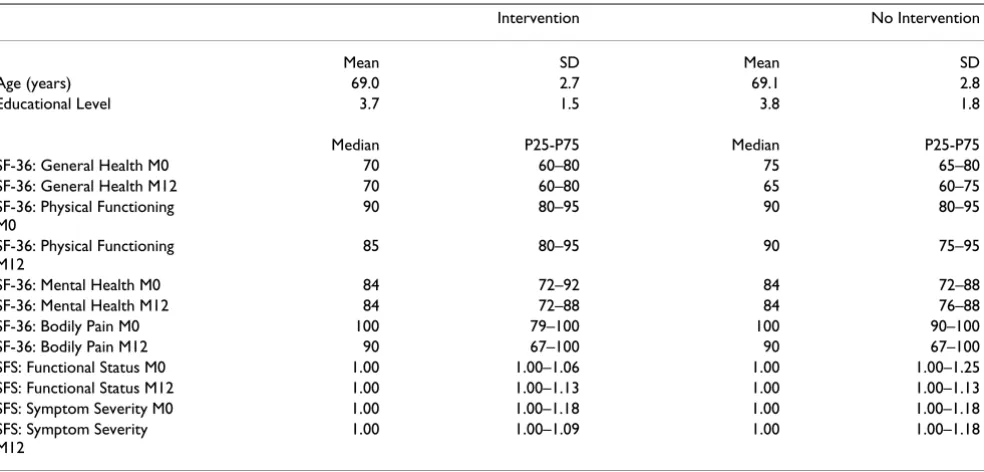
Table 1 presents the baseline characteristics of both study groups. At the twelve-month follow-up moment, partici-pants in the Intervention group reported an average com-puter use of 8.3 (SD = 6.2) hours per week. In total 6.5 hours (SD = 5.6) per week was spent on Internet-related activities (web surfing, e-mail). Incidental or regular pain medication use did not differ between groups before and after the intervention (M0: 16 versus 21 percent; M12: 19 versus 19 percent in the intervention and control group, respectively, Chi-square p > .05).
reduction in complaint level in the No Intervention group only (p = .052).
Discussion
In this study we tested whether the prolonged use of a standard computer interface puts older novice users at risk of poorer functional health and upper extremity com-plaints. This is the first randomized study into the effects of computer and Internet use on long-term functional
sta-tus. No clear indication was found that participants who were part of the Intervention group were at greater risk as regards the development of health complaints or func-tional impairment of the upper limb than participants in the control group. Still, although the general health level marginally decreased in the No Intervention group, the small reduction in SFS: Functional Status complaint level in this group was not present in the Intervention group. The latter finding may be due to random variation but
Table 2: M12 (12 month follow-up) minus M0 (baseline) difference scores on all outcome variables in both study groups. Between group differences were tested with Mann-Whitney U tests.
Intervention No Intervention
Median P25-P75 Median P25-P75 p
SF-36: General Health M12-M0
.00 -10.00–2.50 -5.00 -15.00–0.00 .079
SF-36: Physical Functioning M12-M0
.00 -5.00–2.50 .00 -10.00–5.00 .797
SF-36: Mental Health M12-M0
.00 -8.00–6.00 .00 -4.00–4.00 .569
SF-36: Bodily Pain M12-M0
.00 -20.41–0.00 .00 -22.45–0.00 .642
SFS: Functional Status M12-M0
.00 0.00–0.03 .00 -0.13–0.00 .052
SFS: Symptom Severity M12-M0
.00 0.00–0.00 .00 -0.09–0.00 .878
SF-36 = Short Form-36 scale; SFS = symptom and functional status scale. P25-P75 = 25–75th percentile range.
Table 1: Descriptive data for demographical variables and outcome measures at M0 and M12 in both study groups. The male/female ratio was 25/32 and 21/26 in the Intervention and No Intervention groups, respectively.
Intervention No Intervention
Mean SD Mean SD
Age (years) 69.0 2.7 69.1 2.8
Educational Level 3.7 1.5 3.8 1.8
Median P25-P75 Median P25-P75
SF-36: General Health M0 70 60–80 75 65–80
SF-36: General Health M12 70 60–80 65 60–75
SF-36: Physical Functioning M0
90 80–95 90 80–95
SF-36: Physical Functioning M12
85 80–95 90 75–95
SF-36: Mental Health M0 84 72–92 84 72–88
SF-36: Mental Health M12 84 72–88 84 76–88
SF-36: Bodily Pain M0 100 79–100 100 90–100
SF-36: Bodily Pain M12 90 67–100 90 67–100
SFS: Functional Status M0 1.00 1.00–1.06 1.00 1.00–1.25
SFS: Functional Status M12 1.00 1.00–1.13 1.00 1.00–1.13
SFS: Symptom Severity M0 1.00 1.00–1.18 1.00 1.00–1.18
SFS: Symptom Severity M12
1.00 1.00–1.09 1.00 1.00–1.18
could be indicative of a trend towards an unfavourable effect in the Intervention group. This would become more likely if a tendency towards lower scores on the SFS scale after repeated administration was documented with this scale in people with no complaints. To our knowledge, however, such trend has not been reported in the litera-ture to date, so we do tend to ascribe these marginally sig-nificant findings to random variation. Furthermore, both marginally significant differences would become insignif-icant when a Bonferroni correction for multiple testing would be applied: after dividing the alpha range by the number of tests (6), the range to render a test marginally significant would become .016 to .008.
The absence of differences between the two groups in reported health complaints at M12 may be a reflection of the lack of sufficient risk factors relating to developing RSI-like symptoms. Firstly, although the participants were well-motivated computer users, the mean time spent on computer related activities in the Intervention group was limited to 8.3 hours. This is lower than the exposure of professional workers who use computers on a daily basis [20] but is comparable to the average use in this age group of 7.7 hours (2002–2004) reported in a recent Dutch sur-vey [12]. Secondly, it has been found that adverse psycho-logical factors, including work-related stress, may add to the effect of repetitive movements of the arms and wrists in the etiology of upper limb complaints [21,22]. Since our participants used the computer mainly for personal goals, this is another reason why the study group may have a lower risk of developing RSI-like complaints than those who are professionally active computer users. Thirdly, unfavourable ergonomic conditions, such as pro-longed fixed body postures, which are common in work-ing environments in the presence of time pressure, are also less likely to occur in a home situation. The question remains as to whether older users who engage more inten-sively in computer-related activities, or who continue such activities for a longer period of time, may develop upper limb complaints at a later stage.
There are some methodological limitations in this study. First, we did not choose to do a specific diagnostic workup to detect functional impairments of the upper limb in accordance with clinical standards. No comprehensive assessment protocol is available to reliably test functional impairments of the forearm in the near normal range. Fur-thermore, application of a functional assessment test was considered to be prone to measurement bias as it would be difficult to test participants unaware of the actual rationale behind such tests. The SFS scales to quantify upper limb pain was developed particularly to measure pain complaints in the hand and wrist regions but may be less sensitive to quantify complaints in the higher regions of the upper extremity, like shoulder and elbow. At the
exit interview no participant in the intervention group expressed such complaints. Next, we chose to use selfre-port measure of actual computer usage. Our estimate of computer usage was derived from earlier population sur-veys on computer usage in the workplace, for which no data on reliability are available. Self-report measures may be sensitive to recall bias or social desirability and there-fore are sometimes considered less accurate than objective measures. Other more objective methods have been con-sidered (e.g. logon time, keystroke logging), but were dis-carded because they were potentially restrictive to the user, had other intrinsic flaws (e.g. uncertainty about user identity) and application without prior notification would be unethical. However, it was made quite clear to all participants that they could use the computer at there own discretion and their own pace without risk of disap-proval by the researchers in case their motivation was low, which may have reduced the chance of an overestimation of actual computer use by the participants. Finally, no sys-tematic inventory was made of individual risk factors, such as ergonomics of the work place, subjective psycho-logical distress, or underlying health disorders causing impairment of hand function.
Conclusion
In summary, older users of a standard computer interface with no prior computer experience did not appear to be at greater risk of a poorer general health or of more symp-toms or functional impairment of the upper extremity after a twelve-month episode of average, selfpaced use. Any reserve to computer use in older persons prompted by putative negative effects on the musculoskeletal system is therefore not supported by our empirical evidence. How-ever, when risk factors are apparent (e.g. osteoarthritis), special precautions may still be necessary in individual cases to prevent symptoms at a later stage, e.g. by main-taining an ergonomic posture, or by avoiding prolonged computer usage.
Abbreviations
RSI, Repetitive Strain Injury; SF-36, Short Form 36 ques-tionnaire; SFS, Symptom and Functional Status scale.
Competing interests
The author(s) declare that they have no competing inter-ests.
Authors' contributions
Publish with BioMed Central and every scientist can read your work free of charge "BioMed Central will be the most significant development for disseminating the results of biomedical researc h in our lifetime."
Sir Paul Nurse, Cancer Research UK
Your research papers will be:
available free of charge to the entire biomedical community
peer reviewed and published immediately upon acceptance
cited in PubMed and archived on PubMed Central
yours — you keep the copyright
Submit your manuscript here:
http://www.biomedcentral.com/info/publishing_adv.asp
BioMedcentral
Acknowledgements
This study was funded by grants from the Dutch Science Foundation (NWO 014-91-048) and Maastricht University. The choice to publish the current data was made by the contributing authors, independent of the funding organisation. The authors would like to thank university staff mem-ber Nico Rozendaal for his technical support to both the project staff and the participants in the study.
References
1. Anonymous: Arbobalans 2004: Arbeidsrisico's, effecten en maatregelen in Nederland [Arbo balance 2004: Occupa-tional risks, effects and measures in the Netherlands]. Den Haag: Ministerie van Sociale Zaken en Werkgelegenheid [Ministry of Social Affairs and Employment] 2004:1-62.
2. Helliwell PS, Taylor WJ: Repetitive strain injury. Postgrad Med J
2004, 80(946):438-443.
3. Bongers PM, de Vet HC, Blatter BM: RSI: Vóórkomen, ontstaan, therapie en preventie [Repetitive strain injury (RSI): occur-rence, etiology, therapy and prevention]. Ned Tijdschr Geneesk
2002, 146(42):1971-1976.
4. Gezondheidsraad: RSI. Den Haag [The Hague]: Gezondheidsraad [Dutch Health Council] 2000.
5. Carmeli E, Patish H, Coleman R: The aging hand. J Gerontol A: Biol Sci Med Sci 2003, 58(2):146-152.
6. Gallagher RM, Verma S, Mossey J: Chronic pain. Sources of late-life pain and risk factors for disability. Geriatrics 2000, 55(9):40-44.
7. Kail R: The neural noise hypothesis: evidence from processing speed in adults with Multiple Sclerosis. Aging Neuropsychol Cogn
1997, 4(3):157-165.
8. Van Gemmert AW, Van Galen GP: Stress, neuromotor noise, and human performance: a theoretical perspective. J Exp Psy-chol Hum Percept Perform 1997, 23(5):1299-1313.
9. Bloemsaat JG, Ruijgrok JM, Van Galen GP: Patients suffering from nonspecific work-related upper extremity disorders exhibit insufficient movement strategies. Acta Psychol 2004, 115(1):17-33.
10. Cerella J, Hale S: The rise and fall in information-processing rates over the life span. Acta Psychol (Amst) 1994, 86(2– 3):109-197.
11. McCrea PH, Eng JJ: Consequences of increased neuromotor noise for reaching movements in persons with stroke. Exp Brain Res 2005, 162(1):70-77.
12. Statline: Use of ict and media Centraal Bureau voor de Statistiek [Statistics Netherlands] [http://statline.cbs.nl/StatWeb/ start.asp?LA=nl&DM=SLNL&lp=Search%2FSearch].
13. Daffner SD, Hilibrand AS, Hanscom BS, Brislin BT, Vaccaro AR, Albert TJ: Impact of neck and arm pain on overall health sta-tus. Spine 2003, 28(17):2030-2035.
14. Slegers K, van Boxtel MPJ, Jolles J: The effects of computer train-ing and Internet usage on autonomy, wellbetrain-ing and social network of older adults: A randomized controlled study. J Gerontol Psychol Sci in press.
15. Folstein MF, Folstein SE, McHugh PR: "Mini Mental State". J Psy-chiat Res 1975, 12:189-198.
16. McHorney CA, Ware J, J E, Raczek AE: The MOS 36-item short-form health survey (SF-36): II. Psychometric and clinical tests of validity in measuring physical and mental health con-structs. Medical Care 1993, 31(3):247-263.
17. Levine DW, Simmons BP, Koris MJ, Daltroy LH, Hohl GG, Fossel AH, Katz JN: A self-administered questionnaire for the assess-ment of severity of symptoms and functional status in carpal tunnel syndrome. J Bone Joint Surg Am 1993, 75(11):1585-1592. 18. Cohen J: Statistical power analysis for the behavioral sciences.
2nd edition. Hillsdale, NJ: LEA Publishers; 1988.
19. Van der Zee KI, Sanderman R: Het meten van de algemene gezondheidstoestand met de RAND-36: een handleiding [Measurement of general health with the RAND-36: a man-ual]. 1993, 3: [http://www.rug.nl/nch/research_tools/ assessment_tools/RAND-36_handleiding.pdf]. Groningen: Noordelijk Centrum voor Gezondheidsvraagstukken NCG [accessed 14 Sept 2007]
20. Smulders P, van den Bossche S: TNO Arbeid – Eerste resultaten Nationale Enquete Arbeidsomstandigheden [TNO Work
and Employment – First results of the National Survey Occu-pational Conditions]. Hoofddorp, the Netherlands: TNO Arbeid; 2004:1-24.
21. Macfarlane GJ, Hunt IM, Silman AJ: Role of mechanical and psy-chosocial factors in the onset of forearm pain: prospective population based study. Brit Med J 2000, 321(7262):676-679. 22. Van den Heuvel SG, van der Beek AJ, Blatter BM, Hoogendoorn WE,
Bongers PM: Psychosocial work characteristics in relation to neck and upper limb symptoms. Pain 2005, 114(1–2):47-53.
Pre-publication history
The pre-publication history for this paper can be accessed here: